

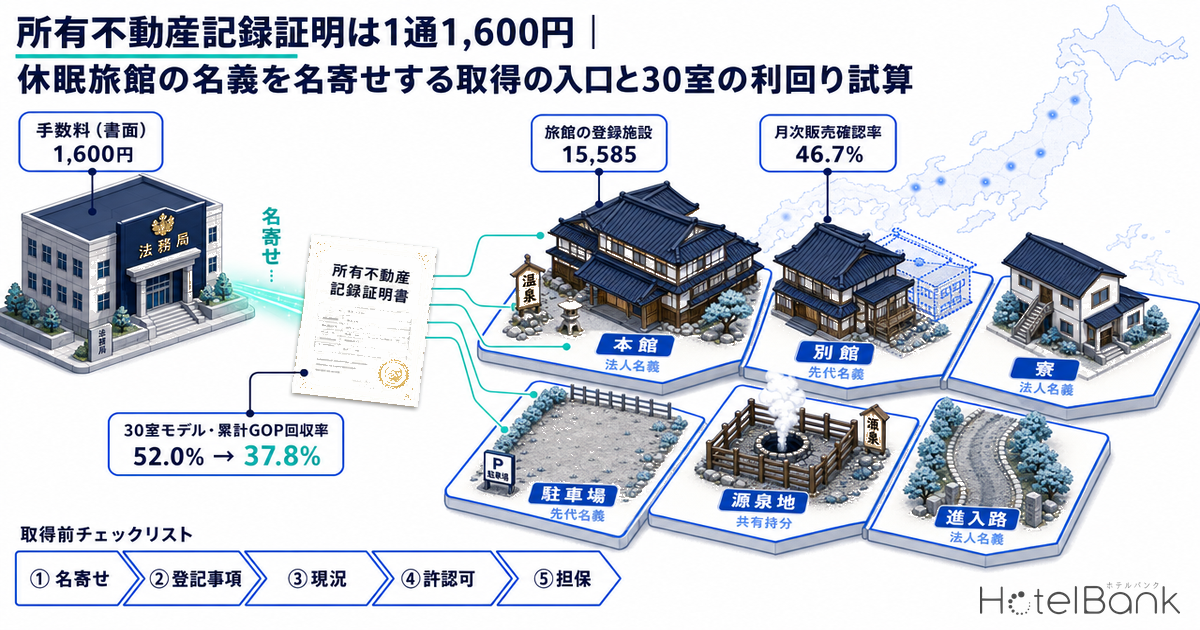
When you set out to revive a dormant ryokan, the first obstacle is usually not price negotiation but a basic check: “Whose name are this inn’s land and buildings registered under today, and how many parcels are there?” On February 2, 2026, Japan’s Legal Affairs Bureaus began operating the Certificate of Registered Real Property Ownership system (所有不動産記録証明制度). Under this system, a registrar compiles a nationwide list of the real estate for which a specific person (or corporation) is the registered owner of record, and issues it as a certificate. The fee for a paper request is ¥1,600 per search condition. This article looks at how the system can be built into the acquisition of lodging assets, covering its scope, the ownership structures peculiar to inns, the size of the ryokan stock, the published fees for a pre-acquisition checklist, and a yield model for a 30-room ryokan.
Metric Definitions Used in This Article
- ADR (Average Daily Rate): An estimated settled room rate (tax-exclusive equivalent), calculated by applying a segment-specific adjustment factor to the lowest-priced plan each property publishes on OTAs (per room, 2 guests per room, tax-inclusive). Checked against property-level results disclosed by listed hotel REITs (91 properties, most recent 3 months), the median error is about 7%. These are estimates and differ from each property’s actual settled prices and accounting figures. Area-level ADR is the median of the covered properties (the level of a typical property in the area).
- Properties with confirmed sales: Among properties classified as ryokan in the lodging database maintained by MetroEngines Research, the number whose selling prices could be confirmed in the given month on major booking sites. Properties that sell only direct or by phone are not included, so the absence of confirmed sales does not mean a property is closed or out of business.
- Room occupancy rate (used in the model): Ryokan room occupancy rate from the Japan Tourism Agency’s Overnight Travel Statistics Survey (2025, final annual figure).
- Data sources: MetroEngines Research & Consulting; published materials from the Ministry of Justice and Legal Affairs Bureaus, the Ministry of Health, Labour and Welfare, and the Japan Tourism Agency
- — Certificates of Registered Real Property Ownership can be requested at Legal Affairs Bureaus nationwide from February 2, 2026. Fees per search condition: ¥1,600 on paper, ¥1,500 online (delivered by mail), ¥1,470 online (collected at the counter). Only the registered owner and heirs or other general successors (including via an agent) may request one.
- — The search requires a prefix match on the name, and an address match either down to the municipality or on the last five characters. Properties still registered under an old address can be missed unless past addresses are added as search conditions, and properties with only a title-section owner or unregistered extensions do not appear, so the certificate must be used alongside municipal property ledgers (名寄帳), cadastral maps and on-site checks.
- — Of the 15,585 properties registered as ryokan, at most 7,277 (46.7%) showed confirmed sales in any month on major booking sites (September 2025–August 2026). In a single month, up to about 8,300 ryokan show no confirmed sales.
- — The median ryokan has 12 rooms, and only 14.6% have 30 rooms or more (N=14,920). A 30-room inn sits in the upper size band of the ryokan stock.
- — In a hypothetical 30-room ryokan model, a 24-month title clean-up lowers the return on invested capital only from 5.78% to 5.40% (−0.38pt), but the cumulative 10-year GOP recovery ratio after acquisition falls from 52.0% to 37.8% (−14.2pt). Time spent sorting out title hurts less through the yield denominator than through lost operating years.
Where This Fits — One Step Before Sale Routes, License Succession and Tax Valuation
Issues surrounding the acquisition of an inn fall into several layers. There is the question of sale routes — how a mortgaged inn comes to market through auction or a voluntary sale; the question of license succession — how a ryokan business license carries over in a business transfer or share transfer; and the question of valuation and tax burden — how inheritance-tax valuation and the deadline of the business succession tax scheme shift the capital structure. HotelBank has covered each of these separately.
This article covers the procedure that underlies all of them: establishing which real estate exists and under whose name. Even when seller and buyer agree, a sales contract, a security interest or a license application cannot be put together unless every piece of land and building involved has been identified. This is especially true for family-run ryokan that have passed through several generations, where it is not unusual for title to be spread across multiple names. The Registered Real Property Ownership Certificate system adds one more entry point to that checking process.
Key Points of the System — A Nationwide List per Registered Owner
According to the Ministry of Justice, the Registered Real Property Ownership Certificate system started on February 2, 2026 (Reiwa 8). A registrar lists the real estate in which a specific person is recorded as the registered owner and issues the list as a certificate. Until now, you could not reach a registry record without knowing where the property was, so heirs looking for a deceased person’s real estate had to go through fixed-asset tax statements and each municipality’s property ledger one by one. Under the new system, requests can be made at any Legal Affairs Bureau or District Legal Affairs Bureau (including branch and sub-branch offices), and a single request produces a list per registered owner regardless of which prefecture the property is in.
| Item | Details |
|---|---|
| Launch | February 2, 2026 (Reiwa 8) |
| What is certified | A list of real estate in which a specific person is recorded as the registered owner |
| Who may request | The registered owner, and their heirs or other general successors (requests via an agent are also allowed) |
| Where to request | Any Legal Affairs Bureau or District Legal Affairs Bureau nationwide (including branch and sub-branch offices). Processing time varies by registry office |
| Fees | Per search condition: ¥1,600 for a paper request / ¥1,500 online with delivery by mail / ¥1,470 online with collection at the counter |
| How the search works | Prefix match on the name, and an address match either “down to the municipality” or “on the last five characters”. Past names and addresses, and a corporation’s corporate number (exact match), can be added as search conditions |
| Examples not covered | Real estate recording only a title-section owner (表題部所有者), and real estate whose register has not been computerized |
For a prospective buyer, the most important point is that only the registered owner and their heirs or other successors can make a request. A turnaround sponsor or a lender cannot request one directly as a third party, so in practice the request is made under a power of attorney from the selling owner or heirs, or handled by the owner’s judicial scrivener or tax accountant. Adding “submit a Registered Real Property Ownership Certificate” to the list of requests to the seller in the early stage of due diligence makes it easier to pin down the scope of later checks early on.
Registration Rules That Changed Around the Same Time — Inheritance Registration, Address Changes, State Acquisition
This system was not introduced on its own. It is part of a series of amendments to the Civil Code and the Real Property Registration Act aimed at resolving land with unknown owners. When considering the succession of lodging assets, three related changes are worth keeping in mind.
First, mandatory inheritance registration began on April 1, 2024. Registering an inheritance within three years of learning that you acquired real estate by inheritance is now a legal obligation, and failing to do so without good reason can lead to a non-penal fine of up to ¥100,000. Real estate inherited before the effective date is also covered, and must be registered by March 31, 2027. A simplified procedure, the “heir declaration registration” (相続人申告登記), lets heirs declare their status within the deadline, but it cannot be used for registration after an estate division has been agreed.
Second, mandatory registration of changes in name or address took effect on April 1, 2026. When the name or address of a registered owner (for a corporation, its name or address) changes, the change must be registered within two years, and failing to do so without good reason can lead to a non-penal fine of up to ¥50,000. Changes made before the effective date are also covered, and must be registered by the end of March 2028. Because the Registered Real Property Ownership Certificate search matches against addresses in the registry record, the more address-change registrations are completed, the more comprehensive the lists become.
Third, the system for the state to acquire inherited land (相続土地国庫帰属制度), which began on April 27, 2023, is rarely an option in inn succession. The Ministry of Justice’s overview lists “land with a building on it” among the grounds for rejection at the application stage, along with land subject to a security interest and land with unclear boundaries. The review fee is ¥14,000 per parcel, but a site carrying a main building or annex does not qualify unless the building is demolished. In other words, an inn with buildings is not something the state will take off your hands; its rights have to be put in order on the premise that someone will take it over and use it. That is where turnaround sponsors have room to step in.
Why Owner-Based Search Works for Lodging Assets — Separate Parcels, Separate Names, Co-Ownership
A ryokan site is not necessarily registered as a single unit from the day it opened. At inns that added rooms by buying neighboring plots, built annexes, and secured parking and staff dormitories over time, what operates as one facility is often split into many parcels and buildings on the register, with owners’ names differing by period. The following is a hypothetical example to illustrate a typical structure.
| Use | Registered units | Registered owner (hypothetical) | Found by owner-based search? |
|---|---|---|---|
| Main building | 2 land parcels, 1 building | Operating company | Appears on the list when searched by company name |
| Annex (incl. extension) | 1 building (extension unregistered) | Previous generation | Registered portion appears on an heir’s request; the unregistered extension does not |
| Parking lot | 1 land parcel | Two generations back | If the registered address is old, a search by current address may miss it |
| Staff dormitory | 1 land parcel, 1 building | Previous generation | Appears on an heir’s request |
| Hot spring source land | 1 land parcel | Co-owned by 4 relatives | Appears under each co-owner’s name, but ownership shares must be checked on the certificate of registered matters |
| Access road | 1 land parcel | Co-owned with a neighboring resident | Appears on the inn-side owner’s list, but the other co-owner’s situation must be checked separately |
In this hypothetical example, what is in practice a single inn is split into 6 land parcels and 3 buildings, with at least three lines of registered owners including the company. Because the form of rights over the hot spring source feeds directly into the property’s value, it should be checked together with the issues covered in hot spring water rights and ryokan valuation. Co-ownership shares tend to fragment with each inheritance, and a single co-owner whose whereabouts are unknown can stall decisions on a sale or a major renovation.
On this point, the co-ownership rules were revised in the Civil Code amendment effective April 1, 2023. Where a co-owner’s whereabouts are unknown, the other co-owners can now, by decision of a district court, acquire that share or transfer the whole property, including that share, to a third party. Because these procedures take time, the model below treats such cases as a “24-month title clean-up”.
What the Registered Real Property Ownership Certificate can do
- List, per registered owner, registered real estate scattered across the country
- Let heirs identify parcels and buildings still registered in the deceased’s name
- Confirm corporate-owned real estate in one go through a request in the company’s name
- Reduce the work of requesting municipal property ledgers from multiple municipalities
What must be checked with other documents
- Co-ownership shares and security interests such as mortgages → certificate of registered matters
- Parcel shapes and position relative to neighboring land → cadastral map (公図) and land survey maps
- Unregistered buildings and extensions → municipal property ledger, on-site survey
- Properties registered under an old address or former surname → add past names and addresses as search conditions (proof via family register, resident record, etc. required)
- Boundaries, encroachments and road access → land survey, on-site check
Size of the Ryokan Stock — Ryokan Operations Fell 44% in 20 Years
How many inns might be candidates for this kind of owner-based search? According to the Ministry of Health, Labour and Welfare’s Report on Public Health Administration and Services (衛生行政報告例), there were 98,338 lodging business facilities at the end of FY2024, up 4,863 (5.2%) from the previous year. Of these, 52,946 were ryokan/hotel operations (up 3.7% year on year) and 44,901 were simple lodging operations (up 7.1%). The overall trend is upward, but the growth appears to come mainly from hotels and simple lodgings.
The long-term series up to FY2017, when ryokan and hotels were counted separately, makes the structural change clear. The number of ryokan operations fell from 68,982 in FY1997 to 38,622 in FY2017 — a 44.0% drop in 20 years. Room count also fell 29.9%, from 982,228 to 688,342. Hotel operations, by contrast, rose from 7,769 to 10,402 over the same period. The 2018 amendment to the Hotel Business Act merged the two into “ryokan/hotel operations”, so separate ryokan counts have not been published since.
Most of the roughly 30,000 properties that disappeared are thought to have filed a closure notice and turned their land and buildings to other uses, but the figure may also include inns that stopped operating while their buildings and ownership rights remain. Such properties are hard to see both in statistical counts and on booking sites, yet once their title is sorted out they can become entry points for a turnaround. Year-by-year permits and closures in the lodging business are covered in detail in our analysis of net lodging supply.
At Most 46.7% of Ryokan Show Confirmed Sales in Any Month — Based on Major Booking Site Listings
In the lodging database maintained by MetroEngines Research, 15,585 properties are classified as ryokan with an identifiable prefecture (265,195 registered rooms in total). Using these as the denominator, we counted by prefecture the ryokan whose selling prices could be confirmed on major booking sites in each month. Summing each prefecture’s monthly peak over the 12 months from September 2025 to August 2026 gives 7,277 properties, or 46.7% of those registered.
Put the other way, up to about 8,300 ryokan show no confirmed sales on major booking sites, at least in a single month. This group includes inns that operate only through direct or phone bookings, and seasonal inns. The absence of confirmed sales does not mean a property is closed or out of business; the figure should be read only as “the upper bound on inns not visible on booking sites”.
Nationwide, the monthly number of ryokan with confirmed sales moved between 6,490 (December 2025) and 7,209 (July 2026) over the last 24 months. August 2026 stood at 7,191, 8.0% above the same month a year earlier (6,657). This range reflects listings appearing and disappearing for the same inn as a result of seasonal operation and changes in sales channels.
By prefecture, the sales-confirmed rate is highest in Saga (72.5%), Kyoto (71.8%) and Oita (65.0%), and lowest in Kagawa (32.6%), Yamaguchi (30.4%) and Aomori (29.8%). Regions with high rates tend to have many onsen towns and tourist destinations where booking-site distribution is well established. Regions with low rates may have many inns that rely mainly on direct sales, local regulars and groups — but there may also be assets with turnaround potential among the inns not listed on booking sites. Which reading applies can only be confirmed locally, region by region.
Let us also look at the distribution by room count. Of the 14,920 ryokan with a registered room count, 6,808 (45.6%) have 10 rooms or fewer, 4,610 (30.9%) have 11–20, 2,161 (14.5%) have 21–40, 1,120 (7.5%) have 41–100, and 221 (1.5%) have 101 or more. The median is 12 rooms, and only 2,178 properties (14.6%) have 30 rooms or more. The model below assumes a 30-room ryokan because that size band is easier for turnaround sponsors and regional lenders to consider as a deal than small inns run by individual owners.
Pre-Acquisition Checklist — Five Stages and Published Fees
Checking rights involves the least rework when done in this order: (1) owner-based search, (2) registered matters, (3) physical status (boundaries, encroachments, road access), (4) licenses and permits, and (5) security interests. The flow is to fix the scope of the target real estate through owner-based search, obtain the registered matters, close gaps between the register and reality through surveys and on-site checks, and then design how licenses will be transferred and how security interests will be released. The published fees payable to the Legal Affairs Bureau at each stage are as follows.
| Stage | What to check | Main documents / procedures | Published fee |
|---|---|---|---|
| 1. Owner-based search | Scope of registered real estate per owner | Registered Real Property Ownership Certificate (paper / online by mail / online at counter) | ¥1,600 / ¥1,500 / ¥1,470 (per search condition) |
| 1. Owner-based search | Proof of inheritance relationships | Copy of the statutory heir information chart | Free |
| 2. Registered matters | Owners, shares, history of rights | Certificate of registered matters (paper / online by mail / online at counter) | ¥600 / ¥520 / ¥490 (per copy) |
| 2. Registered matters | Preview of contents (no evidentiary value) | Registry information service (all matters / owner matters) | ¥331 / ¥141 (per item) |
| 3. Physical status | Parcel shape, neighboring land, building layout | Certificates of maps / cadastral maps, land survey maps and building plans (paper / online by mail / online at counter) | ¥500 / ¥470 / ¥440 (per parcel or building) |
| 3. Physical status | Boundaries, encroachments, road access | Boundary survey, on-site check | Quoted per case |
| 4. Licenses | Ryokan business license, hot spring use permit, etc. | Inquiries and applications to the competent local government | Varies by municipality |
| 5. Security interests | Status of mortgages and revolving mortgages | Certificate of registered matters (rights section B), discussions with lenders | Included in stage 2 |
| Reference | Transfer title to heirs | Inheritance registration (registration and license tax) | Fixed-asset tax assessed value × 0.4% |
| Reference | Hand land without buildings over to the state | Review fee for state acquisition of inherited land (land with a building is rejected) | ¥14,000 (per parcel) |
Applied to the hypothetical example in Table 2 (6 land parcels, 3 buildings, 3 lines of owners), the fees payable to the Legal Affairs Bureau come to about ¥17,700 in total: 3 Registered Real Property Ownership Certificates (¥4,800), 9 certificates of registered matters (¥5,400), cadastral map certificates for 6 parcels (¥3,000), building plans for 3 buildings (¥1,500), and land survey maps for 6 parcels (¥3,000). Adding a few extra searches under old addresses still keeps the total within a few tens of thousands of yen.
In other words, the big costs in checking rights are not the official fees but the fees of judicial scriveners and land and house investigators, survey costs, and the time needed to reach agreement among all heirs. On license succession, the 2023 amendment to the Hotel Business Act made it possible to succeed to an operator’s status through a business transfer, and this should be designed together with the key points of the Hotel Business Act. Where renovation is involved, the conditions under which a building confirmation application is required also need to be built into the schedule.
Linking to Investment Decisions — A 30-Room Ryokan Model with Varying Title Clean-Up Periods
To see how the time needed to sort out title affects investment decisions, we modeled the turnaround acquisition of a hypothetical 30-room ryokan. The estimated settled ADR for ryokan nationwide (September 2025–August 2026, prefectural medians weighted by property count) is about ¥15,100 (cumulative N=80,052 property-months, a monthly average of 6,671 properties); allowing for rate upside after renovation, we set the ADR at ¥18,000. The Japan Tourism Agency’s Overnight Travel Statistics Survey puts the ryokan room occupancy rate at 38.2% for 2025 (final annual figure); allowing for operational improvement after the turnaround, we set occupancy at 45%.
| Item | Assumption | Basis / rationale |
|---|---|---|
| Rooms | 30 | A size band in the top 14.6% of ryokan |
| ADR | ¥18,000 | Nationwide ryokan estimated settled ADR of about ¥15,100 plus post-renovation upside |
| Room occupancy | 45% | JTA ryokan actual of 38.2% (2025 final) plus operational improvement |
| Annual room revenue | ¥88.7 million | 30 rooms × ¥18,000 × 45% × 365 days |
| GOP margin | 15% | Assumption (ryokan carry F&B departments and tend to have lower GOP margins) |
| Annual GOP | ¥13.3 million | Room revenue × GOP margin |
| Acquisition price | ¥50 million | Assumes bulk acquisition of land and buildings of a dormant ryokan |
| Renovation cost | ¥180 million | ¥6 million per room |
| Construction period | 12 months | Starts after the title clean-up is complete |
| Holding cost during clean-up | ¥4.25 million/yr | Fixed-asset tax and maintenance ¥3 million + interest on acquisition funds ¥1.25 million (¥50 million × 2.5%) |
We set four title clean-up periods: title consolidated in a company (0 months); one generation’s inheritance registration outstanding (6 months); co-ownership fragmented through several generations of inheritance (12 months); and a co-owner whose whereabouts are unknown, requiring court proceedings (24 months). Out-of-pocket costs such as professional fees and surveys were assumed at ¥0.3 million, ¥1.5 million, ¥4 million and ¥8 million respectively.
| Case | Clean-up period | Additional cost (out-of-pocket + holding) | Total investment | Return on invested capital | Time to opening | 10-yr cumulative GOP recovery |
|---|---|---|---|---|---|---|
| A Consolidated in a company | 0 months | ¥0.3M | ¥230.3M | 5.78% | 12 months | 52.0% |
| B One generation’s inheritance registration | 6 months | ¥3.63M | ¥233.63M | 5.69% | 18 months | 48.4% |
| C Fragmented co-ownership | 12 months | ¥8.25M | ¥238.25M | 5.58% | 24 months | 44.7% |
| D Co-owner whereabouts unknown | 24 months | ¥16.5M | ¥246.5M | 5.40% | 36 months | 37.8% |
The results show that even when the clean-up period stretches from 0 to 24 months, the return on invested capital falls only 0.38 points, from 5.78% to 5.40%. The additional cost of ¥16.5 million is about 7% of total investment, so its effect on the denominator is limited. By contrast, the share of total investment recovered through cumulative GOP in the 10 years after acquisition falls 14.2 points, from 52.0% to 37.8%. This is because a 24-month delay in opening cuts the years of operation from 9 to 7.
This gap widens when a fund’s term or a loan repayment schedule is fixed. If the scope of title is fixed with a Registered Real Property Ownership Certificate before acquisition, and it can be determined early whether a deal falls into Case D, the buyer can either price the clean-up period into negotiations or push back the contract date until the clean-up is done. Even though the owner-based search costs only a few thousand yen, that judgment can shift the payback period by years — which is why it makes sense to build this system into acquisition practice.
| ADR \ Occupancy | 38.2% (2025 ryokan actual) | 45% (base case) | 55% |
|---|---|---|---|
| ¥15,000 | 3.95% | 4.65% | 5.69% |
| ¥18,000 (base case) | 4.74% | 5.58% | 6.83% |
| ¥21,000 | 5.53% | 6.51% | 7.96% |
In the sensitivity analysis, yields range from 3.95% to 7.96% depending on the combination of rate and occupancy. How far rate and occupancy can be raised after the turnaround has a larger effect on yield than differences in the title clean-up period (at most 0.38 points). But it is the title clean-up that determines when that operational improvement can begin. Property tax levels during the holding period and exit design — the relationship between hotel property tax and yields, and after-tax net sale proceeds — should also be factored into the model.
How Different Readers Can Use This
For turnaround sponsors and small funds, adding the Registered Real Property Ownership Certificate to the initial requests to the seller makes it easier to fix the scope of the target real estate before signing. Having the request include searches under old addresses also helps catch easily missed parcels such as parking lots and access roads.
For advisers to owners facing succession (tax accountants, judicial scriveners), the overlapping deadlines for inheritance registration (March 31, 2027 for inheritances before the effective date) and name/address change registration (end of March 2028 for changes before the effective date) provide an opportunity to take stock of title all at once. An inn with clean title has more options, whether it chooses a sale, a business transfer or succession within the family.
For regional banks and shinkin banks lending to the lodging sector, it offers material for reviewing whether the parcels held as collateral match the parcels actually used in the business. If parking lots or hot spring source land sit on parcels outside the collateral, adjustments will be needed in a restructuring or sale.
For developers looking for sites, the fact that a certain number of ryokan in each region show no confirmed sales on booking sites can be a lead for finding off-market deal candidates. However, since only registered owners and their heirs can make a request, building a relationship with the owner comes first.
Summary
The Registered Real Property Ownership Certificate system launched on February 2, 2026, allowing registered owners and their heirs to list registered real estate scattered across the country for ¥1,600 per request (paper). For ryokan, where annexes, parking lots, dormitories, hot spring source land and access roads tend to remain on separate parcels under separate names, it can shorten the first step of acquisition or succession. On the other hand, because the search relies on a prefix match on the name and a match on the registered address, properties still under an old address can be missed unless past addresses are added as search conditions, and unregistered extensions are not captured. It must be combined with certificates of registered matters, cadastral maps, municipal property ledgers and on-site surveys.
Of the 15,585 properties registered as ryokan, at most 46.7% show confirmed sales in any month on major booking sites, meaning a sizeable number of inns are invisible there. In the 30-room ryokan model, the title clean-up period has little effect on the level of yield, but by cutting the number of operating years it moves the 10-year cumulative recovery ratio substantially. Putting title verification at the very start of the acquisition process is a practical step toward turning dormant inns into turnaround opportunities.
Methodology
- Number of properties registered as ryokan: of the 16,229 properties classified as ryokan in the lodging database maintained by MetroEngines Research, the 15,585 whose prefecture could be identified from their address (as of September 16, 2026).
- Room-count distribution: the 14,920 of the 16,229 ryokan with a registered room count (this includes properties whose prefecture could not be identified, so the population differs from the 15,585).
- Monthly number of properties with confirmed sales: the number of ryokan whose selling price for 2 guests in 1 room could be confirmed on major booking sites in the month, tallied by prefecture and summed (September 2024–August 2026). The sales-confirmed rate is each prefecture’s monthly peak for September 2025–August 2026 divided by the number of registered properties.
- Estimated settled ADR: prefectural medians for the ryokan category, weighted by the number of covered properties each month (September 2025–August 2026, cumulative 80,052 property-months).
- Published fees and system details were confirmed from Ministry of Justice and Legal Affairs Bureau materials as of the survey date, September 16, 2026.
Related Reading
- 98,338 Lodging Facilities: 30 of 47 Prefectures Lost Rooms in FY2024
- Who Owns the Hot Spring? Water Rights and Ryokan Valuation
References and Sources
■ Data sources
System details and fees are from published materials of the Ministry of Justice and District Legal Affairs Bureaus (checked September 16, 2026); lodging business counts from the Ministry of Health, Labour and Welfare’s Report on Public Health Administration and Services; ryokan room occupancy from the Japan Tourism Agency’s Overnight Travel Statistics Survey (2025 final). The number of registered ryokan (N=15,585), the monthly number of properties with confirmed sales (September 2024–August 2026) and estimated settled ADR (September 2025–August 2026, cumulative 80,052 property-months) are tabulations by MetroEngines Research & Consulting based on major booking site listings.
■ Model assumptions
30 rooms, ADR ¥18,000, room occupancy 45%, GOP margin 15% (annual GOP ¥13.3 million), acquisition price ¥50 million, renovation cost ¥180 million, construction period 12 months, holding cost during clean-up ¥4.25 million per year. Title clean-up periods of 0, 6, 12 and 24 months with out-of-pocket costs of ¥0.3 million, ¥1.5 million, ¥4 million and ¥8 million. Return on invested capital = annual GOP ÷ total investment; 10-year cumulative GOP recovery = years of operation within 10 years of acquisition × annual GOP ÷ total investment. All are illustrative assumptions.
■ Limitations
Counts of properties with confirmed sales exclude properties selling only direct or by phone, and the absence of confirmed sales does not mean closure. Prefectural sales-confirmed rates are based on monthly peaks and exclude Okinawa, which has fewer than 100 registered properties. The model covers room revenue only and excludes F&B and banquet revenue, depreciation, taxes and loan principal repayments. Estimated settled ADR is an estimate and differs from individual properties’ actual results.
■ Market data
- MetroEngines Research & Consulting — number of properties registered as ryokan (N=15,585), monthly number of properties with confirmed sales, estimated settled ADR
■ Systems and laws (Ministry of Justice / Legal Affairs Bureaus)
- Ministry of Justice, “About the Registered Real Property Ownership Certificate System” (Japanese)
- Asahikawa District Legal Affairs Bureau, “Registered Real Property Ownership Certificate system starts February 2, 2026” (Japanese)
- Ministry of Justice, “Mandatory Inheritance Registration” (Japanese)
- Ministry of Justice, “Mandatory Registration of Name/Address Changes” special page (Japanese)
- Ministry of Justice, “Overview of the System for State Acquisition of Inherited Land” (Japanese)
- Ministry of Justice, “Review of Basic Civil Legislation to Resolve Land with Unknown Owners” (Japanese)
- Ministry of Justice, “Overview and Key Points of the New Rules” (incl. revision of co-ownership rules) (Japanese)
- Morioka District Legal Affairs Bureau, “List of Main Fees (from April 1, 2025)” (Japanese, PDF)
- Legal Affairs Bureau, “Online procedures are convenient for requesting certificates of registered matters” (Japanese)
■ Government statistics
- Ministry of Health, Labour and Welfare, “Overview of the FY2024 Report on Public Health Administration and Services” (Japanese)
- e-Stat, Report on Public Health Administration and Services, Appendix: number of lodging businesses by year, FY1997 onward (statistical table ID: 0004048085)
- Japan Tourism Agency, “Overnight Travel Statistics Survey (2025 annual final figures, etc.)” (Japanese)