

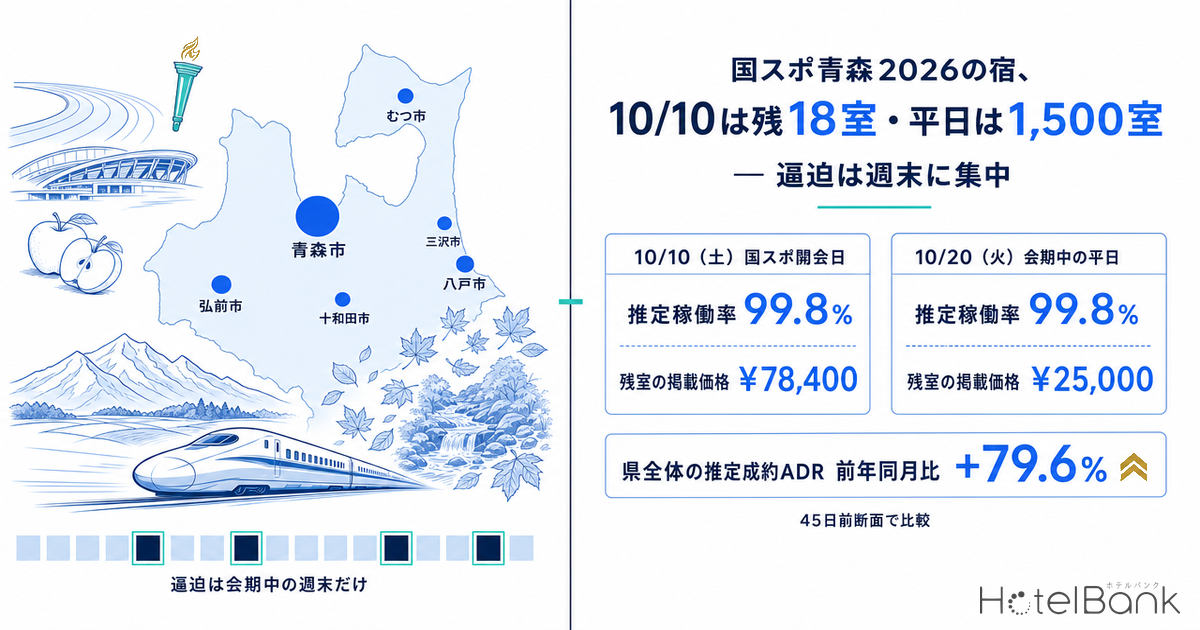
In October 2026, Aomori Prefecture hosts Japan’s National Sports Games (Kokumin Sports Taikai, or “Kokuspo”) for the first time in 49 years, since the 1977 “Asunaro Kokutai.” The main competition of the 80th National Sports Games runs from October 10 to October 20, followed by the 25th National Sports Festival for Persons with Disabilities (“Shospo”) from October 23 to October 26. Venues are spread across 22 municipalities in the prefecture, including Aomori City, Hachinohe, Hirosaki, Towada and Mutsu, so lodging demand does not converge on a single location. Using inventory data for rooms listed on major booking sites, this article measures how supply and demand move day by day and city by city through October.
Metric Definitions Used in This Article
- ADR (Average Daily Rate): An estimated settled rate (tax-exclusive equivalent), calculated by applying segment-specific adjustment factors to the lowest-priced plan each property publishes on OTAs and similar channels (per room, 2 guests per room, tax included). Checked against property-level results disclosed by listed hotel REITs (91 properties, most recent 3 months), the median error is about 7%. These are estimates and differ from each property’s actual settled rates and accounting figures. Area-level ADR is the median of the properties covered (the level of a typical property in the area).
- OCC (Occupancy Rate): The share of rooms sold relative to total rooms in the area (an estimate based on OTA sales inventory). Because it reflects how inventory offered on OTAs is being absorbed, it differs from a property’s actual overall occupancy.
- LT (Lead Time): Days until check-in. LT45 = 45 days before the stay date. This article does not use observation points beyond 45 days out, as they do not reflect booking progress.
- Remaining rooms: Of the room allotments listed on major booking sites, the number still available for sale at the time of observation. This does not equal a property’s total room count.
- Listed price: Per-room rate for 2 guests (tax included), averaged across all plans.
- Data source: MetroEngines Research
- — 18 rooms left: On Saturday, October 10, 2026, the Games’ opening day, only 18 rooms remained across all of Aomori Prefecture at the same 45-days-out (LT45) cross-section (estimated occupancy 99.8%, October 10, 2026, 45-days-out cross-section). That is about one-hundredth of the 1,828 rooms left on the control date of Saturday, October 3.
- — Only weekends are tight: Of the 11-day main competition, inventory truly thins only on two weekends, 10/10–10/11 and 10/16–10/17. On Tuesday, October 20, still within the Games period, 1,556 rooms (78.9% occupancy) remained. The gap between days exceeds tenfold.
- — +79.6%: The estimated settled ADR for Aomori Prefecture as a whole in October 2026 is ¥14,900, up 79.6% from ¥8,300 in the same month last year — clearly a different level from the prior year’s +9.7% (October 2024 → October 2025).
- — Hirosaki +113.0%, Misawa +120.5%: Growth stands out in cities where the scale of the events they host is large relative to their room count. By contrast, Towada, an autumn-foliage destination with high rates even in normal years, rose only 30.9%.
- — Limited spillover to neighboring prefectures: On Saturdays 10/17 and 10/24, which are not general holiday weekends, Aomori stood at 99.3% and 98.7%, versus 81.6% and 80.3% in Iwate and 72.8% and 77.1% in Akita. Movement across prefectural lines is not large.
An 11-day event plus 4 more days, with venues spread across 22 municipalities
First, let’s confirm the framework of the event. According to the official website, “Ao no Kirameki Aomori Kokuspo / Shospo,” the main National Sports Games run for 11 days, from Saturday, October 10 to Tuesday, October 20, 2026. Pre-Games competitions are scheduled in two phases: Phase I from September 3 to September 13, and Phase II from October 2 to October 9. The Shospo runs for 4 days, from Friday, October 23 to Monday, October 26.
What matters for reading lodging demand is that the event is not concentrated in a single city. Counting the official list of host municipalities, venues span 22 municipalities within the prefecture. Aomori City hosts the most events, including athletics, swimming, tennis and volleyball; Hachinohe covers soccer, basketball, wrestling, cycling and more; and Hirosaki handles gymnastics, karate, rifle shooting and others. Venues stretch from the Shimokita Peninsula to the Tsugaru region, with Towada (soccer, basketball, sumo), Misawa (hockey, baseball, jukendo) and Mutsu (rowing, sailing, fencing). In addition, there are two venues outside the prefecture: diving in Rifu, Miyagi Prefecture, and equestrian in Hokuto, Yamanashi Prefecture. The Shospo is also held across multiple municipalities, including Aomori City, Hirosaki, Hachinohe, Misawa, Mutsu and Towada.
In other words, lodging demand from athletes, officials and supporters is not concentrated in the prefectural capital but divided among the municipalities nearest to each event. It is also worth noting that October 10–12 is a three-day weekend that includes Sports Day (Monday, October 12), so event demand overlaps with general holiday demand.
Circle size = listed rooms by municipality. Source: MetroEngines Research; compiled by HotelBank Editorial Team
About 21,000 rooms in the prefecture, with occupancy in the 90% range in the latest closed month (August 2026)
How large is the total capacity? Within the scope MetroEngines Research tracks from listings on major booking sites, Aomori Prefecture has 686 lodging properties with 20,962 rooms. Note that this is not a full census; ryokan, minshuku (guesthouses) and simple lodgings not listed on booking sites are excluded.
Of these roughly 21,000 rooms, Aomori City accounts for 5,475 (26.1%), Hachinohe 3,634 (17.3%) and Hirosaki 2,792 (13.3%). The top three cities alone hold 11,901 rooms, or 56.8% of the prefectural total. Adding Towada (1,748 rooms), Mutsu (1,433) and Misawa (1,110) brings the six main host cities to 16,192 rooms, or 77.2% of the prefecture. While venues are scattered across 22 municipalities, rooms are stacked in six cities — this is the starting point for thinking about supply and demand in Aomori. Capacity and price levels by municipality are also covered in Aomori’s First National Sports Games in 49 Years: Prices and Inventory.
So how full does that inventory get in a normal month? In August 2026, the most recent closed month, estimated occupancy (based on OTA-listed inventory) was 94.4% for the prefecture as a whole (August 2026, 81 properties, 6,874 rooms). By segment, business hotels were at 94.9%, city hotels at 95.4% and ryokan at 91.2%. July was also high at 91.6% prefecture-wide (July 2026, 85 properties, 7,007 rooms). August, home to the Nebuta Festival, is Aomori’s peak, but even outside it this is a market where around 90% of inventory gets absorbed in normal months. In other words, even before event demand is added, the market does not carry a large surplus.
Lined up 45 days out, only the Fridays and Saturdays during the Games are tight
This is the core of the article. For each day in October, we lined up how many rooms remained in the prefecture at the same lead time (LT45 = 45 days before the stay date). Aligning the observation point for every date removes the apparent gap of “late October only looks open because it is still far away.” Coverage is 101–103 properties and 7,358–7,432 rooms in the prefecture (based on listings on major booking sites; observation coverage 100%).
Source: MetroEngines Research; compiled by HotelBank Editorial Team (101–103 properties, 7,358–7,432 rooms)
The result was clear. On Saturday, October 10, 2026, the Games’ opening day, only 18 rooms remained prefecture-wide 45 days out (LT45). That is a remaining-room ratio of 0.2% against 7,358 rooms, with estimated occupancy reaching 99.8% (October 10, 2026, 45-days-out cross-section). The following day, Sunday, October 11, had 34 rooms. Just before the Shospo, Friday, October 23 had 302 rooms, and the Shospo opening day, Saturday, October 24, had 193 — also thin for the prefecture as a whole.
On the other hand, Tuesday, October 20 — still within the main Games period — had 1,556 rooms remaining (estimated occupancy 78.9%, October 2026, same 45-days-out cross-section). Monday, October 19 had 916 rooms and Wednesday, October 21 had 1,163. Although the Games last 11 days, prefecture-wide inventory truly thins only on two weekends: October 10–11, and Friday, October 16 (127 rooms) and Saturday, October 17 (106 rooms). Comparing at the same 45-days-out cross-section, Tuesdays and Wednesdays during the Games had more than ten times as many rooms left as the weekends.
The contrast is sharper when we look at Saturdays unrelated to the event. Remaining rooms 45 days out were 1,828 on Saturday, October 3, 2026 (estimated occupancy 75.2%, October 3, 2026, 45-days-out cross-section) and 1,088 on Saturday, October 31 (85.4%, October 31, 2026, 45-days-out cross-section). Against these, October 10 had 18 rooms. On the same day of the week and at the same lead time, remaining rooms had shrunk to one-hundredth.
| Date | Context | Rooms left 45 days out | Est. occupancy | Listed price of remaining rooms |
|---|---|---|---|---|
| Sat 10/3 | Before Games / control date | 1,828 rooms | 75.2% | ¥35,500 |
| Fri 10/9 | Last day of pre-Games Phase II | 607 rooms | 91.8% | ¥36,800 |
| Sat 10/10 | Games opening day / first day of 3-day weekend | 18 rooms | 99.8% | ¥78,400 |
| Sun 10/11 | During Games / middle of 3-day weekend | 34 rooms | 99.5% | ¥66,600 |
| Sat 10/17 | During Games / weekend | 106 rooms | 98.6% | ¥54,400 |
| Tue 10/20 | Final day of Games / weekday | 1,556 rooms | 78.9% | ¥25,000 |
| Sat 10/24 | Shospo opening day | 193 rooms | 97.4% | ¥52,200 |
| Sat 10/31 | After the Games / foliage season | 1,088 rooms | 85.4% | ¥28,000 |
Estimated occupancy and remaining rooms are all as of the October 2026, 45-days-out (LT45) cross-section. Listed price of remaining rooms = average listed price of allotments still on sale at that point (2 guests per room, tax included, all plans). Source: MetroEngines Research; compiled by HotelBank Editorial Team
Note the rightmost column as well. The thinner the remaining inventory, the higher the listed price of what is left: ¥78,400 on October 10 and ¥66,600 on October 11, versus ¥25,000 on October 20. This does not mean that “hotels are uniformly expensive on event days”; it reflects an inventory structure in which lower-priced allotments sell first and the higher-priced tiers are what remain. From a booker’s perspective, it is a straightforward result: the leftovers cost more.
Capacity and rates by host city — Hirosaki and Misawa moved sharply in October
Next, we look at capacity and price levels by host city. Please note that the estimated settled ADR in the table below is a closed figure for October 2025 (verified historical basis), while October 2026 is an estimate based on current listing levels (snapshot basis).
| Municipality | Main events hosted | Listed properties | Rooms | Oct 2025 ADR | Oct 2026 ADR | YoY |
|---|---|---|---|---|---|---|
| Aomori City | Athletics, swimming, volleyball, etc. | 101 | 5,475 | ¥12,100 | ¥21,200 | +75.3% |
| Hachinohe | Soccer, basketball, etc. | 73 | 3,634 | ¥7,000 | ¥12,200 | +73.5% |
| Hirosaki | Gymnastics, karate, shooting, etc. | 78 | 2,792 | ¥6,900 | ¥14,800 | +113.0% |
| Towada | Soccer, sumo, etc. | 65 | 1,748 | ¥11,400 | ¥14,900 | +30.9% |
| Mutsu | Rowing, sailing, etc. | 59 | 1,433 | ¥6,900 | ¥12,400 | +79.3% |
| Misawa | Hockey, baseball, etc. | 20 | 1,110 | ¥6,400 | ¥14,200 | +120.5% |
| Kuroishi | Badminton | 27 | 295 | ¥11,300 | ¥18,600 | +64.5% |
| Aomori Prefecture total | — | 686 | 20,962 | ¥8,300 | ¥14,900 | +79.6% |
Listed properties and rooms are based on listings on major booking sites. ADR is the estimated settled ADR (October 2026 is an estimate based on the listing snapshot). Properties included in the ADR calculation: Aomori City 38, Hachinohe 31, Hirosaki 23, Towada 16, Kuroishi 9, Misawa 9, Mutsu 8; prefecture total 174. Source: MetroEngines Research; compiled by HotelBank Editorial Team
Source: MetroEngines Research; compiled by HotelBank Editorial Team
The prefecture-wide estimated settled ADR is ¥14,900 for October 2026 against ¥8,300 in October 2025, up 79.6% year on year. For reference, growth from October 2024 to October 2025 was 9.7%, so this October is clearly not on the usual trend line.
By city, Hirosaki (+113.0%) and Misawa (+120.5%) grew far faster than the prefectural average. What the two have in common is that the scale of the events they host is relatively large compared with their room count. Hirosaki, with 2,792 rooms, hosts multiple events including gymnastics, karate, rifle shooting and clay shooting, while Misawa, with 1,110 rooms, handles hockey, baseball, softball and jukendo. Towada, meanwhile, rose only 30.9%. Home to the autumn-foliage destinations of the Oirase Gorge and Lake Towada, its October rate was already above the prefectural average at ¥11,400 in normal times, which suggests relatively less room for event demand to push it higher.
Looking at estimated occupancy by city for August 2026: Aomori City 96.2% (August 2026, 22 properties, 2,627 rooms), Hirosaki 95.7% (same month, 11 properties, 1,170 rooms) and Hachinohe 90.7% (same month, 13 properties, 1,466 rooms). The picture is one of 11 days plus 4 days of event demand landing on a market that already runs at these levels in the normal pre-event period.
From 45 days out to now — days where allotments shrank, and days where they came back
So far we have looked at a single cross-section, 45 days out. What about progress since then? Below, we compare remaining rooms as observed on September 16, 2026 (LT24 for October 10, LT31 for October 17 and LT38 for October 24) with the 45-days-out cross-section.
Source: MetroEngines Research; compiled by HotelBank Editorial Team (101 properties, 7,358 rooms)
October 17 fell from 106 rooms to 48, and October 24 from 193 to 97 — both roughly half of the 45-days-out level. October 10, on the other hand, rose slightly from 18 rooms to 37. This signals cancellations, or properties releasing additional allotments to booking sites. Prefecture-wide it is a small movement of about 20 rooms, but for those searching it carries a practical meaning: “even a day that once sold out can see rooms come back close to the date.”
The same movement can be seen at the individual property level. The table below shows examples of properties whose listed allotments filled early and properties whose allotments came back. Only properties that listed at least 30% of their total rooms on major booking sites are included, and the remaining-room figures are “remaining listed allotments,” not the property’s total rooms.
| Property | Location | Total rooms | Stay date | Change in listed allotment |
|---|---|---|---|---|
| Daiwa Roynet Hotel Hachinohe (ダイワロイネットホテル八戸) | Hachinohe | 227 rooms | 10/10 | 0 rooms left from 45+ days before the stay date. 6 rooms relisted as of 9/17 |
| Capsule Inn Hirosaki (カプセルイン弘前) | Hirosaki | 68 rooms | 10/10 | 0 rooms left from 45+ days before the stay date. Still 0 as of 9/16 |
| Suigun no Yado (水軍の宿) | Ajigasawa | 20 rooms | 10/10 | 0 rooms left from 45+ days before the stay date. 1 room left as of 9/17 |
| Hotel Select Inn Hachinohe Chuo (ホテルセレクトイン八戸中央) | Hachinohe | 112 rooms | 10/17 | 20 rooms 45 days out → 9 rooms as of 9/16 |
| Dormy Inn Hon-Hachinohe (ドーミーイン本八戸) | Hachinohe | 175 rooms | 10/24 | 5 rooms left as of 9/17 |
| Hotel Grand Mer Sankaiso (ホテルグランメール山海荘) | Ajigasawa | 80 rooms | 10/10 | 4 rooms 30 days out → recovered to 14 rooms as of 9/17 |
Observed September 16–17, 2026. Remaining rooms are the remaining allotments listed on major booking sites. Properties listing less than 30% of total rooms are excluded. Source: MetroEngines Research; compiled by HotelBank Editorial Team
For anyone looking for a room on an event day, this shows that even on a day like October 10, when only double-digit rooms remain prefecture-wide, individual properties can have moments when allotments return. Conversely, from the operator’s side, it is clear that listed allotments vanish fastest on the days of heaviest demand. In a market where the gap between days exceeds tenfold even within the Games period, there is considerable room to design how allotments are released day by day.
Note that properties listing less than 30% of their total rooms are excluded here. The reason for their small public allotments cannot be pinned to a single cause. Possibilities include channel strategies centered on direct sales through official websites or travel agencies, inventory control that adds allotments gradually as check-in approaches, or contractually small allocations to booking sites. During the event, group blocks secured through the official accommodation allocation office (“haishuku”) also come into play, so one cannot judge a property’s overall occupancy from its public allotments alone. How this allocation system works and how far its rate caps diverge from market prices is covered in detail in Aomori 2026 Sports Games Lodging: ¥18,000 Cap vs ¥5,900 Break-Even.
Spillover to neighboring prefectures appears only in a limited way, on opening day
When allotments in Aomori thin out, demand flows to neighboring prefectures. Lining up same-day inventory in Iwate and Akita reveals the outline. All of the following figures were observed on September 16, 2026, with the same dates and the same observation point for all three prefectures.
Source: MetroEngines Research; compiled by HotelBank Editorial Team (Aomori 101 properties, 7,358 rooms / Iwate 183–185 properties, 9,836–9,907 rooms / Akita 109–111 properties, 4,826–4,856 rooms)
On October 10, 2026, estimated occupancy was 94.1% in Iwate (October 10, 2026; 581 of 9,907 rooms left) and 86.6% in Akita (same day; 649 of 4,828 rooms left) — both clearly higher than on other days that month. However, since this is also the first day of the three-day weekend that includes Sports Day, the portion pushed out by Aomori’s event demand cannot be fully separated from holiday demand itself.
The clue for separating them lies in October 17 and October 24. These are ordinary Saturdays, not part of a general holiday weekend, yet while Aomori is pinned at 99.3% and 98.7%, Iwate stands at 81.6% and 80.3%, and Akita at 72.8% and 77.1%, each with around 20% of allotments still available. In other words, event-weekend demand is thick enough to exhaust inventory within Aomori but does not seep much into neighboring prefectures. Staying across prefectural lines carries a large travel-time cost, and for an event with venues spread widely across the prefecture, there is little incentive for participants to fall back as far as Iwate or Akita.
Put the other way, visitors unable to find a room in Aomori on the October 17 and 24 weekends still have options on the neighboring side, such as Morioka, Hachimantai and Odate. Hachinohe and Morioka are linked by shinkansen in as little as the 30-minute range, making this a realistic alternative for those attending events around Hachinohe.
Late October to November after the Games — foliage demand brings levels back to “a bit above normal”
What happens in Aomori after the Shospo closes on Monday, October 26? At the 45-days-out cross-section: Tuesday, October 27 had 1,692 rooms; Wednesday, October 28, 1,643; Thursday, October 29, 1,623; Friday, October 30, 1,510; and Saturday, October 31, 1,088. Estimated occupancy ranges from 77% to 85% (October 2026, 45-days-out cross-section), a completely different picture from the weekends during the Games.
That said, it is not the case that “once the event ends, it’s the off-season.” For comparison, the same cross-section for early October shows 2,495 rooms (66.3%) on Thursday, October 1 and 2,280 rooms (69.0%) on Friday, October 2. The end of the month is roughly 10 points tighter than the beginning. This reflects the autumn foliage at the Oirase Stream, Hakkoda and Lake Towada, which typically peaks from mid to late October — a seasonal pattern separate from event demand.
The same trend shows up in prices. The prefecture-wide estimated settled ADR for November is ¥10,700, up 33.8% from ¥8,000 in the same month last year. That is milder than October’s +79.6% but clearly above the prior year. By city, some continue to show strong growth after the Games — Misawa +108.2%, Goshogawara +58.6%, Mutsu +42.2% — while Towada is down 7.5% year on year. In cities where November rates are already high as foliage destinations, levels are settling near last year’s.
Source: MetroEngines Research; compiled by HotelBank Editorial Team (Aomori Prefecture total; September 2026 onward are estimates based on listing snapshots)
Looking at the annual trend, Aomori’s estimated settled ADR has typically spiked in August with the Nebuta Festival and then eased gradually through October and November. How August demand builds up at the same 45-days-out cross-section is tracked in Aomori Nebuta 2026: 97.4% Sold 45 Days Out, Post-Festival +14pt. In 2026, October (¥14,900) surpasses that August peak (¥11,600), an unprecedented shape. It is fair to say that hosting the Games for the first time in 49 years is temporarily rewriting Aomori’s annual demand calendar.
For hotels: plan-naming tips for this theme
Most common selling points in plan names published in Aomori Prefecture (N=956) —
Breakfast included 42%Room only 27%Buffet 15%Western room / twin 11%Discount 11%Early-bird 10%
Examples of actual names (anonymized, translated):
- [30-Day Early-Bird Discount] Great value for 2+ nights ◆ Eco Stay ◆ Free breakfast buffet
- [Last-Minute Deal] [2 Meals] Non-refundable <prepayment only> Bookable from 7 days before
- [Special Value] Corner twin with view bath, or Japanese-style room overlooking the strait! Easy hot-spring stay ♪ 2 meals included
*These are trends based on an aggregation of public plan names and do not indicate that naming causes sales.
Summary — not “you can’t book during the Games,” but “you can’t book on Games weekends”
Let us summarize the measurements. First, Aomori Prefecture’s lodging inventory, based on listings on major booking sites, is 686 properties and 20,962 rooms, of which 77.2% is concentrated in the six main host cities. Venues are spread across 22 municipalities, but rooms are not.
Second, supply and demand become truly tight not across the whole event but on a limited number of weekends. At the same 45-days-out cross-section, prefecture-wide remaining rooms were 18 on Saturday, October 10; 34 on Sunday, October 11; 106 on Saturday, October 17; and 193 on Saturday, October 24. By contrast, 1,556 rooms remained on Tuesday, October 20, during the Games. Treating all 11 days of the Games as one “unbookable period” does not match reality.
Third, prices prefecture-wide are running 79.6% above the same month last year, with growth standing out in cities where the scale of hosted events is large relative to room count — Hirosaki +113.0% and Misawa +120.5%. Fourth, spillover to neighboring prefectures appears only in a limited way on October 10, the first day of the three-day weekend; on the October 17 and 24 weekends, both Iwate and Akita still had around 20% of allotments available. Fifth, late October through November after the Games hands off to foliage demand, with estimated occupancy of 77–85% and November ADR up 33.8% year on year — on track to land at a level a bit above normal.
How far will the milestone of hosting the Games for the first time in 49 years lift Aomori’s October? Much of the answer is already starting to appear on the lodging-inventory side.
⚠ Note on data for future dates: Inventory and estimated settled ADR for October and November 2026 in this article are estimates based on sales information listed on major booking sites at the time of the survey (September 16–17, 2026), and will change as check-in dates approach. In particular, October 24 onward is more than five weeks away from the time of writing, and figures will move with booking progress, cancellations and additional allotments released by properties. Because inventory can also change during the day through property-side operations, please treat the remaining-room figures in this article as snapshots at the observation times above. The aggregation is not a full census and is limited to what is listed on major booking sites.
Related Articles
- Aomori 2026 Sports Games Lodging: ¥18,000 Cap vs ¥5,900 Break-Even
- Aomori’s First National Sports Games in 49 Years: Prices and Inventory
- Aomori Settled ADR July 2026: Ryokan +19.1%, Business Hotels +0.6%
- Aomori Nebuta 2026: 97.4% Sold 45 Days Out, Post-Festival +14pt
- North Tohoku’s 2,079 New Rooms: Which Segments Can Absorb the Supply
- Japan Autumn ADR 2026: 20 Prefectures Peak in Nov, Kyoto +81.8%
References and Sources
■ Data Sources
Our own aggregated data (MetroEngines Research), collected daily from the prices and inventory of lodging plans listed on major booking sites. Daily inventory covers 101–103 properties and 7,358–7,432 rooms in Aomori Prefecture; estimated settled ADR covers 174 properties in Aomori Prefecture; stock by municipality covers 686 properties and 20,962 rooms; public plan names cover N=956. Event dates, venues and event assignments are based on information published on the official event websites.
■ Calculation Assumptions
All daily comparisons are aligned at the same 45-day lead-time cross-section (LT45 = 45 days before the stay date), removing the apparent effect that “later dates look emptier.” Estimated occupancy is the absorption rate of OTA-listed inventory, calculated as the share of listed allotments sold. Estimated settled ADR is an estimate (tax-exclusive equivalent) obtained by applying segment-specific adjustment factors to the lowest published plan level (2 guests per room, per room, tax included); area values are the median of the properties covered. October 2025 figures are closed values (verified historical basis); September 2026 onward are estimates based on listing snapshots.
■ Limitations
This is not a full census and is limited to what is listed on major booking sites. Unlisted ryokan, minshuku and simple lodgings, as well as direct sales via official websites, travel-agency channels and group blocks through the accommodation allocation office, cannot be captured, so remaining-room figures do not match properties’ actual vacancies. Properties listing less than 30% of total rooms are excluded from property-level tabulations. October 2026 onward are future dates, and figures will change with booking progress, cancellations and additional allotments released by properties. Estimated occupancy and estimated settled ADR differ from each property’s actual occupancy, actual settled rates and accounting figures.
- Ao no Kirameki Aomori Kokuspo / Shospo official website (80th National Sports Games / 25th National Sports Festival for Persons with Disabilities) — dates and schedule
- Same site: list of host municipalities (National Sports Games) — host municipalities and event assignments
- Same site: Shospo competition venues — Shospo host municipalities
- Ao no Kirameki Aomori Kokuspo / Shospo, Aomori City Executive Committee
- Hachinohe Executive Committee official website
- MetroEngines Research — inventory trends based on listings on major booking sites (Aomori 101–103 properties, 7,358–7,432 rooms / Iwate 183–185 properties / Akita 109–111 properties), estimated settled ADR (174 properties in Aomori), properties and rooms by municipality (686 properties, 20,962 rooms), aggregation of public plan names (N=956)