

Cancer treatment in Japan now leans more on outpatient visits than on inpatient stays. According to the Ministry of Health, Labour and Welfare’s Patient Survey, the estimated number of outpatients with malignant neoplasms as of October 2023 was 186,400 — 1.76 times the estimated 106,100 inpatients. Chemotherapy and radiotherapy are increasingly delivered on an outpatient basis, and the average length of stay has fallen to 14.4 days. The result is that even when the treatment itself is completed inside the hospital, patients travelling from far away, and the family members who accompany them, need somewhere to sleep near the hospital.
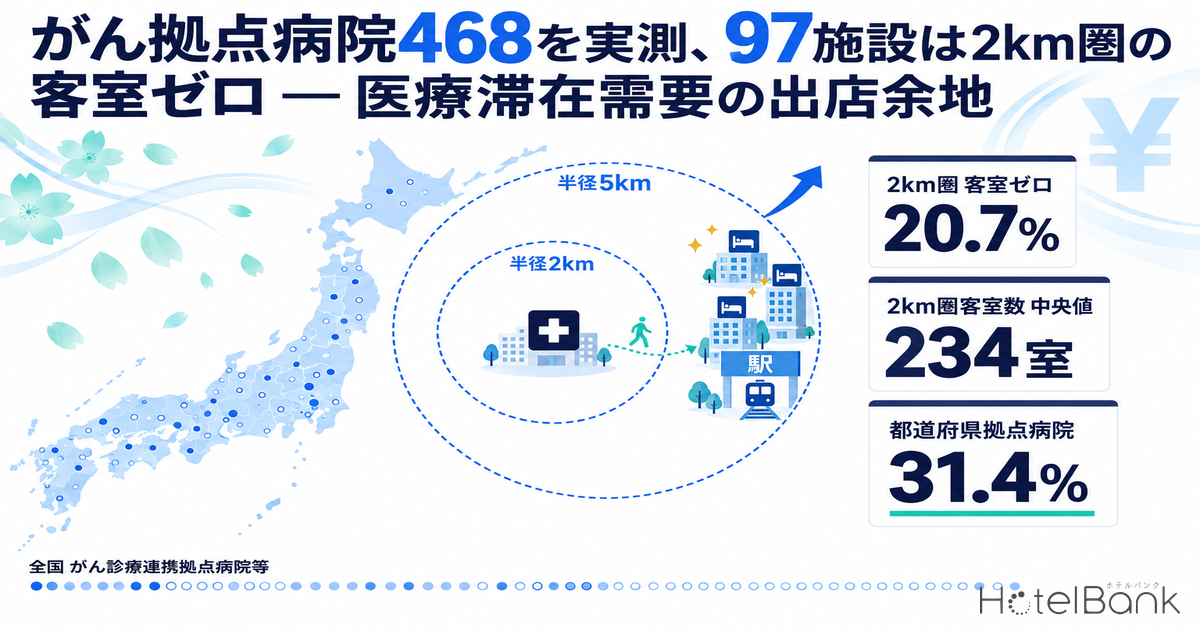
So where is that capacity, and how much of it is there? For this article we geocoded the locations of all 468 designated cancer care hospitals in Japan (as of April 1, 2026) and measured the number of lodging properties and guest rooms within a 2 km and a 5 km radius of each. To state the conclusion first: at 97 of them (20.7%) not a single guest room sold through OTAs and similar channels sits within 2 km, and among the 51 prefectural designated cancer care hospitals the figure is 16 (31.4%). That is a gap in capacity — and, at the same time, room to open.
Metric Definitions Used in This Article
- ADR (average daily rate) = an estimated settled rate (tax-excluded equivalent) derived by applying a segment-specific adjustment coefficient to the cheapest plan level each property publishes on OTAs and similar channels (two guests per room, per-room price, tax included). Cross-checked against the property-level results disclosed by listed hotel REITs (91 properties, most recent three months), the median error is approximately 7%. These are estimates and differ from each property’s actual transacted prices and accounting figures. An area-level ADR is the median across the properties covered (the level of a typical property in that area).
- Listed price = the average price across all plans posted on OTAs and similar channels (two guests per room, per-room price, tax included, from room-only through meal-inclusive plans). The day-of-week comparisons in this article are made on this listed-price basis.
- Rooms within radius = the total guest rooms at lodging properties located within a 2 km / 5 km radius of the hospital’s location. The universe is the properties for which activity can be confirmed (27,248 as of September 2026) among the roughly 168,000 properties in Japan tracked by MetroEngines Research. Ryokan, guesthouses and simple lodgings not posted on OTAs or similar channels, and accommodation for patients’ families operated by the hospitals themselves, are not included.
- Data sources: MetroEngines Research & Consulting / Ministry of Health, Labour and Welfare, “List of Designated Cancer Care Hospitals” / Ministry of Land, Infrastructure, Transport and Tourism, National Land Numerical Information “Medical Institution Data”
- — At 97 of the 468 designated cancer care hospitals (20.7%) there is not a single guest room sold through OTAs and similar channels within a 2 km radius. Among prefectural hospitals alone the figure reaches 16 of 51 (31.4%).
- — The 97 hospitals with zero rooms within 2 km are not a uniform group. For the 46 “location mismatch” hospitals with 500 or more rooms within 5 km the issue is access design; for the 19 “empty catchment” hospitals with fewer than 100 rooms even within 5 km the issue is supply itself.
- — The estimated number of outpatients with malignant neoplasms is 186,400, 1.76 times the inpatient figure (2023 Patient Survey). The average length of stay is 14.4 days, and an accompanying family member’s stay tracks that period.
- — Among the property clusters within 2 km of a designated cancer care hospital, listed prices peak on Saturday in all seven municipalities, with weekday (Mon–Thu) to Saturday gaps of +25.1% to +56.9% (check-ins between May 17 and September 13, 2026). Medical-stay demand, which falls on weekdays, is out of phase with leisure.
- — While 54–75% of properties offer at least one multi-night plan, such plans account for only 5.6–9.1% of all plans (28.3% in Gifu City alone). The night count at which the multi-night discount starts, housekeeping frequency and laundry facilities are where differentiation remains.
The Shape of Medical-Stay Demand — 990,000 New Diagnoses a Year, and 18 Years of Outpatients Outnumbering Inpatients
It helps to start with the demand side. According to the Ministry of Health, Labour and Welfare’s “Cancer Incidence in Japan 2022,” 990,930 people nationwide were newly diagnosed with cancer in 2022. The designated cancer care hospitals covered here are the institutions that deliver the advanced multidisciplinary treatment such cases require.
What matters for lodging demand is that the site of treatment has shifted from inpatient to outpatient care. Tracking the Patient Survey’s estimated patient counts from 1996 onward, inpatients with malignant neoplasms fell 21.1% from 134,400 to 106,100, while outpatients rose 46.8% from 127,000 to 186,400. The two crossed over in the 2008 survey. An inpatient bed doubles as lodging; outpatient treatment means the patient travels there and back every time. For a patient commuting from more than two hours away, that is where the need for a night before or after treatment arises.
There is a second figure that bears on how long people stay. For patients with malignant neoplasms discharged in September 2023, the average length of stay was 14.4 days (15.5 days for those aged 65 and over). An accompanying family member’s stay tracks that period. Where treatment is outpatient chemotherapy delivered every few weeks, the pattern is repeat demand of one to two nights. Either way, it arises on a completely different time axis from a two-night leisure weekend.
On the capacity side, low-cost lodging for patients and families — what are known in Japan as family houses — has been built up by local NPOs and hospital-affiliated organisations. Roughly 79 houses are registered with the JHHH Network (the nationwide network of patient-family lodging houses), broken down as 27 in Kanto, 16 in Kyushu and Okinawa, 11 in Kinki, 9 in Tokai, 5 in Hokkaido, 5 in Tohoku, 3 in Hokuriku and Koshinetsu, 2 in Chugoku and 1 in Shikoku. Most serve families accompanying children with cancer, and most run to only a handful of rooms per house. What 79 houses against 468 designated cancer care hospitals shows is that the bulk of medical-stay demand is carried by ordinary lodging properties.
The Nationwide Measurement — 97 Hospitals With Zero Rooms Within 2 km, and One in Three Prefectural Hospitals
This is the core of the article. We took the 468 facilities listed in the Ministry of Health, Labour and Welfare’s “List of Designated Cancer Care Hospitals (as of April 1, 2026)” — 51 prefectural designated cancer care hospitals, 357 regional designated cancer care hospitals, 1 specific-area designated cancer care hospital and 59 regional cancer care hospitals — matched them by facility name against the hospitals in the Ministry of Land, Infrastructure, Transport and Tourism’s National Land Numerical Information “Medical Institution Data” to fix the latitude and longitude of every one, and then computed the distance to the coordinates of each lodging property we track, one property at a time.
The result was clearly polarised. Rooms within a 2 km radius came to a median of 234 against a mean of 1,870, with a maximum of 25,976 around a hospital in Fukuoka City. While the top 30 are urban-core hospitals in Tokyo, Fukuoka, Sapporo and Osaka, 97 hospitals have not a single room observed within 2 km. Widen the line to fewer than 100 rooms and it is 176 hospitals (37.6%); to fewer than 300 rooms, 250 hospitals (53.4%). Slightly more than half of these hospitals sit in an environment holding no more than one mid-sized hotel’s worth of rooms within a 2 km radius.
“Zero rooms” is the strictest line to draw. The table below shows how the count changes as the threshold is loosened, broken out by hospital category. Prefectural hospitals exceed the regional group only up to the “fewer than 100 rooms” line (31.4% against 19.4% at zero rooms); at fewer than 300 rooms the two are almost level, and at fewer than 500 and fewer than 1,000 rooms the regional group is the higher share. What distinguishes prefectural hospitals is less that lodging is scarce than that there is none at all within walking distance. Note that widening to fewer than 1,000 rooms captures 72.2% of the total — where the definition is set changes the count by a factor of 3.5.
| Rooms within 2 km | All (N=468) | Prefectural (N=51) | Regional and other cancer care hospitals (N=417) |
|---|---|---|---|
| 0 rooms (zero rooms) | 97 hospitals (20.7%) | 16 hospitals (31.4%) | 81 hospitals (19.4%) |
| Fewer than 100 rooms | 176 hospitals (37.6%) | 22 hospitals (43.1%) | 154 hospitals (36.9%) |
| Fewer than 300 rooms | 250 hospitals (53.4%) | 27 hospitals (52.9%) | 223 hospitals (53.5%) |
| Fewer than 500 rooms | 280 hospitals (59.8%) | 28 hospitals (54.9%) | 252 hospitals (60.4%) |
| Fewer than 1,000 rooms | 338 hospitals (72.2%) | 33 hospitals (64.7%) | 305 hospitals (73.1%) |
By category, the median room count within 2 km was 261 for prefectural designated cancer care hospitals, 287 for regional designated cancer care hospitals and 69 for regional cancer care hospitals. What stands out is that 16 of the 51 prefectural hospitals (31.4%) have zero rooms within 2 km. The hub of cancer care in each prefecture sits somewhere with no lodging within walking distance. University medical school hospitals and cancer centres have historically been built on the outskirts or on developed land because they need large sites, so this is also a rational consequence of how the locations were chosen.
| Prefectural hospital | Address | To nearest property | Properties within 5 km | Rooms within 5 km |
|---|---|---|---|---|
| Fukushima Medical University Hospital (Fukushima) | 1 Hikarigaoka, Fukushima City | 6,803m | 0 | 0 rooms |
| University of Miyazaki Hospital (Miyazaki) | 5200 Kihara, Kiyotake-cho, Miyazaki City | 2,421m | 1 | 21 rooms |
| Kanagawa Cancer Center (Kanagawa) | 2-3-2 Nakao, Asahi Ward, Yokohama City | 4,075m | 2 | 42 rooms |
| Oita University Hospital (Oita) | 1-1 Idaigaoka, Hasama-machi, Yufu City | 3,659m | 2 | 66 rooms |
| Kagawa University Hospital (Kagawa) | 1750-1 Ikenobe, Miki-cho, Kita District | 3,588m | 2 | 135 rooms |
| Iwate Medical University Hospital (Iwate) | 2-1-1 Idai-dori, Yahaba-cho, Shiwa District | 4,765m | 1 | 153 rooms |
| Ibaraki Prefectural Central Hospital (Ibaraki) | 6528 Koibuchi, Kasama City | 2,761m | 2 | 159 rooms |
| Shikoku Cancer Center (Ehime) | 160 Ko, Minamiumemoto-machi, Matsuyama City | 3,528m | 5 | 213 rooms |
| Kochi Medical School Hospital (Kochi) | 185-1 Kohasu, Oko-cho, Nankoku City | 2,601m | 7 | 305 rooms |
| Saitama Cancer Center (Saitama) | 780 Komuro, Ina-machi, Kitaadachi District | 2,806m | 5 | 319 rooms |
| Gifu University Hospital (Gifu) | 1-1 Yanagido, Gifu City | 3,675m | 9 | 637 rooms |
| Miyagi Cancer Center (Miyagi) | 47-1 Nodayama, Medeshima-Shiote, Natori City | 2,574m | 4 | 794 rooms |
| Aichi Cancer Center (Aichi) | 1-1 Kanokoden, Chikusa Ward, Nagoya City | 2,174m | 17 | 1,277 rooms |
| Chiba Cancer Center (Chiba) | 666-2 Nitona-cho, Chuo Ward, Chiba City | 2,624m | 18 | 1,548 rooms |
| Aomori Prefectural Central Hospital (Aomori) | 2-1-1 Higashi-tsukurimichi, Aomori City | 3,348m | 30 | 3,474 rooms |
| Akita University Hospital (Akita) | 44-2 Hasunuma, Hiromote, Akita City | 2,292m | 29 | 3,656 rooms |
That said, “zero within 2 km” cannot be treated as one group. Stratifying the 97 hospitals by rooms within 5 km, 28 have 1,000 rooms or more and 18 have 500–999. In those cases the town is not short of room stock — the stock is concentrated around the station and away from the hospital, a mismatch of location. Conversely, 19 hospitals have fewer than 100 rooms even within 5 km, and 6 have no rooms at all within 5 km; for these, supply in the catchment itself is thin. The former leaves room to close the distance with shuttles and pick-up services; the latter leaves room to open a property in the first place.
Type A Location mismatch
0 rooms within 2 km / 500+ rooms within 5 km: 46 hospitals
The rooms are in the town but 3–5 km from the hospital. Pick-up and shuttle services, plans designed for medical stays, and clear routes from station-front properties are what work first here.
Type B Empty catchment
0 rooms within 2 km / fewer than 100 rooms within 5 km: 19 hospitals
At 6 of them no rooms are observed even within 5 km. This is the group where room to open a small, low-cost property remains most plainly.
Type C Deep urban-core
1,000+ rooms within 2 km: 130 hospitals
Supply is sufficient. Competition shifts from volume to handling multi-night and long stays, and to the operational details that fit a treatment schedule.
Prefecture-Level Variation — Chiba With 8, Aichi 6 and Akita 5 Hospitals at “Zero Within 2 km”
Broken out by prefecture, the largest number of designated cancer care hospitals with zero rooms within 2 km is in Chiba, with 8 (47% of the prefecture’s 17 hospitals), followed by Aichi with 6, and Akita and Saitama with 5 each. By share, Kochi reaches 3 of 4 hospitals (75%), and Akita and Yamaguchi both reach 50%.
The character of each prefecture differs, however. Chiba, Saitama, Aichi and Kanagawa are metropolitan prefectures, but their designated hospitals sit in suburban medical complexes or on university campuses, which opened up the distance. In Akita, Iwate, Kochi and Yamaguchi the prefecture-wide room stock is itself thin, and the median within 2 km is a mere 0–28 rooms. For the former the lever is access design; for the latter it is supply itself.
| Prefecture | Designated hospitals | Zero rooms within 2 km | Share | Median rooms within 2 km | Median rooms within 5 km |
|---|---|---|---|---|---|
| Chiba | 17 | 8 | 47% | 123 rooms | 1,241 rooms |
| Aichi | 19 | 6 | 32% | 77 rooms | 1,277 rooms |
| Akita | 10 | 5 | 50% | 17 rooms | 490 rooms |
| Saitama | 15 | 5 | 33% | 211 rooms | 678 rooms |
| Yamaguchi | 8 | 4 | 50% | 18 rooms | 859 rooms |
| Iwate | 10 | 4 | 40% | 28 rooms | 332 rooms |
| Kanagawa | 26 | 4 | 15% | 292 rooms | 1,332 rooms |
| Shizuoka | 13 | 4 | 31% | 315 rooms | 1,806 rooms |
| Kochi | 4 | 3 | 75% | 0 rooms | 187 rooms |
| Tochigi | 8 | 3 | 38% | 10 rooms | 391 rooms |
| Ibaraki | 10 | 3 | 30% | 120 rooms | 798 rooms |
| Tokyo | 31 | 3 | 10% | 2,818 rooms | 25,136 rooms |
| Nara | 6 | 2 | 33% | 40 rooms | 283 rooms |
| Oita | 6 | 2 | 33% | 65 rooms | 1,194 rooms |
| Niigata | 9 | 2 | 22% | 98 rooms | 1,828 rooms |
| Fukushima | 7 | 2 | 29% | 125 rooms | 2,230 rooms |
Three Location Types — 21,967 Rooms in Tsukiji, Zero in Aomori, Zero in Shimotsuke
Even among “cancer care hospitals,” the surrounding room environment differs by orders of magnitude. We take three hospitals — a major-city type, a prefectural-capital type and a regional type — and compare how rooms accumulate across distance bands.
National Cancer Center Hospital (Tsukiji, Chuo Ward, Tokyo) has 136 properties and 21,967 rooms within 2 km. The median estimated ADR inside that radius is ¥18,100 (N=90 properties, average for April–August 2026), with a first quartile of ¥14,100 and a third quartile of ¥25,300. The price range spans Ginza, Higashi-Ginza, Tsukiji and Hatchobori, so patients and families can choose according to budget — the lower band for a long stay, the upper band for a short accompanying visit.
Aomori Prefectural Central Hospital (Higashi-tsukurimichi, Aomori City) has zero rooms within 2 km. The nearest property is 3.3 km away, and 30 properties with 3,474 rooms cluster around Aomori Station in the 3–5 km band. The median estimated ADR in that band is ¥10,400 (N=23 properties, likewise the average for April–August 2026). As a prefectural capital the room stock itself is ample, making this a textbook case where the question is how to close the distance. Put the other way, a small property specialising in medical stays placed right beside the hospital could get started without competing with the existing station-front supply.
Jichi Medical University Hospital (Yakushiji, Shimotsuke City, Tochigi) had no rooms observed within 5 km, let alone 2 km. The nearest is a 61-room property 5.9 km away, and widening to 8 km yields only 3 properties and 124 rooms. The median estimated ADR is ¥3,700 (N=3 properties, average for April–August 2026; a reference value given the small sample), low even by national standards — but rather than the price signalling weak demand, the situation is that there are only three room options in the first place. A 1,000-bed advanced treatment hospital sitting in a catchment whose lodging stock runs to the low hundreds reads very plainly as room to open.
Medical Stays Fall on Weekdays — Listed Prices Trough on Sunday and Peak on Saturday
The other characteristic of medical-stay demand is the day of the week on which it arises. Outpatient consultations and admission procedures are as a rule handled on weekdays, so demand falls Monday to Friday. That is exactly out of phase with the weekend concentration of leisure demand.
For the seven municipalities where designated cancer care hospitals cluster, we aggregated the listed prices of the property clusters within 2 km of each hospital by day of week (check-ins between May 17 and September 13, 2026; two guests per room, all-plan average, tax included). In all seven, Saturday is the highest, and in the six excluding Kyoto City Sunday is the cheapest (in Kyoto City, Sunday sits slightly above the Monday–Thursday average). The gap between the Monday–Thursday average and Saturday is +31.7% in Bunkyo Ward, Tokyo, +27.3% in Okayama City, +52.4% in Sapporo City and +56.9% in Gifu City.
| Municipality (within 2 km of a designated hospital) | Properties covered | Sunday | Weekday (Mon–Thu) average | Saturday | Weekday → Saturday |
|---|---|---|---|---|---|
| Bunkyo Ward, Tokyo | 183 | ¥28,814 | ¥30,265 | ¥39,861 | +31.7% |
| Sapporo City | 135 | ¥30,147 | ¥31,158 | ¥47,472 | +52.4% |
| Kyoto City | 624 | ¥33,484 | ¥32,919 | ¥41,171 | +25.1% |
| Okayama City | 45 | ¥20,411 | ¥23,118 | ¥29,418 | +27.3% |
| Kumamoto City | 46 | ¥19,743 | ¥20,191 | ¥28,074 | +39.0% |
| Kagoshima City | 53 | ¥18,303 | ¥18,493 | ¥23,710 | +28.2% |
| Gifu City | 9 | ¥16,764 | ¥18,149 | ¥28,473 | +56.9% |
From an operator’s point of view this structure is convenient. Medical stays arise from Sunday through Thursday, when prices are at their softest, and do not compete with the Friday and Saturday that leisure comes for. Filling the same rooms with leisure on the weekend and with medical and business demand on weekdays levels occupancy across the week. And because treatment schedules are independent of the seasonal peaks and troughs, a certain volume arises even in the tourism low season. For a property in the catchment of a designated cancer care hospital, this is a segment worth considering as a way to fill weekday inventory.
Capacity for Multi-Night Stays — Only 6–9% of All Plans
Length of stay is another feature of medical travel. Accompanying a 14.4-day average inpatient stay, the days around a few nights of diagnostic admission, the daily visits of a course of radiotherapy — there are many situations that do not end in a single night. So we counted how many of the accommodation plans published by the property clusters within 2 km of a designated cancer care hospital are multi-night or long-stay plans (those whose names contain terms such as consecutive nights, long stay, weekly or monthly).
| Municipality (within 2 km of a designated hospital) | Properties publishing plans | Properties with a multi-night plan | Share of properties | Plans published | Multi-night plan share |
|---|---|---|---|---|---|
| Bunkyo Ward, Tokyo | 169 | 114 | 67.5% | 4,332 | 8.6% |
| Sapporo City | 119 | 86 | 72.3% | 5,028 | 7.5% |
| Okayama City | 37 | 20 | 54.1% | 1,208 | 6.1% |
| Kumamoto City | 45 | 29 | 64.4% | 1,666 | 9.1% |
| Kagoshima City | 50 | 30 | 60.0% | 2,142 | 5.6% |
| Gifu City | 8 | 6 | 75.0% | 304 | 28.3% |
Properties offering at least one multi-night plan are already widespread at 54–75%. At the same time, such plans make up only 5.6–9.1% of all plans (28.3% in Gifu City alone), still a narrow slot within the product mix. Whether the multi-night discount starts at two nights or three, how housekeeping is handled, whether there is an on-site laundry or kitchen, whether guests may leave during a multi-night stay — these conditions vary from property to property, and aligning them with how medical stays actually work is where differentiation remains. For a sense of how many nights it takes for a discount to bite, see How Many Nights Before a Japanese Hotel Long-Stay Discount Kicks In?, which measures it.
A note on price bands. The estimated ADR within 2 km of a designated cancer care hospital ranges from ¥18,100 in Tsukiji to ¥10,400 around Aomori Station (the 3–5 km band) and ¥3,700 around Shimotsuke City (the 5–8 km band). Because the per-night budget for a medical stay tends to fall the longer the stay runs, midscale and economy inventory works better as capacity than upscale inventory. In practice, in all three of the location types above, the bulk of the surrounding rooms were business-hotel stock.
What the Data Shows — Access for 46 Hospitals, Supply Itself for 19
What measuring all 468 designated cancer care hospitals reveals is not the coarse claim that “capacity is thin nationwide,” but that the lever differs by location type.
For the 46 hospitals with zero rooms within 2 km but 500 or more within 5 km, the room stock itself is in the catchment. What works here is not new supply but operations: designing pick-up and shuttle services, setting check-in and check-out times around treatment schedules, offering a choice of housekeeping frequency during a multi-night stay, and making the route from station-front properties to the hospital visible. These are straightforward for existing properties to take on as a way to fill weekday inventory.
By contrast, the 19 hospitals with fewer than 100 rooms even within 5 km (6 of them with zero within 5 km) sit in catchments genuinely short of rooms. Where a 1,000-bed-class hospital such as Jichi Medical University Hospital stands in a catchment whose surrounding stock runs to the low hundreds, room to open a small, low-cost property remains. Anyone weighing that would be realistic to assume weekday-driven demand independent of the leisure season and to run a tightly limited room count.
And at the 130 urban-core hospitals, the competitive axis is substance rather than volume. In a catchment as amply supplied as Tsukiji’s 21,967 rooms, properties are chosen on multi-night pricing, in-room or on-site cooking and laundry facilities, quiet, and walking minutes to the hospital. As the previous section showed, multi-night plans still account for less than a tenth of all plans by count, so there is room left in product design.
Finally, a reminder that this measurement is limited to lodging inventory posted on OTAs and similar channels. Ryokan, guesthouses and simple lodgings that are not posted, accommodation for patients’ families run by the hospitals themselves, and the roughly 79 houses registered with the JHHH Network are not included in these counts. Actual capacity is therefore thicker than the figures shown here — but as inventory bookable on the general lodging market, 97 hospitals stand at zero rooms within 2 km.
For hoteliers: plan-name cues that work for this theme
The appeals that appear most often in published plan names for business hotels × multi-night stays (N=727) —
Multi-night discount 97%Breakfast included 48%Room only 32%Eco 25%Long stay / living 24%Discount 17%
Examples of actual names (anonymised):
- [30-Day Advance Discount] Save on 2+ Consecutive Nights ◆ Eco Stay ◆ Free Buffet Breakfast ◆◆ Children Through Elementary School Sleep Free
- [Long Stay ◆ Breakfast Included] 12:00 Check-Out ◆ Japanese Buffet Breakfast ◆ Free Parking ◆ Children Sleep Free ◆
- [Long Stay ◆ Breakfast Included] 12:00 Check-Out ◆ Japanese Buffet Breakfast ◆ Free Parking ◆ Children Sleep Free ◆◆
* A tendency observed in aggregated published plan names; it does not demonstrate that naming causes sales. For a deeper look at market × naming, see our naming benchmark and event articles.
Related reading
References and Sources
■ Data sources
Hospital locations were fixed by matching the 468 facilities in the Ministry of Health, Labour and Welfare’s “List of Designated Cancer Care Hospitals (as of April 1, 2026)” by facility name against the hospitals in the Ministry of Land, Infrastructure, Transport and Tourism’s National Land Numerical Information “Medical Institution Data (P04),” establishing latitude and longitude for every one. For lodging, we used the locations and room counts of the 27,248 properties in Japan whose activity MetroEngines Research & Consulting has confirmed (as of September 2026), aggregating a 2 km and a 5 km radius around each hospital. The estimated settled ADR is the median of each property’s April–August 2026 average; the day-of-week listed prices cover check-ins between May 17 and September 13, 2026 (two guests per room, all-plan average, tax included); multi-night plans are classified by the names of published plans on sale as of September 2026 or updated within the preceding 90 days. Demand-side figures come from the Ministry of Health, Labour and Welfare’s “Patient Survey” (2023) and “Cancer Incidence in Japan 2022,” and the house count from JHHH Network registration data.
■ Estimation assumptions
This article makes no revenue projections. Rooms within radius are aggregated by straight-line distance from the hospital’s representative point; road distance and travel time are not taken into account. The location types are a HotelBank Editorial Team classification: “location mismatch” for 0 rooms within 2 km and 500 or more within 5 km, “empty catchment” for 0 rooms within 2 km and fewer than 100 within 5 km, and “deep urban-core” for 1,000 or more rooms within 2 km. “Weekday” in the day-of-week comparison is the Monday–Thursday average, and each municipality’s universe is the property cluster located within 2 km of the designated cancer care hospitals in that municipality.
■ Limitations and caveats
Ryokan, guesthouses and simple lodgings not posted on OTAs or similar channels, accommodation for patients’ families operated by hospitals, and the roughly 79 houses registered with the JHHH Network are excluded from the counts. Depending on how a hospital’s coordinates are taken and how properties near the 2 km boundary are handled, the number of hospitals captured could move by roughly one. Medians for prefectures with few designated hospitals shift considerably on a single property. The estimated settled ADR is an estimate (median error approximately 7% when cross-checked against listed hotel REIT disclosures), and values based on small samples — such as the N=3 figure around Shimotsuke City — should be treated as reference values. There is no nationwide official statistic for the share of patients commuting from far away or the rate at which accompanying family members stay overnight, so this article does not estimate the volume of demand.
■ Market data
- MetroEngines Research & Consulting — lodging property locations and room counts (27,248 properties in Japan, as of September 2026), estimated settled ADR, listed prices, published plan mix
■ Government statistics and public data
- Ministry of Health, Labour and Welfare, “List of Designated Cancer Care Hospitals (as of April 1, 2026)”
- Ministry of Health, Labour and Welfare, “Designated Cancer Care Hospitals”
- Ministry of Health, Labour and Welfare, “Overview of the 2023 Patient Survey” (estimated patient counts and average length of stay)
- Ministry of Health, Labour and Welfare, “Cancer Incidence in Japan 2022”
- Ministry of Land, Infrastructure, Transport and Tourism, National Land Numerical Information “Medical Institution Data (P04)” (used to match hospital latitude and longitude)
■ Survey and organisation materials