

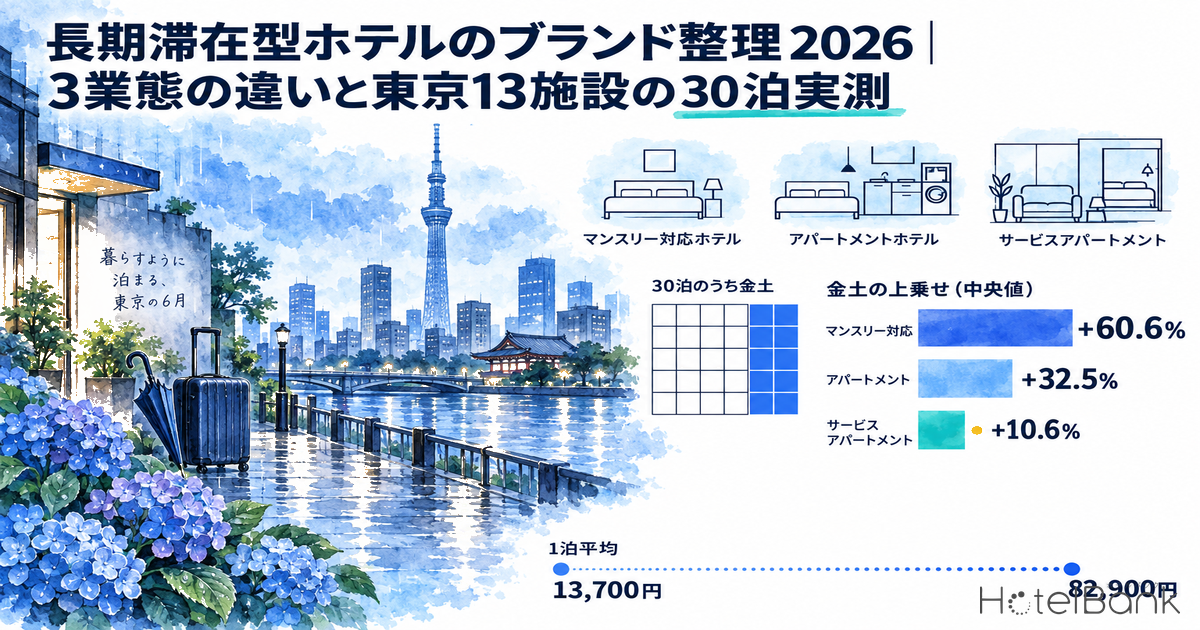
“Long-stay hotel” is not the name of a single format. A conventional hotel that offers monthly and weekly plans, an apartment hotel with a kitchen and a washer-dryer, a serviced apartment designed around stays of 30 nights or more — these three differ far more in contract form, billing unit and pricing behaviour than they do in how the room looks. This article sets out where the lines fall between the three formats, lays the brands side by side using the figures each operator publishes, and measures what 30 nights actually cost at 13 Tokyo properties using listed rates.
Metric Definitions Used in This Article
- ADR (average daily rate): an estimated settled rate (tax-exclusive equivalent) derived by applying a format-specific adjustment factor to the lowest listed plan level each property publishes on OTAs and elsewhere (2 guests per room, per-room rate, tax included). Cross-checked against per-property results disclosed by listed hotel REITs (91 properties, most recent three months), the median error is about 7%. It is an estimate and differs from each property’s actual transaction prices and accounting figures. Area-level ADR is the median of the properties covered (the level of a typical property in that area).
- Listed rate (lowest plan): the per-room rate of the cheapest plan each property had published for that stay date at the time of the survey (2 guests per room, tax included). The per-property measurements in this article use this figure, which is a different metric from the ADR (estimated settled rate) above.
- 30-night total: the sum of the listed rate (lowest plan) for each of 30 consecutive nights. It differs from the monthly-plan rates each operator sells officially.
- Data source: MetroEngines Research
- — Three formats: monthly/weekly-plan hotels, apartment hotels and serviced apartments are separated by minimum stay length and billing unit rather than by the room itself. All three remain taxable transactions for consumption tax even on stays of a month or more (National Tax Agency No. 6226).
- — ¥13,700–82,900 per night: measured over 30 nights in June 2026 at 13 Tokyo properties (lowest listed rate, 2 guests per room, tax included). Format labels and price bands do not map one to one.
- — Fri/Sat uplift, median +60.6% / +32.5% / +10.6%: the more a format commits to long stays, the less it moves price by day of week.
- — Four guests, virtually the same room rate: MIMARU Tokyo Hatchobori is ¥71,000 for one, two or four guests — about ¥17,800 per person per night at four.
- — Seasonality moves the total: Tokyo ADR (estimated settled rate) bottoms out for the year at ¥12,100 in June and reaches ¥18,800 in October (estimate). For the four monthly-plan properties, the October 30-night total runs +69.6% to +74.8% above June.
The three long-stay formats — the dividing line is the contract and the billing unit, not the room
The first thing needed when handling the long-stay segment is to draw the line between formats. In practice it is easiest to split them three ways. For how a product that lets you stay a month straight with no lease actually works, see What is a monthly hotel? A month-long consecutive stay with no lease, which also sets out indicative costs.
First, the monthly/weekly-plan hotel. It uses ordinary hotel rooms as they are and sets up consecutive-stay plans of 7, 14 or 30 nights. Capital expenditure is small, so an existing accommodation-led hotel can enter as it stands. Because inventory is shared with nightly retail sales, the property can prioritise short-stay demand in peak periods and fill the trough with long stays.
Second, the apartment hotel. Rooms come with a kitchen, refrigerator and washer-dryer, and are designed at more than 40 sq m with capacity for four to six guests. They are operated under the same Hotel Business Act licence as a conventional hotel, but because the room is configured closer to a home, they can go directly after mid-length stays by families and groups.
Third, the serviced apartment. This format puts the length of stay itself at the centre of product design, and includes properties that set a minimum number of nights. Oakwood Oimachi Tracks Tokyo (78 rooms), opened by Ascott Japan on 25 June 2026, is a long-stay-only serviced residence restricted to stays of 30 nights or more, with units ranging from studios of about 27 sq m to three-bedroom apartments of 107 sq m (company news release).
What is easily overlooked in practice here is the tax treatment. The National Tax Agency’s tax answer “Leasing of housing” (No. 6226) states explicitly that the leasing of facilities used in the hotel business as defined in Article 2, Paragraph 1 of the Hotel Business Act is outside the scope of the exemption, and that “inns, hotels, rental villas, resort condominiums, weekly apartments and the like are not exempt even where the period of use is one month or longer.” In other words, all three formats covered here remain taxable transactions beyond one month, and are different in accounting character from a monthly apartment let under a lease (leasing of housing). The reason corporates choose them for business-trip and relocation expense claims is rooted not only in the rate level but in this difference of contract form.
| Point of comparison | Monthly / weekly-plan hotel | Apartment hotel | Serviced apartment |
|---|---|---|---|
| Contract | Accommodation contract (Hotel Business Act) | Accommodation contract (Hotel Business Act) | Accommodation contract (Hotel Business Act). Some properties are long-stay only |
| Consumption tax | All are taxable even on stays of a month or more (National Tax Agency No. 6226). A monthly apartment under a lease is exempt as leasing of housing | ||
| Room facilities | Ordinary hotel rooms. Shared laundry is the norm | Kitchen and washer-dryer fitted as standard inside the room | Kitchen and washer-dryer plus a unit mix from studio to multiple bedrooms |
| Minimum nights | From one night. Consecutive-stay plans at 7, 14 or 30 nights | From one night | Some properties restrict to 30 nights or more |
| Billing unit (measured) | Tends to track party size (see below) | Tends to be a flat per-room rate (see below) | Varies by unit type |
| Expected stay | Business trips, construction work, training, exam travel | Family and group travel, mid-length stays | Relocation, accompanying family, long projects |
Source: National Tax Agency tax answer No. 6226 and operator disclosures, compiled by the HotelBank Editorial Team
The main brands in each format — laid out using the figures each operator publishes
Next, what brands exist in Japan under each of the three formats, side by side. The property and room counts given here are quoted exactly as each operator publishes them. Some count directly operated properties only, others include franchised or partner properties and group companies, so the counting definitions are not aligned. This table is therefore a list for grasping each operator’s footprint, not a comparison of scale.
| Format | Brand / operator | What the operator publishes |
|---|---|---|
| Monthly / weekly-plan hotel | APA Hotel | Publicises a monthly plan on its official site allowing 30 consecutive nights at the same hotel. Runs a dedicated page aimed at long business trips |
| Tokyu Stay | Rooms fitted with a washer-dryer; officially offers mid-to-long-stay plans of up to 31 nights and a flat-rate long-stay plan | |
| Dormy Inn (Kyoritsu Maintenance) | Officially promotes weekly and monthly use as “urban workation” at properties with a large public bath | |
| hotel MONday / ICI HOTEL (JHAT) | Weekly and monthly plans set in three bands: from 7, from 14 and from 30 nights. States a 10% discount off the standard rate, zero deposit and key money, and utilities and Wi-Fi included | |
| Weekly Sho (Kibousha) | Opened 2001. Targets “a place to stay from a week to several months” and officially advertises a single rate for all 365 days that does not change between peak and off-peak | |
| Apartment hotel | MIMARU (Cosmos Hotel Management / Daiwa House Group) | Its official site lists 29 properties in total: 15 in Tokyo, 7 in Kyoto and 7 in Osaka. Rooms run about 40–100 sq m with capacity up to 10 guests. MIMARU Osaka Shinsaibashi Central (66 rooms), opening 1 September 2026, takes the total to 1,500 rooms, and the group has announced it is restarting new openings toward 3,000 rooms by 2030 |
| MONday Apart / GRAND MONday (JHAT) | Apartment-type rooms with a kitchen and a fully automatic washing machine. GRAND MONday Asakusa was rebranded from MONday Apart Premium Asakusa on 1 April 2026 and announced as the second property of the group’s top brand, with all rooms in suite specification | |
| GRAND BASE (REQREA) | Publishes 50 locations across 12 cities nationwide, centred on western Japan. Rooms have a kitchen and washing machine; the brand advertises more than twice the space of a typical business hotel and unstaffed front-desk operation | |
| Minn (SQUEEZE) | Publishes that it plans and operates apartment-type rooms with kitchens and similar facilities, aimed at group and family stays | |
| Serviced apartment | Ascott / Somerset / Citadines / Oakwood / lyf (Ascott Japan) | Publishes that it operates 5 brands and 21 properties in Japan (as of its March 2026 news release). Consolidated the brands following its 2022 acquisition of Oakwood |
| Oakwood Oimachi Tracks Tokyo | Opened 25 June 2026, 78 rooms. Long-stay only from 30 nights, with studios to three-bedroom units of about 27–107 sq m |
Source: operator official sites and news releases, compiled by the HotelBank Editorial Team (figures quoted exactly as each operator publishes them; counting definitions differ by operator)
Measuring 30 nights at 13 Tokyo properties — ¥13,700 to ¥82,900 a night
So what does 30 nights actually cost? We selected 13 properties in Tokyo covering all three formats and, for 30 consecutive nights from 1 to 30 June 2026, summed the price of the cheapest plan listed for each stay date (2 guests per room, per-room rate, tax included). Every property had an observable price on all 30 nights (N = 30 nights per property, 390 property-days in total).
Check-in 1–30 June 2026; sum over 30 nights of the lowest listed plan for each day (2 guests per room, per-room rate, tax included) / N = 13 properties x 30 nights. Source: MetroEngines Research, compiled by the HotelBank Editorial Team
The results ranged from ¥13,700 to ¥82,900 a night, and from ¥411,800 to ¥2,487,900 over the full 30 nights. What is worth noting is that the format label and the price band do not map one to one. The cheapest was Minn Kasai (55 rooms, ¥411,800 over 30 nights), which is classed as an apartment hotel, sitting at almost the same level as ICI HOTEL ASAKUSABASHI (103 rooms, ¥413,300) and hotel MONday Premium Toyosu (263 rooms, ¥415,100), both of which use ordinary hotel rooms. Meanwhile lyf Ginza Tokyo (140 rooms, ¥605,400), a serviced apartment, comes in at less than a quarter of Ascott Marunouchi Tokyo (130 rooms, ¥2,487,900) in the same class. The format name is a label for the design intent; it is more accurate to read the price band as being set by location and unit size.
| Format | Property | Rooms | Per night | 30-night total | Coefficient of variation | Fri/Sat uplift |
|---|---|---|---|---|---|---|
| Monthly-plan | ICI HOTEL ASAKUSABASHI (イチホテル浅草橋) | 103 | ¥13,778 | ¥413,334 | 27.0% | +55.6% |
| Monthly-plan | hotel MONday Premium Toyosu (Hotel MONday豊洲) | 263 | ¥13,836 | ¥415,072 | 36.5% | +74.6% |
| Monthly-plan | ICI HOTEL UENO SHIN OKACHIMACHI (イチホテル上野新御徒町) | 108 | ¥14,121 | ¥423,630 | 30.3% | +64.1% |
| Monthly-plan | hotel MONday Asakusa (HOTEL MONday 浅草) | 115 | ¥16,611 | ¥498,322 | 29.4% | +57.1% |
| Apartment | Minn Kasai (Minn 葛西) | 55 | ¥13,727 | ¥411,800 | 27.1% | +54.0% |
| Apartment | MIMARU Tokyo Ueno North (MIMARU東京 上野NORTH) | 40 | ¥56,858 | ¥1,705,740 | 18.2% | +32.5% |
| Apartment | GRAND MONday Asakusa (GRAND MONday 浅草) | 25 | ¥61,569 | ¥1,847,068 | 27.6% | +39.0% |
| Apartment | MIMARU Tokyo Hatchobori (MIMARU東京 八丁堀) | 74 | ¥71,013 | ¥2,130,400 | 17.4% | +25.6% |
| Apartment | MIMARU Tokyo Akasaka (MIMARU東京 赤坂) | 40 | ¥73,243 | ¥2,197,300 | 12.8% | +13.6% |
| Serviced apartment | lyf Ginza Tokyo (lyf銀座東京) | 140 | ¥20,180 | ¥605,388 | 18.4% | +26.4% |
| Serviced apartment | Citadines Shinjuku Tokyo (シタディーン新宿東京) | 160 | ¥27,462 | ¥823,872 | 15.7% | +9.5% |
| Serviced apartment | Oakwood Hotel & Apartments Azabu Tokyo (オークウッドホテル&アパートメンツ麻布) | 171 | ¥36,327 | ¥1,089,812 | 8.3% | +11.7% |
| Serviced apartment | Ascott Marunouchi Tokyo (アスコット丸の内東京) | 130 | ¥82,928 | ¥2,487,850 | 8.2% | -0.6% |
Check-in 1–30 June 2026; lowest listed plan for each day (2 guests per room, per-room rate, tax included) / N = 30 nights x 13 properties. Coefficient of variation = the spread of the 30 nightly prices divided by their mean. Source: MetroEngines Research, compiled by the HotelBank Editorial Team
Note that apartment-type and serviced-apartment rooms are mostly designed at 40–100 sq m with capacity for four to six guests, so both space and capacity differ from an ordinary hotel room. Reading the per-room price gap straight across as “expensive” is not appropriate.
What separates the formats is how day of week bites — a Fri/Sat uplift of 60.6% against 10.6%
The format difference showed up more clearly in how price moved across the 30 nights than in the absolute level. Taking the “Fri/Sat uplift” — the average for Friday and Saturday check-ins against the average for the other days — the median by format steps cleanly down: +60.6% for monthly/weekly-plan hotels, +32.5% for apartment hotels and +10.6% for serviced apartments. The coefficient of variation across the 30 nights narrows in the same order, at 29.9%, 18.2% and 12.0%.
Check-in 1–30 June 2026; index with each property’s weekday median = 100 / N = 3 properties x 30 nights. Source: MetroEngines Research, compiled by the HotelBank Editorial Team
The chart above takes one property from each format and plots the 30 nights with the weekday median set to 100. hotel MONday Premium Toyosu swings from 79 to 265, reaching 2.65 times its weekday level on Saturday 20 June. MIMARU Tokyo Akasaka runs from 68 to 128, and Oakwood Hotel & Apartments Azabu Tokyo sits almost entirely within a band of 100 to 130, with 12 of the 30 nights at exactly the same price. A 30-night stay spans eight or nine weekends, so this difference feeds straight through to the total.
The more a property is designed to make long stays its main business, the more it holds a steady level rather than swinging price by day of week — and that pattern reads as a deliberate pricing stance. Weekly Sho’s official single rate for all 365 days, which “does not change between peak and off-peak”, is the extreme form of the same idea. For the guest the total is easy to read; for the operator, long-stay inventory is locked in early. Put the other way, a hotel that swings hard by day of week and wants to win long stays has room to combine a design that does not give up the high weekend rate — opening weekends to short-stay demand, or restricting which dates a consecutive-stay plan applies to.
One format does not change the room price even when four people stay
Another clear divider between the formats is the billing unit. Among the same 13 properties, for those where a price could be confirmed on searches for one, two and four guests, we lined up the 30-night average of the lowest listed price by party size.
Check-in 1–30 June 2026; 30-night average of the lowest listed price under search conditions of one, two and four guests / N = 7 properties x 30 nights. Source: MetroEngines Research, compiled by the HotelBank Editorial Team
MIMARU Tokyo Hatchobori comes out at exactly ¥71,000 for one, two and four guests alike, and MIMARU Tokyo Ueno North holds all three conditions within one yen of each other at about ¥56,900. MIMARU Tokyo Akasaka and GRAND MONday Asakusa stopped at 1.02 and 1.04 times the two-guest level at four guests. Because a large unit with a kitchen is sold as a single room, the room price does not move as the party grows. Used by four, the per-person rate falls to a quarter — about ¥17,800 per person per night at MIMARU Tokyo Hatchobori.
By contrast, hotel MONday Premium Toyosu, which uses ordinary hotel rooms, goes from ¥13,800 at two guests to ¥33,900 at four (about 2.5 times), and hotel MONday Asakusa from ¥16,600 to ¥33,100 (about twice), switching up to a higher room type as the party grows. Serviced apartments also move with party size, because units are tiered from studio to multiple bedrooms: Ascott Marunouchi Tokyo was ¥82,900 at two guests against ¥236,200 at four. Minn Kasai sits in between at 1.20 times.
Re-cut to a “per person per night” basis, the same measurements show the difference in billing unit clearly as a cost to the guest. At the three MIMARU properties and GRAND MONday Asakusa, which are close to a flat per-room rate, the per-person rate at four guests falls to about 0.5 times the two-guest level. At hotel MONday Premium Toyosu, which switches up to a higher room type as the party grows, the per-person rate at four guests rises to 1.23 times the two-guest level, while hotel MONday Asakusa is essentially unchanged at 1.00.
| Format | Property | 1 guest | 2 guests | 4 guests | 4 guests / 2 guests |
|---|---|---|---|---|---|
| Apartment | MIMARU Tokyo Akasaka | ¥74,493 | ¥36,622 | ¥18,623 | 0.51x |
| Apartment | MIMARU Tokyo Hatchobori | ¥71,013 | ¥35,507 | ¥17,753 | 0.50x |
| Apartment | GRAND MONday Asakusa | ¥61,569 | ¥30,785 | ¥15,972 | 0.52x |
| Apartment | MIMARU Tokyo Ueno North | ¥56,858 | ¥28,429 | ¥14,214 | 0.50x |
| Apartment | Minn Kasai | ¥13,770 | ¥6,864 | ¥4,117 | 0.60x |
| Monthly-plan | hotel MONday Asakusa | ¥16,474 | ¥8,306 | ¥8,282 | 1.00x |
| Monthly-plan | hotel MONday Premium Toyosu | ¥13,450 | ¥6,918 | ¥8,475 | 1.23x |
Check-in 1–30 June 2026; the 30-night average of the lowest listed price (per room, tax included) under search conditions of one, two and four guests, divided by party size as a simple calculation / N = 7 properties x 30 nights. At four guests the room type differs by property. Source: MetroEngines Research, compiled by the HotelBank Editorial Team
Seen from the demand side of the segment, this difference in billing unit maps directly onto whose budget pays for the stay. A hotel that tracks party size is efficient for the solo business traveller; a flat per-room rate works for accompanying families and multi-person project teams. From an operating and investment standpoint, making rooms larger is a lever that not only raises the per-room rate but widens the range of party sizes a single room can take.
Demand backdrop — 9.5 nights on average for inbound visitors, 646 nomad visas, and the trough and peak of the market
The tailwinds behind the long-stay segment come from several directions. According to the Japan Tourism Agency’s Consumption Trend Survey for Foreigners Visiting Japan for calendar 2025 (released 21 January 2026), travel spending per inbound visitor was ¥229,000 (+0.9% year on year) and total travel consumption was ¥9.4559 trillion (+16.4%), both record highs. The average number of nights stayed came to 9.5 overall, 0.5 nights longer than the previous year, and by nationality there are long-stay markets such as France at 18.4 nights and Germany at 18.0 nights. By expenditure category, accommodation is the largest item at 36.6% (¥3.4617 trillion). The longer a stay runs, the more “the total for 30 nights” and “can I cook and do laundry” rise up the decision criteria, ahead of per-night comfort.
On the policy side there is the framework for digital nomads under the “Designated Activities” residence status, which began operating in March 2024. On a tally based on Ministry of Foreign Affairs visa-issuance statistics, issuances rose 2.51 times, from 257 in 2024 (the nine months from 31 March) to 646 in 2025 (Japan Digital Nomad Association, released 3 August 2026). Because the permitted period of stay is six months at most with no renewal, it fits demand to stay under an accommodation contract rather than a lease with a residence registration. The absolute numbers are still small, but the growth rate and the length of stay are hard to ignore when designing the product on the host side.
Domestic demand is persistent too. Just as Weekly Sho began in 2001 from the idea of “building somewhere construction workers could stay cheaply”, businesses that involve a physical site — construction, plant work, power — generate accommodation demand continuously in units of weeks to months. In recent years there have also been more projects, offshore wind among them, where mid-length-stay demand builds up intensively in a specific regional area around a designated base port. In search behaviour too, queries comparing long-stay hotels and brands occur in steady volume, showing that an audience looking for this information genuinely exists.
That said, the total cost of a long stay tracks the market itself closely. Tokyo ADR (estimated settled rate) was ¥12,100 in June 2026 (N = 1,137 properties), the trough of the year, against ¥18,800 in October (N = 1,097 properties) — more than 50% higher. June was chosen for the measurement here in order to hold all 13 properties to the same condition, the trough of the market. For reference, aggregating 30 nights of October check-ins at the same 13 properties, the four monthly/weekly-plan hotels moved +69.6% to +74.8% on the total. Treating long stays only as “stable, resilient demand” means missing how the level shifts with the season.
January 2025 – December 2026; Tokyo ADR (estimated settled rate, median of the properties covered) / N = 1,034–1,151 properties. Source: MetroEngines Research, compiled by the HotelBank Editorial Team
⚠ Note on prices for future dates: the October 2026 check-in figures and Tokyo ADR from September 2026 onward are estimates based on the selling prices published on OTAs and elsewhere at the time of the survey, and will move as the check-in date approaches. Please note that the current level will not necessarily be what is realised.
Implications for operators and investors
First, listed rates on OTAs and the operators’ own monthly-plan rates are different things. What this article measured is the listed rate sold in single nights; the long-stay-specific rates the hotel MONday group states as “10% off the standard rate, zero deposit and key money, utilities and Wi-Fi included” sit in a separate sales design centred on the official site. If you are going after long stays, having a direct-sales route separate from listed inventory translates straight into a margin difference.
Second, long stays leave room to change the operating cost structure. If cleaning can be designed at once or twice a week, labour hours compress, and the number of check-ins and check-outs per room falls sharply. As GRAND BASE’s unstaffed front-desk operation shows, labour-saving and long stays fit well together by design. Filling the occupancy trough with long stays is a realistic upside for existing hotels as well.
Third, pricing. What the measurements showed is that the more a property commits to long stays, the less it moves price by day of week. That is also a choice not to chase the weekend rate on short-stay demand, so it is not a question of which is correct. What matters is building the applicable days and minimum nights of a consecutive-stay plan with a clear view of which design you are competing on. Given that eight or nine weekends fall within 30 nights, offering a consecutive-stay discount without first deciding how weekends are handled leaves the total looking incoherent.
Fourth, from an investment standpoint, the design of room area and capacity drives the payback scenario. A flat per-room format does not change price when used by four, so it can hold a high per-room rate, but it competes less well for the solo business-trip demand pool. A party-size-linked format reaches a wider audience, but its per-room ceiling is bound by the size of the room. As MIMARU’s stated target of 3,000 rooms by 2030 shows, growth in this segment is becoming an argument about how many rooms of what size to stack, rather than how many buildings to put up. Per-unit-area profitability also differs sharply between central business locations and resort locations, which is where the area design and the target rate have to be decided together.
Summary
Long-stay hotels can be organised into three formats: monthly/weekly-plan hotels, apartment hotels and serviced apartments. All are accommodation contracts under the Hotel Business Act and all remain taxable transactions beyond one month, but the design of minimum nights and the billing unit differ substantially. Measuring 30 nights at 13 Tokyo properties, the price band spread from ¥13,700 to ¥82,900 a night, and the format label did not necessarily match the price band. On the other hand, the Fri/Sat uplift (median +60.6% / +32.5% / +10.6%) and the way price moves with party size split clearly by format, confirming that the more a property is optimised for long stays, the more it levels its pricing and sells at a flat per-room rate. With the average stay by inbound visitors stretching to 9.5 nights and the digital-nomad residence framework growing 2.5 times, deciding first which format to design as is, for this segment, the same decision as designing both the pricing and the cost structure.
Related reading
References and sources
■ Data sources
Listed-rate data collected by MetroEngines Research (13 Tokyo properties; check-in 1–30 June 2026 and 1–30 October 2026; cheapest plan for each stay date, per room, tax included. Per-property measurements use 2 guests per room; the party-size comparison uses search conditions of one, two and four guests), together with monthly estimates of Tokyo ADR (estimated settled rate) for January 2025 – December 2026 (N = 1,034–1,151 properties). Brand information is as published on operator official sites and news releases.
■ Calculation assumptions
The 30-night total is the simple sum of the lowest listed price on each stay date, and excludes consecutive-stay discounts and the operators’ own monthly-plan rates. The “Fri/Sat uplift” is the ratio of the average for Friday and Saturday check-ins to the average for the other days; the coefficient of variation is the standard deviation of the 30 nightly prices divided by their mean; the value for each format is the median of the property-level values. The rate per person per night is a simple calculation dividing the per-room price by party size.
■ Limitations and cautions
The 13 properties were chosen as representative examples of the three formats, and are not a sample showing the average or the scale of each format. Listed rates change with plan, room type and the time of collection, and differ from actual transaction prices and from each operator’s long-stay-specific rates. The October check-in figures and Tokyo ADR from September 2026 onward are estimates based on listed levels at the time of the survey and will move. Brand property and room counts are counted under each operator’s own definition and are not used for comparison between operators.
■ Market data
- MetroEngines Research — listed-rate data (13 Tokyo properties, check-in June / October 2026, N = 30 nights per property) and Tokyo ADR estimates (N = 1,034–1,151 properties)
■ Government statistics and public documents
- National Tax Agency, Tax Answer No. 6226 “Leasing of housing” (in Japanese)
- Japan Tourism Agency, “Results of the Consumption Trend Survey for Foreigners Visiting Japan, calendar 2025 (preliminary) and Oct–Dec quarter (first preliminary)” (21 January 2026, in Japanese)
- Japan Tourism Agency, “Consumption trends of foreign visitors to Japan: survey results and analysis, 2025 annual report” (in Japanese)
■ Operator disclosures and press releases
- Daiwa House Group, “Apartment hotel MIMARU restarts new openings toward 3,000 rooms by 2030 / MIMARU Osaka Shinsaibashi Central opens 1 September 2026” (26 August 2026, in Japanese)
- APARTMENT HOTEL MIMARU official site, “About MIMARU” (in Japanese)
- Ascott Japan, “A long-stay base connecting the city centre and the airport (from 30 nights): Oakwood Oimachi Tracks Tokyo opens 25 June 2026” (in Japanese)
- JHAT Inc., “GRAND MONday Asakusa rebrand opening, 1 April 2026” (in Japanese)
- hotel MONday, “Guide to weekly and monthly plans” (in Japanese)
- GRAND BASE official site (REQREA INC., in Japanese)
- SQUEEZE, “Minn: planning and operating apartment hotels where everyone can stay together” (in Japanese)
- APA Hotel, “A recommendation for the APA Hotel monthly plan” (in Japanese)
- Tokyu Stay, “About mid-to-long-stay plans (up to 31 nights)” (in Japanese)
- Dormy Inn, “Urban workation: a new way of working only dormy inn can offer” (in Japanese)
- Weekly Sho, “What kind of hotel is it?” (Kibousha Co., Ltd., in Japanese)
- Japan Digital Nomad Association, “[MOFA statistics] Japan’s digital nomad visa: 646 issued in 2025, 2.5 times the previous year” (3 August 2026, in Japanese)
- Yamatogokoro, “Inbound consumption hits a record ¥9.5 trillion in 2025” (tally of average nights and expenditure mix, in Japanese)