

“Leasing” means something quite different for hotel real estate than it does for offices or retail. The tenant being courted is a hotel operator, and the contract is not simply a lease of space: it is the mechanism that decides who sells the rooms, who bears the risk of swings in demand, and how the profit is split. This article sets out what leasing means for hotels, how risk is allocated under the three contract types — lease, management contract (MC), and owner-operated — and real examples of rent structures such as fixed rent, variable rent and GOP-linked rent, drawn with sources from the public disclosures of four hotel J-REITs. We also model owner income by contract type for a 200-room hotel and set out the KPIs an owner should examine when leasing a hotel.
Metric Definitions Used in This Article
- ADR (Average Daily Rate): An estimated settled rate (tax-excluded equivalent), calculated by applying a property-type adjustment factor to the lowest-plan price level each property publishes on OTAs and similar channels (2 guests per room, per-room price, tax included). Checked against property-level results disclosed by listed hotel REITs (91 properties, most recent 3 months), the median error is about 7%. These are estimates and differ from each property’s actual settled prices and accounting figures. Area-level ADR is the median of the properties covered (the level of a typical property in the area).
- OCC (Occupancy): The share of sold rooms in the total room stock of an area (an estimate based on OTA sales inventory). The OCC, ADR and RevPAR figures quoted in this article as REIT disclosures are the actual results published by each investment corporation in its monthly disclosures, quoted as-is.
- GOP (Gross Operating Profit): Operating-level profit after deducting the costs directly incurred in running the hotel from its total revenue. Before rent, depreciation, interest expense, property taxes and similar items.
- RevPAR: ADR × OCC. Room revenue per available room.
- Data sources: MetroEngines Research & Consulting, and the monthly and financial disclosures of each investment corporation
- — Rent is paid out of room revenue itself. Hotel leasing means designing three things at once: the operator, the contract type, and the metric the rent is linked to
- — A two-tier structure — fixed rent sets the floor, variable rent removes the cap — is common to all four J-REITs. Kasumigaseki Hotel REIT uses variable rent plus a minimum guaranteed rent at 11 of its 15 properties
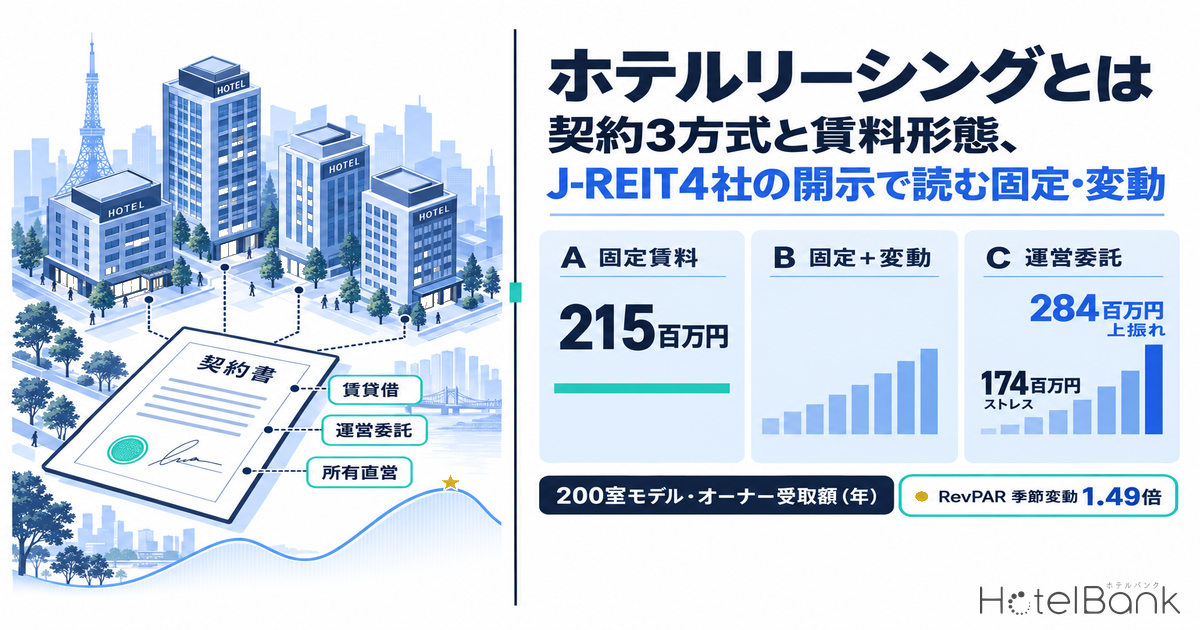
- — At a full-year OCC of 82% for a 200-room model, owner income is ¥215 million under fixed rent, ¥231 million under fixed + variable, and ¥259 million under a management contract
- — In a stress case at 55% full-year OCC, GOP falls to ¥206 million, below the ¥215 million fixed rent, for a rent-to-GOP ratio of 104%. Fixed rent depends on the operator’s ability to pay
- — At GOP margins of 25% and 45%, the maximum annual rent per room is ¥710,000 and ¥1.28 million (1.8x). Comparing proposals requires going back to their GOP-margin assumptions
What Leasing Means for Hotels — Attracting an Operator as the “Tenant” and Structuring the Contract
In real estate generally, leasing refers to the whole process of attracting a tenant to vacant space and signing a lease. For a hotel, the counterparty is a hotel operator acting as a business. Whereas an office tenant uses its floor space for its own business, a hotel operator uses the leased building to sell rooms to the general public and pays rent out of that revenue. The decisive difference is that the source of the rent is not outside the tenant’s core business: it is the room revenue generated in that very building.
Because of this structure, hotel leasing means designing three things at the same time. First, which operator to choose (brand, operating capability, creditworthiness). Second, which contract type to adopt (lease, management contract, or owner-operated). Third, which metric to link the rent to (fixed, revenue-linked, or GOP-linked). These are not independent: the operator’s capacity to invest and its creditworthiness determine the contract type, and the contract type narrows the options for the rent structure.
In addition, if a lease is chosen, the operator becomes a lessee protected by Japan’s Act on Land and Building Leases. The owner’s freedom to terminate mid-term or revise the rent is lower than owners tend to assume. Negotiating leasing terms is better understood as deciding how each side can act when occupancy deteriorates, rather than when business is good.
The Three Contract Types — Lease / Management Contract (MC) / Owner-Operated
Contract structures used for hotel real estate in Japan fall broadly into three types: the lease model, the management contract (MC) model, and the owner-operated model. A franchise (FC) is a licence to use a brand, not a way of deciding who operates the hotel, so this article limits itself to the three types. The decisive difference comes down to one point: where profit and loss end up when lodging demand moves.
| Item | Lease model | Management contract (MC) model | Owner-operated model |
|---|---|---|---|
| Owner’s role | Lessor (property owner) | Hotel business owner (principal) | Both business owner and operator |
| Operator’s role | Lessee (protected by the Act on Land and Building Leases) | Contractor (receives management fees) | — (owner’s own employees) |
| Who books revenue and costs | Operator (owner receives rent only) | Owner (the P&L sits with the owner) | Owner |
| Demand risk | Operator, if rent is fixed / owner shares the variable portion | Borne entirely by the owner | Borne entirely by the owner |
| Share of upside | None with fixed rent / partial via variable rent | Everything after fees | Everything |
| In-house expertise required | Low (mainly rent administration) | Medium (operator oversight, budget approval) | High (down to hiring, sales and cost control) |
| Working capital and FF&E | Working capital: operator / major repairs: owner | Both borne by the owner | Both borne by the owner |
| Disclosure and visibility | May require the operator’s consent | High (monthly P&L reaches the owner) | High |
Source: Prepared by MetroEngines Research & Consulting based on the public disclosures of each investment corporation and industry practice materials
In short, the lease model “gives up the upside in exchange for stable income”, while the management contract model “goes after the upside in exchange for carrying demand risk itself”. Owner-operation takes on the MC risk profile plus the burden of hiring and day-to-day operations. So the question is not which model is better: it is a decision about where to sit, based on three factors — the owner’s cost of capital, holding period, and operating know-how.
An important practical fork is that under a lease, operating figures are not necessarily disclosed to the owner. For example, Mori Trust REIT (森トラストリート投資法人) uses variable rent at 4 of its 6 hotels, yet only its two Courtyard by Marriott properties are covered by monthly OCC, ADR and RevPAR disclosure. Shangri-La Tokyo and Hilton Odawara Resort & Spa, although also on variable rent, disclose only the rent amount, and the two fixed-rent properties disclose no operating results at all. Invincible Investment Corporation (インヴィンシブル投資法人) likewise states for some fixed-rent properties that figures are “not disclosed because the operator’s consent to disclosure has not been obtained”. This follows from the contract design: when rent is fixed, there is little economic need to know the operating figures.
Rent Structures in Practice — Fixed, Variable and GOP-Linked, as Disclosed by Four J-REITs
Rent structures fall into fixed rent, revenue-linked variable rent, GOP-linked variable rent, and hybrids of these. Because hotel J-REITs are built around the lease model, the design of the rent structure feeds directly into distributions to unitholders. As a result, this is the area in Japan where rent schemes are disclosed in the most detail, which makes it the most practical benchmark for owners considering leasing terms. How the share of variable rent and the timing of lease expiries are spread across REIT portfolios can be examined property by property in each REIT’s portfolio disclosures.
| Investment corporation | Disclosed rent scheme | Scope of disclosure and latest results (July 2026) |
|---|---|---|
| Japan Hotel REIT Investment Corporation (ジャパン・ホテル・リート投資法人) | Has introduced variable rent schemes linked to GOP or revenue and management-contract schemes, used alongside fixed-rent schemes. States explicitly that it aims to capture upside while maintaining stability | Monthly disclosure covers the total of “29 hotels with variable rent, etc.”; OCC 83.1% (July 2026) / ADR ¥21,806 / RevPAR ¥18,119 (year on year: OCC +4.0pt, ADR +0.1%, RevPAR +5.1%) |
| Invincible Investment Corporation (インヴィンシブル投資法人) | Fixed rent plus GOP-linked variable rent, which arises when GOP for the calculation period set in each lease (1 or 6 months) exceeds the fixed rent. Some properties are on fixed rent only | Monthly disclosure covers 101 domestic hotels; OCC 86.3% (July 2026) / ADR ¥15,100 / RevPAR ¥13,039 (year on year: OCC +1.9pt, ADR −1.0%, RevPAR +1.2%) |
| Kasumigaseki Hotel REIT Investment Corporation (霞ヶ関ホテルリート投資法人) | 11 of 15 properties are on variable rent linked to hotel revenue plus a minimum guaranteed rent. The 4 recently opened properties are to stay on fixed rent until occupancy stabilises | Monthly operating results are disclosed for 11 of the 15 properties held. The REIT does not publish portfolio totals; a simple average of the 11 disclosed properties gives OCC 75.6% (July 2026) / ADR ¥28,178 / RevPAR ¥21,472 |
| Mori Trust REIT, Inc. (森トラストリート投資法人) | Of 6 hotels, 4 are on variable rent and 2 on fixed rent. Monthly disclosure of operating results is limited to variable-rent properties | Of the 4 variable-rent properties (845 rooms in total), only the two Courtyard properties (482 rooms) have monthly OCC, ADR and RevPAR disclosure. The 2 fixed-rent properties (1,092 rooms) are not disclosed |
Source: Prepared by MetroEngines Research & Consulting from each investment corporation’s monthly operating reports and portfolio disclosures (Mori Trust’s rent type by property from its financial summary for the period ended February 2026, dated 22 April 2026; room counts from its portfolio list)
The design philosophy that emerges from these four examples is shared: fixed rent builds a floor on the downside, and variable rent goes after the upside — a two-tier structure. Kasumigaseki Hotel REIT’s “variable rent plus minimum guaranteed rent” expresses this idea most directly. Because occupancy is hard to predict right after opening, the sponsor supports new hotels with fixed rent, then moves them to variable rent once occupancy has stabilised. It is a template owners can use as-is when thinking about leasing terms for the early years after opening.
Why variable rent is needed becomes clear from the size of seasonal swings in hotel revenue. For the total of the 28 hotels with variable rent, etc. — the unit Japan Hotel REIT used for monthly disclosure up to 2025 (the old definition, including Hilton Tokyo Odaiba) — RevPAR in 2025 ranged from ¥15,216 in January to ¥22,618 in August, a ratio of 1.49x between the lowest and highest months of the year. Ichigo Hotel REIT’s total for its disclosed hotels also spanned ¥7,759 to ¥11,466 in 2025, a gap of 1.48x. Smoothing these swings with a single fixed rent across the year means the operator takes on the entire seasonal risk.
Source: Prepared by MetroEngines Research & Consulting from Japan Hotel REIT’s monthly disclosures (2024 and 2025: total of 28 hotels with variable rent, etc.; 2026: total of 29 hotels). The REIT changed the hotels covered by its disclosure in 2026 (excluding Hilton Tokyo Odaiba and adding Southern Beach Hotel & Resort Okinawa and Hilton Fukuoka Sea Hawk), so the lines for each year are not a same-property year-on-year comparison (on the 29-hotel basis, July 2026 was +5.1% year on year)
How Does Profit Change by Contract Type? — A 200-Room Model
Laying out the terms alone does not give a basis for decisions, so we model how owner income moves when the same hotel is placed under each of the three contract types. The assumptions are as follows. 200 rooms; ADR of ¥12,300, rounded from the actual estimated settled ADR for business hotels in Tokyo (July 2026: ¥12,306 / N=913 properties); ancillary revenue of 10% of room revenue; and a GOP margin of 38%. The GOP margin references the 38.9% GOP result disclosed by Invincible Investment Corporation for its 91 operated properties (fiscal year ended December 2024), set slightly more conservatively.
For rent terms, against GOP of ¥308 million in the base scenario (OCC 82%), Model A (fixed rent) is set at ¥215 million a year, about 70% of that GOP; Model B (fixed + variable hybrid) at ¥154 million fixed plus 50% of GOP above the fixed amount; and Model C (management contract) at a base fee of 3% of total revenue plus an incentive fee of 8% of GOP. All are placeholder terms based on ranges common in practice and do not represent any specific contract. When comparing several management-contract proposals with different fee rates, the consistent approach is to compare them on NOI after fees.
Source: MetroEngines Research & Consulting estimates (200-room model, ADR ¥12,300, GOP margin 38%)
| Scenario | RevPAR | GOP | A Fixed rent | B Fixed + variable | C Management contract |
|---|---|---|---|---|---|
| Stress (full-year OCC 55%) | ¥6,765 | ¥206M | ¥215M | ¥180M | ¥174M |
| Downside (full-year OCC 72%) | ¥8,856 | ¥270M | ¥215M | ¥212M | ¥227M |
| Base (full-year OCC 82%) | ¥10,086 | ¥308M | ¥215M | ¥231M | ¥259M |
| Upside (full-year OCC 90%) | ¥11,070 | ¥338M | ¥215M | ¥246M | ¥284M |
Source: MetroEngines Research & Consulting estimates. ¥M = millions of yen. All owner income figures are before property tax, city planning tax, insurance and FF&E reserves
Three points stand out. First, owner income under fixed rent stays at ¥215 million however demand moves; even when OCC rises to 90%, not a single yen of upside reaches the owner. Second, the hybrid model roughly matches the fixed model even in the downside case at ¥212 million, and rises to ¥246 million in the upside case. It lowers the floor slightly in exchange for removing the cap. Third, the management contract model gives the largest share in the upside case at ¥284 million, but falls to ¥174 million in the stress scenario. Its range of outcomes is far wider than Models A and B.
And it is the stress scenario row that holds the essential issue of the lease model. At a full-year OCC of 55%, GOP shrinks to ¥206 million, below the fixed rent of ¥215 million. This means the operator cannot pay the rent from its operating profit alone. During the COVID-19 pandemic, Invincible Investment Corporation did in fact amend its contracts for properties operated by MyStays Hotel Management, waiving fixed rent and changing the method used to calculate variable rent. Fixed rent is not “money that is guaranteed to come in”; it is merely a claim backed by the operator’s ability to pay. This must always be factored in when considering leasing terms.
The KPIs an Owner Should Examine When Leasing — ADR, OCC, GOP and Rent-Paying Capacity
When evaluating the business plan submitted by a candidate operator, the metrics to examine come down to four: ADR, OCC, GOP margin, and the rent-paying capacity derived from them. The order matters. ADR and OCC are used to test whether the proposal’s assumptions are reasonable, GOP margin measures operating capability, and rent-paying capacity is what ultimately sets the rent terms.
| KPI | What it measures | What to check when leasing |
|---|---|---|
| ADR | Price positioning of the proposed brand | Does it diverge from actual ADR for the same grade in the same market? Does it assume exceeding the market median from the first year after opening? |
| OCC | Ability to capture demand | Check it month by month, not as a full-year average. The level in the slowest months determines whether fixed rent can be paid |
| RevPAR | The combined result of ADR and OCC | Identify whether the proposal is high-ADR/low-OCC or low-ADR/high-OCC. The latter tends to favour rent stability |
| GOP margin | Profitability at the operating level | Does it fall outside typical ranges by property type (limited-service 40–60%, city hotels 10–30%, resorts 20–40%, ryokan 5–15%)? |
| Rent-paying capacity | How much of GOP can go to rent | What percentage of GOP is the fixed rent? Does the ratio stay below 100% even in slow months and stress scenarios? |
Source: Prepared by MetroEngines Research & Consulting. Typical GOP margins by property type are figures published by Relo Hotel Solutions Co., Ltd.
In practice, rent-paying capacity is best captured as the ratio of rent to GOP. In the 200-room model in the previous section, the ¥215 million fixed rent is 70% of GOP at a full-year OCC of 82%, rising to 80% at OCC 72% and 104% at OCC 55%. The higher the ratio, the thinner the operator’s buffer, and the moment demand falls short, the parties end up at the table renegotiating the contract. Put the other way, the number the owner needs to protect is not the absolute rent but whether this ratio stays within an acceptable range across every scenario considered.
The rent level itself is strongly determined by GOP margin. Even at the same ADR and OCC, GOP margin moves widely depending on property type and the operator’s cost control, and that directly moves the maximum rent that can be paid. The chart below shows, for the 200-room model with OCC fixed at 82%, the maximum annual rent per room (with the cap set at 70% of GOP) as only the GOP margin changes.
Source: MetroEngines Research & Consulting estimates (200-room model, ADR ¥12,300, full-year OCC 82%, rent capped at 70% of GOP)
Between GOP margins of 25% and 45%, the maximum annual rent per room differs 1.8-fold, at ¥710,000 versus ¥1.28 million. Differences in the rent offered by candidate operators in leasing negotiations are, in many cases, less about brand strength than about this difference in operating efficiency and how much buffer each operator has built in. Comparing only the headline offers side by side makes the proposal with the most optimistic assumptions look best. It is essential to go back to the GOP-margin assumptions when comparing.
Practical Issues to Settle in the Contract Terms
Even if the rent level is agreed, loosely drafted contract terms will come back to bite in later years. The following five points in particular should be raised explicitly as issues at the early stage of leasing.
First, the basis for calculating variable rent. The nature of the risk the owner bears differs between revenue-linked and GOP-linked rent. Revenue-linked rent leaves cost-fluctuation risk with the operator, whereas under GOP-linked rent, increases in labour and utility costs pass straight through to a reduction in the owner’s rent. In the recent environment of rising labour and energy costs, this difference produces gaps in actual amounts that cannot be ignored. If GOP-linked rent is adopted, the cost items included in the calculation need to be clearly defined in the contract.
Second, setting a minimum guaranteed rent. With variable rent only, the owner’s income can fall without limit in a downturn. The “variable rent plus minimum guaranteed rent” model used by Kasumigaseki Hotel REIT at 11 properties can be seen as the standard answer to this issue.
Third, how the opening period is handled. A newly opened hotel needs a certain period before occupancy stabilises. The same REIT keeps its four recently opened properties on fixed rent until occupancy stabilises. Setting out how the early period will be supported, and when the switch to variable rent will happen, together with objective criteria such as occupancy, makes disputes in later years easier to avoid.
Fourth, a clause on disclosure of operating figures. Under a lease, operating figures may not reach the owner. With variable rent, disclosure is essential as the basis for the calculation, but even with fixed rent there is great value in making at least monthly reporting of OCC, ADR and GOP a contractual obligation — for a future sale, rent revision negotiations, or rebranding decisions.
Fifth, how FF&E reserves and major repairs are shared. A hotel is an asset whose competitiveness depends directly on how dated its guest-room fixtures become, and under a lease it is standard for the owner to bear major repairs. Comparing models on absolute rent alone drops this future spending from view. The correct approach is to put each model on the same footing by comparing rent after deducting FF&E reserves and property and city planning taxes (capital expenditure per room at listed hotel REITs, as disclosed in their IR materials, provides a benchmark for the reserve level).
Summary
Hotel leasing is not about filling space with a tenant; it is about designing how demand risk and profit upside are split between owner and operator. The lease model gives up upside in exchange for stability, and the management contract model takes on demand risk in exchange for upside. Filling the middle ground is the hybrid, which builds a floor with fixed rent while removing the cap with variable rent — and hotel J-REIT disclosures show this model becoming mainstream.
The order of decisions is clear. First, decide how much variability can be tolerated, based on your own cost of capital and holding period. Next, test the candidate operators’ proposals by going back to their ADR, OCC and GOP-margin assumptions. Finally, confirm the ability to pay across every scenario considered, using the ratio of rent to GOP rather than the absolute rent. Following these three steps avoids decisions pulled along by the size of the rent on offer.
References and Sources
■ Data sources
Monthly disclosures of each investment corporation (Japan Hotel REIT Investment Corporation, total of 29 hotels with variable rent, etc., July 2026; Invincible Investment Corporation, 101 domestic hotels, July 2026; Kasumigaseki Hotel REIT Investment Corporation, 11 disclosed properties, July 2026), each company’s portfolio and financial disclosures, and MetroEngines Research & Consulting’s estimated settled ADR (Tokyo, business hotels, July 2026, N=913 properties).
■ Model assumptions
200 rooms, ADR ¥12,300, 365 days a year, ancillary revenue 10% of room revenue, GOP margin 38%. Four scenarios for full-year average OCC: 55% / 72% / 82% / 90%. Model A: fixed rent of ¥215 million a year. Model B: ¥154 million fixed plus 50% of GOP above the fixed amount. Model C: base fee of 3% of total revenue and incentive fee of 8% of GOP. Maximum rent per room calculated as 70% of GOP.
■ Limitations and caveats
Rent terms and fee rates are placeholders based on ranges common in practice and do not represent any specific contract. Owner income is before property tax, city planning tax, insurance and FF&E reserves. REIT monthly figures are unaudited, and the range of properties covered differs by investment corporation, so side-by-side comparisons are for reference only. Japan Hotel REIT figures for 2025 and earlier are totals for 28 hotels and are not on the same-property basis as the 2026 total for 29 hotels. Estimated settled ADR is an estimate and differs from actual settled prices.
■ Market data
- MetroEngines Research & Consulting — Estimated settled ADR (Tokyo, business hotels, July 2026, N=913 properties); owner income model by contract type
■ REIT disclosures (Japanese)
- Japan Hotel REIT Investment Corporation, “Investment Policy and Growth Strategy” / monthly disclosure (total of 29 hotels with variable rent, etc., July 2026)
- Invincible Investment Corporation, “Hotel Operating Results” / monthly operating status (101 domestic hotels, July 2026)
- Kasumigaseki Hotel REIT Investment Corporation, “Portfolio Summary”
- Mori Trust REIT, “Portfolio List” (room counts) / Financial summary for the period ended February 2026 (rent type by property) / Hotel Operating Results (scope of monthly disclosure)
- Ichigo Hotel REIT Investment Corporation, IR Library / monthly operating status (entire portfolio, July 2026)
■ Industry materials and press (Japanese)
- Japan Securities Journal (日本証券新聞), “New Listing: Kasumigaseki Hotel REIT Investment Corporation” (breakdown of rent schemes)
- Relo Hotel Solutions Co., Ltd., “What Is GOP? A Key Metric for Hotel and Ryokan Profit” (typical GOP margins by property type)
- Sogo Unicom, “The Essence of Hotel Management Contracts” (practical overview of contract types)
- Airstair, “Invincible Investment Corporation waives fixed rent payments” (example of rent relief)
- JLL, “Japan Hotel Investment Market 2025”