

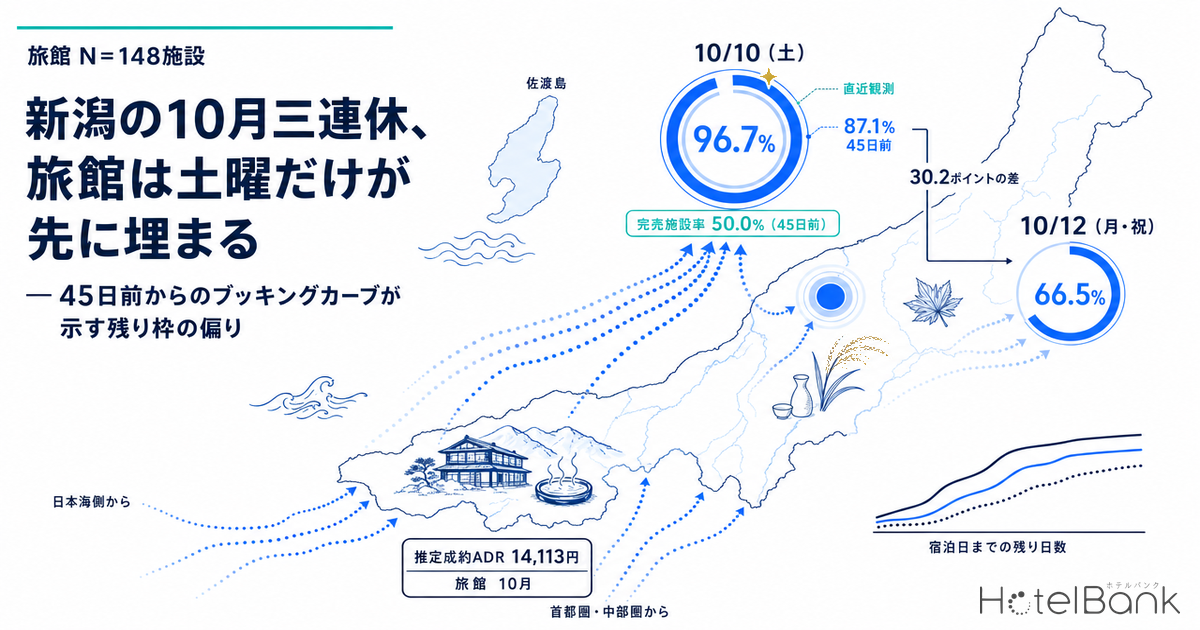
We tracked booking progress for the October 10 (Sat) – October 12 (Mon, public holiday) 2026 three-day weekend across ryokan, business hotels and resort hotels in Niigata Prefecture, using observations from 45 days before the stay date through the latest reading. For ryokan (148 properties, 3,483 rooms), estimated OCC on the Saturday was already 87.1% at 45 days out and reached 96.7% at the latest observation (25 days out). The holiday Monday on the 12th, by contrast, moved only from 58.7% at 45 days out to 66.5% at the latest observation (27 days out), leaving a 30.2-point gap within the same long weekend. Demand for the holiday is not spread over “three days” — it is concentrated on the Saturday, with rooms left over on the Sunday and the holiday itself.
Coverage: ryokan in Niigata Prefecture (N=148 properties, 3,483 rooms), business hotels (N=49 properties, 5,876 rooms) and resort hotels (N=15 properties, 2,631 rooms), all based on listings on major booking sites. The price metric in this article is settled ADR (the estimated level of transacted room rates derived from OTA and other sales data, tax-excluded equivalent); occupancy is an estimate based on OTA-listed inventory. Both are defined at the end of the article. Data as of September 16, 2026.
- — Estimated OCC 87.1%, sold-out property rate 50.0%: this is where Niigata ryokan (N=148 properties) stood for Saturday, October 10, 2026, at 45 days out — 13.7 to 18.7 points higher than on ordinary Saturdays (Oct 3 and Oct 17).
- — A 30.2-point gap: at the latest observation on September 15, 2026, the Saturday was at 96.7% while the holiday Monday (Oct 12) was at 66.5%. The sold-out property rate for the 12th barely moved, from 14.9% at 45 days out to 15.5% at the latest reading.
- — ¥14,113: the current estimate of October 2026 settled ADR for Niigata ryokan (N=233 properties). The settled figure for August was ¥15,618, down 3.0% year on year. On the Saturday the question is rate; on the holiday Monday it is volume.
The ryokan curve — half of all properties were sold out for Saturday at 45 days out
Start with the ryokan booking curve. For October 10 (Sat), estimated OCC was already 87.1% and the sold-out property rate 50.0% at the 45-day observation. In other words, when observation began, exactly half of the 148 properties had no listed inventory visible on OTAs and other channels. From there the figures rose to 94.2% and 68.2% at 30 days out, and to 96.7% and 76.4% at the latest observation (25 days out). The gain from 45 days out to the latest reading was +9.6 points in estimated OCC and +26.4 points in the sold-out property rate.
October 11 (Sun) went from 79.4% (32.4% sold out) at 45 days out to 88.6% (53.4% sold out) at the latest observation (26 days out). The +9.2-point gain is almost the same as Saturday’s, but the absolute level is 8.1 points lower. October 12 (Mon, holiday) went from 58.7% (14.9% sold out) at 45 days out to 66.5% (15.5% sold out) at the latest observation (27 days out) — a gain of +7.8 points, with the sold-out property rate hardly moving at all within this observation window.
Source: MetroEngines Research; compiled by the HotelBank Editorial Team
The three lines are already separated at 45 days before the stay date and never cross in subsequent observations. At least within this observation window, there is no sign of the middle day or the final day of the holiday catching up with the Saturday. For ryokan running a half-board (dinner-and-breakfast) operation, Saturday and the holiday Monday place entirely different loads on purchasing, kitchen and service staffing. A pattern in which Saturday is close to full, Sunday sits in the high 80s and the holiday itself stays in the 60s is awkward to handle from a staffing perspective as well.
Sold-out property rate — where the remaining upside lies
Estimated OCC shows how much of the inventory has been absorbed, but the sold-out property rate shows more clearly how many individual properties have sold out. For ryokan, the sold-out property rate for October 10 (Sat) built up by 26.4 points, from 50.0% at 45 days out to 76.4% at the latest reading, whereas October 11 (Sun) moved from 32.4% to 53.4% (+21.0 points) and October 12 (Mon, holiday) only from 14.9% to 15.5% (+0.6 points).
Source: MetroEngines Research; compiled by the HotelBank Editorial Team
Two things can be read from this. First, Saturday demand had already entered the “fully captured” phase at 45 days out, so for this date the revenue question has shifted from volume to rate. Second, inventory for the holiday Monday effectively did not move from 45 days out through the latest reading, so the remaining rooms are something to be actively worked, not something to wait on until they disappear on their own.
| Category (N) | Stay date | 45 days out OCC / sold-out | 30 days out OCC / sold-out | Latest OCC / sold-out |
|---|---|---|---|---|
| Ryokan (148 properties) | Oct 10 (Sat) | 87.1% / 50.0% | 94.2% / 68.2% | 96.7% / 76.4% |
| Ryokan (148 properties) | Oct 11 (Sun) | 79.4% / 32.4% | 87.2% / 49.3% | 88.6% / 53.4% |
| Ryokan (148 properties) | Oct 12 (Mon, holiday) | 58.7% / 14.9% | 65.0% / 16.2% | 66.5% / 15.5% |
| Business hotels (49 properties) | Oct 10 (Sat) | 93.6% / 69.4% | 96.1% / 83.7% | 97.1% / 81.6% |
| Business hotels (48 properties) | Oct 11 (Sun) | 91.2% / 54.2% | 94.4% / 60.4% | 94.6% / 60.4% |
| Business hotels (49 properties) | Oct 12 (Mon, holiday) | 50.6% / 4.2% | 52.3% / 6.1% | 54.2% / 6.1% |
| Resort hotels (15 properties) | Oct 10 (Sat) | 70.0% / 40.0% | 76.9% / 26.7% | 78.9% / 26.7% |
| Resort hotels (15 properties) | Oct 12 (Mon, holiday) | 59.8% / 13.3% | 62.8% / 6.7% | 63.3% / 6.7% |
The latest observation is 25 days before the stay date for Oct 10, 26 days for Oct 11 and 27 days for Oct 12 (all observed on September 15, 2026). Note that the resort hotel sample is small at 15 properties, so a single property moves the sold-out property rate by 6.7 points. Source: MetroEngines Research; compiled by the HotelBank Editorial Team
The shape also differs by category. Business hotels (49 properties, 5,876 rooms) were already high on the Saturday at 45 days out, at 93.6% with 69.4% sold out, reaching 97.1% and 81.6% at the latest reading. Their gain from 45 days out to the latest reading was only +3.5 points, clearly smaller than the +9.6 points for ryokan. They sell out even earlier than ryokan, yet on the holiday Monday they moved only from 50.6% at 45 days out to 54.2% at the latest reading, with a sold-out property rate of 6.1% — so the spread across the three days (42.9 points at the latest reading) is wider than for ryokan.
How special is this long weekend compared with an ordinary weekend?
To assess the level of the long weekend, it has to be set against ordinary weekends in the same October. For ryokan, October 3 (Sat) stood at 68.4% (20.3% sold out) at 45 days out, and October 17 (Sat) at 73.4% (21.6% sold out). The first day of the long weekend, October 10 (Sat), was at 87.1% (50.0% sold out) at 45 days out, meaning it started 13.7 to 18.7 points higher in estimated OCC and 28.4 to 29.7 points higher in sold-out property rate than an ordinary Saturday.
Conversely, the holiday Monday, October 12, was at 58.7% at 45 days out — actually below the 61.1% for October 4, an ordinary Sunday. At the latest observation, the 12th was at 66.5% versus 73.5% for October 4 (19 days out): the last day of the long weekend is tracking as “a weaker day than an ordinary Sunday.” Setting aggressive rates across the whole long weekend as a block would therefore leave business on the table on the final day.
A yardstick for rate — where does Niigata’s settled ADR stand?
To move the Saturday discussion from volume to rate, we check monthly settled ADR. For Niigata ryokan, August 2026 — the most recent month that can be compared on a settled-to-settled basis — came in at ¥15,618 (N=241 properties), 3.0% below the ¥16,106 (N=239 properties) of the same month a year earlier. Across the settled months from January to August, January rose sharply at +13.1% year on year, while April (−4.0%), July (−2.4%) and August (−3.0%) show that it is the busier months that have tended to fall below the prior year.
Figures for September–December 2026 are estimates based on current sales and may change. Source: MetroEngines Research; compiled by the HotelBank Editorial Team
For October 2026, Niigata ryokan are currently estimated at ¥14,113 (N=233 properties) based on sales to date. The settled figure for October last year was ¥13,258 (N=236 properties), but a settled figure and a current estimate cannot be compared directly, so the actual outcome will only be known once the month is settled. The figure is best used as a yardstick for “the level at which the market is currently expected to sell.” Business hotels came in at ¥8,383 (N=126 properties) in August 2026, up 5.4% from ¥7,956 (N=127 properties) a year earlier, and are currently estimated at ¥9,771 (N=118 properties) for October. For background on how rates have moved by category in Niigata Prefecture, see our analysis Niigata Settled ADR H1 2026: Business +10.8% in June, City −7.6%.
A day like the first day of this long weekend, where half of all properties were sold out at 45 days out, reflects a price band the market accepted — but it is also a day on which to test whether rooms could have been sold at a higher rate. For these three days, the question on the 10th is rate, on the 11th both rate and volume, and on the 12th volume.
For revenue managers running ryokan and business hotels in Niigata — implications and an action plan
(1) Judge the Saturday by “when it filled,” not “whether it filled.” In the ryokan market, October 10 reached a 50.0% sold-out property rate at 45 days out. If your own property was close to full at the same point, that may mean your rates were not keeping pace with the market on a high-demand date. For the first day of the same long weekend in future years, keep a record of how many days out, and at what price band, you filled.
(2) Treat inventory on the holiday itself as “not going to move if you wait.” For ryokan, the sold-out property rate for October 12 was essentially flat, at 14.9% at 45 days out and 15.5% at the latest reading. With inventory sitting unsold across the whole market, your own remaining rooms are unlikely to be absorbed naturally either. There is room to rethink how you present the final day to match how it is actually used — for example, packages built around consecutive-night stays, check-out times and guests’ journey home.
(3) Overlay your own curve on the market curve and look at which way it diverges. The market ran from 87.1% at 45 days out to 96.7% at the latest reading for the 10th, and from 58.7% to 66.5% for the 12th. If your booking pace across the three days has the same shape, you are in line with the market. If only the Saturday lags the market, look at your visibility and how you release inventory; if only the holiday Monday runs ahead of the market, your rate may be weaker than the market’s.
(4) With half-board, volume and cost of sales are directly linked. The 30.2-point gap between 96.7% on the Saturday and 66.5% on the holiday Monday directly shapes how purchasing, food preparation and staffing are allocated over the three days. Design volume-moving measures (stronger sales for the final day) separately from measures that do not add cost (Saturday rates).
| Horizon | Action | Trigger (tied to figures in this article) | Aim |
|---|---|---|---|
| This week (about 3 weeks before the stay date) | Check remaining rooms for Oct 12 (Mon, holiday) and rethink how the final day is presented when sold on its own | The market’s holiday Monday is flat at 66.5% estimated OCC and a 15.5% sold-out property rate | Avoid relying on last-minute demand for unsold inventory |
| This week | If your remaining rooms for Oct 10 (Sat) are few, recheck the rates on the remaining room types | The market’s Saturday has reached 96.7% (76.4% sold out) at the latest observation | Don’t let the last few rooms go cheap |
| Within 2 weeks (by T-14) | Capture Oct 11 (Sun) as “the extra night after Saturday” through multi-night booking paths | Sunday’s sold-out property rate is 53.4%, 23.0 points below Saturday’s 76.4% | Build volume on the middle day |
| Within 2 weeks | Take stock of meal options for the holiday itself (lighter dinner, later departure) | The holiday Monday, at 66.5%, is below an ordinary Sunday (Oct 4, 73.5% at the latest reading) | Give guests a reason to choose you without raising costs |
| Looking ahead to next month | Review your actual October rates against the market’s settled ADR level | Current October estimates: ¥14,113 for ryokan, ¥9,771 for business hotels | Use as the basis for initial rate settings for the next long weekend |
| Looking ahead to next month | Switch to designing long weekends as three separate days — first day, middle day and final day | Within the same long weekend, estimated OCC at 45 days out differs by 28.4 points | Avoid lost revenue from blanket rate settings |
Source: MetroEngines Research; compiled by the HotelBank Editorial Team
Summary — three yardsticks for measuring a long weekend
First, how early the first day fills. Niigata ryokan had reached a 50.0% sold-out property rate for October 10 (Sat) at 45 days out. A day that fills early should be judged on rate, not volume.
Second, the gain within the observation window. The rise in estimated OCC from 45 days out to the latest reading was +9.6 points on Saturday, +9.2 points on Sunday and +7.8 points on the holiday Monday for ryokan, and +3.4 to +3.6 points for business hotels. Where the gain is small, there is also little room to count on late organic pickup.
Third, the difference from an ordinary weekend. The first day of the long weekend was 13.7 to 18.7 points higher than ordinary Saturdays at 45 days out, while the final day was below an ordinary Sunday. The assumption that every day of a long weekend is strong does not hold in this data. These three yardsticks apply directly to planning for the next long weekend and for the year-end and New Year period.
About the data
• Definition of estimated OCC (based on OTA-listed inventory): OTA-listed-inventory occupancy = 100 − 100 × OTA-listed rooms remaining ÷ total rooms. The sample is a fixed cohort (the same set of properties for each stay date) of properties that list at least 30% of their total rooms on OTAs. It is an estimate based on how inventory sold on OTAs is being absorbed and is defined differently from actual room occupancy (rooms not listed are counted on the absorbed side, so it reads higher).
• Booking curves: based on observations from 45 days before the stay date through the latest reading. The stay month covered in this article is October 2026; observations ran from August 26 to September 15, 2026.
• Sold-out property rate: the share of properties in the cohort for which no listed inventory can be found on OTAs and other channels for the stay date in question (estimate).
• Definition of settled ADR: the estimated level of transacted room rates (tax-excluded equivalent), derived from OTA and other sales data (lowest-plan rate level × category-specific factor, ensembled across multiple channels). Past months are settled figures; current and future months are estimates based on sales to date. Median error against published operating results is 6.6%.
• Breakdown of N: booking curves cover Niigata Prefecture ryokan (148 properties, 3,483 rooms), business hotels (49 properties, 5,876 rooms; 48 properties and 5,868 rooms for October 11 only) and resort hotels (15 properties, 2,631 rooms), all fixed cohorts based on listings on major booking sites. Settled ADR covers 188–253 ryokan and 106–135 business hotels per month in Niigata Prefecture.
• Data as of September 16, 2026. Sales and inventory change daily, so the figures in this article are a snapshot as of the time of retrieval.