

The Reiwa 8 Kumamoto Earthquake struck at 16:27 on July 28, 2026 (JMA magnitude 7.1, with a maximum seismic intensity of 7 recorded in Uki City and Hikawa Town). In response, Kumamoto Prefecture began accepting applications on August 3 for “hotel evacuation” (secondary evacuation) into hotels and ryokan. For accommodation operators, this means providing guest rooms under a framework quite different from ordinary room sales. This article sets out what public funds cover, where the line falls between public funding and the guest’s own expense, how billing and on-site operations work, and what can be prepared in peacetime — all based on primary sources from the Cabinet Office and Kumamoto Prefecture.
Metric Definitions Used in This Article
- ADR (average daily rate): An estimated settled rate (tax-exclusive equivalent) calculated by applying property-type correction coefficients to the lowest listed plan level each property publishes on OTAs and similar channels (double occupancy, per room, tax included). Cross-checked against property-level results disclosed by listed hotel REITs (91 properties, most recent three months), the median error is about 7%. These are estimates and differ from each property’s actual transaction prices and accounting figures. Area-level ADR is the median across the covered properties (the level of a typical property in the area).
- Occupancy rate (OTA-listed-inventory basis, estimated): The share of rooms sold against the total room count in the area (an estimate based on OTA sales inventory). It is an estimate based on how inventory listed on OTAs is absorbed, and differs from a property’s overall actual occupancy.
- Data source: MetroEngines Research (Kumamoto Prefecture, 523 properties / 21,559 rooms covered, based on listings on major booking sites)
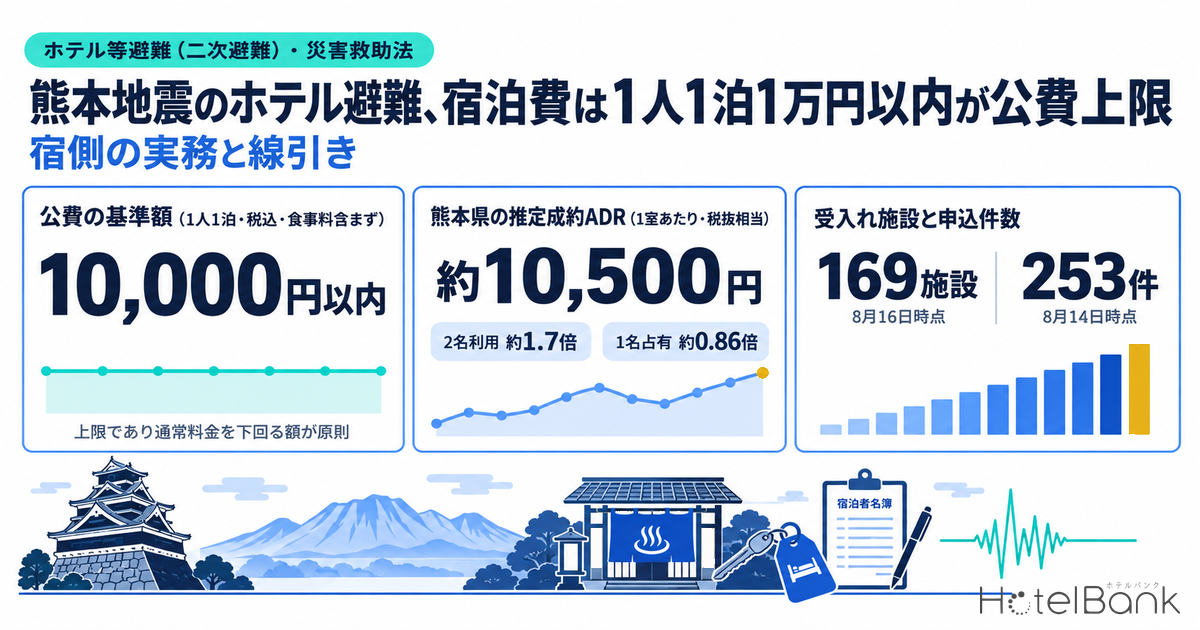
- — Within ¥10,000 including tax per person per night (excluding meal charges; as of FY2025) is the standard amount covered by public funds. It is a ceiling, and the stated principle is to handle it at an amount below the property’s ordinary rate.
- — Converted to a per-room basis, that is about 1.7× Kumamoto’s estimated settled ADR (about ¥10,500) at double occupancy, and about 0.86× at single occupancy. How the room is used changes per-room revenue substantially.
- — Public funds cover only the number of people and nights actually used. Vacant rooms and cancellation fees are excluded, and the daily record of guests in house is the basis for billing.
- — Kumamoto Prefecture lined up 169 receiving properties (as of August 16), and 253 applications had been matched to suitable conditions (as of August 14). Only 27 are in the south of the prefecture, and distance is proving to be a barrier.
- — The four things to settle in peacetime are capacity, period, rates, and what the property cannot do. Agreements stay effective through periodic checks of contact points and procedures.
What Is Happening Now — The Framework of Hotel Evacuation
According to the “Guide to Hotel Evacuation” published by the Kumamoto Prefecture Tourism Promotion Division (updated August 16, 2026), the scheme is open to “persons affected by the disaster who wish to evacuate to a hotel or similar facility” — specifically, those living in or evacuated from Kumamoto City, Yatsushiro City, Uto City, Uki City, Hikawa Town, Misato Town, Kosa Town, Mifune Town, Kashima Town and Mashiki Town. The destinations are “hotels and similar facilities secured by the national government and Kumamoto Prefecture,” and on costs the guide states explicitly that “accommodation costs are in principle borne by public funds. Meal costs and similar are borne by the guest.”
The legal basis for this framework is the Disaster Relief Act. Hotels, ryokan and similar facilities are used as evacuation shelters as one form of the “provision of evacuation shelters” under that Act. From the operator’s point of view, then, the counterparty is not the individual evacuee but the prefecture (or the relief-implementing city) that carries out the relief. The Cabinet Office (Disaster Management) “Guidelines for Using Hotels, Ryokan and Similar Facilities as Evacuation Shelters in Times of Disaster” set out this concept of the implementing body, and then list the situations in which use of hotels and ryokan is envisaged: where shelters are quantitatively insufficient relative to the total number of evacuees, where evacuation life is expected to be prolonged, and where shelters do not offer a good living environment — for example, where heating and cooling are not installed.
It is worth fixing the scale in mind. According to the Kumamoto Nichinichi Shimbun (distributed August 17, 2026), as of August 16 there were 3,121 people evacuated across 71 shelters in 11 municipalities in the prefecture, and Kumamoto Prefecture had lined up 169 accommodation properties. However, “only 27 secondary evacuation facilities are in the south of the prefecture; the remaining 142 are scattered across Kumamoto City and the north of the prefecture.” Of the 1,166 applications received as of the 14th, the prefecture had made contact on 1,136, and conditions at an evacuation destination matched for 253, with 500 still being coordinated and 159 withdrawn. Reasons given on the evacuee side include “if I evacuate somewhere far away, I will not be able to clean up my house” and “I will not be able to get to my medical appointments.”
Conditions on the receiving side were shifting at the same time. According to Kanko Keizai Shimbun (August 10, 2026), of the 420 member properties of the Kumamoto Prefecture Ryokan and Hotel Life-Sanitation Business Association, 29 were closed and seven were partially operating as of August 3, and cancellations received between July 28 and 31 came to roughly 65,500 person-nights, worth about ¥900 million. The association has a disaster agreement with Kumamoto Prefecture and was reported to have secured 114 ryokan and hotels, centered on Yatsushiro, Minamata-Ashikita and Hitoyoshi-Kuma. Operators had to work through damage checks on their own properties and the rebooking of reservations while, at the same time, answering whether they could accept evacuees. How the properties that officially announced closures immediately after the quake diverge from the change visible in accommodation inventory data is set out in Kumamoto Quake 2026, 72 Hours On: 6 Closures vs 17.9% Inventory Loss.
The record of the 2024 Noto Peninsula Earthquake is a useful reference. The Cabinet Office guidelines note that “the number of evacuees reached a maximum of approximately 50,000” and that “a maximum of approximately 5,000 people lived as evacuees in hotels, ryokan and similar facilities.” Hotels and ryokan therefore carried on the order of one-tenth of all evacuees; they contributed to easing congestion at shelters and to encouraging evacuation from isolated communities, while the review also concluded that there was confusion over matching and transport in the early stages. In Kumamoto too, matching applications to receiving conditions has become the first hurdle — the same pattern.
The Standard Amount Is Within ¥10,000 per Person-Night — How Far That Sits From Normal Per-Room Rates
What operators most want to know is the basis for the amount. The Cabinet Office guidelines state that the expenditure available under the Disaster Relief Act for the use of hotels, ryokan and similar facilities is, “as of FY2025 (Reiwa 7), an actual cost within a standard amount of ¥10,000 including tax per person per night (excluding meal charges).” What matters here is that this is per person per night, not per room, and that it excludes meal charges. The guidelines also caution, in the following terms, that this is not an invitation simply to bill that amount.
“It is not intended to require the provision of all the services normally offered by hotels, ryokan and similar facilities; because the principle is that what is received is primarily the provision of space as an evacuation shelter, the arrangement is to be handled at an amount below the ordinary rate of the hotel or ryokan concerned.”
“The costs required for relief cover the number of people and nights actually used”; “in cases such as a whole-building rental, anything beyond the number of people and nights actually used is not covered, and compensation for cancellation fees is not covered either.”
As benchmarks for balance where disaster-time rates are set in an agreement, two references are given: “the lowest accommodation rate listed on booking sites and similar channels for the same period in normal times” and “the average accommodation rate in the previous fiscal year’s low season.”
Source: Cabinet Office (Disaster Management), “Guidelines for Using Hotels, Ryokan and Similar Facilities as Evacuation Shelters in Times of Disaster”
In other words, ¥10,000 is a ceiling, not a target level. The landing point envisaged in practice is “an amount below the ordinary rate” and somewhere near “the average accommodation rate in the low season.” So where does Kumamoto’s normal-period level sit?
■ Calculation assumptions
- Public funding standard amount: within ¥10,000 including tax per person per night (excluding meal charges). The amount the Cabinet Office guidelines present as being “as of FY2025 (Reiwa 7).”
- Converted to a per-room basis: ¥20,000 including tax per room-night where two people share a room (about ¥18,200 tax-exclusive equivalent); ¥10,000 including tax per room-night where one person occupies a room (about ¥9,100 tax-exclusive equivalent).
- Comparison basis: Kumamoto Prefecture’s estimated settled ADR (12-month average, September 2025 to August 2026) = about ¥10,500 per room-night (tax-exclusive equivalent, double-occupancy basis, N=366–404 properties).
- Both are comparisons of ceiling against ceiling; the amount actually paid is decided in consultation between the municipality and the property. The setting of special standards, and differences by region and season, are not taken into account.
Lined up on these assumptions, the standard ceiling where two people share a room (about ¥18,200 tax-exclusive equivalent) works out at about 1.7× Kumamoto’s normal-period per-room rate (about ¥10,500). The ceiling where one person occupies a room (about ¥9,100 tax-exclusive equivalent), by contrast, is about 0.86× — slightly below the normal-period per-room rate. Even set against the lowest-rate month of the year (June 2026, about ¥9,000 per room-night), the single-occupancy ceiling is at roughly the same level.
Two things follow. First, because the standard amount accumulates by number of people × number of nights, per-room revenue changes substantially depending on whether shared rooms and family-unit stays are the norm. Second, where the pattern is mostly single evacuees occupying a room each, then even billing at the full ceiling leaves per-room revenue at about the same level as an ordinary low-season rate. Accepting publicly funded evacuees is not a scheme designed to displace normal-period sales and raise revenue; it is closer to the reality to understand it as a social function that fills a quantitative shortfall in shelter capacity.
Source: MetroEngines Research; compiled by the HotelBank Editorial Team (Kumamoto Prefecture, estimated settled ADR, N=366–404 properties)
Kumamoto’s estimated settled ADR has moved broadly in a ¥9,000–¥12,000 range since 2025. Seasonally, November to January runs somewhat higher and June is the lowest. August 2026 was about ¥10,800, 5.0% below the same month a year earlier (about ¥11,400). From late July into August, immediately after the earthquake, inventory returning through cancellations coincided with demand of a kind not normally present — people engaged in the disaster response, and the acceptance of evacuees — so movements in rate and occupancy over that window cannot be read as normal-time supply and demand.
Where the Line Falls — Period, Coverage and Out-of-Pocket Costs
Next, how far public funds reach and where the evacuee’s own expense begins. Cross-reading Kumamoto Prefecture’s guide, the Cabinet Office guidelines and the general standards of the Disaster Relief Act, the line falls as set out in the table below.
| Item | Treatment | Basis and notes |
|---|---|---|
| Accommodation cost | In principle public funds | Kumamoto Prefecture: “accommodation costs are in principle borne by public funds.” The standard amount is within ¥10,000 including tax per person per night (as of FY2025) |
| Meal charges | Not included in the accommodation standard amount | Kumamoto’s guide states “meal costs and similar are borne by the guest” and “meals are in principle to be procured by the guest.” Where a municipality provides meal support, it sits in a separate budget line (see below) |
| Accommodation tax / bathing tax | Out of pocket | Kosa Town’s guide (updated August 10, 2026) states explicitly that “meal costs, accommodation tax, bathing tax and similar are borne by the guest.” Kumamoto City introduced an accommodation tax (a flat ¥200 per person per night) for stays from July 1, 2026 |
| Parking fees | Out of pocket | Kumamoto Prefecture: “where parking fees arise, they are borne by the guest.” The guidelines likewise place municipal leasing of parking for evacuees outside the scope |
| Local transport during the stay | Out of pocket | Kumamoto Prefecture: “transport costs in the area around the hotel during the stay are also borne by the guest.” Travel between the shelter and the receiving property, however, is covered by relief |
| Lavish meals and alcohol | Not covered | The guidelines state that these are “naturally outside the scope of support, and are to be kept within what is socially acceptable” |
| Pet accommodation charges and food | Not covered | Guidelines: “under the Disaster Relief Act, pet accommodation charges, pet food and similar are not covered” |
| Cancellation fees and vacant rooms | Not covered | “The number of people and nights actually used is what is covered.” Even with a whole-building rental, the unused portion is not covered |
| Period of use | Until the shelter closes, within the period the property can accept guests | Kumamoto Prefecture: “for the period until the shelter in your municipality of residence closes, within the period each hotel or similar facility is able to accept guests” |
Source: Kumamoto Prefecture, “Guide to Hotel Evacuation” (updated August 16, 2026); Kosa Town, “Guide to Hotel Evacuation for Those Affected by the Reiwa 8 Kumamoto Earthquake” (updated August 10, 2026); Cabinet Office (Disaster Management) guidelines; Kumamoto City, “Introduction of the Accommodation Tax”; compiled by the HotelBank Editorial Team
The relief period is also worth pinning down. Under the general standards in the Cabinet Office’s “Outline of the Disaster Relief Act (June 2026),” the establishment of evacuation shelters runs “within seven days from the day the disaster occurs,” with a cost limit of “within ¥370 per person per day.” The provision of food through communal cooking and similar means is “within ¥1,480 per person per day,” and here too the relief period is seven days from the day the disaster occurs. That same document makes clear, however, that these are items for which special standards can be set, and in actual large-scale disasters it is standard practice for the prefecture to extend the period after consulting the Cabinet Office. Rather than reading this as “it ends in seven days,” operators should understand that the period may be extended, but that the extension is a matter for the municipality and the national government to settle, not something the property can decide.
On meals, there are two routes. The guidelines list three ways of supporting meals — “provided by the hotel or ryokan,” “boxed meals arranged by the municipality and distributed,” and “requesting communal cooking support from NPOs and similar bodies” — and state that how many meals a day are provided is “to be coordinated with the receiving property.” Because Kumamoto’s guide on this occasion says “meals are in principle to be procured by the guest,” a property that takes the form of providing meals needs to agree that individually and in advance with the prefecture and the municipality.
Billing Flow and On-Site Practice — Five Touchpoints for the Front Desk
Because payment is made by the municipality rather than by the individual evacuee, the basis for settlement comes down to a record of who stayed, for how many nights, and whether they actually stayed. Given that the guidelines repeatedly state that “the number of people and nights actually used is what is covered,” keeping track of the daily in-house headcount is the lifeline of billing. Alongside this, the Cabinet Office may require the submission of reporting forms on the status of evacuees on a regular basis (weekly, for example), so data needs to be held at a granularity that can answer inquiries from the municipality.
| Stage | What the property needs to cover |
|---|---|
| Acceptance decision | The practice is for the municipality to issue a “notice of decision” to the eligible evacuee, together with the “rules on use.” The property should check that the content of the list of available receiving properties finalized by the municipality (capacity, period, whether meals can be provided) matches its own registered details |
| Check-in | Manage these separately from ordinary reservations and confirm whether a notice of decision exists. The evacuee list is a mechanism created and shared by the municipality, so rather than the property compiling its own roster, the operation works by matching against the shared list |
| During the stay | Record the in-house headcount daily. Municipal staff, public health nurses and others make rounds, and health, medical and welfare bodies under contract also visit, so front-desk staff must be thoroughly briefed. Guest-room visits are coordinated with the municipality in advance |
| Inquiries from outside | Contact asking whether a particular evacuee is staying is designed to be handled centrally by the municipality. Set a rule in advance that where an inquiry is directed at an employee, the caller is referred to the municipal contact point |
| Departure | The practice indicated is for the front desk to pass on a “departure notification” so that information on the planned departure date and destination reaches the municipal officer in charge. Because the number of meals provided has to be adjusted, setting an advance rule such as “submit the departure notification by two days before departure” is recommended |
Source: Cabinet Office (Disaster Management), “Guidelines for Using Hotels, Ryokan and Similar Facilities as Evacuation Shelters in Times of Disaster”; compiled by the HotelBank Editorial Team
The line operators should draw for themselves is also spelled out in the guidelines. What staff can be asked to do is limited to general tasks relating to use of the facility, and to what does not interfere with ordinary operations: “cooperating with the setting up of notice boards and consultation desks in the entrance, providing parking free of charge, distributing leaflets and similar materials, passing documents to and from the municipality, guiding guests to communal baths, explaining how to use guest-room equipment, and assisting public health nurses and others visiting individual guest rooms.” By contrast, “physical nursing care of evacuees, handling inquiries from outside including from family members, shopping on evacuees’ behalf, and contacting the municipality on their behalf” are given as examples of what hotels, ryokan and similar facilities cannot handle. Kumamoto’s guide likewise tells users that “there are no direct nursing or care services inside the hotel.” Confirming this scope in writing in advance is the single biggest lever for containing the burden on the front line if the stay is prolonged.
On preparing for a prolonged stay, maintaining the quality of meals is also an issue. The Cabinet Office’s general standards list among the points to note that “where communal cooking at shelters and similar sites becomes prolonged, consideration should be given to securing quality — as far as possible diversifying menus, serving food at an appropriate temperature, and securing nutritional balance.” In a case from Atami City, Shizuoka Prefecture, cited in the guidelines, a dietitian created panels setting out “recommended ways to serve yourself” for the buffet-style meals offered at a hotel being used as a shelter, displayed them in the dining area and provided nutritional guidance. Where a property takes the form of providing meals, there is room to consult the municipality about working with professionals of this kind.
Source: MetroEngines Research; compiled by the HotelBank Editorial Team (Kumamoto Prefecture, May–August 2026; the number of properties covered varies by month — 269–312 across all types, 59–62 business hotels, 14–15 city hotels, 13–17 resorts, 112–155 ryokan)
To think about the headroom on the receiving side, it is worth looking at how inventory is being absorbed within Kumamoto. On MetroEngines Research’s estimated occupancy, the all-property average for June 2026 was 77.5%, the lowest of the four months from May to August, while August rose to 89.6%. By property type, August business hotels were at 95.4% and city hotels at 95.1% — high levels — while ryokan were at 78.7% and resorts at 76.8%, a widening gap. As noted above, 142 of the 169 receiving properties are scattered across Kumamoto City and the north of the prefecture. Kumamoto City and the north are areas with thick business demand even in normal times, so the receiving capacity for secondary evacuation is structurally sharing the same inventory pool as ordinary demand. Put the other way round, the fact that receiving capacity in the south of the prefecture stops at 27 properties connects directly to what evacuees are saying — that they cannot clean up their houses, that they cannot get to their medical appointments. Distance is an element of geography that operators’ willingness alone cannot close.
What Can Be Prepared in Peacetime — Putting Substance Into Agreements and Lists
Chapter 1 of the Cabinet Office guidelines is devoted to “peacetime efforts,” and lists, as preparations on the municipal side, prior consultation with hotels, ryokan and lodging-industry associations, and putting the result in writing by concluding an agreement. From the operator’s side, what gets settled at that consultation table is the key to reducing confusion when a disaster strikes. The guidelines list four matters for consultation.
- Acceptance conditions — capacity, whether and how often meals can be provided, whether pets are allowed, and so on
- The period during which the property can accept evacuees
- Rates for acceptance
- What the property is being asked to do when accepting evacuees, and what it cannot do
On rates, as noted above, the guidelines state that “there is nothing to prevent disaster-time rates being set in advance with hotels, ryokan and similar facilities through agreements and the like, but where an agreement is concluded with application of the Relief Act in mind, due regard should be had to balance against the amounts below, and the basis on which the rate is calculated should be discussed with the Cabinet Office well in advance” — with “the lowest accommodation rate listed on booking sites and similar channels for the same period in normal times” and “the average accommodation rate in the previous fiscal year’s low season” given as the benchmarks for that balance. In Kumamoto’s case, the lowest month of the year on estimated settled ADR is June 2026 at about ¥9,000 per room-night, and that is the level from which the calculation starts. Sorting out one’s own low-season actuals and the lowest room-only rate band before entering agreement discussions makes the conversation quicker.
The guidelines also give four criteria for the municipality to apply when compiling a “list of properties available to accept evacuees” in peacetime: whether there are commercial facilities and medical institutions nearby; whether there is a transport network within walking distance; whether guest rooms and shared spaces are barrier-free; and whether continuous use over a set period is possible, so as to avoid moving people between properties as far as possible. Of these, “whether continuous use over a set period is possible” bears directly on the property’s inventory planning, in the sense that ordinary reservations falling on days inside an acceptance period break up continuous use. A property that cannot take evacuees across its peak season is better off saying so in advance, sparing evacuees the burden of being moved between properties. How to count receiving capacity on the assumption of consecutive nights is also covered in 43% of Chiba’s 75,065 Rooms Sit in 25 Disaster-Relief Municipalities, which looks at the 25 Chiba municipalities where the Disaster Relief Act was applied after heavy rain.
On making agreements effective, the guidelines ask that they not be treated as finished once concluded. They state that parties should “periodically confirm the matters agreed in writing, along with contact points at the time of a disaster, request procedures and response procedures, and strive to secure the effectiveness of the agreement,” and add that “at the time of a disaster, it is necessary to confirm afresh, by telephone or other means, the damage to the hotel or ryokan itself and the situation of ordinary guests.” In Kumamoto too, 29 of the association’s 420 member properties were closed and seven partially operating as of August 3. Even with an agreement in place, whether a property can accept evacuees immediately after a disaster depends on its own damage. Keeping contact details updated, and building an internal flow that can answer on damage status in a short time, are the conditions that make a paper agreement function.
Conclusion
Seen as an accommodation business, hotel evacuation is an exceptional transaction. The counterparty is the municipality; the rate sits under a ceiling of within ¥10,000 including tax per person per night (the standard amount as of FY2025, excluding meal charges), with “an amount below the ordinary rate” expected on top of that; and settlement is tied strictly to the number of people and nights actually used. Converted to a per-room basis, it is about 1.7× Kumamoto’s normal-period estimated settled ADR (about ¥10,500 per room-night) at double occupancy, and about 0.86× at single occupancy — the view changes with how the room is used. It is not a scheme designed as a means of raising revenue.
At the same time, being able to provide space with heating, cooling and a private room when evacuation life drags on is a function that local accommodation properties hold uniquely. In Noto, a maximum of about 5,000 people lived as evacuees in hotels, ryokan and similar facilities, contributing to easing congestion at shelters. In Kumamoto, against 169 receiving properties, applications matched to suitable conditions numbered 253 as of August 14, and the barrier of distance remains. What operators can do is to put concrete substance, while conditions are calm, into the four points — capacity, period, whether meals can be provided, and what they cannot do — and to be ready, when a disaster strikes, to answer quickly on their own damage and their ordinary reservation position. The better a property understands the framework in advance, the more room it has to function as a receiving site when the moment comes.
⚠ Note on the standard amount and its operation: The standard amount of within ¥10,000 including tax per person per night cited in this article is the figure the Cabinet Office guidelines present as being “as of FY2025 (Reiwa 7).” It may be revised from fiscal year to fiscal year, and the guidelines also state that “where there are special circumstances meaning the cost cannot be kept within the standard amount, consult the Cabinet Office.” For the amounts, periods and procedures actually applied, please confirm with the relevant departments of Kumamoto Prefecture and each municipality.
Related Reading
References and Sources
■ Institutional and primary sources
- Cabinet Office (Disaster Management), “On Evacuation to Hotels, Ryokan and Similar Facilities” / “Guidelines for Using Hotels, Ryokan and Similar Facilities as Evacuation Shelters in Times of Disaster”
- Cabinet Office, Director-General for Policy Planning (Disaster Management), “Outline of the Disaster Relief Act (June 2026)” — establishment of evacuation shelters within ¥370 per person per day, communal cooking within ¥1,480 per person per day, relief period seven days
- Kumamoto Prefecture, Tourism Promotion Division, “Guide to Hotel Evacuation” (updated August 16, 2026)
- Kosa Town, “Guide to Hotel Evacuation for Those Affected by the Reiwa 8 Kumamoto Earthquake” (updated August 10, 2026) — meal costs, accommodation tax, bathing tax and similar are borne by the guest
- Kumamoto City, “Introduction of the Accommodation Tax” — ¥200 per person per night for stays from July 1, 2026
- Japan Meteorological Agency, “Reiwa 8 Kumamoto Earthquake Portal Site”
■ News coverage
- Kanko Keizai Shimbun, “¥900 Million in Accommodation Cancellations From the Kumamoto Earthquake; Ryokan and Hotels Begin Accepting Secondary Evacuees” (August 10, 2026)
- Kumamoto Nichinichi Shimbun, “<2026 Kumamoto Earthquake> Applications Open for Evacuation to Hotels and Ryokan in Yatsushiro, Uki and Elsewhere; Expansion to Follow” (August 3, 2026)
- Kumamoto Nichinichi Shimbun, “<2026 Kumamoto Earthquake> ‘Secondary Evacuation’ to Hotels and Ryokan Is Not Progressing” (distributed August 17, 2026)
■ Market data
- MetroEngines Research — monthly trend in Kumamoto Prefecture’s estimated settled ADR (N=366–404 properties); estimated occupancy rate (May–August 2026; of the 523 properties / 21,559 rooms covered in Kumamoto Prefecture, 269–312 properties in the aggregation, based on listings on major booking sites)