

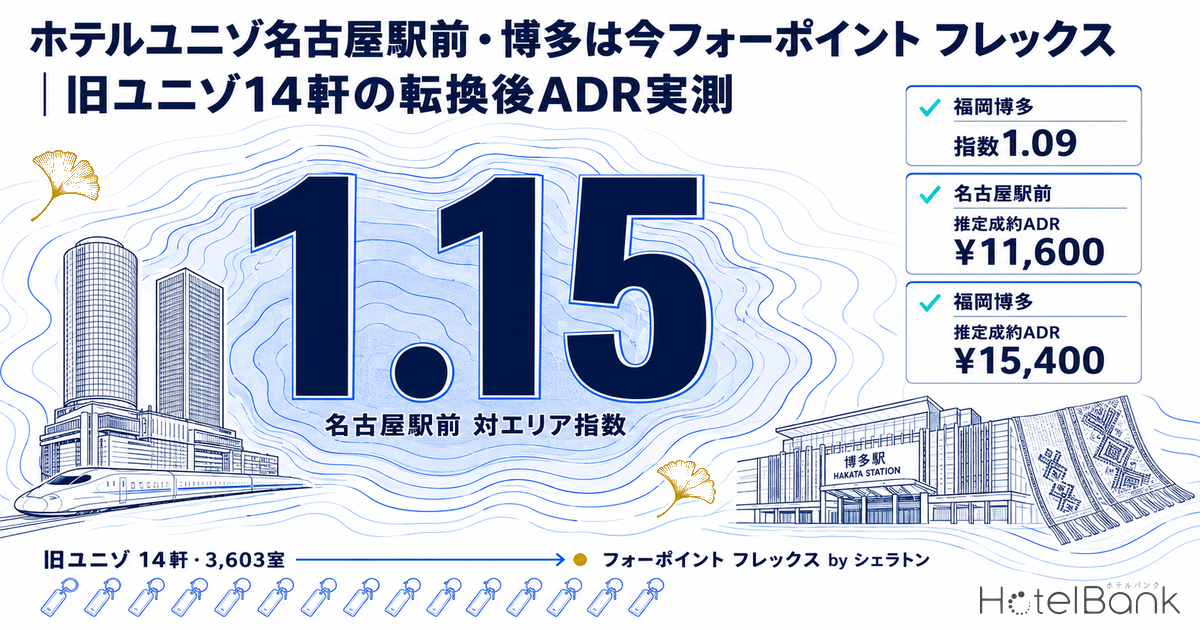
The former Hotel Unizo Nagoya Station-mae (ホテルユニゾ名古屋駅前) now operates as Four Points Flex by Sheraton Nagoya Station (210 rooms). Likewise, Hotel Unizo Hakata Station Hakata Exit (ホテルユニゾ博多駅博多口) is now Four Points Flex by Sheraton Fukuoka Hakata (217 rooms), and Unizo Inn Osaka Kitahama (ユニゾイン大阪北浜) is now Four Points Flex by Sheraton Osaka Kitahama (291 rooms). All three are among the 14 hotels that US investment firm KKR acquired from Unizo Holdings in April 2024 and converted to a new midscale brand from Marriott International. This article first pins down the old-to-new name correspondence from primary sources, then uses measured data to examine where each property sits on price and how guest review scores have moved in the one to two years since conversion.
Metric Definitions Used in This Article
- ADR (average daily rate): an estimated settled rate (tax-excluded equivalent) derived by applying a property-type correction factor to the lowest published plan level each property lists on OTAs and similar channels (two guests per room, per-room rate, tax included). Cross-checked against property-level results disclosed by listed hotel REITs (91 properties, most recent three months), the median error is about 7%. These are estimates and differ from each property’s actual transacted rates and accounting figures. Area-level ADR is the median across the properties in scope (the level of a typical property in that area).
- Listed price: the average price across all plans published on OTAs and similar channels (two guests per room, per-room rate, tax included). Includes everything from room-only to meal-inclusive plans.
- Data sources: pricing = MetroEngines Research / guest review scores = HotelBank Editorial Team research.
- — The former Hotel Unizo Nagoya Station-mae now operates as Four Points Flex by Sheraton Nagoya Station (210 rooms), and Hotel Unizo Hakata Station Hakata Exit as Four Points Flex by Sheraton Fukuoka Hakata (217 rooms). Both are among the 14 hotels KKR acquired in April 2024 and converted to Marriott’s new midscale brand.
- — The brand was renamed in late 2024 from “Four Points Express by Sheraton” — the name used at announcement — to “Four Points Flex by Sheraton.” All 14 Japanese properties have carried the “Flex” name since opening, so searching the old name will not match any actual property name.
- — Across the 13 converted properties with a full price series, the area index (property ADR ÷ the median for business hotels in the same municipality) runs 0.71 to 1.16, with a median of 0.93 (September 2025 to August 2026). The interquartile band is 0.90 to 1.12 — attaching a global soft brand does not by itself lift a property above the area median.
- — Guest review scores dip immediately after conversion and recover in a J-curve over roughly 12 to 18 months. Osaka Kitahama went from 4.14 before conversion to 3.91 in year one and 4.23 most recently — a recovery of about 14 months. Fukuoka Hakata, converted last of the 14, is still partway through it.
- — What the portfolio-acquisition-plus-soft-brand play delivers is not a jump in rate but launch fixed costs spread across the group, direct bookings through the loyalty base, and a wider pool of buyers at exit. Judging a property on its first-year score and rate understates what it can do.
Old-to-New Name Map for the 14 Former Unizo Hotels — 10 Cities, 3,603 Rooms
What KKR and Marriott International announced on 7 May 2024 was the conversion of 14 hotels in 10 Japanese cities, totalling more than 3,600 rooms, to a single new brand. The table below reconciles the announced city breakdown against each property’s room count to establish the old-to-new name correspondence. The 14 properties total 3,603 rooms, consistent with the announced “over 3,600 rooms.”
| City | Former name (Unizo era) | Current name (Four Points Flex by Sheraton) | Rooms | Rebrand opening |
|---|---|---|---|---|
| Hakodate | Unizo Inn Express Hakodate Ekimae (ユニゾインエクスプレス函館駅前) | Four Points Flex by Sheraton Hakodate Station | 277 rooms | November 2024 |
| Morioka | Unizo Inn Express Morioka (ユニゾインエクスプレス盛岡) | Four Points Flex by Sheraton Morioka | 259 rooms | November 2024 |
| Utsunomiya | Unizo Inn Express Utsunomiya (ユニゾインエクスプレス宇都宮) | Four Points Flex by Sheraton Utsunomiya | 323 rooms | November 2024 |
| Yokohama | Hotel Unizo Yokohama Station West (ホテルユニゾ横浜駅西) | Four Points Flex by Sheraton Yokohama Station West | 156 rooms | November 2024 |
| Nagoya | Hotel Unizo Nagoya Station-mae (ホテルユニゾ名古屋駅前) | Four Points Flex by Sheraton Nagoya Station | 210 rooms | November 2024 |
| Kanazawa | Unizo Inn Kanazawa Hyakumangoku-dori (ユニゾイン金沢百万石通り) | Four Points Flex by Sheraton Kanazawa | 220 rooms | November 2024 |
| Kyoto | Hotel Unizo Kyoto Karasuma Oike (ホテルユニゾ京都烏丸御池) | Four Points Flex by Sheraton Kyoto Oike | 317 rooms | November 2024 |
| Osaka | Hotel Unizo Osaka Umeda (ホテルユニゾ大阪梅田) | Four Points Flex by Sheraton Osaka Umeda | 220 rooms | 18 November 2024 |
| Osaka | Unizo Inn Shin-Osaka (ユニゾイン新大阪) | Four Points Flex by Sheraton Shin-Osaka | 225 rooms | November 2024 |
| Osaka | Unizo Inn Osaka Kitahama (ユニゾイン大阪北浜) | Four Points Flex by Sheraton Osaka Kitahama | 291 rooms | 13 November 2024 |
| Osaka | Unizo Inn Express Osaka Minami-Honmachi (ユニゾインエクスプレス大阪南本町) | Four Points Flex by Sheraton Osaka Honmachi | 503 rooms | December 2024 |
| Osaka | Hotel Unizo Osaka Shinsaibashi (ホテルユニゾ大阪心斎橋) | Four Points Flex by Sheraton Osaka Shinsaibashi | 186 rooms | November 2024 |
| Kobe | Unizo Inn Kobe Sannomiya (ユニゾイン神戸三宮) | Four Points Flex by Sheraton Kobe Sannomiya | 199 rooms | November 2024 |
| Fukuoka | Hotel Unizo Hakata Station Hakata Exit (ホテルユニゾ博多駅博多口) | Four Points Flex by Sheraton Fukuoka Hakata | 217 rooms | 25 February 2025 |
| Total, 14 hotels (10 cities) | 3,603 rooms | Nov 2024 – Feb 2025 | ||
Source: compiled by the HotelBank Editorial Team from KKR and Marriott International announcements and each property’s opening notice. Room counts as recorded by MetroEngines Research.
Note: properties whose opening is shown only to the month (e.g. “Nov 2024”) are those for which an individual date could not be confirmed within the announced window of phased openings from 1 November 2024 through early 2025.
One point deserves care: the former Hotel Unizo Kyoto Shijo Karasuma (281 rooms) and the converted Kyoto Oike property (formerly Hotel Unizo Kyoto Karasuma Oike, 317 rooms) are different hotels. Unizo operated several properties in Kyoto, and without reconciling room counts as well as names it is easy to confuse them. The same applies in Kanazawa: the conversion covered the former Unizo Inn Kanazawa Hyakumangoku-dori (220 rooms), not the former Unizo Inn Express Kanazawa Ekimae (392 rooms).
The brand was renamed from “Express” to “Flex”
A common source of confusion in search is that the brand name itself changed partway through. At the May 2024 announcement it was billed as Four Points Express by Sheraton, but Marriott International renamed the brand Four Points Flex by Sheraton in the second half of 2024. The Japanese properties have operated under the “Flex” name since they opened in November 2024, and all 14 property names recorded in our database read “Flex” as well. So a search for “Four Points Express Nagoya” will not match any real property name, even though it refers to the same hotel.
How the Deal Was Structured — From EBO to Civil Rehabilitation, and the Hotel Business Carve-Out to KKR
The reason these 14 hotels were converted as a single block lies in the restructuring of Unizo Holdings. Laid out chronologically, the publicly announced facts are as follows.
| Date | Publicly announced fact |
|---|---|
| 2 April 2020 | An employee buyout (EBO) closes, at ¥6,000 per share. |
| 18 June 2020 | Delisted from the Tokyo Stock Exchange. On 19 June the same year, asset sales including Hotel Unizo Shimbashi and Hotel Unizo Shibuya are announced. |
| 26 April 2023 | Files for civil rehabilitation with the Tokyo District Court. Total liabilities are approximately ¥126.2 billion. |
| 6 March 2024 | A rehabilitation plan sponsored by 3D Investment Partners is approved. A separate framework is settled under which KKR sponsors the hotel business. |
| 23 April 2024 | The hotel operating company, Unizo Hotel, is transferred to KKR and carved out as a standalone business. |
| 7 May 2024 | KKR and Marriott International announce the conversion of 14 hotels to a new brand — 10 cities, over 3,600 rooms. |
| Nov 2024 – Feb 2025 | Phased rebrand openings following renovation. Osaka Umeda, which opened on 18 November, is Marriott’s 100th property in Japan. |
| Aug – Dec 2025 | Three hotels open in Tokyo (Higashi-Kanda 78 rooms, Ueno 199 rooms, Shibuya West 92 rooms). Whether they were formerly Unizo properties has not been confirmed. |
Source: compiled by the HotelBank Editorial Team from company announcements and press reports
As an investment structure this is a textbook value-add deal. Within the rehabilitation process, the hotel business alone is separated from the real-estate leasing business, and the 14 properties are acquired together as a portfolio. Rather than launching a proprietary brand, the buyer attaches a global chain’s soft brand and plugs the portfolio into its distribution and loyalty base. Renovation ran to a few months per property, so capital is tied up for far less time than in a ground-up development.
Source: compiled from MetroEngines Research by the HotelBank Editorial Team
Price Position After Conversion — Estimated Settled ADR at 13 Properties vs Their Own Areas
Here is the central question: once a global soft brand went on the building, where was the price set? We aggregated estimated settled ADR by property over the most recent 12 months (September 2025 to August 2026) and placed it alongside the median for business hotels (our classification) in the same municipality. The sample size (N) on the area side is shown as well.
Source: compiled from MetroEngines Research by the HotelBank Editorial Team (average of monthly estimated settled ADR, September 2025 to August 2026)
| Property | Est. settled ADR | Listed price all-plan average, tax incl. |
Comparison area | Area median | Index |
|---|---|---|---|---|---|
| Shin-Osaka | ¥10,700 | ¥15,100 | Yodogawa-ku, Osaka(N=30) | ¥9,200 | 1.16 |
| Osaka Umeda | ¥12,300 | ¥17,900 | Kita-ku, Osaka(N=55) | ¥10,700 | 1.15 |
| Nagoya Station | ¥11,600 | ¥17,800 | Nakamura-ku, Nagoya(N=63) | ¥10,100 | 1.15 |
| Fukuoka Hakata | ¥15,400 | ¥23,600 | Hakata-ku, Fukuoka(N=134) | ¥14,100 | 1.09 |
| Utsunomiya | ¥7,700 | ¥10,800 | Utsunomiya City(N=42) | ¥7,100 | 1.08 |
| Osaka Shinsaibashi | ¥12,900 | ¥18,300 | Chuo-ku, Osaka(N=155) | ¥12,300 | 1.04 |
| Morioka | ¥6,200 | ¥8,900 | Morioka City(N=24) | ¥6,700 | 0.93 |
| Hakodate Station | ¥6,800 | ¥10,100 | Hakodate City(N=47) | ¥7,400 | 0.92 |
| Yokohama Station West | ¥13,600 | ¥19,400 | Nishi-ku, Yokohama(N=5) | ¥15,000 | 0.91 (reference) |
| Kanazawa | ¥8,000 | ¥11,800 | Kanazawa City(N=81) | ¥8,800 | 0.90 |
| Kobe Sannomiya | ¥10,000 | ¥16,200 | Chuo-ku, Kobe(N=40) | ¥11,100 | 0.90 |
| Osaka Kitahama | ¥9,800 | ¥13,400 | Chuo-ku, Osaka(N=155) | ¥12,300 | 0.80 |
| Kyoto Oike | ¥11,300 | ¥16,700 | Nakagyo-ku, Kyoto(N=81) | ¥15,900 | 0.71 |
Source: compiled from MetroEngines Research by the HotelBank Editorial Team. Index = property ADR ÷ the business-hotel median in the same municipality. Sample size for the area median is shown in parentheses (as of August 2026). Kobe Sannomiya has 11 aggregable months; the others have 12. Scope is the 13 properties with a full 12-month price series (Osaka Honmachi excluded).
The 13 indices range from 0.71 to 1.16, with a median of 0.93. Six properties sit above the business-hotel median for their area; the remaining seven sit in the middle of their area’s range or slightly below it. In other words, the arrival of a global soft-brand sign does not by itself produce a rate above the area average. That is consistent with how the brand is designed. Four Points Flex is Marriott’s entry into the affordable midscale segment, and it is not built to differentiate on rate the way the group’s upper brands are. The intent of the play is to hold mid-market pricing discipline while connecting the property to a loyalty base and international distribution.
For Yokohama Station West, the business-hotel sample in the same ward (Nishi-ku, Yokohama) is thin at five properties, so its index should be treated as a reference figure.
Nagoya Station (210 rooms) — Above the Nakamura-ku business-hotel median for 12 straight months
The former Hotel Unizo Nagoya Station-mae reopened under its current name in November 2024. It sits within walking distance of the Sakura-dori exit of Nagoya Station and has 210 rooms. Estimated settled ADR over the most recent 12 months was about ¥11,600, against a business-hotel median of roughly ¥10,100 in Nakamura-ku, Nagoya over the same period — an index of 1.15. Month by month it cleared the area median in all 12 months, so its price position is stable.
Source: compiled from MetroEngines Research by the HotelBank Editorial Team (Nakamura-ku business hotels N=63 properties, as of August 2026)
On listed price (all-plan average, tax included), the 12-month average was about ¥17,800, rising to roughly ¥20,500 in the peak month of November 2025. Nagoya is a market where exhibition and event demand makes rates spike, and this property moves with those swings while consistently holding a position above the median.
Fukuoka Hakata (217 rooms) — Converted last, and running at an index of 1.09 against the Hakata-ku median
The former Hotel Unizo Hakata Station Hakata Exit reopened on 25 February 2025 — the last of the 14. It is within walking distance of the Hakata exit of Hakata Station and has 217 rooms across four types: single, twin, double and accessible twin. Estimated settled ADR over the most recent 12 months was about ¥15,400, against a business-hotel median of roughly ¥14,100 in Hakata-ku, Fukuoka — an index of 1.09. With 134 properties in our sample, Hakata-ku is one of the most competitive lodging markets in Japan, and this hotel sits above its median.
Source: compiled from MetroEngines Research by the HotelBank Editorial Team (Hakata-ku business hotels N=134 properties, as of August 2026)
The peak was roughly ¥19,500 in November 2025, about 24% above the area median of some ¥15,700 that month. Since June 2026, however, it has settled around ¥14,000 and the gap to the area has narrowed. Take a premium in strong months, move back toward the area in quiet ones — a straightforward midscale pricing pattern.
Guest Review Scores Trace a J-Curve — Roughly 12 to 18 Months to Recover
Judging a brand conversion on rate alone tells only half the story. Because the operating company, the operation itself and the facilities all change at once, guest review scores tend to dip immediately after conversion and then come back. Below are three-month moving averages of guest review scores for three properties converted at different times.
Source: HotelBank Editorial Team research (January 2023 to August 2026; three-month moving average weighted by review volume, with low-volume months smoothed by combining the two adjacent months)
The figures read as follows. Nagoya Station averaged 4.12 before conversion (January 2023 to August 2024, N=2,194 reviews) and 4.13 over the most recent 12 months (September 2025 to August 2026, N=617) — back to its pre-conversion level. Its latest three-month moving average has risen to 4.30, so it is still trending up.
Osaka Kitahama is clearer still: 4.14 before conversion (N=766), 3.91 in 2025, its first year after conversion (N=292), and 4.23 from January to August 2026 (N=296) — back above where it started. Since it converted on 13 November 2024, that works out to a full recovery in about 14 months.
Fukuoka Hakata converted last, on 25 February 2025: 4.18 before conversion (N=1,951), 3.62 from March to December 2025 (N=457), and 3.73 from January to August 2026 (N=201), with its latest three-month moving average back to 3.80. Measured against the 12-to-18-month recovery the two earlier properties showed, it is partway through that window.
The practical implication for investors and operators sits here. The review score a property posts in its first year after conversion measures transition cost, not the property’s capability. Using the year-after score as the benchmark for an acquisition decision or an operating review will mark the asset down below what it is. Conversely, a score that has not recovered more than 18 months after conversion is a reason to examine the operating design rather than the brand.
Translating This Into Underwriting — Three Scenarios and a Two-Axis Sensitivity
It is worth restating the measurements above as an underwriting range. The area indices of the 13 properties fall at a first quartile of 0.90, a median of 0.93 and a third quartile of 1.12, and anything above 1.15 sits at the top of the observed range (Shin-Osaka 1.16, Osaka Umeda 1.15, Nagoya Station 1.15). Underwriting to an index of 1.15 or higher therefore means treating the edge of the observed distribution as the base case. Every anchor below is a figure measured in this article, not a forecast of future performance.
| Scenario | Area index | Basis for the index | Review J-curve recovery | Basis for the recovery | Year-two lift above market |
|---|---|---|---|---|---|
| Downside | 0.80 | Measured value at Osaka Kitahama; below the first quartile of 0.90 | Not recovered at 18 months | Fukuoka Hakata stands at 3.73 against a pre-conversion 4.18 at the 18-month mark | 0.0pt or below (9 of 19 properties in our earlier study) |
| Base | 0.93 | Measured median across the 13 properties | About 14 months | Osaka Kitahama recovered from 4.14 pre-conversion to 4.23 in January–August 2026 | +0.4pt (median across 33 properties in our earlier study) |
| Upside | 1.12 | Third quartile across the 13 properties | About 12 months (the bottom of the observed band) | Nagoya Station is back at its pre-conversion 4.12, averaging 4.13 over the most recent 12 months | Above +0.4pt (10 of 19 properties in our earlier study) |
| Area median ADR \ Index | 0.80 | 0.90 | 0.93 | 1.05 | 1.15 |
|---|---|---|---|---|---|
| ¥7,000 | ¥5,600 | ¥6,300 | ¥6,500 | ¥7,400 | ¥8,000 |
| ¥9,000 | ¥7,200 | ¥8,100 | ¥8,400 | ¥9,400 | ¥10,400 |
| ¥11,000 | ¥8,800 | ¥9,900 | ¥10,200 | ¥11,600 | ¥12,600 |
| ¥13,000 | ¥10,400 | ¥11,700 | ¥12,100 | ¥13,600 | ¥14,900 |
| ¥15,000 | ¥12,000 | ¥13,500 | ¥14,000 | ¥15,800 | ¥17,200 |
Laid out on two axes, the character of this play becomes clear. An index of 0.93 in a market with an area median of ¥15,000 produces a property ADR of ¥14,000 — far above the ¥10,400 an index of 1.15 yields in a market with an area median of ¥9,000. Being in a market with a high median matters more than moving the index up a notch. Indeed, the three highest-index properties of the 13 — Shin-Osaka, Utsunomiya and Morioka — all sit in markets with an area median of ¥9,200 or less, so a high index does not translate into a high rate. When assessing the diversification benefit of a portfolio acquisition, the thing to look at is the mix of city-level median levels, not the average index.
The Three Tokyo Properties Cannot Be Confirmed as Former Unizo Hotels
The three hotels that opened in Tokyo in 2025 are not among the announced 14. Marriott’s announcements do not name any predecessor property, so we could not confirm whether they were formerly Unizo hotels. Their estimated settled ADR over the most recent 12 months is shown below for reference.
| Property | Rooms | Opening | Est. settled ADR | Former Unizo? |
|---|---|---|---|---|
| Tokyo Higashi-Kanda | 78 rooms | 22 August 2025 | ¥18,800 | Not confirmed |
| Tokyo Ueno | 199 rooms | 14 October 2025 | ¥16,800 | Not confirmed |
| Tokyo Shibuya West | 92 rooms | 1 December 2025 | ¥24,300 | Not confirmed |
Source: Marriott International announcements (opening dates, room counts) / MetroEngines Research (ADR). ADR is the average of aggregable months only: 11 months for Tokyo Ueno and 9 for Tokyo Shibuya West.
Adding these three brings Four Points Flex in Japan to 17 hotels and roughly 3,970 rooms. The brand platform was established through the block conversion of the 14 former Unizo hotels, and the three Tokyo properties have since been added individually on top of it.
On the properties still carrying the “Unizo” name in our data
Our database still holds records for a number of properties under the former Hotel Unizo, Unizo Inn and Unizo Inn Express names. Among the larger ones alone are Ginza Itchome (305 rooms), Osaka Yodoyabashi (333 rooms), Kyoto Shijo Karasuma (281 rooms), Kanazawa Ekimae (392 rooms), Kagoshima Tenmonkan (295 rooms), Nagoya Sakae (252 rooms) and Hiroshima Ekimae (250 rooms).
None of them is among the 14 covered here. Because the 14 properties’ 3,603 rooms reconcile with the announced figure, the correspondence can be established with confidence. Unizo Holdings had been selling assets from before the civil rehabilitation filing, and sales including Hotel Unizo Shimbashi and Hotel Unizo Shibuya were announced on 19 June 2020. The current operator and name of any individual property goes beyond what public sources confirm, so this article does not assert them. If a search on the Unizo name turns up no matching property, the first step is to check the correspondence table above to see whether it is one of the KKR–Marriott 14.
How Investors Should Read It — The Portfolio-Acquisition-Plus-Soft-Brand Play
Abstracted as an investment structure, this deal breaks into three elements.
First, buying the portfolio in one block spreads the conversion cost. Acquiring 14 hotels and 3,603 rooms at once means launch costs — brand rollout, PMS migration, training, advertising — are allocated across the group rather than carried by a single property. Fixed costs that would be crushing for a one-off rebrand thin out considerably when divided across 14 hotels. Spreading across 10 cities also diversifies exposure to demand swings in any single market.
Second, soft-branding works on distribution more than on rate. Our own tracking of 33 brand conversions covering 9,113 rooms found the median year-two lift above market to be just +0.4pt, with only 10 of 19 properties moving into positive territory at all. Deals where the rate jumps do exist, but they are not the median. Among these 14 hotels, too, the median index against the area median is 0.93. What a midscale soft-brand conversion realistically delivers is not a leap in rate but a higher share of direct bookings through the loyalty base, firmer occupancy, and a wider pool of buyers at exit.
Third, the review-score J-curve has to be built into the timeline. As shown above, guest review scores took roughly 12 to 18 months to return to pre-conversion levels. Evaluating a deal on first-year scores and rates alone understates what the asset can do. The hold-period design, the timing of additional capex and even the way the story is presented to lenders all need to be built around that lag.
Conclusion
The former Hotel Unizo Nagoya Station-mae, Hotel Unizo Hakata Station Hakata Exit and Unizo Inn Osaka Kitahama are all among the 14 hotels KKR acquired in April 2024 and converted to Marriott’s new midscale brand, Four Points Flex by Sheraton. The brand was renamed from “Express” at announcement to “Flex,” and every current property name carries “Flex.”
Comparing estimated settled ADR at the 13 properties one to two years past conversion against the business-hotel median in the same municipality, the index runs 0.71 to 1.16 with a median of 0.93. Six clear their area average, with Nagoya Station at 1.15 and Fukuoka Hakata at 1.09 near the top. The numbers show a design that holds midscale pricing discipline while plugging into international distribution, rather than one that jumps the rate. Guest review scores dip right after conversion and return within 12 to 18 months. Whether an investor can underwrite that lag is what separates a sound read on a value-add conversion deal from a poor one.
Related reading
References and sources
■ Data sources
Pricing and room counts = lodging inventory and rate data recorded by MetroEngines Research (scope: the 14 properties plus the three in Tokyo; monthly aggregation over September 2025 to August 2026). The area median is the property-level median across the business-hotel classification in the same municipality, with sample sizes shown in the tables. Guest review scores = HotelBank Editorial Team research (January 2023 to August 2026; three-month moving average weighted by review volume). The deal timeline, property correspondence, opening dates and brand renaming come from KKR and Marriott International announcements and press reports.
■ Calculation assumptions
Area index = a property’s estimated settled ADR ÷ the median estimated settled ADR for business hotels in the same municipality (same period, same definition). The index anchors for the three scenarios use the first quartile of 0.90, median of 0.93 and third quartile of 1.12 measured across the 13 properties in this article; no forecast is applied. The review J-curve recovery period is the range read off measurements at three properties converted at different times (Osaka Kitahama, Nagoya Station, Fukuoka Hakata). The year-two lift above market is carried over as a reference value from the median (+0.4pt) in our previously published brand-conversion ROI analysis, which tracked 33 properties and 9,113 rooms. The two-axis sensitivity table is simple arithmetic — index multiplied by area median ADR — rounded to the nearest hundred yen.
■ Limitations and caveats
ADR is a settled rate estimated from published rates and differs from each property’s actual transacted prices and accounting figures. Occupancy, revenue and costs are outside the scope of this article, and no assessment of profitability or investment yield is made. For Yokohama Station West the comparison-area sample is thin at five properties, so its index is treated as a reference figure. Kobe Sannomiya has 11 aggregable months, Tokyo Ueno 11 and Tokyo Shibuya West 9. Osaka Honmachi is excluded from the 13-property aggregation because it lacks a full 12-month price series. Whether the three Tokyo properties were formerly Unizo hotels could not be confirmed from public sources and is not asserted. The same applies to the current operator and name of the properties still carrying the Unizo name in our data, which go beyond what public sources confirm.
■ Public sources on the transaction and the brand
- KKR, “KKR and Marriott International announce new hotel brand Four Points Express by Sheraton, entering Japan’s midscale hotel market” (7 May 2024)
- Marriott International, “Announcing the opening of Four Points Flex by Sheraton Osaka Umeda, Marriott’s 100th property in Japan” (18 November 2024)
- Marriott International, “Four Points Flex by Sheraton to open three new hotels in Tokyo” (August 2025)
- Marriott International, Four Points Flex by Sheraton official brand page (in Japanese)
- TRAICY, “Marriott offers opening discount for Four Points Flex by Sheraton” (6 November 2024; records the brand renaming, in Japanese)
- TRAICY, “Marriott International opens Four Points Flex by Sheraton Osaka Umeda” (18 November 2024, in Japanese)
- Travel Voice, “Marriott to open three affordable hotels in Tokyo” (25 August 2025, in Japanese)
- Travel Vision, “Marriott to rebrand 14 Unizo HD hotels in partnership with KKR” (May 2024, in Japanese)
- Nikkei, “KKR acquires 14 Unizo Holdings hotels, to roll out new brand after renovation” (7 May 2024, in Japanese)
- Yuto Soken, “Former Hotel Unizo Hakata Station Hakata Exit reopens as Four Points Flex by Sheraton Fukuoka Hakata” (25 February 2025, in Japanese)
■ On the restructuring of Unizo Holdings
- Unizo Holdings (EBO closing date, delisting date, civil rehabilitation filing date, total liabilities, and the date the hotel business was transferred; in Japanese)
- Jutaku Shimpo, “Unizo HD sells Yanase Shibuya Building, Hotel Unizo Shimbashi and Shibuya, and others” (19 June 2020, in Japanese)
■ Pricing and guest review data
- MetroEngines Research — estimated settled ADR and listed price (September 2025 to August 2026), property master (room counts, locations)
- HotelBank Editorial Team research — monthly guest review score trend (January 2023 to August 2026)