

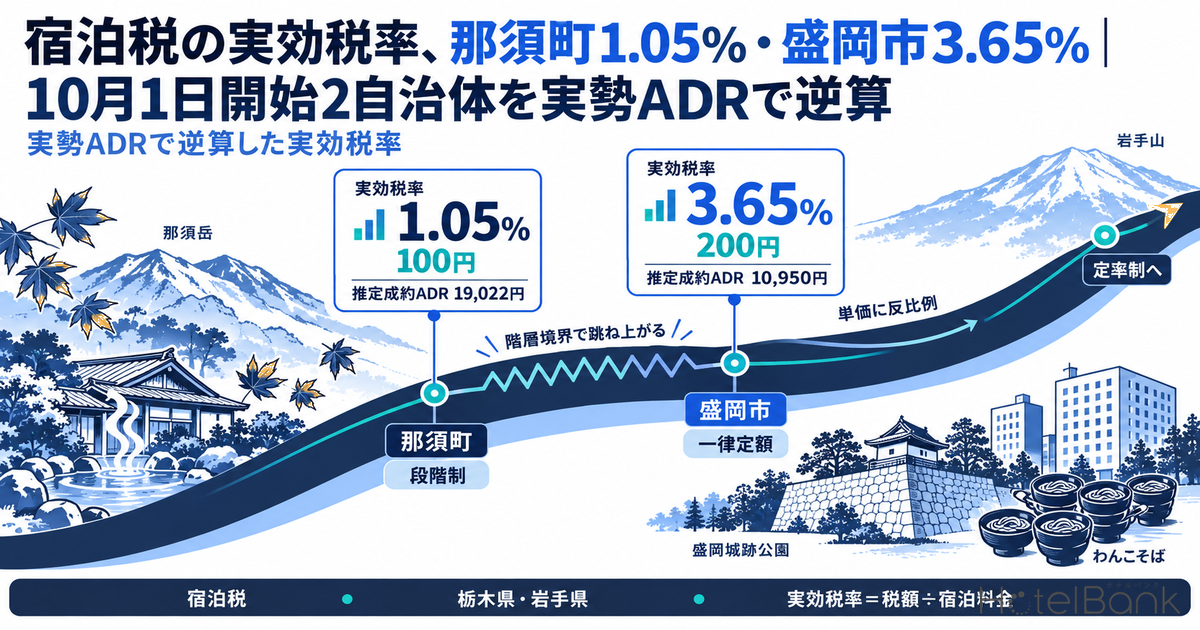
On October 1, 2026, Nasu Town (那須町) in Tochigi Prefecture and Morioka City (盛岡市) in Iwate Prefecture will begin collecting lodging tax. Both are the first in their respective prefectures to introduce one, yet the thinking behind their rate designs could hardly be more different. Nasu uses a six-tier flat-amount system keyed to the room rate (¥100 below ¥10,000 up to ¥3,000 at ¥100,000 or more), while Morioka charges a uniform ¥200 regardless of age or price. Rather than simply noting that “more municipalities are adopting the tax,” this article reverse-calculates from market price data in both areas to visualize how flat-amount taxation changes the effective tax rate (tax ÷ room rate) dramatically depending on the price band.
Metric Definitions Used in This Article
- ADR (Average Daily Rate): An estimated settled rate (tax-exclusive equivalent), calculated by applying segment-specific adjustment factors to the lowest-plan price level each property publishes on major booking sites (per room, 2 guests, tax-inclusive). Cross-checked against property-level actuals disclosed by listed hotel REITs (91 properties, most recent 3 months), the median error is approximately 7%. These are estimates and differ from each property’s actual settled prices and accounting figures. Area-level ADR is the median of the target properties (the level of a typical property in the area).
- Per-person rate: Because lodging tax is levied on the room charge per person per night, this article uses an approximate per-person figure obtained by dividing the per-room rate for 2 guests (above) by 2.
- Effective tax rate: Lodging tax amount ÷ room charge per person per night. Under flat-amount taxation it varies by price band.
- Data source: MetroEngines Research
- — Nasu 1.05%, Morioka 3.65% — Reverse-calculating the two October 1 launches from market estimated settled ADR shows the uniform ¥200 imposes an effective burden more than three times heavier than the six-tier system.
- — Just below a tier boundary — Nasu’s approximate per-person rate of ¥9,511 sits only 5.1% below the ¥10,000 boundary; within the estimation error, the effective rate could move from 1.05% to 2.95%.
- — 1.00% to 4.00% at the same ¥10,000 — Nationwide, rates span a 4x range from Tokyo at 1.00% to Kyoto City at 4.00%. At ¥4,000 per person, the presence or absence of a tax-exemption threshold splits outcomes between 0% and 5.00%.
- — The shift toward percentage rates — Tokyo moves to a uniform 3% in April 2027 and raises its exemption line to ¥13,000. Under a percentage rate, the effective rate stays constant regardless of price.
- — Issues for operators — Price revisions that cross tier boundaries, separating room-only charges from meal costs, and tax-inclusive display and advance notice in the budget segment are the three areas of pricing-design latitude.
Two Municipalities Starting October 1 — Six-Tier Flat Amounts vs. a Uniform Flat Amount
Nasu Town’s lodging tax divides the room charge per person per night into six tiers and levies a fixed amount for each tier. According to the town’s official leaflet, the “room charge” that forms the tax base refers to the room-only rate plus associated service charges, and excludes meal costs and consumption tax. Exemptions apply to guests under 12 years of age and to students and chaperones participating in school trips and similar activities. First-year tax revenue is projected at approximately ¥114 million (FY2026 initial draft budget). Use of the revenue is restricted to purposes such as toilet facilities at tourist sites, improved secondary transportation, tourist information signage, human resource development and retention, and tourism DX.
| Room charge (per person per night, excl. meals etc.) | Tax amount | Effective rate range within tier |
|---|---|---|
| Under ¥10,000 | ¥100 | 1.00%+ (rises as price falls) |
| ¥10,000 to under ¥20,000 | ¥300 | 1.50%–3.00% |
| ¥20,000 to under ¥30,000 | ¥500 | 1.67%–2.50% |
| ¥30,000 to under ¥50,000 | ¥800 | 1.60%–2.67% |
| ¥50,000 to under ¥100,000 | ¥1,500 | 1.50%–3.00% |
| ¥100,000 or more | ¥3,000 | Up to 3.00% (falls as price rises) |
Source: Compiled by HotelBank Editorial Team from Nasu Town, “Introduction of the Nasu Town Lodging Tax”
Morioka City, by contrast, sets the rate at a uniform ¥200 per guest per night, as stated in the city’s published “Lodging Tax Special Collection Procedures Guide (1st edition, January 13, 2026).” There is no tax-exemption threshold, and any stay that incurs a room charge is taxable regardless of age. The only exemption is for stays by foreign ambassadors and similar persons in the performance of their duties under the Vienna Convention on Diplomatic Relations; there are no categories for school trips or children under 12. The approach to the tax base is the same as Nasu’s: meal costs, entertainment expenses, consumption tax, and service fees for using booking sites are not included in the room charge. The guide does not mention first-year revenue, and positions the lodging tax as a non-statutory earmarked tax “to be applied to the costs of measures to promote tourism, including enhancing the appeal of tourism resources and encouraging visits and exchange by people from Japan and abroad.”
As systems, Nasu can be summarized as a design that “grades the burden according to ability to pay,” and Morioka as a design that is “the same amount for everyone and easy to understand.” Viewed as a ratio to the room charge, however, the two trace entirely different curves.
The Effective Rate Traces a “Sawtooth” — Rates Jump Just Above Each Tier Boundary
Dividing a flat-amount tax by the room charge means that, within a band where the tax is fixed, the effective rate falls as price rises, then jumps the moment a tier boundary is crossed. As a result, Nasu’s effective rate traces a sawtooth pattern. Concretely, a stay at ¥9,999 per person per night carries ¥100 in tax for an effective rate of 1.00%, but at just ¥1 more—¥10,000—the tax becomes ¥300 and the effective rate triples to 3.00%. The same phenomenon repeats at each boundary: ¥20,000 (1.50%→2.50%), ¥30,000 (1.67%→2.67%), ¥50,000 (1.60%→3.00%), and ¥100,000 (1.50%→3.00%).
A uniform flat amount like Morioka’s is simpler: the effective rate follows a smooth downward curve inversely proportional to price. At ¥5,000 per person per night it is 4.00%; at ¥10,000, 2.00%; at ¥20,000, 1.00%; at ¥50,000, 0.40%. A uniform flat amount is “the same for everyone,” but it also inherently makes the burden ratio heavier in lower price bands. For reference, adding the curve for Kyoto City—which raised its upper tiers on March 1, 2026—shows that even within flat-amount systems, the way tiers are cut produces a completely different profile.
Source: Compiled by HotelBank Editorial Team from rate tables published by each municipality
It is worth noting that Nasu’s tier boundaries fall at round price points: ¥10,000, ¥20,000, ¥30,000, ¥50,000, and ¥100,000. Accommodation plan prices tend to cluster around psychological thresholds, and settings such as ¥9,800 or ¥19,800 per person per night are common. In other words, the zone just below a tier boundary is, in practice, a price band where a considerable number of plans are likely to concentrate. A price revision that lifts a rate by just a few hundred yen from there would raise the guest’s total tax-inclusive cost by more than the increase in the rate itself.
Applying Market Prices — Nasu 1.05%, Morioka 3.65%
With the shape of each system’s curve established, we now apply actual price levels. The estimated settled ADR for October 2026 compiled by MetroEngines Research (per room, 2 guests, tax-exclusive equivalent) is ¥19,022 for Nasu Town (N=51 properties) and ¥10,950 for Morioka City (N=41 properties). Because lodging tax is levied on the room charge per person per night, dividing these by two gives approximate per-person rates of about ¥9,511 and ¥5,475, respectively.
Applying these rates to each system gives an effective rate of 1.05% in Nasu (¥100 tax) and 3.65% in Morioka (¥200 tax). A reversal emerges: Nasu, whose tiered system was designed “according to ability to pay,” has an effective burden less than one-third of flat-rate Morioka’s. The reason is simple—Nasu’s typical rate sits near the top of the lowest tier (under ¥10,000), while Morioka’s typical rate is relatively low compared with the uniform ¥200.
Source: Compiled by MetroEngines Research and HotelBank Editorial Team (October 2026; approximate per-person rate = area median estimated settled ADR divided by 2)
Nasu’s level of about ¥9,511 sits just ¥489 below the ¥10,000 tier boundary. If rates on particular dates—such as peak autumn-foliage days—cross that boundary, the effective rate for those days would jump from 1.05% to around 3.00%. Even for the same property under the same system, daily price fluctuations can move the effective rate by nearly three times—a characteristic unique to tiered flat-amount systems.
Laying out the levels of surrounding municipalities makes the contours of the systems even clearer. The following are reference figures for major municipalities in Tochigi and Iwate prefectures, converting October 2026 estimated settled ADR to a per-person basis and applying each municipality’s system (six tiers for Nasu, uniform ¥200 for Morioka). Note that lodging tax applies only within each municipality’s boundaries, so rows other than Nasu Town and Morioka City should be read as comparative guides showing “what would happen if the same rate table were applied.”
| Municipality | Estimated settled ADR 2 guests, per room |
Approx. rate per person |
Tax at applicable tier | Effective rate | N |
|---|---|---|---|---|---|
| Nasu Town (six tiers / taxable) | ¥19,022 | ¥9,511 | ¥100 | 1.05% | 51 |
| Nikko City (reference, six tiers applied) | ¥21,883 | ¥10,942 | ¥300 | 2.74% | 115 |
| Nasushiobara City (reference, six tiers applied) | ¥13,439 | ¥6,720 | ¥100 | 1.49% | 65 |
| Utsunomiya City (reference, six tiers applied) | ¥10,840 | ¥5,420 | ¥100 | 1.85% | 46 |
| Morioka City (uniform ¥200 / taxable) | ¥10,950 | ¥5,475 | ¥200 | 3.65% | 41 |
| Hachimantai City (reference, uniform ¥200 applied) | ¥17,552 | ¥8,776 | ¥200 | 2.28% | 14 |
| Hanamaki City (reference, uniform ¥200 applied) | ¥17,361 | ¥8,681 | ¥200 | 2.30% | 29 |
| Ichinoseki City (reference, uniform ¥200 applied) | ¥9,793 | ¥4,897 | ¥200 | 4.08% | 21 |
| Kitakami City (reference, uniform ¥200 applied) | ¥9,474 | ¥4,737 | ¥200 | 4.22% | 21 |
Source: Compiled by MetroEngines Research and HotelBank Editorial Team (October 2026; area median estimated settled ADR / N = number of properties in the estimate)
One caveat is needed on how to read these figures. The tax base for lodging tax is the room-only equivalent charge and excludes meals. Estimated settled ADR is derived from price bands that include plans with meals, so in areas with a high share of hot-spring ryokan (such as Nasu Town, Hanamaki City, and Hachimantai City), the actual tax base is likely to be lower than this article’s approximate per-person rate. A lower tax base means a higher effective rate, so for these areas the effective rates in the table above are best treated as lower-bound guides.
Effective Rate Range Accounting for Estimation Error
The approximate per-person rates above are estimated settled ADR divided by two, and estimated settled ADR carries a median error of roughly 7% against actuals. Because Nasu’s ¥9,511 sits 5.1% below the ¥10,000 tier boundary, an error of this size is large enough to cross tiers. The effective rates when the error is applied in each direction are as follows.
| Estimation error | Nasu per person | Tax | Effective rate | Morioka per person | Tax | Effective rate |
|---|---|---|---|---|---|---|
| −7% | ¥8,845 | ¥100 | 1.13% | ¥5,092 | ¥200 | 3.93% |
| Midpoint (figures in text) | ¥9,511 | ¥100 | 1.05% | ¥5,475 | ¥200 | 3.65% |
| +7% | ¥10,177 | ¥300 | 2.95% | ¥5,858 | ¥200 | 3.41% |
In Nasu, an upward estimation error of just 7% changes the applicable tier, moving the effective rate from 1.05% to 2.95%—roughly 2.8 times higher. Morioka, with neither an exemption threshold nor tiers, stays within 3.41%–3.93% under the same error range. Nasu’s “1.05%” is a figure sitting just below a tier boundary and should be read as a range. Morioka’s “3.65%” can be treated as relatively stable, since the tax amount does not change wherever the price lands.
Source: Compiled by MetroEngines Research and HotelBank Editorial Team (error range based on the median error of estimated settled ADR against actuals)
The Same ¥10,000-per-Person Stay Ranges from 1.00% to 4.00% — A Cross-Municipality Comparison
Widening the view nationwide shows that effective rates vary considerably by municipality even at the same price. The table below sets a common yardstick of ¥10,000 per person per night (excluding meals and consumption tax) and compares major municipalities already levying the tax with the two starting in October. For the full picture including municipalities that have introduced or plan to introduce the tax, see Japan Lodging Tax 2026: All 62 Municipalities, Rates and ADR Burden.
| Municipality | Method | Exemption threshold | At ¥4,000 |
At ¥10,000 |
At ¥30,000 |
|---|---|---|---|---|---|
| Tokyo | Flat, 2 tiers (¥100, ¥200) | Under ¥10,000 | 0% | 1.00% | 0.67% |
| Osaka | Flat, 3 tiers (¥200, ¥400, ¥500) | Under ¥5,000 | 0% | 2.00% | 1.67% |
| Kyoto City (from March 2026) | Flat, 5 tiers (¥200–¥10,000) | None | 5.00% | 4.00% | 3.33% |
| Kanazawa City | Flat, 2 tiers (¥200, ¥500) | Under ¥5,000 | 0% | 2.00% | 1.67% |
| Kumamoto City (from July 2026) | Uniform ¥200 | None | 5.00% | 2.00% | 0.67% |
| Miyazaki City (from July 2026) | Uniform ¥200 | None | 5.00% | 2.00% | 0.67% |
| Nasu Town (from October 2026) | Flat, 6 tiers (¥100–¥3,000) | None (under-12s and school trips etc. exempt) | 2.50% | 3.00% | 2.67% |
| Morioka City (from October 2026) | Uniform ¥200 | None | 5.00% | 2.00% | 0.67% |
Source: Compiled by HotelBank Editorial Team from rate tables published by each municipality (all amounts are room charges per person per night, excluding meals and consumption tax)
Source: Compiled by HotelBank Editorial Team from rate tables published by each municipality
Under the same condition of ¥10,000 per person per night, effective rates span a 4x range, from 1.00% in Tokyo to 4.00% in Kyoto City. Dropping further to the ¥4,000-per-person budget band, Tokyo, Osaka, and Kanazawa City—which have exemption thresholds—are at 0%, while Kyoto City, Kumamoto City, Miyazaki City, and Morioka City, which have none, reach 5.00%. Whether an exemption threshold exists is the variable that most strongly determines the gap between systems in the low price band. Nasu’s choice to set a low ¥100 in its lowest tier can be read as a design that holds down the burden ratio in the low price band in lieu of an exemption threshold.
The Shift Toward Percentage Rates — Tokyo Moves to a Uniform 3% in April 2027
Moves are also emerging to resolve this structural property of flat-amount taxation from the policy side. From April 1, 2027, Tokyo will abolish its current two-tier flat amounts (¥100 and ¥200) and move to a percentage-based system levying a uniform 3% of the room charge. At the same time, it will raise the exemption threshold from “under ¥10,000 per person per night” to “under ¥13,000,” and newly bring simple lodging facilities and private lodging (under the Private Lodging Business Act and special-zone minpaku) into the tax. Under a percentage rate, the effective rate stays constant at 3% regardless of price, with neither jumps at tier boundaries nor dilution in higher price bands. Raising the exemption line to ¥13,000 also contrasts with Osaka, which retains its tiered system.
Kyoto City’s substantial increase to its upper tiers from March 1, 2026 (¥20,000 to under ¥50,000 raised from ¥500 to ¥1,000; ¥50,000 to under ¥100,000 raised from ¥1,000 to ¥4,000) can be seen as a move grounded in the same perspective. Before the revision, even a ¥100,000 stay carried an effective rate of only 1.00%. The revision raised effective rates in the upper price bands, and the city projects post-revision tax revenue of approximately ¥12.6 billion. Whether to stay with flat amounts but cut tiers more finely to approximate a percentage rate, or to switch to a percentage rate as Tokyo has—later-adopting municipalities will choose between these two designs. Nasu’s six tiers lean toward the former, while the uniform ¥200 of Morioka, Kumamoto, and Miyazaki can be described as designs that prioritize administrative simplicity.
Practical Duties of Special Collection Agents — Filing and Payment, Subsidies, and Receipt Display
Both municipalities use a special collection system, under which operators of accommodation facilities collect the lodging tax from guests and file and pay it to the municipality. According to Morioka’s guide, businesses already operating accommodation as of October 1, 2026 must submit a “Lodging Tax Special Collection Agent Declaration” to the Miscellaneous Taxes Section of the Municipal Tax Division by the day before taxation begins. Submissions can be made in person or by mail, and electronic filing via eLTAX is also supported. Filing and payment are due at the end of each month, and a filing is required even for months with no guests.
To fund compliance work, Morioka City offers a special collection administration subsidy. For on-time payment, it equals 2.5% of the amount paid; for the first five years after taxation begins this is raised to 3.0%, and 3.5% is granted for electronic filing. Switching to electronic filing is an option that simultaneously reduces administrative workload and raises the subsidy rate. Nasu Town also plans to establish support measures for system modification costs and reducing administrative burden; operators should check the town’s announcements for details.
There is one more practical point. Morioka’s guide asks that receipts and similar documents display the name of the lodging tax (「宿泊税」 in Japanese, “Accommodation Tax” in English) and its amount, and states explicitly that if the name and amount are not clearly displayed, the lodging tax amount may also be subject to consumption tax. It is well worth reviewing receipt and invoice formats—including payments made through booking sites—before taxation begins. Morioka also clarifies that cancelled stays are not taxable since no stay takes place, and that where payment including lodging tax has already been made, the accommodation facility or booking site operator will refund the tax amount. Because refund methods depend on arrangements with the facility operator, contract terms should be checked.
Latitude in Pricing Design — Issues at Tier Boundaries and in the Budget Segment
The analysis so far points to three issues operators can consider. None of them is about “lodging tax becoming a cost”; rather, they are best framed as opportunities for pricing and display design that take the shape of each system into account. In Nagano Prefecture, which introduced its lodging tax earlier, in June 2026, market ADR showed no clear decline in the first two months after implementation.
First, the timing of price revisions that cross tier boundaries. In Nasu, there is a ¥200 step in tax between a per-person rate of ¥9,999 and ¥10,000. Raising the rate by ¥1 would increase the tax-inclusive total by ¥201. Conversely, if a price revision crosses the boundary, it works well to pair it with enough added value to absorb the ¥200 step—for example, in-house facility vouchers or early check-in. For the same size of price increase, guests’ perception differs depending on whether the rate is kept just below the boundary or clearly crosses it with added value.
Second, separating meal costs. Neither municipality includes meal costs in the tax base. For hot-spring ryokan where plans with two meals are the norm, whether the room-only equivalent charge and meal costs can be clearly separated and managed translates directly into the accuracy of the amount collected. Organizing the breakdown at the plan-design stage also makes the basis for tier determination clear. In municipalities with tiered systems like Nasu, this separation can in some cases have the effect of lowering the applicable tier by one.
Third, display design in the budget segment. Morioka’s uniform ¥200 reaches an effective rate of around 4% at business hotels and simple lodging facilities priced at around ¥5,000 per person. In this band, the experience of “the amount paid on site differs from what I saw when booking” is more likely to shape guest impressions than the tax itself. Clarifying for each booking channel whether lodging tax is included in prepayment or collected on site, and stating this clearly at the booking-screen stage, leads directly to maintaining satisfaction. In systems without an exemption threshold, families with children are also taxed per person (Nasu exempts under-12s; Morioka applies regardless of age), so advance notice is all the more effective at properties with many family guests.
Summary
Looking only at the rate tables, the lodging taxes starting in Nasu Town and Morioka City on October 1, 2026 appear to differ merely as “six tiers vs. uniform.” Applying market price levels, however, yields an effective rate of 1.05% in Nasu and 3.65% in Morioka—a reversal in which the tiered system is lighter and the uniform flat amount heavier. Because the effective rate under flat-amount taxation depends on price, a system’s “apparent fairness” and its “actual burden ratio” do not coincide.
This structure becomes even clearer in a nationwide comparison. Under the same condition of ¥10,000 per person per night, there is a 4x range from 1.00% in Tokyo to 4.00% in Kyoto City, and dropping to ¥4,000 per person splits outcomes between 0% and 5.00%. Tokyo’s move to a uniform 3% percentage rate in April 2027 is an effort to eliminate this price dependence from the policy side.
What matters for operators is knowing where their core price points sit relative to the tiers. If they sit just below a boundary, price increases need some careful design; if they are in the low price band, display and advance notice are effective levers. The introduction of lodging tax is also an opportunity to revisit price breakdowns and refine how value is communicated.
⚠ Note on ADR for future dates: The October 2026 estimated settled ADR used in this article is an estimate based on selling prices published as of the survey date (compiled September 6, 2026), and will change as check-in dates approach. Please note that for rates near a tier boundary, daily price fluctuations may change the applicable tier. In addition, the actual tax base for lodging tax is the room-only equivalent charge, which does not match estimated settled ADR that includes plans with meals.
Related Articles
- Nasu vs Morioka Lodging Tax Oct 1: Tiered 1.0-3.0% vs Flat ¥200
- Japan Lodging Tax 2026: All 62 Municipalities, Rates and ADR Burden
- Tochigi Hotel ADR: 3.6x City Gap, Nasu ¥20,192 vs Utsunomiya ¥7,349
- Iwate Hotel Market 2026: 2.2x ADR Gap, Morioka ¥200 Lodging Tax
- Japan Minimum Wage 2026: Chiba & Aichi ¥1,195, Oct 1-15 Rollout
References and Sources
■ Nasu Town and Morioka City (starting October 1)
- Nasu Town, “Introduction of the Nasu Town Lodging Tax” (Japanese)
- Nasu Town, “Frequently Asked Questions about the Nasu Town Lodging Tax (FAQ)” (Japanese)
- Nasu Town lodging tax leaflet (tax table, exemptions, use of revenue / PDF, Japanese)
- Shimotsuke Shimbun, “Nasu Town lodging tax expected to raise ¥114 million in first year” (Japanese)
- Morioka City, “Introduction of the Lodging Tax” (Japanese)
- Morioka City, “About the Morioka City Lodging Tax Ordinance” (Japanese)
- Morioka City, “Lodging Tax Special Collection Procedures Guide,” 1st edition, January 13, 2026 (PDF, Japanese)
■ Comparison municipalities
- Tokyo Metropolitan Government Bureau of Taxation, “Accommodation Tax: For Guests” (Japanese)
- Kyoto City, “Revision of the Accommodation Tax from March 1, 2026 Formally Decided” (Japanese)
- Osaka Convention & Tourism Bureau, “Osaka Accommodation Tax and Minpaku Guide (September 2025 rate revision)”
- Kanazawa City, “About the Accommodation Tax” (Japanese)
- Kumamoto City, “Overview of the Lodging Tax” (Japanese)
- Miyazaki City, “About the Lodging Tax” (Japanese)
- Ministry of Internal Affairs and Communications, “Establishment of the ‘Lodging Tax’ in Miyazaki City, Miyazaki Prefecture” (consent to non-statutory earmarked tax / PDF, Japanese)
■ Market data
- MetroEngines Research — Estimated settled ADR for October 2026 (21 municipalities in Tochigi Prefecture and 29 in Iwate Prefecture; area medians; compiled September 6, 2026)