

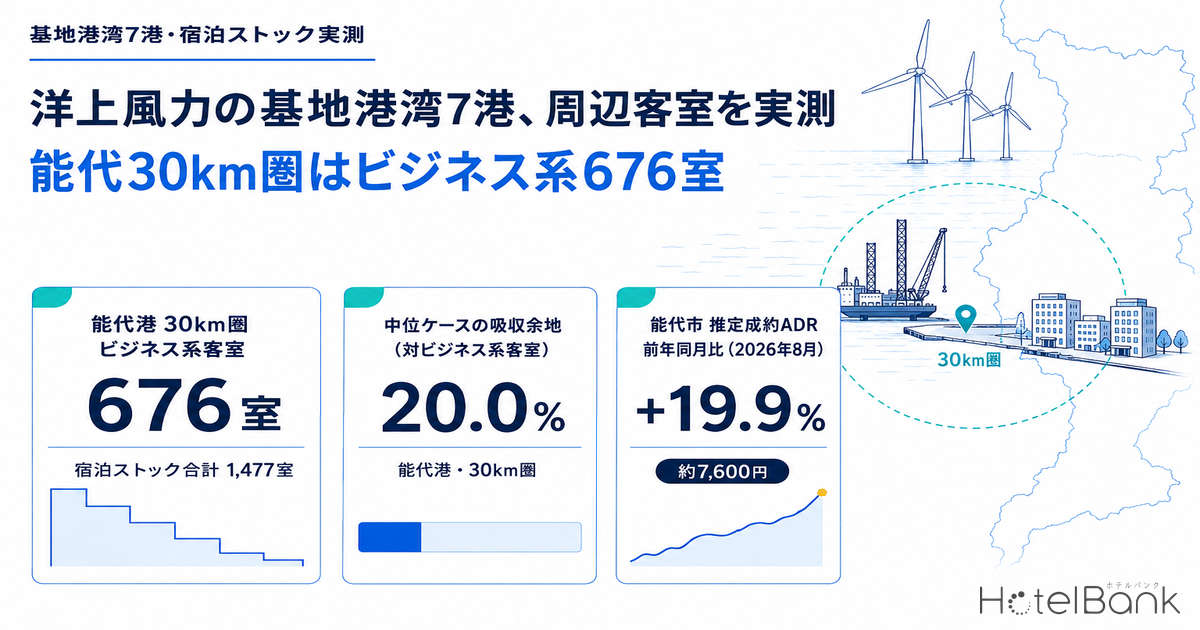
Building an offshore wind farm means workers are tied to the same port for years. For regional business hotels, that points to a kind of demand quite different from tourism: extended, long-term, weekday-centric stays. In this article, we use MetroEngines Research data to measure the lodging stock within 10km and 30km of each of the seven base ports designated by Japan’s Ministry of Land, Infrastructure, Transport and Tourism (MLIT), and quantify, as a range, how much extended-stay demand from construction workers each area can absorb.
Metric Definitions Used in This Article
- ADR (Average Daily Rate): An estimated settled rate (tax-excluded equivalent), calculated by applying segment-specific adjustment factors to the lowest-plan price level each property publishes on OTAs and other channels (per room, 2 guests, tax included). Checked against property-level results disclosed by listed hotel REITs (91 properties, most recent 3 months), the median error is about 7%. These are estimates and differ from each property’s actual settled prices and accounting figures. Area-level ADR is the median of the properties covered (the level of a typical property in the area).
- Room stock: The total registered rooms of lodging facilities located within a 10km or 30km radius of each port’s coordinates, drawn from the property master maintained by MetroEngines Research. This is not a complete census.
- Business-type rooms: Total rooms at properties classified as business hotels, city hotels, or deluxe hotels. We use this category as the realistic pool for construction workers’ extended stays.
- Data sources: MetroEngines Research (room stock, ADR); published materials from MLIT, the Ministry of Economy, Trade and Industry (METI), and project developers (project plans and schedules)
- — There are 7 base ports. Aomori and Sakata were added in April 2024, bringing the total to seven. For the three Round 1 sea areas, the developer withdrew, and re-tendering during FY2026 has so far only been set out as a policy.
- — Onshore lodging demand comes only from land-side work. Offshore crews mainly live aboard support vessels, so simply scaling room demand from project size overstates it.
- — Room stock within 30km differs by an order of magnitude between ports. Kitakyushu has 17,533 rooms; Noshiro has 1,477, of which 676 are business-type. The median property there has 14 rooms, and only 2 have more than 100.
- — The mid case of 135 rooms equals 20.0% of Noshiro’s stock (low 6.7%, high 35.5%). Compared with 1.0% at Kitakyushu and 1.5% at Niigata, the difference in absorption headroom determines the right strategy at each port.
- — Noshiro City’s estimated settled ADR was about ¥7,600 in August 2026, up 19.9% YoY (N=7 properties). With Akita City +18.8% and Aomori City +11.5%, rates in port cities are already moving.
Seven Base Ports — Reading the Pipeline After the Round 1 Reshuffle
The number of “base ports” (officially, bases for offshore renewable energy power generation facilities), which serve as construction hubs for offshore wind, rose to seven when Aomori Port and Sakata Port were added on April 26, 2024. They joined Akita, Noshiro, Kashima, Kitakyushu, and Niigata ports. Separately, MLIT materials list Wakkanai, Ishikari Bay New Port, Mutsu-Ogawara, and Omaezaki as ports with offshore wind plans, but these have not been designated as base ports.
One premise needs to be clarified first. For the sea area off Noshiro City, Mitane Town, and Oga City, which prompted this article, the developer, the Mitsubishi Corporation group, announced on August 27, 2025, following a reassessment of project viability, that it would withdraw from three sea areas including this one. The original schedule of starting construction in March 2026 is therefore no longer valid. For the two sea areas off Akita Prefecture, re-tendering during FY2026 has so far only been set out as a policy. Noshiro Port therefore cannot be treated as “a port where construction starts in 2026.”
Round 2 and Round 3 projects, on the other hand, have more concrete schedules. In terms of base-port activity, these form the real pipeline.
| Promotion zone | Capacity | Selected developer | Base port | Planned start of operation |
|---|---|---|---|---|
| Off Oga, Katagami & Akita cities, Akita | 315 MW | Oga Katagami Akita Offshore Green Energy (JERA, J-Power, Itochu, Tohoku Electric) | Akita Port (O&M at Funakawa Port) | June 2028 |
| Off Happo Town & Noshiro City, Akita | 375 MW | Happo Noshiro Offshore Wind (ENEOS Renewable Energy, Iberdrola, Tohoku Electric) | Akita Port, Muroran Port | June 2029 (onshore construction start postponed, date TBD) |
| Off Murakami & Tainai cities, Niigata | 684 MW | Murakami Tainai Offshore Wind (Mitsui & Co., RWE, Osaka Gas) | Niigata Port | Offshore works moved to April 2028; operation start under review |
| Off Enoshima, Saikai City, Nagasaki | 420 MW | Mirai Enoshima (Sumitomo Corporation et al.) | Kitakyushu Port, among others | August 2029 |
| Aomori Sea of Japan (South) | 615 MW | Tsugaru Offshore Energy consortium (JERA, Green Power Investment, Tohoku Electric) | Aomori Port | June 2030 |
| Off Yuza Town, Yamagata | 450 MW | Yamagata Yuza Offshore Wind (Marubeni, Kansai Electric, Tokyo Gas, Marutaka, BP Iota Holdings) | Sakata Port | June 2030 (onshore works Nov 2027; Sakata Port use from Apr 2028) |
| Off Noshiro, Mitane & Oga / off Yurihonjo, Akita; off Choshi, Chiba | — | Developer announced withdrawal in August 2025 | Noshiro, Akita, Kashima ports | Re-tendering during FY2026 set out as policy |
Source: Compiled by HotelBank Editorial Team from MLIT and METI releases, developer disclosures, and Noshiro City materials (as of September 2026)
The key point is that every one of these schedules can change. The Happo–Noshiro project postponed the start of onshore construction, citing rising material costs, and the Murakami–Tainai project switched turbines from 38 units of 18 MW to 46 units in the 15 MW class and pushed the start of offshore works back by a year. Hoteliers using these projects for investment decisions should not pin “when demand arrives” to a single date; reading it as a range is more realistic.
Offshore Crews Sleep on Ships — Hotel Demand Comes From Land-Side Work
This is the biggest structural difference between offshore wind and construction projects such as data centers or semiconductor fabs. Offshore wind construction and maintenance use dedicated vessels that let workers stay at sea for long periods. SOVs (service operation vessels) offer hotel-like accommodation, designed for crews of dozens to hundreds of people to stay for extended periods with private cabins, mess halls, and recreation facilities. CTVs (crew transfer vessels) carry around 10–20 people to the site. In other words, a large share of the workforce in the turbine installation and subsea cable phases does not stay in onshore hotels.
The demand hoteliers can realistically capture should therefore be limited to the “land-side” work below.
| Construction phase | Main work | Onshore lodging demand | Nature of stay |
|---|---|---|---|
| Onshore transmission & substation works | Surveying, excavation, substation construction, onshore cable laying | Large | Extended stays of months to years, mainly weekdays |
| Marshalling & pre-assembly at base port | Receiving, temporary storage, and pre-assembly of components | Large | Extended stays close to the port; vehicle use assumed |
| Offshore foundations, cables & turbine installation | Offshore work by SEP vessels and cable-laying vessels | Limited | Mainly at sea; onshore stays for crew rotation and standby |
| Management, supervision, inspection & developer visits | Site supervision, regulatory consultations, site tours | Moderate | Repeated short stays; relatively higher rate tolerance |
| O&M after start of operation | Periodic inspections, parts replacement | Small to moderate | Steady demand over 20+ years, around the O&M port |
Source: Organized by HotelBank Editorial Team based on developer and MLIT publications
This structure differs from the premises of our earlier analyses of lodging demand from data center construction (364–725 rooms per 50MW) and ADR trends around a semiconductor cluster. The method (project size → required workforce → required rooms → measured local stock) is the same, but for offshore wind an extra step subtracts the workers who stay at sea. Ignore this difference and scale rooms directly from project size, and demand will be significantly overestimated.
Measuring Lodging Stock at the 7 Base Ports — From 387 to 10,015 Rooms Within 10km
We extracted lodging facilities within 10km and 30km of each port’s coordinates and totaled their registered rooms. The results differ by orders of magnitude from port to port.
Source: MetroEngines Research; compiled by HotelBank Editorial Team (N=7 ports; 1,482 facilities in total counted within 30km, including overlaps)
| Base port | 10km facilities | 10km rooms | 30km facilities | 30km rooms | Of which business-type | Median rooms | 100+ rooms |
|---|---|---|---|---|---|---|---|
| Noshiro Port | 40 | 981 | 69 | 1,477 | 676 | 14 | 2 |
| Sakata Port | 39 | 1,656 | 183 | 4,714 | 2,625 | 14 | 15 |
| Kashima Port | 101 | 3,616 | 328 | 7,642 | 3,512 | 15 | 17 |
| Akita Port | 82 | 5,345 | 132 | 6,194 | 4,665 | 17 | 25 |
| Aomori Port | 70 | 5,060 | 184 | 7,014 | 5,080 | 15 | 26 |
| Niigata Port (East District) | 20 | 387 | 228 | 11,275 | 9,038 | 20 | 36 |
| Kitakyushu Port (Hibikinada) | 131 | 10,015 | 358 | 17,533 | 13,166 | 24 | 57 |
Source: MetroEngines Research; compiled by HotelBank Editorial Team (radius around each port’s coordinates. Median rooms and 100+ room counts cover only facilities with known room counts)
The seven ports fall roughly into three tiers. Kitakyushu and Niigata (East District) are urban ports with more than 10,000 rooms within 30km, where construction demand is small enough to be absorbed by existing stock. Akita, Aomori, and Kashima form a middle tier with 6,000–7,600 rooms within 30km. And Noshiro has just 1,477 rooms within 30km, of which 676 are business-type — an order of magnitude thinner than the other ports. Within 10km, Niigata (East District) has the fewest rooms at 387, but that is because the East District is an industrial port away from central Niigata; widen the radius to 30km and Niigata City’s 10,000+ rooms come into range. Noshiro is different in that it has no such larger city behind it.
Source: MetroEngines Research; compiled by HotelBank Editorial Team. Circle size corresponds to rooms within 30km
Estimating Required Rooms — With Every Assumption Disclosed
At the time of our research, we could not find any developer that publishes the “number of workers staying onshore at peak” for an offshore wind project. What follows is therefore an estimate based on our own assumptions, not a confirmed demand forecast. We disclose the assumptions in a table so readers can substitute their own values.
Two public reference points are available. First, the Vision for Offshore Wind Power Industry (1st edition, December 15, 2020, Public-Private Council on Enhancement of Industrial Competitiveness for Offshore Wind Power Generation) sets a 2040 installation target of 30–45 GW, with industry aiming to train and secure about 40,000 offshore wind workers by 2040. Dividing mechanically, this works out to about 8.9–13.3 workers per 10 MW (40,000 ÷ 30–45 GW) across the whole industry, including manufacturing, construction, and O&M. Second, Fukui Prefecture’s estimate for the project off Awara City (350 MW, 30-year project period) puts job creation over the full lifecycle at 9,330 over 30 years (about 310 per year), of which 6,880 (about 230 per year) are within the prefecture. The estimate is based on a survey of 214 companies in the prefecture and interviews with 13 developers.
Both figures cover the whole industry or the whole lifecycle; the number who are on site at construction peak and stay in hotels is smaller still. In this article, we therefore vary the number of workers staying onshore at peak between 100 and 400, and set the hotel capture rate (the share staying in hotels rather than company dormitories, leased apartments, monthly rentals, etc.) at 30–60% to derive required rooms. Because long-term worker stays are generally one person per room, we use a conversion factor of 1.0 room per person.
| Workers staying onshore at peak (assumption) | Hotel capture 30% | 45% | 60% |
|---|---|---|---|
| 100 | 30 rooms | 45 rooms | 60 rooms |
| 200 | 60 rooms | 90 rooms | 120 rooms |
| 300 (mid case in this article) | 90 rooms | 135 rooms | 180 rooms |
| 400 | 120 rooms | 180 rooms | 240 rooms |
This table is an estimate by HotelBank Editorial Team based on assumptions. Conversion factor 1.0 room per person. Actual room needs will vary with the schedule, construction setup, and local housing availability
Setting these room requirements against each port’s business-type room stock within 30km reveals clear differences in “absorption headroom.” In the mid case of 135 rooms, the demand equals just 1.0% of existing business-type stock at Kitakyushu and 1.5% at Niigata (East District), and would be almost entirely absorbed by existing hotels. At Noshiro, it equals 20.0%.
Source: MetroEngines Research; compiled by HotelBank Editorial Team. Mid case of 135 rooms as a share of business-type room stock within 30km
| Base port | Business-type rooms within 30km | Low: 45 rooms | Mid: 135 rooms | High: 240 rooms |
|---|---|---|---|---|
| Noshiro Port | 676 | 6.7% | 20.0% | 35.5% |
| Sakata Port | 2,625 | 1.7% | 5.1% | 9.1% |
| Kashima Port | 3,512 | 1.3% | 3.8% | 6.8% |
| Akita Port | 4,665 | 1.0% | 2.9% | 5.1% |
| Aomori Port | 5,080 | 0.9% | 2.7% | 4.7% |
| Niigata Port (East District) | 9,038 | 0.5% | 1.5% | 2.7% |
| Kitakyushu Port (Hibikinada) | 13,166 | 0.3% | 1.0% | 1.8% |
Source: MetroEngines Research; compiled by HotelBank Editorial Team. Required rooms are estimates based on the assumptions above
Within 30km of Noshiro, only 2 properties have more than 100 rooms, and the median property has 14. In this market, the mid case of 135 rooms means “demand close to one large business hotel landing on a fragmented existing stock.” Put the other way, for an operator that can reliably supply a block of extended-stay rooms, there is still open ground in both price point and occupancy.
Port-City Rates Are Already Moving — Noshiro Up 19.9% YoY
This demand is not purely in the future. The offshore wind farms inside the port areas (13 turbines at Akita Port and 20 at Noshiro Port, about 140 MW in total) began commercial operation between December 2022 and January 2023, and business travel by related companies is already established. Media reports note that, with rising business use related to offshore wind and other projects, hotels around Noshiro City are frequently close to fully booked.
According to MetroEngines Research’s estimated settled ADR, Noshiro City was about ¥7,600 in August 2026, up 19.9% YoY (N=7 properties). In the same month, Akita City was about ¥10,300 (+18.8%, N=30), Sakata City about ¥7,300 (+15.9%, N=15), Aomori City about ¥17,600 (+11.5%, N=39), and Kamisu City, home to Kashima Port, about ¥6,200 (+8.8%, N=21).
Source: MetroEngines Research; compiled by HotelBank Editorial Team (Noshiro City, estimated settled ADR. N=5–7 properties)
Source: MetroEngines Research; compiled by HotelBank Editorial Team (August 2026, YoY change in estimated settled ADR)
Noshiro’s sample of N=7 properties reflects how small the market is. A few properties can move the city-wide level, so monthly swings are relatively large. Even so, the step up from about ¥6,300 in September 2024 to about ¥7,600 in August 2026 is hard to explain as a one-off monthly fluctuation. Read alongside segment-level ADR trends across Akita Prefecture, it suggests that business demand is pushing up rates within the prefecture as well.
Checking Extended-Stay Readiness Through Guest Reviews — Parking and Breakfast Established, Laundry Has Room to Grow
In practice, three things decide whether a hotel wins extended-stay demand from construction workers: parking, breakfast, and coin laundry. Workers drive to the site; with early mornings and late nights, being able to eat on-site is valuable; and for stays of several weeks to months, laundry access strongly affects comfort.
We analyzed guest reviews for major properties in Noshiro, Akita, and Sakata to see how often each element is mentioned. Note that the mention rate is not a rating score but “the share of reviews in which the element came up.”
| Property | Reviews analyzed | Parking | Breakfast buffet | Coin laundry | Long stay |
|---|---|---|---|---|---|
| Hotel Route-Inn Noshiro (ホテルルートイン能代) | 238 | 13.9% | 8.4% | — | 3.8% |
| Hotel New Green Noshiro (ホテルニューグリーン能代) | 98 | 13.3% | — | 11.2% | — |
| Hotel Minami, Noshiro (ホテルミナミ) | 96 | 13.5% | 7.3% | — | — |
| Hotel Alpha-One Akita (ホテル・アルファ-ワン秋田) | 726 | 13.1% | 3.3% | — | 2.8% |
| Hotel Inn Sakata (ホテル イン 酒田) | 333 | 11.1% | 12.3% | 3.9% | 5.1% |
| Hotel Alpha-One Sakata (ホテル・アルファ-ワン酒田) | 354 | 11.9% | 4.0% | — | — |
| Hotel Route-Inn Sakata (ホテルルートイン酒田) | 230 | 9.1% | 3.5% | — | 2.2% |
Source: HotelBank Editorial Team research (NLP analysis of guest reviews, most recent 24 months). “—” means the mention rate did not reach the reporting threshold; it does not mean the facility is absent
The results are clear. Parking has high mention rates of 9–14% at all seven properties, making it an established evaluation criterion in this market. Breakfast also features prominently at 7–12% in Noshiro and Sakata. By contrast, coin laundry comes up as a review topic at only 2 of the 7 properties. For stays of several weeks or more, laundry can be a real deciding factor, so this is an area with room for differentiation. Mentions in a long-stay context are also only 2–5%, suggesting this need has not yet been fully articulated.
For hotels targeting extended-stay demand, clearly stating — in plan names and property information — washing and drying facilities, microwaves and hot water, handling of work clothes, and early check-out, on top of the parking and breakfast existing properties already do well, translates directly into being chosen at booking. The supply of “worker lodging” in central Hokkaido is a useful reference as an early example of this design approach in practice.
New Supply Is Limited — Price Bands Remain Open
How is supply responding to this demand outlook? New openings tracked by MetroEngines Research (based on confirmed OTA listings) show that opening volumes in the prefectures with base ports are small.
| Prefecture | 2024 openings / rooms | 2025 openings / rooms | 2026 openings / rooms | Plans (building permit applications) |
|---|---|---|---|---|
| Akita | 16 / 294 | 11 / 711 | 4 / 168 | 0 |
| Aomori | 7 / 164 | 18 / 566 | 5 / 363 | 0 |
| Yamagata | 10 / 203 | 13 / 248 | 7 / 188 | 0 |
| Niigata | 31 / 278 | 18 / 251 | 15 / 585 | 0 |
| Ibaraki | 25 / 561 | 18 / 884 | 14 / 209 | 1 / 197 rooms |
Source: MetroEngines Research & Consulting (based on confirmed OTA listings) / MLIT “Statistical Survey on Building Starts.” *OTA listings appear several months before opening, so figures for recent and upcoming months may rise as more listings appear. *The plans column is based on building permit applications as of the survey date; counts and rooms are expected to rise as more applications are filed, so treat it as a lower bound on the confirmed pipeline at present
In Akita, Aomori, and Yamagata, no plans based on building permit applications can be identified at present. This does not mean “no supply will come”; permit applications are typically filed 1–2 years before opening, so the pipeline visible today is thin. Actual openings in 2024–2026 also show small project sizes: Akita had 31 openings with 1,173 rooms over three years, and Yamagata 30 openings with 639 rooms.
There is some individual movement. In Noshiro City, the mayor told the city council in September 2024 that an out-of-prefecture company was planning a 4-story, 74-room business hotel on the site of a building on city-owned land in front of JR Noshiro Station, with a target opening in 2026. Against the mid case of 135 rooms, 74 rooms would absorb just over half in a single building. Put differently, some headroom would still remain.
Conclusion — Each Port Calls for a Different Strategy
Measuring the lodging stock around the seven base ports shows that positioning for offshore wind construction demand falls into three types.
First, urban ports such as Kitakyushu and Niigata (East District). With more than 10,000 rooms within 30km, mid-case demand is only 1.0–1.5% of existing stock. The winning play here is not new supply but for existing hotels to become the ones chosen, through extended-stay plans and in-house amenities.
Second, the middle tier: Akita, Aomori, and Kashima. With 6,000–7,600 rooms within 30km, absorption headroom is 2.7–3.8%. Rates are already rising (Akita City +18.8%, Aomori City +11.5%, Kamisu City +8.8%), and construction demand will add on top of existing business demand. The key question is how to allocate between locking in blocks of extended-stay rooms on long-term contracts and protecting rates for general demand.
Third, ports with no larger city behind them, such as Noshiro. 1,477 rooms within 30km, 676 of them business-type, a median of 14 rooms per property, and only 2 properties over 100 rooms. The mid case of 135 rooms equals 20.0% of existing business-type stock, reaching 35.5% in the high case. Estimated settled ADR rose 19.9% YoY, the fastest among the cities around the seven ports, and the price band is still open. For operators able to supply extended-stay-ready rooms at scale, this is a clear upside.
That said, schedules at every port remain fluid. The three Round 1 sea areas are at the re-tendering stage, and even Round 2 projects have seen schedule revisions from postponed onshore works and turbine changes. For lodging investment, rather than “build because offshore wind is coming,” it is more realistic to design around a base load of existing business, site-visit, and O&M demand, with the construction peak layered on top as upside. O&M demand after the start of operation is steady and lasts more than 20 years, making it the more stable foundation for a business plan.
⚠ Note on ADR for future dates: ADR figures in this article for September 2026 onward are estimates based on selling prices published on OTAs and other channels at the time of research, and will change as check-in dates approach. The required-room estimates are based on the stated assumptions and are not confirmed demand forecasts. Project schedules and developer circumstances may change; please check the latest published materials.
Related Articles
- Data Center Construction Needs 364-725 Hotel Rooms per 50MW in Japan
- TSMC Fab 2 & Kumamoto’s Chip Corridor: Kikuyo–Koshi–Ozu ADR 2024–2026
- Chitose & Tomakomai Worker Lodging — 7 New Hotels, 738 Rooms in 2026
- Niigata Hotel Investment Map: Niigata City, Yuzawa & Sado in 3 Layers
- North Tohoku’s 2,079 New Rooms: Which Segments Can Absorb the Supply
References & Sources
■ Data sources
Room stock was calculated by extracting facilities within a 10km/30km radius of each base port’s coordinates from our lodging property master and totaling their registered rooms (1,482 facilities in total within 30km, including overlaps). Rates are estimated settled ADR (the lowest-plan price level each property publishes, adjusted by segment-specific factors) aggregated at the municipality level, using the monthly series from September 2024 to December 2026. Extended-stay readiness is based on facility-level mention rates from guest review analysis (most recent 24 months); new supply is based on openings confirmed by listings and plans based on building permit applications. Base port designations and promotion zone capacities, selected developers, and schedules are from MLIT, METI, and developer publications.
■ Estimation assumptions
Required rooms were calculated assuming 100–400 workers staying onshore at peak, a hotel capture rate (share staying in hotels rather than company dormitories, leased apartments, monthly rentals, etc.) of 30–60%, and a conversion factor of 1.0 room per person. This article uses a range of low 45 rooms (100 × 45%), mid 135 rooms (300 × 45%), and high 240 rooms (400 × 60%). Absorption headroom = required rooms ÷ business-type rooms within 30km of each port. Business-type rooms are the total rooms at properties classified as business hotels, city hotels, or deluxe hotels. YoY compares estimated settled ADR for the same municipality in August 2025 and August 2026; N= is the number of properties in that comparison.
■ Limitations
(1) No developer publishing the number of workers staying onshore at peak could be found at the time of research; the required rooms above are estimates based on our assumptions, not confirmed demand forecasts. Changing the assumptions changes the conclusions. (2) Room stock is not a complete census and is limited to facilities we track. (3) Estimated settled ADR is an estimate and differs from each property’s actual settled prices and accounting figures (median error of about 7% against property-level results disclosed by listed hotel REITs). In markets with single-digit property counts such as Noshiro, a few properties can move the level, so monthly swings are relatively large. (4) Review mention rates are the share of reviews in which a topic came up, not rating scores; “—” means the reporting threshold was not reached and does not imply the facility is absent. (5) ADR for September 2026 onward is estimated from selling prices published at the time of research and will change as check-in dates approach. (6) Project schedules and developer circumstances may change; check the latest published materials before making investment decisions.
■ Market data
- MetroEngines Research — Lodging facilities and rooms within 10km/30km of the 7 base ports; estimated settled ADR for port cities (September 2024–December 2026)
- MetroEngines Research & Consulting (based on confirmed OTA listings) — Number of new openings and rooms
- HotelBank Editorial Team research — Facility-level mention rates from NLP analysis of guest reviews (most recent 24 months)
■ Government statistics & public materials (Japanese)
- MLIT, “Offshore Wind Power Introduction Plans at Ports (Areas Using Renewable Energy Sources)”
- MLIT Ports and Harbours Bureau, “Offshore Wind Power”
- MLIT, “Results of Offshore Wind Developer Selection for the Sea Area off Happo Town and Noshiro City, Akita”
- METI, “Results of Offshore Wind Developer Selection for Aomori Sea of Japan (South) and off Yuza Town, Yamagata”
- Public-Private Council on Enhancement of Industrial Competitiveness for Offshore Wind Power Generation, “Vision for Offshore Wind Power Industry (1st)” (December 15, 2020)
- Public-Private Council on Enhancement of Industrial Competitiveness for Offshore Wind Power Generation, “Vision for Offshore Wind Power Industry (2nd) [Industrial Strategy for Floating Offshore Wind, etc.]” (August 8, 2025)
- Agency for Natural Resources and Energy (METI) & MLIT Ports and Harbours Bureau, “Analysis of the Causes of Withdrawal from Round 1 Offshore Wind Projects” (December 2025)
- MLIT Ports and Harbours Bureau, “Case Studies on Regional Development Through Offshore Wind (Regional Development Guidebook)”
- Noshiro City, “Round 2 Tender Results for Large-Scale Offshore Wind Farms: 3 Developers”
■ Developer publications (Japanese)
- Mitsubishi Corporation, “Results of Reassessment of Domestic Offshore Wind Projects” (August 27, 2025)
- Oga Katagami Akita Offshore Green Energy LLC, “Project Overview”
- Akita Offshore Wind Corporation, “Project Overview” (Akita Port and Noshiro Port projects)
- Sumitomo Heavy Industries Marine & Engineering, “Offshore Wind Vessels” (SOV and CTV accommodation)
- NYK Line, “Roles of the Key Vessels Supporting Offshore Wind Power”
■ Media reports (Japanese)
- Wind Journal, “[Offshore Wind Round 2] Niigata Changes Turbine Model; Northern Akita Postpones Start of Onshore Works”
- Wind Journal, “[Offshore Wind Round 2] Off Oga, Katagami & Akita: Onshore Works Ramp Up Toward Operation in 3 Years”
- Wind Journal, “[Offshore Wind Round 3] Selected Developers Announced for Aomori and Yamagata Sea Areas”
- Wind Journal, “[Offshore Wind Round 1] Mitsubishi Corporation Formally Announces Withdrawal from 3 Sea Areas”
- Wind Journal, “Off Awara City, Fukui: Economic Impact Estimated at ¥167.4 Billion and 9,330 Jobs”
- Nikkei BP Mega Solar Business, “MLIT Designates Aomori and Sakata as Offshore Wind Base Ports”
- Akita Sakigake Shimpo, “Hotel Planned in Front of Noshiro Station; Chiba Company Targets 2026 Opening”
- Hokuu Shimpo, “4-Story, 74-Room Business Hotel in Front of Noshiro Station by Chiba Real Estate Firm”