

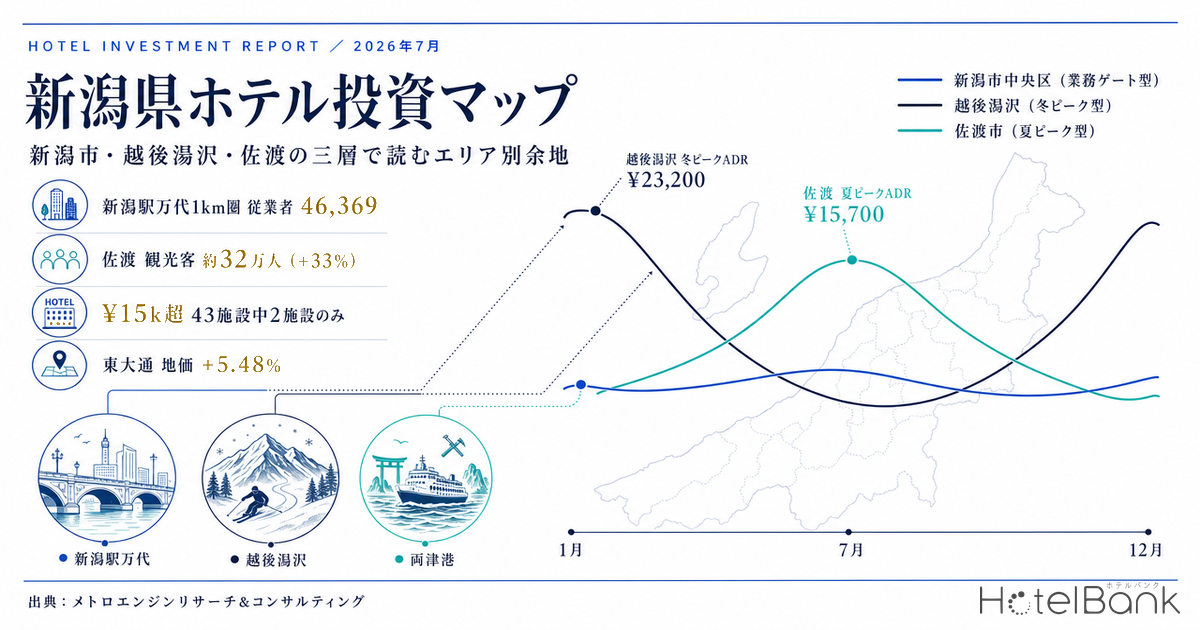
Hotel investment in Niigata Prefecture is distinguished by the coexistence, within a single prefecture, of three demand profiles of entirely different character: business demand in the prefectural capital, a seasonal ski-resort peak, and tourism growth driven by a World Heritage site. This article maps area-by-area investment headroom across three markets — central Niigata City (Niigata Station Bandai and Furumachi), Echigo-Yuzawa, and Sado City — from the perspective of regional banks, regional developers, and tourism funds, using estimated settled ADR derived from public price data, trade-area employment data, residential population mesh data, and published land prices.
Metric Definitions Used in This Article
- ADR (Average Daily Rate): An estimated settled rate (tax-exclusive equivalent) calculated by applying category-specific adjustment coefficients to the lowest published plan level each property lists on OTAs (double occupancy, per-room rate, tax-inclusive). Reconciliation against property-level actuals disclosed by listed hotel REITs (91 properties, most recent 3 months) yields a median error of approximately 7%. These are estimates and differ from each property’s actual transacted rates and accounting figures. Area-level ADR is the median of the target properties (the level of a typical property in that area).
- OCC (Occupancy Rate): The ratio of sold rooms to total room supply within an area (estimated based on OTA sales inventory).
- Listed Price: The per-room rate at double occupancy (tax-inclusive, averaged across all plans). Stated separately from ADR, as a distinct metric.
- Data Source: MetroEngines Research & Consulting
- — Niigata’s demand peaks are dispersed across three layers within one prefecture — winter (Echigo-Yuzawa), summer (Sado), and year-round business (Niigata City) — allowing portfolio design to smooth seasonal volatility.
- — Central Niigata City rests on a resilient business demand base of 46,369 workers, yet only 2 of 43 properties post an estimated settled ADR above ¥15,000, leaving headroom for new upper-midscale supply or repositioning into that band.
- — Echigo-Yuzawa holds abundant conversion stock in bubble-era resort condominiums (used units trading from several hundred thousand yen to around ¥1.5 million), leaving room to restructure toward multi-night models that capture the winter peak ADR of ¥23,200 (roughly 2.4× the summer level).
- — Sado City, in year two of World Heritage status, has expanded to roughly 320,000 visitors (+33% versus 2019, before inscription) with a summer ADR of ¥15,700. Opportunity lies in small- and mid-scale renewal that absorbs the shortfall in lodging and last-mile transport.
- — Land prices in Niigata City’s Chuo Ward have risen for 9 consecutive years (Higashi-Odori +5.48%), and the 2027 Niigata Station renewal is a tailwind for business-gateway investment.
Executive Summary — Three Demand Peaks Dispersed Across One Prefecture
To state the conclusion first, each of the three areas carries a distinct investment thesis. Central Niigata City holds stable business demand year-round, but estimated settled ADR clusters in the ¥7,000–14,000 range and the upper-midscale band above ¥15,000 is all but empty. Echigo-Yuzawa has abundant conversion stock in bubble-era resort condominiums and room to restructure lodging supply around the winter ski demand peak (+48% versus summer on an estimated settled ADR basis). Sado City, in its second year as a World Heritage site, is seeing summer tourism demand grow while a shortage of accommodation becomes increasingly visible. The sections below quantify this in the order of trade area, seasonality, and location.
(1) Central Niigata City — Quantifying the Business-Gateway Demand Base with Trade-Area Data
Chuo Ward in Niigata City is the wide-area central city of the Hokuriku-Shinetsu region, and the Niigata Station Bandai area is its business and commercial core. Trade-area data show that within a 1km radius of Niigata Station there are 3,221 establishments and 46,369 employees, of which office-type employees account for 23.8%. The Furumachi area (1km radius) has 689 establishments, 8,894 employees, and an office-type employee ratio of 26.0% — smaller in scale, but more strongly characterized as an administrative and corporate base. Data coverage is good for both, confirming that weekday business-travel and meeting demand forms a resilient foundation for lodging.
Reflecting business demand, estimated settled ADR in Niigata City’s Chuo Ward runs high during the summer event season (July–August, averaging ¥8,400) and sinks in the winter low season (January–February, averaging ¥5,600). The annual amplitude is roughly 1.9×, far less extreme than in resort locations. This “shallow trough, resilient floor” profile is precisely the signature of a business-gateway city, and represents a demand structure that investors prioritizing occupancy stability can readily underwrite.
Residential Population Mesh — Urban Living Density and 2040 Resilience
The residential population within a 1.5km radius of Niigata Station Bandai stands at 50,053 as of 2025. Ministry of Land, Infrastructure, Transport and Tourism projections put it at 47,374 even in 2040 (−5.5% versus 2025), a gentle rate of decline for a regional city. The working-age population ratio holds at 65.5%, meaning a substantial resident base coexists with business demand. The mesh map below shows the distribution of residential population in 250m mesh units.
Positioning — The Upper-Midscale Whitespace
Mapping the 43 properties in central Niigata City with 20 or more rooms for which estimated settled ADR could be observed, the market clusters densely in the ¥7,000–14,000 band. Only 2 of the 43 exceed ¥15,000, leaving the larger-scale upper price band (upper-midscale) essentially empty. As station-area redevelopment raises the quality of visitor flows — Niigata Station is scheduled for completion in 2027, and CoCoLo Niigata held its grand opening in 2024 — there is revenue headroom in new mid-scale upper-midscale supply, or in repositioning existing properties into that band, to capture senior business travelers, special-occasion stays, and affluent out-of-prefecture guests. How similar upper-band whitespace is distributed across regional core cities of designated-city rank is compared across five markets, including Niigata, in Hotel Investment in Japan’s “Second-Tier” Cities: ADR, Supply & Yield Across 5 Markets.
For reference, the table below lists the most-reviewed properties in central Niigata City. These are properties with demonstrated drawing power, and offer a guide to the demand potential of the upper band.
| Rank | Property | Rooms | Estimated Settled ADR | Review Score | Review Count |
|---|---|---|---|---|---|
| 1 | Hotel Nikko Niigata (ホテル日航新潟) | 203 | ¥12,200 | 4.01 | 18,318 |
| 2 | APA Hotel & Resort Niigata Ekimae Odori (アパホテル&リゾート〈新潟駅前大通〉) | 1001 | ¥8,300 | 3.86 | 13,849 |
| 3 | Juraku Stay Niigata (ジュラクステイ新潟) | 160 | ¥7,500 | 4.16 | 13,413 |
| 4 | APA Hotel Niigata Furumachi (アパホテル〈新潟古町〉) | 233 | ¥7,400 | 3.23 | 13,111 |
| 5 | Hotel Okura Niigata (ホテルオークラ新潟) | 265 | ¥10,800 | 3.81 | 12,619 |
| 6 | Art Hotel Niigata Ekimae (アートホテル新潟駅前) | 304 | ¥14,900 | 3.21 | 12,416 |
| 7 | Hotel Global View Niigata (ホテルグローバルビュー新潟) | 308 | ¥10,100 | 4.12 | 12,338 |
| 8 | Dormy Inn Niigata (ドーミーイン新潟) | 229 | ¥9,800 | 3.86 | 12,189 |
| 9 | Bandai Silver Hotel (万代シルバーホテル) | 222 | ¥8,200 | 3.48 | 11,467 |
| 10 | Comfort Hotel Niigata Ekimae (コンフォートホテル新潟駅前) | 196 | ¥7,900 | 4.04 | 10,045 |
(2) Echigo-Yuzawa — Bubble-Era Resort Condominium Conversion and the Economics of the Winter Peak
Echigo-Yuzawa lies roughly 70 minutes from Tokyo on the Joetsu Shinkansen, with a dense stock of resort condominiums built in volume during the bubble era clustered around the station. Trade-area data show an office-type employee ratio of just 9.6%, so business demand is thin and demand is driven primarily by skiing and onsen leisure. The seasonality of estimated settled ADR is unambiguous: January 2026 reaches ¥23,200, while the June low season falls to ¥9,700. The summer-to-winter amplitude is roughly 2.4×, with winter (January–February average ¥21,200) far above summer (July–August average ¥14,300).
From an investment standpoint, what stands out is the low acquisition cost of second-hand resort condominiums. Sectional-ownership units trade on the market from several hundred thousand yen to around ¥1.5 million, and many buildings come with shared facilities such as large onsen baths or direct ski-slope access. Aggregating individual units, or converting an entire building through renovation into a lodging business, is worth examining as a model that captures the winter ADR peak while holding down initial acquisition cost. That said, resort condominiums carry ongoing management fees and reserve contributions for repairs, and conversion is governed by the Hotel Business Act and the Condominium Ownership Act — factors that determine profitability. The simplified scenarios below therefore indicate direction only. The same trade-off — low acquisition cost set against a sharply seasonal demand curve — applies to villa and sectional-conversion investment in resort locations generally.
| Scenario (Echigo-Yuzawa sectional conversion) | A. Room-Only Focus | B. Onsen Multi-Night Preferred ◎ |
|---|---|---|
| Units converted | 10 units | 10 units |
| Assumed ADR (full-year average) | ¥12,000 | ¥16,000 |
| Winter peak ADR | ¥18,000 | ¥24,000 |
| Assumed full-year occupancy (estimated) | 45% | 50% |
| Countermeasure for the June trough | Outdoor activities, training camps | Onsen therapy stays, workation |
(3) Sado City — Year Two of World Heritage Status and the Summer-Winter ADR Gap
The Sado Island Gold Mines were inscribed as a UNESCO World Cultural Heritage site in July 2024. According to Niigata Prefecture and Sado City statistics, approximately 320,000 people visited Sado for tourism purposes in 2025, exceeding roughly 280,000 in 2024 and roughly 240,000 in 2019, before the pandemic. At the same time, total arrivals to the island have fallen below the prior year in some months as business and hometown-return travel declined — a pattern indicating that the composition of demand is shifting from “business and family visits” toward “tourism.”
This shift is clearly visible in the seasonality of estimated settled ADR. Sado City’s estimated settled ADR peaks in summer, reaching ¥15,700 in August 2025, against a winter floor of ¥7,500 (December 2024) — a summer-to-winter gap of roughly 2.1×. This summer-peak profile stands in contrast to Echigo-Yuzawa’s winter-peak profile, so that seasonal demand within the prefecture is mutually complementary.
The 2026 summer level is particularly notable. On a listings basis observed as of the survey date, August 2026 is estimated at ¥15,500 and September at ¥15,400 — a sustained high level suggesting that year-two World Heritage tourism demand is extending the summer peak later into the season (future months are estimates based on listed levels and remain subject to change). Sado has headroom in both accommodation capacity and last-mile transport to absorb this growth in summer demand, and there is scope for investment in new or renewed small- and mid-scale lodging to capture the excess demand, provided it is aligned with the region’s tourism strategy.
(4) Location Assessment — Sea-of-Japan-Side Transport Access and Disaster Risk
Transport and location characteristics differ sharply across the three areas, and materially change the preconditions for investment. Because detailed retrieval of MLIT geospatial data was partly constrained at the time of writing, published land prices and transport access are organized here from official statistics and published materials.
| Area | Primary access | Published land price / YoY | Primary demand driver | Disaster risk and considerations |
|---|---|---|---|---|
| Niigata City, Chuo Ward (Bandai) | Niigata Station (Shinkansen and conventional-line terminal) | Chuo Ward +2.12% Higashi-Odori +5.48% | Business, events | Low-lying Shinano River estuary; redevelopment in progress |
| Echigo-Yuzawa | Echigo-Yuzawa Station (Joetsu Shinkansen, approx. 70 min from Tokyo) | Leisure location, low level | Skiing, onsen | Heavy-snow region; snow-clearing costs |
| Sado City | Ryotsu Port (ferry from Niigata Port) | Island area, low level | Tourism (World Heritage) | Dependence on last-mile transport and sea freight |
Land prices in Niigata City’s Chuo Ward have risen for nine consecutive years since 2017, and “Higashi-Odori,” running from Niigata Station toward Bandai, posts a +5.48% increase — the highest rate of appreciation in the prefecture. The Niigata Station renewal scheduled for completion in 2027, together with station-area redevelopment, is pushing up both land values and visitor demand, providing a tailwind for business-gateway investment. Echigo-Yuzawa and Sado have low land price levels and correspondingly contained land acquisition costs, but require business plans that price in seasonal and geographic risk — heavy snowfall and dependence on sea transport, respectively.
Investment Summary — Headroom by Area
Central Niigata City
Business gateway × upper-midscale whitespace
A resilient demand base of 46,369 workers. Only 2 of 43 properties sit above the ¥15,000 band, leaving headroom for new supply or repositioning into the upper tier. Station redevelopment is a tailwind.
Echigo-Yuzawa
Resort condominium conversion × winter peak
Aggregate low-cost second-hand sectional units into a multi-night model that captures the ¥23,200 winter ADR peak. Scrutiny of management fees and conversion requirements is the key to profitability.
Sado City
World Heritage year two × summer excess demand
Visitors expanded to roughly 320,000 with a summer ADR of ¥15,700. Opportunity in small- and mid-scale lodging renewal that absorbs the shortfall in accommodation and last-mile transport, conditional on alignment with regional tourism strategy.
Demand peaks across the three areas are dispersed — winter (Echigo-Yuzawa), summer (Sado), and year-round business (Niigata City) — so assembling a portfolio within the region can smooth seasonal volatility. For regional banks, regional developers, and tourism funds, an investment design that combines all three layers within the prefecture, rather than concentrating on a single area, is a realistic way to contain seasonal risk while capturing growth demand. Treating a prefecture as a hierarchy of several distinct sub-markets, rather than as a single average, is a broadly applicable design method for regional hotel investment.
⚠ Note on ADR for future dates: ADR figures for future months in this article (Sado’s summer 2026 and others) are estimates based on sales prices published on OTAs as of the survey date, and will shift as new plans are added and prices adjusted closer to the check-in date. Please note that current levels may change going forward.
Related Reading
References & Sources
■ Data sources
Estimated settled ADR is derived by MetroEngines Research & Consulting from OTA public price data (Niigata City Chuo Ward N=44, Echigo-Yuzawa N=up to 53, Sado City N=up to 27 properties; period July 2024 – December 2026). Trade-area employment is based on the Economic Census for Business Activity (2021) and 2020 Population Census small-area units; residential population on National Land Numerical Information 250m mesh future population projections; land prices on the 2025 Published Land Prices; and Sado tourism statistics on materials published by Niigata Prefecture and Sado City.
■ Scenario assumptions
The Echigo-Yuzawa sectional conversion scenarios are simplified calculations premised on 10 converted units; assumed ADR and assumed full-year occupancy are estimates intended to indicate direction only. ADR for future months (Sado summer 2026 and others) is estimated from sales prices listed on OTAs as of the survey date and will change as the check-in date approaches.
■ Limitations and caveats
Estimated settled ADR is an estimate based on OTA listed prices and may differ from actual transacted amounts. Resort condominium conversion carries ongoing management fees and repair reserve contributions, and profitability is governed by conversion requirements under the Hotel Business Act and the Condominium Ownership Act, requiring property-by-property scrutiny. MLIT geospatial data was subject to partial retrieval constraints at the time of writing, and published land prices and transport access were supplemented with official statistics and published materials. This document is not intended as a solicitation to invest.
■ Market data
- MetroEngines Research & Consulting — estimated settled ADR from OTA public price data (Niigata City Chuo Ward N=44, Echigo-Yuzawa N=up to 53, Sado City N=up to 27), estimated OCC
■ Government statistics and official data
- Ministry of Internal Affairs and Communications / Ministry of Economy, Trade and Industry, “Economic Census for Business Activity (2021)”; 2020 Population Census small-area units (e-Stat Statistical GIS) — trade-area employment data
- Ministry of Land, Infrastructure, Transport and Tourism, National Land Numerical Information, “Projected Future Population by 250m Mesh (2024 National Spatial Planning Bureau estimates)”
- MLIT Published Land Prices 2025 — land prices and per-tsubo values in Niigata Prefecture (in Japanese)
■ News and tourism statistics
- “Sado Island Gold Mines” World Heritage inscription confirmed — what is the economic impact? (Honichi Lab, August 2024, in Japanese)
- Tourist arrivals in Sado City (Niigata Nippo, in Japanese)
- Sado City statistical materials: Tourism (in Japanese)
- Yuzawa resort condominium listings (Angel Fudosan, in Japanese)