

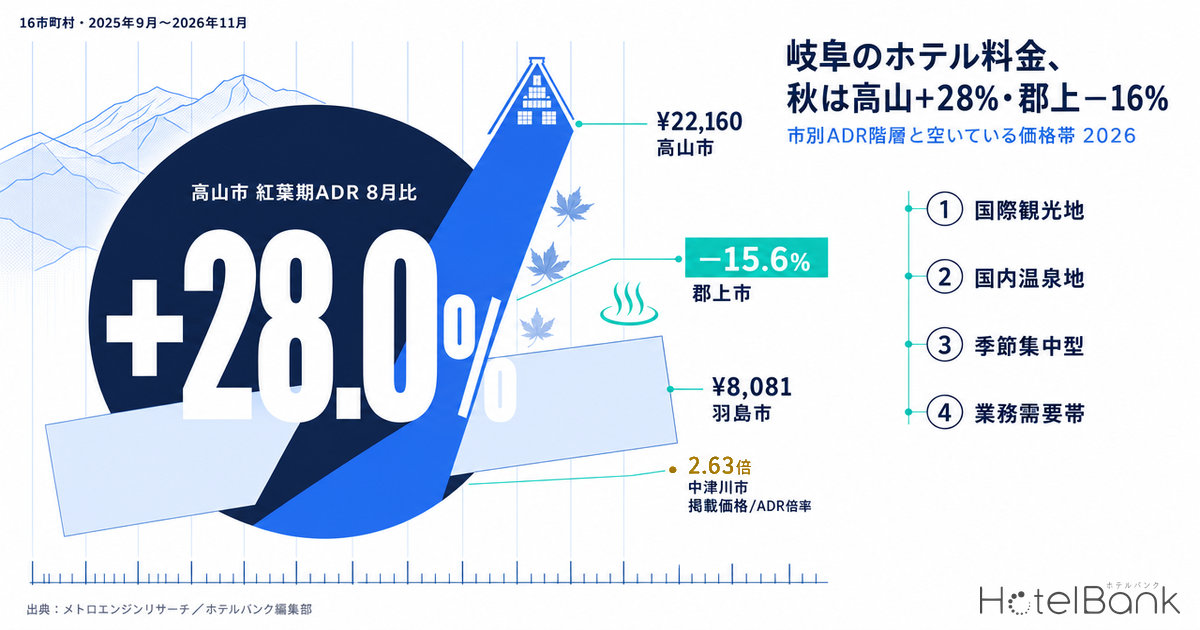
Hotel pricing in Gifu Prefecture cannot be described by a single average. The international tourist destinations of Hida, the hot spring towns along the Hida River, small markets where guests concentrate in one season, and the business-demand belt of the Nobi Plain all sit within the same prefecture, yet each has its own price level and its own seasonal pattern. Lining up the estimated settled ADR (average daily rate) for 16 Gifu municipalities from September 2025 to November 2026 using monthly data from MetroEngines Research shows cities where ADR rises as much as +28.0% in the autumn foliage season (October–November) versus August, alongside cities where it falls −15.6% because summer is their peak. This article splits the prefecture’s lodging market into four tiers and maps out the price hierarchy and where the “open price bands” that do not rise in autumn can be found.
Metric Definitions Used in This Article
- ADR (average daily rate): An estimated settled rate (tax-excluded equivalent), calculated by applying a property-type adjustment factor to the lowest-plan price level each property publishes on OTAs and other booking sites (per room, 2 guests, tax included). Checked against property-level results disclosed by listed hotel REITs (91 properties, most recent 3 months), the median error is about 7%. These are estimates and differ from each property’s actual settled prices and accounting figures. Area-level ADR is the median of the properties covered (the level of a typical property in the area).
- Listed price: The average of all plans listed on booking sites (from room-only to two-meal plans; per room, 2 guests, tax included). Its basis differs from the ADR above, so this article always keeps the two distinct.
- Differences in basis: Figures through July 2026 use a verified basis built on finalized history; figures from August 2026 onward use an estimated basis calculated from listings at the time of the survey. The “vs. August” comparisons in this article compare the latter basis with itself, so the basis is consistent. Year-over-year changes cannot be compared on a consistent basis, so they are shown on the listed price side, which can be aggregated on a single basis throughout.
- Data source: MetroEngines Research (aggregation period September 2025 – November 2026)
- — Gifu Prefecture’s foliage-season ADR (average of October–November 2026) is ¥14,614, the highest level in the aggregation period. That is +14.5% vs. August, and the listed price is +10.0% year over year.
- — Takayama, the largest market, posts ADR of ¥22,160, +28.0% vs. August — the biggest rise in the prefecture. 281 listed properties; 129 properties in the ADR calculation.
- — Gujo is −15.6% vs. August, with summer as its peak. Hida (−9.2%) and Ibigawa (−13.5%) also fall in the foliage season, coexisting in the same prefecture.
- — The ratio of listed price to estimated settled ADR is 1.5–1.6x in the business-demand belt and 1.8–2.6x in hot spring and tourist areas. Differences in the products being sold show up in the ratio.
- — The gap between the highest and lowest municipality in the prefecture is 2.78x. That is almost the same shape as Nagano (2.83x), and structurally different from Ishikawa (1.92x) and Aichi (1.84x).
Gifu’s Prefecture-Wide ADR Reaches Its Annual High in the Foliage Season
Start with the outline of the prefecture as a whole. Gifu’s ADR is projected at ¥14,572 in October 2026 and ¥14,655 in November, the highest levels in the aggregation period. Compared with ¥12,764 in August 2026, that is +14.6%, and even within the range that can be compared on the same basis, the foliage season forms the annual peak. On the listed-price side, the October–November 2026 average of ¥30,761 is +10.0% against ¥27,955 for the same period of 2025, showing that double-digit growth is continuing.
The shape of the season itself is little changed from prior years. The chart below overlays prefecture-wide ADR by year: a two-peak pattern — troughs in February and June, peaks in August and October–November — lines up neatly across three years. ADR drops to ¥9,623 in June, before the end of the rainy season, and then builds up by nearly ¥5,000 toward the foliage season. This swing is the basic rhythm of Gifu’s lodging market.
Source: MetroEngines Research; compiled by HotelBank Editorial Team
The Price Hierarchy in Four Tiers — ¥20,000+ at the Top, Around ¥10,000 in the Business-Demand Belt
Behind the prefectural average lies a clear hierarchy. Ranking foliage-season ADR (October–November average) by municipality, the top group clusters above ¥20,000: Shirakawa Village ¥22,450, Takayama ¥22,160, and Gero ¥20,336. The middle group follows with Nakatsugawa ¥14,898, Seki ¥13,107, and Gifu City ¥12,253, while the bottom group sits around ¥10,000: Ogaki ¥9,744, Minokamo ¥9,912, and Tajimi ¥10,000. The gap between the top and bottom groups is about 2.3x.
This ranking is not simply a story of “tourist areas are expensive, cities are cheap.” Each tier has different demand and a different product design, so each reacts to the seasons differently. How this four-tier structure formed is also covered in Gifu’s Hotel Market in 4 Tiers 2026: ADR from ¥6,200 to ¥16,500. Below, we look at each of the four tiers in turn.
Source: MetroEngines Research; compiled by HotelBank Editorial Team
| Municipality | Properties (Oct) |
Properties in ADR calc. |
Foliage ADR (Oct–Nov avg) |
vs. Aug | Listed price (Oct–Nov avg) |
Listed vs. Aug |
Listed YoY |
|---|---|---|---|---|---|---|---|
| ① International tourist destination Hida area with a high share of inbound visitors | |||||||
| Takayama | 281 | 129 | ¥22,160 | +28.0% | ¥40,782 | +15.4% | +13.7% |
| ② Domestic hot spring towns Mainly ryokan with meals included | |||||||
| Gero | 60 | 44 | ¥20,336 | +19.0% | ¥41,928 | +1.3% | +2.4% |
| Nakatsugawa | 31 | 11 | ¥14,898 | +24.2% | ¥39,200 | +9.2% | +14.1% |
| ③ Seasonal, small-scale markets Few properties, so individual properties move the average | |||||||
| Shirakawa Village | 16 | 8 | ¥22,450 | +11.8% | ¥40,910 | +7.4% | -9.0% |
| Gujo | 71 | 23 | ¥11,632 | -15.6% | ¥26,488 | -6.0% | +15.3% |
| Ibigawa Town | 4 | 2 | ¥12,050 | -13.5% | ¥53,207 | -5.0% | -10.8% |
| Hida | 27 | 13 | ¥10,381 | -9.2% | ¥27,168 | -3.9% | +10.0% |
| Ena | 27 | 14 | ¥10,888 | +8.5% | ¥21,798 | -3.9% | +15.3% |
| Seki | 8 | 4 | ¥13,107 | +15.7% | ¥28,018 | +3.1% | +1.9% |
| ④ Business-demand belt Supported by weekday business travel | |||||||
| Gifu City | 51 | 32 | ¥12,253 | +22.1% | ¥18,656 | +24.4% | +10.2% |
| Ogaki | 15 | 11 | ¥9,744 | -5.0% | ¥15,425 | +4.7% | -1.8% |
| Kakamigahara | 9 | 5 | ¥12,434 | +68.8% | ¥13,870 | +23.9% | -20.2% |
| Kani | 7 | 6 | ¥10,046 | +40.9% | ¥15,062 | +12.9% | +3.7% |
| Minokamo | 8 | 7 | ¥9,912 | +10.1% | ¥15,958 | +3.4% | +17.4% |
| Tajimi | 8 | 6 | ¥10,000 | +4.9% | ¥15,722 | +1.6% | +11.8% |
| Hashima | 13 | 8 | ¥8,081 | +23.6% | ¥13,236 | +4.6% | +11.1% |
Source: MetroEngines Research; compiled by HotelBank Editorial Team (listed property counts as of October 2026)
Note on sample size: ADR is calculated from properties in categories whose property type has been verified (business, city, resort, ryokan, capsule), and “Properties in ADR calc.” is that base. Ibigawa has only 1–2 properties in the calculation, and Kakamigahara falls to 4 properties in November, so these series include months with coverage thinner than the series median. In these municipalities the sales of 1–2 properties move the average significantly, so treat the figures as a guide to direction rather than level. The same applies to Seki (4 properties).
① Takayama — The Largest Market, Backed by Inbound Demand, +28.0% vs. August in Foliage Season
With 281 listed properties (as of October 2026), Takayama is by far the largest market in the prefecture. ADR rises from ¥17,312 in August 2026 to ¥22,923 in October and ¥21,398 in November, putting the October–November average +28.0% above August. The listed price also rises +15.4%, from ¥35,351 to ¥40,782, and is +13.7% year over year, making Takayama the prefecture’s leader on both level and growth.
Behind this is the depth of inbound demand. According to Takayama City, in 2025 tourist arrivals reached 4,795,000 and foreign overnight guests 978,312, both the highest since the 2005 municipal merger. For Gifu Prefecture as a whole, foreign guest nights in 2024 were a record 2,305,600, ranking 11th nationwide. Autumn in Hida is when long stays from Europe, North America and Australia overlap with domestic foliage demand, and this double layer of demand creates the price step.
Note that October (¥22,923) is higher than November (¥21,398). Autumn foliage in the Hida area peaks at different times by elevation: the high-altitude side, such as Norikura and Hirayu, peaks in mid-October, while central Takayama peaks in early November. The October price peak likely reflects the concentration of high-altitude foliage, the autumn holiday weekends, and the Takayama Festival (Autumn Hachiman Festival) on October 9–10 in the same month. A new opening of about 283 rooms is also scheduled in the Takayama area in September 2026; how that supply enters this high-ADR tier is analyzed in detail in Hilton Takayama Resort Opens Sept 14: 283 Rooms Into a 562-Room Tier.
② Gero and Nakatsugawa — Ryokan With Meals Dominate, and the Listed-Price-to-ADR Ratio Widens
Gero has 60 listed properties, and ADR rises +19.0% from ¥17,088 in August to ¥20,336 in the foliage season. On the listed-price side, Gero is among the highest in the prefecture at ¥41,928, but it moves little: +1.3% vs. August and +2.4% year over year. ADR rises by double digits while the listed price is nearly flat. This gap shows that Gero’s inns keep high-priced two-meal plans listed all year, so seasonal variation shows up in the price bands that actually sell.
Nakatsugawa has the same structure, with ADR up +24.2% from ¥12,000 in August to ¥14,898 in the foliage season. Against a listed price of ¥39,200, ADR is ¥14,898, a ratio of 2.63x — the widest in the prefecture. The city has autumn attractions such as Magome-juku, Tsukechi Gorge and Ena Gorge, and its accommodation is mainly ryokan and old folk-house inns.
The ratio of listed price to ADR can serve as an indicator of what kind of product a market sells. As the table below shows, the business-demand cities stay within 1.5–1.6x, while hot spring and tourist areas widen to 1.8–2.6x. In room-only markets, listed prices and settled levels are close; in markets dominated by two-meal plans, high-priced listed plans push the average up.
| Municipality | Listed price (Oct–Nov avg, tax incl.) |
ADR (est. settled, tax excl. equiv.) |
Ratio | Tier |
|---|---|---|---|---|
| Gero | ¥41,928 | ¥20,336 | 2.06x | Domestic hot spring |
| Nakatsugawa | ¥39,200 | ¥14,898 | 2.63x | Domestic hot spring |
| Gujo | ¥26,488 | ¥11,632 | 2.28x | Seasonal |
| Shirakawa Village | ¥40,910 | ¥22,450 | 1.82x | Seasonal |
| Takayama | ¥40,782 | ¥22,160 | 1.84x | International tourist |
| Gifu City | ¥18,656 | ¥12,253 | 1.52x | Business demand |
| Minokamo | ¥15,958 | ¥9,912 | 1.61x | Business demand |
| Ogaki | ¥15,425 | ¥9,744 | 1.58x | Business demand |
| Kani | ¥15,062 | ¥10,046 | 1.50x | Business demand |
| Hashima | ¥13,236 | ¥8,081 | 1.64x | Business demand |
Source: MetroEngines Research; compiled by HotelBank Editorial Team (average of October–November 2026)
③ Seasonal Small Markets — Gujo Peaks in Summer, −15.6% vs. August in Foliage Season
The third tier consists of markets with few properties where guests concentrate in a particular season. The most distinctive is Gujo. ADR hits one of its highest levels of the year at ¥13,782 in August 2026, then falls to ¥11,235 in October and ¥12,028 in November, leaving the foliage season −15.6% vs. August. The listed price points the same way: ¥26,488 in the foliage season against ¥28,189 in August, or −6.0%.
Gujo hosts the all-night dances of the Gujo Odori festival in August, which overlap with summer-escape demand in the Hirugano Highlands and Gujo Hachiman. It is the only place in the prefecture with a price curve that clearly peaks in summer. Year over year, however, the listed price is up +15.3%, so the autumn level itself is higher than last year. “Down vs. August, but up year over year” — the two are not contradictory.
Hida (−9.2% vs. August) and Ibigawa (−13.5%) are also on the side that falls in the foliage season. Ibigawa, however, has an extremely thin base of 1–2 properties in the ADR calculation and only 4 listed properties. Because the sales of a single property can swing the figure substantially, we avoid reading it as more than a tendency. Ena (+8.5%) and Seki (+15.7%) are on the rising side, but their calculation bases are also limited, at 14 and 4 properties respectively.
Shirakawa Village has only 16 properties, yet its ADR of ¥22,450 is the highest in the prefecture, +11.8% vs. August. This is a market with an irreplaceable asset — its gassho-zukuri farmhouse village — and given a calculation base of just 8 properties, the picture is one of a small number of inns holding a high level. The listed price is −9.0% year over year, but that too needs to be read in light of the small base.
Source: MetroEngines Research; compiled by HotelBank Editorial Team
④ Business-Demand Belt — Gifu City +22.1%, Ogaki and Minokamo Barely Move
The business-demand belt on the Nobi Plain side is the tier with the most stable prices in the prefecture. Foliage-season ADR is ¥12,253 in Gifu City, ¥12,434 in Kakamigahara, ¥10,046 in Kani, ¥9,912 in Minokamo, ¥9,744 in Ogaki, ¥10,000 in Tajimi, and ¥8,081 in Hashima. The gap with the top tourist areas is more than 2x.
Movement within this tier is not uniform. Gifu City rises +22.1% vs. August on ADR and +24.4% on listed price, on par with the tourist areas. Its city-center hotels are positioned to capture tourist demand too, and with 51 listed properties it is the largest market in the business-demand belt. Its listed price is also up +10.2% year over year.
Ogaki, by contrast, stays in a near-flat range: ADR −5.0% and listed price +4.7% vs. August. Minokamo (+10.1%, listed price +3.4%) and Tajimi (+4.9%, listed price +1.6%) also show limited movement. Weekday business travel supports these markets year-round, so seasonal swings are smaller.
Kakamigahara (+68.8%) and Kani (+40.9%) show large increases on paper, but only 5–6 properties are in their ADR calculations, and Kakamigahara drops to 4 in November. These two cities’ increases very likely include swings caused by changes in the sales mix of a few properties, so we avoid comparing their levels side by side with other cities.
Mapping Property Distribution Against ADR
The map below overlays the number of listed properties (circle size) and foliage-season ADR (color) for the prefecture’s 16 municipalities. Takayama, with a large, dark circle, sits at the center of the Hida area, with Gero to the south and Shirakawa Village to the west. On the Nobi Plain side, by contrast, the circles are small and light. In the north of the prefecture, where properties cluster and where prices are high largely coincide.
Source: MetroEngines Research; compiled by HotelBank Editorial Team
Supply Side — A 120-Room Project Due in 2028; Coverage Limited to Listed Properties and Public Plans
Supply trends also matter when reading the price hierarchy. Among publicly available building plans, the only hotel project in Gifu Prefecture with a confirmed room count is in Yamate-cho, Minokamo. The developer is AB Hotel, with 120 rooms in an eight-story building scheduled for completion in December 2028. Minokamo currently has 8 listed properties, 7 of which are in the ADR calculation, so the impact of adding 120 rooms to this tier is not small. The city’s foliage-season ADR of ¥9,912 is near the bottom of the prefecture, and it moves only modestly at +10.1% vs. August. The project adds new capacity to a business-demand belt underpinned by the Chukyo region’s manufacturing industry.
Recent openings have also leaned toward the Hida side. Gifu properties confirmed as operating on booking sites since 2025 include Super Hotel Gifu Nakatsugawa Natural Hot Spring (スーパーホテル岐阜・中津川天然温泉, 142 rooms), Hotel Amanek Hida Takayama (ホテルアマネク飛騨高山, 153 rooms), KOKO HOTEL Hida Takayama (KOKO HOTEL 飛騨高山, 139 rooms), TAOYA Gero (TAOYA下呂, 99 rooms), Yutoria Resort Hida Takayama (ユトリアリゾート飛騨高山, 104 rooms), and Toyoko Inn Gifu (東横イン岐阜, 207 rooms). Projects of more than 100 rooms are concentrated in Takayama, Gero, Nakatsugawa and Gifu City, bringing supply into both the top price tier and the business-demand belt. For existing properties in Hida’s high-ADR tier, how profitability shifts as this supply arrives is a key question to watch.
About the coverage of supply data: Opening records are properties confirmed as operating on major booking sites, and planned projects are based on publicly available building plans; neither is a complete census. Because booking-site listings begin several months before opening, counts for recent months may increase as more listings appear. Planned projects are based on building confirmation applications, and counts and room numbers are expected to rise as applications are added, so treat them as a lower bound on the confirmed pipeline at this time.
Sources: MetroEngines Research & Consulting (based on booking-site listing confirmation) / Ministry of Land, Infrastructure, Transport and Tourism, “Building Construction Statistics”
Where Are the “Open Price Bands” That Don’t Rise in Autumn?
Let us flip the analysis so far to the perspective of those bringing lodging demand. There are three bands in the prefecture where prices are unlikely to rise in the foliage season.
The first is Gujo and Hida. Gujo is −15.6% vs. August and Hida −9.2%, with levels dropping in autumn after the summer peak. Gujo keeps 71 listed properties in the foliage season, the second-largest count in the prefecture, so the range of options remains broad. Hida (Furukawa) is about 15 minutes by train from Takayama, yet its foliage-season ADR of ¥10,381 is 47% of Takayama’s level.
The second is part of the business-demand belt, including Ogaki, Minokamo and Tajimi. Their change vs. August is small, from −5.0% to +10.1%, and only +1.6% to +4.7% on a listed-price basis. Weekday business travel supports prices here all year, so levels are slow to jump even when weekend tourist demand comes in. Tajimi is just over 30 minutes from Nagoya by rapid train, and Kani and Minokamo connect to the Ena Gorge and Magome areas via the Tokai-Kanjo Expressway.
The third is late November within the same city. Takayama is ¥22,923 in October against ¥21,398 in November, so October is the peak even on a monthly basis. Prefecture-wide, October (¥14,572) and November (¥14,655) are nearly level, but the higher the tier, the more demand shifts toward October.
In autumn 2026, Gifu Prefecture is also running the “Tanoshisugiruzo Gifu! Discount Benefits Campaign” (楽しすぎるぞ岐阜!割引特典キャンペーン, September 1, 2026 – February 28, 2027). Scanning an in-store QR code at participating outdoor facilities, accommodations, restaurants and souvenir shops in the prefecture gives access to discounts, novelty gifts and other benefits. The program does not directly change room rates, but in Gifu, with its clear price hierarchy, there is room to consider it alongside the choice of which tier to stay in.
Compared With Neighboring Prefectures — Top of Chubu–Hokuriku on Level, Nagano-Type on Spread
So far we have looked inside Gifu Prefecture, but it is also worth checking where this level and pattern of movement stand relative to its neighbors. The table below lines up eight Chubu and Hokuriku prefectures on the same basis (estimated settled ADR, average of October–November 2026).
| Prefecture | Foliage ADR (Oct–Nov avg) |
vs. Aug | Listed properties (Oct) |
Properties in ADR calc. |
|---|---|---|---|---|
| Ishikawa | ¥14,689 | +25.0% | 508 | 233 |
| Gifu | ¥14,614 | +14.5% | 690 | 355 |
| Nagano | ¥14,163 | −0.6% | 1927 | 755 |
| Mie | ¥12,827 | +2.0% | 563 | 334 |
| Fukui | ¥12,365 | −1.1% | 350 | 202 |
| Aichi | ¥12,281 | +30.3% | 713 | 474 |
| Shiga | ¥11,607 | +1.6% | 326 | 147 |
| Toyama | ¥11,400 | ±0.0% | 264 | 160 |
Source: MetroEngines Research; compiled by HotelBank Editorial Team (average of October–November 2026)
Gifu’s foliage-season ADR of ¥14,614 ranks 2nd of the eight prefectures, just behind Ishikawa at ¥14,689. On level, it is fair to say Gifu sits near the top of Hokuriku and Chubu. Its rise vs. August, however, is +14.5%, not as steep as Ishikawa (+25.0%) or Aichi (+30.3%). That is because autumn looks different in Gifu, which already has a solid level in August, than in prefectures where summer is a trough. Nagano (−0.6%) and Fukui (−1.1%) stay below August even in the foliage season.
It is also worth comparing the spread within each prefecture. Taking the highest and lowest values among municipalities with at least 5 properties in the ADR calculation, Gifu’s spread is 2.78x: Shirakawa Village ¥22,450 against Hashima ¥8,081. On the same basis, Nagano’s is 2.83x — Karuizawa ¥24,128 against Ina ¥8,530 — almost the same spread. Ishikawa, on the other hand, is 1.92x (Kaga ¥19,736 against Hakusan ¥10,254), and Aichi is 1.84x (Nakamura Ward, Nagoya ¥16,089 against Ichinomiya ¥8,751), with neither reaching 2x.
In other words, Gifu sits alongside Ishikawa near the top on prefectural average level, but its internal price structure is closer to Nagano’s. As prefectures where international tourist destinations, hot spring towns, small markets and a business-demand belt coexist, each with its own demand curve, Gifu and Nagano belong to the same type. The difficulty of describing either with a single prefectural average is also something the two share.
Summary — Four Price Markets in One Prefecture
Gifu’s lodging market cannot be explained by a single point such as the prefectural average of ¥14,572 (October 2026). Takayama, which moves +28.0% in the foliage season on inbound demand; Gero, where ADR rises +19.0% even though the listed price is flat; Gujo, which peaks in summer and is −15.6% in autumn; and Ogaki and Tajimi, which move only about ±5% with the seasons — these are four markets within the same prefecture, each with its own demand curve.
From an operator’s perspective, the shape of the price a property can achieve in the foliage season depends on which tier it belongs to. In the top tier, there is room to build prices in stages from long-lead-time bookings, on the premise that demand shifts toward October. In the business-demand belt, where year-round support is solid, upside remains in product design that captures weekend and holiday tourist demand. In seasonal small markets, the core design question is how to spread peak-season levels across annual revenue.
On the supply side, a 120-room project due for completion in 2028 is planned in Minokamo, and openings of more than 100 rooms have recently continued in the Hida area. The price hierarchy is not fixed; it is rearranged tier by tier, starting where supply enters. The next time you read prices in the prefecture, start by confirming which tier is being discussed.
Related Articles
- Gifu’s Hotel Market in 4 Tiers 2026: ADR from ¥6,200 to ¥16,500
- Hilton Takayama Resort Opens Sept 14: 283 Rooms Into a 562-Room Tier
⚠ Note on ADR for future dates: ADR and listed prices for September 2026 onward in this article are estimates based on selling prices published on booking sites at the time of the survey, and they will change as check-in dates approach. Prices currently set high may fall with last-minute adjustments, and levels may also shift as new plans are added. Year-over-year changes are shown on a listed-price basis to align for this difference in the estimated basis.
References and Sources
■ Data Sources
Monthly ADR and listed prices for 16 Gifu municipalities and 8 Chubu–Hokuriku prefectures were collected daily and aggregated by MetroEngines Research from published selling prices on major booking sites (aggregation period September 2025 – November 2026; listed property counts as of October 2026). Municipal figures within the prefecture are property-weighted medians, and prefectural figures are calculated with the same definition. Foreign guest nights and tourist arrivals are from statistics published by Gifu Prefecture and Takayama City; supply plans are based on publicly available building plans.
■ Calculation Assumptions
Estimated settled ADR is an estimate (tax-excluded equivalent) calculated by applying a property-type adjustment factor to each property’s lowest-plan price level (per room, 2 guests, tax included). “Foliage season” is the simple average of October and November 2026, and “vs. August” refers to a comparison on the same basis (estimated basis vs. estimated basis). Year-over-year changes cannot be aligned on basis, so they are shown only on the listed-price side, which can be carried on a single basis. The ratio is listed price ÷ estimated settled ADR. Intra-prefecture spreads (such as 2.78x) take the highest and lowest values among municipalities with at least 5 properties in the ADR calculation.
■ Limitations and Caveats
The ADR in this article is an estimate, not actual accounting data; checked against property-level disclosures by listed hotel REITs (91 properties, most recent 3 months), the median error is about 7%. For municipalities with a thin base of 1–6 properties in the ADR calculation, such as Ibigawa, Seki, Kakamigahara and Kani, the sales of 1–2 properties can swing the figures significantly, so treat them as a guide to direction rather than level. Figures from September 2026 onward are estimates based on listed prices for future dates and will change as check-in dates approach. Supply coverage is limited to major booking-site listings and public building plans and is not a complete census.
■ Market Data
- MetroEngines Research — Monthly ADR and listed prices for 16 Gifu municipalities (September 2025 – November 2026; listed property counts as of October 2026)
- MetroEngines Research & Consulting — New opening records (based on booking-site listing confirmation)
■ Government and Municipal Statistics
- Ministry of Land, Infrastructure, Transport and Tourism, “Building Construction Statistics” — Building plan (Minokamo, 120 rooms, completion scheduled December 2028)
- Gifu Prefecture, “Tourism Statistics” (Tourism Planning Division) — Foreign guest nights 2,305,600 (2024, record high, 11th nationwide)
- Takayama City, “Tourism Statistics”
- Japan Tourism Agency, “Overnight Travel Statistics Survey”
■ Municipal Campaigns and News Coverage