

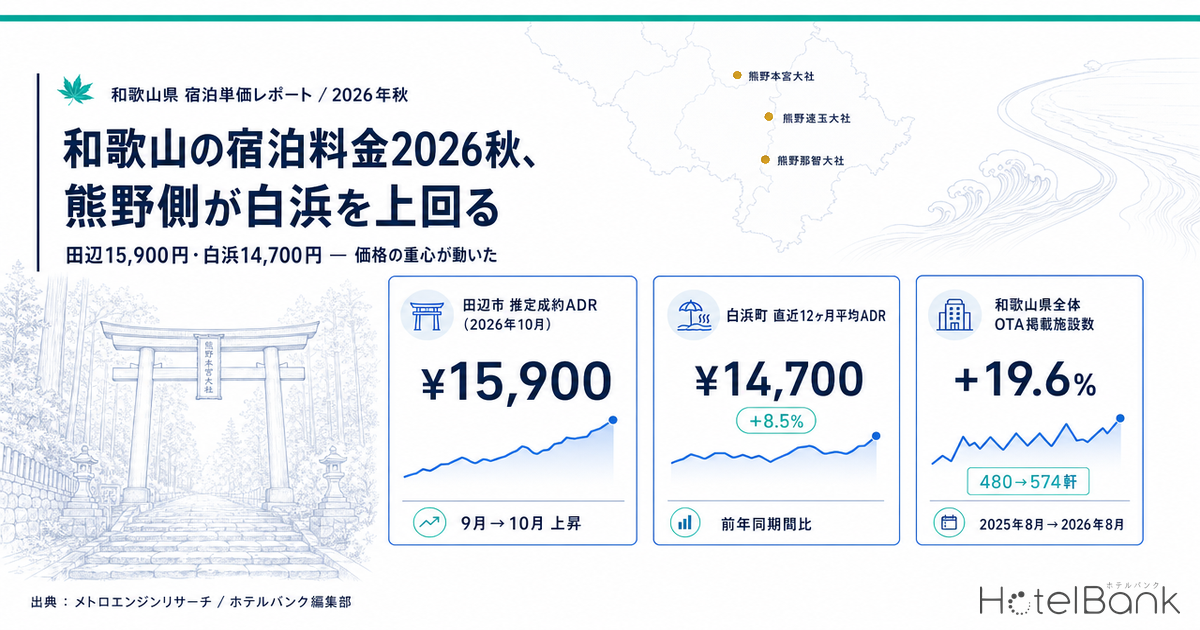
Wakayama Prefecture’s hotel pricing is shifting its center of gravity. According to MetroEngines Research, the estimated settled ADR as of October 2026 is approximately ¥15,900 in Tanabe City and ¥14,800 in Nachikatsuura Town — matching or exceeding Shirahama Town (approximately ¥14,700), which has long been the benchmark for resort pricing in the prefecture. Meanwhile, Shirahama’s listed property count has grown roughly 20% in a single year, from 127 to 151 properties, and its trailing 12-month average rate is up 8.5% year on year. This article examines how the price structure has been rearranged between Shirahama and Kumano (Tanabe, Hongu, Nachikatsuura and Kushimoto), drawing on municipality-level monthly data, supply composition, and Wakayama Prefecture’s visitor movement survey.
Metric Definitions Used in This Article
- ADR (average daily rate) = an estimated settled rate (tax-excluded equivalent) calculated by applying a property-type correction factor to the lowest published plan rate each property lists on OTAs and similar channels (two guests per room, per-room rate, tax included). Cross-checked against property-level results disclosed by listed hotel REITs (91 properties, trailing three months), the median error is approximately 7%. These are estimates and differ from each property’s actual transacted rates and accounting figures. Area-level ADR is the median across the covered properties (the level of a typical property in that area).
- Listed property count = the number of properties whose selling rates could be observed on OTAs and similar channels in the given month. The property count used to calculate ADR (shown as N= in the text) is limited to those with a confirmed property type, so it is smaller than the listed property count.
- Data source: MetroEngines Research. Months from August 2026 onward are estimates based on listed rates at the time of the survey, prior to recalculation on a confirmed basis.
- — Tanabe City at ¥15,900 and Nachikatsuura Town at ¥14,800 have overtaken Shirahama Town’s ¥14,700 (October 2026, median estimated settled ADR). In the same period of 2025, Shirahama was more than 20% higher — the prefecture’s price hierarchy has inverted within a year.
- — Shirahama Town’s trailing 12-month average is up 8.5% year on year. The August peak is down 11.7% against the prior year, but the listed property count turned over from 127 to 151 in the same window, so the pattern reads as flattening — a lower peak and a higher trough.
- — Prefecture-wide listed property count rose from 480 to 574 properties (+19.6%). The increase is concentrated in inventory of 10 rooms or fewer; in Shirahama Town, 144 properties have 10 rooms or fewer yet account for only 15% of rooms.
- — Even after four giant pandas were returned to China, summer 2025 visitor arrivals in the former Shirahama Town area held at 101.2% of the prior year (352,400 overnight guest-nights). Volume held; what moved was the center of gravity in rate.
- — Two price-band gaps stand out. Shirahama Town has just 2 properties and 102 rooms in the ¥30,000–50,000 band, and the Kumano side is effectively empty above ¥25,000. On medians, the Kumano Hongu area at ¥17,300 sits above Shirahama Town at ¥16,900.
Shirahama’s annual average is up 8.5%; only the peak month has flattened
Start with Shirahama Town’s monthly trend. The trailing 12-month average estimated settled ADR (September 2025 to August 2026) is ¥14,700, against ¥13,500 for the preceding 12 months (September 2024 to August 2025) — up 8.5%. The year-round lift in rate is unambiguous. The sample covers properties within Shirahama Town with a confirmed property type, N=51–63, varying by month.
What changed, though, is August — the peak month. The estimated settled ADR for August 2025 was ¥17,700, the highest month of the year. August 2026 came in at ¥15,600, down 11.7% year on year. It would be premature to read that as “rates fell.” Over the same period, Shirahama Town’s OTA-listed property count rose 18.9%, from 127 to 151. This is a median taken after roughly 20% of the sample turned over, and the straightforward reading is that the peak-month spike has softened while the year as a whole has levelled up. Indeed, the off-season months — November 2025 (¥16,600), December 2025 (¥17,400) and January 2026 (¥16,900) — all came in well above the same months a year earlier.
Source: MetroEngines Research; compiled by the HotelBank Editorial Team (Shirahama Town, median estimated settled ADR, N=51–63 properties)
A lower seasonal peak and a higher trough is, if anything, easier to manage for operations aiming at year-round utilization. The structure is moving away from generating most of the year’s revenue in two weeks of summer, toward one in which the onsen demand of November–January and the leisure demand of March–May also carry rate.
Autumn 2026: Tanabe at ¥15,900 and Nachikatsuura at ¥14,800 top Shirahama’s ¥14,700
The larger change is in the prefecture’s price hierarchy itself. Comparing estimated settled ADR for September and October 2026, Tanabe City comes in at ¥15,600 and ¥15,900, and Nachikatsuura Town at ¥13,800 and ¥14,800. Shirahama Town sits at approximately ¥14,700 in both months. In the autumn shoulder season at least, the Kumano side has moved into a rate band equal to or above Shirahama’s. In the same period of 2025, Shirahama was at ¥13,300 and ¥14,000 against Tanabe’s ¥11,600 and ¥11,500 — more than 20% higher. The order has flipped in a single year.
Source: MetroEngines Research; compiled by the HotelBank Editorial Team (Shirahama Town N=51–63 properties / Tanabe City N=27–30 properties, median estimated settled ADR)
| Municipality | Aug 2025 | Aug 2026 | Trailing 12M avg YoY change | Oct 2026 (estimate) | Listed properties Aug 2025 → Aug 2026 | N (ADR basis) |
|---|---|---|---|---|---|---|
| Shirahama Town | ¥17,700 | ¥15,600 | +8.5% | ¥14,700 | 127 → 151 (+18.9%) | 51–63 |
| Tanabe City | ¥14,900 | ¥14,100 | +1.6% | ¥15,900 | 71 → 94 (+32.4%) | 27–30 |
| Nachikatsuura Town | ¥13,300 | ¥13,400 | +3.9% | ¥14,800 | 37 → 44 (+18.9%) | 14–15 |
| Kushimoto Town | ¥8,000 | ¥8,900 | +4.0% | ¥9,200 | 27 → 28 | 4–7 |
| Wakayama City | ¥7,500 | ¥10,300 | +6.9% | ¥9,600 | 55 → 65 | 39–46 |
| Wakayama Prefecture total | ¥12,000 | ¥11,400 | — | ¥11,300 | 480 → 574 (+19.6%) | 202–230 |
Source: MetroEngines Research; compiled by the HotelBank Editorial Team. Figures in the text are rounded to the nearest ¥100. Kushimoto Town has a small sample (N=4–7) and should be treated as a reference value.
Sample size deserves attention here. The ADR basis is N=27–30 properties for Tanabe City, N=14–15 for Nachikatsuura Town, and as few as N=4–7 for Kushimoto Town. Compared with Shirahama Town’s N=51–63, figures on the Kumano side are more easily moved by the pricing of a handful of properties. Kushimoto Town’s August year-on-year change (+11.6%) in particular is a median of N=5–6 properties: useful as an indication of direction, but not for asserting a level. With that caveat, the increases in Tanabe City and Nachikatsuura Town run across both September and October, so they are not a single-month blip.
Listed properties are up 19.6% prefecture-wide, and the growth is small-scale inventory
Before discussing rate, it is worth pinning down supply. Across Wakayama Prefecture, properties with observable rates on OTAs rose 19.6%, from 480 in August 2025 to 574 in August 2026. By municipality, Tanabe City grew fastest at +32.4% (71 → 94), followed by Shirahama Town at +18.9% (127 → 151) and Nachikatsuura Town at +18.9% (37 → 44).
Source: MetroEngines Research (based on confirmed OTA listings); compiled by the HotelBank Editorial Team
The size distribution shows what that growth consists of. Within the scope MetroEngines Research covers, Shirahama Town has 237 properties and 4,034 rooms, of which 144 properties and 622 rooms are small properties with 10 rooms or fewer. That is 60% of properties but only 15% of rooms. Tanabe City is similar: 115 properties and 489 rooms of its 165 properties and 2,194 rooms have 10 rooms or fewer. In other words, much of the 20–30% rise in listed property counts is explained not by large new hotel openings but by minshuku, vacation rentals and small ryokan becoming visible on OTAs.
| Area | Properties | Rooms | Of which ≤10 rooms | Rooms in ≤10-room properties |
|---|---|---|---|---|
| Shirahama Town | 237 | 4,034 rooms | 144 properties | 622 rooms |
| Tanabe City (incl. Hongu: 53 properties, 806 rooms) | 165 | 2,194 rooms | 115 properties | 489 rooms |
| Nachikatsuura Town | 66 | 1,163 rooms | 40 properties | 143 rooms |
| Kushimoto Town | 55 | 810 rooms | 36 properties | 166 rooms |
| Wakayama City | 106 | 4,005 rooms | — | — |
Source: MetroEngines Research (based on confirmed OTA listings, N=1,008 properties across Wakayama Prefecture); compiled by the HotelBank Editorial Team
Room distribution seen through Nanki-Shirahama Airport, the Kumano Sanzan shrines and Adventure World
Behind the shift in the center of gravity lies the underlying geography. The southern Kii Peninsula holds two demand areas of very different character side by side: Shirahama in the west, a coastal resort anchored by Nanki-Shirahama Airport and Adventure World; and Kumano to the inland and east, home to the Kumano Sanzan — Kumano Hongu Taisha, Kumano Hayatama Taisha and Kumano Nachi Taisha — and the Kumano Kodo pilgrimage routes. The two are about 45 km apart in a straight line and roughly an hour and a half by car, so as lodging demand they behave almost as separate markets.
Source: MetroEngines Research; compiled by the HotelBank Editorial Team (168 properties with 12 or more rooms shown. Map tile attribution appears on the map.)
On the map, room supply is heavily concentrated along the Shirahama Onsen coastline. Against Shirahama Town’s 4,034 rooms, the Kumano Hongu area (Hongu, Tanabe City) has 806 rooms and Nachikatsuura Town 1,163. The Kumano side has a structure of scattered onsen villages — Yunomine, Kawayu and Watarase — plus a small cluster around Katsuura Port, with fewer rooms per property. At the same time, the Kumano Kodo is a component asset of the “Sacred Sites and Pilgrimage Routes in the Kii Mountain Range” World Heritage listing, and supports multi-day walking pilgrimages with overnight stops along the way. Because value in that “walk and stay along the route” demand is determined by position on the route rather than by property size, even small properties can command rate. HotelBank has separately measured the room supply within 3 km of the route itself.
Even after four pandas left, Shirahama’s summer arrivals held at 101.2% — volume held, rate moved
Shirahama saw a major change in its environment in 2025. The four giant pandas kept at Adventure World (Rauhin, Yuihin, Saihin and Fuhin) were returned to China after their final public appearance on 27 June. The 21 properties belonging to the Shirahama Onsen Ryokan Cooperative recorded 88,524 overnight guests in July 2025, reported to be roughly 10,000 fewer than the same month a year earlier (Kii Minpo). On a single-month basis for July, an impact is visible.
The picture changes when the whole summer is considered. According to Wakayama Prefecture’s Visitor Movement Survey, arrivals in the former Shirahama Town area for summer 2025 (1 July – 31 August) were 352,400 overnight guest-nights (101.6% of the prior year), 260,400 day-trippers (100.7%) and 612,800 in total (101.2%) — all above the prior year. The prefecture attributes this to generally favourable weather and to the Nanki-Shirahama Fireworks Festival being held in August after its cancellation the previous year. In short, the volume of visitors held. What moved was not volume but the center of gravity in rate.
Source: Wakayama Prefecture, “Summer 2025 Visitor Arrivals at Major Tourist Destinations” (Visitor Movement Survey, published 30 October 2025); compiled by the HotelBank Editorial Team
The same survey shows Hongu in Tanabe City at 253,700 total visitors (116.2% of the prior year), the largest increase among the seven locations covered. That breaks down into 22,400 overnight guest-nights (95.3%) against 231,300 day-trippers (118.7%); the prefecture cites worshipper numbers at Kumano Hongu Taisha exceeding pre-pandemic levels and rising inbound demand. Nachikatsuura Town recorded 90,700 overnight guest-nights (110.2%) and the former Kushimoto Town area 81,100 (116.9%) — on the Kumano side, lodging demand itself is growing at double-digit rates. Across all seven locations, the totals were 791,300 overnight guest-nights (106.8%) and 3,370,600 visitors (108.9%), the highest level since 2020.
Inbound demand is what underpins that growth in lodging. Wakayama Prefecture recorded 713,562 foreign guest-nights in 2025, up 39.8% year on year and an all-time high, of which Tanabe City accounted for 91,309 guest-nights (up 32.9%) (Wakayama Shimpo, Honichi Lab). The Kumano and Koya area is characterised by a high share of travellers from Europe, North America and Australia, with limited overlap with the guest mix at a coastal resort such as Shirahama. For a closer look at what this segment pays for, our analysis of the cultural-tourism lodging business model on the Kumano Kodo and Koyasan examines the experience-value premium in detail. The +18.7% figure for day-trippers in Hongu is consistent with a deepening pattern of walking the Kumano Kodo, staying nearby and visiting Hongu during the day.
Price-band map: Shirahama has 2 properties in the ¥30,000–50,000 band, and the Kumano side is empty above ¥25,000
Turning to the operating and investment view: estimated settled ADR for June–September 2026 was averaged at the property level and distributed across price bands. The sample is limited to properties in each area with both property type and rate confirmed (Shirahama Town N=36, Kumano Hongu area N=8, Nachikatsuura Town N=14, Kushimoto Town N=4).
Source: MetroEngines Research; compiled by the HotelBank Editorial Team (property-level average estimated settled ADR for June–September 2026; Shirahama Town N=36 / Kumano Hongu area N=8 / Nachikatsuura Town N=14)
| Estimated settled ADR band | Shirahama Town (N=36) | Kumano Hongu area (N=8) | Nachikatsuura Town (N=14) |
|---|---|---|---|
| Up to ¥10,000 | 10 properties / 339 rooms | 2 properties / 87 rooms | 5 properties / 125 rooms |
| ¥10,000–15,000 | 7 properties / 345 rooms | 0 properties | 3 properties / 66 rooms |
| ¥15,000–20,000 | 7 properties / 629 rooms | 4 properties / 157 rooms | 3 properties / 445 rooms |
| ¥20,000–30,000 | 9 properties / 696 rooms | 2 properties / 61 rooms | 2 properties / 170 rooms |
| ¥30,000–50,000 | 2 properties / 102 rooms | 0 properties | 1 property / 44 rooms |
| ¥50,000 and above | 1 property / 18 rooms | 0 properties | 0 properties |
| Median | ¥16,900 | ¥17,300 | ¥13,500 |
Source: MetroEngines Research; compiled by the HotelBank Editorial Team
Three points emerge from the distribution. First, against Shirahama Town’s median of ¥16,900, the Kumano Hongu area is already higher at ¥17,300. The assumption that Shirahama sits at the top of the prefecture is no longer self-evident. Second, Shirahama Town has only 2 properties and 102 rooms in the ¥30,000–50,000 band and 1 property with 18 rooms above ¥50,000, while the ¥20,000–30,000 band holds 9 properties and 696 rooms — so there is a thin stretch between the ¥20,000s and ¥50,000-plus where options of any scale are scarce. Third, on the Kumano side the absolute count above ¥20,000 is small to begin with: 2 properties and 61 rooms in the Hongu area, and 3 properties and 214 rooms in Nachikatsuura Town.
Shirahama and its surroundings — including the coastal side of neighbouring Tanabe City — do have well-regarded mid- to large-scale properties. In the guest-review scores MetroEngines Research covers, Shirahama Koganoi Resort & Spa (172 rooms, 4.47), Hotel Harvest Nanki-Tanabe (187 rooms, 4.40), Kishu Shirahama Onsen Musashi (148 rooms, 4.33) and Shiraraso Grand Hotel (100 rooms, 4.15) all rate highly. The fact that several properties combine scale with strong scores also means the area already has a base on which to design a product in the ¥30,000s.
On the Kumano side, properties in the 20–50 room range draw high scores: Yunomine Onsen Adumaya (22 rooms, 4.53), Yunomineso (26 rooms, 4.67), Watarase Onsen Hotel Sasayuri (30 rooms, 4.42), Aokishima no Yado Kumano Bettei Nakanoshima in Nachikatsuura (44 rooms, 4.82) and Kyukamura Nanki-Katsuura (50 rooms, 4.47). Kushimoto Town also has highly rated properties in Fairfield by Marriott Wakayama Kushimoto (90 rooms, 4.58) and Mercure Wakayama Kushimoto Resort & Spa (251 rooms, 4.17), so the eastern side of Nanki combines growth in lodging demand (former Kushimoto Town, summer overnight stays +16.9%) with the arrival of well-regarded properties.
Operating and investment implications: the Kumano autumn shoulder, and Shirahama’s ¥30,000 band
Translated into operating and investment decisions, the data so far points to three issues.
1. Kumano side: rate is rising in the autumn shoulder
Tanabe City’s estimated settled ADR is ¥15,600 in September 2026 and ¥15,900 in October, above the summer peak (¥14,100 in August). Nachikatsuura Town’s ¥14,800 in October is also its highest level of the year. Because pilgrimage-style stays avoid midsummer and thicken in autumn, there is room on the Kumano side to design October–November, rather than August, as the annual price peak. Inbound demand with a high share of European, North American and Australian travellers (Wakayama Prefecture 2025: foreign guest-nights +39.8%; Tanabe City +32.9%) involves consecutive nights and travel on foot, so it holds up even with thinner multi-night discounts.
2. Shirahama: wide room for a product in the ¥30,000s
The ¥30,000–50,000 band holds 2 of the 36 measured properties, with 102 rooms. The step up from the ¥20,000–30,000 band (9 properties, 696 rooms) is large. If an existing highly rated property were to carry a single product in the ¥30,000s — a renovated detached wing, an upgraded dining tier, or a package including early check-in — it could sell it with few comparables inside the area. A phase in which the year-round average is rising by 8.5% is a favourable moment to test a higher-tier product.
3. The supply increase is largely a matter of visibility
The 19.6% rise in listed properties consists mainly of inventory of 10 rooms or fewer; in Shirahama Town, 144 properties have 10 rooms or fewer (15% of rooms). On a room-count basis, the change in competitive density is far smaller than the property count suggests. Small-scale inventory picks up demand centred on one or two guests without meals, so its price-band overlap with the mid- to large-scale properties competing for two-guest, meals-included bookings is limited.
In sum, Wakayama’s lodging market is midway through a shift from “Shirahama alone” to “Shirahama plus Kumano” as a two-node structure. Shirahama has lifted its annual average rate by 8.5% while adding 20% more listed properties, so as a market it has arguably gained depth. At the same time, lodging demand on the Kumano side is growing at double-digit rates, and its autumn rates have reached parity with Shirahama’s. Because the two draw different guest mixes, this is not a relationship in which one grows at the other’s expense. Viewed as a single touring region across southern Wakayama, Shirahama’s ¥30,000 band and the Kumano side’s autumn shoulder are the two segments with the least competition at present.
⚠ Note on future dates and recent-month ADR: The estimated settled ADR figures for August, September and October 2026 in this article are estimates based on selling rates published on OTAs and similar channels at the time of the survey, and will move as check-in dates approach. October 2026 in particular is one month ahead of the time of writing, and levels may shift as plans are added and rates adjusted. Please also note that the Kumano side (Tanabe City N=27–30 properties, Nachikatsuura Town N=14–15, Kushimoto Town N=4–7) has a small calculation sample and is readily influenced by the pricing of a few properties.
Related reading
- Wakayama Silver Week Peaks Midway: Ryokan 93.7% Sun, 82.9% Sat
- Wakayama Obon 2026: Aug 13 Peaks 94.9%, Aug 15 Ryokan Stuck at 73.2%
- Kumano Kodo & Koyasan: Cultural Tourism Hotel Business Model Analysis 2026
- All Area & Property Analysis articles
References and Sources
■ Data sources
The primary series is listed-rate and inventory data observed by MetroEngines Research on OTAs (1,008 properties in Wakayama Prefecture; monthly by municipality, August 2024 – October 2026), cross-checked against published statistics including Wakayama Prefecture’s Visitor Movement Survey. Estimated settled ADR is calculated by applying a property-type correction factor to each property’s lowest published plan rate (two guests per room, per-room, tax included); at the area level, the median across covered properties (the level of a typical property) is used.
■ Calculation assumptions
Municipality-level ADR covers only properties with a confirmed property type (Shirahama Town N=51–63, Tanabe City N=27–30, Nachikatsuura Town N=14–15, Kushimoto Town N=4–7, Wakayama City N=39–46), so the sample is smaller than the listed property count. The year-on-year comparison contrasts the 12-month averages for September 2025 – August 2026 and September 2024 – August 2025. The price-band distribution aggregates estimated settled ADR for June–September 2026 averaged at the property level. Figures in the text are rounded to the nearest ¥100.
■ Limitations and caveats
Estimated settled ADR has a median error of approximately 7% when cross-checked against property-level results disclosed by listed hotel REITs (91 properties, trailing three months), and differs from each property’s actual transacted rates and accounting figures. Months from August 2026 onward are estimates based on listed rates at the time of the survey, prior to recalculation on a confirmed basis. Areas with samples below 10 properties, such as Kushimoto Town and the Kumano Hongu area, are readily moved by the pricing of a few properties and should be treated as directional only. Occupancy and results-based room rates are outside the scope of this article.
■ Market data
- MetroEngines Research — estimated settled ADR (monthly by municipality, August 2024 – October 2026), OTA listed property counts, property-level room counts and guest-review scores (N=1,008 properties in Wakayama Prefecture)
■ Brand official sites
- Marriott — Fairfield by Marriott Wakayama Kushimoto official page
- Accor — Mercure Wakayama Kushimoto Resort & Spa official page
■ Government and municipal statistics
- Wakayama Prefecture, “Summer 2025 Visitor Arrivals at Major Tourist Destinations” (released 30 October 2025)
- Wakayama Prefecture, “Visitor Movement in Wakayama Prefecture”
■ News coverage
- Kii Minpo AGARA, “Overnight guests down 10,000 year on year — panda return and Expo cited, Shirahama Onsen, Wakayama, July”
- Kansai TV, “Hotel guest numbers down 10,000 — Shirahama without its pandas” (20 August 2025)
- Kishu Shimbun, “Visitor numbers up at seven major tourist destinations in the prefecture, partly on Expo effects” (1 November 2025)
- Wakayama Shimpo, “Record high foreign overnight stays in the prefecture in 2025, aided by the Expo” (19 May 2026)
- Honichi Lab, “Wakayama Prefecture’s foreign overnight guests hit a record high, with the Kumano Kodo among many popular destinations” (1 July 2026)