

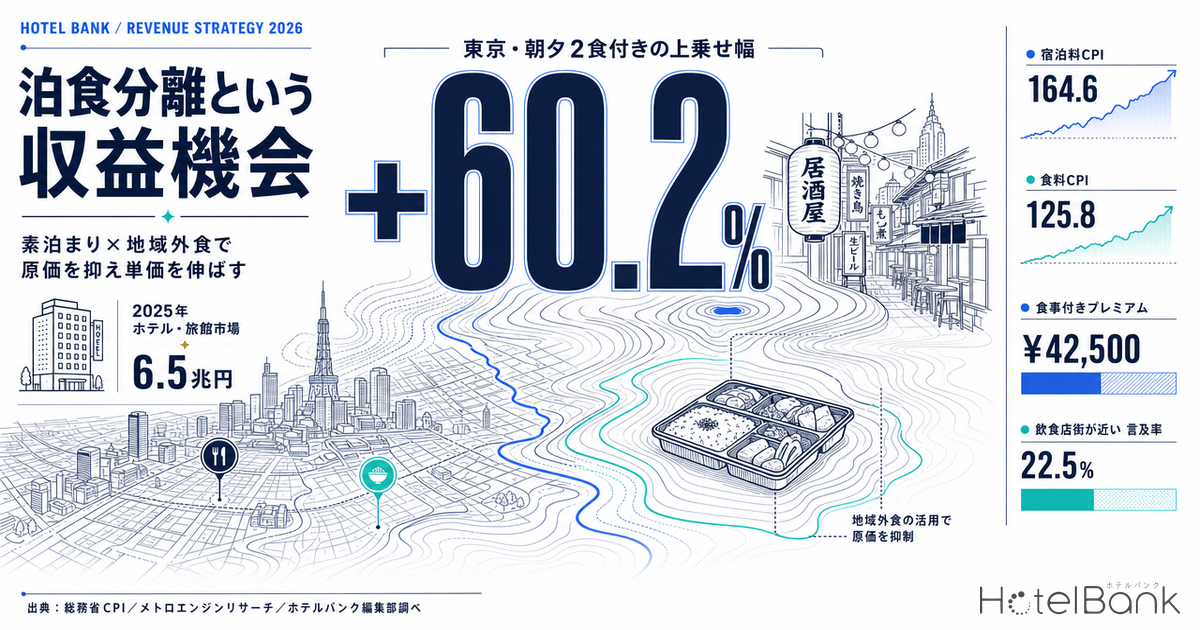
With food costs and the squeeze on kitchen and service staff showing no sign of easing, a growing number of properties — mainly in urban markets — are shifting to a meal–accommodation unbundling model (泊食分離, haku-shoku bunri): sell the room on a room-only basis and leave dining to the restaurants in the surrounding neighborhood. The conventional operating model built around one night with two meals has embedded a triple cost burden — ingredients, cooking, and table service — inside the room rate. In an inflationary environment, however, that meal cost is becoming the single largest drag on profit. This article reads three data sets — the Consumer Price Index (CPI), guest reviews, and the price premium on meal-inclusive plans — to unpack how a model that leads with room-only stays and secures guest satisfaction through the local dining scene can become a revenue opportunity that holds cost exposure down while lifting both occupancy and rate.
Metric Definitions Used in This Article
- ADR (estimated transacted rate): An estimated transacted rate (tax-exclusive equivalent) calculated by applying category-specific adjustment coefficients to the lowest publicly listed plan rate each property publishes on OTAs and similar channels (double occupancy, per-room rate, tax-inclusive). Cross-checked against property-level results disclosed by listed hotel REITs (91 properties, most recent three months), the median error is approximately 7%. These are estimates and differ from each property’s actual transacted rates and accounting figures.
- Listed price: The prices used for the price premium by meal type are averages of publicly listed selling prices on OTAs and similar channels (double occupancy, per-room rate, tax-inclusive). The comparison uses the difference between a room-only plan and a meal-inclusive plan sold within the same hotel (paired comparison).
- CPI (Consumer Price Index): Ministry of Internal Affairs and Communications, “Consumer Price Index” (2020 = 100).
- Data sources: MetroEngines Research; HotelBank Editorial Team research; Ministry of Internal Affairs and Communications, “Consumer Price Index”; Teikoku Databank.
Food cost has become the variable that erodes hotel profit the most
Behind the attention on meal–accommodation unbundling lies a structural rise in the cost of providing meals. On the Ministry of Internal Affairs and Communications’ Consumer Price Index (2020 = 100), food reached 125.8 in 2025 and climbed to 128.7 by May 2026 — roughly 29% above the pre-COVID baseline. Dining out rose to 116.3 in 2025 and 117.4 in May 2026, up about 17% over five years. For lodging operators carrying both purchased ingredients and kitchen labor, that increase passes straight through into meal cost.
Meanwhile, Teikoku Databank’s “Ryokan and Hotel Market Trends Survey” projects that Japan’s domestic ryokan and hotel market will reach a record ¥6.5 trillion in operator revenue in fiscal 2025. Even so, only about 30% of companies are growing revenue, and roughly 30% remain in a state of negative net worth — a persistently high level. As inflation pushes up ingredients, labor, and utilities simultaneously, the properties finding it hardest to secure profit are mid-price-band inns built around one night with two meals. The sense of labor shortage itself has eased for a third consecutive year — 38.5% on a non-regular-employee basis as of April 2026, down from 51.8% a year earlier — yet kitchens and service floors remain stretched.
In short, among all the costs a property carries, meal-related costs are rising fastest and are the tightest on the labor supply side. Externalizing that block structurally lightens cost-side risk — and that is the starting point for treating meal–accommodation unbundling as room to grow.
Source: Compiled by the HotelBank Editorial Team from the Ministry of Internal Affairs and Communications, “Consumer Price Index” (2020 = 100)
Pricing power is concentrated most heavily in selling the room
What deserves attention here is the gap in growth rates across the three indices. Within the same CPI, lodging fees reached 164.6 in 2025 and 172.3 in May 2026 — more than 70% above the pre-COVID baseline. Compared with food at +29% and dining out at +17%, the pricing power of lodging stands out. Against a backdrop of recovering demand and an inbound tailwind, the guest room itself has become the product where rate increases pass through most easily.
Read the other way, dining out (+17%) has not risen as much as food (+29%). Restaurants have absorbed part of their own input cost increases, and the street-level dining scene remains at an accessible price level. For hotels, that is an important precondition: concentrate on selling rooms, where rate increases pass through best, and hand dining demand to neighborhood restaurants, where value for money still holds — putting the price characteristics of both markets to work. Meal–accommodation unbundling can be understood as an approach that builds the difference between these two markets into revenue design.
How much cost meal-inclusive plans carry inside them
To measure how much meal-inclusive plans add to the room rate, we isolated only those cases where a hotel sells both a room-only plan and a meal-inclusive plan within the same property (paired analysis; April 2026; double occupancy; tax-inclusive listed prices). In Tokyo, the room-only average is approximately ¥42,500, while breakfast-inclusive adds ¥9,400 (+22.2%) and dinner-plus-breakfast adds ¥25,600 (+60.2%). Osaka shows +¥14,200 (+53.7%) for two meals, and Kyoto +¥25,000 (+65.7%) — in every market, adding meals lifts the room rate sharply.
A substantial portion of that uplift goes to the still-rising cost of ingredients and to kitchen and service labor, as described above. Put differently, the incremental revenue earned on a two-meal plan is revenue that also carries a high cost load. Shifting to a room-only-led mix means giving up that price premium — but it simultaneously means detaching the costs under the strongest upward pressure (ingredients, cooking, table service) from the guest room. What remains in hand is pure room revenue, where pricing power is highest.
Source: Compiled from MetroEngines Research and HotelBank Editorial Team research (paired comparison within the same hotel; April 2026; listed-price basis)
Which categories, price bands, and areas favor properties close to dining districts
Whether a room-only-led model works hinges on whether guests can secure satisfaction from dining in the surrounding area. We therefore analyzed guest reviews and extracted the properties where the locational advantage of “close to a restaurant district” is mentioned favorably, drawing on reviews from the most recent 24 months (HotelBank Editorial Team research). The mix of properties at the top of that list draws a clear outline of the markets where this model works best.
First, category. The top entries are almost without exception urban business hotels and city hotels — properties that do not build their offer around in-house dining. Second, price band. Splitting the top 25 extracted properties by estimated transacted ADR, the ¥15,000–¥25,000 mid band accounts for 40% and the ¥25,000–¥40,000 upper-mid band for a little over 30%, clustering within a ¥10,000–¥50,000 range. Luxury properties and ryokan do not appear. Third, area. The three major metropolitan areas — covering Tokyo, Osaka, Kyoto, and Nagoya — dominate, but station-front business hotels in regional cities with well-developed dining infrastructure, such as Okayama, also break into the top ranks. An onsen destination in Shimane is likewise known as an early adopter that introduced meal–accommodation unbundling in earnest and lifted occupancy, showing that the model can work outside the major metros wherever the local dining infrastructure is in place.
Source: HotelBank Editorial Team research (tag analysis of guest reviews, most recent 24 months) / estimated transacted ADR from MetroEngines Research
The table below lists the leading properties where a “close to a restaurant district” location is mentioned favorably. Alongside the mention rate (the share of reviews containing the relevant mention), it shows each property’s area and estimated transacted ADR band. What stands out is the concentration in downtown entertainment districts and station-front locations — places with an abundance of dining options.
| Property | Area | Mention rate | Estimated transacted ADR band | Price band |
|---|---|---|---|---|
| Hotel Gracery Shinjuku (ホテルグレイスリー新宿) | Tokyo | 7.9% | ¥30,000 | Upper-mid |
| Hotel Sunroute Plaza Shinjuku (ホテルサンルートプラザ新宿) | Tokyo | 6.7% | ¥31,200 | Upper-mid |
| Ours Inn Hankyu (アワーズイン阪急) | Tokyo | 10.9% | ¥14,700 | Economy |
| Tobu Hotel Levant Tokyo (東武ホテルレバント東京) | Tokyo | 10.3% | ¥22,200 | Mid |
| HOTEL THE FLAG Shinsaibashi (HOTEL THE FLAG 心斎橋) | Osaka | 8.1% | ¥21,700 | Mid |
| Richmond Hotel Premier Asakusa (リッチモンドホテルプレミア浅草) | Tokyo | 8.9% | ¥30,700 | Upper-mid |
| Hotel Metropolitan Edmont (ホテルメトロポリタン エドモント) | Tokyo | 8.1% | ¥23,000 | Mid |
| Tokyu Stay Shibuya (東急ステイ渋谷) | Tokyo | 13.5% | ¥34,000 | Upper-mid |
| JR Kyushu Hotel Blossom Shinjuku (JR九州ホテル ブラッサム新宿) | Tokyo | 7.7% | ¥51,000 | Upper |
| Miyako City Kintetsu Kyoto Station (都シティ 近鉄京都駅) | Kyoto | 5.4% | ¥20,400 | Mid |
| Okayama Koraku Hotel (岡山 後楽ホテル) | Okayama | 10.8% | ¥10,900 | Economy |
| Hotel MyStays Asakusabashi (ホテルマイステイズ浅草橋) | Tokyo | 22.5% | ¥22,000 | Mid |
Source: HotelBank Editorial Team research (N = 794–5,703 total reviews per property, most recent 24 months) / estimated transacted ADR from MetroEngines Research
The economics of unbundling — hold cost down, and leave room for occupancy and rate to grow
Layering the data so far together, the revenue appeal of the unbundled model comes into focus. First, a lighter cost structure. With food CPI up roughly 29% over five years and kitchen and service staff in short supply, handing dining to neighborhood restaurants lets a property detach the cost block under the strongest upward pressure from its rooms P&L. The fixed burden of kitchen equipment, prep work, and shift management eases, creating room to run operations with fewer people.
Second, headroom on occupancy. Under a two-meal model, the volume of dinner prep effectively caps how many rooms can be sold; on a room-only-led basis, that dining-capacity constraint falls away and more rooms can be sold on days when demand is there. As labor shortages increasingly force properties to turn business away, being able to concentrate limited staff on housekeeping and front desk works in the direction of raising the occupancy ceiling.
Third, upside on rate. The pricing power of lodging fees far exceeds that of anything meal-related. By narrowing to room-only, a property can focus its resources on room revenue, where rate increases pass through most readily. In urban and regional station-front locations where the surrounding dining scene still offers value for money, guests can achieve high satisfaction without relying on in-house dining, and review scores are easier to sustain. Indeed, favorable comments about proximity to dining districts were concentrated precisely in these business-to-upper-mid urban hotels.
Of course, unbundling is not a prescription that applies uniformly to every property. At resorts and onsen ryokan where the in-house dining experience is itself the reason for the stay, meals are not a cost to be shed but the core of the value proposition. What matters is to judge whether your property’s location, guest mix, and brand meet the condition that “the local dining scene can carry guest satisfaction,” and then to design the mix of room-only and meal-inclusive inventory strategically. For urban business and city hotels with well-developed dining infrastructure nearby, meal–accommodation unbundling is best positioned as constructive room to grow — one that holds cost exposure down while offering upside on both occupancy and rate.
For hoteliers: plan-naming cues that work for this theme
Appeal elements most common in publicly listed plan names for business hotels × room-only stays (N=781) —
Room-only 94% Near the station 14% Large public bath 11% Discount 11% Points & coupons 10%
Examples of actual names (anonymized):
- [Limited time / last-minute deal] Still time to book — room-only plan / natural hot-spring public bath and sauna on site
- Room to stretch out for families and groups, a base for sightseeing / room-only
* These are tendencies based on aggregated public plan names and do not demonstrate a causal link between naming and sales.
Summary
The squeeze on food costs and on kitchen and service staff has become the strongest drag on profit at properties built around one night with two meals. As the CPI shows, the pricing power of lodging fees far exceeds that of food and dining out, while the street-level dining scene still offers value for money. Meal–accommodation unbundling builds that difference between two markets into revenue design: concentrate on room-only stays to lighten cost, and generate headroom on both occupancy and rate. The guest-review analysis likewise confirmed that favorable comments about proximity to dining districts cluster in the ¥10,000–¥50,000 urban business-to-upper-mid band, indicating that the model works most readily where dining infrastructure is well developed. Judging whether your property’s location and guest mix meet those conditions — and then building the mix of room-only and meal-inclusive inventory strategically — is the first step toward capturing this revenue opportunity.
Related reading
- Only Hotels That Capture Demand Survive: 2026’s Occupancy Ceiling
- Ryokan Succession Crisis: 89 Bankruptcies & 30% Without Heirs in 2025
- H2 2026 Hotel & Ryokan Bankruptcy Re-Acceleration: View from the Exit Side
References and sources
- Ministry of Internal Affairs and Communications, “Consumer Price Index” (2020 = 100; statistics ID: 0003427113) — indices for lodging fees, food, and dining out
- Teikoku Databank, “National Ryokan and Hotel Market Trends Survey (FY2025 outlook)” (in Japanese)
- Nikkei, “Unbundling meals from stays as an answer to labor shortages: ‘dinner out’ spreads at a Shimane onsen” (in Japanese)
- Travel Voice, “Rethinking the ‘unbundling of meals and stays’ that ryokan need to survive” (in Japanese)
- MetroEngines Research — estimated transacted ADR; price premium by meal type within the same hotel (paired comparison)
- HotelBank Editorial Team research — tag analysis of guest reviews (mentions of proximity to dining districts, most recent 24 months)