

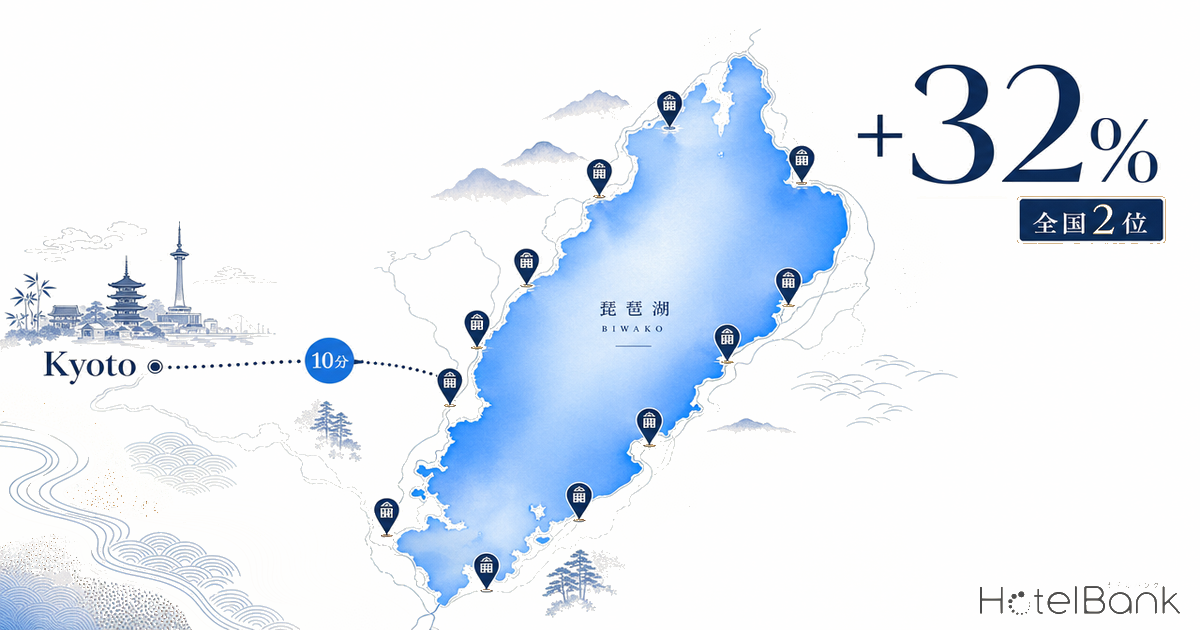
In a major OTA’s summer 2026 travel trend survey released on May 22, 2026, one prefecture ranked #2 nationwide in year-over-year search growth. Following Tokyo (+48% YoY) was Shiga Prefecture (+32%). Until now, regional hotel market analysis has concentrated on Tokyo, Osaka, Kyoto, Okinawa and Hokkaido, with Shiga — home to Lake Biwa — rarely discussed head-on as a “dark-horse area.” Yet as overtourism drives Kyoto’s room rates to record highs, the lakeside areas of Shiga are emerging as a clear spillover destination with growing supply-demand opportunity. In this report, we benchmark the monthly ADR of the three main Lake Biwa shorefront areas — Otsu, Hikone, and Nagahama — against central Kyoto, quantify the “10-Minute Adjacency Discount,” and decode both the lakeview differentiation assets unique to Shiga and the new supply now coming online.
Metric Definitions Used in This Article
- ADR (Average Daily Rate): Average of publicly listed prices on OTAs. Differs from actual transacted rates (when cross-checked against REIT disclosures, public-list ADR runs roughly +25–30% above realized ADR; unsold higher-priced plans remain visible on OTAs, which structurally biases the public average upward). Stated as per-room rate for double occupancy (tax-included), averaged across all plan types (room-only through meal-inclusive).
- Central Kyoto ADR: Weighted average across listing observations for Kyoto City’s 11 wards (Shimogyo, Nakagyo, Higashiyama, Minami, etc.).
- 10-Minute Adjacency Discount: Discount rate of Otsu ADR vs. central Kyoto ADR = (Central Kyoto ADR − Otsu ADR) ÷ Central Kyoto ADR.
- Data Source: MetroEngines Research
- — Shiga ranks #2 nationwide in search growth (+32% YoY) in a major OTA’s summer 2026 trend survey, emerging as a dark-horse destination behind Tokyo (+48%).
- — Otsu’s public-list ADR runs about 27% below central Kyoto on average, with the discount widening to a peak of 43% during cherry-blossom season. A “10-Minute Adjacency Discount” — about 10 minutes by JR Rapid — has become structural.
- — Shiga’s prefecture-wide public-list ADR rose +27.3% YoY (from roughly ¥29,500 to ¥37,600), with search heat now feeding through to realized pricing.
- — Supply is concentrated in southern Lake Biwa (Otsu), leaving the north and east shores thin. Lakeview rooms and open-air baths at Shiga’s signature inns serve as core differentiation assets.
- — New roadside-format supply is launching in Nagahama and Hino. Shiga is at an inflection point from “Kyoto spillover” to “destination of choice” lakeshore.
#2 Search Surge — Why Japan’s Largest Lake Suddenly Emerged
The major OTA’s summer 2026 trend survey ranked search-growth leaders as Tokyo (+48%), Shiga (+32%), Fukuoka and Gunma (tied at +22%), and Nara (+21%). Shiga was singled out for “Japan’s largest lake — Lake Biwa — combined with historic streetscapes.” Sitting on the doorstep of powerhouse destinations Kyoto and Osaka while offering a large-scale natural asset like the lake is drawing the attention of crowd-averse travelers.
This search heat is already showing up in realized pricing. According to MetroEngines Research, Shiga’s prefecture-wide public-list ADR climbed from roughly ¥29,500 in June 2025 to about ¥37,600 in June 2026 — a +27.3% year-over-year increase. The near-lockstep movement of search growth (+32%) and ADR growth (+27%) suggests that rising interest is materializing as accommodation demand. Why did Shiga break through at this specific moment? The answer lies in Kyoto’s adjacent price structure. (For context on how Kansai-region traveler flows are now spilling well beyond the Kinki region, see our analysis of wide-area travel patterns of Osaka-Kansai Expo visitors.)
Source: Major OTA “Summer 2026 Travel Trends” (May 22, 2026), compiled by the HotelBank Editorial Team
The “10-Minute Adjacency Discount” — Pricing Edge as a Kyoto Spillover
The JR Tokaido Main Line Rapid covers Otsu Station to Kyoto Station in about 9–10 minutes. Although a prefectural border lies in between, in practice Otsu sits inside Kyoto’s metropolitan commuting and tourism catchment. Even so, the gap in room rates between the two areas is wide. As of June 2026, public-list ADR for central Kyoto (weighted across the 11 wards) was approximately ¥49,700, versus ¥34,400 for Otsu — a gap of about ¥15,300, or a 31% discount.
This “10-Minute Adjacency Discount” tends to widen during Kyoto’s peak seasons when rates spike hardest. In April 2026, cherry-blossom season, central Kyoto pushed up to around ¥63,800 while Otsu held at ¥36,400 — a peak discount of 43%. The 12-month trailing average discount of Otsu vs. central Kyoto sits at about 27%, with an average gap of roughly ¥13,400. In other words, simply substituting an Otsu booking for a Kyoto one delivers savings of over ¥10,000 per night — a structural arbitrage that holds almost continuously.
Source: MetroEngines Research, compiled by the HotelBank Editorial Team (central Kyoto N≈430 properties / Otsu N≈13 properties)
What deserves notice is that Otsu’s ADR is not being “left cheap.” Otsu’s ADR rose from approximately ¥27,300 in June 2025 to ¥40,600 by May 2026, climbing steadily during Kyoto’s peak periods. The reason a roughly 30% gap persists is simply that Kyoto’s pace of rate increase has been even faster. As long as Kyoto’s pricing keeps probing new ceilings, the lakeshore areas — Otsu first among them — should retain room as a price-side spillover catchment. Background on why Kyoto-side rates keep climbing is examined in detail in our companion piece on the first month of Kyoto’s new accommodation tax.
Three Faces of the Lakeshore — Pricing Profiles of Otsu, Hikone, and Nagahama
“Lake Biwa shore” sounds singular, but pricing tiers and area character vary widely. Otsu, the southern lake gateway, sits around ¥34,000 on the back of Kyoto commuter convenience, with deep supply running from Ogoto Onsen ryokan through business and city hotels. By contrast, eastern shore Hikone — anchored by Hikone Castle — has surged into Shiga’s top tier at ¥45,000–¥61,000 since autumn 2025. Northern shore Nagahama, supported by the historic Kurokabe Square streetscape, has held steady at ¥37,000–¥43,000. Taga Town is shown only for reference (single observation property) at ¥23,000–¥27,000 — a budget-tilted band.
Source: MetroEngines Research, compiled by the HotelBank Editorial Team
The table below summarizes June 2025 vs. June 2026 ADR by area. Hikone’s growth stands out — driven both by the inclusion of high-rate resort properties in the observation set and by tourism demand around Hikone Castle and Genkyu-en garden. All areas are above year-ago levels, confirming that the demand lift extends across the whole shoreline.
| Area | Jun 2025 ADR | Jun 2026 ADR | YoY | N (properties) |
|---|---|---|---|---|
| Otsu (South shore) | ¥27,300 | ¥34,400 | +25.9% | 13 |
| Hikone (East shore) | ¥25,800 | ¥56,400 | +118.9% | 11 |
| Nagahama (North shore) | ¥35,400 | ¥37,700 | +6.5% | 12 |
| Taga Town (reference, N=1) | ¥16,800 | ¥27,200 | +61.7% | 1 |
| Shiga prefecture total | ¥29,500 | ¥37,600 | +27.3% | ~180 |
* Hikone’s growth is amplified by the inclusion of high-rate resort properties in the observation set. Taga Town is a single-property reference value.
Lakeviews and Open-Air Baths — Omi’s Signature Inns Hold Real Differentiation
Pricing leverage as a Kyoto spillover alone is not a durable demand engine. What gives Shiga staying power is its uniquely Shiga experience value: lakeview rooms overlooking Lake Biwa and lakeside open-air baths. The HotelBank Editorial Team aggregated guest reviews and pulled out properties most frequently cited for “open-air bath” — the leaders are concentrated on the lake shore.
Topping mentions is Biwako Ryokusuitei (Ogoto Onsen, Otsu, 69 rooms, 122 mentions). It is followed by Happu-no-Yu (Higashi-Omi, 99 mentions, 45.6% mention rate) and Biwako Hotel (Otsu, 175 rooms, 61 mentions). View-related mentions favor Hikone Castle Resort & Spa and the lakeside Hotel Piazza Biwako, showing how Shiga’s signature lake-and-castle-town scenery underpins property valuations. On composite review scores, smaller Ogoto Onsen ryokan such as Biwako Hanakaido (4.55) and Dantokan Kikunoya (4.67) earn standout marks.
Source: Guest review data (HotelBank Editorial Team analysis, 24-month window, 206 Shiga properties)
What these properties share is that they are “chosen for experience, not price.” Evening views over the water and the openness of outdoor baths are unobtainable at a standard Kyoto city hotel, and they sustain repeat demand while holding rates at a respectable level. Even within a spillover area, properties that own a lakeview differentiator can attract guests well beyond the “cheap Kyoto substitute” segment.
Lake Biwa Supply Map — Southern Concentration, Northern and Eastern Gaps
The map below shows the distribution of major ryokan and hotels along the Lake Biwa shoreline; circle size indicates room-count scale. At a glance, Otsu (south shore) dominates, with large hotels and onsen ryokan clustering there, while Hikone (east) and Nagahama (north) remain relatively thin in both property count and scale. Proximity to Kyoto explains the Otsu concentration, but the flip side is that Hikone and Nagahama — both with strong tourism anchors — still have runway for incremental supply.
Source: MetroEngines Research / compiled by the HotelBank Editorial Team
Fresh Supply on the Ground — Roadside Formats Land in Nagahama and Hino
The supply side is responding to the demand uptick. Within MetroEngines Research’s coverage, the main new properties confirmed on OTAs in Shiga during 2025–2026 are concentrated in Nagahama City and Hino Town, with roadside-format hotels driving the cycle. HOTEL R9 The Yard Nagahama Interchange (44 rooms, opened April 2026) and HOTEL R9 The Yard Gamou Hino (47 rooms, opened January 2026) are both container-format business hotels adjacent to expressway interchanges, designed to capture road-trip tourism and business demand. In July 2025, Super Hotel Shiga Nagahama Natural Hot Spring (144 rooms) opened, adding mid-scale supply with a natural onsen attached at the northern lake hub of Nagahama.
In Hikone, Trail Inn Hikone (30 rooms, August 2024) and the small-scale machiya-style HATAGO HIKONE series have rolled out in succession, deepening the castle-town guest experience. Nagahama is also seeing more boutique, high-value-add openings such as one-party-per-day kominka (traditional house) inns — one example covered in detail in our field report on the opening of “Tsunagu-yado Kihei” in Shiga’s Nagahama. Together, these moves point to a barbell: roadside, value-tier supply that catches “Kyoto-is-too-expensive” overflow, alongside machiya and onsen inns selling experiences unique to Shiga.
| Property | Location | Rooms | OTA listing confirmed |
|---|---|---|---|
| HOTEL R9 The Yard Nagahama Interchange | Nagahama City | 44 | April 2026 |
| HOTEL R9 The Yard Gamou Hino | Hino Town | 47 | January 2026 |
| Super Hotel Shiga Nagahama Natural Hot Spring | Nagahama City | 144 | July 2025 |
| Trail Inn Hikone | Hikone City | 30 | August 2024 |
| HATAGO HIKONE (Main / Bettei) | Hikone City | 15 / 7 | July 2025 |
Source: MetroEngines Research & Consulting (based on confirmed OTA listings). Listings typically appear several months ahead of opening, so the most recent period may grow as listings are added.
Conclusion — From “Kyoto Spillover” to “Lakeshore of Choice”
Shiga’s Lake Biwa supply-demand opportunity rests on three structural supports. First, the demand kick-off where interest and pricing have moved in lockstep — #2 nationwide in search growth (+32%) with ADR up +27% YoY. Second, a structural pricing edge — the “10-Minute Adjacency Discount” running 20–40% below central Kyoto on an enduring basis. Third, lakeview rooms and lakeside open-air baths — differentiation assets that get the property chosen for reasons other than price.
The takeaway for regional hotel investors and Kansai-area OTA managers is straightforward. So long as Kyoto’s rates keep probing new ceilings, Otsu’s accessibility (south shore), and the tourism anchors plus supply headroom of Hikone (east) and Nagahama (north) can all serve as a spillover catchment for Kyoto demand. The question is whether each property settles for being a cheap alternative or instead becomes a “destination of choice” via lakeshore experience value. Combining existing strengths — lakeview, onsen — with disciplined peak-season pricing leaves plenty of room to convert Kyoto-coupled rate growth into incremental revenue. Shiga is moving past the “untouched dark horse” stage and earning a formal seat on the Kansai accommodation map.
⚠ Note on forward-dated ADRs: ADRs in this article reflect publicly listed OTA prices at the time of our survey and will shift as check-in dates approach. Currently high-set prices may be cut closer to arrival via last-minute discounting — please bear that in mind.
Related Reading
- Kyoto’s New Accommodation Tax — First Month: City ADR +18.6% YoY, Mix Shifts to High-End
- Wide-Area Travel Patterns of Osaka-Kansai Expo Visitors — Spillover Beyond the Kinki Region
- [Field Report] Shiga’s Nagahama Welcomes “Tsunagu-yado Kihei” — A One-Party-Per-Day Kominka Inn
References and Sources
■ Data Sources
Public-list ADR data come from MetroEngines Research OTA price observations (monthly by municipality, Shiga and Kyoto prefectures, June 2025 – June 2026). Search trend figures are from a major OTA’s “Summer 2026 Travel Trends” report (released May 22, 2026). Review evaluations are aggregated across 206 Shiga properties over a trailing 24-month window.
■ Calculation Assumptions
Central Kyoto ADR is a weighted average across Kyoto City’s 11 wards. Discount rate = (Central Kyoto ADR − Otsu ADR) ÷ Central Kyoto ADR. Gaps and discount rates are derived from monthly public-list ADR observations; peak-season figures use April 2026, and the average uses the simple mean of the trailing 12 months.
■ Limitations
ADR is OTA public-list-based, which can diverge from realized transacted rates. New supply coverage is based on confirmed OTA listings, so completeness is bounded. Search-growth figures rely on a single OTA’s survey. Occupancy (OCC) is out of scope for this article.
■ Market Data
- MetroEngines Research — OTA public-list price data (monthly ADR by municipality, Shiga and Kyoto prefectures), new opening data (confirmed OTA listings)
- HotelBank Editorial Team analysis — guest review data (206 Shiga properties, 24-month window)
■ News and Press Releases