

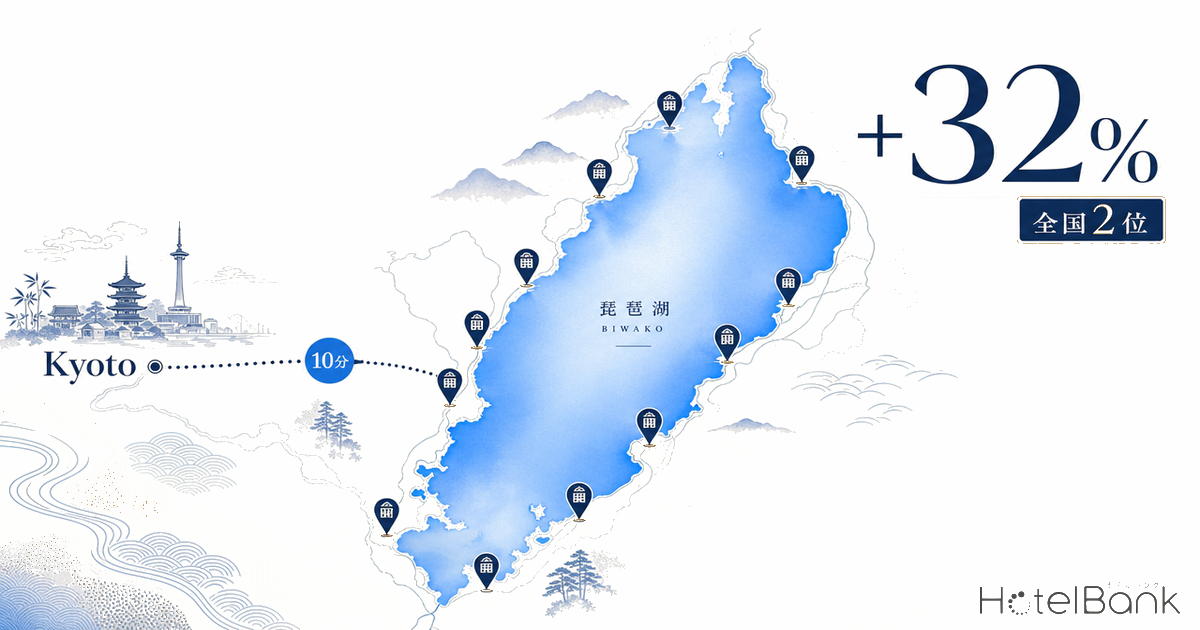
A major OTA’s summer travel trend survey released on May 22, 2026 highlighted a prefecture posting the nation’s second-highest search growth: Shiga, at +32% YoY, trailing only Tokyo (+48%). Regional hotel market analysis has long centered on Tokyo, Osaka, Kyoto, Okinawa, and Hokkaido, leaving Shiga — home to Lake Biwa — as an under-discussed “dark horse” area. Yet as Kyoto’s nightly rates surge under overtourism pressure, Shiga’s lakeside areas are emerging as a credible spillover destination with a clear supply-demand opportunity. This article cross-references monthly ADR for the three main Lake Biwa-shore areas — Otsu, Hikone, and Nagahama — against central Kyoto, quantifies the “10-minute neighbor discount,” and reads the lake-view differentiation asset and the new supply currently underway.
Metric Definitions Used in This Article
- ADR (Average Daily Rate): Average of advertised prices on OTAs. Differs from actual transacted prices (cross-checks against REIT disclosures show advertised ADR runs +25-30% higher than transacted ADR, because unsold high-tier plans linger on OTAs and push the advertised average above the booked average). Per-room rate for 2 guests/room (tax included), averaged across all plans (room-only through meal-included).
- Central Kyoto ADR: Weighted average across the 11 wards of Kyoto City (Shimogyo, Nakagyo, Higashiyama, Minami, etc.), weighted by number of observations.
- 10-Minute Neighbor Discount: Otsu City ADR’s discount versus central Kyoto ADR = (Central Kyoto ADR − Otsu City ADR) ÷ Central Kyoto ADR.
- Data Source: MetroEngines Research
- — Shiga posted Japan’s second-highest search growth (+32%) in a major OTA’s summer 2026 trend survey, behind only Tokyo (+48%), emerging as a dark-horse destination.
- — Otsu’s advertised ADR runs roughly 27% cheaper than central Kyoto on average, with the discount widening to as much as 43% during cherry-blossom season. The “10-minute neighbor discount” (about a 10-minute JR limited-express ride) is now structural.
- — Shiga’s prefecture-wide advertised ADR rose +27.3% YoY (about ¥29,500 → ¥37,600), confirming that search heat is feeding into actual price levels.
- — Lodging supply is concentrated in the southern lakeshore (Otsu), with the northern and eastern shores comparatively empty. Lake-view rooms and open-air baths at established Omi properties function as differentiation assets.
- — Roadside-format new supply is opening in Nagahama and Hino. The area is shifting from a passive “Kyoto spillover” to a deliberately chosen lakeside destination.
#2 in Search Growth — Why “Japan’s Largest Lake” Suddenly Surfaced
In the major OTA’s summer 2026 trend survey, the top of the search-growth ranking ran: Tokyo (+48%), Shiga (+32%), Fukuoka and Gunma (tied at +22%), and Nara (+21%). Shiga was cited for “the natural scale of Japan’s largest lake, Lake Biwa, combined with historic streetscapes.” Sitting just outside the powerful Kyoto-Osaka tourism corridor while offering a uniquely large-scale natural asset, Shiga is attracting travelers who want to sidestep congestion without giving up Kansai access.
This search heat is showing up in actual pricing. According to MetroEngines Research, Shiga’s prefecture-wide advertised ADR climbed from roughly ¥29,500 in June 2025 to about ¥37,600 in June 2026 — a +27.3% YoY increase. Search growth (+32%) and ADR growth (+27%) are moving almost in lockstep, suggesting interest is converting into real lodging demand. So why is Shiga surfacing now? The answer lies in the neighboring Kyoto pricing structure. The fact that Kansai foot-traffic is increasingly spilling beyond the immediate Kinki region was also documented in our Osaka-Kansai Expo wide-area visitor mobility analysis.
Source: Major OTA, “Summer 2026 Travel Trends” (May 22, 2026), compiled by HotelBank Editorial Team
The “10-Minute Neighbor Discount” — Pricing Edge as Kyoto’s Spillover
Otsu Station to Kyoto Station takes about 9-10 minutes on the JR Tokaido Main Line limited express. Though the journey crosses a prefectural border, Otsu effectively sits inside Kyoto’s commuter and tourism catchment. Even so, nightly rates between the two are sharply divergent. As of June 2026, central Kyoto’s advertised ADR (11-ward weighted average) was about ¥49,700, against Otsu’s ¥34,400 — a gap of roughly ¥15,300, or a 31% discount.
This “10-minute neighbor discount” tends to widen during the high seasons when Kyoto rates spike. In April 2026, the cherry-blossom peak, central Kyoto reached about ¥63,800 while Otsu stayed at ¥36,400 — a discount that hit 43%. Over the trailing 12 months the average discount sits near 27%, with an average gap of about ¥13,400. In other words, a traveler simply swapping a Kyoto night for Otsu can save more than ¥10,000 per night on a near-permanent basis. (We have previously documented why Kyoto rates keep rising, including the impact of the city’s lodging-tax hike.)
Source: MetroEngines Research, compiled by HotelBank Editorial Team (central Kyoto N≈430 properties / Otsu N≈13 properties)
Importantly, Otsu’s ADR is not being “left cheap.” It has climbed from about ¥27,300 in June 2025 to roughly ¥40,600 by May 2026, and during the high season it tracks Kyoto’s rises faithfully. The reason a ~30% gap persists is simply that Kyoto’s pace of price increase has been even steeper. As long as Kyoto continues to test the ceiling on rates, the Lake Biwa-shore areas — Otsu first among them — should retain a pricing-side absorption capacity for displaced Kyoto demand.
Different Faces by Area — Pricing in Otsu, Hikone, and Nagahama
“The Lake Biwa shore” is far from monolithic — each area carries its own price band and character. Otsu, the southern gateway, leans on Kyoto-commuter convenience and tracks around ¥34,000, with deep layering from onsen ryokan (Ogoto Onsen) through business and city hotels. Hikone, on the eastern shore, anchors itself to Hikone Castle and has climbed to ¥45,000-¥61,000 since autumn 2025 — the prefecture’s highest tier. Nagahama, on the northern shore, holds steady at ¥37,000-¥43,000, backed by historic streetscape tourism around Kurokabe Square. Taga Town is a single-property reference point, but it sits in the ¥23,000-¥27,000 budget zone.
Source: MetroEngines Research, compiled by HotelBank Editorial Team
The table below shows ADR by area for June 2025 vs. June 2026. Hikone’s growth stands out because the observation set includes high-end resort properties and because tourism demand around Hikone Castle and Genkyuen Garden has lifted rates. Every area outperformed the year-earlier month, confirming that demand uplift extends across the entire Lake Biwa shoreline.
| Area | 2025/06 ADR | 2026/06 ADR | YoY | N (properties) |
|---|---|---|---|---|
| Otsu City (southern shore) | ¥27,300 | ¥34,400 | +25.9% | 13 |
| Hikone City (eastern shore) | ¥25,800 | ¥56,400 | +118.9% | 11 |
| Nagahama City (northern shore) | ¥35,400 | ¥37,700 | +6.5% | 12 |
| Taga Town (reference, N=1) | ¥16,800 | ¥27,200 | +61.7% | 1 |
| Shiga Prefecture (total) | ¥29,500 | ¥37,600 | +27.3% | ~180 |
Note: Hikone’s growth rate is elevated because the observation set includes high-end resort properties. Taga Town is a reference value (N=1).
Lake Views & Open-Air Baths — Omi’s Historic Ryokan as Differentiation Assets
Pricing advantage as Kyoto’s spillover alone is not a durable basis for long-term demand capture. Shiga’s truly distinctive experiential assets are lake-view guest rooms and lakeside open-air baths. When HotelBank Editorial Team aggregated guest reviews and isolated properties most frequently cited for “open-air bath,” lakeside ryokan and hotels dominated the top of the list.
The single most-mentioned property was Biwako Ryokusui-tei (Ogoto Onsen, Otsu City; 69 rooms; 122 mentions), followed by Happu no Yu (Higashi-Omi; 99 mentions, 45.6% mention rate) and Biwako Hotel (Otsu City; 175 rooms; 61 mentions). For lake-view mentions, Hikone Castle Resort & Spa (Hikone) and Hotel Piazza Biwako (lakeside) rank near the top — confirming that the lake-and-castle-town scenery unique to Shiga underpins guest evaluations. Total satisfaction scores also highlight small Ogoto Onsen ryokan such as Biwako Hanakaido (4.55) and Dantokan Kikunoya (4.67).
Source: Guest review data (HotelBank Editorial Team analysis, 24-month window, Shiga Prefecture, 206 properties)
What these properties share is that “they are chosen for experience, not price.” The sunset view across the lake and the openness of a lakeside open-air bath are simply not replicable at a typical central-Kyoto city hotel — a moat that sustains repeat demand while preserving ADR. Even within a spillover area, a property anchored on a lake-view differentiation axis can capture demand that goes well beyond merely being a “cheaper alternative to Kyoto.”
Property Distribution Around the Lake — Southern Concentration, Northern/Eastern Gaps
The map below shows the distribution of major hotels and ryokan along the Lake Biwa shore. Circle size reflects room-count scale. At a glance: Otsu (southern shore) clusters both large hotels and onsen ryokan, while Hikone (east) and Nagahama (north) are comparatively thin in both property count and scale. Proximity to Kyoto drives the southern concentration, but the flip side is that Hikone and Nagahama — with their own tourism anchors — still have meaningful supply headroom.
Source: MetroEngines Research / compiled by HotelBank Editorial Team
New Supply on the Ground — Roadside Brands Arriving in Nagahama and Hino
Supply is starting to respond to the demand surge. Within the scope MetroEngines Research tracks, the main new properties confirmed on OTAs in Shiga during 2025-2026 cluster in Nagahama City and Hino Town, and roadside-format hotels stand out. HOTEL R9 The Yard Nagahama Inter (44 rooms, opened April 2026) and HOTEL R9 The Yard Gamo-Hino (47 rooms, opened January 2026) are both interchange-adjacent container-style business hotels positioned for both car-borne sightseeing flow and corporate demand. In July 2025, Super Hotel Shiga Nagahama Tennen Onsen (144 rooms) added mid-scale supply with on-site natural hot springs to Nagahama, the northern shore’s anchor city.
In Hikone, Trail Inn Hikone (30 rooms, August 2024) and the HATAGO HIKONE series of small machiya-conversion inns have layered fresh castle-town accommodation experiences. In Nagahama, the one-group-per-day kominka inn format is also taking root in small, high-value-add formats. Together these moves show supply expanding along two distinct vectors — affordable roadside capacity absorbing “priced-out of Kyoto” demand on one hand, and machiya and onsen inns selling distinctly Shiga experiences on the other.
| Property | Location | Rooms | OTA listing confirmed |
|---|---|---|---|
| HOTEL R9 The Yard Nagahama Inter | Nagahama City | 44 | April 2026 |
| HOTEL R9 The Yard Gamo-Hino | Hino Town | 47 | January 2026 |
| Super Hotel Shiga Nagahama Tennen Onsen | Nagahama City | 144 | July 2025 |
| Trail Inn Hikone | Hikone City | 30 | August 2024 |
| HATAGO HIKONE (Main / Annex) | Hikone City | 15 / 7 | July 2025 |
Source: MetroEngines Research & Consulting (OTA-listing-confirmed basis). Listings typically appear several months before opening, so coverage of the most recent period may continue to expand.
Conclusion — From “Kyoto’s Spillover” to “Lakeside, by Choice”
The supply-demand opportunity around Shiga and Lake Biwa rests on three structural pillars. First, the demand take-off in which interest and pricing are now moving together — search growth ranked #2 nationally (+32%) and prefecture-wide ADR up +27% YoY. Second, the structural pricing edge: a “10-minute neighbor discount” running 20-40% below central Kyoto on a near-permanent basis. And third, lake-view rooms and lakeside open-air baths — differentiation assets that have nothing to do with price.
For regional hotel investors and Kansai-area OTA managers, the implication is clean. So long as Kyoto rates keep testing the ceiling, Otsu’s southern-shore convenience, Hikone’s eastern-shore tourism anchor, and Nagahama’s northern-shore supply headroom can all function as receiving capacity for displaced Kyoto demand. Whether a property settles for being merely a cheaper alternative — or evolves into a destination chosen for its lakeside experience — depends on the operator. Leveraging existing strengths like lake-view rooms and onsen while layering on tiered pricing through high seasons can convert further upside from Kyoto-linked price climbs into incremental revenue. Shiga is no longer an “untouched dark horse” — it now belongs squarely on the formal Kansai accommodation map.
Caveat regarding forward-dated ADR: The ADR values in this article are averages of advertised OTA prices at the time of analysis and will move as the check-in date approaches. Prices currently set high may fall through late-stage discounting.
Related Reading
- Kyoto Lodging Tax Month 1: Kyoto ADR +18.6% YoY, Mix Shifts Upmarket
- Osaka-Kansai Expo Visitors Drove Wide-Area Tourism Despite Lodging Demand Decline
References & Source List
Data Sources
Advertised ADR data comes from MetroEngines Research’s OTA-advertised-price dataset (monthly, by municipality, Shiga Prefecture and Kyoto Prefecture, June 2025 – June 2026). Search trends are from the major OTA’s “Summer 2026 Travel Trends” survey (released May 22, 2026). Review evaluations aggregate 206 properties in Shiga over a trailing 24-month window.
Calculation Assumptions
Central Kyoto ADR is the observation-count-weighted average of the 11 wards. Discount rate = (Central Kyoto ADR − Otsu ADR) ÷ Central Kyoto ADR. Gaps and discount rates are computed from each month’s advertised ADR; the high-season figure uses April 2026 and the average uses a simple 12-month trailing average.
Limitations & Caveats
ADR is on an advertised-OTA-price basis and may diverge from realized transacted ADR. New-supply coverage is based on confirmed OTA listings and is not exhaustive. Search-growth figures rely on a single OTA’s survey. Occupancy (OCC) is outside the scope of this analysis.
Market Data
- MetroEngines Research — OTA-advertised-price data (monthly municipality-level ADR, Shiga and Kyoto Prefectures), new-opening data (OTA-listing-confirmed basis)
- HotelBank Editorial Team analysis — Guest review data (206 properties in Shiga Prefecture, 24-month window)
News & Press Releases