

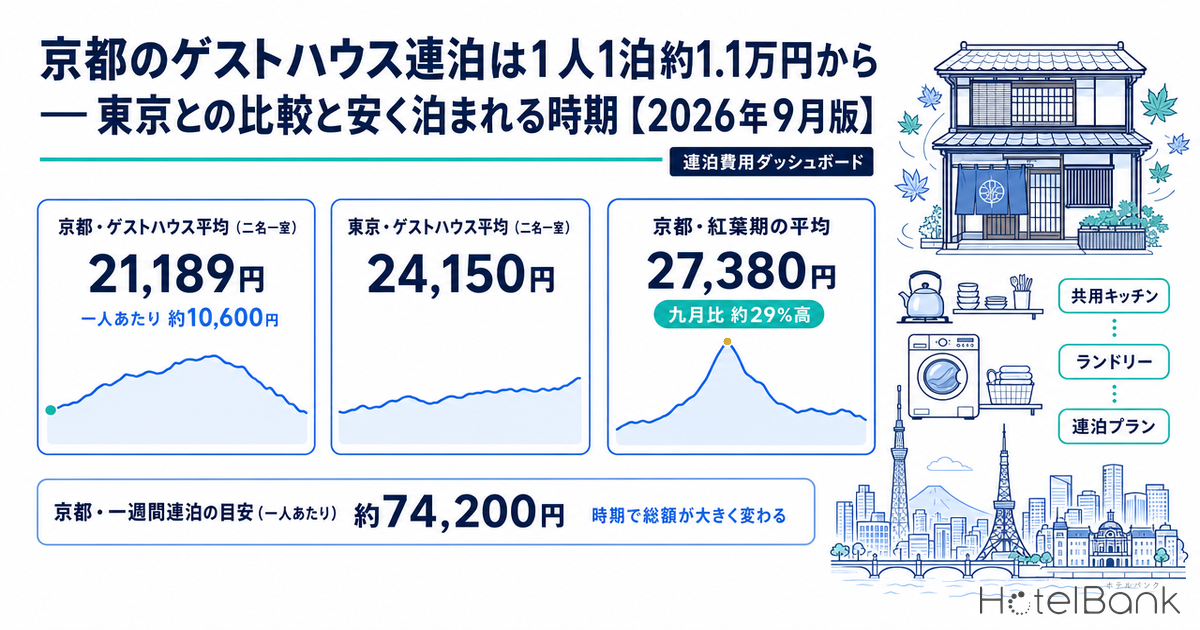
A multi-night stay at a guesthouse in Kyoto costs an average of ¥21,189 per night based on listed OTA prices (two guests in one room, tax included), which works out to roughly ¥10,600 per person (for stays in September 2026, N=148 properties, HotelBank Editorial Team research). Tokyo averages ¥24,150 per night, or about ¥12,100 per person (same basis, N=121 properties). On that arithmetic, three nights in Kyoto come to roughly ¥31,800 per person and seven nights to about ¥74,200. Note, however, that during the autumn foliage season the same Kyoto guesthouses list at around 30% higher, so the total cost of a long stay depends far more on when you go than on how many nights you book. This article walks through the going rates for guesthouses in Kyoto and Tokyo, what a multi-night stay actually costs, when rates are cheapest, and how to pick a guesthouse that works for a longer stay.
What one night costs at a guesthouse in Kyoto and Tokyo
Start with the going nightly rate. The table below aggregates listed OTA prices for stays in September 2026 by accommodation category, and every figure is a per-room rate for two guests in one room (tax included), on a room-only basis (HotelBank Editorial Team research, as of September 2026).
| Category | Kyoto Prefecture (2 guests/room) | Kyoto, per person | Tokyo (2 guests/room) | Tokyo, per person |
|---|---|---|---|---|
| Guesthouse | ¥21,189 (N=148) | approx. ¥10,600 | ¥24,150 (N=121) | approx. ¥12,100 |
| Hostel | ¥22,122 (N=237) | approx. ¥11,100 | ¥24,849 (N=337) | approx. ¥12,400 |
| Minshuku (family-run inn) | ¥30,348 (N=31) | approx. ¥15,200 | ¥25,479 (N=20) | approx. ¥12,700 |
| Business hotel (for reference) | ¥18,059 (N=342) | approx. ¥9,000 | ¥18,496 (N=949) | approx. ¥9,200 |
Source: HotelBank Editorial Team research (aggregated from publicly listed OTA data, for stays in September 2026). N is the number of properties in the sample.
Two caveats. First, these are rates for a private room used by two people, which is a different basis from the per-bed price of a dormitory. Dormitories are sold one bed at a time, and on a per-person basis they are often available below half the price of a private room. If you are travelling alone and cost is the priority, check per-bed prices separately. Second, the per-person figure (room rate ÷ 2) assumes two people are sharing; use a private room on your own and you pay close to the full room rate.
It may come as a surprise, but on a room-rate basis the average business hotel is cheaper than the average guesthouse. Guesthouses still get chosen for longer stays because of what they do to the total cost of staying: a shared kitchen you can cook in, laundry facilities, and plans priced by the week or discounted for consecutive nights. The basic rule for a long stay is to compare the all-in cost — room, food and laundry — rather than the room-only rate alone.
What a multi-night stay costs — three nights and seven nights
Simply multiplying the averages above by the number of nights gives the following benchmarks (based on average listed prices for stays in September 2026, tax included).
| Nights | Kyoto, 2 guests/room | Kyoto, per person | Tokyo, 2 guests/room | Tokyo, per person |
|---|---|---|---|---|
| 3 nights | approx. ¥63,600 | approx. ¥31,800 | approx. ¥72,500 | approx. ¥36,200 |
| 7 nights | approx. ¥148,300 | approx. ¥74,200 | approx. ¥169,100 | approx. ¥84,500 |
Source: HotelBank Editorial Team research. Calculated as the average listed price for the guesthouse category (for stays in September 2026; Kyoto N=148 properties, Tokyo N=121 properties) multiplied by the number of nights.
What you actually pay will move from there. Most guesthouses price weekdays and weekends differently, so seven nights built around a Sunday-to-Friday core tends to come out cheaper than seven nights spanning a weekend. Properties also list plans on OTAs with conditions such as “7 nights or more” or “consecutive-night discount,” and for the same room, booking seven nights in one go can cost less than booking seven separate nights. If your dates are already fixed, enter the number of nights up front when you search and start your comparison with the long-stay plans that come up.
When long stays get cheaper — Kyoto peaks in November, bottoms out in September
Timing is the single biggest lever on the total cost of a long stay. Lining up the monthly average listed price for the guesthouse category (two guests in one room, tax included) makes Kyoto’s autumn swing clearly visible (HotelBank Editorial Team research, aggregated as of September 2026).
| Month of stay | Kyoto Prefecture | Tokyo |
|---|---|---|
| September 2026 | ¥21,189 (N=148) | ¥24,150 (N=121) |
| October 2026 | ¥23,831 (N=133) | ¥27,554 (N=108) |
| November 2026 | ¥27,380 (N=125) | ¥27,464 (N=97) |
| December 2026 | ¥24,173 (N=114) | — |
Source: HotelBank Editorial Team research (aggregated from publicly listed OTA data). Average listed price for stays in each month; two guests in one room, tax included.
Kyoto reaches ¥27,380 in November, the autumn foliage season — about 29% above September. Over seven consecutive nights that is a difference of more than ¥40,000 for two people in one room. If your dates are flexible, shifting a Kyoto long stay into September is the most effective single move. October at ¥23,831 and December at ¥24,173 sit at much the same level, both a little over 10% below November. If November is fixed, lock in a long-stay plan early, or widen the search to include per-bed dormitory rates. And if rooms are simply hard to find in Kyoto during foliage season, basing yourself in Otsu or Kusatsu — 9 to 20 minutes from Kyoto Station by train — and commuting in is a realistic alternative.
Tokyo runs around ¥27,500 in both October and November, climbing gently into the autumn leisure and events season. There is no sharp peak of the kind Kyoto has, so for a long stay in Tokyo, building the trip around weekdays and shifting one station away from the obvious areas does more than picking a different month.
How to choose a guesthouse for a long stay — four things to check
Two guesthouses in the same price band can differ sharply in how comfortable they are over several nights. Four things to check before you book.
1. Dormitory or private room. A dormitory suits a solo traveller for whom cost comes first; a private room suits anyone who wants to spread out their luggage and keep a routine. Past roughly the third night, the chore of making up your bed and putting your things back in a locker every day starts to tell, so for longer stays a private room — or a semi-private bed with a curtain or door — is worth more.
2. Shared kitchen and laundry. What really brings down the total cost of a long stay is not the room rate but food and laundry. If there is a supermarket within walking distance and you can use a kitchen and a washing machine, swapping one breakfast and one dinner a day for home cooking saves on the order of a thousand yen a day — over seven nights, potentially more than any discount on the room.
3. Long-stay plans and weekly rates. Properties that advertise consecutive-night discounts are used to hosting longer stays, and tend to have clearer rules around cleaning frequency and rubbish disposal. The efficient approach is to enter your number of nights first when searching an OTA and compare only the properties that return a long-stay plan.
4. Location matters less for the station than for daily life. For a single night, being right by the station is convenient; for a long stay, a more residential area with a sento (public bath), a supermarket and a coin laundry is often more comfortable. In Kyoto, letting go of the need to be right next to the central sightseeing areas and moving one or two stations out puts a private room within reach on the same budget. In Tokyo, guesthouses and hostels cluster in the older downtown districts of Kuramae and Asakusa, where the balance between price and quality of stay is easier to strike.
Where to look in more detail
For property-by-property comparisons, these articles go deeper (both in Japanese).
Staying in the Kuramae and North Asakusa neighbourhood — five design guesthouses reworked from old Tokyo warehouses (wabistay, in Japanese)
Compares five properties in the Kuramae and North Asakusa area where Tokyo’s guesthouses and hostels cluster — including Nui. HOSTEL & BAR LOUNGE, converted from a toy wholesaler’s warehouse (roughly ¥14,000–18,000 for two guests in one room), and &AND HOSTEL ASAKUSA KAPPABASHI on the Kappabashi kitchenware street — with notes on the architecture and price band of each.
An autumn of commuting to Kyoto without staying there — nine and twenty minutes on the Biwako Line, building a trip from station-front hotels in Otsu and Kusatsu, Top 5 (October–November 2026) (HotelPicks, in Japanese)
Proposes staying in Otsu or Kusatsu, 9 to 20 minutes from Kyoto Station by Special Rapid Service, as another answer to a long stay in Kyoto during the expensive foliage season. Compares five station-front hotels — including Hotel Boston Plaza Kusatsu Biwako, 30 seconds’ walk from the west exit of Kusatsu Station, and Super Hotel Otsu Ekimae, nine minutes from Kyoto — with journey times and breakfast opening hours.