

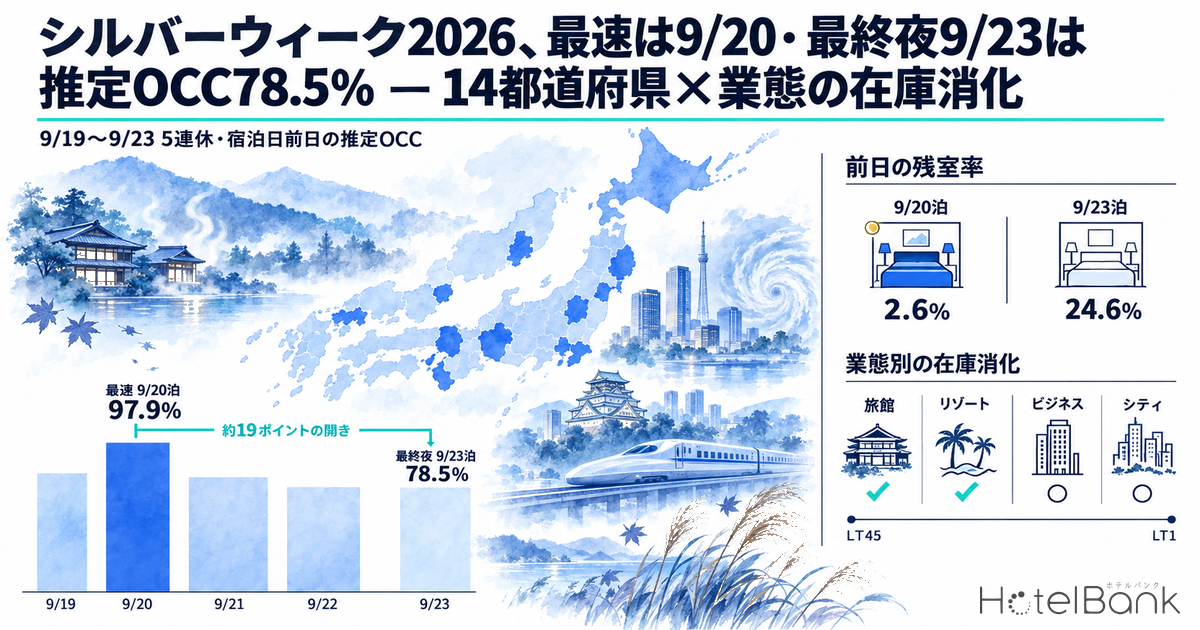
Across Japan’s Silver Week 2026 (the five-day holiday from September 19 to 23), hotel inventory filled fastest for the night of Sunday, September 20, whose estimated OCC (occupancy) reached 97.9% on the day before arrival. By contrast, the final night, Wednesday, September 23 (national holiday), stopped at 78.5%, as the following day was a regular weekday — a gap of about 19 points across the five nights. This article aggregates property-level remaining-room data by stay date, hotel type and region for 14 major prefectures, including Tokyo, Osaka, Kyoto, Hokkaido, Okinawa, Fukuoka, Nagano, Shizuoka, Ishikawa and Hiroshima, and sets out practical moves for the October three-day weekend (October 10-12).
Metric Definitions Used in This Article
- OCC (occupancy): rooms sold as a share of total rooms in the area (an estimate based on OTA sales inventory). Referred to as “estimated OCC” in this article. Because it is estimated from how OTA-listed inventory sells through, it differs from a property’s actual overall occupancy.
- LT (lead time): days before the stay date. LT1 = the day before the stay date. This article uses only observations from LT45 to LT1.
- Remaining-room rate: remaining rooms on OTAs as a share of each property’s total rooms (room basis), calculated as total remaining rooms / total rooms across the covered properties.
- Population for property-level figures: only properties listing at least 30% of their total rooms on OTAs (assessed per stay date, so the number of properties varies by date).
- Listed price: per-room rate for two guests sharing one room (tax included), averaged across all plans. Not a transacted price.
- Data source: MetroEngines Research
- — The night of Sunday, September 20 filled fastest, reaching 97.9% estimated OCC the day before arrival (LT1). The final night, September 23, stopped at 78.5% — a gap of about 19 points across the five nights (14 major prefectures, all hotel types, about 8,000 properties).
- — Ryokan and resort hotels had almost fully sold the two middle nights two weeks out (LT14), adding virtually nothing in the final two weeks. Business and city hotels still had inventory left for the night of September 22.
- — In 11 of the 14 prefectures, the low point within the holiday was the night of September 22. In Kanagawa and Shizuoka, inventory came back onto the market four to five days before arrival for the middle nights, which coincided with the approach of Typhoon No. 25.
- — Even though the LT21 listed price for the final night, September 23, was about half that of the middle nights (about ¥25,700 vs. about ¥49,500 for September 20), roughly 20% of inventory remained unsold up to the day before arrival across all hotel types.
- — For the October three-day weekend (observed September 22), the first night, October 10, is pacing in line with the first night of Silver Week. The middle night, October 11, is 12.3 points lower at the same lead time, leaving room to grow.
Silver Week 2026: Sep 20 Was the First Night to Fill
First, the overall picture for the five nights. Combining all hotel types across the 14 major prefectures (about 8,000 properties and about 510,000 rooms), estimated OCC already showed clear differences by date 45 days before arrival (LT45). September 20 led at 75.9%, followed by September 19 at 72.6% and September 21 at 70.1%. September 22 (63.4%) and September 23 (55.4%) started more slowly — the later in the holiday, the weaker the early pickup.
The ranking did not change as bookings built up. Estimated OCC on the day before arrival (LT1) was highest for September 20 at 97.9%, followed by September 21 (96.5%), September 19 (95.5%), September 22 (92.6%) and September 23 (78.5%). In other words, the pattern — the Sunday night in the middle of the holiday closing first and the final night staying open to the end — held consistently from 45 days out to the day before.
Source: MetroEngines Research; compiled by HotelBank Editorial Team (14 major prefectures, all hotel types; 8,067 properties / 508,035 rooms for Sep 19 to 8,172 properties / 513,053 rooms for Sep 23. Estimated OCC is an estimate based on OTA inventory)
The same trend holds at the property level. The table below restricts the sample to properties listing at least 30% of their total rooms on OTAs and aggregates remaining rooms on a room basis. For September 20, the remaining-room rate fell to 2.6% the day before arrival, and 73.4% of the covered properties had zero rooms left at that point. 18.6% of properties had already sold out 45 or more days before arrival — the highest share of the five nights. For September 23, by contrast, the remaining-room rate the day before was 24.6%, and only 24.7% of properties had zero rooms left.
| Stay date | Properties | Total rooms | Remaining LT14 | Remaining LT7 | Remaining LT1 | Sold out at LT1 | Sold out 45+ days out |
|---|---|---|---|---|---|---|---|
| 9/19 (Sat) | 3,691 | 307,225 | 16.1% | 11.9% | 5.8% | 55.9% | 14.1% |
| 9/20 (Sun) | 3,327 | 290,651 | 10.1% | 5.7% | 2.6% | 73.4% | 18.6% |
| 9/21 (Mon, holiday) | 3,758 | 331,369 | 13.8% | 9.0% | 4.1% | 68.1% | 14.5% |
| 9/22 (Tue, holiday) | 4,525 | 376,950 | 23.1% | 18.1% | 8.7% | 52.4% | 8.8% |
| 9/23 (Wed, holiday) | 4,783 | 417,783 | 37.6% | 33.7% | 24.6% | 24.7% | 5.8% |
Source: MetroEngines Research; compiled by HotelBank Editorial Team (14 major prefectures x business, city, resort and ryokan. The population across the four types was 5,035 properties for Sep 19; only properties listing at least 30% of their total rooms on OTAs are aggregated)
Note that the number of covered properties is lowest for September 20 (3,327) and highest for September 23 (4,783) because the earlier a date fills, the fewer properties still have at least 30% of their rooms listed on OTAs. The number of covered properties itself therefore reflects the strength of demand on each date.
By Hotel Type: Ryokan and Resorts Closed the Middle Nights First; Business and City Hotels Had Rooms Left on Sep 22
Next, by hotel type. Estimated OCC on the day before arrival held high for the two middle nights: ryokan reached 98.6% on September 20 and 98.4% on September 21, and resort hotels 95.4% and 94.5%. Ryokan also climbed to 97.8% on September 22, effectively filling four of the five nights.
Business and city hotels peaked on September 20 at 98.4% and 97.5% respectively, but finished at 91.8% and 93.0% on September 22 — a few points below ryokan (97.8%). The later in the holiday and the closer to a weekday, the more likely limited-service and urban hotels were to have inventory left.
Source: MetroEngines Research; compiled by HotelBank Editorial Team (14 major prefectures. Coverage for Sep 19: ryokan 1,697 properties / 45,275 rooms, resort 614 properties / 48,624 rooms, business 2,388 properties / 309,810 rooms, city 336 properties / 64,886 rooms. Estimated OCC is an estimate based on OTA inventory)
Lining up the property-level remaining-room rate (properties listing at least 30% of rooms on OTAs only) from two weeks out (LT14) to the day before (LT1) makes the difference in when each hotel type “closes” even clearer. Ryokan had only 1.9% of rooms remaining for September 20 two weeks out, and 88.0% of covered properties had zero rooms left at that point. Business hotels, by contrast, still had 25.5% of rooms remaining for September 22 two weeks out, and sold down to 10.0% by the day before.
| Hotel type | 9/19 (Sat) | 9/20 (Sun) | 9/21 (Mon, holiday) | 9/22 (Tue, holiday) | 9/23 (Wed, holiday) |
|---|---|---|---|---|---|
| Ryokan | 11.1% → 3.5% N=1,412 | 1.9% → 2.2% N=1,122 | 2.9% → 2.0% N=1,261 | 15.2% → 2.8% N=1,664 | 36.2% → 20.3% N=1,628 |
| Resort hotels | 16.4% → 9.2% N=440 | 8.0% → 6.8% N=344 | 8.1% → 8.2% N=368 | 18.3% → 6.1% N=503 | 32.1% → 20.8% N=555 |
| Business hotels | 17.5% → 5.6% N=1,650 | 11.4% → 2.1% N=1,692 | 16.0% → 4.1% N=1,917 | 25.5% → 10.0% N=2,104 | 39.3% → 25.9% N=2,309 |
| City hotels | 11.9% → 6.3% N=189 | 8.7% → 3.3% N=169 | 11.6% → 3.8% N=212 | 20.4% → 8.8% N=254 | 33.1% → 24.0% N=291 |
Source: MetroEngines Research; compiled by HotelBank Editorial Team (each cell: remaining-room rate at LT14 → remaining-room rate at LT1. Only properties listing at least 30% of their total rooms on OTAs)
The difference also shows in how much was added in the final two weeks. For September 20 and 21, ryokan and resort hotels added virtually nothing in the last two weeks (ryokan: -0.6 points and 0.0 points) — the outcome was settled two weeks out. September 22, by contrast, grew strongly in the final stretch: +10.1 points for ryokan and +12.3 points for business hotels. The last two nights of the holiday were “late-filling dates,” suggesting there was room to hold rates early and wait for last-minute demand.
Source: MetroEngines Research; compiled by HotelBank Editorial Team (14 major prefectures. Change in estimated OCC from LT14 to LT1. Estimated OCC is an estimate based on OTA inventory)
Regional Low Points: Most Regions Dipped on Sep 22, but Kanagawa and Shizuoka Dipped Mid-Holiday
Ranking prefectures by estimated OCC on the day before arrival, the lowest night — the “trough” — among the four nights excluding the final night of September 23 was September 22 in 11 of the 14 prefectures. Osaka reached 100.0% on September 20 but fell to 87.6% on September 22 and 67.9% on September 23, the widest swing within the holiday. Fukuoka (99.9% → 89.3% → 73.4%) and Kyoto (99.9% → 92.1% → 79.8%) followed the same shape: nearly full in the middle of the holiday, then stepping down toward the end. The Osaka five-day holiday, tracked from 45 days before arrival, is analyzed in detail in Osaka Sep 2026 Holiday: Demand Peaks First 2 Nights.
Aichi stayed high throughout the five nights, and its final night of September 23 reached 91.3% — the only prefecture of the 14 above 90%. Okinawa was more modest at 95.2% even for the middle night of September 20, but its final night was the second highest at 83.4%, making for the flattest profile within the holiday.
| Prefecture | Properties / rooms | 9/19 (Sat) | 9/20 (Sun) | 9/21 (Mon, holiday) | 9/22 (Tue, holiday) | 9/23 (Wed, holiday) | Holiday low point (9/19-9/22) |
|---|---|---|---|---|---|---|---|
| Hokkaido | 803 / 55,160 | 94.9% | 97.9% | 97.3% | 92.1% | 80.2% | 9/22 (Tue, holiday) |
| Miyagi | 210 / 14,168 | 97.0% | 98.0% | 97.4% | 95.2% | 77.6% | 9/22 (Tue, holiday) |
| Tokyo | 868 / 106,714 | 96.2% | 97.6% | 94.5% | 92.5% | 80.6% | 9/22 (Tue, holiday) |
| Kanagawa | 483 / 32,919 | 93.4% | 92.1% | 88.6% | 95.8% | 77.3% | 9/21 (Mon, holiday) |
| Nagano | 724 / 22,502 | 98.0% | 99.5% | 99.5% | 96.2% | 82.6% | 9/22 (Tue, holiday) |
| Shizuoka | 917 / 32,584 | 95.6% | 94.0% | 95.0% | 95.1% | 76.4% | 9/20 (Sun) |
| Ishikawa | 260 / 14,913 | 95.1% | 99.4% | 99.6% | 95.2% | 73.5% | 9/19 (Sat) |
| Aichi | 369 / 32,995 | 98.6% | 99.9% | 99.5% | 97.1% | 91.3% | 9/22 (Tue, holiday) |
| Kyoto | 785 / 33,393 | 95.3% | 99.9% | 99.7% | 92.1% | 79.8% | 9/22 (Tue, holiday) |
| Osaka | 438 / 60,484 | 94.2% | 100.0% | 98.4% | 87.6% | 67.9% | 9/22 (Tue, holiday) |
| Hyogo | 583 / 20,049 | 98.4% | 99.9% | 99.8% | 95.4% | 75.7% | 9/22 (Tue, holiday) |
| Hiroshima | 277 / 15,439 | 97.2% | 100.0% | 100.0% | 96.0% | 76.9% | 9/22 (Tue, holiday) |
| Fukuoka | 427 / 29,486 | 94.1% | 99.9% | 98.7% | 89.3% | 73.4% | 9/22 (Tue, holiday) |
| Okinawa | 923 / 37,229 | 92.1% | 95.2% | 93.1% | 88.9% | 83.4% | 9/22 (Tue, holiday) |
Source: MetroEngines Research; compiled by HotelBank Editorial Team (estimated OCC on the day before arrival = LT1, all hotel types. Properties / rooms as of the Sep 19 stay date. Outlined cell = lowest night among the four nights Sep 19-22. Estimated OCC is an estimate based on OTA inventory)
In Ishikawa, September 19 (95.1%) and September 22 (95.2%) were just 0.1 point apart. The clear exceptions are Kanagawa (trough on September 21 at 88.6%) and Shizuoka (trough on September 20 at 94.0%). In these two prefectures, after the middle nights had nearly filled, remaining inventory was observed coming back four to five days before arrival. For resort hotels in Kanagawa (36 properties / 4,569 rooms), estimated OCC for September 21 fell from 97.9% at LT7 to 73.0% the day before. Across Shizuoka as a whole (906 properties / 32,425 rooms), September 20 also fell from 99.7% at LT6 to 94.0% the day before.
The timing coincides with September 21, when Typhoon No. 25 came quite close to the Kanto-Koshin region. As of September 16, the Japan Weather Association had indicated that warning-level heavy rain and storms were possible in Kanto and Tokai from around the 21st, and on the 21st Japan’s two major airlines canceled a combined 275 domestic and international flights (Aviation Wire). Public OTA data alone cannot tell whether the returning inventory came from cancellations or from properties adding inventory, but the case shows that the weather outlook can affect last-minute inventory.
Source: MetroEngines Research; compiled by HotelBank Editorial Team (Kanagawa resorts 36 properties / 4,569 rooms, Kanagawa all types 479 properties / 32,839 rooms, Shizuoka all types 906 properties / 32,425 rooms. Estimated OCC is an estimate based on OTA inventory)
Final Night Sep 23: Around 20% of Inventory Remained Up to the Day Before Across All Hotel Types
The night with the most unsold inventory of the five was the final night, September 23, across every hotel type and every region. Estimated OCC on the day before arrival was 81.4% for ryokan, 83.3% for resort hotels, 79.5% for city hotels and 77.1% for business hotels, and in the property-level figures the remaining-room rate fell in the 20-26% range. With the following day a regular Thursday, it is the day leisure travelers head home, while business travel has yet to pick up.
Listed prices were also sharply lower for the final night. Three weeks before arrival (LT21), the listed price (all-plan average, tax included, averaged across the 14 prefectures weighted by number of properties) was about ¥49,500 for September 20 and about ¥25,700 for September 23 across all hotel types — roughly half. Business hotels fell from about ¥36,100 to about ¥13,700, a level about 60% lower. That 20% of final-night inventory remained even with such deep discounts shows it is a demand “trough” that price alone struggles to move.
Source: MetroEngines Research; compiled by HotelBank Editorial Team (listed price = per-room rate for two guests sharing one room, tax included, all-plan average, at LT21. Not a transacted price)
A Little Over Two Weeks to the October Three-Day Weekend: Three Moves Matched to Each Night’s Strength
The next peak is the three-day weekend from Saturday, October 10 to Monday, October 12 (Sports Day). As observed on September 22, estimated OCC across all hotel types in the 14 prefectures was 86.9% for October 10 (18 days before arrival), almost level with the first night of Silver Week, September 19, at the same lead time (86.7%). The middle night, October 11, however, was 78.5% (19 days out), 12.3 points below September 20 at the same point (90.8%). The final night, October 12, was 68.0% (20 days out), slightly above September 23 at the same point (64.5%).
Source: MetroEngines Research; compiled by HotelBank Editorial Team (14 major prefectures, all hotel types. Oct 10: 8,186 properties / 514,821 rooms. October figures as observed on Sep 22; Silver Week figures are the values at the same lead time. Estimated OCC is an estimate based on OTA inventory)
By hotel type, the gap is large for ryokan on October 11, at 80.4% vs. 98.2% for September 20 at the same point. Business hotels are at 77.0% (vs. 89.1%), also leaving room to grow on the middle night. Combined with the Silver Week results, the moves available in the remaining two-plus weeks can be summarized in three points.
Three Moves for the October Three-Day Weekend
1. Anchor length-of-stay restrictions on the “strong night,” and review them about two weeks out. During Silver Week, ryokan had already filled the two middle nights to a remaining-room rate of 1.9-2.9% two weeks before arrival. A multi-night restriction that includes a strong night is an effective way to move inventory on weaker nights along with it. However, some nights — like September 22 — add 10 points or more in the final two weeks, so if inventory under a multi-night restriction has not moved by two weeks out, switching to single-night sales captures last-minute one-night demand. For the October three-day weekend, one option is to design around the firm October 10 night, paired with October 11.
2. Build a “staircase” of nightly rates by date. During Silver Week, listed prices were highest for the middle nights, and the final night was roughly half the middle-night level. Even so, 20% of final-night inventory remained, while the middle nights were full two weeks out. The middle nights, having filled early, leave room to raise last-minute rates; for the final night, creating a reason to choose it through added value — such as a multi-night discount combined with a middle night or a late check-out — is more likely to lead to revenue opportunities than cutting the rate. The final night of the October weekend (October 12) is likely to follow the same pattern.
3. Release last-minute inventory separately for “returns” and “late-arriving demand.” In Kanagawa and Shizuoka, inventory for the middle nights came back four to five days before arrival. Anticipating weather-driven last-minute swings and preparing to resell returned inventory immediately (having last-minute plans ready and checking cancellation policies in advance) helps limit lost sales. And for dates like September 22, where demand catches up in the final two weeks, holding back part of the inventory for the last minute rather than releasing it all early makes it easier to hold rates.
Summary
In the Silver Week 2026 five-day holiday, the night of September 20 filled fastest, with estimated OCC on the day before arrival reaching 97.9%. Ryokan and resort hotels had almost fully sold the two middle nights two weeks out, while business and city hotels were more likely to have inventory left on September 22. The regional trough fell on September 22 in most regions, but Kanagawa and Shizuoka saw last-minute inventory returns on the middle nights, coinciding with the typhoon’s approach. On the final night, September 23, around 20% of inventory remained across all hotel types even with listed prices cut to about half the middle-night level.
For the October three-day weekend, as of September 22 the first night (October 10) is pacing in line with the first night of Silver Week, while the middle night (October 11) still has room to grow. Combining length-of-stay restrictions matched to each night’s strength, a rate staircase and a deliberate approach to last-minute inventory will be key to widening revenue opportunities in the remaining two-plus weeks.
⚠ Note on forward-dated data: Estimated OCC for the October three-day weekend is an interim reading based on inventory listed on OTAs as of the September 22 observation and will change as the stay dates approach. All estimated OCC figures are estimates based on OTA inventory and differ from a property’s actual overall occupancy.
Frequently Asked Questions
Q. Which night of Silver Week 2026 filled fastest?
A. The night of Sunday, September 20. Estimated OCC across all hotel types in the 14 major prefectures was 75.9% 45 days before arrival (LT45) — the highest of the five nights — and reached 97.9% the day before (LT1). Among properties listing at least 30% of their total rooms on OTAs, 73.4% had zero rooms left the day before arrival.
Q. Why did inventory remain for the final night of September 23?
A. Most likely because the following day was a regular Thursday: it was the day leisure travelers headed home, and business travel had yet to pick up. The listed price three weeks before arrival (LT21) was about ¥25,700 across all hotel types — roughly half that of September 20 (about ¥49,500) — yet the remaining-room rate the day before was 24.6%.
Q. Did the timing of sell-through differ by hotel type?
A. Yes. Ryokan and resort hotels had almost fully sold the middle nights of September 20 and 21 two weeks out and added virtually nothing in the final two weeks. Business hotels still had 25.5% of rooms remaining for September 22 two weeks out and sold down to 10.0% by the day before.
Q. Did the typhoon affect Silver Week hotel inventory?
A. In Kanagawa and Shizuoka, inventory was observed coming back four to five days before arrival around September 21, when Typhoon No. 25 approached the Kanto-Koshin region. For resort hotels in Kanagawa, estimated OCC for September 21 fell from 97.9% at LT7 to 73.0% the day before. Public OTA data alone cannot tell whether this came from cancellations or from added inventory.
Q. What should hotels review ahead of the October three-day weekend?
A. Three things: anchor length-of-stay restrictions on the strong night (October 10) and review them about two weeks out; build a date-by-date “staircase” of nightly rates; and release last-minute inventory separately for inventory returns and late-arriving demand. As observed on September 22, the middle night of October 11 was 12.3 points below Silver Week at the same lead time, leaving room to grow.
Q. What is estimated OCC in this article?
A. An occupancy indicator estimated from how inventory sold on OTAs is being consumed — rooms sold as a share of total rooms in the area. It differs from a property’s actual overall occupancy. This article uses observations from 45 days before arrival to the day before.
Related Articles
References and Sources
■ Data Source
OTA-listed inventory (remaining rooms) and listed prices observed daily by MetroEngines Research. Covers all hotel types in 14 major prefectures (8,067 properties / 508,035 rooms for Sep 19 to 8,172 properties / 513,053 rooms for Sep 23), aggregated from 45 days before arrival (LT45) to the day before (LT1).
■ Calculation Assumptions
Estimated OCC is an estimate based on how OTA-listed inventory sells through. Property-level remaining-room rates are limited to properties listing at least 30% of their total rooms on OTAs, assessed per stay date. Listed prices are per-room rates for two guests sharing one room (tax included, all-plan average), taken at LT21 and averaged weighted by number of properties. The October three-day weekend figures are as observed on September 22, 2026, compared with Silver Week figures at the same lead time.
■ Limitations and Caveats
Inventory in channels not listed on OTAs is not observed. Whether last-minute inventory returns came from cancellations or from properties adding inventory cannot be determined. Listed prices are not transacted prices. The October three-day weekend figures are interim and will change before the stay dates.
- MetroEngines Research — property-level OTA remaining-room trends (LT45 to LT1), estimated OCC and listed prices for 14 major prefectures
- Japan Weather Association, tenki.jp: “Typhoon forming – stormy weather warning for Silver Week; warning-level heavy rain and storms possible in Kanto and Tokai from around the 21st” (September 16, 2026; in Japanese)
- Aviation Wire: “Typhoon No. 25: 275 flights canceled on the 21st, affecting 42,000 passengers, including international flights” (September 21, 2026; in Japanese)
- Cabinet Office: “About National Holidays” (in Japanese)
- Japan Tourism Agency: “Overnight Travel Statistics Survey” (in Japanese)