

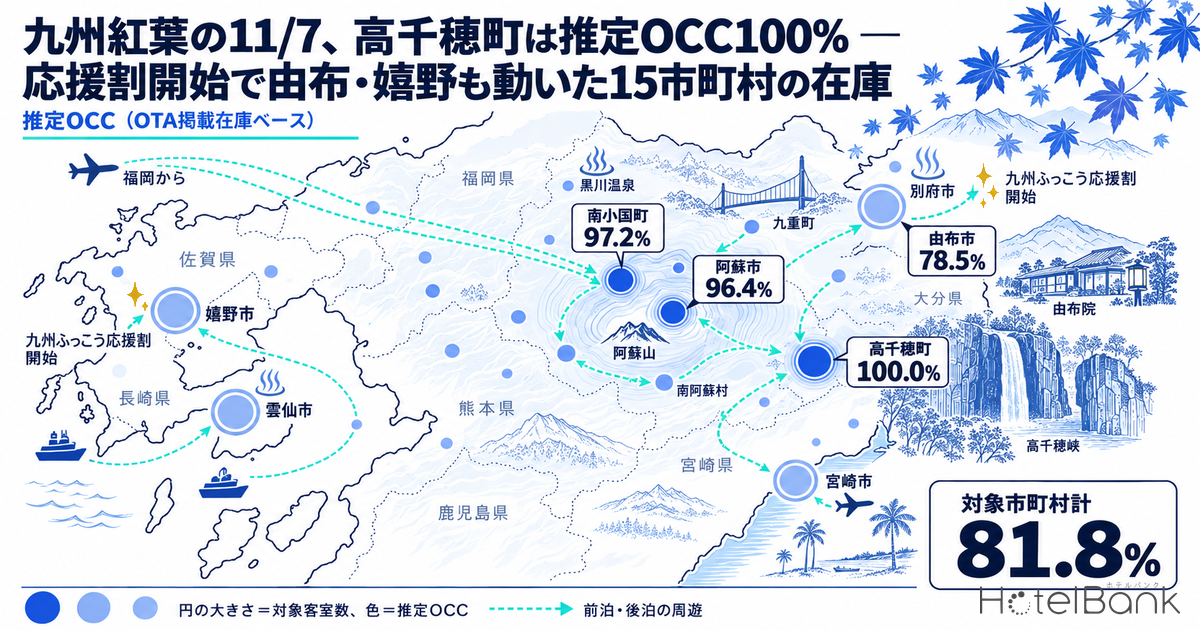
Saturday, November 7, 2026 is a night on which demand gathers in Kyushu’s autumn-foliage season. In an observation on September 25, 43 days before the stay date, the estimated OCC (based on OTA-listed inventory) of Takachiho Town in Miyazaki Prefecture reached 100.0% (14 covered properties / 240 rooms, based on listings on major booking sites), followed by Minamioguni Town (97.2%) and Aso City (96.4%) in Kumamoto Prefecture. Meanwhile, Yufu City, Minamiaso Village and Miyazaki City still hold a combined 1,690 rooms of listed inventory. Using the latest observations, which straddle each prefecture’s launch date for the “Kyushu Fukko Ouenwari” recovery travel subsidy, this article lines up inventory municipality by municipality across 15 municipalities in four prefectures, including Aso, Kuju, Yufuin, Takachiho, Ureshino and Unzen, and sets out the gap against November 3 (a public holiday) and how to sell the rooms that remain. This is an interim reading taken about six weeks before the stay date, and it does not mean any individual property is fully booked.
Metric Definitions Used in This Article
- OCC (occupancy rate): the share of rooms sold out of total rooms in an area (an estimate based on OTA sales inventory). Because it is estimated from how inventory sold on OTAs is being consumed, it differs from a property’s actual overall occupancy. Rooms not listed are counted on the consumed side, so the figure runs higher than actual occupancy.
- Covered properties: a fixed group of properties in each municipality that list at least 30% of their total rooms on major booking sites (shown in the text as “N covered properties / M rooms (based on listings on major booking sites)”).
- LT (lead time): the number of days until the stay date. This article uses only observations from LT45 to LT1, and does not use observations taken more than 45 days before the stay date.
- Listed rooms remaining: the number of remaining rooms listed on major booking sites (two guests per room).
- Data source: MetroEngines Research (observed September 25, 2026)
- — 81.8%: estimated OCC for the 15 municipalities combined on Saturday, November 7, 2026 (observed September 25, 2026, LT43; 707 covered properties / 16,481 rooms). Takachiho Town (100.0%), Minamioguni Town (97.2%) and Aso City (96.4%) lead.
- — 19.6pt: the gap to November 7, with the 15 municipalities combined at 62.2% on Tuesday, November 3 (a public holiday). Listed rooms remaining were 6,212 for Nov 3 and 3,003 for Nov 7 (same-day observation).
- — +9.4pt: on Saga Prefecture’s booking launch day (September 24), Ureshino City’s Nov 7 estimated OCC rose from 66.3% to 75.7%. Takeo City rose 8.5pt.
- — 1,690 rooms: Nov 7 listed inventory remaining in Yufu City, Minamiaso Village and Miyazaki City (as of September 25). There is room to pitch pre-stays and extra nights around the highest-OCC areas, and to fill the Nov 3 trough with multi-night stays.
- — An interim reading taken about six weeks before the stay date; it does not mean any individual property is fully booked. Figures will move as listings are added or cancelled.
Peak Foliage and Where November 7 Falls
Kyushu’s autumn colours start in the high mountains and plateaus and work their way down to the gorges and the gardens on the plains. Lining up the typical-year guidance from local governments and tourism associations: Nita Pass in Unzen (Unzen City, Nagasaki Prefecture) usually peaks from late October to mid-November; Kyusuikei Gorge seen from the Kokonoe “Yume” Otsurihashi suspension bridge (Kokonoe Town, Oita Prefecture) from late October to mid-November; the area around Lake Kinrinko in Yufuin (Yufu City, Oita Prefecture) from early to mid-November; Takachiho Gorge (Takachiho Town, Miyazaki Prefecture) from mid- to late November; and Mifuneyama Rakuen (Takeo City, Saga Prefecture) from mid- to late November. How the colours turn in 2026 depends on temperatures, and this article does not forecast this year’s peak.
Against that backdrop, November 7 is a weekend on which the mountain-side peak and the start of colour in the gorges tend to overlap, and it also falls within the stay period of the Kyushu Fukko Ouenwari (stays from October 1). To support demand recovery after the 2026 Kumamoto earthquake, the Japan Tourism Agency set up a scheme across Kyushu’s seven prefectures that discounts travel and accommodation charges by 50% (60% in Kumamoto and Kagoshima). Booking launch dates differ by prefecture: September 15 for Kumamoto and Nagasaki (booking sites), September 24 for Fukuoka and Saga, September 25 for Oita (booking sites) and Miyazaki, while Kagoshima is reported to be expected in mid-October. Because the per-person cap is fixed, the effective discount a guest receives depends on each property’s price band.
| Prefecture | Booking launch (main channel) | Eligible stays | Discount rate |
|---|---|---|---|
| Kumamoto | Sep 15 | 10/1–12/25 | 60% |
| Nagasaki | Sep 15 (booking sites) / Sep 24 & 28 (accommodation providers) | 10/1–12/25 | 50% |
| Fukuoka | Sep 24 | 10/1–12/15 | 50% |
| Saga | Sep 24 | 10/1–12/25 | 50% |
| Oita | Sep 25 (booking sites) | 10/1–12/25 | 50% |
| Miyazaki | Sep 25 (booking sites and properties) | 10/1–12/25 | 50% |
| Kagoshima | Expected mid-October (reported) | Expected mid-October to end of February 2027 (reported) | 60% |
* Caps per person: ¥20,000 per night for stay-only or travel-inclusive one-night packages, ¥30,000 for travel-inclusive packages of two nights or more, and ¥35,000 for multi-prefecture tours (two or more prefectures). Each prefecture ends the scheme once its budget runs out.
Source: compiled by HotelBank Editorial Team from Japan Tourism Agency, “Kyushu Fukko Ouenwari” (updated September 24, 2026) and Travel Watch (September 18, 2026)
Estimated OCC by Municipality for Saturday, November 7 — An Interim Reading 43 Days Out
Ranking the November 7 estimated OCC observed on September 25 (LT43) from highest to lowest, the top places cluster on the mountain side, in Aso, Kuju and Takachiho. Takachiho Town at 100.0% (14 covered properties / 240 rooms, 0 listed rooms left), Minamioguni Town at 97.2% (44 properties / 573 rooms, 16 left) and Aso City at 96.4% (31 properties / 741 rooms, 27 left) are above 95%, followed by Taketa City at 91.5% (25 properties / 328 rooms), Kokonoe Town at 89.2% (34 properties / 397 rooms) and Hita City at 89.1% (31 properties / 652 rooms). All are estimates based on listings on major booking sites.
Larger hot-spring resorts and cities, by contrast, are filling more gently. Beppu City is at 87.0% (150 properties / 4,100 rooms) with 535 listed rooms left, Yufu City at 78.5% (172 properties / 1,715 rooms) with 368, and Miyazaki City at 73.8% (52 properties / 3,998 rooms) with 1,048 still available. Minamiaso Village in Kumamoto Prefecture is the lowest of the 15 at 71.5% (42 properties / 961 rooms) and holds 274 rooms of listed inventory. That it sits nearly 25 points below Aso City, despite being in the same Aso region, is hard to overlook when thinking about where to send guests.
Source: MetroEngines Research; compiled by HotelBank Editorial Team
What matters here is that these figures are “an interim reading around 45 days before the stay date.” With some six weeks still to go, estimated OCC will fall if properties add listings, and remaining rooms will come back if cancellations appear. Even Takachiho Town’s 100.0% only shows that the allotments listed on major booking sites have been used up; it does not mean every room in the town is taken.
On the Map — The Mountains Fill First, the Coast and Cities Have Room
Placing the 15 municipalities on a map, the dark circles marking high estimated OCC line up across the mountains running from the Aso outer caldera rim through Kuju to Takachiho. In contrast, the western, coastal and urban side — Ureshino and Takeo in Saga, Unzen in Nagasaki, Amakusa and Miyazaki City — stays mid-range. Many pairs of municipalities about an hour apart by car differ by 20 points or more in estimated OCC, so the focus of November 7 sales is how to connect the inventory surrounding the high-OCC municipalities.
Source: MetroEngines Research; compiled by HotelBank Editorial Team (circle position = representative point of each municipality, circle size = covered rooms, colour = Nov 7 estimated OCC)
November 3 (Holiday) vs. November 7 (Saturday) — The Trough in a Broken Holiday Week
In 2026, Culture Day (November 3) falls on a Tuesday. Because the following day is a weekday, demand for that night struggles to build even though it is a public holiday. In the September 25 observation, estimated OCC for the 15 municipalities combined was 62.2% for November 3 and 81.8% for November 7, a gap of 19.6 points (707 covered properties / 16,481 rooms, based on listings on major booking sites). The November 3 reading was taken 39 days out, four days closer to the stay date than November 7, yet it is still lower — so the gap, if anything, is likely understated.
The widest gaps are in Taketa City (60.4%→91.5%, +31.1 points), Miyazaki City (46.3%→73.8%, +27.5 points), Hita City (66.7%→89.1%, +22.4 points), Takeo City (60.1%→80.4%, +20.3 points) and Beppu City (67.3%→87.0%, +19.7 points). Conversely, Takachiho Town (94.6%→100.0%) and Minamioguni Town (89.9%→97.2%) were already high on November 3, and their gaps are only 5–7 points. Minamioguni, home to Kurokawa Onsen, and Takachiho can be described as areas where demand is deep regardless of the day of the week.
Source: MetroEngines Research; compiled by HotelBank Editorial Team
Adding the dates around the weekend makes the shape of the trough clearer. Listed rooms remaining for the 15 municipalities combined were 5,295 on Monday, November 2; 6,212 on Tuesday, November 3 (holiday); 3,003 on Saturday, November 7; and 5,191 on Sunday, November 8 (all observed September 25). On the night of November 3, more than twice as many rooms as on November 7 remain on major booking sites.
| Municipality | Prefecture | Covered properties | Rooms | Nov 3 (Tue, holiday) | Nov 7 (Sat) | Nov 8 (Sun) | Nov 7 listed rooms left | 11/7−11/3 |
|---|---|---|---|---|---|---|---|---|
| Takachiho Town | Miyazaki | 14 | 240 | 94.6% | 100.0% | 97.9% | 0 | +5.4 |
| Minamioguni Town | Kumamoto | 44 | 573 | 89.9% | 97.2% | 95.1% | 16 | +7.3 |
| Aso City | Kumamoto | 31 | 741 | 78.8% | 96.4% | 87.4% | 27 | +17.6 |
| Taketa City | Oita | 25 | 328 | 60.4% | 91.5% | 76.8% | 28 | +31.1 |
| Kokonoe Town | Oita | 34 | 397 | 76.1% | 89.2% | 73.0% | 43 | +13.1 |
| Hita City | Oita | 31 | 652 | 66.7% | 89.1% | 72.1% | 71 | +22.4 |
| Beppu City | Oita | 150 | 4,100 | 67.3% | 87.0% | 75.5% | 535 | +19.7 |
| Oguni Town | Kumamoto | 13 | 113 | 64.6% | 82.3% | 62.8% | 20 | +17.7 |
| Takeo City | Saga | 14 | 424 | 60.1% | 80.4% | 59.9% | 83 | +20.3 |
| Kamiamakusa City | Kumamoto | 27 | 455 | 62.4% | 80.0% | 70.4% | 91 | +17.6 |
| Yufu City | Oita | 172 | 1,715 | 63.4% | 78.5% | 73.1% | 368 | +15.1 |
| Ureshino City | Saga | 30 | 963 | 63.2% | 77.7% | 71.2% | 215 | +14.5 |
| Unzen City | Nagasaki | 28 | 821 | 69.3% | 77.6% | 73.3% | 184 | +8.3 |
| Miyazaki City | Miyazaki | 52 | 3,998 | 46.3% | 73.8% | 49.9% | 1,048 | +27.5 |
| Minamiaso Village | Kumamoto | 42 | 961 | 51.9% | 71.5% | 59.5% | 274 | +19.6 |
| 15 municipalities total | — | 707 | 16,481 | 62.2% | 81.8% | 68.5% | 3,003 | +19.6 |
* Estimated OCC (based on OTA-listed inventory), observed September 25, 2026. Lead times to the stay date are LT39 for Nov 3, LT43 for Nov 7 and LT44 for Nov 8. Covered properties and rooms are the Nov 7 cohort (based on listings on major booking sites; properties listing at least 30% of total rooms). The Nov 3 cohort differs by about one property in some municipalities (Taketa City 24 properties / 318 rooms, Hita City 30 / 646, Ureshino City 29 / 962, Minamiaso Village 42 / 928).
Source: MetroEngines Research; compiled by HotelBank Editorial Team
Ureshino and Takeo Moved on Saga’s Launch Day — Prefectural Launch Dates Show Up in Area Inventory
Because the subsidy launched on different dates in different prefectures, each prefecture’s launch date can be compared day by day with movements in area inventory. On September 24, when Saga Prefecture opened bookings, November 7 estimated OCC rose in a single day from 66.3% to 75.7% in Ureshino City (+9.4 points, 30 covered properties / 963 rooms) and from 66.5% to 75.0% in Takeo City (+8.5 points, 14 properties / 424 rooms). Ureshino City’s listed rooms remaining fell by 90, from 324 to 234. According to news reports and a sales-status roundup (checked September 26, 2026), Saga Prefecture’s allocation sold out on several of the major booking sites on launch day itself.
The next day, September 25, it was Oita’s and Miyazaki’s turn. Yufu City rose from 73.2% to 78.5% (+5.3 points, 172 properties / 1,715 rooms), Beppu City from 81.9% to 87.0% (+5.1 points, 150 properties / 4,100 rooms), Hita City +4.9 points, Kokonoe Town +3.6 points, Taketa City +3.1 points, and Miyazaki City from 66.6% to 73.8% (+7.2 points, 52 properties / 3,998 rooms) — municipalities in both prefectures moved together. Aso City (−0.5 points) and Minamiaso Village (+0.2 points) in Kumamoto Prefecture, which had already opened bookings on September 15, barely moved that day.
Estimated OCC trend for stays on Saturday, October 31 (horizontal axis = days until the stay date; LT37 = 9/24, LT36 = 9/25). Source: MetroEngines Research; compiled by HotelBank Editorial Team
The same pattern appears for the stay date a week earlier, Saturday, October 31. Curves that had been building gently from LT45 stepped up: Ureshino City from 80.8% to 88.9% on September 24 (LT37), Yufu City from 76.9% to 83.4% on September 25 (LT36), and Miyazaki City from 71.5% to 79.0% on the same day. At the prefectural level too, the one-day change in November 7 OCC was +5.5 points for Saga on September 24, +4.3 points for Oita on September 25 and +5.0 points for Miyazaki on the same day — standing out against Tokyo (+0.6 / +0.5 points) and Kyoto (0.0 / +0.5 points) over the same two days.
One-day change in estimated OCC for stays on Saturday, November 7, by prefecture. Source: MetroEngines Research; compiled by HotelBank Editorial Team
That said, a fall in listed inventory is not the same as the number of bookings. If properties reshuffled their allotments or pulled some of them from listings to coincide with the subsidy launch, remaining rooms would also appear to fall. The launch-day steps should be read as the fact that “prefectural launch dates coincided with movements in area inventory,” and the volume of demand is best confirmed again with observations closer to the stay date. Even so, the fact that some areas saw nearly 10% of covered rooms move in a single day on launch day shows the value of timing sales preparation to the launch date.
Selling the Remaining Rooms — The Areas Around the Leaders, and Filling the Nov 3 Trough With Multi-Night Stays
The distribution of November 7 inventory points to three opportunities for properties, travel agencies and DMOs. The first is pitching stays the night before or after in the areas surrounding the highest-OCC municipalities. While Aso City, Minamioguni Town and Takachiho Town are above 95%, Minamiaso Village in the same Aso region still has 274 listed rooms, Yufu City on the Kuju–Yufuin side 368, and Beppu City 535. Travellers looking for somewhere to stay for Takachiho Gorge or the Daikanbo viewpoint may well spill over into the surrounding municipalities. Messaging built around touring — “Aso’s autumn colours in the morning,” “the day after Takachiho’s night kagura” — also fits well with the subsidy’s ¥35,000 cap for multi-prefecture tours (two or more prefectures).
The second is designing multi-night stays to fill the November 3 trough. For the 15 municipalities combined, listed rooms remaining on November 3 stand at 6,212, more than twice the November 7 figure. Three-night stays over Culture Day (11/1–11/3), or plans of two nights or more that include weekdays, make good use of the subsidy framework, whose cap rises to ¥30,000 for travel-inclusive stays of two nights or more. The third is capturing Sunday, November 8. Estimated OCC for November 8 is 68.5% for the 15 municipalities combined, 13.3 points below November 7. A “Sunday night” offer that extends a foliage weekend by one night can absorb demand that could not be accommodated on November 7.
For travel agencies building autumn group tours, the mountain side on November 7 is close to being filled by independent travellers, so group capacity will have to be found either in larger areas such as Beppu, Yufu and Miyazaki City, or on the weekday side around November 3 and from November 8 onward. Municipalities and DMOs can use the data on how inventory moved on each prefecture’s launch day in their messaging around the timing of the next sales reopening or additional allocations.
For hotels: plan-name hints for this theme
Most common selling points in published plan names for Oita Prefecture × ryokan × autumn foliage (N=97) —
Open-air hot spring 56%Points / coupons 51%Kaiseki course 31%Wagyu / branded beef 27%Two meals included 22%Pets 11%
Examples of actual names (anonymised, translated):
- [Autumn only! Hot spring × scenic views Kokonoe coupon] <Standard | private dining room | max 2 groups a day> Kaiseki with a Bungo beef steak main
- ★Oita wagyu, autumn leaves and hot springs!★ Super value! Autumn-leaves tour plan!! One night with two meals! 5kg of rice as a souvenir gift!
- [Autumn only! Hot spring × scenic views Kokonoe coupon] [Weekdays only] Bungo beef + seasonal kaiseki☆
* These are tendencies based on aggregated published plan names; they do not show that naming causes sales.
Summary
For Kyushu’s foliage and hot-spring destinations on Saturday, November 7, 2026, the picture 43 days before the stay date is that the mountain side — Aso, Kuju and Takachiho — has reached estimated OCC in the high 90s, while listed inventory remains in Beppu, Yufu, Miyazaki City, Minamiaso Village and elsewhere. On the subsidy launch days, Ureshino and Takeo in Saga and municipalities across Oita and Miyazaki stepped up by several points in a single day, with prefectural launch dates coinciding with movements in area inventory. The mid-week holiday of November 3 sits 19.6 points below November 7, and filling it with multi-night stays and touring itineraries is where autumn sales have room to grow. These figures are an interim reading and should be checked again with observations closer to the stay date.
⚠ Note on estimated OCC for future dates: The estimated OCC in this article is based on remaining rooms listed on major booking sites at the time of the survey (September 25, 2026) and will change as listings are added, cancelled or withdrawn closer to the stay date. Please treat it as an interim reading taken around 45 days before the stay date.
Frequently Asked Questions
Q. Are there no rooms left at Kyushu’s hot-spring destinations for Saturday, November 7?
It varies by municipality. As of September 25, 2026 (43 days before the stay date), estimated OCC (based on OTA-listed inventory) was high in Takachiho Town at 100.0% (14 covered properties / 240 rooms, 0 listed rooms left), Minamioguni Town at 97.2% (44 properties / 573 rooms) and Aso City at 96.4% (31 properties / 741 rooms), while listed inventory remains in Yufu City at 78.5% (172 properties / 1,715 rooms, 368 listed rooms left), Minamiaso Village at 71.5% (42 properties / 961 rooms, 274 left) and Miyazaki City at 73.8% (52 properties / 3,998 rooms, 1,048 left). With about six weeks to go, this is an interim reading that will change as listings are added or cancelled.
Q. November 3 (Culture Day) is a public holiday, so why is it emptier than November 7?
In 2026, November 3 falls on a Tuesday, and the following day is a weekday. Overnight demand concentrates on nights before a day off, so the night of the holiday itself tends to build slowly. Estimated OCC for the 15 municipalities combined was 62.2% for November 3 and 81.8% for November 7, a gap of 19.6 points (observed September 25; 707 covered properties / about 16,000 rooms).
Q. Did hotel inventory move on the launch days of the Kyushu Fukko Ouenwari?
Inventory movements coincided with the launch days. On September 24, when Saga Prefecture opened bookings, Ureshino City’s November 7 estimated OCC rose 9.4 points in one day, from 66.3% to 75.7%, and Takeo City’s rose 8.5 points. On September 25, when Oita and Miyazaki launched, Yufu City rose 5.3 points and Miyazaki City 7.2 points. Tokyo moved 0.5 points that day. Because the fall in listed inventory also includes listings being withdrawn, it is not the same as the number of bookings.
Q. What are the subsidy’s eligible period and discount rate?
According to the Japan Tourism Agency (updated September 24, 2026), eligible stays run from October 1 to December 15 in Fukuoka and to December 25 in Saga, Nagasaki, Kumamoto, Oita and Miyazaki. The discount is 50% of travel and accommodation charges (60% in Kumamoto and Kagoshima), capped per person at ¥20,000 for stay-only or travel-inclusive one-night bookings, ¥30,000 for travel-inclusive stays of two nights or more, and ¥35,000 for multi-prefecture tours. Kagoshima is reported to be expected to launch in mid-October. Each prefecture ends the scheme once its budget runs out.
Q. Is this estimated OCC the same as a property’s actual occupancy?
No. It is an estimate back-calculated from the number of remaining rooms listed on major booking sites, and rooms not listed (allotments for direct sales, travel agencies, groups and so on) are counted on the consumed side, so it runs higher than actual occupancy. Use it as a yardstick for comparing how quickly inventory is being drawn down across areas.
About the Data
Estimated OCC was calculated from remaining rooms listed on major booking sites (two guests per room) for a fixed group of properties (covered properties) in each municipality that list at least 30% of their total rooms on major booking sites. Covered properties and room counts are per-stay-date cohorts, so they differ by about one property by stay date even within the same municipality. Only observations in the LT45 to LT1 range are used; observations taken more than 45 days before the stay date and on the day itself (LT0) are not. The observation date is September 25, 2026, which is LT43 for November 7. Observation coverage on September 23–24 was 98–99% in some municipalities, and all properties were observed on September 25. A fall in inventory is a fall in listed inventory, not the number of bookings (it includes listings withdrawn and allotments reshuffled by properties). Facts about sales status were confirmed against Japan Tourism Agency guidance and news reports and sales-status roundups (checked September 26, 2026).
References and Sources
■ Data sources
MetroEngines Research estimated OCC (based on OTA-listed inventory): by municipality for 15 municipalities in four Kyushu prefectures, and prefectural booking curves for each Kyushu prefecture, observed September 16–25, 2026. Scheme details for the Kyushu Fukko Ouenwari are from the Japan Tourism Agency’s “Kyushu Fukko Ouenwari” page (updated September 24, 2026); sales status is from news reports and sales-status roundups (checked September 26, 2026).
■ Calculation assumptions
Estimated OCC = 100 − 100 × listed rooms remaining ÷ total rooms (two guests per room). Coverage is a fixed per-stay-date cohort of properties in each municipality that list at least 30% of their total rooms on major booking sites. Only observations from LT45 to LT1 are used, and the 15-municipality total is calculated by summing each municipality’s covered rooms.
■ Limitations and caveats
A fall in listed inventory is not the number of bookings and includes listings withdrawn and allotments reshuffled by properties. Rooms not listed are counted on the consumed side, so figures run higher than actual occupancy. This is an interim reading taken about six weeks or more before the stay date and will change as listings are added or cancelled. The link between subsidy launch dates and inventory movements shows overlapping timing and does not establish causation.
■ Sources
- MetroEngines Research — estimated OCC by municipality and prefecture (based on OTA-listed inventory) and booking curves (observed September 16–25, 2026)
- Japan Tourism Agency, “Kyushu Fukko Ouenwari” (updated September 24, 2026; in Japanese)
- Japan Tourism Agency, “2026 (Reiwa 8) Kumamoto Earthquake: related information” (in Japanese)
- Kagoshima’s “Kyushu Fukko Ouenwari” expected to start in mid-October (Travel Watch, September 18, 2026; in Japanese)
- Kyushu Fukko Ouenwari sells out within 20 minutes of launch in places, to be expanded in stages (Asahi Shimbun, distributed September 19, 2026; in Japanese)
- Sales status of Saga Prefecture’s Kyushu Fukko Ouenwari (travel comparison site, checked September 26, 2026; in Japanese)
- Takachiho Tourism Association, “Takachiho Gorge autumn foliage information” (in Japanese)
- Unzen City tourism navigator, “Enjoy deepening autumn at Unzen Nita Pass” (in Japanese)
- Nagasaki Tabinet, “Enjoy spectacular autumn views at popular foliage spots” (in Japanese)
- i-Navi Oita, “Autumn colours peak around the Kokonoe ‘Yume’ Otsurihashi” (in Japanese)
- Asobo Saga, “Mifuneyama Rakuen Autumn Leaves Festival” (in Japanese)
- Autumn foliage at Lake Kinrinko, foliage information (Jorudan; in Japanese)