

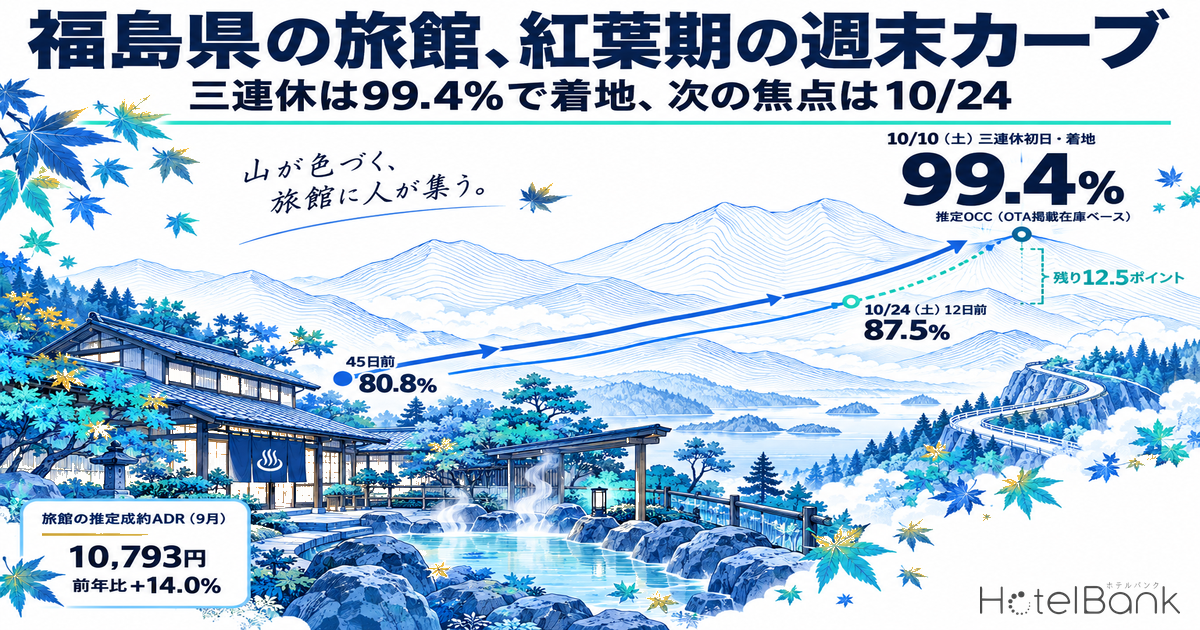
We tracked booking curves for 139–140 ryokan in Fukushima Prefecture (4,277–4,296 rooms, listed on major booking sites) for the stay dates Saturday Oct 10, Sunday Oct 11, Saturday Oct 17 and Saturday Oct 24, 2026. Oct 10, the first night of the three-day weekend, opened at an estimated OCC (OTA listed-inventory basis) of 80.8% 45 days out, passed 87.8% at 30 days and 93.8% at 14 days, and landed at 99.4% just before arrival. Sunday Oct 11 started lower at 68.7% 45 days out, but added 12.0 points in the final week to reach 97.7%. Meanwhile Oct 24, the weekend that falls in peak foliage season, stood at 87.5% 12 days out — 8.3 points behind Oct 10 at the same lead time (95.8%), but ahead of Oct 17 at the same point (84.4%). This article overlays these four curves with same-date curves for Fukushima business hotels and the autumn shape of ryokan estimated settled ADR, and asks how to fill the remaining 12.5 points of inventory with Oct 24 as the target date.
About the data — Scope: Fukushima Prefecture ryokan, N=139–140 properties (4,277–4,296 rooms); comparison set: Fukushima Prefecture business hotels, N=48–49 properties (5,505–5,737 rooms). Price metrics are estimated settled ADR (the settled price level estimated from OTA and other sales data, tax-excluded equivalent); occupancy is an estimate based on OTA-listed inventory. Definitions are at the end of the article. Data as of October 13, 2026.
- — Oct 10, the first night of the three-day weekend, landed at 99.4%. Estimated OCC (OTA listed-inventory basis) for Fukushima ryokan (N=139–140) built from 80.8% at 45 days out → 87.8% at 30 days → 93.8% at 14 days, and the middle night, Oct 11, reached 97.7% on a +12.0-point final week.
- — Saturday Oct 24 stood at 87.5% 12 days out. That is 8.3 points behind Oct 10 at the same lead time (95.8%) but ahead of Oct 17 (84.4%). On ordinary Saturdays the 30-to-14-day window adds a thin +3.7–4.1 points, and growth after 14 days out is smaller still.
- — September estimated settled ADR was ¥10,793, up 14.0% YoY (tax-excluded equivalent). Business hotels added +8.6–9.2 points from 14 days out onward (Oct 10 and Oct 17), so for the remaining 12.5 points on Oct 24 the question is how sales allotments are opened.
The Oct 10–11 three-day weekend — the first night climbed steadily from 45 days out; the middle night gained 12 points in the final week
We start with the two nights of the three-day weekend (Oct 10–12; Oct 12 was Sports Day), whose results are now final. The ryokan curve for Saturday Oct 10 rose from 80.8% at 45 days out to 87.8% at 30 days (+7.0 points), 93.8% at 14 days (+6.0 points) and 99.4% just before arrival (+5.6 points), adding almost equal increments across all three windows. Being above 80% already at 45 days out was a natural starting point given where September Saturdays landed (92.0% on Sep 5, 93.5% on Sep 12, 91.6% on Sep 26), and it reflects a demand pattern in which the first night of a long weekend fills early. A mid-September read of this same weekend put ryokan at 82.2% 45 days out (a figure based on the cohort observed at that time); this article follows that pace through to the actual landing.
The middle night, Sunday Oct 11, tells a different story. At 68.7% 45 days out it was 12.1 points below Oct 10, and it trailed the first night at every checkpoint — 76.9% at 30 days, 84.4% at 14 days. But it then added 13.3 points between 14 days out and arrival, landing at 97.7%. In particular, the 12.0 points gained from 85.7% at 7 days out to 97.7% just before arrival were more than three times the first night’s gain over the same window (95.7%→99.4%, +3.7 points). The curve shows plainly that the second, middle night of a long weekend relies on late-deciding demand. The final night of the holiday (Oct 12) landed far lower, at 83.7% (Table 1).
Figure 1: Booking curves of estimated OCC (OTA listed-inventory basis) for Fukushima Prefecture ryokan, from 45 days before the stay date to the latest observation. Oct 10 and Oct 11 are final; Oct 17 runs to 5 days out and Oct 24 to 12 days out. N=139–140 properties. Source: MetroEngines Research; compiled by HotelBank Editorial Team
Set against weekend results since September, the 99.4% on Oct 10 and 97.7% on Oct 11 sit in the top band for ryokan in the prefecture, alongside Silver Week (Sep 19–22: 98.4%, 99.1%, 99.1%, 98.2%). Given that ordinary Saturdays have run at 91–94% and Sundays at 83–87%, the three-day weekend added roughly +6–8 points on the Saturday and +11–15 points on the Sunday.
| Weekend | Saturday | Sunday | Notes |
|---|---|---|---|
| 9/5 & 9/6 | 92.0% | 85.7% | Ordinary weekend |
| 9/12 & 9/13 | 93.5% | 86.9% | Ordinary weekend |
| 9/19 & 9/20 | 98.4% | 99.1% | Silver Week (Mon 9/21 99.1%, Tue 9/22 98.2%) |
| 9/26 & 9/27 | 91.6% | 82.9% | Ordinary weekend |
| 10/3 & 10/4 | 93.2% | 84.6% | Ordinary weekend |
| 10/10 & 10/11 | 99.4% | 97.7% | Three-day weekend (Mon 10/12 holiday 83.7%) |
Table 1: Weekend estimated OCC for Fukushima Prefecture ryokan (OTA listed-inventory basis; observed just before the stay date). September daily results cover 98–133 properties; October, 127–139. Source: MetroEngines Research; compiled by HotelBank Editorial Team
Where Oct 17 and Oct 24 stand — ordinary Saturdays gain little after 14 days out
This is the core of the article. Saturday Oct 17 moved from 71.8% at 45 days out to 79.2% at 30 days (+7.4 points) — the same pace as the first night of the long weekend — before slowing to 82.9% at 14 days (+3.7 points) and 85.4% at 5 days (+2.5 points). Saturday Oct 24 is tracing the same path: 75.5% at 45 days, 82.4% at 30 days (+6.9 points), 86.5% at 14 days (+4.1 points) and 87.5% at 12 days (+1.0 point). The 45-to-30-day window was +6.9–8.2 points for all four dates with no real difference, so the common thread across the four curves is that weekend-to-weekend differences in landing are decided after 30 days out, and especially after 14 days out.
This post-14-day behaviour is the dividing line between an ordinary foliage-season Saturday and a three-day weekend. Oct 10 added +5.6 points and Oct 11 +13.3 points between 14 days out and arrival, whereas Oct 17 managed only +2.5 points from 14 to 5 days out. Viewed from its 87.5% at 12 days out, Oct 24 is 8.3 points short of Oct 10 at the same point (95.8%), but ahead of both Oct 17 at 12 days out (84.4%) and Oct 11 at the same point (85.1%) — in other words, “not a long weekend, but the furthest-along of October’s ordinary Saturdays.”
| Stay date | 45 days out | 30 days out | 14 days out | Latest | 45→30 | 30→14 | 14→Latest |
|---|---|---|---|---|---|---|---|
| Ryokan 10/10 (Sat) | 80.8% | 87.8% | 93.8% | 99.4% (1 day out) | +7.0 | +6.0 | +5.6 |
| Ryokan 10/11 (Sun) | 68.7% | 76.9% | 84.4% | 97.7% (1 day out) | +8.2 | +7.5 | +13.3 |
| Ryokan 10/17 (Sat) | 71.8% | 79.2% | 82.9% | 85.4% (5 days out) | +7.4 | +3.7 | +2.5 |
| Ryokan 10/24 (Sat) | 75.5% | 82.4% | 86.5% | 87.5% (12 days out) | +6.9 | +4.1 | +1.0 |
| Business 10/10 (Sat) | 69.3% | 77.8% | 90.1% | 99.3% (1 day out) | +8.5 | +12.3 | +9.2 |
| Business 10/11 (Sun) | 59.0% | 66.5% | 76.0% | 94.0% (1 day out) | +7.5 | +9.5 | +18.0 |
| Business 10/17 (Sat) | 66.6% | 72.4% | 83.6% | 92.2% (5 days out) | +5.8 | +11.2 | +8.6 |
| Business 10/24 (Sat) | 69.2% | 78.3% | 89.2% | 90.0% (12 days out) | +9.1 | +10.9 | +0.8 |
Table 2: Checkpoint comparison of estimated OCC (OTA listed-inventory basis) for Fukushima Prefecture ryokan (N=139–140 properties, 4,277–4,296 rooms) and business hotels (N=48–49 properties, 5,505–5,737 rooms). Increment columns are in points. Source: MetroEngines Research; compiled by HotelBank Editorial Team
The curves for the prefecture’s business hotels, included for comparison, have the opposite shape to the ryokan curves. On Oct 10 business hotels started 11.5 points below ryokan at 69.3% 45 days out, but added +12.3 points between 30 and 14 days out and +9.2 points from 14 days out to arrival, drawing level with ryokan at 99.3%. On Oct 17 they also rose +8.6 points from 83.6% at 14 days to 92.2% at 5 days, far outpacing ryokan over the same window (+2.5 points). At 12 days out on Oct 24, business hotels at 90.0% have already overtaken ryokan at 87.5%. The contrast between the two hotel types shows that there clearly is lodging demand in the prefecture that moves in the final two weeks.
Figure 2: Ryokan vs business hotel curves for Oct 10 and Oct 24 (estimated OCC, OTA listed-inventory basis, from 45 days before the stay date to the latest observation). Source: MetroEngines Research; compiled by HotelBank Editorial Team
That said, it is too early to read the ryokan’s thin late pickup as weak demand. Because ryokan plan purchasing and staffing around stays with dinner and breakfast, many deliberately restrict late-booking allotments, and estimated OCC on an OTA listed-inventory basis reflects that policy directly. The fact that Sunday Oct 11 gained 12.0 points in its final week shows that short-lead demand does flow into ryokan when allotments are open, so the question is on what terms to open the remaining 12.5 points for Oct 24.
The autumn shape of estimated settled ADR — September up 14.0% YoY; October currently estimated in the ¥12,300 range
On price, estimated settled ADR for Fukushima ryokan (tax-excluded equivalent, area median) was finalised at ¥10,793 for September 2026 (N=237 properties), up 14.0% from ¥9,465 in the same month last year (N=237). August was ¥11,873, up 1.1% on the prior year’s ¥11,748, and July ¥9,774, up 2.0%, so the rate of increase widened in September after a broadly flat summer. Last autumn traced a staircase that climbed from the foliage season into year-end — ¥9,465 in September, ¥10,400 in October, ¥11,818 in November and ¥13,170 in December — and whether that seasonal shape repeats this year is the focus from October onward.
The current estimate for October 2026 is ¥12,322 (N=229 properties) and for November ¥12,384 (N=224); both are estimates based on current sales and may move when the month closes. A direct comparison with last October’s final figure of ¥10,400 should wait for month-end, but the fact that prices currently on sale sit above where they were at this point last year is consistent with the strength of demand that saw the three-day weekend land in the 99% range.
Figure 3: Estimated settled ADR for Fukushima Prefecture ryokan (tax-excluded equivalent, area median), year-over-year overlay. 2025 and Jan–Sep 2026 are final; Oct–Dec 2026 are estimates based on current sales (dashed line). N=211–246 properties. Source: MetroEngines Research; compiled by HotelBank Editorial Team
The progress of the autumn colours affects both price and occupancy, so it is worth pinning down where things stand from official sources. Foliage information for the Bandai-Azuma Skyline published by Fukushima Prefecture (Kenpoku Construction Office) on Oct 9 rated the stretch from Otomezawa to Nehanzaka, the low shrubs of the Jododaira wetland, the slopes of Azuma-Kofuji and the area from Okenuma to Soryu-no-Tsuji as at “perfect peak”, while the Fudosawa Gorge and the stretch from Tenpukyo to the former Tsuchiyu toll gate were colouring and “likely to reach peak next week”. The typical peak periods given in the Fukushima City Tourism & Convention Association’s “[2026] Fukushima City Autumn Foliage Information” (updated Oct 12) are late September to early October for Jododaira, mid-to-late October for Fudosawa Bridge and the Takayu Onsen area, and late October to early November for the Tsuchiyu Onsen area and Anahara/Iizaka Onsen. In a typical year, Oct 17 coincides with peak colour on the mountainsides and Oct 24 with peak colour descending to the hot-spring towns at the foot of the mountains; however, as of writing there is no official announcement fixing the peak for Oct 24, so we treat this only as a typical-year guide.
For revenue managers running ryokan in Fukushima Prefecture — implications and action plan
1. The 45-to-30-day window moves by around +7 points regardless of the type of weekend. All four ryokan curves added +6.9–8.2 points in this window, and the gap between the first night of the long weekend (Oct 10) and ordinary Saturdays (Oct 17 and 24) was already visible in the 45-day starting point (80.8% vs 71.8–75.5%). When reviewing your own Oct 24 curve, where you stood at T-45 relative to the market’s 75.5% can be seen as the first factor that set your expected landing.
2. For ordinary Saturdays, the decisive window is 30 to 14 days out. Oct 17 added +3.7 points and Oct 24 +4.1 points from 30 to 14 days out, thinner than the +6.0 points for the first night of the long weekend. Working back from these curves, the time to review was T-30 (around Sep 24): compare your pace with the market’s 82.4%, and if you were behind, adjust selling terms over those two weeks.
3. Growth after 14 days out depends on whether allotments are open. Across all ryokan, Oct 17 added only +2.5 points from 14 to 5 days out and Oct 24 only +1.0 point from 14 to 12 days out, whereas business hotels added +8.6–9.2 points from 14 days out onward (Oct 10 and 17), and ryokan on Sunday Oct 11 gained +12.0 points in the final week. Since late demand has been shown to exist in the prefecture, there is room to consider whether to offer options beyond the standard dinner-and-breakfast stay (such as no-dinner plans or terms for late arrivals) for the remaining 12.5 points on Oct 24.
4. Read prices against last autumn’s staircase, comparing final months with final months. September 2026 estimated settled ADR was finalised at +14.0% YoY, and October’s current estimate of ¥12,322 is selling above last October’s final figure of ¥10,400. If your Oct 24 rate is still below the market’s current estimate, check your price position before revisiting the terms on remaining rooms. Properties priced above it, conversely, should decide based on whether their occupancy has reached the market’s 87.5%.
| Timeline (relative to 10/24) | Action | Decision trigger (figures from this article) | Aim |
|---|---|---|---|
| Today–10/16 (T-11 to T-8) | Check your 10/24 pace against the market curve and review how remaining rooms are allocated by room type | The market is at 87.5% 12 days out. Properties below this should act on the premise that 10/17 at 85.4% 5 days out is on the same track | Early read on expected landing |
| Today–10/16 (T-11 to T-8) | Compare your 10/24 rate with the market’s estimated settled ADR position | October current estimate ¥12,322 (N=229); September final ¥10,793 (+14.0% YoY) | Check price position before chasing occupancy |
| 10/17–10/18 (T-7 to T-6) | Record the 10/17 landing for your property and the market, and use it as a guide to how much 10/24 can still gain in its final week | 10/17 was 85.4% 5 days out. Treat the long-weekend middle night’s +12.0-point final week as a holiday-specific effect | Gauge late pickup on ordinary Saturdays |
| 10/19–10/23 (T-5 to T-1) | Decide whether to offer options for late demand (no-dinner plans, terms for late arrivals, etc.) | Business hotels added +8.6–9.2 points from 14 days out; ryokan added +2.5 points on 10/17. Consider it if the same gap shows at your property | Capture demand beyond the dinner-and-breakfast stay |
| 10/19–10/23 (T-5 to T-1) | Reflect official foliage updates (the prefecture’s Skyline information; Fukushima City’s Monday/Friday updates) in sales copy | As of 10/9 the Jododaira area was at peak; the hot-spring towns at the foot of the mountains typically peak late October to early November. Do not state unconfirmed peak dates | Appeal to guests still deciding at short lead |
| From 10/25 (review) | Save the 10/24 values at 45, 30 and 14 days out and at landing as your own curve, and roll the approach out to November weekends | Market checkpoints 75.5%→82.4%→86.5%→(landing). Last November’s estimated settled ADR was finalised at ¥11,818 | Design T-45 for next year’s foliage season |
Table 3: Action plan with 10/24 as the target date. Source: HotelBank Editorial Team
Summary — three yardsticks for reading foliage-season weekend curves
First, the 45-day starting point sets the character of the weekend. The gap between the long weekend’s first night at 80.8% and ordinary Saturdays at 71.8–75.5% barely narrowed through the 45-to-30-day window (+6.9–8.2 points). Second, differences among ordinary Saturdays open up between 30 and 14 days out. Oct 17 and 24 added +3.7–4.1 points in this window, less than the +6.0 points for the long weekend’s first night, and slowed further afterwards. Third, growth after 14 days out depends not on whether demand exists but on how sales allotments are opened. Business hotels adding +8.6–9.2 points over the same window on Saturdays, and ryokan adding +12.0 points in the final week of the long weekend’s middle night, bear this out — and on what terms to open the remaining 12.5 points for Oct 24 will likely be the last call for ryokan RM this foliage season.
About the Data
| Item | Definition / notes |
|---|---|
| Estimated OCC (OTA listed-inventory basis) | OTA listed-inventory occupancy = 100 − 100 × OTA-listed remaining rooms ÷ total rooms. Based on a fixed cohort of properties that list at least 30% of their total rooms on OTAs (the same set of properties for each stay date; the property counts given in the text are the cohort size). This is an estimate based on the sell-through of inventory sold on OTAs and is defined differently from actual room occupancy (rooms not listed are counted on the sold side, so it reads high). |
| Booking curve | Based on observations from 45 days before the stay date to the latest available. Checkpoints are 45, 30 and 14 days out and the latest observation (1 day out for 10/10 and 10/11, 5 days out for 10/17, 12 days out for 10/24). |
| Estimated settled ADR | Settled price level (tax-excluded equivalent) estimated from OTA and other sales data (lowest-plan price level × type-specific coefficient, ensembled across multiple channels). Past months are final; current and future months are estimates based on current sales. Median error against published operating results is 6.6%. Amounts in the text, tables and charts are shown as retrieved (to the yen). |
| Properties covered | Booking curves: Fukushima Prefecture ryokan, N=139–140 properties (4,277–4,296 rooms); business hotels, N=48–49 properties (5,505–5,737 rooms). Daily results: ryokan, 98–133 properties in September and 127–139 for Oct 1–13 (varies by day). Estimated settled ADR: Fukushima Prefecture ryokan, N=211–246 properties (varies by month). All based on listings on major booking sites. |
| Data as of | Data as of: October 13, 2026. Sales status and inventory change daily, so the figures in this article are a snapshot at the time of retrieval. |
Source: MetroEngines Research; compiled by HotelBank Editorial Team
References and Sources
■ Data sources
Aggregated data from MetroEngines Research (daily observations of listed inventory and selling prices on major booking sites). Booking curves and daily estimated OCC cover Fukushima Prefecture ryokan and business hotels; estimated settled ADR is the monthly series for Fukushima Prefecture ryokan (January 2025–December 2026). Foliage conditions are from the information published by Fukushima Prefecture and the Fukushima City Tourism & Convention Association listed below.
■ Calculation assumptions
Window increments are the difference in estimated OCC between checkpoints (in points). “The remaining 12.5 points” is 100% minus 10/24’s 87.5% at 12 days out and is not a forecast of the landing. YoY changes are calculated between final months (e.g. September 2026 vs September 2025); current estimates for October onward are not used in YoY calculations.
■ Limitations
Estimated OCC is based on the sell-through of OTA-listed inventory and reads higher than actual room occupancy. Some ryokan restrict late-booking allotments, so a thin curve does not equate to weak demand. 10/17 and 10/24 are in-progress readings before the stay date, and estimated settled ADR for October–December may move when each month closes. Figures are prefecture-wide aggregates and do not reflect differences by area or property.
| Document | Publisher / content referenced |
|---|---|
| Bandai-Azuma Skyline Foliage Information (磐梯吾妻スカイライン 紅葉情報) | Fukushima Prefecture (Kenpoku Construction Office). Colouring status as of Oct 9, 2026. |
| [2026] Fukushima City Autumn Foliage Information (【2026】福島市紅葉情報) | Fukushima City Tourism & Convention Association. Updated Oct 12, 2026; typical peak periods by spot. |