

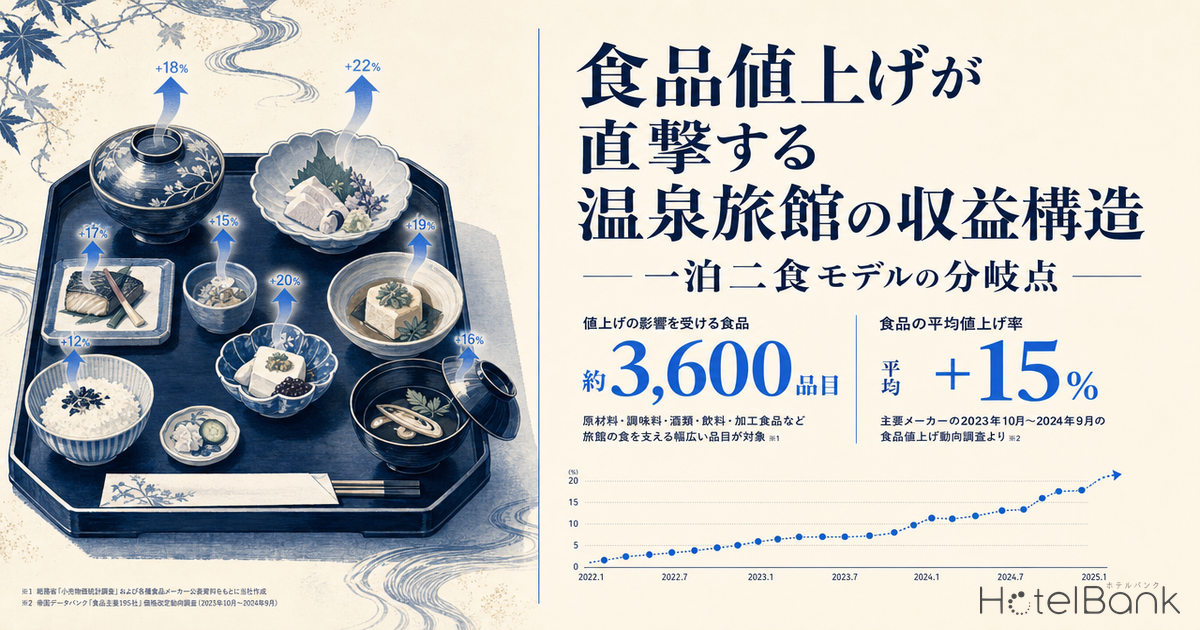
In just the first four months of 2026, approximately 3,600 food items saw price hikes. Centered on seasonings, processed foods, and alcoholic beverages, the average hike per round was around 14-15%. Rice products, egg products, and frozen foods are also affected, continuously pushing up procurement costs for restaurants and lodging operators. Among them, onsen ryokan (hot spring inns) — whose core product is the “one night with two meals” plan — face a structure in which rising dinner ingredient costs directly erode profits. They have entered a phase where the skill of price pass-through determines profitability. This article uses ADR (Average Daily Rate) and plan composition data from Japan’s major onsen regions to examine the squeeze on dinner ingredient costs, the limits of price pass-through, and the strategic tipping point of expanding “breakfast-only / room-only plans.”
Metric Definitions Used in This Article
- ADR (Average Daily Rate): The average of listed selling prices published on OTAs. Differs from actual transaction prices (cross-referencing with REIT disclosure data shows OTA-listed averages trend +25-30% higher than transaction ADR — unsold high-priced plans remain on OTAs, structurally lifting the listed-price average above the transacted price). Per-room rate for double occupancy (tax included), averaged across all plans (including room-only through meal-inclusive plans).
- OCC (Occupancy Rate): The ratio of sold rooms to total rooms in the area (estimated value based on OTA inventory).
- Data Source: MetroEngines Research (メトロエンジンリサーチ). Plan composition for the ryokan category is aggregated for major onsen prefectures: Gunma, Shizuoka, Oita, Nagano, and Ishikawa.
The 2026 Food Price Hike Rush — What Rose and by How Much
According to Teikoku Databank’s “Price Revision Survey of 195 Major Food Companies,” 3,593 food and beverage items had confirmed price hikes from January to April 2026. While this is down roughly 40% from the same period last year (6,121 items), the scale has grown month by month, with April alone seeing 2,278 items — the year’s first major price hike wave. The average hike rate per round is around 14%, on par with 2025 (15%).
By category, “Seasonings” topped the list with 1,603 items. Mayonnaise, dressings, miso products and other items indispensable to ryokan dinners and breakfasts are prominently featured. “Processed Foods” followed with 947 items, mainly frozen foods, packaged rice, and instant noodles. “Alcoholic Beverages and Drinks” totaled 882 items, with shochu and other alcohol along with PET-bottled green tea standing out. Rice products and egg products are also subject to hikes, meaning virtually every category that makes up lodging food costs is under upward pressure.
Source: Teikoku Databank “Price Revision Survey of 195 Major Food Companies” (April 2026); compiled by HotelBank Editorial Team
Notable is that these hikes are not “one-off” but structurally ongoing. Hikes in basic ingredients like rice and seasonings ripple across every element of a ryokan dinner — sashimi, simmered dishes, fried dishes, rice, and sake. Even if individual hike rates are in the low double digits, when aggregated across the entire menu, the cost impact reaches a level that cannot be ignored.
Onsen Ryokan ADR Has Risen — But Cannot Keep Up With Procurement
So, are onsen ryokan able to pass through these hikes into room rates? Comparing the ryokan category ADR for Japan’s 10 major onsen prefectures in April 2025 vs. April 2026 via MetroEngines Research, the average rose +5.8% YoY. While regions like Shizuoka (+16.1%), Oita (+11.3%), and Kanagawa (+10.8%) showed double-digit gains, others such as Ishikawa (+1.2%), Wakayama (+1.1%), and Gifu (-5.5%) were flat to negative — there are large regional disparities in how pass-through has progressed.
Source: MetroEngines Research; compiled by HotelBank Editorial Team
What matters here is to view the ADR growth rate alongside the procurement cost growth rate. Teikoku Databank’s survey shows that 91.0% of ryokan and hotels face rising procurement unit prices, while only 64.5% have been able to raise their selling prices. The gap is 26.5 points. Furthermore, as of February 2026, the price pass-through rate fell to 39.4%, the lowest level since the survey began. In other words, for every ¥100 of cost increase, ryokan are able to add less than ¥40 to room rates. Even if ryokan ADR is up +5.8% YoY, in reality it has not caught up with overall procurement growth including food ingredients. A similar structure is seen on the hotel side, where Labor Cost Pass-Through ADR Surge: Structural Change in 2026 Hotel Prices via OCC×ADR Divergence examines the limits of labor-cost-driven ADR growth and the divergence with OCC from another angle.
| Onsen Prefecture | Ryokan ADR April 2025 | Ryokan ADR April 2026 | YoY | Properties |
|---|---|---|---|---|
| Shizuoka | ¥29,200 | ¥33,900 | +16.1% | 434 |
| Oita | ¥30,000 | ¥33,400 | +11.3% | 293 |
| Kanagawa | ¥28,000 | ¥31,000 | +10.8% | 256 |
| Tochigi | ¥27,200 | ¥29,000 | +7.0% | 197 |
| Hyogo | ¥33,200 | ¥35,100 | +5.8% | 257 |
| Nagano | ¥29,300 | ¥30,800 | +5.1% | 447 |
| Gunma | ¥31,500 | ¥33,100 | +4.9% | 254 |
| Ishikawa | ¥32,800 | ¥33,200 | +1.2% | 110 |
| Wakayama | ¥33,100 | ¥33,400 | +1.1% | 105 |
| Gifu | ¥32,900 | ¥31,100 | -5.5% | 216 |
Source: MetroEngines Research; compiled by HotelBank Editorial Team
Monthly Trend of Onsen Ryokan ADR — Seasonality and a Gradual Lift
Plotting the ryokan ADR for the six main onsen prefectures (Gunma, Shizuoka, Oita, Nagano, Ishikawa, Hyogo) on a monthly basis reveals clear seasonality. August (covering the Obon holiday) is the annual peak, with October to December also high — driven by autumn foliage and year-end/New Year demand. By contrast, the shoulder months of April, June, and September are relatively weak. This seasonal pattern itself does not change much year to year.
Source: MetroEngines Research; compiled by HotelBank Editorial Team
However, overlaying year by year shows that from 2024 to 2025 to 2026 — particularly the autumn-onward levels — have crept gradually higher. August 2025 at ¥35,800, November 2025 at ¥34,100, and December 2025 at ¥34,000 all exceeded the same month a year earlier. This is evidence that some of the price hikes have been passed through. However, the gains are only on the order of a few percent annually — not enough to fully absorb double-digit food cost hikes. Ryokan are walking a tightrope: “raising prices, but unable to raise them enough.”
How Dinner Cost Erodes Profit — Why Ryokan Are Cautious About Price Hikes
Generally, the food cost ratio of a “one night with two meals” plan at a ryokan is around 25-35% of the room rate. Suppose at a ryokan where dinner and breakfast ingredient costs make up 30% of the room rate, food costs rise 15%. If the room rate is held flat, the cost ratio rises from 30% to 34.5% — a 4.5 point increase. For ryokan with thin GOP (Gross Operating Profit) margins, those 4.5 points translate directly into lost profit.
Source: HotelBank Editorial Team estimate (model assuming 30% food cost ratio and 15% food cost increase)
Despite this, ryokan are cautious about raising prices because they fear the price elasticity of demand. The core customer base of onsen ryokan includes seniors (including pensioners) and budget-conscious family travelers. The “common sense” price of around ¥20,000 for one night with two meals is deeply entrenched among customers, so pricing significantly above that level tends to directly cut into bookings. Teikoku Databank’s survey also points out that “ryokan and hotels fear losing customers to price hikes due to consumer thrift and competitive pricing, and have not been able to pass costs through sufficiently.”
The deeper this bind, the harder it hits ryokan that have marketed themselves on lavish dinners. Cut the number of dishes or the ingredient grade, and review ratings fall; raise prices, and bookings slow. The very “cuisine-focused inn” brand is increasingly becoming a burden amid the changing cost environment.
Current Plan Composition — Two-Meal Plans Over 60%, Room-Only Just 10%
In considering the strategic tipping point, the current plan composition is essential. Using MetroEngines Research data, classifying plans sold by ryokan in the five major onsen prefectures (Gunma, Shizuoka, Oita, Nagano, Ishikawa) by plan name, “one night with two meals” plans — including cuisine names (kaiseki, kaiseki-ryori) or “with 2 meals” — accounted for approximately 64% of the total. “Breakfast-included” plans came in at about 18%, and “room-only” plans at just 11%. Onsen ryokan remain heavily dependent on the one-night-two-meals plan as their core product.
Source: MetroEngines Research (plan name classification across 5 major onsen prefectures, ryokan category); compiled by HotelBank Editorial Team
On price, the room-only plan average is around ¥37,900 (double occupancy, tax included), more than ¥20,000 lower than the one-night-two-meals plan at around ¥59,800. This price gap shows that a high per-stay rate and meal provision are two sides of the same coin. Increasing room-only plans makes it easier to fill rooms, but revenue per booking falls sharply. Conversely, focusing on the two-meal plan preserves per-customer revenue but misses customer segments that don’t need dinner. Plan composition has become a management decision in itself: which to prioritize, occupancy or per-customer revenue.
Strategic Tipping Point — Three Directions Ryokan Can Choose
Where do the revenue opportunities lie for onsen ryokan in an environment of continued food cost hikes? Three broad directions emerge from the data. These should be viewed not as “current weaknesses” but as options with upside potential.
| Direction | Description | Expected Effect |
|---|---|---|
| ① Redesign the value of the two-meal plan | Trim down the number of dishes, focus on local ingredients and signature cuisine. Tell a story with the menu and lift per-guest pricing. | Achieve both food waste reduction and higher per-guest revenue. Optimize cost while maintaining dining satisfaction. |
| ② Expand breakfast-only plans | “Lodging-dining separation” — leave dinner to local restaurants. Keep breakfast as a ryokan strength. | Decouple dinner cost risk while lifting occupancy. Also creates linkages with the local economy. |
| ③ Strategic use of room-only plans | Deploy room-only plans selectively in shoulder seasons and weekdays to fill empty rooms. | Maximize utilization of the onsen asset. Capture floor-level demand while preserving two-meal plan pricing. |
Source: HotelBank Editorial Team
The key point is that these are not either/or choices. Maximizing per-guest revenue with the two-meal plan in peak seasons, and lifting occupancy with breakfast-only and room-only plans in shoulder seasons — this “seasonal mix” produces the most realistic upside. Indeed, onsen ryokan ADR has clear seasonality: demand in August or the year-end peak is completely different from the shoulder months of April and June. Missing the strong-demand periods with a thin plan lineup, while leaving rooms empty in weak periods with a heavy lineup, leaves revenue opportunities on the table in both directions. As for the structure of food cost pressure itself, the same tug-of-war is happening on the hotel side — Hotel Breakfast Price Hike Wave 2: Japan’s 2026 Breakfast Deficit Reckoning digs into the mechanism by which breakfast plans turn into a loss center.
Pair tiered pricing with linking the plan composition itself to the demand calendar. This is where the room lies to turn the external environment of food price hikes around and grow revenue. Rather than the binary “serve dinner or not,” stepping into the design of “when, to whom, and which dining style to sell” gives ryokan a new revenue opportunity that complements the limits of price pass-through.
REIT Data Shows Solid Operations for Onsen and Resorts
Looking at the monthly operating performance of Hoshino Resorts REIT (3287, 星野リゾート・リート投資法人), which holds a high share of ryokan and onsen resorts, the overall portfolio’s March 2026 ADR was approximately ¥21,300 (+2.3% YoY), occupancy was 78.7% (+0.2 points YoY), and RevPAR was approximately ¥16,800 (+2.5% YoY) — all above the prior year. Demand in the onsen and resort segment is solid, with both price and occupancy showing gradual improvement.
However, even this ADR growth (+2.3%) is not enough to absorb double-digit food cost hikes. The fact that demand is solid means, conversely, “there is large room to grow revenue through appropriate price design and plan composition.” Whether ryokan can shift to a price and plan strategy commensurate with the cost environment while demand is solid will determine their earning power. On the demand-side tailwind — reading high-end spending capacity — Will the 2026 Summer Bonus Flow to High-End Onsen Ryokan? — ADR Analysis of 5 Onsen Areas approaches the question via ADR analysis of 5 onsen areas. Note that REIT disclosed ADR is on a transacted-price (actual) basis, while this article’s ADR is on an OTA-listed-price basis — they differ in nature. Refer to the YoY direction, not the absolute level.
Summary
Food price hikes continue in 2026, with seasonings, processed foods, and alcohol pushing up onsen ryokan dinner costs. While ryokan ADR in major onsen prefectures rose an average +5.8% YoY, the industry-wide figures — 91.0% on procurement vs. 64.5% on selling, and a price pass-through rate of 39.4% — show that the cost increases are not being fully translated into prices. The very revenue structure built around the two-meal plan harbors fragility in the face of changing external conditions.
On the other hand, demand for onsen and resort stays remains solid, and by linking plan composition and tiered pricing to the demand calendar, there is clear room to grow revenue. Maximize value with the two-meal plan in peak season, and lift occupancy with breakfast-only and room-only plans in shoulder seasons — switching the mindset from “serve dinner or not” to “when, to whom, and how to sell” is the most realistic growth strategy for onsen ryokan in the food price hike era.
About the data in this article: Ryokan ADR and plan composition are aggregated values based on OTA-listed price data collected by MetroEngines Research. Plan classification is a mechanical classification based on plan name keywords and may differ in part from actual meal-provision content. Food price hike item counts and hike rates are based on figures published by Teikoku Databank, and REIT data is based on monthly operating performance disclosures by each company.
Related Articles
- Mother’s Day 5/10 & Father’s Day 6/21: Booking Patterns at High-End Onsen Ryokan via Filial-Trip Demand
- [Interview] Century-Old Inn Reborn: Boutique Hotel “mont” Opens in Nozawa Onsen
- Hotel Breakfast Price Hike Wave 2: Japan’s 2026 Breakfast Deficit Reckoning
- Labor Cost Pass-Through ADR Surge: Structural Change in 2026 Hotel Prices via OCC×ADR Divergence
References & Sources
- Teikoku Databank “Price Revision Survey of 195 Major Food Companies” — April 2026
- 2026 January/February/March/April price hike list (summary of 3,593 food item price revisions)
- Teikoku Databank: For 40 consecutive months, over 70% of companies face rising procurement prices (Ryokan & Hotels: procurement 91.0%, selling 64.5%)
- Teikoku Databank “Price Pass-Through Survey” (February 2026, 39.4% pass-through rate)
- Kanko Keizai Shimbun: “Major impact on the national lodging industry — beyond the limits of self-help”
- A new management style for onsen ryokan — lodging-dining separation and regional partnership
- Hoshino Resorts REIT (3287, 星野リゾート・リート投資法人) monthly operating performance (March 2026)
- MetroEngines Research (メトロエンジンリサーチ) — ryokan ADR and plan composition data for major onsen prefectures nationwide