

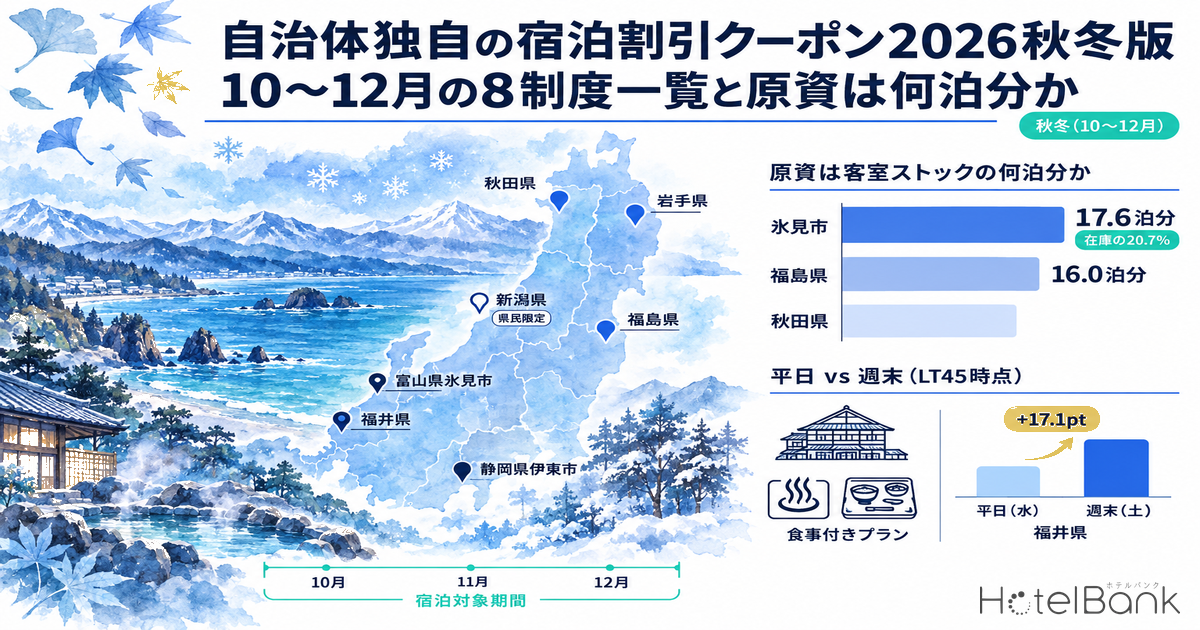
We checked each local government’s official website and press releases for lodging discounts run by prefectures and municipalities whose eligible stay periods fall in October–December 2026, and list the eight schemes we found. The table sets out each scheme’s name, operator, period, type of discount, cap per night, budget and eligibility (residents only or nationwide); items that have not been published are marked “Not disclosed”. For the four schemes whose funding is known, we estimate how many nights of local room stock that funding is worth. We also compare estimated occupancy on weekdays and weekends from October to early November, to check from the inventory side where the discounts are likely to work best.
Schemes for May–July and the overall picture of the Japan Tourism Agency budget are covered in our earlier article Local Lodging Discounts & JTA’s ¥138.3B Budget: Regional Demand Strategy May-Jul 2026. This article deals only with schemes usable for stays in autumn and winter (October–December).
Metric Definitions Used in This Article
- ADR (average daily rate): an estimated settled rate (tax-exclusive equivalent), calculated by applying a category-specific correction factor to the level of each property’s cheapest plan published on booking sites (2 guests per room, per-room price, tax-inclusive). Checked against property-level results disclosed by listed hotel REITs (91 properties, most recent 3 months), the median error is about 7%. It is an estimate and differs from each property’s actual settled prices and accounting figures. Area-level ADR is the median of the properties covered and represents the level of a typical property in the area.
- OCC (occupancy): rooms sold as a share of total rooms in the area (an estimate based on OTA sales inventory). It is estimated from how inventory sold on booking sites is drawn down, and differs from a property’s actual occupancy.
- LT (lead time): days until the stay date. This article uses only observations within LT45 (45 days before the stay).
- Room stock: total rooms at properties whose prices were confirmed on booking sites over the most recent three months (stay dates June 22 – September 21, 2026).
- Listed price: per-room price for 2 guests (tax-inclusive). The average across all plans is taken for each property, and the area figure is the median of those averages.
- Data source: MetroEngines Research
- — 8 schemes confirmed from official announcements: local-government lodging discounts usable for stays in October–December 2026 (the Kyushu Recovery Support Discount is shown for reference only, as it is nationally funded). Only Niigata limits eligibility to its own residents, and 4 schemes have not disclosed a budget.
- — Funding equals 5–18 nights of room stock: estimated for the 4 schemes with a known budget or expected number of stays. At city level, Himi’s 8,500 coupons reach about one-fifth (20.7%) of room inventory over the eligible period.
- — Weekdays have more room: at 45 days before the stay, estimated occupancy on Saturdays was above Wednesdays in all 7 areas (by +5.6 to +17.1pt, stay dates October 14 – November 4, 2026).
- — Eligibility thresholds sit above standard rates: against Fukushima’s condition of “¥8,000 or more per person per night”, the prefecture’s estimated settled ADR is equivalent to about ¥4,200 per person. Plans with meals or activities are the ones most likely to qualify.
The 8 local-government lodging discounts for autumn–winter (October–December)
As of September 22, 2026, official announcements confirmed the following eight lodging discounts whose eligible stay periods overlap October–December and that are run (or funded) by a local government. Periods and amounts are shown as stated on the official websites and in press releases. Budgets not published officially are marked “Not disclosed”; only those confirmed in press reports are shown, with their source.
| Scheme | Operator | Eligible stay period | Type of discount | Cap per person per night | Budget | Eligibility |
|---|---|---|---|---|---|---|
| Odense! Iwate Travel Discount Campaign, Round 2 (おでんせ!いわて旅割キャンペーン 第2弾) | Iwate Prefecture | Oct 1 – Dec 25 (check-out by Dec 26) | Fixed discount (up to half the room charge) | Northern & coastal areas ¥7,000 / elsewhere ¥5,000 | Not disclosed (230,000 guest-nights expected across all 3 rounds) | No residence restriction stated |
| Fukushima “Come Again” Discount, Phase 3 (福島県「また来て。」割 第3期) | Fukushima Prefecture | Nov 1 – Dec 25 (bookings from Oct 1, 10:00) | Fixed discount (stays of ¥8,000 or more per person per night) | ¥3,000 | ¥3.54bn (all 4 phases, 900,000 guest-nights expected; press report) | Nationwide (no residence restriction) |
| “Still Undiscovered Akita” Tokutabi Campaign, Round 2 (まだバレてない秋田県。得旅キャンペーン 第2弾) | Akita Prefecture | Nov 1 – check-out by Feb 28, 2027 | Fixed-amount coupon (4 tiers by room charge per person) | ¥10,000 (¥12,000 for plans with activities etc.) | Coupon funding ¥590M (including carry-over from Round 1; press report) | Nationwide (open to anyone) |
| Niigata Go To Travel, Round 2 (にいがたGo Toトラベル 第2弾) | Niigata Prefectural Tourism Association (prefectural program) | Sep 7 – check-out by Dec 29 | 30% discount | ¥5,000 | Not disclosed | Niigata residents only (business travel excluded) |
| Stay in Fukui! “Iitoko Horidakusan”, Round 2 (福井に泊まろう!「いいとこ、掘りだくさん。」第2弾) | Fukui Prefecture | Sep 1 – Oct 31 (excluding Sep 19–22) | Local-currency credit (bookings for 2 or more guests) | ¥5,000 worth (¥4,000 worth as paper coupons) | Not disclosed | No residence restriction stated |
| Come to Ito Now! Campaign, Phase 2 (今こそ伊東へ!キャンペーン 第2期) | Ito City, Shizuoka (secretariat: Ito Tourism Association) | Sep 7 – check-out by Dec 14 (varies by booking site) | Percentage discount (up to 20%) | ¥5,000 | Not disclosed | No residence restriction |
| Himi Travel Discount Campaign (氷見旅行割キャンペーン) | Himi City, Toyama | Aug 23 – check-out by Nov 16 | Fixed coupon per booking (first come, first served, via one designated booking site) | ¥3,000 / ¥5,000 / ¥10,000 per booking (conditions on party size and amount) | Not disclosed (8,500 coupons in total) | No residence restriction stated |
| Kyushu Recovery Support Discount (九州ふっこう応援割) (reference; national funding) | 7 Kyushu prefectures (national subsidy) | Stays from Oct 1. Until Dec 25 in 5 prefectures, Dec 15 in Fukuoka, undecided in Kagoshima | 50% (60% in Kumamoto and Kagoshima) | Per person ¥20,000 / ¥30,000 / ¥35,000 (by product type) | ¥15.5bn for “support toward tourism recovery” (national reserve funds) | Nationwide |
Source: compiled by the HotelBank Editorial Team from the official websites and press releases of each local government and the Japan Tourism Agency (checked September 22, 2026). Budgets marked “press report”: Fukushima = Fukushima Minpo (December 16, 2025); Akita = Nikkei (August 20, 2026)
Some schemes were left out of the table. Yamaguchi Prefecture’s “Yamaguchi no Asobi Shinhakken Wari 2026” Phase 2 (October 1 – December 31, 30% off) covers experiences and activities and does not include lodging. Nagano Prefecture’s activity discount and Chiba Prefecture’s support discount were excluded for the same reason. Referral campaigns run by travel agencies are not listed either, as they are not local-government schemes.
Set side by side, the eight schemes fall into two broad designs. One is the fixed-amount type that welcomes guests from all over Japan, as in Akita, Iwate and Fukushima. The other is the percentage type limited to a prefecture’s own residents, as in Niigata. Many schemes also do not publish their budget: 4 of the 8 have not disclosed one, and Iwate gives only an expected number of guest-nights (230,000). The form of the discount varies too — fixed discounts, percentage discounts, local-currency credits (Fukui) and per-booking coupons (Himi). Comparing the schemes only on “how much cheaper per night” therefore makes it easy to misread how they actually work.
The Kyushu Recovery Support Discount is kept to a single reference row
The Kyushu Recovery Support Discount is a national program to revive tourism after the 2026 Kumamoto earthquake. It is funded from the ¥15.5bn allocated to “support toward tourism recovery” within the Ministry of Land, Infrastructure, Transport and Tourism’s use of reserve funds (Cabinet decision of August 28, 2026), with a subsidy rate of 50% (60% in Kumamoto and Kagoshima). The Japan Tourism Agency has already published the per-person caps: ¥20,000 for lodging only and for one night with transport, ¥30,000 for two or more nights with transport, and ¥35,000 for touring packages covering two or more prefectures. As it is not a local-government scheme, this article includes it only as one row of the table for comparison. For how October’s unsold rooms are spread across the seven prefectures, see Kyushu Subsidy: Kumamoto & Kagoshima Hold 34.9% of Oct Unsold Rooms.
How many nights of local room stock does the funding cover? — Estimates for 4 schemes
Four schemes publish a budget or an expected number of guest-nights (including figures confirmed in press reports): Akita, Iwate, Fukushima and Himi. For these four, we converted the funding back into the number of room-nights eligible for the discount. Comparing this with the room stock in each scheme’s area shows how many nights of local rooms the funding is worth, and what share of room inventory over the eligible period it can reach. The assumptions are as follows.
- Each room is assumed to be used by 2 guests (guest-nights ÷ 2 = room-nights)
- For Akita, the average discount per person per night was set at two levels, ¥3,000 and ¥5,000, and divided into the ¥590M coupon funding (the funding includes carry-over from Round 1, and the eligible stay period is 119 nights from November to February)
- For Iwate and Fukushima, the expected guest-nights published by each prefecture (Iwate 230,000; Fukushima 900,000) were used as they are. Both are full-fiscal-year figures spanning several phases
- For Himi, all 8,500 coupons are assumed to be used, with one booking = one room for one night (bookings for consecutive nights would raise the room-night count above this)
- Room stock is the total rooms at properties whose prices were confirmed over the most recent three months, so inns not listed on booking sites are not included
| Scheme | Funding / expected | Discount-eligible room-nights (est.) | Room stock | Nights of stock | Inventory coverage over the eligible period |
|---|---|---|---|---|---|
| Himi Travel Discount (Himi City) | 8,500 coupons | 8,500 | 37 properties / 484 rooms | 17.6 nights | 20.7% (85 nights) |
| “Come Again” Discount (Fukushima, all 4 phases) | 900,000 guest-nights | 450,000 | 673 properties / 28,107 rooms | 16.0 nights | Not calculated (Phase 4 period not disclosed) |
| Tokutabi Round 2 (Akita, average discount ¥3,000) | ¥590M | 98,333 | 262 properties / 11,754 rooms | 8.4 nights | 7.0% (119 nights) |
| Tokutabi Round 2 (Akita, average discount ¥5,000) | ¥590M | 59,000 | 262 properties / 11,754 rooms | 5.0 nights | 4.2% (119 nights) |
| Iwate Travel Discount (Iwate, all 3 rounds) | 230,000 guest-nights | 115,000 | 372 properties / 18,234 rooms | 6.3 nights | 2.8% (223 nights across all 3 rounds) |
Source: estimates by the HotelBank Editorial Team from MetroEngines Research (room stock: properties with prices confirmed over the most recent three months) and local-government materials and press reports
Source: estimates by the HotelBank Editorial Team from MetroEngines Research and local-government materials and press reports
Himi City came out thickest. The city’s stock is small at 484 rooms, and 8,500 coupons are distributed into it, so the discount reaches about one-fifth of room inventory over the 85-night eligible period. City-level schemes cover few properties, so even a small budget tends to deliver a large effect per property. Fukushima stands out for its scale of 900,000 guest-nights, equal to 16 nights of the prefecture’s room stock (28,107 rooms). However, this figure is the total of all four phases in the fiscal year, and the amount going to Phase 3 alone (November 1 – December 25) has not been published.
For Akita, the result depends on the assumed average discount, giving a range of 5–8 nights of room stock and 4–7% of inventory over the eligible period. Iwate equals 6.3 nights of room stock over the fiscal year, and spread across the three rounds it reaches only 2.8% of inventory. If bookings concentrate in the 17 northern and coastal municipalities, where the discount cap is set higher, coverage within that area will be above the prefectural average. Each prefecture’s design shows its character not only in how deep the discount is but also in which areas it prioritises.
Discount conditions vs local rate levels — which plans capture the benefit
Fixed-amount schemes come with a condition of the form “¥X or more per person per night”. We therefore compared each threshold with local rate levels, using the estimated settled ADR and the listed price for the same period of the previous year (October–December 2025), for which the figures are final.
| Area | Room stock | Est. settled ADR (Oct–Dec 2025) | Listed price (all-plan average, tax incl.) | Discount condition |
|---|---|---|---|---|
| Akita | 262 properties / 11,754 rooms | ¥7,992 (N=166) | ¥18,800 | ¥1,000 or more off from ¥6,000 per person |
| Iwate | 372 properties / 18,234 rooms | ¥7,206 (N=248) | ¥18,558 | Up to half the room charge |
| Fukushima | 673 properties / 28,107 rooms | ¥7,655 (N=431) | ¥20,423 | ¥8,000 or more per person |
| Niigata | 765 properties / 29,204 rooms | ¥10,114 (N=408) | ¥21,764 | 30% (cap reached at ¥16,667 per person) |
| Fukui | 385 properties / 11,023 rooms | ¥12,483 (N=207) | ¥29,430 | Bookings for 2 or more guests |
| Ito City, Shizuoka | 455 properties / 5,320 rooms | ¥21,843 (N=121) | ¥38,708 | Up to 20% (cap ¥5,000) |
| Himi City, Toyama | 37 properties / 484 rooms | ¥13,564 (N=14) | ¥35,369 | From ¥6,000 or more per booking |
Source: compiled by the HotelBank Editorial Team from MetroEngines Research. Estimated settled ADR and listed price are N-weighted averages over the three months October–December 2025. N is the monthly average number of properties covered by the estimated settled ADR. Himi has few properties, at N=14
Fukushima’s condition is “¥8,000 or more per person per night”. The prefecture’s estimated settled ADR (tax-exclusive equivalent, per room), by contrast, is about ¥7,700; adding tax and dividing by two guests gives about ¥4,200 per person, only around half the threshold. The listed price (all-plan average, tax-inclusive) is about ¥20,400 per room, or about ¥10,200 per person, which clears the condition. In other words, the plans most likely to qualify are higher-priced ones, such as ryokan plans with dinner and breakfast, rather than plans at standard, near-room-only rates. Akita follows the same pattern: its lowest tier of “¥6,000 or more per person” sits above the estimated settled ADR level (about ¥4,400 per person), while the listed-price level (about ¥9,400 per person) falls within the tiers.
From the property’s side, simply having plans with meals or activities is itself what makes it easier to benefit from these schemes. Akita in particular adds ¥2,000 to the discount for plans that combine activities or local products. The more a property’s products build in local food and experiences, the more scope it has to use the scheme’s discount as a selling point.
Discounts work best on weekdays — evidence from October to early-November inventory
For the same funding, a discount creates more new lodging demand for an area when it is used on dates that still have rooms left than on dates that fill easily anyway. We therefore compared estimated occupancy by area at 45 days before the stay (LT45) for four Wednesdays and three Saturdays between Wednesday, October 14 and Wednesday, November 4. As all seven dates are compared at the same LT, differences in booking progress can be read directly.
Source: compiled by the HotelBank Editorial Team from MetroEngines Research. Estimated occupancy at 45 days before the stay. Weekday = average of October 14, 21, 28 and November 4 (Wednesdays); weekend = average of October 17, 24 and 31 (Saturdays)
| Area | Properties / rooms | Weekday (Wed) average | Weekend (Sat) average | Gap |
|---|---|---|---|---|
| Akita | 115 properties / 4,926 rooms | 66.6% | 72.2% | +5.6pt |
| Iwate | 185 properties / 9,897 rooms | 63.1% | 76.5% | +13.4pt |
| Fukushima | 279 properties / 12,905 rooms | 57.3% | 69.4% | +12.1pt |
| Niigata | 289 properties / 13,274 rooms | 58.3% | 72.3% | +14.0pt |
| Fukui | 180 properties / 5,491 rooms | 52.9% | 70.0% | +17.1pt |
| Ito City, Shizuoka | 219 properties / 3,740 rooms | 56.0% | 63.0% | +7.0pt |
| Himi City, Toyama | 18 properties / 354 rooms | 73.1% | 89.7% | +16.6pt |
Source: compiled by the HotelBank Editorial Team from MetroEngines Research. Properties and rooms are based on listings on the major booking sites (the universe for stays on October 14). Himi has only 18 properties, so day-to-day swings are large
In all seven areas, Saturdays were ahead of Wednesdays. The widest gap was in Fukui at +17.1pt, followed by Himi (+16.6pt), Niigata (+14.0pt) and Iwate (+13.4pt). At 45 days before the stay, weekends in many areas are already around 70% full, while weekdays sit in the 50–60% range with many rooms still unsold. If discount budgets flow to weekdays, where vacancies are higher, they do more than discount weekend demand that was already moving — they have far more room to create new lodging demand.
Akita’s gap is small at +5.6pt. Its weekday on Wednesday, November 4 was also high at 71.8%, suggesting a structure with steady weekday demand in October–November. For Toyama Prefecture as a whole, occupancy was heavily concentrated on particular Saturdays, at 95.9% on Saturday, October 24 and 90.5% on Saturday, October 31 (119–120 properties and about 7,700 rooms prefecture-wide). However, prefecture-wide figures include movements in other cities, so they cannot be read as a direct reflection of Himi’s scheme.
Source: compiled by the HotelBank Editorial Team from MetroEngines Research. Fukushima Prefecture, all properties (279 properties / 12,905 rooms, based on listings on the major booking sites). Observations up to September 22
Looking at how bookings built up in Fukushima for Wednesday, October 14 and Saturday, October 17, both rose 8–11pt in the two to three weeks from LT45. However, the Saturday had reached 77.0% by LT26, while the Wednesday was still only 64.6% at LT23. Bookings for Phase 3 open on October 1 and cover stays from November 1. The window between bookings opening and the stay dates corresponds to the same stretch as these October curves (LT45 to LT1), so there is ample time to build the discount in as a tool for filling weekday vacancies.
How properties can use the schemes — capturing discount funding with weekday inventory and meal-inclusive plans
The data so far points to three directions for bringing these schemes into sales. The first is a focus on weekday inventory. In all seven areas more rooms remain on weekdays than on weekends, and in five of them the gap is 10pt or more, so stacking discount-eligible plans on weekday dates makes it easier to tie the funding to new lodging demand. Many schemes are first come, first served or end once the budget runs out; if the funding is used up on weekends first, the share left for weekdays shrinks quickly. Putting weekday plans in a prominent position right after bookings open is an effective way to capture the funding.
The second is product design matched to the eligibility conditions. Fukushima’s “¥8,000 or more per person” and Akita’s tiered thresholds draw the line above standard room-only rates. Placing meal- or activity-inclusive plans in the price band just above the threshold keeps the guest’s effective cost down while holding spend per guest. Niigata’s 30% rate reaches its cap at ¥16,667 per person, so the discount plateaus for premium rooms priced above that band; plans in that band, on the other hand, get the most out of the discount.
The third is preparing for the end of each scheme. Iwate ends on December 25, Fukushima’s Phase 3 also on December 25, and Niigata with check-outs on December 29, so the year-end and New Year period falls outside most schemes. Akita’s Round 2 runs until February 2027. How demand recovers after a scheme ends differs by region, so it pays to draw up post-scheme sales plans early.
Summary
Excluding the Kyushu Recovery Support Discount, we confirmed seven local-government lodging discounts usable for stays in October–December 2026. Only Niigata limits eligibility to its own residents; the rest are open to guests from anywhere in Japan or state no residence restriction on their official sites. Many schemes do not publish a budget, and the funding could be converted back into room-nights for only four. For those four, the funding equals 5–18 nights of local room stock, and city-level Himi reaches about one-fifth of room inventory over the eligible period. On the inventory side, every area has more rooms left on weekdays than on weekends, so the more discount funding flows to weekdays, the greater the room to create new lodging demand. The period around October 1, when bookings open, is a good time to sharpen the presentation of weekday plans and of meal-inclusive plans matched to the eligibility conditions.
Note on data for future stay dates: Estimated occupancy for October–November is an interim reading based on the inventory drawdown observed on booking sites up to the survey date (September 22, 2026), and it will change as the stay dates approach. Estimated occupancy is an estimate based on inventory listed on the major booking sites and differs from properties’ actual occupancy. Scheme periods, amounts and budget status may change at each local government’s discretion, and many schemes end once their budget runs out. Please check the latest status on each official website before use.
Related Articles
- Local Lodging Discounts & JTA’s ¥138.3B Budget: Regional Demand Strategy May-Jul 2026
- Kyushu Subsidy: Kumamoto & Kagoshima Hold 34.9% of Oct Unsold Rooms
References and Sources
■ Data Sources
Scheme periods, amounts, budgets and eligibility were checked on the official websites and in the press releases of each local government and the Japan Tourism Agency (as of September 22, 2026). Room stock, estimated settled ADR, listed prices and estimated occupancy are from MetroEngines Research (aggregates based on observations of prices and inventory published on the major booking sites).
■ Calculation Assumptions
2 guests per room (guest-nights ÷ 2 = room-nights). For Akita, the average discount per person per night was set at two levels, ¥3,000 and ¥5,000. For Iwate and Fukushima, the full-fiscal-year expected guest-nights published by each prefecture were used as they are. For Himi, all 8,500 coupons are assumed to be used, with one booking = one room for one night. Inventory coverage = discount-eligible room-nights ÷ (room stock × nights in the eligible period).
■ Limitations and Caveats
Room stock does not include inns that are not listed on booking sites. Niigata, Fukui and Ito, which publish neither a budget nor an expected number of guest-nights, were excluded from the estimates. Estimated occupancy for October–November is an interim reading as of September 22, 2026 and will change as the stay dates approach. Estimated settled ADR is an estimate and differs from each property’s actual settled prices.
- Iwate Prefecture, “Implementation of the Odense! Iwate Travel Discount Campaign” (press handout, May 15, 2026)
- Odense! Iwate Travel Discount Campaign, official campaign site
- Fukushima Prefecture, “Implementation of Fukushima’s ‘Come Again’ Discount” (updated September 4, 2026)
- Fukushima Minpo, “Fukushima Prefecture takes its own measures against prolonged inflation: subsidies for ryokan and hotel stays” (December 16, 2025)
- Akita Prefecture Tokutabi Campaign, Round 2, official site
- Nikkei, “‘Still Undiscovered Akita’ campaign Round 2: coupons from October” (August 20, 2026)
- Niigata Prefectural Tourism Association, “Niigata Go To Travel”
- Fukui Prefecture, “Iitoko Horidakusan” campaign official site
- Shizuoka Shimbun, “Ito City launches its own tourism campaign: 20% off lodging, up to ¥5,000” (May 28, 2026)
- Travel Watch, “Come to Ito Now! Campaign” Round 2 (August 25, 2026)
- Himi City, “Notice of the Himi Travel Discount Campaign”
- TRAICY, “Himi City, Toyama, runs the ‘Himi Travel Discount Campaign’” (September 10, 2026)
- Japan Tourism Agency, “Kyushu Recovery Support Discount” (updated September 18, 2026)
- Ministry of Land, Infrastructure, Transport and Tourism, “Use of FY2026 MLIT-related reserve funds” (August 28, 2026)
- Yamaguchi Prefecture, launch of “Yamaguchi no Asobi Shinhakken Wari 2026” (excluded from the table as it covers experiences)
- MetroEngines Research — estimated settled ADR (October–December 2025), room stock (properties with prices confirmed over the most recent three months), estimated occupancy (at 45 days before the stay, based on listings on the major booking sites)