

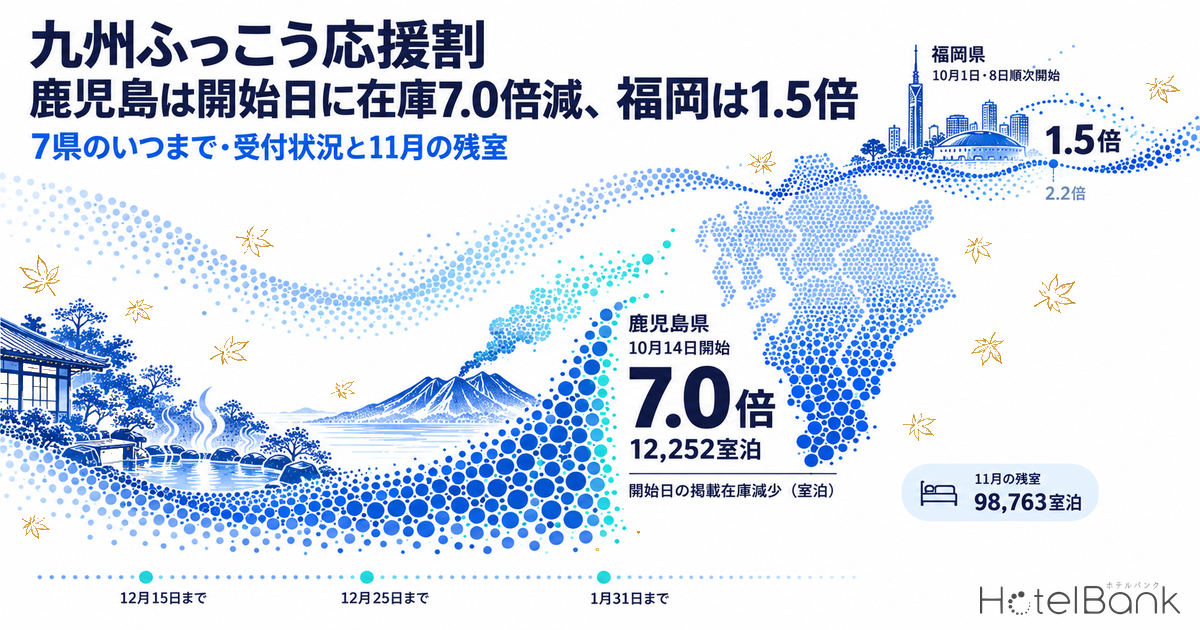
Kagoshima, the last of the seven prefectures still waiting for the Kyushu Recovery Support Discount (Kyushu Fukko Ouenwari), launched the program on Wednesday, October 14, 2026, while Fukuoka’s rollout on the major booking sites was completed in stages between Thursday, October 1 and Thursday, October 8. How did inventory move in these two late starters? Counting with MetroEngines Research observation data, Kagoshima’s listed inventory for stay dates October 17 to November 15 fell by 12,252 room-nights on launch day alone, 7.0 times the daily average of the preceding five days. Fukuoka, by contrast, registered only 2.2x on October 1 and 1.5x on October 8: the “launch-day step-up” seen in the five earlier prefectures never materialized. This article measures the launch days of both prefectures by property type and by stay date, then consolidates on one page the eligibility windows and booking status of all seven prefectures as updated by the Japan Tourism Agency on October 16, together with November availability.
Metric Definitions Used in This Article
- OCC (occupancy rate): Share of sold rooms in the total room count of the area (an estimate based on OTA sales inventory). In the text and charts it is labeled “occupancy (OTA listed-inventory basis, estimated)” or “estimated OCC”, shown together with the number of properties and rooms covered (major booking sites listing basis). It is an estimate based on how OTA-listed inventory is absorbed and differs from a property’s actual overall occupancy.
- LT (lead time): Days until the stay date. Booking curve = the path of OTA remaining rooms toward the stay date. This article uses observations from LT45 to LT1 only; same-day (LT0) observations and those 46+ days out are not used.
- Step-up: The difference (pt) between the observation on the sales launch day and the observation on the previous day.
- Listed inventory drawdown (room-nights): For each target stay date, the total decrease in remaining rooms on the major booking sites from the previous day’s observation to the current day’s observation (1 room x 1 night = 1 room-night). Besides bookings, it includes properties pulling listings and reloading inventory, so it is not the number of bookings itself. Where remaining rooms increased versus the previous day, the increase is netted off as a negative.
- Data source: MetroEngines Research (observations through October 15, 2026; property and room counts are on a major-booking-site listing basis)
- — On its launch day alone (Wed, Oct 14), Kagoshima’s listed inventory for stay dates Oct 17 to Nov 15 fell by 12,252 room-nights. That is 7.0x the preceding five-day average (1,747 room-nights), the same “simultaneous-launch step-up” pattern as the earlier prefectures (Miyazaki 10.6x, Saga 8.8x, Kumamoto 5.5x) (359 properties / 11,983 rooms).
- — In Fukuoka the major booking sites launched on two dates, Oct 1 and Oct 8, producing 2.2x and 1.5x. The step-up for the Sat, Oct 17 stay date was only +0.3pt: the date was already at an estimated OCC in the 89% range before launch (observations in early October 2026), leaving the discount little room to add demand (432 properties / 29,452 rooms).
- — Kagoshima’s step-up varied widely by property type. For the Sat, Oct 24 stay date it was ryokan +8.0pt and resorts +6.9pt, versus business hotels +4.2pt and city hotels +2.8pt. Averaged over Monday-Thursday stays, ryokan still gained +6.0pt and resorts +5.0pt, so the discount is working on weekdays too.
- — As of the Japan Tourism Agency’s Oct 16 update, eligible stay periods run through Dec 15 in Fukuoka, through Dec 25 in five prefectures, and in Kagoshima through Jan 31 (travel agencies etc.) / Feb 28 (direct bookings). The major booking site allocations in Kumamoto, Nagasaki, Saga, Oita and Miyazaki remain closed after hitting their budget caps, and demand has shifted to direct bookings and travel agencies.
- — As of Oct 15, remaining inventory for Nov 1-29 stays was 206,397 room-nights in Fukuoka, 98,763 in Kagoshima and 93,400 in Kumamoto. On Mon, Nov 23 (national holiday) all seven prefectures sit at an estimated OCC of 52-67%: the last day of the three-day weekend is the emptiest.
How Long Does the Kyushu Recovery Discount Run? Eligibility Periods and Booking Status in 7 Prefectures (as of Oct 16)
The Japan Tourism Agency’s “Kyushu Fukko Ouenwari” page was updated on October 16, 2026, and now lists the booking start dates and discount eligibility periods for all seven prefectures. The framework is unchanged: a discount of 50% of the travel or accommodation price (60% in Kumamoto and Kagoshima), capped per trip per person at ¥20,000 for accommodation only or a one-night package with transport, ¥30,000 for a package with transport of two nights or more, and ¥35,000 for multi-prefecture itineraries staying in two or more prefectures. What has changed is the prefecture-by-prefecture answer to “until when can I stay?”. Fukuoka covers stays through Tuesday, December 15; the five prefectures of Saga, Nagasaki, Kumamoto, Oita and Miyazaki cover stays through Friday, December 25; and only Kagoshima, the last to launch, runs into the new year, covering stays through Sunday, January 31, 2027 when booked via travel agencies or booking sites, and through Sunday, February 28 when booked directly with the property (December 26 to January 3 excluded).
The eligibility period and the period in which you can actually book are, however, two different things. In five prefectures, Kumamoto and Nagasaki (launched September 15) and Saga, Miyazaki and Oita (launched September 24-25), the allocations given to the major booking sites hit their budget caps on launch day or the day after, and closure notices remain in place. In Fukuoka, direct bookings with properties began on September 24, were temporarily suspended around September 28, and reopened for additional bookings at noon on Friday, October 9. In Oita, direct bookings with properties open only today, Friday, October 16, so some prefectures still have channels just about to open.
| Prefecture | Discount rate | Booking start (per Japan Tourism Agency) | Eligible stay period | Booking status (as of Oct 16, based on press reports and official notices) |
|---|---|---|---|---|
| Fukuoka | 50% (60% for multi-prefecture trips including Kumamoto or Kagoshima) | 9/24, rolling as operators became ready (major booking sites rolled out 10/1-10/8) | 10/1-12/15 (check-out by 12/16) | Open on major booking sites. Direct bookings with properties suspended around 9/28, then reopened for additional bookings at noon on 10/9 |
| Saga | 50% | Booking sites 9/24, travel agencies 10/2, properties 10/13 | 10/1-12/25 | Major booking site allocations closed at budget cap. Direct bookings with properties from 10/13 |
| Nagasaki | 50% | Booking sites 9/15, properties 9/28, travel agencies etc. 9/30 | 10/1-12/25 | Major booking site allocations closed at budget cap. Direct and travel agency bookings from late September |
| Kumamoto | 60% | 9/15 | 10/1-12/25 | Major booking site allocations closed at budget cap |
| Oita | 50% | Booking sites 9/25, travel agencies 10/9, properties 10/16 | 10/1-12/25 | Major booking site allocations closed at budget cap. Direct bookings with properties from 10/16 |
| Miyazaki | 50% | Booking sites 9/25, properties and travel agencies 9/28 | 10/1-12/25 | Major booking site allocations closed at budget cap |
| Kagoshima | 60% | 10/14 | 10/14-1/31/2027 (travel agencies and booking sites), 10/14-2/28/2027 (direct with properties). 12/26-1/3 excluded | Open. Each operator closes once its budget cap is reached |
Source: Compiled by the HotelBank Editorial Team from Japan Tourism Agency “Kyushu Fukko Ouenwari” (updated October 16, 2026), Fukuoka Prefecture press release (September 18, 2026), Kagoshima Prefecture “Kagoshima Fukko Ouenwari” (updated October 10, 2026), and Travel Watch (September 30, October 7, October 9 and October 15, 2026)
The program as a whole is covered from several angles in our earlier Japanese-language analyses, including a property-facing summary of the 2026 program and a traveler-facing quick reference of discount amounts.
Kagoshima Drew 12,252 Room-Nights on Launch Day: 7.0x Normal, 20x+ for Ryokan and Resorts
So how did inventory move in Kagoshima, the last prefecture to launch? Through stays on Tuesday, October 13, Kagoshima had been applying its own prefectural program, the “Kagoshima Kanko Ouenwari” (we tracked inventory around the boundary between the prefectural and national discounts in an earlier analysis), and the Kyushu Recovery Support Discount began on Wednesday, October 14 as its successor. Summing the listed inventory drawdown from the previous day to the current day across the 30 stay dates from October 17 to November 15, launch day (October 14) came to 12,252 room-nights, 7.0x the daily average of 1,747 room-nights over the preceding five days (October 9-13). The following day, October 15, still saw 3,343 room-nights, 1.9x normal, so movement continued after the step-up.
Using the same “October stays” cut as for the earlier prefectures (17 stay dates from October 15 to 31), the figure is 6,904 room-nights, or 5.9x, in line with Miyazaki at 10.6x, Saga 8.8x, Nagasaki 8.1x, Oita 6.6x and Kumamoto 5.5x (from our earlier analysis of the Miyazaki and Oita launch days). Because the multiple also depends on how much inventory was left to begin with, it should be read with the caveat that Kagoshima’s Saturday, October 24 stay date was already at an estimated OCC of 82.4% before launch (observed October 13, 2026), fuller than Miyazaki’s Saturday, October 17 stay date at 69.7%.
Source: Compiled by the HotelBank Editorial Team from MetroEngines Research (Kagoshima, stay dates October 17 to November 15, all property types, 359 properties / 11,983 rooms, major booking sites listing basis)
The bulk increase in remaining rooms in the Saturday, October 3 observation (minus 1,721 room-nights) reflects properties reloading inventory, likely rebuilding allocations ahead of the campaign launch. Splitting the launch-day movement by property type makes the difference even clearer. Ryokan went from a preceding five-day average of 120 room-nights to 2,702 on launch day (22.5x, 66 properties / 1,475 rooms), resorts from 133 to 2,578 (19.4x, 33 properties / 1,589 rooms), and business hotels from 1,333 to 5,344 (4.0x, 74 properties / 6,062 rooms). City hotels had barely moved in the preceding five days (a daily average of 15 room-nights) before 1,052 room-nights came in (16 properties / 1,928 rooms). Business hotels were largest in absolute volume and ryokan and resorts largest in multiple, the same pattern seen in Kumamoto and Miyazaki.
| Prefecture | Sales launch day | Launch-day drawdown (stays 10/17-11/15) | Preceding 5-day daily average | Multiple | Drawdown, October stays (day after launch to 10/31) | Multiple | Next-day drawdown |
|---|---|---|---|---|---|---|---|
| Kagoshima | Wed, Oct 14 | 12,252 room-nights | 1,747 room-nights | 7.0x | 6,904 room-nights (17 stay dates) | 5.9x | 3,343 room-nights |
| Fukuoka | Thu, Oct 8 | 7,984 room-nights | 5,233 room-nights | 1.5x | 6,702 room-nights (23 stay dates) | 1.4x | 5,940 room-nights |
| Fukuoka | Thu, Oct 1 | 9,082 room-nights | 4,140 room-nights | 2.2x | 10,698 room-nights (30 stay dates) | 1.6x | 4,498 room-nights |
Source: Compiled by the HotelBank Editorial Team from MetroEngines Research. Properties / rooms covered: Kagoshima 359 / 11,983 rooms, Fukuoka 432 / 29,452 rooms (October 24 stay-date cohort, major booking sites listing basis). Fukuoka’s two launch days, October 1 and October 8, are tallied separately
No Step-Up in Fukuoka: 2.2x on Oct 1, 1.5x on Oct 8, the Shape of a Staggered Launch
Fukuoka, on the other hand, shows no step-up even when measured with the same yardstick. Bookings in Fukuoka opened on Thursday, September 24 “on a rolling basis as operators became ready”, and the major booking sites came online one by one over a week: Thursday, October 1 at 10:00 and 12:00, Wednesday, October 7, and Thursday, October 8 at 10:00. The listed inventory drawdown for stay dates October 17 to November 15 was 9,082 room-nights on October 1, 2.2x the preceding five-day average (4,140 room-nights), and 7,984 room-nights on October 8, 1.5x the preceding five-day average (5,233 room-nights). Fukuoka also has weeks in which Mondays and Tuesdays move around 7,000 room-nights without any launch (7,109 on October 5, 7,212 on October 13), so the 7,984 room-nights on October 8 look buried in the weekly rhythm.
Source: Compiled by the HotelBank Editorial Team from MetroEngines Research (Fukuoka, stay dates October 17 to November 15, all property types, 432 properties / 29,452 rooms, major booking sites listing basis)
Why does Fukuoka alone show no step-up? Three reasons are plausible. First, spreading the launch across a week smoothed out demand that would otherwise have concentrated on a single day. Second, Fukuoka’s actual stays for October 1-15 (estimated OCC as of the day before the stay) were 91.8%, the highest of the seven prefectures, and the Saturday, October 24 stay date was already 95.9% full the day before launch. With few rooms left, the same discount has less room to move anything. Third, 22,797 (77%) of Fukuoka’s 29,452 rooms are in business hotels, with a high share of business-travel demand. Business hotels’ drawdown on October 8 was only 1.3x the preceding five-day average, whereas ryokan reached 3.2x (423 room-nights, 52 properties / 952 rooms) and city hotels 3.0x (859 room-nights, 24 properties / 3,331 rooms): leisure-oriented property types responded to the discount even in Fukuoka. October 1 showed the same order: ryokan 5.4x, city hotels 3.7x, business hotels 2.1x.
Booking Curves for Sat, Oct 24: Kagoshima +4.6pt at LT10, Fukuoka Flat at 96%
Overlaying the curves of three prefectures for the same stay date makes the presence or absence of a step-up obvious at a glance. For the Saturday, October 24 stay date, Kagoshima’s estimated OCC built from 63.2% at LT45 (observed September 9) to 82.4% at LT11, the day before launch, jumped +4.6pt to 87.0% at LT10 on launch day, and then stayed almost flat at 87.1% at LT9 (remaining rooms 2,104 to 1,554). Fukuoka, for the same date, climbed without any steps from 85.8% at LT45 into the 96% range and moved only +0.4pt around October 8 (LT16). Kumamoto, shown for reference (launched September 15, 336 properties / 13,247 rooms), rose from 70.9% at LT45 to 92.6% at LT9 in a shape similar to Kagoshima’s, including a launch-day step-up.
Source: Compiled by the HotelBank Editorial Team from MetroEngines Research (Saturday, October 24 stay date, all property types, LT45 to LT9. Kagoshima 359 properties / 11,983 rooms, Fukuoka 432 properties / 29,452 rooms, Kumamoto 336 properties / 13,247 rooms, major booking sites listing basis)
Kagoshima’s step-up is not limited to Saturdays. It was +3.7pt for Saturday, October 31 (85.4% to 89.1%), +4.5pt for Saturday, November 7 (77.7% to 82.2%), +3.5pt for Saturday, November 21 and +4.7pt for Sunday, November 22, and the average across 16 Monday-Thursday stay dates was +3.1pt, so weekdays received a similar lift. In Kumamoto, one of the earlier prefectures, our analysis of inventory after the sell-out found that the +5.8pt launch-day step-up was followed by a slowdown to +1.7pt over the nine days after bookings closed. Kagoshima is likely to bend the same way once its major booking site allocations hit their budget caps, and when that “bend” arrives is the next point to watch.
Step-Up by Property Type: Kagoshima Ryokan +8.0pt and Resorts +6.9pt; in Fukuoka, Ryokan +2.4pt Is the Largest
Splitting the Saturday, October 24 stay date by property type, Kagoshima’s ryokan moved sharply from 82.4% to 90.4% (+8.0pt, 66 properties / 1,475 rooms) and resorts from 82.4% to 89.3% (+6.9pt, 33 properties / 1,589 rooms), while business hotels went from 81.7% to 85.9% (+4.2pt, 74 properties / 6,062 rooms) and city hotels from 91.3% to 94.1% (+2.8pt, 16 properties / 1,928 rooms). The order was the same for the Saturday, November 7 stay date: ryokan +8.3pt, resorts +6.5pt, business +4.4pt, city +0.9pt. Under a design of a 60% discount capped at ¥20,000, the higher-priced ryokan and resorts get the largest discount amounts (as our earlier analysis of the effective discount rate under the ¥20,000 cap showed), so travelers’ choices tend to tilt toward ryokan and resorts.
Source: Compiled by the HotelBank Editorial Team from MetroEngines Research (Kagoshima, launch-day step-up by property type, observations October 13 to 14. Ryokan 66 properties / 1,475 rooms, resorts 33 / 1,589, business 74 / 6,062, city 16 / 1,928, major booking sites listing basis)
| Property type | Kagoshima launch-day drawdown / preceding 5-day avg (multiple) | Kagoshima 10/24 (Sat) step-up | Kagoshima properties / rooms | Fukuoka 10/8 drawdown / preceding 5-day avg (multiple) | Fukuoka 10/24 (Sat) step-up | Fukuoka properties / rooms |
|---|---|---|---|---|---|---|
| Ryokan | 2,702 / 120 room-nights (22.5x) | 82.4% to 90.4% (+8.0pt) | 66 / 1,475 rooms | 423 / 131 room-nights (3.2x) | 85.9% to 88.3% (+2.4pt) | 52 / 952 rooms |
| Resort | 2,578 / 133 room-nights (19.4x) | 82.4% to 89.3% (+6.9pt) | 33 / 1,589 rooms | 193 / 26 room-nights (7.5x) | 95.5% to 96.7% (+1.2pt) | 14 / 757 rooms |
| Business hotel | 5,344 / 1,333 room-nights (4.0x) | 81.7% to 85.9% (+4.2pt) | 74 / 6,062 rooms | 5,862 / 4,368 room-nights (1.3x) | 97.1% to 97.3% (+0.2pt) | 178 / 22,797 rooms |
| City hotel | 1,052 / 15 room-nights (—) | 91.3% to 94.1% (+2.8pt) | 16 / 1,928 rooms | 859 / 286 room-nights (3.0x) | 93.7% to 93.9% (+0.2pt) | 24 / 3,331 rooms |
Source: Compiled by the HotelBank Editorial Team from MetroEngines Research. Drawdown is the total for stay dates October 17 to November 15. No multiple is shown for Kagoshima city hotels because their preceding five-day daily average was small (15 room-nights). Fukuoka resorts (14 properties) are a small sample; figures are for reference only
By property type in Fukuoka, ryokan saw the largest move, from 85.9% to 88.3% (+2.4pt, 52 properties / 952 rooms), followed by resorts at +1.2pt (a small sample of 14 properties), city hotels at +0.2pt and business hotels at +0.2pt. The direction is the same in Fukuoka, “it is ryokan that move on a discount”, but because business hotels, which account for nearly 80% of the prefecture’s rooms, fill up early with business-travel demand, the effect barely shows in prefecture-level figures. The average weekday (Monday-Thursday) step-up for business hotels was +2.6pt in Kagoshima versus +1.0pt in Fukuoka, so a gap remains here as well.
Where the 7 Prefectures Stand: Early-October Occupancy, November Availability, and an Empty Last Day of the Long Weekend
Two weeks after the launch, here is where the seven prefectures stand, side by side in one table. Actual stays for October 1-15 (estimated OCC as of LT1, the day before the stay) were Fukuoka 91.8%, Kumamoto 86.8%, Kagoshima 85.4%, Saga 85.1%, Oita 83.7%, Nagasaki 82.9% and Miyazaki 81.4%, and Fridays and Saturdays are in the 80-94% range in all seven. Kumamoto, where bookings closed earliest, has recovered from its early-September level, which we tracked in our earlier analysis of the post-earthquake recovery curve, to second place among the seven prefectures in October.
| Prefecture | Properties / rooms | 10/1-15 actual stays estimated OCC | 10/24 (Sat) estimated OCC / rooms left | 11/7 (Sat) estimated OCC / rooms left | 11/21 (Sat) / 22 (Sun) / 23 (Mon, holiday) estimated OCC | Nov 1-29 total rooms left (average estimated OCC) |
|---|---|---|---|---|---|---|
| Fukuoka | 432 / 29,452 rooms | 91.8% | 97.1% / 865 rooms | 87.1% / 3,800 rooms | 90.0% / 78.2% / 62.1% | 206,397 room-nights (75.9%) |
| Kagoshima | 359 / 11,983 rooms | 85.4% | 87.1% / 1,551 rooms | 83.0% / 2,047 rooms | 91.5% / 80.6% / 57.9% | 98,763 room-nights (71.7%) |
| Kumamoto | 336 / 13,247 rooms | 86.8% | 92.6% / 977 rooms | 87.9% / 1,596 rooms | 95.0% / 83.1% / 64.7% | 93,400 room-nights (75.6%) |
| Nagasaki | 252 / 10,835 rooms | 82.9% | 87.3% / 1,375 rooms | 83.7% / 1,760 rooms | 92.7% / 80.0% / 61.9% | 77,615 room-nights (75.4%) |
| Saga | 121 / 4,331 rooms | 85.1% | 93.0% / 304 rooms | 86.5% / 583 rooms | 92.5% / 83.1% / 66.6% | 23,924 room-nights (80.9%) |
| Oita | 430 / 10,832 rooms | 83.7% | 89.7% / 1,120 rooms | 87.6% / 1,345 rooms | 93.1% / 87.8% / 65.9% | 74,398 room-nights (76.2%) |
| Miyazaki | 141 / 6,169 rooms | 81.4% | 91.9% / 502 rooms | 79.2% / 1,254 rooms | 86.0% / 72.4% / 52.4% | 57,705 room-nights (68.0%) |
Source: Compiled by the HotelBank Editorial Team from MetroEngines Research. Stay dates from October 24 onward are values observed on October 15, 2026 (LT9 to LT45). Properties / rooms are the October 24 stay-date cohort (major booking sites listing basis); counts differ by a few properties depending on the stay date
Turning to November, remaining inventory for stays from November 1 to 29 as of October 15, 2026 was 206,397 room-nights in Fukuoka (average estimated OCC 75.9%), 98,763 in Kagoshima (71.7%), 93,400 in Kumamoto (75.6%), 77,615 in Nagasaki (75.4%), 74,398 in Oita (76.2%), 57,705 in Miyazaki (68.0%) and 23,924 in Saga (80.9%). By date, the first and second days of the autumn-foliage three-day weekend (November 21-23) are already 72-95% full in all seven prefectures, while the final day, Monday, November 23 (national holiday), has plenty of rooms left everywhere: Miyazaki 52.4%, Kagoshima 57.9%, Nagasaki 61.9%, Fukuoka 62.1%, Kumamoto 64.7%, Oita 65.9% and Saga 66.6%. Fukuoka has 11,169 rooms left on November 23 and Kagoshima 5,060, so the last day of the long weekend remains a “you can still get a room” date. We are also tracking Kyushu foliage demand for Saturday, November 7 at the municipality level, and booking progress for the November three-day weekend in Hiroshima, Yamaguchi and Oita.
What Properties Can Do: Kagoshima’s Long Direct-Booking Window, Fukuoka’s Reopened Direct Channel and the Back Half of the Long Weekend
The measurements above show that the opportunity for properties differs by prefecture and property type. For Kagoshima properties, the October 14 step-up was strong for ryokan and resorts, and business hotels moved the largest absolute volume at 5,344 room-nights. Since the step-up is likely to bend once the major booking site allocations hit their budget caps, the channel that matters beyond that point is direct booking with the property, which has the longest eligibility period, covering stays through February 28, 2027. Bookings via travel agencies and booking sites end on January 31, while direct bookings can be used throughout February. Given that December 26 to January 3 is excluded, one approach is to place direct-booking discount plans in the shoulders on either side of the year-end holidays (through mid-December and from January 4) and fill higher-priced rooms with multi-night stays and multi-prefecture itineraries (capped at ¥35,000). As observed on October 15, 2026, business hotels were at an estimated OCC of 71.3% for Sunday, November 22 and the prefecture as a whole at 57.9% for Monday, November 23 (holiday): plenty of rooms remain in the back half of the long weekend, which is another reason to steer demand toward weekday-like dates.
For Fukuoka properties, the very fact that no step-up appeared at the prefecture level is information. Layering a discount onto dates already 90% full with business travel adds little, and the discount works only for ryokan and city hotels and on dates that were “empty to begin with”, such as Monday, November 23 (holiday) at an estimated OCC of 62.1% with 11,169 rooms left. Direct booking with properties, reopened on October 9, is an entry point that operates independently of the major booking site allocations. Within the eligibility period running to December 15, concentrating discount plans on weekdays from late November to early December and on the final days of long weekends lets properties use the full discount budget to lift occupancy. The “gap between the first and last day” seen in our earlier analysis of the final day of the October three-day weekend at Yufuin ryokan is appearing in the same form for Kyushu’s November three-day weekend.
For properties: plan-naming hints for this theme
Most common selling points in public plan names containing “Ouenwari” in Kagoshima (N=21):
Travel subsidy 57%Two meals included 33%Room only 24%Discount 19%Hot spring / open-air bath 14%
Most common selling points in public plan names containing “Ouenwari” in Fukuoka (N=28):
All-you-can-drink 39%Travel subsidy 39%Kaiseki course 29%Hot spring / open-air bath 21%Breakfast included 21%
Examples of actual names (anonymized, translated):
- [Kagoshima Kanko Ouenwari] Room with private hot spring x finest kaiseki and abalone gourmet collaboration – a luxurious premium stay
- [Kyushu Fukko Ouenwari only] Kuroge Wagyu A5 loin yakiniku (hoba-leaf grill) plan with two meals
- [Kyushu Fukko Ouenwari – Kiwami course] A luxury trip in a detached villa with hot spring or top-floor special room with panoramic bath x premium dinner x all-you-can-drink
- [Kyushu Fukko Ouenwari] Supporting group travel! All-you-can-drink included! Banquet hall and sashimi platter for groups of 10+
Note: These are tendencies based on a tally of public plan names and do not show that naming causes sales. Kagoshima’s names lean on food (two meals, wagyu, seafood), while Fukuoka’s lean on group-oriented appeals such as all-you-can-drink and kaiseki courses, showing in the plan names which guest segments each market aims the discount at.
Summary
In Kagoshima, the last of the prefectures to launch the Kyushu Recovery Support Discount, listed inventory for stay dates October 17 to November 15 fell by 12,252 room-nights (7.0x the preceding five-day average) on October 14 alone, with the size of the step-up varying by property type: ryokan 22.5x, resorts 19.4x, business hotels 4.0x. In Fukuoka the major booking site launches were spread over October 1-8, holding the multiples to 2.2x and 1.5x with no step-up, although ryokan and city hotels showed responses of 3-5x. With the Japan Tourism Agency’s October 16 update, the eligibility periods for all seven prefectures are now set, giving a definitive answer to “until when”: Fukuoka December 15, five prefectures December 25, and Kagoshima January 31 (direct bookings February 28). Common to the five prefectures whose major booking site allocations have closed, to Kagoshima, which is about to bend, and to Fukuoka, which shows no step-up, is that rooms remain plentiful on weekdays and on the final days of long weekends, starting with Monday, November 23 (holiday). Steering direct and travel agency bookings and discount plans toward those dates is the shortest path to turning the discount budget into occupancy.
Frequently Asked Questions
Q. How long can the Kyushu Recovery Support Discount be used?
As of the Japan Tourism Agency’s October 16, 2026 update, the eligible stay periods are: Fukuoka through stays on December 15; the five prefectures of Saga, Nagasaki, Kumamoto, Oita and Miyazaki through stays on December 25; and Kagoshima through stays on January 31, 2027 via travel agencies and booking sites, and through stays on February 28 when booked directly with the property (December 26 to January 3 excluded in Kagoshima). However, each prefecture and each operator stops once its budget runs out, so bookings may not be available until the end of the eligibility period.
Q. Can I still book in Fukuoka and Kagoshima?
According to press reports and official notices as of October 16, Fukuoka is open on the major booking sites, and direct bookings with properties reopened for additional bookings at noon on October 9. Kagoshima only began on October 14 and is open, but each operator closes once its budget cap is reached. In the five prefectures of Kumamoto, Nagasaki, Saga, Oita and Miyazaki, the major booking site allocations are closed, and direct bookings with properties and travel agencies have become the remaining channels. Please check each prefecture’s dedicated website for the latest status.
Q. Inventory dropped sharply on launch day, so why are rooms still available?
The “listed inventory drawdown” in this article is the change in remaining rooms on the major booking sites, i.e. movement within the allocations properties assigned to them. In Kagoshima, 98,763 room-nights remained for stays from November 1 to 29 as of October 15, 2026, and Monday, November 23 (holiday) in particular is at an estimated OCC of 57.9%. Launch-day movement was concentrated on Saturdays and in ryokan and resorts, so rooms remain on weekdays, on the final days of long weekends and at business hotels.
⚠ Note on future-date inventory and occupancy: Estimated OCC and remaining rooms for stay dates from October 17 onward in this article are based on major booking site listed inventory at the time of the survey (observed October 15, 2026) and will change as the stay dates approach through bookings, cancellations and properties reloading inventory. Booking status changes daily as each prefecture and operator uses up its budget; please check the Japan Tourism Agency and each prefecture’s dedicated website for the latest information.
References and Sources
■ Data sources
Daily observations of major booking site listed inventory by MetroEngines Research (7 Kyushu prefectures, observed September 9 to October 15, 2026, within 45 days of the stay date). Program eligibility periods and booking status are from the official pages of the Japan Tourism Agency, Fukuoka Prefecture and Kagoshima Prefecture and from press reports (as of October 16, 2026).
■ Calculation assumptions
“Listed inventory drawdown” is the sum, for each stay date from October 17 to November 15, of the decrease in remaining rooms from the previous day’s observation to the current day’s observation (increases in remaining rooms are netted off as negatives). The multiple is the launch-day drawdown divided by the daily average of the preceding five days. The step-up is the difference (pt) in estimated OCC between launch day and the previous day. Estimated OCC was aggregated at the prefecture and property-type level after capping each property’s remaining rooms at its room count. Property and room counts are per stay-date cohort and are given in each table.
■ Limitations
The listed inventory drawdown includes not only bookings but also properties pulling listings and reloading inventory, so it is not the number of bookings itself. Estimated OCC is an estimate based on inventory listed on the major booking sites and does not match sales through direct or travel agency channels or a property’s actual overall occupancy. Stay dates from October 17 onward are values at the time of observation and will change with future bookings and cancellations. Small segments (such as Fukuoka’s 14 resort properties) are for reference only.
■ Sources
- Japan Tourism Agency, “Kyushu Fukko Ouenwari” (disaster-related information, updated October 16, 2026) (in Japanese)
- Fukuoka Prefecture, “Kyushu Fukko Ouenwari Fukuoka Campaign” press release (September 18, 2026) (in Japanese)
- Kagoshima Prefecture, “Kagoshima Fukko Ouenwari” (updated October 10, 2026) (in Japanese)
- Travel Watch, “Fukuoka Prefecture to resume ‘direct bookings with properties’ for the Kyushu Fukko Ouenwari from noon on October 9” (September 30, 2026) (in Japanese)
- Travel Watch, article on the launch of Fukuoka’s Kyushu Fukko Ouenwari bookings on a major booking site (up to ¥30,000 off) (October 7, 2026) (in Japanese)
- Travel Watch, “Kagoshima confirms Kyushu Fukko Ouenwari from October 14: up to 60% off for stays through end of February, dedicated site opens tomorrow” (October 9, 2026) (in Japanese)
- Travel Watch, article on the launch of Kagoshima’s Kyushu Fukko Ouenwari bookings on a travel booking site (flight plus hotel up to 60% off) (October 15, 2026) (in Japanese)
- MetroEngines Research: daily observations of major booking site listed inventory (7 Kyushu prefectures, observed September 9 to October 15, 2026, within LT45), estimated OCC and booking curves. Property and room counts are given in each table