

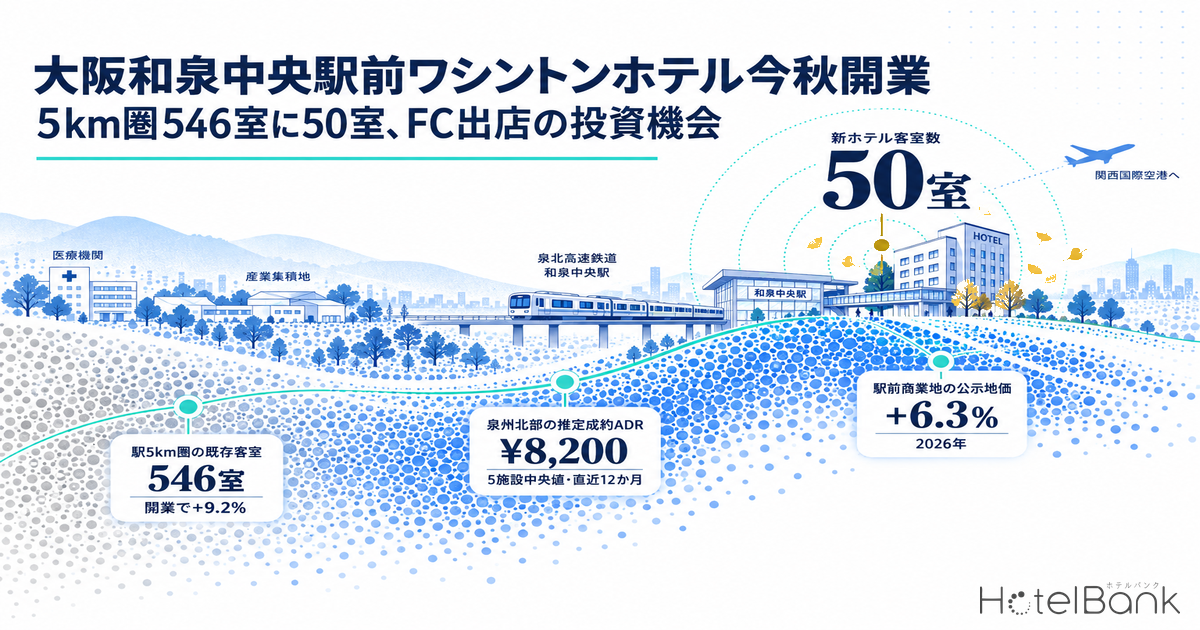
On February 12, 2026, Fujita Kanko announced that it will open the Osaka Izumi-Chuo Ekimae Washington Hotel (tentative name) in autumn 2026 in front of Izumi-Chuo Station on the Nankai Semboku Line in Izumi City, Osaka. The four-story building will have 50 rooms (18 singles and 32 twins), with the second floor connecting to a pedestrian deck linked directly to the station. It will be the 14th franchise (FC) property of WHG Hotels and the third for its operator, Flat Field Operations, following the Kansai Airport Washington Hotel and the Kanku Izumiotsu Washington Hotel. Using data on room supply, estimated settled ADR, catchment population and employment, and land prices around Izumi-Chuo Station, this article quantifies the growth strategy of franchise expansion — adding locations without owning the brand’s assets — and the investment opportunity for the franchisee owner.
Metric Definitions Used in This Article
- ADR (average daily rate): An estimated settled rate (tax-exclusive equivalent) calculated by applying segment-specific adjustment factors to the lowest-plan price level each property publishes on OTAs (per room, two guests per room, tax included). When checked against property-level results disclosed by listed hotel REITs (91 properties, most recent three months), the median error is about 7%. These are estimates and differ from each property’s actual settled prices and accounting figures. Area-level ADR is the median of the properties covered (the level of a typical property in the area).
- OCC (occupancy rate): The share of rooms sold relative to total rooms in the area (an estimate based on OTA sales inventory). It is an estimate based on how inventory sold on OTAs is consumed and differs from the actual occupancy of the entire property.
- Room supply: The number of properties and rooms as of each year-end for lodging facilities tracked by MetroEngines Research that are confirmed to be operating and whose opening date could be confirmed (based on confirmed OTA listings).
- Data source: MetroEngines Research
The conclusion first. The area around Izumi-Chuo Station has a thin concentration of lodging: even within a 5 km radius of the station, MetroEngines Research tracks only 546 rooms. In that market, the main business and city hotels of northern Senshu held their estimated settled ADR at about ¥8,200 — in line with the prior year — over the latest 12 months, the year after the Osaka Expo. Compared with business hotels across Osaka Prefecture (-7.7% over the same period), the data suggest that the demand base comes not from tourism events but from business demand tied to industrial parks, medical care and airport access. The modest 50-room scale can be read as a design that captures this resilient demand at a station-connected location.
- — 50 rooms, 14th franchise property: The Washington Hotel that Fujita Kanko will open in autumn 2026, directly connected to Izumi-Chuo Station, is a WHG franchise. The brand side expands its footprint without holding the asset.
- — 546 rooms within 5 km of the station: Existing supply is thin at 12 properties, and the new hotel adds only +9.2% within 5 km and +22.6% within 3 km.
- — Estimated settled ADR of about ¥8,200, -0.1% YoY: The five northern Senshu hotels stayed flat even in the year after the Expo. Business hotels across Osaka Prefecture fell 7.7% over the same period.
- — 35,432 employees: The 3,127 establishments within 3 km of the station (2021), together with industrial parks, hospitals and airport access, support weekday business demand.
- — Annual room revenue of about ¥116 million: The base case assumes ADR of ¥8,500 and OCC of 75% (full year). Even at ADR -10% and OCC -5pt, revenue holds at about ¥98 million.
Expanding Without Ownership Through Franchising — The WHG Growth Model
WHG Hotels presents four development schemes to business partners: the lease scheme, in which the owner constructs the building and Fujita Kanko leases it; the management contract (MC) scheme, in which the owner handles ownership and business management while Fujita Kanko dispatches the general manager and other staff; the franchise (FC) scheme, in which the owner handles ownership, business management and operations and receives the brand and operational guidance; and the asset securitization scheme. Izumi-Chuo falls under the franchise scheme: the land, building and operations sit with the owner side, while Fujita Kanko provides the brand and operating know-how and receives royalties. HotelBank’s separate analysis puts hotel franchise royalties in Japan at roughly 4-11% of room revenue.
The strength of this structure is that the brand side can grow its property count without holding assets itself. For the franchisee, it means continuing to operate in-house while drawing on the brand power and customer-referral strength of Washington Hotel. In the fiscal year ended December 2025, Fujita Kanko posted record results with net sales of ¥82.0 billion and operating profit of ¥13.79 billion, and the average daily rate (ADR) of the WHG business rose 11% YoY to a record high (Kanko Keizai Shimbun, February 2026). On February 10, 2026, it also announced a capital and business alliance with the NSSK Group, placing the brand in a phase of growth investment.
| Item | Osaka Izumi-Chuo Ekimae Washington Hotel (tentative name) |
|---|---|
| Planned opening | Autumn 2026 |
| Location | Ibukino 4-chome, Izumi City, Osaka (3-minute walk from Izumi-Chuo Station on the Nankai Semboku Line; connection to the station deck planned) |
| Rooms | 50 in total: 18 singles (with refrigerator and microwave) and 32 twins (with mini-kitchen, refrigerator and microwave) |
| Scale | 4 stories above ground |
| Facilities | Restaurant serving breakfast |
| Airport access | About 32 minutes to Kansai International Airport by limousine bus |
| Scheme | 14th WHG franchise property (third in partnership with Flat Field Operations) |
The room mix is also distinctive. The 32 twins — a little over 60% of the total — come with mini-kitchens, and the singles also have refrigerators and microwaves. The specification suits demand built around consecutive nights: engineers staying several days to several weeks for plant start-ups and equipment maintenance, family members visiting a hospital, and stays before or after flights.
50 Rooms Added to 546 Within 5 km — New Supply in a Thinly Supplied Market
Centered on Izumi-Chuo Station (34.4613 N, 135.4562 E), we tallied the number of lodging rooms tracked by MetroEngines Research as of each year-end. There are 3 properties with 221 rooms within a 3 km radius, 12 properties with 546 rooms within 5 km, and 47 properties with 1,847 rooms within 10 km. Rooms within 5 km rose to 335 in 2017 with the opening of a roughly 200-room limited-service hotel and to 557 in 2022 with another opening of similar size, and have stood at 546 since 2024. The new hotel’s 50 rooms add +22.6% to existing rooms within 3 km and +9.2% within 5 km.
This scale points to a development logic different from that of the urban core. About 70% of the 546 rooms within 5 km belong to two limited-service hotels that opened in 2017 and 2022, both located 2.8-3.5 km from Izumi-Chuo Station near an expressway interchange or along the JR Hanwa Line. The new hotel, by contrast, is directly connected to the station, at a node where rail and airport buses meet. Because the character of the locations differs even within the same catchment, the picture is less one of sharing demand with existing properties than of capturing a different customer base — station users. Note that opening data are based on confirmed OTA listings, and since listings appear several months before opening, recent and upcoming supply may increase as new listings come through.
Competitor Map — Car-Oriented Existing Hotels and a Station-Connected Newcomer
| Station-front block | Commercial zone; floor-area ratio 400% / building coverage 80% |
| Surroundings | Category 1 residential, mid/high-rise exclusive residential, etc. (200%) |
The map makes the structure clear: the existing large properties are spread around the interchange and along the JR Hanwa Line, 2.8-3.5 km from the station, and the new hotel will be the first lodging facility directly connected to Izumi-Chuo Station. On the Izumiotsu waterfront sits the Kanku Izumiotsu Washington Hotel (151 rooms, opened December 2021), run by the same partner operator, so the new hotel complements the inland side of Senshu as another base for that operator.
Northern Senshu Estimated Settled ADR Flat YoY — Resilient Even After the Expo
We gauge the price level of the catchment by the median estimated settled ADR of five main business and city hotels (826 rooms in total) located in Izumiotsu, Izumi and Kishiwada. Because the sample at the municipal level is small — one to four properties per city — we treated these five northern Senshu hotels as a single catchment. The 12-month average for September 2025 to August 2026 was about ¥8,200, virtually unchanged from the same period a year earlier (September 2024 to August 2025), at -0.1% YoY.
By month, 2025 climbed to about ¥11,100 in August in step with the Osaka-Kansai Expo (April to October), and 2026 has tracked back toward pre-Expo levels. Compared with the same months two years earlier (2024), however, July 2026 was about ¥8,300, up 14.4%, and January was about ¥8,400, up 17.1% — clearly above pre-Expo levels. Even after event demand dropped out, prices have remained a notch higher, which can be read as suburban business demand underpinning rates.
Business hotels across Osaka Prefecture (N=487-503 hotels) fell 7.7% over the same period, from about ¥10,800 to about ¥10,000. While the pullback in the urban core, which had surged on the Expo, shows up in the prefecture-wide figure, the five northern Senshu hotels were essentially flat at -0.1% YoY. The absolute rate level is about ¥1,800 lower than in the urban core, but the smaller swings mean this is a market that is easier for a franchisee owner to read when building a business plan. Note that ADR in this article is an estimate, with a median error of about 7% when checked against results disclosed by REITs.
| Property (northern Senshu) | Rooms | Opened | Estimated settled ADR Avg. Sep 2025-Aug 2026 | Estimated settled ADR Avg. Jun-Aug 2026 |
|---|---|---|---|---|
| Kanku Izumiotsu Washington Hotel (run by the partner operator) | 151 | 2021 | ¥8,562 | ¥9,006 |
| Limited-service hotel A (Izumi City) | 200 | 2017 | ¥8,351 | ¥7,794 |
| Limited-service hotel B (Izumi City) | 197 | 2022 | ¥8,281 | ¥8,087 |
| Limited-service hotel C (Kishiwada City) | 230 | 2019 | ¥8,267 | ¥7,720 |
| City hotel D (Izumiotsu City) | 48 | 1994 | ¥8,198 | ¥8,739 |
The Kanku Izumiotsu Washington Hotel, run by the partner operator, averaged about ¥8,600 over the latest 12 months, on the high side among the five. Its three-month average for June to August 2026 was about ¥9,000, firmly translating summer demand into rate. Guest reviews also frequently include comments such as “the view from here is exceptional,” “you can get in from the parking lot without getting wet in the rain,” “there is a free shuttle bus” and “an ideal hotel with thoughtful attention to detail” (303 guest reviews compiled by the HotelBank Editorial Team, September 2024 to September 2026). This service and operating know-how, built up by the same operator, is an asset that can be put to work as-is at Izumi-Chuo, its third property.
Osaka Business Hotel Occupancy in the Mid-80% Range on Weekends — Room to Capture Weekday Business Demand
Because the sample for Izumi City alone is small, we check occupancy using business hotels across Osaka Prefecture. Estimated occupancy based on OTA-listed inventory was 83.4% in May 2026, 77.1% in June, 81.1% in July and 80.1% in August (279-287 hotels / 47,378-47,987 rooms, based on listings on major booking sites). By day of week, Friday and Saturday check-ins were high in all four months at 83.8-85.3%, while Sunday to Thursday moved in a range of 74.6-82.6%.
The variability in weekday levels has an opportunity side for a new hotel in front of a suburban station. Demand around Izumi-Chuo is centered on what moves on weekdays — business trips to the industrial park, hospital visits and accompanying family, and stays before or after flights — so the day-of-week mix differs from the urban core, which tends to skew toward tourist-heavy weekends. Within a 3 km radius of the station there are 3,127 establishments and 35,432 employees (2021 Economic Census), a deep base supporting weekday lodging demand. Note that this estimated occupancy tends to come out higher than actual occupancy because rooms not listed are counted as sold, so the estimates below conservatively use 75% as the base.
72,000 Residents Within 2 km of the Station — A Gentle -6.2% Through 2040
As of 2025, 71,743 people live within a 2 km radius of Izumi-Chuo Station, and the working-age population (ages 15-64) accounts for 64.2%. The future projections in the National Land Numerical Information put the figure at 67,698 in 2040, a gentle change of -6.2% over 15 years. This is a residential area developed as the terminus of Semboku New Town, and the depth of the resident population also forms a base for locally generated lodging demand such as homecomings, weddings and funerals, and visits to relatives.
Station-Front Commercial Land Price Up 17.5% in Three Years — Asset Values on the Rise
The official land price of a commercial site about 370 m from Izumi-Chuo Station (Izumi 5-3, Ibukino 5-chome) rose from ¥143,000/sqm in 2023 to ¥168,000/sqm in 2026. YoY growth has accelerated each year: +1.4% in 2023, +4.9% in 2024, +5.3% in 2025 and +6.3% in 2026. The station-front block is designated a commercial zone with a 400% floor-area ratio, a designation that makes mid-rise buildings such as hotels easy to build.
| Site | 2023 | 2024 | 2025 | 2026 | 2026 YoY |
|---|---|---|---|---|---|
| Izumi 5-3 (commercial; 370 m from station) | 143,000 | 150,000 | 158,000 | 168,000 | +6.3% |
| Izumi-33 (residential; 600 m from station) | — | 109,000 | 113,000 | 118,000 | +4.4% |
| Izumi-28 (residential; 1,400 m from station) | 96,500 | 98,100 | 99,800 | 102,000 | +2.2% |
For a franchisee owner who develops the business while retaining the land, rising land prices mean enjoying growth in asset value on top of hotel earnings. Construction costs are also high — MLIT’s Building Starts Statistics put steel-frame construction in 2025 at ¥2.405 million per tsubo (about 3.3 sqm) — and the higher profitability hurdle for new entrants works as an upside factor that eases the competitive environment for properties that open ahead of them.
The Franchisee Owner’s Revenue Opportunity — Estimating Room Revenue for a 50-Room Franchise
Based on the data so far, we make a simple estimate of the scale of room revenue and gross operating profit (GOP) for 50 rooms. Because total floor area and construction cost have not been disclosed, the estimate is limited to rooms-department revenue and does not extend to investment yield.
■ Assumptions
| Item | Assumption | Basis |
|---|---|---|
| Rooms | 50 | Fujita Kanko press release |
| ADR (base) | ¥8,500 | References the latest 12-month average of ¥8,242 for the five northern Senshu hotels and about ¥8,600 at the partner operator’s property; a level reflecting a new, station-connected building |
| OCC (base) | 75% full year | Set conservatively from the estimated occupancy of Osaka Prefecture business hotels on an OTA-listed inventory basis (May-August 2026 average of 80.4%) |
| GOP margin | 45% | A conservative value that allows for franchise royalties and similar costs, while taking into account that limited-service hotels are centered on room revenue and tend to have relatively high GOP margins (Relo Hotel Solutions) |
| Case | ADR | OCC | RevPAR | Annual room revenue | GOP (45%) |
|---|---|---|---|---|---|
| Base case | ¥8,500 | 75% | ¥6,375 | ¥116.3M | ¥52.4M |
| Upside (ADR +10%, OCC 80%, full year) | ¥9,350 | 80% | ¥7,480 | ¥136.5M | ¥61.4M |
| ADR -10% | ¥7,650 | 75% | ¥5,738 | ¥104.7M | ¥47.1M |
| OCC -5pt | ¥8,500 | 70% | ¥5,950 | ¥108.6M | ¥48.9M |
| ADR -10%, OCC -5pt | ¥7,650 | 70% | ¥5,355 | ¥97.7M | ¥44.0M |
■ ADR × OCC sensitivity table (annual room revenue)
| ADR \ OCC (full year) | 65% | 70% | 75% | 80% | 85% |
|---|---|---|---|---|---|
| ¥7,650 | ¥90.7M | ¥97.7M | ¥104.7M | ¥111.7M | ¥118.7M |
| ¥8,075 | ¥95.8M | ¥103.2M | ¥110.5M | ¥117.9M | ¥125.3M |
| ¥8,500 (base) | ¥100.8M | ¥108.6M | ¥116.3M | ¥124.1M | ¥131.9M |
| ¥8,925 | ¥105.9M | ¥114.0M | ¥122.2M | ¥130.3M | ¥138.4M |
| ¥9,350 | ¥110.9M | ¥119.4M | ¥128.0M | ¥136.5M | ¥145.0M |
The sensitivity table shows that even if ADR is lowered by one step (about 5%), raising OCC by one step (5pt) brings room revenue back to almost the same level as the base case. Weekday demand in northern Senshu centers on engineers staying consecutive nights and on hospital visits and accompanying family, so the structure is one in which building occupancy with multi-night plans, rather than moving rates sharply, is more likely to stabilize revenue.
Base-case annual room revenue comes to about ¥116 million, or about ¥2.33 million per room. Even in the harsh case where ADR and OCC both fall short, room revenue holds close to ¥100 million and GOP secures a little over 80% of the base case. Given that northern Senshu ADR was essentially flat YoY, this is a market where the downside can be expected to be smaller than for urban-core hotels. Meanwhile, if operations can capture weekday business demand with multi-night plans and add family and homecoming demand on weekends, the upside case of about ¥137 million also comes into view. The mini-kitchens in the 32 twins are a tool for lifting the rate on this multi-night demand. As for how long it takes for post-opening rates to catch up with the catchment level, HotelBank’s measurement of 182 newly opened hotels found a median ADR recovery of two months. This is a simple estimate, and an actual investment decision requires a detailed feasibility study.
Three Conditions That Make a Suburban Station-Front Franchise Work
1. Thin supply and a station-connected site
Supply is thin at 546 rooms within 5 km and 221 within 3 km of the station, and the existing large properties sit away from the station near the interchange and along the JR line. Fifty rooms adjoining the station can capture a different customer base.
2. Business demand that does not depend on tourism
About 35,000 employees within 3 km, an industrial park, Kindai University Hospital and the airport 32 minutes away. ADR held at about ¥8,200, in line with the prior year, even in the year after the Expo.
3. Rolling out operating know-how
The third property of the same operator. The partner operator’s existing property posted a latest 12-month ADR of about ¥8,600, among the top in the catchment, and that accumulated operating strength can be applied to the new base.
The Izumi-Chuo case clearly illustrates the division of roles unique to franchising: the brand side widens its coverage without holding assets, and the franchisee creates a revenue opportunity by drawing on its own land and operating capability. Rather than large-scale supply of the urban-core type, placing 50 rooms in front of a thinly supplied suburban station is a realistic way to capture station-user demand while limiting the supply impact. After this autumn’s opening, the path of rates and occupancy in the area will remain worth watching as an indicator of the growth potential of suburban station-front franchise development.
Note on the data: The estimated settled ADR in this article uses only finalized months through August 2026 (past months already aggregated at the time of the research). Occupancy is an estimate based on how inventory sold on OTAs is consumed and differs from the actual occupancy of the entire property. The specifications and timing of the planned hotel reflect plans as of the announcement and are subject to change.
References and Sources
■ Data sources
OTA public price and inventory data continuously tracked by MetroEngines Research (estimated settled ADR: northern Senshu N=5 hotels, 826 rooms; Osaka Prefecture business hotels N=487-503 hotels / estimated occupancy: Osaka Prefecture business hotels N=279-287 hotels / room supply: based on confirmed OTA listings), combined with MLIT official land prices, zoning and 250m-mesh future population projections, the Economic Census for Business Activity (2021), and published materials from Fujita Kanko and other companies.
■ Assumptions
The base case is 50 rooms, ADR of ¥8,500, OCC of 75% (full year) and a GOP margin of 45%; annual room revenue and GOP were estimated over a range of ADR ±10% and OCC of 65-85%. The estimate covers the rooms department only, and investment yield is not calculated because total floor area and construction cost have not been disclosed.
■ Limitations and caveats
Estimated settled ADR is an estimate that applies segment-specific adjustment factors to the lowest-plan price level published on OTAs, with a median error of about 7% when checked against results disclosed by listed hotel REITs. Estimated occupancy is based on the consumption of OTA sales inventory and comes out higher than actual occupancy because rooms not listed are counted as sold. The northern Senshu catchment ADR rests on a small sample of N=5 hotels and is easily swayed by movements at individual properties. The specifications and timing of the planned hotel reflect plans as of the announcement and are subject to change.
■ Market data
- MetroEngines Research & Consulting — Estimated settled ADR (northern Senshu N=5 hotels; Osaka Prefecture business hotels N=487-503 hotels), estimated occupancy (N=279-287 hotels), room supply (based on confirmed OTA listings)
- HotelBank Editorial Team research — 303 guest reviews (September 2024 to September 2026)
■ Government statistics and public data
- MLIT Real Estate Information Library — official land prices (2023-2026) and zoning
- MLIT National Land Numerical Information (future population projections by 250m mesh, FY2024 estimates by the MLIT National Spatial Planning and Regional Policy Bureau)
- Ministry of Internal Affairs and Communications / Ministry of Economy, Trade and Industry, Economic Census for Business Activity (2021)
- MLIT, Building Starts Statistics
■ Company and industry materials
- Fujita Kanko Inc., “Osaka Izumi-Chuo Ekimae Washington Hotel (tentative name) to open this autumn in Izumi City, Osaka” (PR TIMES, February 12, 2026; in Japanese)
- Flat Field Operations Co., Ltd. news release (in Japanese)
- WHG Hotels, “Business schemes” (in Japanese)
- Fujita Kanko, notice regarding the conclusion of a capital and business alliance agreement with NSSK-GAMMA2 LLC (February 10, 2026; in Japanese)
- Relo Hotel Solutions, “What is GOP?” (in Japanese)
- Kindai University news release (relocation of Kindai University Hospital, October 2025; in Japanese)
- Izumi-Chuo Station (passenger numbers and location; in Japanese)
■ News
- Fujita Kanko posts record operating profit, also announces capital and business alliance with NSSK (Kanko Keizai Shimbun, February 2026; in Japanese)
- Four-story, 50-room hotel under construction in Izumi-Chuo (Semboku Community; in Japanese)
- Update on the hotel plan in front of Izumi-Chuo Station (Gogai NET Izumi City, February 17, 2026; in Japanese)
- Fujita Kanko to open Osaka Izumi-Chuo Ekimae Washington Hotel this autumn (TRAICY; in Japanese)