

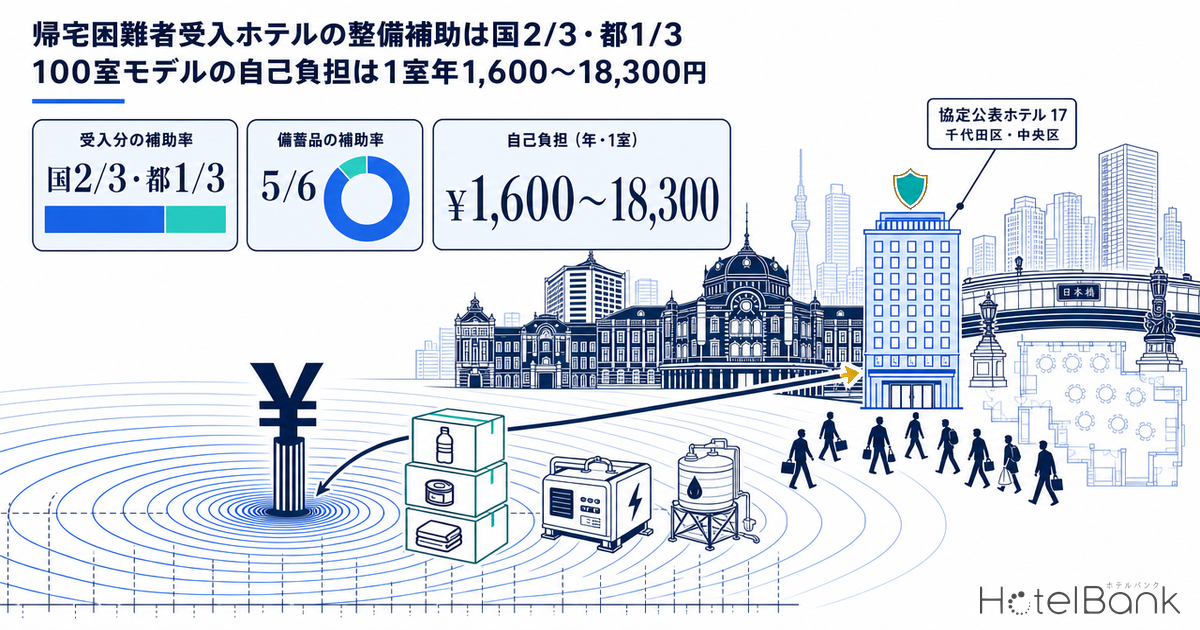
In the hours after a major earthquake directly beneath Tokyo, the areas around Tokyo Station and Nihonbashi would fill with shoppers, tourists and other visitors who cannot stay at a workplace and have nowhere to go — so-called stranded commuters with no place to shelter. The Tokyo Metropolitan Government (TMG) offers two subsidy programs to private operators that set up temporary shelter facilities for them: the “Disaster-Time Base Resilience Emergency Promotion Project,” which supports physical works, and the “Private Temporary Shelter Facility Stockpile Purchase Subsidy,” which supports emergency supplies. This article goes back to the original program documents to lay out how far a hotel that signs a shelter agreement with its ward can be subsidized, and what remains as the owner’s own cost. We then model a 100-room central Tokyo hotel with a banquet hall and convert the owner’s cost into an annual amount per room.
Metric Definitions Used in This Article
- ADR (average daily rate): an estimated settled rate (tax-exclusive equivalent), calculated by applying a segment-specific adjustment factor to the lowest-plan price level each property publishes on OTAs (per room, two guests, tax-inclusive). Checked against property-level results disclosed by listed hotel REITs (91 properties, most recent three months), the median error is about 7%. These are estimates and differ from each property’s actual settled rates and accounting figures. Area-level ADR is the median of the covered properties (the level of a typical property in the area).
- Trailing 12-month average: the simple average of monthly estimated settled ADR from September 2025 to August 2026. The prior-year period is September 2024 to August 2025.
- Incremental costs: the additional development costs needed to accommodate stranded commuters. The term follows TMG’s grant guidelines and the Ministry of Land, Infrastructure, Transport and Tourism (MLIT) guidebook.
- Shelter portion / own-use portion: the shelter portion corresponds to the number of stranded commuters to be accepted under the agreement; the own-use portion corresponds to regular occupants (people who use the facility in normal times and the people who serve them).
- Data sources: MetroEngines Research & Consulting; published materials from TMG, Chiyoda Ward, Chuo Ward, the Cabinet Office and MLIT; Economic Census (Ministry of Internal Affairs and Communications / Ministry of Economy, Trade and Industry)
- — TMG’s base-resilience program subsidizes incremental costs for the shelter portion at 2/3 from the national government and 1/3 from TMG when a private operator carries out the works. Combined, that is 10/10 of the shelter portion, but the grant is capped at the lower of a “standard amount set by the Governor” and actual expenditure, and is limited to the available budget. The program summary and grant guidelines do not state a specific cap.
- — TMG’s program covers projects started by March 31, 2027, and in principle only works involving the building structure. The own-use portion is excluded on a headcount pro-rata basis.
- — Emergency supplies are subsidized at 5/6 of the purchase cost, with purchases eligible up to ¥9,000 per sheltered person (an effective subsidy cap of ¥7,500). The FY2026 application window runs until January 22, 2027.
- — In the wards’ published lists (as of May 2026), 12 of Chuo Ward’s 42 indoor temporary shelter facilities are hotels. Chiyoda Ward’s 93 agreement facilities include 5 hotels.
- — In the 100-room model, the owner’s cost is ¥1,600–18,300 per room per year. Against the estimated settled ADR of Chuo Ward city hotels (trailing 12-month average ¥40,700), that is the equivalent of 0.04–0.45 room-nights.
TMG’s Two Programs for Temporary Shelter Facilities — Physical Works and Supplies Are Subsidized Separately
According to a TMG leaflet, a major earthquake directly beneath Tokyo would leave about 660,000 stranded commuters with nowhere to go. Against that, temporary shelter capacity secured stood at about 530,000 people (as of January 1, 2026). TMG’s disaster-prevention website puts the figure for the same date at 1,310 facilities with capacity for 533,644 people. TMG urges operators to “make use of this program and cooperate in accepting stranded commuters,” seeking private-sector help to cover the remaining gap of about 130,000 people.
Support for private temporary shelter facilities falls into two broad strands. One is the “Temporary Shelter Facility Disaster-Time Base Resilience Emergency Promotion Project,” which supports physical works and is a TMG top-up to MLIT’s “Disaster-Time Base Resilience Emergency Promotion Project” (merged into the “Housing and Building Disaster Resilience Emergency Promotion Project” from FY2025). The other is TMG’s standalone “Private Temporary Shelter Facility Stockpile Purchase Subsidy.” For hotels, the former applies when building storage and equipment in a new build or major renovation, and the latter when an existing hotel signs an agreement and stocks up on supplies.
| Item | Base Resilience Emergency Promotion Project (physical works) | Stockpile Purchase Subsidy (supplies) |
|---|---|---|
| Eligible items | Development of refuge space (shelter space) / emergency stockpile storerooms for stranded commuters / shelter-related equipment (emergency generators, water-supply equipment, earthquake-resistant water tanks, emergency wells, manhole toilets, emergency communication and information facilities, etc.) | I. Supplies for stranded commuters (9 liters of water, 9 meals, 15 portable toilets and 1 blanket = 3 days per person) / II. Smartphone chargers and similar / III. Heat-countermeasure supplies (cooling towels, hand fans) |
| Subsidy rate | Private operator as project owner: incremental costs for stranded commuters at national 2/3 + TMG 1/3 (national 1/2 + municipality 1/2 when a ward or municipality is the owner) | 5/6 of purchase cost |
| Cap | The standard amount is “an amount set by the Governor.” No specific figure in the program summary or grant guidelines | Eligible purchase cap: I. accepted persons × ¥9,000 (effective subsidy cap ¥7,500) / II. × ¥2,500 / III. × ¥1,050 |
| Main requirements | Shelter agreement for 100+ people (20+ when using an existing building) / area designated in an urban-renewal safety plan or similar / seismic performance (new builds: equivalent to seismic grade 2, or vibration-control or base-isolated structure) / storeroom able to hold 3 days of supplies for both own-use and stranded-commuter portions / new builds must meet energy-efficiency standards | Shelter agreement with the ward or municipality (signed or planned) / 3 days of supplies for employees fully in place / business continuity plan covering operation of the temporary shelter |
| Deadline | Projects started by March 31, 2027 (start must be on or after receipt of the grant decision notice) | FY2026 applications June 9, 2026 – January 22, 2027. Results reports due by February 26, 2027. Closes early if the budget is exhausted |
| Procedure | Prior consultation → grant application → grant decision → start of works → completion → signing of agreement → results report → confirmation and payment (applications accepted via jGrants) | Prior consultation → grant application → grant decision → order and delivery → results report → site inspection → confirmation → invoice → payment (application must be made before ordering or purchasing) |
The stockpile subsidy leaflet also mentions one more scheme that should not be overlooked: tax relief for stockpile storerooms for stranded commuters. According to TMG’s Bureau of Taxation, it applies to facilities and operators within the 23 wards. For storerooms certified under TMG’s stockpile support programs, fixed asset tax and city planning tax are reduced by 100%, and the asset-based portion of business office tax by 100%. The relief runs for five fiscal years starting from the year of the first installment deadline after the grant decision date (for business office tax, business years ending within five years), and must be applied for each year. Storerooms leased for a fee, or for which storage fees are received, are not eligible. Municipal fixed-asset-tax relief of this kind can move hotel investment returns, so it is worth factoring into underwriting alongside the grants themselves.
Reading “National 2/3 + TMG 1/3” — 10/10 for the Shelter Portion, Own-Use Portion Excluded Pro Rata
Added together, the physical-works subsidy covers 10/10 of the incremental costs for the shelter portion. On the numbers alone the operator’s burden looks like zero, but the grant guidelines attach three conditions.
The first is headcount pro-rating. Article 6 of the grant guidelines states that facilities for stranded commuters and for regular occupants need not be built separately, and then provides that the development cost is “in principle to be calculated by apportioning it by the ratio of stranded commuters to regular occupants.” The program summary likewise says that “development costs for the own-use portion (the portion for people who use the facility in normal times) are not eligible for subsidy.” For the own-use portion, the leaflet says to “use existing support schemes of the national government and others” and that “cost shares depend on each scheme” — it is outside this program.
The second is the standard amount. The grant is the lower of the standard amount set by the Governor and actual eligible expenditure, further compared with total project cost less donations and other income, again taking the lower. Neither the program summary nor the grant guidelines give a specific standard amount; it is confirmed case by case in prior consultation.
The third is the type of works. The grant calculation is “limited to works involving the building structure (in principle, those requiring a building confirmation application).” Where an existing hotel simply offers its banquet hall as shelter space and buys supplies, the physical-works subsidy is hard to use; the stockpile subsidy becomes the main tool.
In practice, what matters most for hotels is how shelter space is treated. TMG’s grant guidelines define shelter space (refuge space) as parts of a building such as entrance halls, lobbies, multipurpose halls, assembly halls and rental meeting rooms, on the premise that spaces used in normal times will be assigned to it. On the other hand, the subsidy covers only items such as parts enlarged specifically for sheltering that are not needed day to day, additional partitioning works to open up meeting rooms that are normally closed off by security, and removal of level differences on routes to the shelter space. In other words, the construction cost of a banquet hall that operates in normal times is itself not eligible; when a banquet hall is used as shelter space, the subsidy is limited to storerooms, equipment, partitioning and routes.
The grant guidelines define regular occupants as people present in order to use the facility in normal times and people present to provide services to them. How a hotel counts overnight guests, banquet guests and employees is settled in prior consultation with the local government. Because the apportionment ratio directly moves the subsidy amount, it is worth confirming early in design.
An easily overlooked point is the restriction on disposal of property. Equipment acquired with the subsidy may not be used for other purposes, transferred, exchanged, leased or pledged as collateral without the Governor’s approval for as long as the facility is designated as a temporary shelter. Asset managers and investors whose exit scenarios include a sale or conversion of the hotel should build the approval process into their timelines.
Shelter portion
Incremental costs of storerooms and equipment corresponding to the number of people accepted under the agreement. National 2/3 + TMG 1/3 (within the standard amount and budget).
Own-use portion
The portion for regular occupants such as overnight guests and employees. Excluded from this program by headcount pro-rating; other national and similar support schemes are expected to be used.
Ineligible works
The banquet hall itself used in normal times, works not involving the building structure, base isolation, and purchase of supplies (covered by a separate scheme).
Central Tokyo Hotels with Agreements — Hotels Make Up About 30% of Chuo Ward’s Indoor Temporary Shelters
How many hotels in the central wards have actually signed agreements? We counted facilities whose names are hotels in the lists published by Chiyoda Ward and Chuo Ward (both as of May 2026). Hotels inside mixed-use buildings (registered together with an office tower) are listed under the building’s name and are not counted.
Chuo Ward has secured 53 facilities, of which 42 are indoor temporary shelters, and 12 of those are hotels: 8 in the Ginza–Tsukiji area and 4 in the Hatchobori–Nihonbashi area. Chiyoda Ward lists 93 agreement facilities, of which 5 are hotels. Chiyoda’s list is dominated by office buildings in Otemachi and Marunouchi, the Central Government Buildings in Kasumigaseki, and universities in Kanda and Surugadai. Chiyoda Ward also notes that “some facilities are not disclosed in order to avoid confusion in normal times,” so some facilities with agreements do not appear on the list.
The 12 Chuo Ward hotels span a wide range of operators and brands, with no concentration in any particular segment. Note that “100 or more people (20 or more for existing buildings)” is the headcount requirement for the physical-works subsidy; the number of people accepted under the agreement itself is set in consultation with the ward according to each facility’s circumstances.
| Ward | Facility (as written in the ward’s list) | Address |
|---|---|---|
| Chiyoda | The Peninsula Tokyo (ザ・ペニンシュラ東京) | 1-8-1 Yurakucho |
| Chiyoda | Imperial Hotel Tokyo (帝国ホテル東京) | 1-1-1 Uchisaiwaicho |
| Chiyoda | Toshi Center Hotel (都市センターホテル) | 2-4-1 Hirakawacho |
| Chiyoda | Hotel Metropolitan Edmont (ホテルメトロポリタンエドモント) | 3-10-8 Iidabashi |
| Chiyoda | Villa Fontaine Tokyo-Otemachi (ヴィラフォンテーヌ東京大手町) | 1-8-8 Uchikanda |
| Chuo | Hotel Gran Bach Tokyo Ginza (ホテルグランバッハ東京銀座) | 5-13-12 Ginza |
| Chuo | The Royal Park Canvas Ginza Corridor (ザ ロイヤルパーク キャンバス 銀座コリドー) | 6-2-11 Ginza |
| Chuo | The Royal Park Hotel Ginza 6-chome (ザ ロイヤルパークホテル銀座6丁目) | 6-16-14 Ginza |
| Chuo | GINZA HOTEL by GRANBELL | 7-2-18 Ginza |
| Chuo | Hotel Keihan Tsukiji Ginza Grande (ホテル京阪 築地銀座 グランデ) | 3-5-4 Tsukiji |
| Chuo | KOKO HOTEL Tsukiji Ginza (KOKO HOTEL 築地銀座) | 6-8-8 Tsukiji |
| Chuo | Tosei Hotel Cocone Tsukiji Ginza Premier (トーセイホテル ココネ築地銀座プレミア) | 6-23-8 Tsukiji |
| Chuo | Mitsui Garden Hotel Ginza Tsukiji (三井ガーデンホテル銀座築地) | 4-7-1 Tsukiji |
| Chuo | MIMARU Tokyo Station East (MIMARU東京 STATION EAST) | 1-12-8 Hatchobori |
| Chuo | Karaksa Hotel Colors Tokyo Yaesu (からくさホテルカラーズ東京八重洲) | 3-5-13 Nihonbashi |
| Chuo | MIMARU SUITES Tokyo Nihombashi (MIMARU SUITES東京日本橋) | 2-10-9 Nihonbashi-Horidomecho |
| Chuo | Caption by Hyatt Kabutocho Tokyo (キャプション by Hyatt 兜町 東京) | 12-1 Nihonbashi-Kabutocho |
1.4 Million Workers Within 2km of Tokyo Station — The Scale of Potential Stranded Commuters
To put the agreements in quantitative context, we tallied establishments and workers within a 1km radius of three points — Tokyo Station, Nihonbashi and Otemachi — using the Economic Census (2021). Within 1km of Tokyo Station there are 12,685 establishments and 556,119 workers; Nihonbashi has 19,111 establishments and 523,457 workers, and Otemachi 10,552 establishments and 452,833 workers. Widening the radius around Tokyo Station to 2km gives 53,267 establishments and 1,405,590 workers. The three circles overlap, so they are not summed.
These people will not all head for temporary shelters, however. The Tokyo Metropolitan Ordinance on Measures for Stranded Persons requires employers to make efforts to keep employees on their premises and to stockpile three days of drinking water, food and other supplies. Most central Tokyo workers are planned, in principle, to stay at their workplaces. Temporary shelters take in those outside that group — visitors such as shoppers, tourists and business travelers who have nowhere to stay. Chiyoda Ward assumes about 590,000 stranded commuters within the ward in a major earthquake directly beneath Tokyo. The share of office-type workers is 47.4% within 1km of Tokyo Station, 49.3% in Otemachi and 38.1% in Nihonbashi, where non-office workers make up a relatively larger share. The heavier the weight of visitors in an area, the more hotel lobbies and banquet halls are likely to be looked to as shelter capacity.
Hotel guests themselves sit within the same structure. Guests in the building when a disaster strikes are regular occupants, and a hotel is expected to be prepared to support their stay whether or not it has an agreement. Signing a shelter agreement can be framed as an option to add a shelter portion on top of these own-use preparations and to cover the cost of that addition with subsidies. How hazard exposure and disaster-prevention Capex feed into site evaluation is a question worth addressing in its own right at the underwriting stage.
Estimated Settled ADR in the Central Wards — Chuo Ward Averages ¥19,100 Over 12 Months, City Hotels ¥40,700
To set the owner’s cost against room revenue, we checked estimated settled ADR in Chuo and Chiyoda wards. According to MetroEngines Research, the 12-month average for September 2025 – August 2026 was ¥19,100 in Chuo Ward (N=148–152 properties) and ¥16,300 in Chiyoda Ward (N=78–84 properties), up +9.5% and +6.1% YoY respectively. The Tokyo-wide average for the same period was ¥14,500 (N=1,067–1,145 properties).
Month by month, Chuo Ward’s August 2026 came in at ¥14,200, -15.0% YoY, and the summer months of June–August were below the prior year. By contrast, the October 2026 level listed at the survey date is ¥24,600, +18.0% above the prior-year actual. Pricing heading into the autumn demand season is firm.
By segment, Chuo Ward city hotels averaged ¥40,700 (N=19–20 properties) and business hotels ¥17,900 (N=127–129); in Chiyoda Ward, city hotels were ¥29,000 (N=12) and business hotels ¥16,100 (N=63–65). As the benchmark for the 100-room model with a banquet hall, we adopted the Chuo Ward city hotel figure of ¥40,700.
It is also worth pinning down the relationship with banquet hall utilization in normal times. The guidebook does not require shelter space to be dedicated. In the sample agreement presented in the guidelines, when the facility manager receives a request from the local government to open the shelter, it inspects the premises for safety and then decides whether it can accept people, notifying the government if there is a reason it cannot comply. Even with an agreement in place, banquet and meeting business can continue as usual in normal times — that is how the scheme is designed. And immediately after a major disaster, regular banquet business is unlikely to be viable in any case. In day-to-day practice, the additional work is mainly participation in drills run by the ward or local councils, and preparing a plan that sets out shelter procedures.
100-Room Model with a Banquet Hall — Sheltering 200 People Costs the Owner ¥1,600–18,300 per Room a Year
From here we model a 100-room hotel with a banquet hall in Chuo Ward. Shelter capacity is derived from the guideline benchmark of 2 people per 3.3㎡ of floor area (excluding corridors). The guidelines of the Liaison and Coordination Council on Measures for Stranded Commuters in a Tokyo Inland Earthquake (July 26, 2024) set this benchmark with reference to TMG’s “Guidelines for Evacuation Shelter Management,” and the MLIT guidebook likewise uses “about 3.3㎡ per 2 people.” With an effective banquet hall area of 330㎡, shelter capacity is 200 people.
| Assumption | Value | Basis |
|---|---|---|
| Rooms / assumed location | 100 rooms / Chuo Ward | Model setting for this article |
| Shelter space (effective banquet hall area) | 330㎡ | Model setting for this article (excluding corridors) |
| People sheltered | 200 | 330㎡ ÷ 3.3㎡ × 2 people (Liaison Council guidelines, MLIT guidebook) |
| Regular occupants | 240 | Assumed room capacity of 200 (2 × 100 rooms) + 40 employees |
| Shelter-portion apportionment ratio | 45.5% | 200 ÷ (200 + 240), headcount pro-rating under Article 6 of the grant guidelines |
| Emergency stockpile storeroom | 22㎡ / ¥16.005M | 440 people × 0.05㎡ (including shelving and aisles; this article’s assumption), ¥2.405M per tsubo (based on MLIT building construction starts statistics, 2025 steel frame) |
| Partitioning of shelter space / removal of level differences on routes | ¥5.0M | Assumed value for this article. Assumed fully eligible as shelter portion |
| Emergency generator capacity upgrade / fuel tank | ¥30.0M | Assumed value for this article (varies widely by model and capacity). Scenario C only |
| Supplies (3 days per person) | ¥9,000/person | Assumed equal to TMG’s eligible purchase cap. Likewise chargers ¥2,500/person and heat-countermeasure supplies ¥1,050/person |
| Supplies for employees | 40 × ¥9,000 | Requirement of the stockpile subsidy (not eligible for subsidy) |
| Annualization | Equipment 15 yrs / supplies 5 yrs | Equipment straight-lined over 15 years, supplies replaced every 5 years (simplified method) |
We set three scenarios. A is an existing hotel offering its banquet hall as shelter space and using subsidies only for supplies (no structural works, so the physical-works subsidy is not used). B is a new build that develops an emergency stockpile storeroom and partitioning and routes for the shelter space. C adds to B an upgrade of emergency generator capacity to cover the shelter portion. In all three scenarios, we assume that the full incremental cost for physical works falls within the standard amount.
| Item (¥ million) | A. Existing, supplies only | B. New build, storeroom + partitioning | C. B + generator upgrade |
|---|---|---|---|
| Total project cost | 2.870 | 23.875 | 53.875 |
| of which physical works | — | 21.005 | 51.005 |
| of which supplies (shelter, chargers, heat countermeasures, employees) | 2.870 | 2.870 | 2.870 |
| National subsidy (physical works, shelter portion 2/3) | — | 8.183 | 17.274 |
| TMG subsidy (physical works, shelter portion 1/3) | — | 4.092 | 8.637 |
| TMG subsidy (supplies 5/6) | 2.092 | 2.092 | 2.092 |
| Owner’s cost | 0.778 | 9.508 | 25.872 |
| Share covered by subsidies | 72.9% | 60.2% | 52.0% |
| Annualized owner’s cost | 0.156 | 0.738 | 1.829 |
| Per room per year | ¥1,557 | ¥7,377 | ¥18,286 |
| In room-nights at estimated settled ADR (¥40,740) | 0.04 nights | 0.18 nights | 0.45 nights |
| Conservative case: supply replacement fully self-funded | ¥5,740 (0.14 nights) | ¥11,560 (0.28 nights) | ¥22,469 (0.55 nights) |
Three points emerge from the estimates. First, in Scenario A, where an existing hotel signs an agreement using its banquet hall, the owner’s cost is ¥778,000, only about ¥1,600 per room per year. Because 5/6 of the purchase cost of shelter supplies is subsidized, the remaining burden is mainly the other 1/6 of the shelter portion and the employees’ supplies. Second, Scenario B, a new build with a storeroom and partitioning, comes to about ¥7,400 per room per year, or 0.18 room-nights at estimated settled ADR. Third, even Scenario C, which also upgrades generator capacity, stays at about ¥18,300 per room per year, or 0.45 room-nights.
In B and C, most of the owner’s cost comes not from the shelter portion but from the own-use portion. Since incremental costs for the shelter portion are subsidized at 10/10, the size of the owner’s cost is determined mainly by “what level of storeroom and power supply the hotel wants for its own guests and staff.” Put differently, adding a shelter portion on top of investment for the hotel’s own business continuity creates almost no additional burden. If the “existing support schemes of the national government and others” mentioned in the leaflet are combined with the own-use portion, or if the storeroom tax relief applies within the 23 wards, the owner’s cost in the table could fall further. Viewing building-safety fixed costs as an annual amount per room is also a useful lens for statutory inspections and other recurring compliance costs.
The standard amount has the biggest effect. Because TMG’s materials give no cap, we tested Scenario C with the standard amount covering only 75% of incremental costs: the annual cost per room becomes about ¥22,600 (0.55 room-nights), and at 50% about ¥26,900 (0.66 room-nights). Even then it stays below one room-night. At the feasibility stage, confirming the level of the standard amount in prior consultation and putting this sensitivity range in the investment committee materials will make the decision easier.
Alongside the standard amount, the other driver of the subsidy is the number of regular occupants used for apportionment. Because how a hotel counts overnight guests, banquet guests and employees is decided in prior consultation, we ranged around this article’s 240 (room capacity 200 + 40 employees) and combined it with the standard amount’s coverage rate. The fewer regular occupants counted, the higher the shelter-portion ratio and the wider the scope of the subsidy.
| Standard amount coverage \ Regular occupants | 140 (ratio 58.8%) | 190 (ratio 51.3%) | 240 (ratio 45.5%) | 290 (ratio 40.8%) | 340 (ratio 37.0%) |
|---|---|---|---|---|---|
| 100% | ¥14,185 | ¥16,498 | ¥18,286 | ¥19,708 | ¥20,867 |
| 90% | ¥16,323 | ¥18,405 | ¥20,013 | ¥21,293 | ¥22,337 |
| 75% | ¥19,529 | ¥21,264 | ¥22,604 | ¥23,671 | ¥24,541 |
| 60% | ¥22,735 | ¥24,123 | ¥25,195 | ¥26,049 | ¥26,744 |
| 50% | ¥24,873 | ¥26,029 | ¥26,923 | ¥27,634 | ¥28,214 |
Operating Burden and Scope of Liability — What the Guidelines and Sample Agreement Say
In deciding whether to sign an agreement, the operating burden and scope of liability in a disaster matter as much as the size of the subsidy. Here we confine ourselves to what the program documents actually state.
Operating period and the decision to accept. The guidelines state that “as a rule, the standard is to operate for three days after the disaster,” until sheltered stranded commuters can safely begin heading home. Under the sample agreement, the facility manager inspects the premises for safety on receiving a request from the local government and accepts when it judges that it can take people in. If there is a reason it cannot comply with the request, it notifies the government accordingly. If safety cannot be maintained due to aftershocks or power outages, it may close the facility and ask people to leave after contacting the local government and obtaining its consent.
Costs. The sample agreement (Article 9) provides that the facility manager reports the costs of its support to the local government, which then pays them “after consultation between the parties.” The guidelines state that, with a view to later seeking reimbursement from the local government under the Disaster Relief Act, it is desirable to keep records such as registers of sheltered people and supply receipts and issues, and note that in areas where the Disaster Relief Act applies, the provision of food and drinking water may be eligible for national treasury funding.
Liability for damages. In an annex to the guidelines, the Cabinet Office (Disaster Management) acknowledges that a facility manager could incur liability if stranded commuters suffer harm attributable to the building, while concluding that a blanket statutory exemption is “difficult at present from the standpoint of protecting disaster victims under the Civil Code.” It then states that facility managers should strive to fulfill their duty of care as a prudent manager (setting shelter capacity in advance, measures to prevent falls and toppling, preparing inspection checklists, etc.) and that, as advance preparation, it is effective to agree shelter conditions with people seeking shelter (including special clauses exempting liability for damages arising from defects in the building or facilities). The example conditions include that the facility manager bears no liability for accidents on the premises absent intent or gross negligence, and that the facility may be closed at short notice depending on circumstances. The national, prefectural and municipal governments are to actively cooperate in responding if the facility manager suffers damage.
Hotels already have the operational know-how — guest safety management, front-desk reception, multilingual guidance and supply management — as part of their daily business. The normal-time preparations the guidelines ask of facility managers can be put in place relatively easily as an extension of a hotel’s existing disaster-prevention plan.
Conclusion — Whether an Agreement Pays Off Depends on How the Own-Use Portion Is Designed
The shelter portion can be covered by subsidies
Physical works: incremental costs for the shelter portion at national 2/3 + TMG 1/3. Supplies: 5/6 of purchase cost. Even if shelter capacity is increased, the owner’s cost of the addition stays small.
What remains is the own-use portion
In the 100-room model the owner’s cost is ¥1,600–18,300 per room per year. It centers on storerooms and power for guests and staff, and depends on the level of business continuity the hotel chooses to design for.
Lock down the timeline first
TMG’s physical-works subsidy covers projects started by March 31, 2027. The supplies application window closes January 22, 2027. New-build plans should work backward from the timing of prior consultation.
As far as the subsidy design goes, shelter agreements for stranded commuters are structured so that the cost of the shelter portion does not fall on the hotel. What remains as the owner’s cost is the preparation a hotel should have for its own guests and employees — an investment that would be considered as BCP regardless of whether there is an agreement. In Chuo Ward, hotels already account for about 30% of indoor temporary shelters. For developers planning new builds in central Tokyo, fixing the apportionment ratio and the standard amount early in prior consultation is the shortest way to narrow the range of the estimates. For owners and asset managers of existing hotels, combining the stockpile subsidy with the storeroom tax relief is the lightest-burden way to join an agreement.
⚠ Note on ADR for future dates: Estimated settled ADR from September 2026 onward in this article is based on price levels publicly listed on OTAs and elsewhere at the survey date (September 14, 2026) and will change as check-in dates approach. Please bear in mind that current listed levels may shift with last-minute price adjustments.
Note on the estimates: The 100-room model in this article is a simplified estimate combining the subsidy rates and requirements in published materials with assumed values. The standard amount, the number of regular occupants used for apportionment and the scope of eligible costs are decided in prior consultation for each project, and grants are made within the available budget. For actual applications, please check with the TMG Bureau of General Affairs, Disaster Management Division, and the ward where the facility is located. Program details are based on materials published as of September 14, 2026.
References and Sources
■ Data sources
Subsidy programs: published materials from TMG, MLIT and the Liaison and Coordination Council on Measures for Stranded Commuters in a Tokyo Inland Earthquake (program summaries, grant guidelines, guidebook and guidelines, as of September 14, 2026). Hotels with agreements: lists published by Chiyoda and Chuo wards (as of May 2026). Worker counts: Economic Census for Business Activity (2021). Estimated settled ADR: monthly aggregates by MetroEngines Research & Consulting (Chuo Ward, Chiyoda Ward and Tokyo, including by segment).
■ Model assumptions
A 100-room hotel with a banquet hall in Chuo Ward. Shelter space 330㎡ ÷ 3.3㎡ × 2 people = 200 sheltered; 240 regular occupants (room capacity 200 + 40 employees), giving a shelter-portion ratio of 45.5%. Emergency stockpile storeroom 22㎡ / ¥16.005M; partitioning and routes ¥5.0M; generator upgrade ¥30.0M (Scenario C only); supplies ¥9,000 + chargers ¥2,500 + heat countermeasures ¥1,050 per sheltered person. Assumes the standard amount fully covers incremental costs for physical works; straight-line annualization over 15 years for equipment and 5 years for supplies. ADR conversion uses the trailing 12-month average for Chuo Ward city hotels (¥40,740).
■ Limitations
The standard amount, the number of regular occupants used for apportionment and the scope of eligible costs are decided in prior consultation for each project, and grants are made within the available budget, so actual subsidies may differ from these estimates. Construction and equipment costs are assumed values and vary widely by model, scale and timing. The count of hotels with agreements is limited to those published by the wards and excludes undisclosed facilities and hotels within mixed-use buildings. Estimated settled ADR is an estimate and differs from each property’s actual settled rates. Other support schemes and tax relief for the own-use portion are not reflected in the estimates.
■ Market data
- MetroEngines Research & Consulting — estimated settled ADR (Chuo Ward N=147–152 properties, Chiyoda Ward N=77–85, Tokyo N=1,067–1,145, including by segment); 100-room model estimates
■ Subsidies and tax (Tokyo Metropolitan Government)
- TMG disaster-prevention website, “Disaster-Time Base Resilience Emergency Promotion Project” (Japanese)
- TMG, “Temporary Shelter Facility Disaster-Time Base Resilience Emergency Promotion Project” program summary (FY2026 edition) (Japanese)
- TMG, “Grant Guidelines for the Temporary Shelter Facility Disaster-Time Base Resilience Emergency Promotion Project” (partially amended July 31, 2026) (Japanese)
- TMG disaster-prevention website, “Private Temporary Shelter Facility Stockpile Purchase Subsidy” (leaflet, handbook and grant guidelines, FY2026; Japanese)
- TMG Bureau of Taxation, “Tax Relief for Stockpile Storerooms for Stranded Commuter Measures” (Japanese)
- TMG disaster-prevention website, “Information on Temporary Shelter Facilities” — 1,310 facilities with capacity for 533,644 people (as of January 1, 2026; Japanese)
- TMG disaster-prevention website, “Tokyo Metropolitan Ordinance on Measures for Stranded Persons” (Japanese)
■ National programs and guidelines
- MLIT, “Disaster-Time Base Resilience Emergency Promotion Project (Housing and Building Disaster Resilience Emergency Promotion Project)” — overview and guidebook, 9th edition (June 2026; Japanese)
- Liaison and Coordination Council on Measures for Stranded Commuters in a Tokyo Inland Earthquake, “Guidelines for Securing and Operating Temporary Shelter Facilities” (July 26, 2024) (Japanese)
■ Ward publications
- Chiyoda Ward, “List of Temporary Reception Facilities for Stranded Commuters (as of May 2026)” (Japanese)
- Chiyoda Ward, “Temporary Reception Agreements for Stranded Commuters” — about 590,000 stranded commuters assumed within the ward (Japanese)
- Chuo Ward, “List of Temporary Shelter Facilities for Stranded Commuters (as of May 2026)” (Japanese)
■ Statistics and construction costs
- Ministry of Internal Affairs and Communications / Ministry of Economy, Trade and Industry, “Economic Census for Business Activity (2021)”; 2020 Census small-area boundaries (e-Stat statistical GIS)
- MLIT, “Building Construction Starts Statistics” / archi-book, “What Is the Level of Hotel Construction Costs per Tsubo? (2025 edition)” (Japanese)
- Geospatial Information Authority of Japan, place-name search API (facility locations on the map)
■ Brand materials
- Nihon Hyatt K.K. (日本ハイアット株式会社), press release (April 2026)
Source: Nihon Hyatt K.K. (日本ハイアット株式会社), press release (April 2026)