

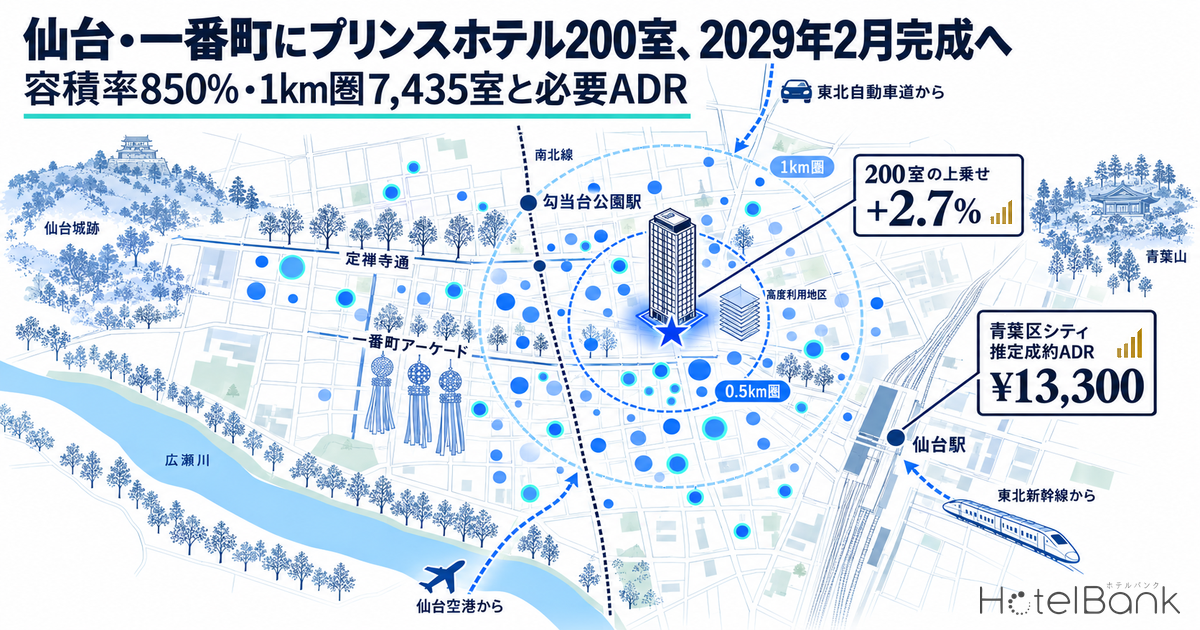
On the site of the SS. Sendai Building (formerly the Odakyu Sendai Building), which faces Higashi-Nibancho-dori just south of the Sendai Mitsukoshi department store, a plan for a 14-storey, 200-room hotel is moving forward. On November 17, 2025, Sendai City’s City Planning Council approved a city planning change that applies the city’s floor area ratio (FAR) bonus for accommodation facilities for the first time, raising the cap on this site from 600% to 850%. According to Nikkei and khb (Higashi Nippon Broadcasting), the hotel will be operated by Seibu Prince Hotels Worldwide, and the building is expected to be completed in February 2029. This article takes these 200 rooms, which will sit on the Ichibancho/Kotodai side of the city centre and not in front of Sendai Station, and works backwards to the room rate the project needs, using the room stock and workforce within 1km of the site and the estimated settled ADR of Aoba Ward.
Metric Definitions Used in This Article
- ADR (average daily rate): An estimated settled rate (tax-exclusive equivalent), calculated by applying a correction factor for each hotel type to the lowest-plan price level each property publishes on OTAs (per room, two guests per room, tax included). When checked against the property-level results disclosed by listed hotel REITs (91 properties, latest three months), the median error is about 7%. These are estimates and differ from each property’s actual settled rates and accounting figures. Area-level ADR is the median of the properties covered (the level of a typical property in the area).
- OCC (occupancy rate): The share of rooms sold out of the total rooms in the area (an estimate based on inventory sold on OTAs). It is an estimate based on how inventory offered on OTAs is taken up, and differs from the actual occupancy of the whole property.
- Listed price: The price per room for two guests per room (tax included), averaged across all plans. It is shown as a separate metric from ADR.
- Within 1km of the site: A 1km radius from 4-7 Ichibancho, Aoba Ward, Sendai (38.2650°N, 140.8719°E). Room stock is the total number of rooms at properties (excluding leisure hotels) whose selling prices could be observed in July–September 2026.
- Data source: MetroEngines Research (figures as of the survey date, October 4, 2026)
- — The plan is for about 16,600 sqm of gross floor area and 200 rooms on a site of about 1,800 sqm. That is about 83 sqm of gross floor area per room, with guest rooms of 30 sqm or more combined with a hall for 200 people and a restaurant.
- — The room stock within 1km of the site is 53 properties and 7,435 rooms, so the 200 rooms add only +2.7%. Thirteen properties with 1,790 rooms, 24% of the existing stock, opened in 2017 or later.
- — The estimated settled ADR of Aoba Ward (average of September 2025–August 2026) is about ¥9,700 for all hotel types and about ¥13,300 for city hotels. Even the average of the five highest properties within 2km is about ¥18,700, and no property among the hotel types covered by the estimate exceeds ¥20,000.
- — Within 1km of the site there are 11,291 establishments and 154,377 employees (2021), and the occupancy rate of Aoba Ward (estimate based on OTA-listed inventory) ran at 90–93% in July–September 2026. Volume is already filled; the room for growth is on the rate side.
- — In a simplified estimate, the room rate that reaches the 5.3% expected yield is about ¥24,000–26,000 when only the building investment is the denominator, and about ¥34,000–36,000 when land is added at a reference land price. The plan can be read as going after an empty price band at 1.3–1.9 times the existing upper tier.
Project Overview — 14 Storeys and 200 Rooms, Built with Ownership and Operation Separated
First, the outline of the plan, as set out in the agenda document and minutes of the Sendai City Planning Council (222nd meeting, November 17, 2025). The subject is an area of about 0.3ha named the “Ichibancho 4-chome 7 District,” located south-west of Kotodai-Koen Station on the Namboku subway line, along Higashi-Nibancho-dori. The site is currently occupied by the roughly 50-year-old SS. Sendai Building, and the proposer is the Kita-Nihon (Northern Japan) Branch of Daiwa House Industry (大和ハウス工業). With the landowner’s consent, the company planned an accommodation facility and related facilities on the site of about 1,800 sqm. Nikkei reports that the company has signed a contract to acquire the land and building, and that after completion Seibu Prince Hotels Worldwide (西武・プリンスホテルズワールドワイド) will operate a Prince Hotel there.
The building is described as 14 storeys above ground and one below, about 60m high, with a gross floor area of about 16,600 sqm (about 17,000 sqm in press reports). The front desk and lobby are on the 3rd floor, and the 200 guest rooms are placed on the ten floors from the 4th to the 13th, which works out to 20 rooms per floor. Guest rooms are generally 30 sqm or larger, and according to press reports there will also be suites on the upper floors. The 2nd floor houses a multi-purpose hall for 200 people, and the plan also includes a restaurant, a lounge and a terrace looking north-east.
| Item | Details |
|---|---|
| Location | Ichibancho 4-chome, Aoba Ward, Sendai (south of Sendai Mitsukoshi, along Higashi-Nibancho-dori) / south-west of Kotodai-Koen Station on the Namboku subway line |
| Current use | SS. Sendai Building (formerly the Odakyu Sendai Building, about 50 years old) |
| Developer / operator | Proposer: Daiwa House Industry, Kita-Nihon Branch / Operator: Seibu Prince Hotels Worldwide (press reports) |
| Scale | 14 storeys above ground and one below, about 60m high, site of about 1,800 sqm, gross floor area of about 16,600 sqm (about 17,000 sqm in press reports) |
| Guest rooms | 200 rooms (4th–13th floors, generally 30 sqm or larger, suites on the upper floors) |
| Ancillary functions | Multi-purpose hall for 200 people on the 2nd floor; front desk and lobby on the 3rd floor; restaurant, lounge and terrace |
| Schedule | January 2026: demolition of the existing building begins; January 2027: construction starts; February 2029: expected completion (no announced opening date could be confirmed as of the survey date) |
| City planning | New High-Level Use District. FAR cap 850% and minimum 300%; building coverage ratio cap 60%; wall setbacks of 4m on the Higashi-Nibancho-dori side and 2m to the north and south |
The way the floor area is used also shows the character of this plan. Dividing 16,600 sqm of gross floor area by 200 rooms gives about 83 sqm per room, a completely different unit basis from a limited-service hotel that holds guest rooms to 13–18 sqm and gross floor area to roughly 25–30 sqm per room. Even if every room were at the 30 sqm minimum, the guest room portion would be 6,000 sqm, only 36% of the gross floor area. The rest goes to the hall, lobby, restaurant, parking and the extra size of rooms above 30 sqm. This is a design that recovers its cost through the rate per room and non-room revenue, not through the number of rooms per unit of floor area.
FAR Bonus — +100% for the Accommodation Function Plus +150% for Open Space
The designated FAR of the site is 600%, and the bonus granted this time is 250%. Following the operating policy of the “FAR bonus scheme focused on the development of accommodation facilities” that the city set in March 2017, the city assessed four items: guest room size, convention function, consideration for surrounding traffic, and service functions. According to the minutes, a bonus of 100% or more was judged possible for developing an accommodation facility and 150% or more for securing sidewalk-type and plaza-type open space, for a combined 250%. Applied to the site of about 1,800 sqm, the floor area counted towards FAR rises by about 4,500 sqm, from a cap of 10,800 sqm to 15,300 sqm. As a condition, a note was written into the city plan that the city will confirm the compliance of the guest rooms, hall, vehicle drop-off and service functions before building confirmation. A comparison of the scheme’s conditions is beyond the scope of this article; the sections below look at the figures on the market side.
Location Assessment — A Commercial Zone on Higashi-Nibancho-dori, with a Nearby Standard Site at ¥3.03 Million per sqm
The site is about 1.1km north-west of Sendai Station, in the central commercial area bounded by the main City Hall building, Jozenji-dori and the arcade of the Ichibancho 4-chome shopping street. Checking the regulations for the site in the Real Estate Information Library of the Ministry of Land, Infrastructure, Transport and Tourism (MLIT), the use district is a commercial zone, the designated FAR is 600% and the building coverage ratio 80%, and the site is designated a fire prevention district. The landform classification is gravelly terrace, which falls in the category with a low tendency for liquefaction, and the flood inundation area data showed nothing applicable to the block containing the site. Disaster risk can be regarded as limited.
| Use district | Commercial zone |
| Designated FAR / building coverage ratio | 600% / 80% |
| High-Level Use District caps | 850% / 60% |
| Fire prevention designation | Fire prevention district |
| Tendency for liquefaction | Low (gravelly terrace) |
The level of land prices is also worth checking. The standard site “Sendai Aoba 5-8” (Honcho 2-chome, commercial zone, FAR 600%), about 70m from the site in a straight line, was ¥3.03 million per sqm in the official land price as of January 1, 2026 (+5.2% YoY). That is up 25.7% in five years from ¥2.41 million in 2021, and the Prefectural Land Price Survey for the same point (as of July 1, 2026) also shows a continued rise at ¥3.07 million (+4.1% YoY). By contrast, the survey point on the arcade side (Ichibancho 4-chome) is ¥1.93 million (+2.7% YoY), a gap of about 1.6 times depending on whether the plot faces the main avenue. A consolidated site of about 1,800 sqm with frontage on Higashi-Nibancho-dori rarely comes onto the market, even in the city centre.
In terms of transport, passengers at the nearest station, Kotodai-Koen, recovered to 32,856 per day in 2023, reaching 96.8% of the 33,926 of 2019. Sendai Station is two stops away by subway, or a little under 20 minutes on foot through the arcade, so the location is also within reach of Shinkansen travellers.
Room Stock Within 1km — 53 Properties and 7,435 Rooms, a Quarter Opened Since 2017
How deep, then, is the market these 200 rooms are joining? Counting the properties (excluding leisure hotels) known to MetroEngines Research whose selling prices could be observed in July–September 2026, there are 23 properties and 3,184 rooms within a 0.5km radius of the site, 53 properties and 7,435 rooms within 1km, and 85 properties and 13,002 rooms within 2km, which takes in both the east and west sides of Sendai Station. The 200 additional rooms amount to +6.3% within 0.5km, but only +2.7% within 1km and +1.5% within 2km.
Looking at the breakdown within 1km, business hotels account for 47 properties and 6,573 rooms, 88% of the rooms, while city hotels number 4 properties and 709 rooms. By opening period, properties that opened up to the 2000s make up 35 properties and 5,212 rooms, 70% of the total, while properties that opened in 2017 or later number 13 properties and 1,790 rooms, 24.1% of the existing stock. In particular, 10 properties and 1,454 rooms are concentrated in the four years 2020–2023, which shows that new rooms-focused hotels were built one after another on the Ichibancho/Kokubuncho side as well. However, the openings of this period were mainly rooms-focused hotels of around 100–200 rooms, a different character from the current plan with its 200-person hall.
Depth of Demand — 154,000 Employees Within 1km, Resident Population Flat to 2040
What about the daytime concentration of people that underpins demand? Aggregating the Economic Census (2021) by radius from the site, there are 11,291 establishments and 154,377 employees within 1km, with office-type industries accounting for 26.4%. This is an area where the prefectural government, City Hall, financial institutions and branch and sales offices overlap, a structure that generates weekday business-trip and meeting demand. Against the room stock, this works out to about 48 rooms per 1,000 employees.
| Radius | Properties | Rooms | 200 rooms as a share | Employees | Establishments | Resident population (2025) | 2040 (vs. 2020) |
|---|---|---|---|---|---|---|---|
| 0.5km | 23 | 3,184 | +6.3% | 40,414 | 3,553 | 2,367 | 0.0% |
| 1km | 53 | 7,435 | +2.7% | 154,377 | 11,291 | 29,927 | +0.9% |
| 1.5km | 77 | 12,226 | +1.6% | 197,367 | 13,926 | 71,555 | +2.3% |
The resident population within 1km is 29,927 (2025 estimate), only about one fifth of the number of employees. In other words, this is a district where people work, not where they live, and accommodation demand comes from people arriving from outside. The projections show the resident population in 2040 almost flat at +0.9% versus 2020, with an increase of +2.3% within 1.5km. Note that the population here is the resident population based on the national census, not the number of visitors or people passing through.
Where Rates Stand Today — About ¥9,700 for All Types and About ¥13,300 for City Hotels in Aoba Ward
Next, the rates actually being achieved in this market. The estimated settled ADR of Aoba Ward averaged about ¥9,700 for all hotel types (N=68–74) over the 12 months from September 2025 to August 2026. By month, August was the highest at about ¥12,400, 4.3% above the roughly ¥11,900 of the same month a year earlier. The shape, with a peak in August when the Tanabata Festival and the summer holidays coincide, has been the same for three years running.
Split by hotel type, business hotels average about ¥9,300 over the 12 months (N=55–56), while city hotels are at about ¥13,300 (N=8–9), 1.44 times as high. Because the city hotel sample is small at 8–9 properties and swings widely from month to month, the annual average is the appropriate measure. In August, city hotels were at about ¥16,100 and business hotels at about ¥12,200, so even the busiest month does not reach ¥20,000.
On occupancy, the occupancy rate of Aoba Ward (estimate based on OTA-listed inventory) was 90.1% in July 2026, 92.8% in August and 92.1% in September (36 properties / 5,518–5,522 rooms, based on listings on major booking sites). This is an estimate based on how inventory offered on OTAs is taken up and differs from the actual occupancy of whole properties, but it does show a market where around 90% of listed inventory is taken up from summer into autumn. Volume is filled, and the room for growth remains on the rate side.
Positioning — No Tier Above ¥20,000 Among 80 Properties Within 2km
These levels can be broken down to the distribution of individual properties. The chart below plots the 80 properties within 2km of the site for which an estimated settled ADR could be calculated (67 business hotels, 10 city hotels, 2 ryokan and 1 capsule hotel) by number of rooms and 12-month average estimated settled ADR. The median is about ¥9,500; 11 properties are at ¥15,000 or above, those at ¥18,000 or above are limited to four properties around Sendai Station, and no property exceeded ¥20,000. Narrowed to within 1km, the median of the 52 properties is about ¥9,400 and the highest is about ¥17,600.
DenseAround ¥10,000 × 70–250 rooms
The band where business hotels are thickly clustered. Most of the 47 business hotels and 6,573 rooms within 1km fall here, and many of the new builds since 2020 have also joined this band.
Upper tier¥15,000–20,000 × mainly 120–300 rooms
Eleven properties within 2km, mainly city hotels in front of Sendai Station and rooms-focused hotels with hot baths or larger rooms. The top five average about ¥18,700.
White spaceAbove ¥24,000 × 200-room class
None among the hotel types covered by the estimate. Just outside the 1km radius there is one deluxe-class property (292 rooms) with a listed price (all-plan average, tax included) in the ¥60,000 range. The price band below it is empty.
Above the upper tier, just outside the 1km radius, there is one deluxe-class hotel (292 rooms). Because this hotel type is outside the scope of the settled ADR estimate, it is viewed here by listed price: in the ¥60,000 range on an all-plan average, tax-included basis, 2.5 times the listed price of city hotels (about ¥25,400 on a 12-month average for Aoba Ward). Between the upper tier at around ¥20,000 on a settled basis and this deluxe-class hotel, there is still room for a property of around 200 rooms. The structure by price band in front of Sendai Station is also set out in our article on the Sendai hotel supply pipeline, and the current plan is positioned to fill that white space from the Ichibancho side and not from the station front.
Development Scenario Estimate — The Rate That Reaches the Expected Yield Is ¥24,000–36,000
At what rate, then, does this plan work? The project cost has not been published, so it is set here in two stages using official statistics as a guide. According to MLIT’s Building Starts Statistics, the planned construction cost of buildings for the accommodation industry averaged ¥591,000 per sqm nationwide in 2024 (¥1.955 million per tsubo), up 41% in two years from ¥419,000 in 2022. Because this average includes low-rise and wooden buildings, a little over 30% is added for this 14-storey plan with a hall, giving ¥2.6 million per tsubo (about ¥787,000 per sqm) as the Stage 1 assumption. Multiplied by the 16,600 sqm of gross floor area, the construction cost comes to about ¥13.1 billion.
Stage 2 factors in two years of 5% annual increases up to early 2028, the midpoint between the planned construction start in January 2027 and the expected completion in February 2029. The statistical rate of increase from 2019 to 2024 averaged about 10% a year, so 5% is a restrained assumption. In this case the construction cost is about ¥14.4 billion (about ¥2.87 million per tsubo). Because the transaction price of the land has not been published, about ¥5.5 billion, the ¥3.03 million official land price of the nearby standard site multiplied by the site area of about 1,800 sqm, is used as a reference value. Rising construction costs push up the project cost, but they also work to hold back the new supply that would follow, so for a plan that starts construction first they can also be an upside in terms of the competitive environment.
| Item | Stage 1 (current level) | Stage 2 (including increases during construction) |
|---|---|---|
| Construction unit cost assumption | ¥2.6 million per tsubo (¥787,000/sqm) | About ¥2.87 million per tsubo (¥867,000/sqm) |
| Construction cost | About ¥13.1 billion | About ¥14.4 billion |
| Land (reference value: official land price × site area) | About ¥5.5 billion | About ¥5.5 billion |
| Total project cost | About ¥18.5 billion | About ¥19.8 billion |
| Per room (construction cost only) | About ¥65 million | About ¥72 million |
| Per room (including land) | About ¥93 million | About ¥99 million |
On the revenue side, the assumptions are an occupancy rate of 80% (full-year assumption), room revenue at 70% of total revenue (hall, food and beverage and others at 30%) and a GOP margin of 35%. The GOP margin is set somewhat lower than the actual 38.9% (fiscal period ended December 2024) of 91 properties run by the main operator, as disclosed by Invincible Investment Corporation (インヴィンシブル投資法人), given that this property has food and beverage and banqueting. The yardstick for comparison is the 5.3% expected yield for limited-service hotels in Sendai shown in the Japan Real Estate Institute’s 54th Japanese Real Estate Investor Survey (as of April 2026). The survey’s yield is on a net income basis, whereas GOP here is before deducting property tax, management fees and similar items, so the yields in this estimate should be read as an upper-end guide.
| Item | A. In line with the existing upper tier | B. 1.4x the upper tier | C. 1.7x the upper tier 5% yield level |
|---|---|---|---|
| Assumed ADR | ¥20,000 | ¥26,000 | ¥32,000 |
| RevPAR | ¥16,000 | ¥20,800 | ¥25,600 |
| Room revenue (annual) | ¥1.17 billion | ¥1.52 billion | ¥1.87 billion |
| Total revenue (annual) | ¥1.67 billion | ¥2.17 billion | ¥2.67 billion |
| GOP (annual) | ¥580 million | ¥760 million | ¥930 million |
| GOP ÷ construction cost (Stage 1) | 4.5% | 5.8% | 7.2% |
| GOP ÷ project cost (Stage 1, including land) | 3.2% | 4.1% | 5.0% |
| GOP ÷ construction cost (Stage 2) | 4.1% | 5.3% | 6.5% |
| GOP ÷ project cost (Stage 2, including land) | 2.9% | 3.8% | 4.7% |
Working backwards under these assumptions to the rate that reaches 5.3%, with only the construction cost as the denominator it is about ¥23,700 at Stage 1 and about ¥26,100 at Stage 2. Adding land at the reference land price raises these to about ¥33,600 and about ¥36,000 respectively. Against the average of the top five properties within 2km (about ¥18,700), that is 1.3–1.4 times on a building basis and 1.8–1.9 times including land. Put the other way round, recovery would take a long time at the same rate as the existing upper tier, and the plan can be read as premised on bundling rooms above 30 sqm, suites, a hall and food and beverage to reach a rate one step higher. The separated structure, in which Daiwa House Industry holds the land and building and a hotel company handles operation, also makes sense as a form in which the owner side takes on the long recovery period.
| Item | Base case | ADR −10% | Occupancy −5pt | Both |
|---|---|---|---|---|
| Total revenue (annual) | ¥2.67 billion | ¥2.40 billion | ¥2.50 billion | ¥2.25 billion |
| GOP (annual) | ¥930 million | ¥840 million | ¥880 million | ¥790 million |
| GOP ÷ project cost (Stage 1, including land) | 5.0% | 4.5% | 4.7% | 4.3% |
| GOP ÷ project cost (Stage 2, including land) | 4.7% | 4.2% | 4.4% | 4.0% |
It is also worth looking at what happens when rate and occupancy move together. The table below sets out the ratio of GOP to the most conservative denominator, the Stage 2 project cost including land (about ¥19.8 billion), across five ADR levels and five full-year occupancy levels. Of the 25 combinations, only four reach the 5.3% expected yield: ADR ¥36,000 with occupancy of 80% or more, or ADR ¥32,000 with occupancy of 90%. At the Scenario C level (ADR ¥32,000, occupancy 80%), adding 5pt of occupancy has the same effect as raising ADR by ¥2,000, and given that around 90% of the listed inventory in Aoba Ward is already taken up, what determines profitability is the rate level reached more than any further gain in occupancy.
| Assumed ADR \ full-year occupancy | 70% | 75% | 80% | 85% | 90% |
|---|---|---|---|---|---|
| ¥20,000 | 2.6% | 2.8% | 2.9% | 3.1% | 3.3% |
| ¥24,000 | 3.1% | 3.3% | 3.5% | 3.8% | 4.0% |
| ¥28,000 | 3.6% | 3.9% | 4.1% | 4.4% | 4.6% |
| ¥32,000 | 4.1% | 4.4% | 4.7% | 5.0% | 5.3% |
| ¥36,000 | 4.6% | 5.0% | 5.3% | 5.6% | 6.0% |
Implications for Investors and Lenders — Watch the Rate Ladder and Non-Room Revenue
To sum up so far, this is a project that enters the market by price band, not by volume. The addition within 1km is small at +2.7%, and it is unlikely to compete head-on for rooms with the existing business hotel band. The focus is on whether it can create a new, higher rung on the rate ladder in a market that currently tops out at around ¥20,000 on a settled basis. Those considering lending or equity investment should check the following four points.
| Point to check | What this article’s data shows | Material to look at next |
|---|---|---|
| Achievability of the rate | The highest within 2km is about ¥19,700. The required rate is about ¥24,000–26,000 on a building basis | Rates and room sizes the same brand achieves in other cities; the rate structure after opening |
| Non-room revenue | A 200-person hall and a restaurant are included. More than 60% of the gross floor area goes to uses other than guest rooms at the minimum size | Expected annual number of meetings and banquets; division of roles with large venues such as the Sendai International Center |
| Changes in project cost | A 5% annual increase adds about ¥1.3 billion to the construction cost in the estimate. Expected completion is February 2029 | Timing of the construction contract and how the price is fixed; progress of demolition |
| Follow-on supply nearby | 10 properties and 1,454 rooms opened within 1km in 2020–23, mainly rooms-focused hotels | Whether follow-on plans use the FAR bonus in the city centre; building confirmation activity |
As tailwinds on the demand side, in addition to the weekday business demand of 154,000 employees, the hotel is positioned as a place to receive participants in international conferences, which the city gives as the purpose of the FAR bonus. Miyagi is also one of the prefectures where stays by guests from Europe, North America and Australia have fed through to higher rates. For investors looking for sites in Tohoku, the significance of this project is that it sets a precedent: even without a prime plot in front of the station, an upper-price-band plan can be put together by combining a site of around 1,800 sqm on a main avenue with the FAR bonus.
Frequently Asked Questions
Q. When will the Prince Hotel in Ichibancho, Sendai be completed?
A. According to press reports, demolition of the existing building begins in January 2026, construction starts in January 2027, and the building is expected to be completed in February 2029. No announced opening date could be confirmed as of the survey date, October 4, 2026.
Q. How many rooms will it have, and how large is the building?
A. According to Sendai City Planning Council documents, it has 14 storeys above ground and one below, a gross floor area of about 16,600 sqm, and 200 guest rooms (generally 30 sqm or larger). A multi-purpose hall for 200 people is on the 2nd floor, and the front desk and lobby are on the 3rd floor.
Q. How was the floor area ratio relaxed?
A. On a site with a designated FAR of 600%, Sendai City’s “FAR bonus scheme focused on the development of accommodation facilities” was applied for the first time, and the cap was set at 850% as a High-Level Use District. The assessment granted 100% or more for the accommodation function and 150% or more for securing open space.
Q. How large is the surrounding hotel market?
A. According to MetroEngines Research’s count, the room stock within 1km of the site is 53 properties and 7,435 rooms, so 200 rooms is equivalent to +2.7%. The estimated settled ADR of Aoba Ward, on a 12-month average, is about ¥9,700 for all hotel types and about ¥13,300 for city hotels.
Summary
Attention on the Ichibancho 4-chome hotel plan tends to go to the novelty of the scheme, the 850% FAR, but seen from the market side it is a plan to “put 200 rooms at a rate one step above the existing upper tier into a 1km radius of 53 properties and 7,435 rooms.” The estimated settled ADR of Aoba Ward is about ¥9,700 for all hotel types and about ¥13,300 for city hotels, and even the highest within 2km is only about ¥19,700, leaving an empty price band between that and the deluxe class above. In the simplified estimate, the rate that reaches the 5.3% expected yield came to about ¥24,000–26,000 on a building basis and about ¥34,000–36,000 when land is added at the reference land price.
Both construction costs and the rate level in Sendai may change before the expected completion in February 2029. The final construction cost and the direction of pricing should become visible around the planned construction start in January 2027, and that will be the time to check the plan against market data again. Note that the estimate in this article is a simplified one based on published documents and statistics, and does not include undisclosed elements such as the transaction price of the land or the rent terms.
Related Articles
References and Sources
■ Data sources
Aggregated data from MetroEngines Research & Consulting (estimated settled ADR and occupancy based on OTA listed prices and inventory sold). Room stock was counted for radii of 0.5km, 1km, 1.5km and 2km from the site, covering properties (excluding leisure hotels) whose selling prices could be observed in July–September 2026 (within 1km: N=53 properties, 7,435 rooms). Estimated settled ADR is the September 2025–August 2026 average for Aoba Ward (all types N=68–74, city N=8–9, business N=55–56) and for 80 properties within 2km; occupancy is for 36 properties in Aoba Ward in July–September 2026. Employment is from the Economic Census for Business Activity (2021), resident population from the 250m-mesh future population projections of the National Land Numerical Information, land prices and building regulations from the Real Estate Information Library, and the project outline from the agenda and minutes of the Sendai City Planning Council and press reports.
■ Estimate assumptions
Gross floor area of about 16,600 sqm and 200 rooms. The construction unit cost is ¥2.6 million per tsubo at Stage 1, a little over 30% above the Building Starts Statistics figure (accommodation industry, 2024 national average of ¥591,000/sqm), and about ¥2.87 million per tsubo at Stage 2, which factors in two years of 5% annual increases. Land is a reference value (about ¥5.5 billion) obtained by multiplying the ¥3.03 million/sqm official land price of the nearby standard site by the site area of about 1,800 sqm. Revenue is held at an assumed full-year occupancy of 80%, a room revenue share of 70% and a GOP margin of 35%, and compared with the 5.3% expected yield for limited-service hotels in Sendai shown in the Japan Real Estate Institute’s 54th Japanese Real Estate Investor Survey.
■ Limitations and caveats
The transaction price of the land, the construction contract amount and the rent or management contract terms are all undisclosed, and the project cost is an assumption derived from statistics and official land prices. GOP is before deducting property tax, management fees, reserves for renewal investment and similar items, so the comparison with an expected yield on a net income basis is no more than an upper-end guide. The GOP margin is held at 35% regardless of the level of rate or occupancy, but in practice it varies with the level of revenue. Estimated settled ADR and occupancy are estimates based on OTA listing information and differ from each property’s accounting figures. No announced opening date could be confirmed as of the survey date; February 2029 is the expected completion of the building.
■ Market data
- MetroEngines Research & Consulting — room stock within 2km of the site (85 properties, 13,002 rooms), estimated settled ADR (Aoba Ward N=68–74, within 2km n=80), occupancy (estimate based on OTA-listed inventory, 36 properties in Aoba Ward)
■ Government statistics and public data
- Sendai City, “Sendai City Planning Council Meetings, Fiscal 2025” (222nd meeting, November 17, 2025)
- Sendai City Planning Council, Agenda Item No. 1080, “Change to the High-Level Use District (Ichibancho 4-chome 7 District)”
- Sendai City Planning Council, minutes of the 222nd meeting
- Sendai City, “Operating Policy for the FAR Bonus Scheme Focused on the Development of Accommodation Facilities” (March 16, 2017)
- MLIT Real Estate Information Library — official land prices and Prefectural Land Price Survey, use districts, fire prevention districts, passengers by station, flood inundation areas, tendency for liquefaction by landform classification
- MLIT, “Building Starts Statistics Survey” (e-Stat table ID 0003114490, use = accommodation industry)
- Ministry of Internal Affairs and Communications and Ministry of Economy, Trade and Industry, “Economic Census for Business Activity” (2021); MLIT National Land Numerical Information (future population projections by 250m mesh)
■ REITs and industry reports
- Japan Real Estate Institute, “54th Japanese Real Estate Investor Survey” (as of April 1, 2026)
- Invincible Investment Corporation (8963), hotel operating results
■ News and press releases
- Prince Hotel to open next to Sendai Mitsukoshi; city to apply FAR bonus for the first time (Nikkei, November 12, 2025; in Japanese)
- Sendai City approves FAR bonus for hotel site next to Mitsukoshi, former SS. Sendai Building (Nikkei, November 17, 2025; in Japanese)
- “Prince Hotel” to open in central Sendai, completion planned for 2029 (khb Higashi Nippon Broadcasting, November 17, 2025; in Japanese)
- Prince Hotel to enter Sendai, aiming for 2029 completion on former Odakyu Building site (Kahoku Shimpo, November 12, 2025; in Japanese)