

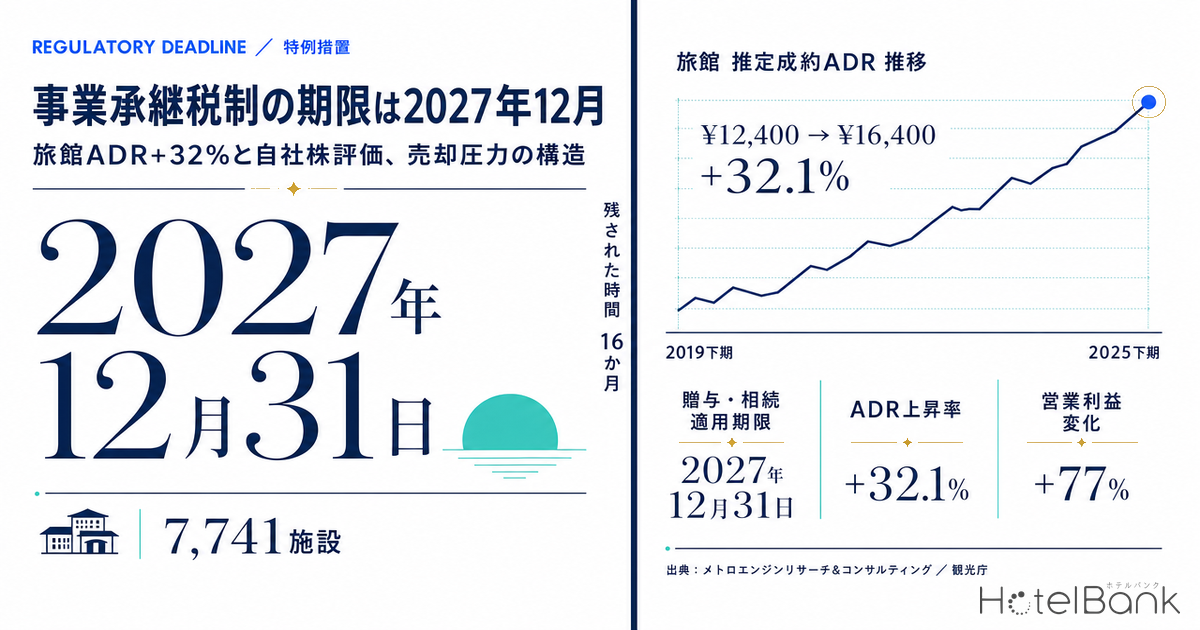
Japan’s fiscal 2026 tax reform extended the filing deadline for the Special Succession Plan under the corporate business succession tax regime to September 30, 2027. But what was extended is only the deadline for filing the plan. The deadline for the gift or inheritance itself remains December 31, 2027. That leaves just three months between filing the plan and executing the transfer.
The subject of this article is neither the property nor the location. It is the shares. Who can afford to keep holding the equity of a ryokan is what determines whether that ryokan comes to the M&A market a few years from now. Drawing on MetroEngines Research data covering 7,741 ryokan and 179,897 guest rooms, alongside disclosed results from listed hotel REITs, we read the tax-side conditions from the perspective of investors and succession advisors.
Metric Definitions Used in This Article
- ADR (Average Daily Rate): An estimated transacted rate (tax-exclusive equivalent) calculated by applying a segment-specific correction coefficient to the lowest advertised plan level each property publishes on OTAs and similar channels (double occupancy, per-room rate, tax-inclusive). Cross-checked against property-level results disclosed by listed hotel REITs (91 properties, most recent three months), the median error is roughly 7%. These are estimates and differ from each property’s actual transacted prices and accounting figures. Area-level ADR is the median of the target properties (the level of a typical property in that area).
- OCC (Occupancy Rate): The 38.2% figure cited in this article as the ryokan occupancy rate (full-year 2025) is the occupancy rate by accommodation type from the Japan Tourism Agency’s Overnight Travel Statistics Survey, 2025 annual figures (final). REIT occupancy rates are the values each investment corporation disclosed monthly.
- Unlisted share valuation: The inheritance-tax valuation of shares without a market quotation. It is calculated using the comparable-industry method, the net asset value method, or a combination of the two. The estimates in this article are reference figures based on assumptions; an individual valuation requires calculation by a certified tax accountant.
- Data sources: MetroEngines Research & Consulting, Japan Tourism Agency, Small and Medium Enterprise Agency, monthly disclosures by individual investment corporations
- — Only the plan deadline moved. The Special Succession Plan filing deadline was pushed back 18 months to September 30, 2027, but the gift/inheritance deadline stays at December 31, 2027. That leaves only three months to execute.
- — Estimated transacted ADR +32.1% (H2 2019 → H2 2025). At ryokan, where operating leverage is high, a +23.7% rate increase corresponds to +79% in operating profit — which feeds straight into the share valuation.
- — 63.6% of the 7,741 operating ryokan have 19 rooms or fewer. Because the entry requirement is “five or more regular employees (excluding relatives sharing the same household finances),” the tier that finds succession hardest is precisely where the eligibility test bites.
- — At a ¥300 million share valuation with no deferral, the tax equals roughly 9.7 years of operating profit. The successor must raise that cash within 10 months of the inheritance — stretching to about 10.9 years at a 45% effective rate.
- — The special measure is designed all the way through to the exit. Transfer the company to a third party after succeeding, and the tax can be recalculated at the share price on the transfer date. Succession and sale are not mutually exclusive — they line up on a timeline. The deadline for that flexibility is December 31, 2027.
Sixteen months left — the planning deadline moved, the execution deadline did not
The special measure of the corporate business succession tax regime was created in 2018 as time-limited legislation with a ten-year window. It defers 100% of the tax on gifts and inheritances of unlisted shares, letting the successor postpone payment until the next generation takes over. Compared with the general measure (the permanent regime), which defers tax on only up to two-thirds of total shares and, for inheritance tax, only 80% of the taxable value, the difference in effect is substantial.
The FY2026 tax reform extended the Special Succession Plan filing deadline — the entry point for using this special measure — from March 31, 2026 to September 30, 2027, an 18-month extension (the individual-version succession plan runs to September 30, 2028). Read in isolation, that sounds like there is still time. Yet the deadline for the gift or inheritance that qualifies for the regime remains December 31, 2027. Between filing the plan and actually moving the shares, the rules leave only three months.
In practice those three months carry real weight. The Special Succession Plan requires the opinion of a certified management innovation support institution, and behind that sit the share valuation, confirming the successor, arrangements for classes of shares and statutory reserved portions, and coordination with lenders. If the gift route is chosen, the application for prefectural governor certification must also be filed by January 15 of the year following the gift. Working backwards, the effective decision deadline falls in the first half of 2027 — roughly 16 months from the time of writing (end of August 2026).
| Item | Special measure (gifts/inheritances through December 31, 2027) | General measure (permanent regime) |
|---|---|---|
| Advance plan filing | Special Succession Plan required (by September 30, 2027) | Not required |
| Eligible shares | All shares acquired | Up to two-thirds of total shares |
| Inheritance tax deferral ratio | 100% | 80% of taxable value |
| Gift tax deferral ratio | 100% | 100% (on up to two-thirds of shares) |
| Effective deferral coverage (inheritance) | 100% | About 53% (two-thirds × 80%) |
| Employment retention requirement | May continue even if the five-year average falls below 80%, provided the reason is reported | Must maintain a five-year average of 80% |
| Succession pattern | From multiple shareholders to up to three successors | From multiple shareholders to one successor |
| Relief for changes in the business environment | Available (recalculation on transfer, merger or dissolution) | None |
The bottom row — relief for changes in the business environment — deserves attention. Under the special measure, if the company is transferred to a third party after the deferral is granted, or merged or dissolved, the tax can be recalculated at the share price as of that point and the difference from the original valuation forgiven. In other words, the special measure is designed to include the exit: succeeding first and selling later. The general measure has no such mechanism. What looks like a binary choice between succession and sale becomes, under the special measure, a staggered option: succeed now, sell when the environment changes. This is where acting before the end of December 2027 makes the greatest difference.
The earnings recovery is pushing share valuations up in lockstep
Now to the data on the properties themselves. Across the 15 prefectures with a high ryokan share (Nagano, Shizuoka, Oita, Gunma, Ishikawa, Niigata, Hyogo, Tochigi, Kanagawa, Hokkaido, Gifu, Wakayama, Mie, Yamagata and Fukushima), MetroEngines Research puts the estimated transacted ADR for ryokan at ¥16,400 in H2 2025, up 32.1% from ¥12,400 in H2 2019 (N = approx. 4,000 properties, weighted by property count). On an annual-average basis the move is from ¥12,700 in 2022 to ¥15,700 in 2025 — up 23.7% in three years.
The increase is not uniform nationwide. Comparing 2022 and 2025 annual averages by prefecture, Hokkaido (+31.9%), Kanagawa (+30.9%) and Nagano (+30.6%) grew around 30%, while Tochigi (+14.9%), Yamagata (+16.8%) and Wakayama (+17.7%) stayed in the high teens. As with land prices, the recovery in earning power varies by region.
| Prefecture | 2022 average ADR | 2025 average ADR | Growth | Properties in sample (2025) |
|---|---|---|---|---|
| Hokkaido | ¥6,900 | ¥9,100 | +31.9% | 273 |
| Kanagawa | ¥16,100 | ¥21,000 | +30.9% | 268 |
| Nagano | ¥9,900 | ¥12,900 | +30.6% | 520 |
| Gunma | ¥12,100 | ¥15,600 | +29.0% | 286 |
| Gifu | ¥11,700 | ¥14,800 | +26.3% | 236 |
| Niigata | ¥11,000 | ¥13,800 | +25.0% | 242 |
| Oita | ¥14,500 | ¥18,100 | +24.8% | 311 |
| Shizuoka | ¥15,100 | ¥18,400 | +22.2% | 450 |
| Hyogo | ¥18,100 | ¥22,200 | +22.2% | 287 |
| Mie | ¥14,100 | ¥17,100 | +21.4% | 212 |
| Fukushima | ¥8,700 | ¥10,400 | +18.9% | 237 |
| Ishikawa | ¥15,900 | ¥18,700 | +17.9% | 110 |
| Wakayama | ¥11,500 | ¥13,500 | +17.7% | 106 |
| Yamagata | ¥11,100 | ¥13,000 | +16.8% | 184 |
| Tochigi | ¥14,400 | ¥16,500 | +14.9% | 209 |
So how does this earnings recovery connect to the share valuation? Inheritance-tax valuation of shares without a market quotation uses the comparable-industry method and the net asset value method (or a combination). The comparable-industry method compares three elements — dividends, profit and book net assets — against industry averages, so a rise in profit lifts the valuation directly. Under the net asset value method, unrealized gains on land and accumulated retained earnings also flow straight into the valuation. In short, when earnings recover, both methods push the share price up.
On top of that, the ryokan business carries exceptionally high operating leverage. Fixed components — payroll, depreciation, repairs and utilities — account for most of the cost base, so a few percentage points on the rate can nearly double operating profit. The following is an index-based simulation assuming a ryokan of average size.
| Item | 2022 | 2025 | Change |
|---|---|---|---|
| Rooms sold per year (30 rooms × 365 days × 38.2% occupancy, full-year 2025) | 4,183 rooms | 4,183 rooms | ±0 |
| Estimated transacted ADR (15-prefecture composite) | ¥12,691 | ¥15,696 | +23.7% |
| Revenue | ¥53.1M | ¥65.7M | +23.7% |
| Variable costs (25% of revenue) | ¥13.3M | ¥16.4M | +23.7% |
| Fixed costs (payroll, repairs, depreciation, etc.) | ¥32.9M | ¥36.9M | +12.0% |
| Operating profit | ¥6.9M | ¥12.4M | +79% |
| Operating margin | 13.0% | 18.9% | +5.9pt |
A +23.7% move in the rate alone takes operating profit up 79%. Given that the profit element carries a one-third weight in the comparable-industry method, the share valuation of ryokan operating companies has risen considerably over these three years without owners doing anything unusual. The National Tax Agency’s published share prices by industry category are also at elevated levels for many industries in the 2025 tables. An earnings recovery is a welcome change for management, but on the single question of succession design it works in the direction of raising the difficulty as time passes.
The entry condition unique to ryokan — asset-holding companies and the “five employees” line
There is one more issue specific to ryokan and hotel operating companies. The business succession tax regime excludes asset-holding companies and asset-management companies. A company qualifies as an asset-holding company when specified assets (securities, real estate not used by the company itself, cash and deposits, and similar) account for 70% or more of the book value of total assets. A ryokan business, built on the heavy assets of land and buildings, can easily approach that definition when judged on the shape of its balance sheet alone.
There is, however, a saving provision. A company that meets all three of the following is treated as having genuine business substance and remains eligible even if it formally falls within the asset-holding company definition.
1. Continuity of operations
Selling goods, leasing assets, providing services and the like continuously for three years or more up to the date of the gift or inheritance.
2. Five or more employees
Having five or more regular employees. The owner-manager and relatives sharing the same household finances are not counted toward this number.
3. Ownership of fixed facilities
Owning or leasing fixed facilities necessary to the business, such as an office, store or plant.
Condition 3 is met by any ryokan as a matter of course. Condition 1 is no obstacle for a long-established operation. The practical dividing line is condition 2, “five or more regular employees.” What bites here is that relatives sharing the same household finances are excluded from the count. At a family-run inn operated by a couple and the parents’ generation, six people may appear on the roster while the number of regular employees under the regime is zero.
So how many properties fall into that size band? Within the scope MetroEngines Research tracks, we broke down 7,741 operating ryokan and 179,897 rooms by room count.
Properties with 19 rooms or fewer account for 4,921 properties, or 63.6% of the total, of which 2,066 (26.7%) have nine rooms or fewer. Yet those same 63.6% hold 52,232 rooms — just 29.0% of the total. An overwhelming majority by property count, but under 30% of supply.
Room count and headcount do not map one to one, so a property with 19 rooms or fewer does not automatically have fewer than five employees. Ryokan serving two meals a day with continuous service are labor-intensive, and it is not unusual for a 10-room property to employ several people. Even so, the relationship holds: the smaller the property, the higher the share of family labor, and the more likely condition 2 becomes the focus of the eligibility test. The order in which to check the entry requirements is clear.
1. On your balance sheet, do specified assets account for 70% or more of the book value of total assets? (If so, proceed to the business-substance test.)
2. Are there five or more regular employees, excluding relatives sharing the same household finances? Verify against social insurance enrollment records.
3. Over the past three years, has specified income such as asset leasing reached 75% or more of total revenue? (The asset-management company test.)
If even one of these is borderline, work backwards from the September 30, 2027 plan filing deadline and bring the consultation with a certified support institution forward.
There is a structural twist here. Succession is hardest for small, family-run inns — and that is exactly the tier most likely to stumble at the regime’s entry requirements. Conversely, mid-sized and larger ryokan companies with dozens of employees clear the requirements easily and can take full advantage of the 100% deferral. How the regime works divides sharply by scale — and the properties that miss the succession window tend to exit the market not through distress but through orderly closure while still profitable.
How the deferral changes what is left — how many years of operating profit go to tax
How much does the amount a successor shoulders differ between using the regime and not? The simulation below sets the share valuation at three levels and assumes a 40% effective inheritance tax rate on the equity portion.
| Share valuation | No deferral | General measure (effective 53% deferral) | Special measure (100% deferral) | Burden with no deferral = model ryokan operating profit |
|---|---|---|---|---|
| ¥200M | ¥80M | ¥37.4M | ¥0 | approx. 6.5 years |
| ¥300M | ¥120M | ¥56M | ¥0 | approx. 9.7 years |
| ¥500M | ¥200M | ¥93.4M | ¥0 | approx. 16.1 years |
The right-hand column is the point of this article. At a ryokan valued at ¥300 million where no deferral is available, the successor must raise cash equivalent to roughly ten years of operating profit within 10 months of the inheritance. The shares are unlisted and cannot be readily converted to cash. Without that cash on hand, the remaining options are limited: borrowing from a lender (the financial support under the Business Succession Facilitation Act gives access to special interest rates from the Japan Finance Corporation and a separate credit guarantee frame), payment in kind, or selling the company itself.
| Share valuation | 30% effective rate | 35% effective rate | 40% effective rate | 45% effective rate | 50% effective rate |
|---|---|---|---|---|---|
| ¥100M | 2.4 yrs | 2.8 yrs | 3.2 yrs | 3.6 yrs | 4.0 yrs |
| ¥200M | 4.8 yrs | 5.6 yrs | 6.5 yrs | 7.3 yrs | 8.1 yrs |
| ¥300M | 7.3 yrs | 8.5 yrs | 9.7 yrs | 10.9 yrs | 12.1 yrs |
| ¥500M | 12.1 yrs | 14.1 yrs | 16.1 yrs | 18.1 yrs | 20.2 yrs |
| ¥1B | 24.2 yrs | 28.2 yrs | 32.3 yrs | 36.3 yrs | 40.3 yrs |
The “roughly ten years of operating profit” cited in the text is not a single point value; it rests on the combination of a ¥300 million valuation and a 40% effective rate. At the same ¥300 million, a 45% effective rate stretches it to about 10.9 years and 50% to about 12.1 years. Conversely, a ¥200 million valuation at 35% stops at about 5.6 years — within reach of financial support or instalment payment. The shaded ten-year line marks the watershed between paying it off with cash on hand plus borrowing, and moving to the side that considers selling the company itself. Which side of that line a company sits on cannot be settled without knowing the current share valuation.
Which returns us to the opening point. Whether the shares can be held is what determines whether the ryokan comes to market. Supply is being decided on a different layer from the property-side debate about whether the location is good, the building new, or the rate rising. If anything, there is a paradox here: the better a property’s earnings, the higher its valuation, and the higher the hurdle to succession without a deferral.
Deferral is not forgiveness — three constraints that remain after using it
Tax deferral is not a cure-all. There are three points anyone choosing the regime should see clearly.
1. Interest tax applies on termination
Trigger a revocation event — the successor ceasing to be representative director, transferring shares, or the company becoming an asset-holding company — and interest tax accruing from the inheritance or gift date is payable on top of the deferred tax. The longer the deferral has run, the more interest tax accumulates.
2. Reporting obligations continue
For five years after the filing deadline, annual reports to the prefectural governor and continuation notifications to the tax office are required; from year six onward, continuation notifications every three years. Stop the paperwork and the deferral stops too.
3. The shares are locked in
Deferred shares are premised on the successor continuing to hold them. Capital-policy flexibility — accepting outside capital, or structuring a partial transfer — narrows.
That said, the special measure carries the relief for changes in the business environment described above. When shares are transferred to a third party after succession, the tax can be recalculated at the transfer-date share price and the difference forgiven, so a two-stage approach — use the deferral to succeed first, then transfer when the timing is right — is contemplated by the regime itself. Being able to line succession and sale up on a timeline rather than set them against each other is a design point worth noting from the investor and advisor side as well. Because the general measure has no such recalculation mechanism, the December 31, 2027 deadline is also a deadline on the breadth of the options themselves.
Uptake of the regime has grown steadily. According to Small and Medium Enterprise Agency materials, applications under the special measure have run at roughly 3,000 a year since its creation, rising to 5,357 in FY2023. Measured by the employees of companies using the regime, the general-measure period (2009–2017) totalled about 60,000 people, while the special-measure period (2018–2023) reached about 270,000. As the deadline nears, a last-minute build-up of applications is to be expected.
What buyers are basing their pricing on
If the seller’s tax conditions determine supply, what are buyers looking at when they set a price? Place the disclosed results of listed hotel REITs alongside ryokan levels and the gap is stark.
On rate alone, the ryokan estimated transacted ADR of ¥15,700 is roughly level with the ¥15,100 that Invincible Investment Corporation disclosed across 101 domestic hotels. The gap opens on occupancy: the REITs operate at 74–86%, while the ryokan segment overall runs at 38.2% (full-year 2025, Japan Tourism Agency final figures). The result is a RevPAR gap of about ¥6,000 against ¥8,000–¥18,000.
Most of that gap comes not from operational skill but from the structure of the business format itself. Ryokan serving two meals with in-room attendants see demand swing sharply between weekdays and weekends, and food preparation and service staffing make sustained full occupancy hard to normalize. Many also close on set days. In other words, 38.2% is “the normal level for that format,” not a number to be measured with the same yardstick as urban hotels.
At the same time, it is a fact that buy-side investors read this gap as a source of upside. Lift occupancy by 10 points at the same location and rate band, and RevPAR grows more than 25%. Cases of actually capturing that headroom through operational redesign — adding room-only plans, consolidating dining venues, opening the restaurant to outside guests, charging for private baths — are increasing. The Japan Real Estate Institute’s 54th Real Estate Investor Survey (as of April 2026) puts the expected yield for limited-service hotels in Tokyo at 4.2%, flat for a second consecutive survey, while regional onsen ryokan sit in a band where far higher yields are demanded. The yield spread against central-city hotels is what creates the incentive for capital to move toward regional ryokan.
Where succession pressure concentrates — mapping ryokan counts against the small-property share
It is the small-property tier where the entry test is most likely to be borderline. The more ryokan a region has in absolute terms, and the higher its share of properties with 19 rooms or fewer, the more succession-planning consultations tend to cluster there. The top 20 prefectures are mapped below.
| Oita (329 properties) | 80.2% |
| Kumamoto (237 properties) | 78.9% |
| Fukui (172 properties) | 76.2% |
| Kyoto (229 properties) | 75.5% |
| Gifu (281 properties) | 72.2% |
| Hyogo (300 properties) | 71.0% |
| Ishikawa (172 properties) | 34.0 rooms avg. |
| Tochigi (210 properties) | 34.1 rooms avg. |
| Hokkaido (341 properties) | 36.4 rooms avg. |
| Iwate (145 properties) | 29.8 rooms avg. |
Yufuin and the Kurokawa area in Oita and Kumamoto, Kyoto, and Awara in Fukui are places where small properties cluster densely. These areas have a distinctive profile: smaller deal sizes per property, but a steadier flow of deals. For regional and shinkin banks, area-wide support programs work well here; for M&A advisors, it is territory where roll-up acquisition structures covering several properties can be made to work. Ishikawa, Tochigi and Hokkaido, by contrast, have larger properties on average, combining two conditions: standalone deal appeal, and an easier path through the regime’s entry requirements.
A decision framework — what to check, in what order, over 16 months
The issues to settle by December 31, 2027 differ by the reader’s position.
| Position | What to confirm first | Where to be by mid-2027 |
|---|---|---|
| Owner-managers of ryokan and hotel companies | The current share valuation. Have a tax accountant calculate how much of the past three years’ profit growth is now embedded in it. In parallel, check the asset-holding company test and the regular employee count (excluding relatives). | Successor confirmed and the Special Succession Plan filed with a certified support institution’s opinion attached. Decide whether to move via gift or wait for inheritance. |
| PE funds and corporates sourcing regional deals | Target-tier shareholder structure and owner age. For companies that have already applied the special measure, a post-succession transfer allows the tax to be recalculated, which changes the negotiating premise. | Separate sourcing priorities between companies that have applied the special measure and those that have not. Expect deals from the un-applied, small-property tier from 2028 onward. |
| Regional and shinkin banks supporting succession | An inventory of clients in lodging where the owner is 60 or older and shareholding is concentrated. For properties with 19 rooms or fewer, run the entry-requirement test first. | Present a tax-funding framework that includes financial support under the Business Succession Facilitation Act (special interest rates from the Japan Finance Corporation, a separate credit guarantee frame). |
| M&A advisors | Whether the seller’s shares are subject to a deferral. Because transferring deferred shares triggers a revocation event, confirm early in structuring whether the recalculation-based forgiveness is available. | Manage succession deals to be executed within 2027 and deals surfacing from 2028 as separate pipelines. |
Conclusion
To summarize, four points.
First, only the plan deadline moved. The Special Succession Plan filing deadline was extended 18 months to September 30, 2027, but the deadline for the gift or inheritance itself stayed at December 31, 2027. The interval is only three months, and the effective decision deadline falls in the first half of 2027.
Second, the earnings recovery is lifting share valuations. Ryokan estimated transacted ADR rose 32.1% from H2 2019 to H2 2025, and 23.7% from 2022 to 2025 (N = approx. 4,000 properties). Because the format carries high operating leverage, a +23.7% rate increase equates to +79% at the operating profit line in our simulation. Under both the comparable-industry method and the net asset value method, that change shows up as a higher valuation. Succession planning is moving in the direction of larger numbers the longer it waits.
Third, how the regime works divides by scale. The asset-holding company test and the “five or more regular employees (excluding relatives sharing the same household finances)” requirement come into focus most sharply at small, family-run properties. Of the 7,741 operating ryokan, 63.6% have 19 rooms or fewer — a tier that is a large majority by property count yet only 29.0% of supply. The tier where succession is hardest to design overlaps with the tier that has the most to verify at the regime’s entry.
Fourth, the equity layer is what determines supply. At a ¥300 million share valuation with no deferral available, the cash a successor must raise within 10 months equals roughly ten years of the model ryokan’s operating profit. Unlisted shares cannot be readily converted to cash, so the choice narrows to borrowing, payment in kind, or transfer. It is not the quality of the property but whether the shares can be held that governs whether a ryokan comes to the M&A market. For buyers, 2028 onward is a phase in which tax-driven deals could accumulate.
The special measure has an exit built in: recalculation of the tax if the company is transferred to a third party after succession. Succession and sale are not exclusive choices; they can be arranged along a timeline. The deadline for securing that flexibility is December 31, 2027.
About the simulations in this article: The model ryokan P&L and the tax scenarios are reference figures built by applying certain assumptions to published statistics and our own aggregated data. They are not the figures of any specific existing property. Share valuations and inheritance tax vary widely with other inherited assets, the number of statutory heirs, various deductions and company size classification. Always confirm eligibility for the regime and specific tax amounts with a certified tax accountant or a certified management innovation support institution. Tax rules are also subject to change in future reforms.
Related reading
- Ryokan Succession Crisis: 89 Bankruptcies & 30% Without Heirs in 2025
- Who Owns the Hot Spring? Water Rights and Ryokan Valuation
References and sources
■ Data sources
MetroEngines Research & Consulting estimated transacted ADR (composite of 15 ryokan-heavy prefectures, N = 3,400–4,498 properties/month, July 2019 – August 2026); the room-count and prefecture-level composition of 7,741 operating ryokan and 179,897 rooms; occupancy rates by accommodation type from the Japan Tourism Agency’s Overnight Travel Statistics Survey, 2025 annual figures (final); published materials from the Small and Medium Enterprise Agency and the National Tax Agency; monthly disclosures from four listed hotel REITs.
■ Simulation assumptions
The model ryokan is assumed to have 30 rooms, sit in a regional onsen area and serve mainly half-board; a 38.2% room occupancy rate (full-year 2025) is applied to both 2022 and 2025 so that only the effect of the rate change is isolated. Variable costs are 25% of revenue and fixed costs 62% of 2022 revenue, with 2025 assumed +12% nominal to reflect payroll and energy increases. The inheritance tax scenarios assume a 40% effective rate on the equity portion (30–50% in the sensitivity analysis), and the general measure’s deferral coverage is calculated as “two-thirds of total shares × 80% of taxable value = 53.3%.” Displayed amounts are rounded, and the differences shown in each row are consistent with the displayed totals.
■ Limitations and caveats
(1) Estimated transacted ADR is an estimate derived by applying segment-specific correction coefficients to OTA advertised prices; cross-checked against listed REIT disclosures, the median error is about 7%. It differs from actual transacted prices and accounting figures. (2) The 2022 average includes January–April, a period affected by COVID-19, and the estimates for those four months show an upward bias. The growth rate measured from 2022 (+23.7%) may therefore understate the true move; the +32.1% measured from H2 2019 does not include the affected period. (3) The room-count aggregation covers only operating properties with a registered room count, and room count does not map one to one onto the number of regular employees. Having 19 rooms or fewer does not by itself mean fewer than five employees. (4) Occupancy is a national figure by accommodation type and differs from the level at individual properties or in individual areas. (5) Tax amounts and share valuations vary widely with other inherited assets, the number of statutory heirs, various deductions and company size classification. Confirm eligibility and specific tax amounts with a certified tax accountant or a certified management innovation support institution.
■ Market data
- MetroEngines Research & Consulting — ryokan estimated transacted ADR (15-prefecture composite, N = 3,400–4,498 properties/month), room-count composition of 7,741 operating ryokan and 179,897 rooms, ryokan counts and average room counts by prefecture
■ Tax and regulatory
- Small and Medium Enterprise Agency, “Corporate Business Succession Tax Regime (Special Measure)”
- Small and Medium Enterprise Agency, “Certification underlying the business succession tax regime (general measure)”
- Yamada & Partners, “Business succession tax regime: extension of the filing deadline for Special Succession Plans (FY2026 tax reform)”
- Tokyo Chamber of Commerce and Industry, “Key points of the business succession tax regime that SME owners should know”
- National Tax Agency, “Share prices by industry category, 2025”
- Small and Medium Enterprise Agency, “Case studies in using the corporate business succession tax regime (special measure)” (application trend)
■ Government statistics and public data
- Japan Tourism Agency, “Overnight Travel Statistics Survey (2025 annual figures, final)”
- Japan Real Estate Institute, “The 54th Japanese Real Estate Investor Survey (as of April 2026)”
■ REIT monthly disclosures
- Invincible Investment Corporation, “Monthly operating status (July 2026, 101 domestic hotels)”
- Japan Hotel REIT Investment Corporation, “Monthly operating results (July 2026, 29 hotels with variable rent structures)”
- Ichigo Hotel REIT Investment Corporation, “Hotel operating status (July 2026, 25 hotels held, total)”
- Hoshino Resorts REIT, “Monthly operating status (June 2026, whole portfolio)”
■ Industry trends