

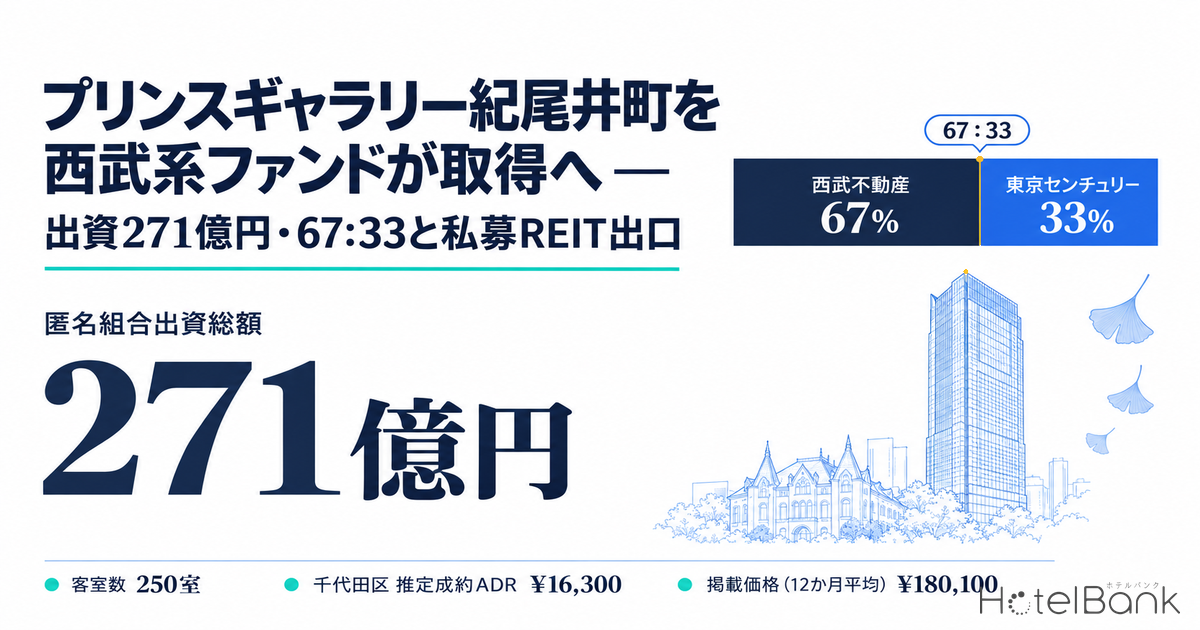
On September 30, 2026, the trust beneficiary interests whose trust assets are The Prince Gallery Tokyo Kioicho (250 rooms) and Akasaka Prince Classic House in Kioicho, Tokyo, are scheduled to pass to a special purpose company formed by the Seibu Group’s asset management company. The vehicle is a tokumei kumiai (TK, a silent partnership), with total equity contributions of ¥27.1bn, split 67% Seibu Real Estate and 33% Tokyo Century. The seller is a Blackstone-backed TMK (special purpose company) that acquired Tokyo Garden Terrace Kioicho for about ¥400bn in February 2025. In other words, the Seibu Group is buying back, through its own fund, just the hotel portion of the complex it sold outright 19 months earlier.
This article reads the deal along two axes: “asset rotation by an operating company” and “the sponsor-led private fund.” Using primary disclosures and our own data, we go through the timeline of the transaction, the structure of the vehicle, the ownership design Tokyo Century keeps repeating in Tokyo luxury hotels, the estimated settled ADR of Chiyoda Ward and the price distribution of the central-Tokyo deluxe segment, and finally the private REIT presented as the exit, set against the holdings of the listed hotel REITs.
Metric Definitions Used in This Article
- ADR (average daily rate): an estimated settled rate (tax-excluded equivalent), calculated by applying a property-type correction factor to the lowest-priced plan each property publishes on OTAs and similar channels (two guests per room, per-room rate, tax included). Checked against property-level results disclosed by listed hotel REITs (91 properties, most recent 3 months), the median error is about 7%. These are estimates and differ from each property’s actual settled prices and accounting figures. Area-level ADR is the median of the properties covered (the level of a typical property in the area).
- Listed price (all-plan average, tax included): a separate metric used to compare individual properties and the deluxe segment. The per-room rate for two guests per room (tax included), averaged across every plan currently on sale, from room-only to plans with meals. Its definition and level differ from estimated settled ADR, so the two are not compared directly.
- TK equity contribution: an equity investment in the special purpose company (the operator of the TK). It is not the acquisition price of the property itself.
- Data sources: MetroEngines Research & Consulting (estimated settled ADR, listed prices, J-REIT ownership data), timely disclosures and press releases of the companies involved, and the Tokyo Metropolitan Government Bureau of Finance, “2026 Official Land Prices.”
- — ¥27.1bn is the total TK equity contribution; the acquisition price is not disclosed. The split is 67% Seibu Real Estate and 33% Tokyo Century (about ¥9bn), and the asset transfer is scheduled for September 30, 2026.
- — The Seibu Group sold Tokyo Garden Terrace Kioicho in February 2025 for about ¥400bn and stayed on as operator; it is now buying back the two hotels’ portion through a fund run by its own asset manager.
- — Sponsor two-thirds, Tokyo Century one-third: after Torch Tower (66.665% : 33.335%), this is the second Tokyo luxury hotel deal with this ownership design.
- — Chiyoda Ward’s estimated settled ADR averaged ¥16,300 from September 2025 to August 2026 (N=78–84 properties, +6.1% YoY). Kioicho’s listed price of ¥180,100 is almost level with the ¥178,600 median of the 18 deluxe properties within 3 km.
- — The exit is a private REIT, planned for some time in FY2027. Across the 56 Tokyo hotels held by listed REITs, the median acquisition price per room is ¥26.07M, and only one property, Shangri-La Tokyo, exceeds ¥200M per room.
Timeline — from the en-bloc sale of February 2025 to buying back only the hotel portion
The starting point is December 12, 2024. On that day Seibu Holdings disclosed that it had signed an agreement to transfer the trust beneficiary interests and other assets of Tokyo Garden Terrace Kioicho to Sakura Holding TMK, a Blackstone-backed special purpose company. The disclosed figures were a book value of about ¥139.6bn, a transfer price of about ¥400bn and a gain of about ¥260.4bn, with the transfer executed on February 28, 2025. The same disclosure provided that the hotel portion would continue to be operated by Seibu Prince Hotels Worldwide (SPW), and that the contractual position relating to the hotels would pass by company split to a Blackstone-backed hotel management company.
At that point the Seibu Group switched to “operating without owning.” It kept the operating-side roles in hand: property management of the office and retail portions, building management of the hotel portion, and asset management (Seibu Real Estate Investment Advisors, “SAM,” then preparing for registration). In 2022 it had already sold 31 hotel and leisure properties to a GIC-backed godo kaisha for about ¥150bn while keeping the operating contracts, and Kioicho followed the same line.
The July 29, 2026 disclosure takes the process a step further. SML I GK, formed by SAM, signed an agreement to acquire the beneficiary interests in the two hotels from the same Sakura Holding TMK. The equity is contributed in two tranches, on July 30 and September 30, and the asset transfer is scheduled for September 30. SAM had obtained licences for comprehensive real estate investment advisory and investment management business by February 2026, and in this deal it takes on the asset management role on its own.
| Date | Event | Seibu Group role |
|---|---|---|
| Feb 2022 | Basic agreement to sell 31 hotel and leisure properties to a GIC-backed godo kaisha (about ¥150bn) | Operating contracts, building management |
| Dec 12, 2024 | Basic agreement on the securitisation of Tokyo Garden Terrace Kioicho (transfer price about ¥400bn) | Hotel operation, PM, BM, AM (planned) |
| Feb 28, 2025 | Transfer of the complex executed | From owner to operator |
| By Feb 2026 | SAM obtains comprehensive real estate investment advisory and investment management licences | AM function brought in-house |
| Jul 29, 2026 | Trust beneficiary interest transfer agreement and TK agreement for the two hotels signed | Sponsor (67% equity) + AM |
| Sep 30, 2026 (scheduled) | Second equity tranche and asset transfer executed | Ownership, AM, operation and BM held together |
| Oct 2026 | Akasaka Prince Classic House brought under direct operation | Capturing banquet and F&B demand |
| FY2027 (planned) | SAM forms a private REIT (provisionally “Seibu REIT”); including these assets is the main scenario | Exit vehicle |
The vehicle — a ¥27.1bn TK, a 67:33 split, and an “undisclosed” acquisition price
The acquirer is SML I GK, whose representative member is a general incorporated association (Square One). Placing a general incorporated association as the representative member while investors contribute as TK silent partners is the standard GK-TK scheme, designed to isolate the asset from the insolvency risk of its investors. What is being acquired is a trust beneficiary interest whose main trust assets are the sectional ownership and land co-ownership interests relating to the two hotels’ portion of Tokyo Garden Terrace Kioicho — not the physical real estate.
The figures need careful reading. ¥27.1bn is the total of the TK equity contributions — the equity portion — not the acquisition price of the property. Seibu Holdings’ disclosure lists the acquisition price as “not disclosed” and says nothing about whether, or how much, debt is used. A “per-room acquisition price” obtained by dividing ¥27.1bn by the room count therefore cannot be calculated, and this article does not show one. What is settled is that Seibu Real Estate contributes 67% and Tokyo Century 33% (about ¥9bn), and that on September 30, when the second contribution is completed, the TK is expected to become a specified subsidiary of Seibu Holdings.
Tokyo Century positions this deal as its second Tokyo luxury hotel investment, following “Dorchester Collection,” a co-investment with Mitsubishi Estate. The first was TOKYO390 TMK, formed with Mitsubishi Estate in March 2021 to acquire the hotel in the upper floors of Torch Tower and a large hall. Its equity was split 66.665% Mitsubishi Estate and 33.335% Tokyo Century. The same ownership design — the sponsor running the business holds two-thirds, the leasing company one-third — appears in both deals.
| Item | SML I GK (Kioicho) | TOKYO390 TMK (Torch Tower) |
|---|---|---|
| Announced | Jul 2026 | Mar 2021 |
| Vehicle | GK + TK (acquires trust beneficiary interests) | TMK (tokutei mokuteki kaisha) |
| Total equity | ¥27.1bn (TK equity) | ¥56bn (total equity expected) |
| Sponsor share | Seibu Real Estate 67% | Mitsubishi Estate 66.665% |
| Tokyo Century share | 33% (about ¥9bn) | 33.335% |
| Assets | Two existing hotels (guest-room tower portion with 250 rooms, etc.) | Hotel under development (110 rooms planned, opening planned for FY2028) and a large hall |
| Operator | SPW (Seibu Prince Hotels Worldwide) | Dorchester Collection (selected) |
Set side by side, the two vehicles show how Tokyo Century takes part. The first deal was entered at the development stage; the second is an existing, operating hotel in which the sponsor also controls asset management and operations. For a leasing company, being able to join a deal where it is clear who does the actual work, even with a minority stake, makes participation easier. Whether a hotel is held directly, as a trust beneficiary interest or through an SPC also changes the transaction tax burden and the range of possible buyers.
From “operating without owning” to “owning again as sponsor”
The Seibu Group’s asset rotation follows the “growth strategy centred on the real estate business” in its “Seibu Group Long-term Strategy 2035,” announced in May 2024. The December 2024 disclosure stated that all properties it holds would be candidates for securitisation, with the aim of realising unrealised gains. The proceeds are to go to redevelopment in central Tokyo (Takanawa, Shinagawa, Shibakoen) and along the Seibu Railway lines (Seibu-Shinjuku, Takadanobaba), resort development and new acquisitions.
What this disclosure shows is the next stage of that rotation. Having moved into the operator’s seat through the sale, the group once again holds the majority of the equity, this time as sponsor of a fund formed by its own asset management company. Seibu Holdings explains that by being directly involved in hotel operations, asset management and building management, it aims to raise asset value and earn returns including from the exit strategy. On the investment decision, it says it expects “a sufficient spread over the investment hurdle rate of the real estate business” and “an expected return above the cost of shareholders’ equity.”
The disclosure is also specific about how value is to be added. First, strategically raising the share of individual guests in rooms business. Second, bringing Akasaka Prince Classic House under direct operation from October 2026 and adding banquet demand to its wedding-centred business. Third, strengthening Bar Napoléon, which dates back to the Akasaka Prince Hotel era. The disclosure also says recent earnings grew sharply through the collaboration with Blackstone. This is a property where the operator since opening has stayed on through changes of owner, and that operator is now moving to the sponsor side.
How the split of roles between ownership, operation and asset management changes the allocation of returns is central to this kind of deal. The flow of overseas capital is also shifting, with foreign investors increasingly on the sell side of Japanese hotel transactions.
Price levels in central-Tokyo luxury — Chiyoda ADR ¥16,300, and 250 rooms at the deluxe-segment median
First, the ward-wide level. According to MetroEngines Research data, Chiyoda Ward’s estimated settled ADR averaged ¥16,300 over the 12 months from September 2025 to August 2026 (monthly N=78–84 properties), up 6.1% from the previous 12 months (September 2024 to August 2025, average ¥15,400). By month, September–December 2025 grew strongly, at +13% to +25% YoY. By contrast, June–August 2026 came in at −9% to −11% YoY, so the summer months fell below the previous year’s level.
From September 2026 the values are estimates based on listed rates at the survey date. October stands at ¥21,600 (+17.7% YoY) and November at ¥20,500 (+6.1% YoY), so the autumn peak is running above last year. Prices change as the stay date approaches, so these are not final, but the seasonal pattern of rates rising in autumn has appeared in the same shape two years running.
Next, we narrow from the whole ward to the central-Tokyo deluxe segment. Among deluxe-category properties within a 3 km radius of The Prince Gallery Tokyo Kioicho, we plotted the 18 properties (5,131 rooms in total) whose prices could be observed in every one of the last 12 months, by room count and listed price (all-plan average, tax included). Our data does not calculate an estimated settled ADR for this property, so its position is shown here with a different metric, the listed price. Its definition differs from the ward’s estimated settled ADR, so the two are not compared.
The 12-month average listed price of The Prince Gallery Tokyo Kioicho was ¥180,100, almost identical to the median of the 18 properties (¥178,600). Its 250 rooms also match the 18-property median (250.5 rooms). In both price and scale it sits in the middle of the central-Tokyo deluxe segment, which makes it an easy benchmark when funds or REITs compare assets in the same price band. On the same chart, REIT-held Shangri-La Tokyo (200 rooms) is at ¥186,700.
On the land side, the 2026 Official Land Prices published by the Tokyo Metropolitan Government Bureau of Finance put Chiyoda Ward’s year-on-year change at +13.1% for commercial land, +10.7% for residential land and +12.8% for all uses, a rise in line with the average of the five central wards (all uses +13.4%). Acquiring an existing central-Tokyo hotel as a trust beneficiary interest while land prices rise means holding a share of central-Tokyo land without building anything new. Together with the sponsor knowing the asset inside out, that is where the investment opportunity lies for the fund.
REITs as the exit — a median of ¥26.07M per room across 56 REIT-held hotels in Tokyo
On the exit strategy, Seibu Holdings says its main scenario is to place the assets in a private REIT (provisionally “Seibu REIT”) that SAM plans to form during FY2027, and that these assets “could also become its flagship property.” Forming a private REIT requires a licence, which SAM is said to be preparing to obtain.
Comparing with the holdings of the listed hotel REITs makes the meaning of this exit clear. Extracting the hotels in Tokyo from MetroEngines Research & Consulting’s J-REIT ownership data (as of September 21, 2026, seven investment corporations) gives 56 properties, and the median acquisition price per room (acquisition price divided by room count) is ¥26.1M (¥26.07M). Of the 56, 39 are below ¥40M, 6 are at ¥100M or more, and only one exceeds ¥200M: Shangri-La Tokyo, held by MORI TRUST REIT, Inc. (8961) (acquisition price ¥49,200M, 200 rooms, ¥246.0M per room).
Within Chiyoda Ward, listed REITs hold two hotels: Shangri-La Tokyo and Hotel MyStays Kanda, held by Invincible Investment Corporation (8963) (acquisition price ¥2,851M, 126 rooms). Listed REIT holdings in Tokyo are centred on limited-service hotels, and central-Tokyo luxury is only a small part. A private REIT is an unlisted vehicle whose investors are mainly institutions, and it can take on larger, longer-term assets more easily than a listed REIT. A design in which the sponsor prepares its own private REIT as the receiving vehicle can also be seen as an option for filling a price band left open in the listed market’s holdings.
| Property (Chiyoda Ward) | Holding REIT | Acquisition price | Rooms | Per room |
|---|---|---|---|---|
| Shangri-La Tokyo (シャングリ・ラ 東京) | MORI TRUST REIT, Inc. (8961) | ¥49,200M | 200 rooms | ¥246.0M |
| Hotel MyStays Kanda (ホテルマイステイズ神田) | Invincible Investment Corporation (8963) | ¥2,851M | 126 rooms | ¥22.6M |
| The Prince Gallery Tokyo Kioicho (ザ・プリンスギャラリー 東京紀尾井町) (reference) | — (to be acquired by a private fund) | Not disclosed | 250 rooms | Not calculated |
Implications for readers — how to design the “way back” in asset rotation
Finance teams at railway and real estate groups that own hotels: this deal sets out a concrete option that does not end at “sell and keep operating.” If the operating contract and the asset management mandate are retained at the time of sale, then once the in-house AM company is licensed, a path opens to buy back the same asset as sponsor of a fund. The prerequisite is that the operating track record and the AM set-up were in place between the sale and the buyback.
Leasing companies and private funds: in Tokyo luxury hotels, joining with one-third in deals where the sponsor holds the majority and runs AM and operations has now happened twice. Deals where, even with a minority stake, it is clear who does the actual work, and where the exit vehicle has already been named, are easy to consider as an entry point for co-investment.
REIT acquisition teams: if the private REIT is formed in FY2027 as planned, central-Tokyo deluxe assets will come out of a sponsor-affiliated pipeline. The Kioicho property sits at the median of the deluxe segment within 3 km in both price and scale, which makes it a useful benchmark when valuing assets in the same price band. With the acquisition price undisclosed, the first market-price signal will be the disclosure when the assets are placed into the REIT.
Methodology and Sources
Estimated settled ADR is the area median for Chiyoda Ward (municipality level), shown separately for settled months (September 2024 to August 2026) and months estimated from listed rates at the survey date (September 2026 to January 2027). The deluxe-segment comparison covers the 18 of the 23 deluxe-category properties within a 3 km radius of The Prince Gallery Tokyo Kioicho whose listed prices could be observed in all 12 months from September 2025 to August 2026. The J-REIT ownership data extracts 56 Tokyo properties from the domestic holdings of seven investment corporations: Ichigo Hotel REIT Investment Corporation (3463), Invincible Investment Corporation (8963), Nippon Hotel & Residential Investment Corporation (3472), Japan Hotel REIT Investment Corporation (8985), Hoshino Resorts REIT, Inc. (3287), MORI TRUST REIT, Inc. (8961) and Kasumigaseki Hotel REIT Investment Corporation (401A). For the facts of the transaction, the primary sources are Seibu Holdings’ timely disclosures (December 12, 2024 and July 29, 2026) and Tokyo Century’s press release (July 29, 2026).
Note on ADR for future dates: Estimated settled ADR from September 2026 onward is an estimate based on selling prices published on OTAs and similar channels at the survey date (September 25, 2026), and will change as check-in dates approach. Please note that current prices may change with last-minute pricing adjustments.
* This article is a market analysis based on published materials and our own data, and does not recommend the acquisition of any specific security or investment product.
References and Sources
■ Data sources
The facts of the transaction rely on Seibu Holdings’ timely disclosures (December 12, 2024 and July 29, 2026) and Tokyo Century’s press release (July 29, 2026) as primary sources. Prices are MetroEngines Research & Consulting’s estimated settled ADR (Chiyoda Ward area median) and listed prices (all-plan average, two guests per room, tax included); REIT-held properties come from the J-REIT ownership data, which aggregates the published portfolios of the seven listed hotel REITs (as of September 21, 2026; 302 properties in Japan).
■ Calculation assumptions
This article does not estimate yields or IRR. Because the acquisition price and borrowing terms are undisclosed, it also does not calculate a per-room price by dividing ¥27.1bn (TK equity) by the room count. Allocated amounts are total equity × ownership share (only Tokyo Century’s Kioicho share uses the published figure of about ¥9bn); REIT acquisition price per room is acquisition price ÷ room count; the 12-month average Chiyoda ADR is a simple average of the monthly values.
■ Limitations
Estimated settled ADR is an estimate obtained by applying a property-type factor to the lowest-plan level, and differs from individual properties’ settled prices. Values from September 2026 onward are based on listed rates at the survey date (September 25, 2026) and will change. The deluxe-segment comparison is limited to the 18 properties whose prices could be observed in all 12 months. REIT acquisition prices per room reflect market conditions at the time of acquisition, not current appraisal values. The timing of the private REIT and the inclusion of these assets are Seibu Holdings’ assumptions and are not confirmed.
■ Market data
- MetroEngines Research & Consulting
- MetroEngines Research & Consulting — Chiyoda Ward estimated settled ADR (monthly N=76–84 properties for September 2024 to January 2027, of which N=78–84 for September 2025 to August 2026), listed prices of the deluxe segment within a 3 km radius (N=18 properties), J-REIT ownership data (as of September 21, 2026; Tokyo, N=56 properties)
■ Primary disclosures and press releases
- Seibu Holdings, “Notice of investment by a subsidiary in the special purpose company acquiring The Prince Gallery Tokyo Kioicho, and resulting change in a sub-subsidiary” (July 29, 2026; in Japanese)
- Tokyo Century, “Joint acquisition of The Prince Gallery Tokyo Kioicho and Akasaka Prince Classic House” (July 29, 2026; in Japanese)
- Seibu Holdings, “Notice of conclusion of basic agreement, etc. on the securitisation of Tokyo Garden Terrace Kioicho” (December 12, 2024; in Japanese)
- GIC, “GIC to acquire 31 hotel and leisure assets from Seibu Holdings” (February 2022; in Japanese)
- Mitsubishi Estate, Tokyo Century and Dorchester Collection, “Dorchester Collection selected for the Torch Tower hotel” (November 8, 2022; in Japanese)
- R.E.port, “Mitsubishi Estate and Tokyo Century jointly acquire TOKYO TORCH hotel and other assets” (March 2021; in Japanese)
- Tokyo Garden Terrace Kioicho, “The Prince Gallery Tokyo Kioicho” facility page (in Japanese)
■ Government statistics, public data and REITs
- Tokyo Metropolitan Government Bureau of Finance, “2026 Official Land Prices: year-on-year change by municipality and use” (in Japanese)
- Ministry of Land, Infrastructure, Transport and Tourism, “2026 Official Land Prices” (in Japanese)
- MORI TRUST REIT, “Portfolio list” (in Japanese)
■ News