

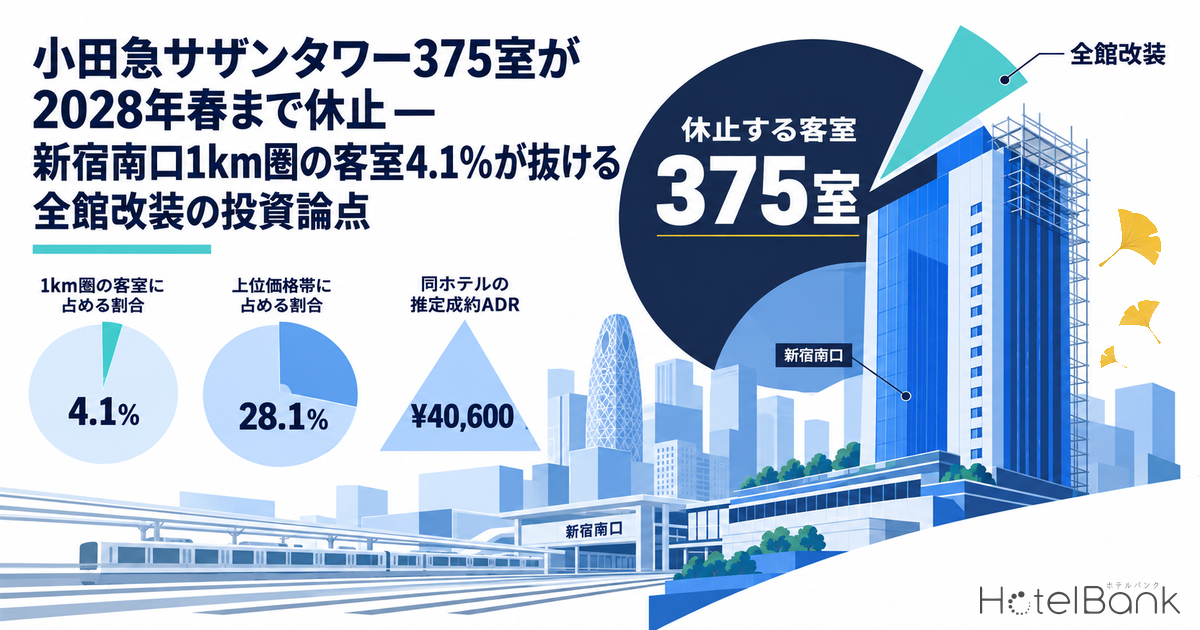
Following the renewal plan announced on December 16, 2025 by Odakyu Electric Railway and Hotel Odakyu Southern Tower Co., Ltd., Odakyu Hotel Century Southern Tower (小田急ホテルセンチュリーサザンタワー; 2-2-1 Yoyogi, Shibuya-ku, Tokyo; 375 rooms) suspended its lodging operations at the end of September 2026 and has begun a full renovation of its guestroom floors. It will reopen in spring 2028 with 377 rooms, two more than before. The 1km radius around the hotel holds a stock of 9,117 guestrooms, so 4.1% of that stock will be off the market for roughly 18 months. Starting from the published renovation specifications, this article uses the area’s estimated settled ADR and booking curves to examine the scale of room revenue forgone during the closure, how demand may shift to neighboring hotels, the conditions under which a full closure makes sense, and the price tier the hotel can target when it reopens.
To set the scope first: HotelBank has previously published a general model that converts rooms taken out of service during renovation into lost revenue, as well as an analysis of a rebranding project in the Kabukicho area of Shinjuku. This article does not repeat those general arguments. Instead, it applies real local data to a specific case in which a large existing city hotel shuts all of its guestrooms to reinvest. Note that the renovation budget has not been disclosed, and this article does not estimate it.
Metric Definitions Used in This Article
- ADR (average daily rate): An estimated settled rate (tax-excluded equivalent), calculated by applying a property-type correction factor to the lowest published plan rate on OTAs (per room, two guests, tax included). Checked against property-level results disclosed by listed hotel REITs (91 properties, most recent three months), the median error is about 7%. These are estimates and differ from each property’s actual achieved rates and accounting figures. Area-level ADR is the median of the properties covered (the level of a typical property in the area).
- OCC (occupancy): Rooms sold as a share of total rooms in the area, estimated from OTA sales inventory. Because it is based on how OTA-listed inventory sells through, it differs from a property’s actual overall occupancy. It is used only at the ward and prefecture level; occupancy for individual properties is not calculated. Occupancy used in the revenue estimates is an assumption; the 77.2% base is the guestroom occupancy of city hotels in Tokyo from the Japan Tourism Agency’s Overnight Travel Statistics Survey (final 2025 figures).
- Booking curve / LT (lead time): A booking curve tracks remaining rooms in the run-up to the check-in date. LT is the number of days before check-in (LT1 = the day before). This article uses LT45 to LT1 only.
- Guestroom stock within 1km: The number of properties and rooms open (and not yet closed) at the end of each year (2026: as of the survey date), counting lodging facilities with a known opening year within a 1km radius of Odakyu Hotel Century Southern Tower (35.6864°N, 139.7005°E, on the south side of Shinjuku Station). Listings with the same location and room count are merged into one property. Capsule hotels are counted by number of units. The hotel itself is included in the 2026 figure of 40 properties and 9,117 rooms; the temporary renovation closure is not reflected. Figures cover the properties tracked by MetroEngines Research and are not a full census.
- Properties covered by estimated settled ADR: For each month from October 2025 to September 2026, 29–34 properties in Shibuya-ku and 84–101 in Shinjuku-ku. In June 2026 the number of properties with published-price data expanded from 69 to 104 in Shibuya-ku and from 187 to 239 in Shinjuku-ku, but the number covered by estimated settled ADR did not change materially. From October 2026 onward, figures are based on published rates as of the survey date and are not used in this article’s year-on-year comparisons.
- Data sources: MetroEngines Research & Consulting; MLIT Real Estate Information Library; Japan Tourism Agency, Overnight Travel Statistics Survey; Ministry of Internal Affairs and Communications / Ministry of Economy, Trade and Industry, Economic Census
- — 375 rooms offline for about 18 months: Lodging stopped at the end of September 2026, with a grand reopening in spring 2028 with 377 rooms. Closures are staggered by function: restaurants and lounge from April to autumn 2027, banquet and meeting rooms from April 2027 to spring 2028.
- — 4.1% of rooms within 1km, 28.1% of the top price tier: Room stock within a 1km radius was essentially flat, from 8,969 rooms in 2017 to 9,117 in 2026 (+1.7%). Among the four properties with an estimated settled ADR of ¥40,000 or more (1,336 rooms), the 375 closed rooms account for 28.1%.
- — Forgone room revenue of ¥4.3bn–¥8.3bn: About ¥6.4bn in the base case, using an estimated settled ADR of ¥40,600 and 77.2% occupancy (an assumption set at the full-year 2025 result for Tokyo city hotels from Japan Tourism Agency data). Recovering that through rate increases alone would take 7.5 years at +20% and 5.0 years at +30%.
- — Occupancy just after the closure rose in line with Tokyo overall: Estimated occupancy one day before arrival rose from September to October 1–6 by +5.3pt in Shibuya-ku, +4.6pt in Shinjuku-ku and +5.1pt across Tokyo. At the ward level, no boost specific to the closure can be distinguished.
- — The top tier holds rate rather than selling out early: Across 34 properties within 1.5km, the share of stay dates that reached zero remaining rooms 7 or more days in advance averaged 4.1% for properties at ¥30,000 and above, versus 18.8% for those under ¥20,000.
The Announced Renovation Plan — Guestrooms Close First, F&B and Banquets Six Months Later
First, the published facts. According to the release, the hotel opened on April 11, 1998 “with a primary focus on domestic and international business travelers.” Leisure travel from both Japan and abroad, led by inbound visitors, has been growing, and the renovation is positioned as a way to adapt the rooms to this broader guest mix. Guestrooms occupy floors 22–35, while the front desk, lobby, restaurants and lounge are on the 20th floor. After the renovation the hotel will have 377 rooms, two more than today (134 double and 243 twin), including four newly added accessible rooms with minimal level changes.
| Item | Details |
|---|---|
| Announcement | December 16, 2025 (Hotel Odakyu Southern Tower Co., Ltd. and Odakyu Electric Railway Co., Ltd.) |
| Location / opening | 2-2-1 Yoyogi, Shibuya-ku, Tokyo; opened April 11, 1998 |
| Room count | 375 → 377 rooms (134 double, 243 twin); 4 new accessible rooms |
| Guestroom closure | October 2026 – spring 2028 (lodging until end of September 2026) |
| Restaurant and lounge closure | April 2027 – autumn 2027 (reopening ahead of guestrooms) |
| Banquet and meeting room closure | April 2027 – spring 2028 |
| Main guestroom works | Fully renewed bathrooms with separate toilet and washbasin; improved solar-shielding and insulation performance of windows; air purifiers built into ceilings; less free-standing furniture to create space for opening luggage |
| Public areas | Expanded luggage back-of-house at the front desk; larger lounge seating area; redesigned restaurant seating layout |
| Design / construction | Design: Taisei Corporation and Nomura Co., Ltd. design joint venture; Construction: Taisei Corporation |
| Outlet operating during works | “Yurakucho Kakida” on the 19th floor |
| Investment amount | Not disclosed |
What stands out in this schedule is the order of closures. Guestrooms close for about 18 months from October 2026, but the restaurants and lounge keep operating until March 2027 and return in the autumn of that year, ahead of the guestrooms. The sequencing preserves non-lodging F&B revenue for longer and reopens the hotel’s connection with the neighborhood first, while work on the guestroom floors enters its final stage. The guestroom works, meanwhile, extend to the layout of wet areas, windows, ceiling equipment and each room’s building systems, switching every room to the same specification in a single pass.
The shift in guest mix is also visible in reviews. Of 1,658 guest reviews of the hotel compiled by the HotelBank Editorial Team (past 24 months, as of early October 2026), 1,440 (86.9%) were written in languages other than Japanese. The most frequently mentioned elements were proximity to the station, with 523 mentions (31.5% mention rate), and the view from the room, with 504 (30.4%). The hotel’s reputation centers on location and views — strengths that cannot be moved. The renovation can be read as keeping those strengths while directing investment toward features that matter for groups and longer stays, such as separate toilets and washbasins and room for luggage.
Location — Commercial Zone with 600% FAR; Commercial Land Prices Within 1km Up 21.5% in Four Years
Next, the location that underpins the reinvestment. The hotel faces Southern Terrace by the south exit of Shinjuku Station. Although its address is in Shibuya-ku, its trade area spans the south side of Shinjuku Station, Nishi-Shinjuku and Shinjuku 3-chome. The map below shows the 39 lodging facilities within a 1km radius of the hotel (excluding the hotel itself), facilities out to 1.5km, and the locations of new projects that could be identified.
Zoning and building regulations
The site is in a commercial zone with a 600% floor area ratio and 80% building coverage ratio. Within 1km, commercial zones with FARs of 800–1,100% continue, forming a high-intensity district where lodging, retail and office uses overlap.
Official land prices (2026)
The median of 16 commercial land price points within 1km was ¥9.465 million/㎡, up 21.5% from ¥7.79 million/㎡ in 2022. The nearest point, in Yoyogi 2-chome, was ¥11.10 million/㎡ (+4.7% YoY).
Nearby working population
Within a 1km radius there are 10,294 establishments and 299,387 workers, of whom 95,385 (31.9%) are in office-type industries. Weekday business demand and weekend leisure demand overlap in the same trade area.
Rising land prices mean the hurdle for building a new lodging facility on the same site gets higher every year. Conversely, reinvesting in an existing building that has been open for 28 years to rebuild the product starts from an advantaged position, because no new land has to be acquired. This pattern — polishing existing stock in a location where new entry is difficult — also shows up clearly in the supply trend examined next.
Supply Within 1km — Nearly Flat Over Nine Years; Growth Came in the 1.0–1.5km Ring
The room stock within a 1km radius of the hotel grew from 29 properties and 8,969 rooms in 2017 to 40 properties and 9,117 rooms in 2026 — just 148 rooms (+1.7%) in nine years. Fifteen properties with 795 rooms opened from 2018 onward, but four properties with 647 rooms closed, so openings and closures largely offset each other. By contrast, widening the radius to 1.5km shows growth of +23.3% over the same period, from 77 properties and 16,194 rooms to 125 properties and 19,971 rooms, with nearly all of the increase in the outer ring toward Kabukicho and Higashi-Shinjuku (7,225 → 10,854 rooms in the 1.0–1.5km band).
| Property type | Properties | Rooms | Share |
|---|---|---|---|
| Business hotels | 18 | 4,296 | 47.1% |
| Deluxe hotels | 4 | 2,420 | 26.5% |
| City hotels (incl. the hotel’s 375 rooms) | 3 | 1,097 | 12.0% |
| Capsule hotels (units) | 5 | 1,006 | 11.0% |
| Other (hostels, apartment-style, etc.) | 8 | 259 | 2.8% |
| Leisure hotels | 2 | 39 | 0.4% |
| Total | 40 | 9,117 | 100.0% |
| Of which: the closed hotel | 1 | 375 | 4.1% |
| Effective stock during the closure | 39 | 8,742 | — |
The 375 rooms are 4.1% of the total, but 10.7% of the 3,517 rooms at the seven city and deluxe hotels closest to full service. Effective stock during the closure, 8,742 rooms, falls back to almost the same level as the 8,779 rooms at the end of 2014. In a trade area where supply does not accumulate, a single full-hotel closure pushes stock back to where it was 12 years ago — that is the supply-side weight of this case.
There is a precedent within the same 1km radius. Park Hyatt Tokyo closed entirely for renovation in May 2024 and reopened 19 months later on December 9, 2025. It reduced its room count from 177 to 171, increasing the number of larger rooms. That is a different direction from the current plan, which adds two rooms while tilting toward multi-guest use, but both show upper-tier hotels from Nishi-Shinjuku to the south exit choosing reinvestment by “closing and rebuilding.”
Source: Hyatt Hotels of Japan, “Press Materials, April 2026”
In terms of ownership, institutional investors also hold a substantial stake in this trade area. Checking against our ownership master for seven listed hotel REITs (Ichigo Hotel REIT (3463), Invincible Investment Corporation (8963), Nippon Hotel & Residential Investment Corporation (3472), Japan Hotel REIT (8985), Hoshino Resorts REIT (3287), Mori Trust REIT (8961) and Kasumigaseki Hotel REIT (401A); N=300 properties, as of October 5, 2026), two properties fall within 1km: Hotel Sunroute Plaza Shinjuku (ホテルサンルートプラザ新宿), owned by Mori Trust REIT (624 rooms, acquisition price ¥32,500 million, fixed rent), and Hyatt Regency Tokyo (ハイアット リージェンシー 東京), owned by JHR (712 rooms per REIT disclosure, 746 rooms per Hyatt Hotels of Japan press materials; acquisition price ¥126,000 million).
Will new supply appear nearby during the closure? Listing the projects within 1km that can be picked up from building plan filings, three are scheduled for completion during the closure (by spring 2028), all in Shinjuku 1-chome and 2-chome, about 0.9km from the hotel toward Shinjuku Gyoen. Large projects in the immediate vicinity of the south exit are expected to complete in 2029 or later.
| Location | Use | Floors | Gross floor area | Scheduled completion | Distance from hotel |
|---|---|---|---|---|---|
| Shinjuku 1-chome 6, Shinjuku-ku | Hotel | 14F | 5,045.63㎡ | Jun 2027 | ~0.9km |
| Shinjuku 1-chome 7, Shinjuku-ku | Hotel | 14F | 1,110.65㎡ | Jun 2027 | ~0.9km |
| Shinjuku 2-chome 19, Shinjuku-ku | Hotel | 12F | 4,217.04㎡ | Mar–May 2028 | ~0.9km |
| Yoyogi 1-chome 60, Shibuya-ku | Hotel | 14F | 5,350㎡ | Mar 2029 | ~0.1km |
| Shinjuku 3-chome 34, Shinjuku-ku (rebuild) | Retail, hotel (158 rooms) | 16F | 14,088㎡ | May 2029 | ~0.5km |
| Shinjuku 3-chome 18, Shinjuku-ku | Hotel, retail | 12F | 8,658.38㎡ | Sep 2029 | ~0.7km |
| Shinjuku 4-chome 4, Shinjuku-ku | Office, hotel, restaurants | 13F | 9,999.8㎡ | Mar 2030 | ~0.5km |
| Shinjuku 5-chome 11, Shinjuku-ku | Hotel, retail | 13F | 4,540㎡ | Not stated | ~0.9km |
| Shinjuku Station West-South Exit District, South Block (Yoyogi 2-chome, Shibuya-ku) | Retail, office, lodging, etc. | 37F | ~150,000㎡ | TBD (per developer) | ~0.3km |
In other words, when the hotel returns in spring 2028, the large projects in its immediate vicinity will most likely not yet be complete. Only one project, the rebuild (158 rooms), has a known room count, and judging by gross floor area as well, no supply large enough to fill the 375 closed rooms appears within 1km during this period.
Rate Position — 1.6x the Shibuya-ku Median, Among the Top Four Properties Within 1km
Measuring the revenue forgone starts with the rate level. On a 12-month average from October 2025 to September 2026, the hotel’s estimated settled ADR was ¥40,600 — about 1.6 times the Shibuya-ku median of ¥25,400, where it is located, and about 2.5 times the median of ¥16,100 in neighboring Shinjuku-ku. Compared with the previous 12 months, growth was +7.2% for the hotel, +13.0% for Shibuya-ku and +7.8% for Shinjuku-ku, showing the hotel lifting its rate level as the whole area moved up.
By month, the hotel’s estimated settled ADR peaked at ¥50,100 in October 2025 and bottomed at ¥29,600 in August 2026. The pattern — peaks in autumn and spring, a trough in summer — matches the ward medians, but the peaks are higher. In October–November and March–May, the rate runs from the mid-¥40,000s up to ¥50,000; in June–August it drops from the mid-¥30,000s to below ¥30,000. October, when the closure began, was the highest-rate month of the past 12 months, and the planned spring reopening coincides with the second peak. Returning in a peak season allows the new rooms to be launched from a high rate level, so setting the reopening for “spring 2028” makes sense.
It is also worth checking the hotel’s position within 1km. Dividing the 19 properties (5,235 rooms, excluding capsule hotels) with an estimated settled ADR available for at least 10 of the 12 months into price tiers gives the following.
| Estimated settled ADR tier | Properties | Rooms | Of which the hotel | Rooms during closure |
|---|---|---|---|---|
| ¥40,000 and above | 4 | 1,336 | 375 (28.1%) | 961 |
| ¥30,000 to under ¥40,000 | 2 | 830 | — | 830 |
| ¥15,000 to under ¥30,000 | 7 | 2,824 | — | 2,824 |
| Under ¥15,000 | 6 | 245 | — | 245 |
| Total | 19 | 5,235 | 375 (7.2%) | 4,860 |
Rooms that make up only 4.1% of the total account for 28.1% of the ¥40,000-and-above tier. Rooms in this tier will drop from 1,336 to 961 during the closure, narrowing the choices available to demand at this price point by nearly 30%. If demand does shift, it is natural to expect it to flow first to this upper tier and to the deluxe hotels one step above it.
Scale of Forgone Room Revenue — About ¥6.4bn in the Base Case, ¥4.3bn–¥8.3bn Depending on Assumptions
What follows is an estimate based on assumptions. Taking the guestroom closure as the 548 days from October 1, 2026 to March 31, 2028, the rooms offline total 375 rooms × 548 days = 205,500 room-nights. Multiplying by rate and occupancy gives a sense of the room revenue that will not be booked during the closure. Rate was varied across levels around the hotel’s estimated settled ADR of ¥40,600, and occupancy from 70% to 90% around a base of 77.2%, the 2025 result for Tokyo city hotels in Japan Tourism Agency statistics.
| ADR assumption | 70% occ. | 77.2% (base) | 85% | 90% |
|---|---|---|---|---|
| ¥30,000 | 4.32 | 4.76 | 5.24 | 5.55 |
| ¥35,000 | 5.03 | 5.55 | 6.11 | 6.47 |
| ¥40,600 (hotel’s estimated settled ADR) | 5.84 | 6.44 | 7.09 | 7.51 |
| ¥45,000 | 6.47 | 7.14 | 7.86 | 8.32 |
The base case of about ¥6.4bn works out to roughly ¥360 million per month, or about ¥11.75 million per day. Each month the reopening slips adds the same amount to forgone revenue, so schedule certainty feeds directly into investment returns. This links to an advantage of closing the whole hotel at once: less interference between work phases and a more predictable reopening date.
How, then, can this ¥6.4bn be recovered after reopening? If the renovated 377 rooms sell at the same occupancy, annual room revenue in the base case is about ¥4.31bn. Simplifying so that revenue rises only by the amount of the rate increase, the years needed to make up the forgone revenue depend solely on the rate uplift.
| ADR uplift after reopening | ADR level | Annual revenue gain | Years to recover |
|---|---|---|---|
| +10% | ¥44,700 | ~¥0.43bn | 14.9 years |
| +20% | ¥48,700 | ~¥0.86bn | 7.5 years |
| +30% | ¥52,800 | ~¥1.29bn | 5.0 years |
| +40% | ¥56,800 | ~¥1.73bn | 3.7 years |
The key point of this table is that the number of years depends only on the uplift rate, not on the level of rate or occupancy. At +20% the 18 months of closure are recovered on a revenue basis in 7.5 years; at +30%, in 5 years. Recovering the construction cost is a separate requirement, so in a reinvestment involving a full closure, “how much can the rate be raised after reopening” sits at the center of the economics. We revisit a realistic range for the uplift in the price positioning section below.
Local Supply and Demand Right After the Closure — Occupancy Gains in Shibuya-ku and Shinjuku-ku Matched Tokyo Overall
Did the way nearby hotels fill up change immediately after the 375 rooms went offline? Only six days after the closure can be observed so far, but we compared ward-level booking curves for September before the closure (26 days, excluding the four days of the Silver Week holidays) with October 1–6 after it. Coverage is limited to properties that list at least 30% of their total rooms on major booking sites: 20–21 properties / 3,880–3,938 rooms in Shibuya-ku, 64–70 properties / 8,049–8,484 rooms in Shinjuku-ku, and 805–884 properties / 103,476–107,025 rooms in Tokyo (all based on major booking site listings). The closed hotel was not in this sample either before or after the closure, so the closure did not change the set of properties covered.
| Area | LT45, Sep | LT45, Oct 1–6 | Change | Day before, Sep | Day before, Oct 1–6 | Change |
|---|---|---|---|---|---|---|
| Shibuya-ku | 52.4% | 63.8% | +11.4pt | 86.3% | 91.6% | +5.3pt |
| Shinjuku-ku | 54.7% | 65.9% | +11.2pt | 89.2% | 93.8% | +4.6pt |
| Tokyo | 53.3% | 60.0% | +6.7pt | 89.0% | 94.1% | +5.1pt |
Comparing occupancy one day before arrival, Shibuya-ku rose from 86.3% to 91.6% and Shinjuku-ku from 89.2% to 93.8%. However, Tokyo as a whole also rose by a similar margin, from 89.0% to 94.1%, so the change cannot be separated from the seasonal effect of entering the autumn peak. Looking at units as broad as wards, the honest reading is that no boost specific to the 375-room closure can be distinguished in these six days of data.
At 45 days out, on the other hand, both wards gained 4.5–4.7pt more than Tokyo overall. October stays filled up earlier in Shibuya and Shinjuku, with Tokyo as a whole catching up close to arrival. This also overlaps with the seasonal pattern of inbound visitors booking central Tokyo early for autumn, so it is not grounds for attributing the change to the closure, but it is worth watching whether the same pattern continues in coming months. For stays from October 7–19, occupancy at 14 days out had reached 78.1% in Shibuya-ku, 82.2% in Shinjuku-ku and 82.6% in Tokyo (versus 68.4%, 71.0% and 72.3% at the same point in September). These reflect bookings in progress and are not final.
The scale of the numbers also matters. Multiplying 375 rooms by 77.2% occupancy means about 290 rooms of demand per day looking for somewhere else to stay. Against this, the rooms still available the day before arrival in September averaged 897 among the Shinjuku-ku sample and 534 in Shibuya-ku — a volume the surrounding hotels could absorb on weekdays. On the holiday dates of September 19–20, however, remaining rooms in Shinjuku-ku the day before had shrunk to 166 and 135 (occupancy of 98.0% and 98.4%). On peak dates there is little capacity to absorb displaced guests, so the shift is more likely to show up in rates than in occupancy. For nearby operators, reviewing prices for upper room types on weekends and holidays early is likely to be a revenue opportunity.
Full Closure vs. Phased Works — Phasing Forgoes Less Revenue; Full Closure Buys Time and Quality
Besides closing the whole hotel at once, guestroom renovations can be done floor by floor or by rolling a small number of rooms out of service at a time. Applying the ratios from HotelBank’s general renovation model (floor-by-floor: 25% of rooms offline at a time with a 1.5x construction period; rolling: 10% with a 2.5x period) to this case’s 375 rooms and 548 days changes the forgone room-nights and revenue as follows.
| Approach | Rooms offline at once | Construction period | Room-nights forgone | Room revenue forgone | Guestroom works complete |
|---|---|---|---|---|---|
| Full closure (announced plan) | 375 rooms | 548 days (~18 months) | 205,500 | ~¥6.44bn | Spring 2028 |
| Floor by floor (assumed) | ~94 rooms | 822 days (~27 months) | ~77,100 | ~¥2.42bn | Around end-2028 |
| Rolling (assumed) | ~38 rooms | 1,370 days (~45 months) | ~51,400 | ~¥1.61bn | Around mid-2030 |
Comparing forgone revenue alone, phased works come out ¥4.0bn–¥4.8bn smaller. Phased works carry a premium for building while operating (generally said to be 10–20% of construction cost), but that premium only offsets this gap if construction cost is 5–10 times the difference. In other words, the choice of a full closure has to be explained by a yardstick other than minimizing forgone revenue. From the published plan and local data, at least three rationales can be identified.
The works extend to every room’s systems
Separating the toilet and washbasin involves relocating wet areas, and strengthening window solar shielding and insulation and installing ceiling air purifiers are common to all guestroom floors. Works whose systems connect vertically between floors are easier to schedule by closing everything at once than by keeping floors operating one at a time.
Not selling a ¥40,000 product next to a construction site
The hotel’s reputation rests on a room experience that includes views and quiet. Construction while operating brings noise and circulation constraints, so the higher the rate of the product, the greater the value of closing, preserving its reputation, and switching to the new specification.
Back before new nearby supply arrives
With phased works, completion of the guestroom renovation would slip to between late 2028 and 2030. Large projects within 1km start completing in March 2029 or later, so a full closure lets the hotel return to market earlier with all 377 rooms on the new specification.
In addition, launching all rooms on the new specification on the same day allows the price revision to happen in a single step. With phased works, renovated and unrenovated rooms coexist for a long time, forcing the hotel to keep differentiating prices under the same room type name. As shown above, the post-reopening rate uplift is central to the economics, so the ability to raise prices across the board at once can also be counted among the benefits of a full closure.
Price Positioning at Reopening — The Top Tier Competes on Holding Rate, Not Early Sell-Outs
Finally, which price tier can the hotel target when it reopens in spring 2028? The chart below plots, for the 34 properties (6,410 rooms) within 1.5km of the hotel whose inventory could be observed on all 28 stay dates from September 1–28, the estimated settled ADR (12-month average) against the share of stay dates on which remaining rooms reached zero 7 or more days in advance. Coverage is limited to properties whose allocation on major booking sites is at least 30% of total rooms.
Under ¥20,000: the sell-early tier
23 properties, 4,387 rooms. On average 18.8% of dates reached zero remaining rooms 7+ days out. Chosen on price, they run out of inventory early on around five days a month.
¥30,000 and above: the hold-rate tier
7 properties, 1,402 rooms. The same share averages just 4.1%. The prevailing practice is to hold inventory until close to arrival and sell without discounting.
The hotel’s current position and reopening target
Its estimated settled ADR of ¥40,600 sits mid-range in the upper tier. +20% would mean ¥48,700 and +30% ¥52,800, on par with the roughly ¥50,000 of an upper-tier property that opened within 1.5km in 2023.
What this distribution shows is that in Shinjuku’s upper tier, “filling up early” is not the axis of competition. The seven properties at ¥30,000 and above sold out 7+ days in advance on only about one of the 28 days on average. What the reopened hotel will be aiming for is not early sell-outs but an operation that sells its 377 rooms at high rates right up to arrival. Accessible rooms with minimal level changes and multi-guest layouts with separate toilet and washbasin work to increase guests per room and length of stay, supporting rate.
How realistic is the uplift? The highest estimated settled ADR within 1km is about ¥76,000, and within 1.5km two properties that opened in 2023 are at about ¥50,000 and about ¥122,000. Aiming for around ¥50,000 after the renovation falls within a range for which there are local precedents. In terms of the earlier table, +20–30% — recovering the forgone revenue in 5–7.5 years — is one reasonable benchmark based on the local price distribution.
Investment Takeaways — Four Variables That Drive the Economics
| Variable | Observation in this article | Effect on economics |
|---|---|---|
| Reopening timing | Spring 2028 (announced). About ¥360 million of room revenue forgone per month in the base case | The more the schedule holds, the better. A full closure makes the schedule more predictable |
| Rate after reopening | Estimated settled ADR ¥40,600 (past 12 months). ¥48,700–¥52,800 at +20–30% | Years to recover forgone revenue depend only on the uplift (7.5 years at +20%) |
| Nearby supply | +1.7% within 1km vs. 2017. Large nearby projects complete from March 2029 onward | Little new-build competition at reopening, making it easier to push through new-spec pricing |
| Demand mix | 86.9% of reviews in languages other than Japanese. Rate peaks in autumn and spring | Strong inbound demand supports upper-tier rates, but sensitivity to exchange rates and international conditions is high |
Summary
Putting it together, this full-closure renovation is a textbook case of reinvestment that “closes and rebuilds existing upper-tier stock in a location where supply does not grow.” Rooms within 1km increased by only 1.7% in nine years, and the 375 closed rooms account for 28.1% of the ¥40,000-and-above tier. Forgone room revenue of about ¥6.4bn in the base case is not small, but if the post-reopening rate can be raised by 20–30%, it would be recovered in 5–7.5 years — a rate level within the range of local precedents.
For nearby operators, the roughly 18 months until spring 2028 will be a window to capture higher rates on upper room types. In the six days immediately after the closure, no distinctive change could be seen in ward-level occupancy, but on dates when capacity is tight, such as holidays, displaced demand is more likely to show up in prices. From the hotel’s perspective, the questions that will determine the success of this investment are whether it can return with all 377 rooms on the new specification before the large nearby projects complete, and whether it can achieve a rate of around ¥50,000 at reopening. HotelBank will continue to track booking pace and rate movements around the hotel during the closure.
⚠ Note on bookings in progress and future dates: Figures for stays from October 7 onward are interim, based on inventory listed on major booking sites as of the survey date (October 6, 2026), and will change as check-in dates approach. Estimated settled ADR from October 2026 onward is based on published rates as of the survey date and is not used in this article’s comparisons. Revenue and recovery-period figures are simplified estimates based on assumptions.
Frequently Asked Questions
Q. How long will Odakyu Hotel Century Southern Tower be closed?
A. Lodging was suspended at the end of September 2026, and guestrooms are announced to reopen at the grand opening in spring 2028. The restaurants and lounge will close from April 2027 and are scheduled to reopen ahead of the guestrooms in the autumn of that year.
Q. How many rooms will the hotel have after the renovation?
A. 377 rooms, two more than the current 375 (134 double and 243 twin). Four new accessible rooms with minimal level changes will be added.
Q. How much is being invested in the renovation?
A. The amount has not been disclosed. This article does not estimate the investment; it only estimates, under stated assumptions, the scale of room revenue forgone during the closure.
References and Sources
■ Data sources
Estimated settled ADR is an estimate obtained by multiplying the lowest published plan rate on OTAs by a property-type correction factor (finalized months from October 2025 to September 2026; Shibuya-ku N=29–34 properties, Shinjuku-ku N=84–101 properties; the hotel is a single-property estimate). Occupancy is based on booking curves estimated from the sell-through of inventory listed on major booking sites (LT45–LT1; 26 stay dates in September and 6 stay dates from October 1–6). Room stock within 1km and 1.5km counts facilities with a known opening year as of the end of each year, merging duplicate listings with the same location and room count into one property. The renovation plan is from the operator’s news release (December 16, 2025); land prices and zoning from the MLIT Real Estate Information Library; working population from the Economic Census for Business Activity (2021).
■ Estimate assumptions
The closure period is the 548 days from October 1, 2026 to March 31, 2028 (assuming “spring 2028” means the fiscal year-end), and rooms offline total 375 rooms × 548 days = 205,500 room-nights. The base case is an estimated settled ADR of ¥40,600 × 77.2% occupancy (Tokyo city hotels, Japan Tourism Agency Overnight Travel Statistics Survey, final 2025 figures), with sensitivity shown on two axes: ADR of ¥30,000–¥45,000 × occupancy of 70–90%. The recovery period is 205,500 room-nights ÷ (377 rooms × 365 days × ADR uplift), assuming the same occupancy before and after the closure. The floor-by-floor and rolling cases mechanically apply the ratios from HotelBank’s general model (25% offline at once with a 1.5x period / 10% with a 2.5x period).
■ Limitations
Because the renovation budget is undisclosed, recovery of construction cost and yields are not estimated. F&B and banquet revenue and variable costs not incurred during the closure are excluded. Estimated settled ADR is an estimate with a median error of about 7% against listed hotel REITs’ disclosed results, and differs from the hotel’s actual achieved rates and accounting figures. Post-closure occupancy reflects six stay dates of observation, and at the ward level the effect of the closure cannot be separated from seasonal factors. Figures for stays from October 7 onward are interim as of the survey date (October 6, 2026). Room stock covers the properties we track and is not a full census.
■ Market data
| MetroEngines Research & Consulting — Estimated settled ADR (Shibuya-ku N=29–35 properties, Shinjuku-ku N=84–104 properties), room stock within 1km and 1.5km (N=45 and 137 facilities), occupancy (estimated from OTA-listed inventory) and booking curves, inventory trends (N=34 properties) |
| HotelBank Editorial Team research — Guest review analysis (N=1,658, past 24 months) |
■ Operator announcements
■ Government statistics and public data
| Japan Tourism Agency, Overnight Travel Statistics Survey 2025 (final) — Tokyo guestroom occupancy by accommodation type |
| MLIT Real Estate Information Library — Official land prices (2022–2026), zoning |
| MLIT, Building Construction Statistics — Building plans including lodging facilities |
| MIC / METI, Economic Census for Business Activity (2021) — Number of establishments and workers |
■ REIT and industry materials
| Mori Trust REIT — Portfolio list |
| Japan Hotel REIT — Portfolio list |
■ News