

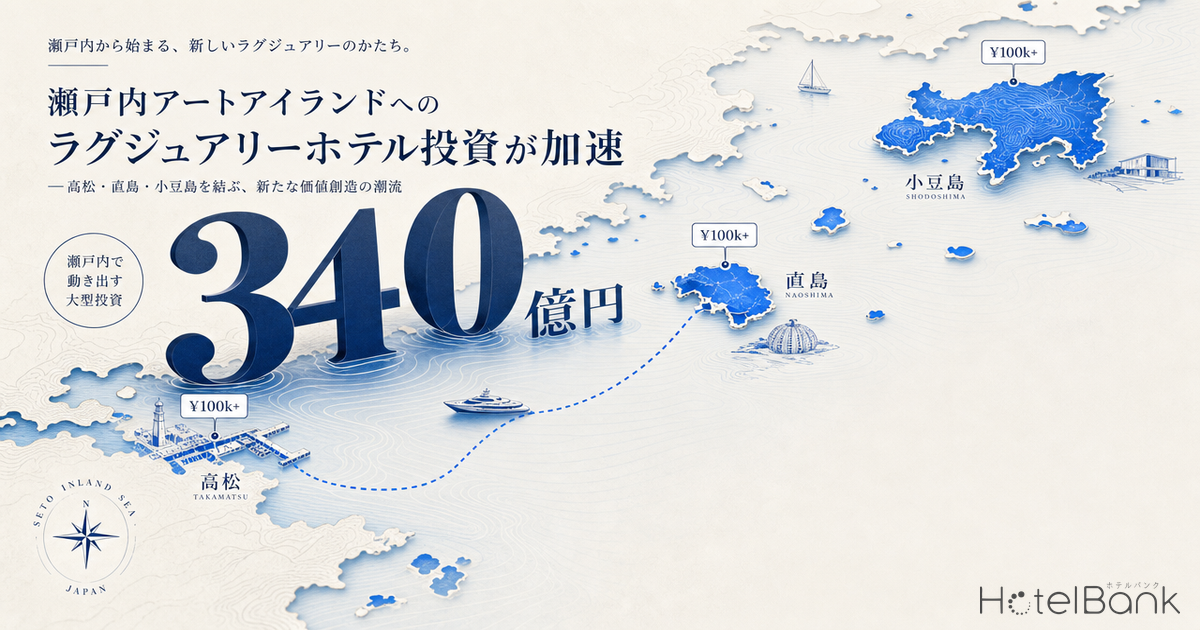
In summer 2027, two luxury hotels under the “Mandarin Oriental Setouchi” brand will open simultaneously in the Setouchi region: a 92-room tower in Takamatsu’s Sunport and a 22-room converted heritage resort in Naoshima’s Honmura district. Construction costs, initially estimated at ¥25 billion, have ballooned to ¥34 billion, prompting Kagawa Prefecture to approve up to ¥8 billion in interest-free Furusato Loans over three years. Meanwhile, in front of Takamatsu Station, JR Clement Inn Takamatsu Hyogomachi (191 rooms) opens in July 2026, adding to the upper-mid-class supply pipeline. The Setouchi Triennale 2025 generated record economic impact of ¥19.5 billion (up 89% YoY), providing strong tailwinds — but at ¥370 million per room in construction investment, what ADR and OCC levels make this project work? Using OTA published-price data from approximately 60 properties (April 2024 to December 2026), 2026 published land prices, and Setouchi Triennale visitor records, we quantify the investment thresholds for the Shikoku-Setouchi region.
Metric Definitions Used in This Article
- ADR (Average Daily Rate): Average of published rates on OTAs and similar platforms. Differs from actual transacted rates (cross-checks with REIT disclosure data suggest published ADR runs 25-30% higher than transacted ADR on average, as unsold high-rate plans persist on OTAs, inflating the published average). Per-room rate for double occupancy (tax included), averaged across all plan types (room-only through dining-included plans).
- OCC (Occupancy Rate): Ratio of sold rooms to total room inventory in the area (estimated based on OTA inventory).
- Cap Rate (Gross Yield): Annual GOP divided by total investment. In this article, calculated against the ¥34 billion total project cost.
- Data Source: MetroEngines Research & Consulting
- — ¥298 million per room (¥370 million for the Takamatsu property alone) is among the highest project-cost levels in Japan. Base-case Cap Rate of 3.21% falls below the typical 4-5% luxury benchmark.
- — The 22 Naoshima rooms are likely to capture the ¥150k-¥200k ADR range, potentially creating an asymmetric revenue structure where Naoshima drives the yield of the combined 114-room portfolio.
- — Kagawa’s 2026 published land prices rose for the first time in 35 years across all use types. Sunport is poised for appreciation as visitor-attraction infrastructure accumulates.
- — Setouchi Triennale 2025 generated ¥19.5 billion in economic impact (up 89% YoY), providing a strong demand tailwind. Closing the demand gap in non-festival years (2026, 2028) is the key challenge.
- — Mandarin’s entry fills the white space above ¥50k ADR. We identify four adjacent investment opportunities (¥40k-60k repositioning, mid-scale Naoshima villas, Sunport real estate).
Executive Summary — The Yield Math of ¥370 Million per Room
The crux of the project is an unprecedented cost level of ¥298 million per room (¥370 million at Takamatsu alone). Our base-case scenario (ADR ¥100,000, OCC 75%, GOP margin 35%) yields a Cap Rate (gross yield) of 3.21%, implying a 31-year simple payback. Even the upside scenario of ADR ¥150,000 with OCC 75% reaches only 4.82% — thin compared to the 4-5% target yield for domestic luxury hotel acquisitions. The ¥34 billion figure is estimated to include not just construction but also Registered Tangible Cultural Property renovation, luxury-spec FF&E, pre-opening expenses, interest, and contingency. On the demand side, the Setouchi Triennale 2025’s ¥19.5 billion economic impact (up 89% YoY) set a record, confirming upward room for nightly rates. This article uses published-price data and land-price trends to identify viable revenue scenarios and adjacent investment opportunities.
Market Trends — Takamatsu ADR Rose +22-35% YoY in 2025, but 2026 Is a Plateau
Aggregating published prices for approximately 49 hotels around Takamatsu and Naoshima from April 2024 to December 2026 reveals an interesting YoY pattern. April-November 2025 saw +12.8% to +35.3% YoY increases — a sharp rise driven by Setouchi Triennale 2025 demand. By contrast, 2026 has plateaued at ±0% to +5% YoY, with October 2026 actually down 2.5% YoY. This reflects the reaction effect to the 2025 Triennale premium year. That said, August 2026 (around the summer Triennale session) and November 2026 maintain strength. Specifically, August 2026 ADR was ¥38,700 (+5.2% YoY, +27.8% vs. 2024), and November 2026 was ¥39,200 (+16.7% YoY).
What stands out is the relationship with OCC indicators. Our estimated OCC data, available from March 2026 onward (limited by observation start date), shows the Takamatsu area at an estimated OCC of 36.1% in April 2026, 43.5% in May 2026, and roughly 35% in July-August 2026. This is an estimate based on OTA inventory availability and differs in definition from the actual occupancy rate concept in Japan Tourism Agency lodging statistics, but it captures the directional supply-demand picture. Mandarin Oriental’s target of “annual OCC of 70% or higher” is an ambitious goal given the current demand structure of the Takamatsu area.
Location Analysis — Kagawa’s 2026 Land Prices Rise for the First Time in 35 Years; Sunport in Demand-Growth Phase
Kagawa Prefecture’s 2026 published land prices rose +0.1% across all use types, marking the first increase in 35 years (source: Nikkei, March 2026). Takamatsu City’s commercial land averages ¥149,000/m². Sunport Takamatsu is layering multiple visitor-attraction assets: the JR Takamatsu Station building (opened March 2024), the prefectural arena (opened 2025), and the Tokushima Bunri University Kagawa Campus relocation (April 2026). Commercial land around the Marugame-machi area continues to rise 0-3%, sustaining the previous period’s upward trend.
The structural drivers of rising land prices include the accumulation of visitor-attraction infrastructure in the Sunport area, plus the surge in commercial real estate demand triggered by anticipation of Mandarin Oriental’s opening. As specialist real-estate media has noted, “Takamatsu sees a string of ¥100 million condos as Mandarin Oriental drives premiumization,” illustrating how luxury hotel entry catalyzes higher property values in surrounding areas.
Competitive Landscape — Takamatsu ADR Clusters in ¥10k-¥40k Range; ¥50k+ Remains White Space
Mapping 153 hotels within a 3 km radius of Takamatsu Station (of which 46 properties have continuous OTA price observations) by ADR and room count reveals a clear structure. Business and economy hotels cluster in the ¥10k-¥30k × 100-300 room band, while mid-upper grade properties — JR Hotel Clement Takamatsu (¥39,200, 300 rooms), Royal Park Hotel Takamatsu (¥36,900, 73 rooms), KEIRIN HOTEL10 (¥36,800, 149 rooms) — occupy the ¥30k-¥40k tier. True luxury above ¥50k is currently absent, and Mandarin’s entry will fill this white space.
| Category | Representative Property | Rooms | ADR (Apr-Sep ’26 avg.) | Reviews |
|---|---|---|---|---|
| New Luxury | Mandarin Takamatsu (opens 2027) | 92 | ¥100,000+ (projected) | — |
| New Luxury | Mandarin Naoshima (opens 2027) | 22 | ¥150,000+ (projected) | — |
| Existing High-End (Naoshima) | Naoshima Ryokan Roka | 11 | ¥185,400 | 318 |
| Existing High-End (Naoshima) | Benesse House | 65 | ¥98,000 | 4,434 |
| Upper Upscale | WASHU BLUE RESORT Furokago | 76 | ¥90,200 | 2,580 |
| Upper Midscale | Yunagi-no-yu Hotel Kajukai | 40 | ¥78,300 | 3,459 |
| Upper Midscale | FAV HOTEL Takamatsu | 41 | ¥57,000 | 1,750 |
| Full-Service | JR Hotel Clement Takamatsu | 300 | ¥39,200 | 22,525 |
| Full-Service | Royal Park Hotel Takamatsu | 73 | ¥36,900 | 5,236 |
| Full-Service | KEIRIN HOTEL10 | 149 | ¥36,800 | 1,501 |
| Full-Service (opens Jul 2026) | JR Clement Inn Takamatsu Hyogomachi | 191 | ¥23,200 | — |
| Midscale | Daiwa Roynet Takamatsu | 175 | ¥24,600 | 11,078 |
| Economy | JR Clement Inn Takamatsu | 222 | ¥25,800 | 4,222 |
On the Naoshima side, Benesse House (65 rooms, ADR ¥98k) and Naoshima Ryokan Roka (11 rooms, ADR ¥185k) represent the existing high-end. The fact that Roka has achieved ADR of ¥185k confirms that demand above ¥150k/night clearly exists in Naoshima’s Honmura district. There is a high probability Mandarin Naoshima can capture the ¥150k-¥200k range, creating a structure where Naoshima rescues the overall revenue of the 114-room portfolio.
Scenario Analysis — Cap Rate of 3.21% Is Tight, but ADR Upside Offers Rescue
Dividing the ¥34 billion project cost by 114 rooms yields ¥298 million per room. For the Takamatsu 92-room property alone, the figure rises to ¥370 million. This is at the highest level domestically — for reference, comparable to reported figures for top-tier Tokyo luxury new builds such as Bulgari Hotel Tokyo. We calculated Cap Rates (gross yields) across three scenarios below.
| Scenario | ADR | OCC | GOP Margin | Annual GOP | Cap Rate | Simple Payback |
|---|---|---|---|---|---|---|
| C. Bear | ¥85,000 | 65% | 30% | ¥690M | 2.03% | 49.3 yrs |
| A. Base Recommended | ¥100,000 | 75% | 35% | ¥1.09bn | 3.21% | 31.1 yrs |
| B. Bull | ¥120,000 | 80% | 38% | ¥1.52bn | 4.46% | 22.4 yrs |
| S. Boutique Upside | ¥150,000 | 75% | 38% | ¥1.78bn | 5.23% | 19.1 yrs |
The base case (ADR ¥100k, OCC 75% [same caveats], GOP 35%) yields a Cap Rate of 3.21%, below the 4-5% target yield for domestic luxury hotel investments. This reflects the inherently high ¥34 billion project cost. Assuming gross floor area of roughly 7,000 m² for Takamatsu plus 3,900 m² for Naoshima — totaling 10,900 m² (approximately 3,300 tsubo) — the cost per tsubo reaches ¥10 million. That is approximately three times the typical luxury new-build construction unit price (¥3.1-3.5 million per tsubo, derived from MLIT’s 2024 Building Construction Statistics at ¥2.405 million for S-frame construction plus a luxury-spec premium). The figure is therefore a total project cost incorporating land, FF&E, Registered Tangible Cultural Property renovation, pre-opening expenses, interest, and other items.
Working backwards from this Cap Rate structure, the “Boutique Upside” scenario of ADR ¥150k, OCC 75% (estimated, April 2026, area-aggregated estimate), and GOP margin 38% reaches 5.23%. Given that Naoshima Ryokan Roka commands ¥185k and Benesse House ¥98k in existing market prices, there is a high probability Mandarin Naoshima can capture this range. Conversely, Takamatsu’s 92 rooms will realistically fall in the ¥80k-¥120k range, making it likely that the 22 Naoshima rooms drive the asymmetric yield structure of the entire 114-room portfolio.
Demand Drivers — Setouchi Triennale 2025 Generated ¥19.5bn Economic Impact (+89% YoY)
On the demand side, Setouchi Triennale 2025’s track record stands out. Bank of Japan’s Takamatsu Branch published economic ripple effects of ¥19.5 billion in February 2026, up 89% from the previous edition (2022, ¥10.3 billion) and exceeding the 2019 figure of ¥18.0 billion to set a record. Visitors totaled 1.08 million (vs. 720,000 previously), driven by a higher share of overnight visitors and rising per-capita spending from inbound tourists. By session, economic impact was ¥4.7 billion (spring), ¥4.4 billion (summer), and ¥10.3 billion (autumn) — with the autumn session standing out.
For Mandarin’s target of “annual OCC of 70% or higher,” the key challenge is creating off-season demand in non-Triennale years (2026, 2028). Because the Triennale runs on a three-year cycle (2022, 2025, 2028), sustaining ADR of ¥100k-¥150k across 114 rooms requires three demand engines: (1) year-round capture of inbound luxury travelers, (2) steady demand from the Benesse Art Site, and (3) longer stays via Takamatsu-Naoshima cruise integration. If a third Setouchi property (conceptually planned for Shodoshima) materializes, the three-site circuit could appeal to Western luxury markets as a multi-destination resort experience.
Competitive Supply Risk — JR Clement Inn Takamatsu Hyogomachi (191 rooms) Opens July 2026
Ahead of Mandarin’s entry, JR Clement Inn Takamatsu Hyogomachi (191 rooms) opens in July 2026. This is the successor to the Takamatsu Tokyu REI Hotel that closed during COVID — closer to a replacement than net new supply — but at an estimated ADR of ¥23,200 (early-booking average for July-September 2026), it thickens the mid-tier segment. The owner entity (JR Shikoku, which is also a primary investor in the Mandarin project) belongs to the same group, suggesting a coordinated supply strategy across high, upper-upscale, and upper-midscale tiers.
| Property | Opening | Rooms | Projected ADR | Strategic Position |
|---|---|---|---|---|
| JR Clement Inn Takamatsu Hyogomachi | Jul 2026 | 191 | ¥20k-¥28k | Mid-tier replacement, JR Shikoku group |
| Mandarin Oriental Setouchi Takamatsu | Summer 2027 | 92 | ¥80k-¥120k | Shikoku’s first true luxury hotel |
| Mandarin Oriental Setouchi Naoshima | Summer 2027 | 22 | ¥150k-¥200k | Cultural-property boutique in Honmura |
| Mandarin Oriental Setouchi 3rd Site (conceptual) | TBD | TBD | — | Shodoshima or similar; 3-site circuit concept |
Investment Opportunities — Mid-Range Repositioning Around Mandarin and Room Shortage in Greater Naoshima
Mandarin’s entry creates not only direct participation opportunities for Shikoku-Setouchi investors but also spillover opportunities. Based on this analysis, we propose four candidate investment plays.
1. Takamatsu ¥40k-¥60k Repositioning
There is roughly a 20-room-scale boutique gap immediately below Mandarin in the ¥40k-¥60k band (between FAV Takamatsu at ¥57k and WASHU BLUE at ¥90k). Rebranding and renovation of properties like Royal Park Hotel Takamatsu (73 rooms, ¥36.9k) offers upside on per-room rates.
2. Mid-Scale Villas in Naoshima and Shodoshima
Naoshima’s existing inventory is dominated by 2-10 room guesthouses and minshuku; mid-luxury 20-40 room properties in the ¥40k-¥80k range are absent. There is a new-development opportunity tied to cruise-transfer demand.
3. Sunport Area Real Estate
With Kagawa’s land prices rising for the first time in 35 years across all use types, and Sunport-Marugamemachi commercial land continuing to rise 0-3%, real-estate acquisition in Mandarin’s direct-benefit zone — including non-lodging uses (tenants, residential) — offers medium-term value appreciation.
Risk Assessment — Further Cost Inflation and the Off-Year Demand Valley
| Risk Factor | Level | Description & Impact |
|---|---|---|
| Further construction cost inflation | High | Already +36% from ¥25bn (2023) to ¥34bn (2025). Construction-cost increases are expected to continue through 2026. Further delays would push the cost per room above ¥400 million. |
| OCC decline in off-years | Medium | Creating off-season demand in non-Triennale years (2026, 2028) determines success. Inbound capture and MICE functions are required to maintain annual OCC of 70% (estimated, April 2026, area-aggregated estimate). |
| ADR ceiling | Medium | Regional city ADR ceiling is estimated at ¥80k-¥120k in Takamatsu. ADR above ¥150k is realistic only on the Naoshima side. A blended average above ¥100k across 114 rooms is an ambitious target. |
| Competitive supply follow-on | Low | As JLL notes, new domestic supply is limited due to construction-cost inflation. No further luxury supply is expected to follow Mandarin in the near term. |
| Additional Kagawa Prefecture support | Low | The ¥8 billion interest-free loan is already secured. Any additional prefectural or municipal support in the event of further cost inflation depends on political consensus. |
Conclusion — A 3%-Range Yield, but Strategic Value in Setouchi Brand Building
Viewed purely as an investment product, ¥34 billion at nearly ¥300 million per room with Cap Rate of 3.21% (base) to 5.23% (bull) is thin by domestic luxury standards. But this project is not a standalone hotel investment — it is the “creation of a Setouchi luxury brand footprint”, and the strategic logic of the 11-company consortium (Shikoku Electric Power, JR Shikoku, four regional banks, DBJ, and others) cannot be measured by yield alone. Whether land-price appreciation in surrounding real estate, cross-traffic with the Triennale and Benesse Art Site, and development of the three-site circuit for Western luxury markets pay off in the long run will be the dividing line.
The near-term watch list is: (1) inflation trends and any further project-cost escalation after September 2026, (2) Takamatsu ADR dynamics after the July 2026 opening of JR Clement Inn Takamatsu Hyogomachi, and (3) the booking-price strategy during the pre-opening period in 2027. Continuous monitoring of these three signals will sharpen the precision of any follow-on investment thesis for the Setouchi region.
Note on Future-Date ADR: ADR figures in this article reflect average published prices on OTAs at the time of analysis and will fluctuate as check-in dates approach. Rates currently set high may decline through last-minute discounting. Cap Rate estimates also depend on assumptions for ¥34 billion in project cost and GOP margin; they are simplified estimates, and actual investment decisions require detailed feasibility studies.
References & Sources
– Data Sources
OTA published-price data (49 properties in Takamatsu and Naoshima area, April 2024 to December 2026, N ≈ 540,000 data points), positioning analysis (53 properties, average for April-September 2026), estimated OCC data (collected from March 2026 onward, based on OTA inventory), Kagawa Prefecture published land prices (2020-2026), Setouchi Triennale 2025 economic ripple effect study (Bank of Japan Takamatsu Branch, February 2026), e-Stat Building Construction Statistics (2024 S-frame unit price).
– Calculation Assumptions
Total project cost ¥34 billion (Mandarin Oriental Setouchi Takamatsu 92 rooms + Naoshima 22 rooms = 114 rooms; includes Registered Tangible Cultural Property renovation, FF&E, pre-opening expenses, interest, etc.). Cap Rate = annual GOP / ¥34 billion. GOP margin assumed at 35% in the base case, 38% in bull and upside cases, 30% in the bear case (range from domestic luxury hotel GOP performance). Simplified cap rate methodology; excludes tenant income, basement utilization, etc.
– Limitations & Caveats
(1) ADR is the average published OTA price and differs from transacted rates (REIT disclosure suggests +25-30% upward bias). (2) OCC is estimated from sales inventory and differs from the definition in Japan Tourism Agency lodging statistics. (3) Project cost breakdown (construction, land, FF&E, expenses) is not disclosed, so calculations use the total figure only. (4) Cap Rate is gross yield; DCF, after-tax IRR, and working-capital effects are excluded — real investment decisions require detailed feasibility analysis. (5) Naoshima ADR assumptions (¥150k-¥200k) are inferred from existing Roka at ¥185k and Benesse House at ¥98k, not actual results.
– Market Data
- MetroEngines Research & Consulting — OTA published-price data (49 properties in Takamatsu and Naoshima area, April 2024 to December 2026, N ≈ 540,000 data points), positioning analysis (53 properties)
– Government Statistics & Public Data
- Kagawa Prefecture “Published Land Prices” (Reiwa 8)
- Bank of Japan Takamatsu Branch, “Economic Ripple Effects of Setouchi Triennale 2025” (February 13, 2026)
- e-Stat “Building Construction Statistics” (Statistics ID: 0003114490)
– Hotel & Land-Price News Coverage
- Mandarin Oriental Setouchi Official Press Release (December 15, 2023)
- Takenaka Corporation Press Release, “Mandarin Oriental Setouchi Takamatsu and Naoshima” (December 15, 2023)
- Nikkei, “Kagawa Prefecture to lend ¥8 billion for Mandarin hotel construction as costs rise” (November 2025)
- KSB Setouchi Broadcasting, “Two new firms join Mandarin Oriental project”
- Shikoku Shimbun, “Mandarin Oriental Setouchi: ¥100,000+ per room”
- Nikkei, “Published Land Prices 2026: Kagawa rises for first time in 35 years” (March 2026)
- JR Shikoku, “JR Clement Inn Takamatsu Hyogomachi opening date announcement” (March 18, 2026)
- Kenbiya, “Takamatsu sees ¥100 million condos as Mandarin Oriental drives premiumization”
– Industry Reports