

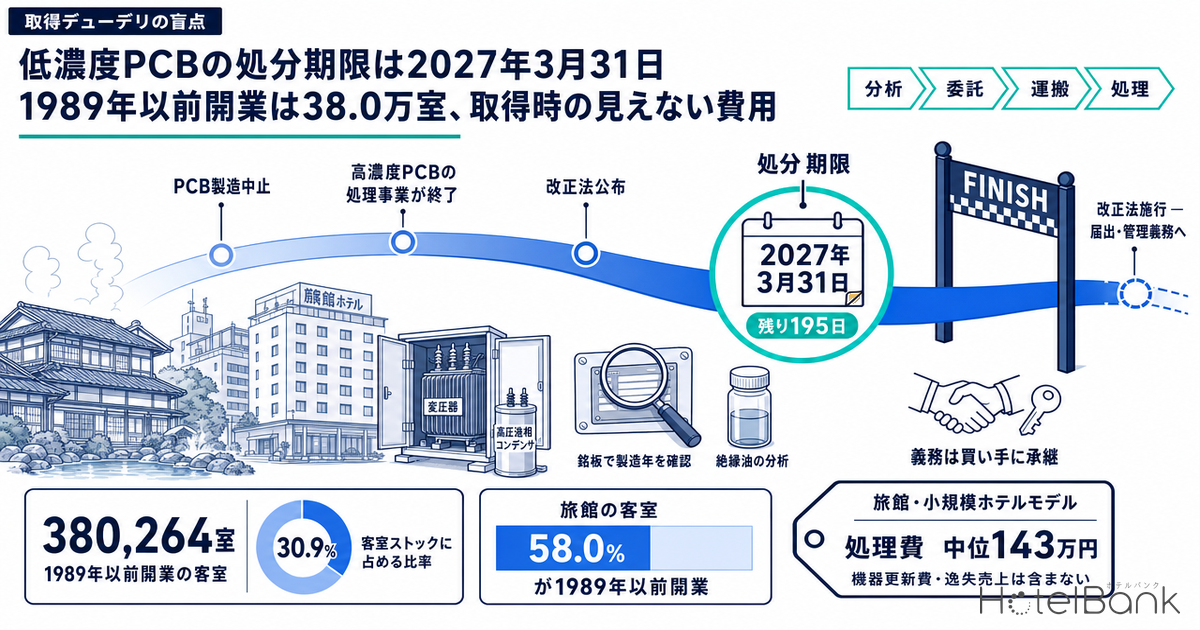
When buyers evaluate a hotel or ryokan acquisition or a major renovation, they work through the building issues thoroughly — but few look inside the cubicle (the high-voltage substation equipment). Yet the electrical room can hold assets that the law has put a disposal deadline on: transformers and high-voltage power-factor capacitors containing low-concentration PCBs (polychlorinated biphenyls). Under the current PCB Special Measures Act, the disposal deadline for low-concentration PCB waste is March 31, 2027 (Reiwa 9) — 195 days from the time of writing (September 17, 2026).
This article differs in both subject and governing law from our earlier coverage of asbestos. The asbestos piece (64.5% of Japan’s hotel rooms opened before 2006, with pre-renovation asbestos surveys adding up to 25.8% to renovation costs) deals with building materials under the Air Pollution Control Act and the Ordinance on Prevention of Asbestos Hazards, where the survey is triggered by demolition or renovation work. This article deals with electrical equipment under the PCB Special Measures Act, and what makes it distinct is that the clock runs simply because you own the equipment, whether or not any work is planned. And whereas transaction costs such as acquisition-related consumption tax pile up at the moment of the deal, PCB is a disposal obligation that stays with the asset — after a sale, it passes to the buyer.
Metric and Aggregation Definitions Used in This Article
- Population: Of the roughly 168,000 properties in Japan tracked by MetroEngines Research & Consulting, 27,249 operating properties whose operation is confirmed through listings on major booking sites. Of these, the 24,616 properties (90.3%) and 1,229,927 rooms with a registered opening year form the denominator for this article.
- Opening year: The opening year (by calendar year) registered in the property master. It does not necessarily match the building’s completion year or the manufacturing year of the substation equipment itself, and does not reflect extensions, rebuilds or equipment replacements.
- Cost estimates: Assumption-based calculations using unit-price ranges published by disposal contractors, not quotes for any specific property. They exclude equipment replacement (purchase and installation of new transformers/capacitors, outage work), revenue lost to closures or room sales suspensions, and management costs during storage.
- Data sources: MetroEngines Research & Consulting; published materials from the Ministry of the Environment, the Tokyo Metropolitan Government and disposal contractors (cited in the text and at the end).
- — March 31, 2027 is the disposal deadline for low-concentration PCB waste under current law. As of September 17, 2026, that is 195 days away, and 134 days remain until Tokyo’s deadline for analysis-cost subsidy applications (must arrive by January 29, 2027).
- — Properties opened in or before 1989 number 6,851 with 380,264 rooms, or 30.9% of room stock (N=24,616 properties). Of these, 3,196 properties with 30+ rooms hold 331,055 rooms — 87.1% of the rooms in scope.
- — 58.0% of ryokan rooms are in properties opened in or before 1989, versus 48.1% for city hotels, 43.1% for resort hotels and 18.8% for business hotels — the focus of due diligence shifts with the property type.
- — Disposal costs run ¥570,000–¥2.6 million (mid case ¥1.43 million) for a 30-room model and ¥1.09–¥4.6 million (mid case ¥2.58 million) for a 100-room model. Unit prices are driven less by the number of units than by how much each unit weighs.
- — The impact on gross yield is small at 0.005–0.136pt, but for a 30-room, ¥150 million deal the upper case equals 21.7% of annual NOI. More than the amount, it is the backward-planned schedule — analysis → contract → transport → disposal — that sets the negotiation calendar.
The March 31, 2027 Deadline — and the Regime That Follows It
PCB is an oily substance with excellent insulating properties that was once widely used in the insulating oil of transformers and capacitors. After its toxicity became clear, production was halted under administrative guidance from 1972 (Showa 47), and from June 1974 (Showa 49) the Chemical Substances Control Law banned its manufacture and import — but the equipment remained. The PCB Special Measures Act regulates by concentration: high-concentration PCB waste has been processed by the state-established Japan Environmental Storage & Safety Corporation (JESCO). According to Ministry of the Environment materials, JESCO’s disposal operations ended at the end of March 2026 (Reiwa 8). What remains is low-concentration PCB — lower in concentration but far more numerous.
The key point is that March 31, 2027 is not an “end” but also a “regime switch.” The amending act promulgated on June 19, 2026 (the Act Partially Amending the Act on Special Measures Concerning Promotion of Proper Treatment of PCB Wastes and the Japan Environmental Storage & Safety Corporation Act) takes effect on April 1, 2027. The Ministry of the Environment’s bill summary states explicitly that for low-concentration PCB waste, the rule will be revised “from an obligation to dispose within the statutory disposal period (end of March, Reiwa 9) to an obligation, as with high-concentration waste, to dispose within a set period after discovery.” In addition, a regime will be introduced to manage low-concentration PCB products in use (i.e., equipment still in service), which fall outside the current law, from the usage stage onward.
Under the outline of the amending act, businesses that own low-concentration PCB products in use must notify the prefectural governor of their name and address, ownership and usage status, location of use and the expected end of use, among other items. Notified equipment must be managed according to standards set by cabinet order and disposed of within a period set by cabinet order from the date its use ends, or from the date stored waste is found to be PCB waste. Notifiers also become subject to guidance and advice, succession, reporting requirements and on-site inspections. The inclusion of a succession provision alone matters to buyers: the administrative status tied to the equipment transfers with the transaction.
In other words, this is not an issue that disappears once the deadline passes. Until March 31, 2027 it is governed by the current disposal period; thereafter by notification, management and post-discovery disposal duties — the contents of the electrical room remain subject to regulation either way. From the buyer’s point of view, only its character changes: from a time-limited one-off cost to an ongoing ownership obligation with recurring notification costs.
| Date | Event | Source |
|---|---|---|
| From 1972 (Showa 47) | PCB production halted (administrative guidance; the statutory ban on manufacture and import applies from the Chemical Substances Control Law in June 1974) | Ministry of the Environment |
| End of March 2026 | JESCO’s disposal operations for high-concentration PCB waste end | Ministry of the Environment (bill summary) |
| June 19, 2026 | Amending act promulgated | e-Gov Laws and Regulations (promulgation date of the amending act) |
| January 29, 2027 | Deadline for Tokyo analysis-cost subsidy applications (must arrive by this date). *For SMEs and others in Tokyo | Tokyo Environmental Public Service Corporation |
| March 31, 2027 | Disposal deadline for low-concentration PCB waste under current law | Ministry of the Environment, “Low-Concentration PCB Waste Early Disposal Information Site” |
| April 1, 2027 | Amending act takes effect (notification and management of low-concentration PCB products in use; shift to disposal within a set period after discovery) | Ministry of the Environment (bill summary and outline) |
Source: Compiled by MetroEngines Research & Consulting from published materials of the Ministry of the Environment, e-Gov Laws and Regulations, and the Tokyo Environmental Public Service Corporation
The penalties also need to be read accurately in terms of where they sit in the statute. Article 33 of the current PCB Special Measures Act provides for “imprisonment of up to three years or a fine of up to ¥10 million,” or both, for violations such as breaching an improvement order or the transfer restrictions (following the Penal Code amendment, “imprisonment with labor” was replaced by “detention” from June 1, 2025). It is not a structure in which a fine is triggered automatically the moment the deadline passes by a day — the prefectural governor first issues an improvement order, and the penalty applies if it is not followed. For an acquirer, however, simply holding an asset that could become the subject of administrative guidance or orders is itself something that must be explained to lenders and investment committees.
Which Equipment Could Be in Scope — Transformers up to 1993, Capacitors up to 1990
The Ministry of the Environment’s “Low-Concentration PCB Waste Early Disposal Information Site” lists as electrical equipment potentially contaminated with low-concentration PCB transformers whose insulating oil can be replaced, manufactured in or before 1993 (Heisei 5), and sealed capacitors manufactured in or before 1990 (Heisei 2). Electric welders, X-ray generators, elevators, switchboards, and motors with built-in or attached capacitors are also listed. For hotels and ryokan, the main places to check are the transformers and high-voltage power-factor capacitors in the cubicle, plus the machine rooms and elevator machine rooms.
This is where property size comes in. As a rule, private high-voltage substation equipment is found at properties receiving high-voltage power with a contracted demand of 50kW or more. Small inns with a handful to a dozen or so rooms take low-voltage supply and often have no transformer of their own. Conversely, mid-size and larger properties with banquet halls, large baths, kitchens and air-conditioning on top of their guest rooms almost certainly have a cubicle. “Properties with 30 or more rooms that have been using the same building since around 1990” are therefore the highest-priority group to check.
One more caveat: the opening year is only a guide. If the cubicle has been replaced since opening, the equipment will be newer; conversely, a newer building may house old equipment if second-hand units were relocated into it. Tallies by opening year are therefore a screening tool to narrow the scope of investigation, not an indication of whether PCB is present. The only ways to tell are the nameplate (manufacturer, year of manufacture, model) and, for transformers, analysis of the insulating oil.
6,851 Properties and 380,000 Rooms Opened in or Before 1989 — 30.9% of Room Stock
So how many properties in Japan could fall within scope? Counting the 24,616 properties and 1,229,927 rooms in the MetroEngines Research & Consulting property master that are operating and have a registered opening year by opening period, 6,851 properties with 380,264 rooms opened in or before 1989. That is 30.9% of the total by room count (N=24,616 properties; opening-year coverage is 90.3% of the 27,249 operating properties).
Source: MetroEngines Research & Consulting (N=24,616 properties, 1,229,927 rooms; based on registered opening year)
Broken down, 3,344 properties with 154,246 rooms opened in or before 1974, and 3,507 properties with 226,018 rooms in 1975–89. Hotels and ryokan built in the 1980s still form a thick layer of today’s room stock. Limiting to properties with 30 or more rooms, which are likely to have high-voltage substation equipment, gives 3,196 properties with 331,055 rooms — 87.1% of pre-1989 rooms are concentrated in this group. Put the other way, by property count the majority (3,655 of 6,851) are small inns with 29 rooms or fewer, and a fair number of those take low-voltage supply and fall outside scope. For how the same room stock looks when cut at the building-side threshold of the new seismic standard of May 1981, see Japan’s Pre-1981 Hotel Stock: 236k Rooms, 19.1% of All Rooms.
| Room-count band (opened ≤1989) | Properties | Rooms | Typical substation setup |
|---|---|---|---|
| 1–29 rooms | 3,655 | 49,209 | Often low-voltage supply; may have no private transformer |
| 30–99 rooms | 2,180 | 122,566 | Typically one cubicle with 1–2 transformers |
| 100–299 rooms | 876 | 140,402 | Typically 2–4 transformers and several power-factor capacitors |
| 300+ rooms | 140 | 68,087 | Extra-high-voltage supply or multiple cubicles possible |
Source: MetroEngines Research & Consulting (N=6,851 properties, 380,264 rooms). Substation setups are general guides and do not describe any specific property
58.0% of Ryokan Rooms Opened in or Before 1989 — Exposure Varies Sharply by Property Type
By property type, the skew is stark. At ryokan, 58.0% of rooms (99,157 of 171,075) are in properties opened in or before 1989; for city hotels the figure is 48.1% (84,694 of 176,103) and for resort hotels 43.1% (40,093 of 93,127). Business hotels, by contrast, come in at just 18.8% (119,569 of 634,440), because the mass supply of limited-service hotels since the 2000s has pulled down the segment’s average age.
Source: MetroEngines Research & Consulting (N=24,616 properties; room-count basis)
This gap matters right at the entry point of a deal. In turnaround or conversion deals for aging ryokan and city hotels, the probability of holding in-scope equipment is structurally high. Conversely, when buying a limited-service hotel opened in the 2010s, electrical-room issues are minor. The data confirms the fairly obvious fact that even for the same “whole-building hotel acquisition,” the focus of due diligence differs by property type.
Regional Distribution — Tokyo, Hokkaido and Osaka by Volume; San’in, Hokuriku and Tohoku Onsen Areas by Share
Stacking pre-1989 rooms by prefecture, the largest volumes are Tokyo with 41,736 rooms, Hokkaido 31,254, Osaka 23,281, Nagano 17,023 and Shizuoka 16,555. Re-ranked by share of each prefecture’s room stock, however, the top places go to Tottori at 51.5%, Kagawa 48.4%, Akita 44.8%, Yamagata 43.8% and Niigata 41.8% — prefectures with onsen resorts and regional cities.
Source: MetroEngines Research & Consulting (N=24,616 properties). Circle size = rooms opened in or before 1989; color depth = share of the prefecture’s room stock
Source: MetroEngines Research & Consulting (limited to prefectures with 150+ properties with a registered opening year; N=24,616 properties)
The high shares in regional onsen areas have a practical implication. Disposal contractors are concentrated in urban areas in both number and location, so in remote areas collection and transport costs and scheduling constraints are relatively heavier. The less slack a deal has against the deadline, the more its location matters.
Cost Structure — Unit Prices Move by Weight Band, Not per Unit
Lining up the unit prices published by disposal contractors, the width of the ranges stands out. Electrical contractor Koden-sha gives a guide of roughly ¥400,000–¥800,000 per transformer containing low-concentration PCB, ¥100,000–¥300,000 per high-voltage power-factor capacitor, and ¥100,000–¥500,000 per unit of oil-filled equipment. Analysis runs about ¥20,000–¥50,000 per sample, and collection and transport around ¥50,000–¥300,000 per trip (published November 2025, updated July 2026).
Industrial-waste contractor Shida Shoten, meanwhile, publishes guides by weight band: transformers from about ¥450,000 at 10kg+, about ¥780,000 at 100kg+ and about ¥1.55 million at 305kg+; capacitors from about ¥500,000 at 10kg+ and about ¥2 million at 200kg+ (published November 2024). Analysis costs about ¥15,000–¥50,000, and collection and transport about ¥30,000–¥80,000 for small units and ¥100,000+ for large ones. Estimates will land closer if you assume that unit prices are set by “how many kilograms each unit weighs” rather than “how many units there are”.
| Cost item | Indicative range | Source |
|---|---|---|
| Transformer disposal | ¥400,000–¥800,000 per unit / by weight band from about ¥450,000 (10kg+) and about ¥1.55 million (305kg+) | Koden-sha / Shida Shoten |
| High-voltage power-factor capacitor disposal | ¥100,000–¥300,000 per unit / by weight band from about ¥500,000 (10kg+) and about ¥2 million (200kg+) | Koden-sha / Shida Shoten |
| Insulating-oil sampling and analysis | ¥15,000–¥50,000 per sample | Koden-sha / Shida Shoten |
| Collection and transport | ¥50,000–¥300,000 per trip (small units ¥30,000–¥80,000; large units ¥100,000+) | Koden-sha / Shida Shoten |
Source: Compiled by MetroEngines Research & Consulting from figures published by Koden-sha Co., Ltd. (published November 2025, updated July 2026) and Shida Shoten Co., Ltd. (published November 2024)
Costs also vary along a second axis. Sealed capacitors cannot have their insulating oil sampled, so they are generally judged from nameplate and manufacturer information, whereas transformers with replaceable oil reveal their concentration only once analyzed. The equipment whose cost “cannot be fixed until it is analyzed” is also the most numerous in the cubicle — and that sequencing is the main source of pressure on acquisition timelines.
¥1.09–¥4.6 Million for a 100-Room Model, ¥570,000–¥2.6 Million for 30 Rooms
Multiplying the unit-price ranges by typical equipment configurations by size gives an estimate of the total. The assumptions: transformer disposal ¥400,000 / ¥800,000 (lower / upper), high-voltage power-factor capacitor ¥100,000 / ¥300,000, analysis ¥20,000 / ¥50,000 per transformer, and collection and transport ¥50,000 / ¥300,000 per trip. All figures cover disposal-side costs only and exclude equipment replacement, outage work and revenue lost to closures.
The lower and upper cases are the two ends of the range and are too wide to use as planning figures. We therefore also show a mid case that sets unit prices at the range midpoints (transformer ¥600,000, capacitor ¥200,000, analysis ¥35,000, collection and transport ¥175,000) and equipment counts at the middle of the configuration ranges. Fractional unit counts are treated as expected values of the equipment configuration in this assumption-based calculation.
| Model | Assumed equipment | Lower case | Mid case | Upper case | Per room |
|---|---|---|---|---|---|
| 30 rooms (ryokan / small hotel) | 1–2 transformers, 1–2 capacitors | ¥0.57M | ¥1.43M | ¥2.60M | ¥19k–¥87k (mid ¥48k) |
| 100 rooms (city / business) | 2–4 transformers, 2–3 capacitors | ¥1.09M | ¥2.58M | ¥4.60M | ¥11k–¥46k (mid ¥26k) |
| 200 rooms (large city hotel) | 3–6 transformers, 3–5 capacitors | ¥1.61M | ¥3.83M | ¥6.90M | ¥8k–¥35k (mid ¥19k) |
Source: MetroEngines Research & Consulting estimates using contractors’ published unit prices (Koden-sha). Not a quote for any specific property
Source: MetroEngines Research & Consulting estimates using contractors’ published unit prices (excluding equipment replacement and lost revenue)
What the shape shows is the simple fact that the smaller the property, the heavier the burden per room. The upper case for the 30-room model is ¥87,000 per room; for the 200-room model, ¥35,000. Cubicles do not scale in proportion to room count, so economies of scale apply directly. This issue weighs heavily on turnaround deals for aging regional ryokan not only because the share is high, but also because the denominator is small.
Impact on Price and Yield of 0.01–0.2pt — Small, but Enough to Use in Price Negotiation
So how does this affect the acquisition price? We model it as the change in gross yield when the one-off cost is added to the acquisition cost. The inputs are assumptions and do not represent actual market transactions.
| Assumptions | Disposal cost as % of price | Yield impact | As % of annual NOI |
|---|---|---|---|
| 100 rooms, ¥10M per room (price ¥1.0bn), NOI yield 5.0% / lower ¥1.09M | 0.11% | 5.000%→4.995% (−0.005pt) | 2.2% |
| Same / mid ¥2.58M | 0.26% | 5.000%→4.987% (−0.013pt) | 5.2% |
| Same / upper ¥4.60M | 0.46% | 5.000%→4.977% (−0.023pt) | 9.2% |
| 30 rooms, ¥5M per room (price ¥150M), NOI yield 8.0% / lower ¥0.57M | 0.38% | 8.000%→7.970% (−0.030pt) | 4.8% |
| Same / mid ¥1.43M | 0.95% | 8.000%→7.924% (−0.076pt) | 11.9% |
| Same / upper ¥2.60M | 1.73% | 8.000%→7.864% (−0.136pt) | 21.7% |
Source: MetroEngines Research & Consulting estimates. Price and NOI yield are assumptions
The nature of the numbers is clear. The yield impact is 0.005–0.136pt — not enough to overturn an investment decision. For a 100-room, ¥1.0 billion deal it is within the margin of error. For a 30-room, ¥150 million deal, however, the upper case reaches 21.7% of annual NOI and 1.7% of the price — large enough to debate, when finalizing terms, whether to “cover it in the reps and warranties, handle it through a price adjustment, or have the seller dispose of it within the deadline at its own cost.” Sensitivity to the assumed price level: in the 30-room model the upper case is 2.89% of price at ¥3 million per room and 0.87% at ¥10 million per room. The lower the acquisition price per room, the more the ratio jumps.
The table below expands how the ratio moves with combinations of price level and disposal cost across two axes for the 30-room model. Rows are the disposal cost level, columns are the acquisition price per room (price = 30 rooms × price per room), and each cell is disposal cost as a share of the acquisition price.
| Disposal cost \ Price per room | ¥2M Price ¥60M | ¥3M Price ¥90M | ¥5M Price ¥150M | ¥7M Price ¥210M | ¥10M Price ¥300M |
|---|---|---|---|---|---|
| ¥0.57M Lower | 0.95% | 0.63% | 0.38% | 0.27% | 0.19% |
| ¥1.00M | 1.67% | 1.11% | 0.67% | 0.48% | 0.33% |
| ¥1.43M Mid | 2.38% | 1.59% | 0.95% | 0.68% | 0.48% |
| ¥2.00M | 3.33% | 2.22% | 1.33% | 0.95% | 0.67% |
| ¥2.60M Upper | 4.33% | 2.89% | 1.73% | 1.24% | 0.87% |
Source: MetroEngines Research & Consulting estimates using contractors’ published unit prices (Koden-sha, Shida Shoten). Prices per room and total prices are assumptions and do not represent actual market transactions
Reading it is simple. At an acquisition price of ¥7 million per room or more, disposal costs stay within 1.3% of the price even at the upper case. In turnaround deals at ¥2–3 million per room, by contrast, the ratio reaches 1.6–2.4% of price once disposal costs exceed the mid case, and 2.9–4.3% at the upper case. The lower the acquisition price per room, the more the sizing of holdbacks and negotiation over seller-borne costs come into play.
And more than money, time matters. The days needed for analysis, booking a disposal contractor, scheduling collection and transport, and coordinating switchover work that requires a power outage — this sequence spans weeks to months. As of September 17, 2026, there are 195 days until the current disposal deadline and just 134 days until the deadline for Tokyo’s analysis-cost subsidy applications (must arrive by January 29, 2027). Deals where analysis and disposal contracts are not underway within this calendar year will struggle to complete within the current deadline — and this backward planning, more than the deadline itself, sets the negotiation calendar.
Subsidies — Local Top-Ups Layered on National Support
Public subsidies can lighten part of the cost. The national government launched a subsidy for disposal costs of low-concentration PCB waste on April 1, 2025 (Reiwa 7), and in response the Tokyo Metropolitan Government revised its support program on June 2, 2025. After the revision, Tokyo’s subsidy covers 50% of analysis and disposal costs after deducting the national subsidy (subject to caps), with the analysis cost capped at ¥12,500 per unit. Eligible applicants are individuals, SMEs, condominium management associations and others that own in-scope equipment in Tokyo; large companies are excluded. Grant applications must arrive by January 29, 2027, and completion reports by April 30, 2027.
Because most properties acquired by funds and operators fall outside the program under the large-company criterion, the subsidy’s effect shows up instead in deals where the seller is a small or mid-sized business. The logic is that total cost is lower if the seller uses the program to complete disposal before the transfer. The subsidy schedule can therefore serve as grounds for requesting “seller’s cost, completed before closing” in sale negotiations. Note that subsidy programs differ in content and deadlines by municipality, so the program in the property’s location must be checked individually.
What to Check in Due Diligence — Nameplates, Notifications and Contracts, Not Building Drawings
For listed REIT portfolios, it is natural to assume that surveys and disposal for statutory obligations of this kind are well advanced. Of the 302 properties held by seven investment corporations (300 in Japan, per our ownership master as of September 14, 2026), 225 could be matched to our property master, and among these 64 (28.4%) opened in or before 1989 — roughly the same share of older properties as in the national room stock (30.9%). That listed portfolios maintain this ratio also means that building age in itself does not undermine investment eligibility. The problem is not the age, but being unable to confirm whether a survey has been done. Because an owner’s survey status cannot be determined from outside, the following can only be confirmed through documents.
| Document | What to look for |
|---|---|
| Nameplate list and single-line diagram of substation equipment | Manufacturer, year of manufacture, model, number of units and weight of transformers and high-voltage power-factor capacitors |
| Insulating-oil analysis report | Analysis date, equipment covered, concentration, and whether any equipment remains unanalyzed |
| Copies of PCB waste storage notifications | Whether notifications were filed and their content, storage location and quantity (after the amendment takes effect, equipment in use must also be notified) |
| Disposal contract and certificate of completion | Contractor, scheduled disposal date, and whether the schedule completes within the deadline |
| Chief electrical engineer’s inspection records | History of equipment replacement and whether second-hand equipment was relocated in |
| Equipment registers for elevators, kitchens and machine rooms | Year of manufacture of equipment with built-in or attached capacitors (switchboards, motors, X-ray equipment, etc.) |
Source: Compiled by MetroEngines Research & Consulting from the Ministry of the Environment’s “Low-Concentration PCB Waste Early Disposal Information Site” and the outline of the amending act
It is also worth deciding in advance how to handle cases where documents are incomplete. For deals where unanalyzed equipment remains, a realistic structure is to set the cost range (in this article’s estimates, ¥0.57–¥2.6 million for 30 rooms and ¥1.09–¥4.6 million for 100 rooms) as a holdback and settle it once analysis results are final. Precisely because the amounts are small, they can be handled through a true-up clause. Conversely, if the buyer takes on the disposal obligation in full with a closing just before the deadline, it must factor in that the notification and management duties after the amendment takes effect will be succeeded to.
Summary — The Amounts Are Small, the Time Is Short, and the Obligation Remains
There are three points. First, the stock that could be in scope is not small. Properties opened in or before 1989 number 6,851 with 380,264 rooms, 30.9% of room stock — and 58.0% of rooms for ryokan alone (N=24,616 properties). Second, the amounts themselves are not large enough to sway an investment decision: ¥0.57–¥2.6 million for 30 rooms and ¥1.09–¥4.6 million for 100 rooms, with a yield impact of 0.005–0.136pt. In small deals with a low acquisition price per room, however, the cost can reach one-fifth of annual NOI.
Third, time cannot be bought. With 195 days left until the current disposal deadline, and given the analysis → contract → transport → disposal sequence, deals in the second half of fiscal 2026 need to decide early whether disposal will be completed before closing or settled via a holdback. And after the amending act takes effect on April 1, 2027, notification and management will be required for equipment in use as well, shifting to a disposal obligation that starts from the date use ends or contamination is found. It is not an issue that ends once the deadline passes; it becomes an item that stays with the asset for as long as you own it — and for buyers, that is the more fundamental change.
About this article: Tallies by opening year are a screening tool for prioritizing checks and do not indicate that equipment containing low-concentration PCB exists at any specific property or area. Whether PCB is present can be determined only from nameplate information and analysis of the insulating oil. Cost estimates are assumption-based calculations using unit-price ranges published by disposal contractors and are not quotes for individual deals, legal interpretations or investment advice. For program details and current practice, please consult the Ministry of the Environment and the competent prefectural or designated-city authorities.
Related Reading
References and Sources
■ Data Sources
Property stock tallies use as the population the 27,249 operating properties, among the roughly 168,000 properties in Japan tracked by MetroEngines Research & Consulting, whose operation is confirmed through listings on major booking sites; the denominator is the 24,616 properties (90.3%) and 1,229,927 rooms with a registered opening year. Properties opened in or before 1989: 6,851 properties, 380,264 rooms. For listed investment corporations, the 302 properties held by seven investment corporations (300 in Japan, as of September 14, 2026) were matched to the property master, covering the 225 with a known opening year. Regulations and deadlines are from the Ministry of the Environment and e-Gov Laws and Regulations; subsidy programs from the Tokyo Metropolitan Government and the Tokyo Environmental Public Service Corporation; disposal unit prices from contractors’ published figures.
■ Estimation Assumptions
Disposal costs are assumption-based calculations using published unit-price ranges. Lower / upper cases: transformers ¥400,000 / ¥800,000; high-voltage power-factor capacitors ¥100,000 / ¥300,000; insulating-oil analysis ¥20,000 / ¥50,000 per transformer; collection and transport ¥50,000 / ¥300,000 per trip. The mid case sets unit prices at range midpoints (transformer ¥600,000, capacitor ¥200,000, analysis ¥35,000, collection and transport ¥175,000) and equipment counts at the middle of the configuration ranges. Yield impact is calculated as the change in gross yield when the one-off cost is added to the acquisition cost; price and NOI yield (100 rooms = ¥10 million per room, 5.0%; 30 rooms = ¥5 million per room, 8.0%) are assumptions. The two-way sensitivity uses the 30-room model with price = 30 rooms × acquisition price per room. Days remaining are counted from September 17, 2026.
■ Limitations
Opening year is the value registered in the property master (by calendar year) and does not necessarily match the building’s completion year or the substation equipment’s year of manufacture. Because extensions, rebuilds and equipment replacements are not reflected, tallies by opening year are a screening tool for prioritizing checks and do not indicate the presence of equipment containing low-concentration PCB. Presence can be determined only from nameplate information and insulating-oil analysis. Cost estimates exclude equipment replacement (purchase, installation, outage work), revenue lost to closures or room sales suspensions, and management costs during storage. Subsidy programs differ in content, deadlines and eligibility by municipality. This article is not a quote for any individual deal, a legal interpretation or investment advice.
■ Market Data
- MetroEngines Research & Consulting — property master (opening year, room count, property type, location; 27,249 operating properties / 24,616 properties and 1,229,927 rooms with registered opening year), REIT ownership master (302 properties, as of September 14, 2026)
■ Laws and Government Materials
- Ministry of the Environment, “Low-Concentration PCB Waste Early Disposal Information Site” (disposal deadline; manufacturing years of in-scope equipment) [Japanese]
- Ministry of the Environment, “Cabinet Decision on the Bill Partially Amending the Act on Special Measures Concerning Promotion of Proper Treatment of PCB Wastes and the Japan Environmental Storage & Safety Corporation Act” (April 10, 2026; summary and outline) [Japanese]
- e-Gov Laws and Regulations, “Act on Special Measures Concerning Promotion of Proper Treatment of PCB Wastes” (Article 33 penalties; amending act promulgated June 19, 2026, effective April 1, 2027) [Japanese]
■ Subsidy Programs
- Tokyo Environmental Public Service Corporation, “PCB (Polychlorinated Biphenyl) Waste Subsidy Program [Analysis Costs]” [Japanese]
- Tokyo Metropolitan Government, “Revision of the Tokyo Trace PCB Waste Disposal Support Program” (May 29, 2025) [Japanese]
- Tokyo Bureau of Environment, “On the Disposal of Low-Concentration (Trace) PCB” [Japanese]
■ Published Disposal Cost Figures