

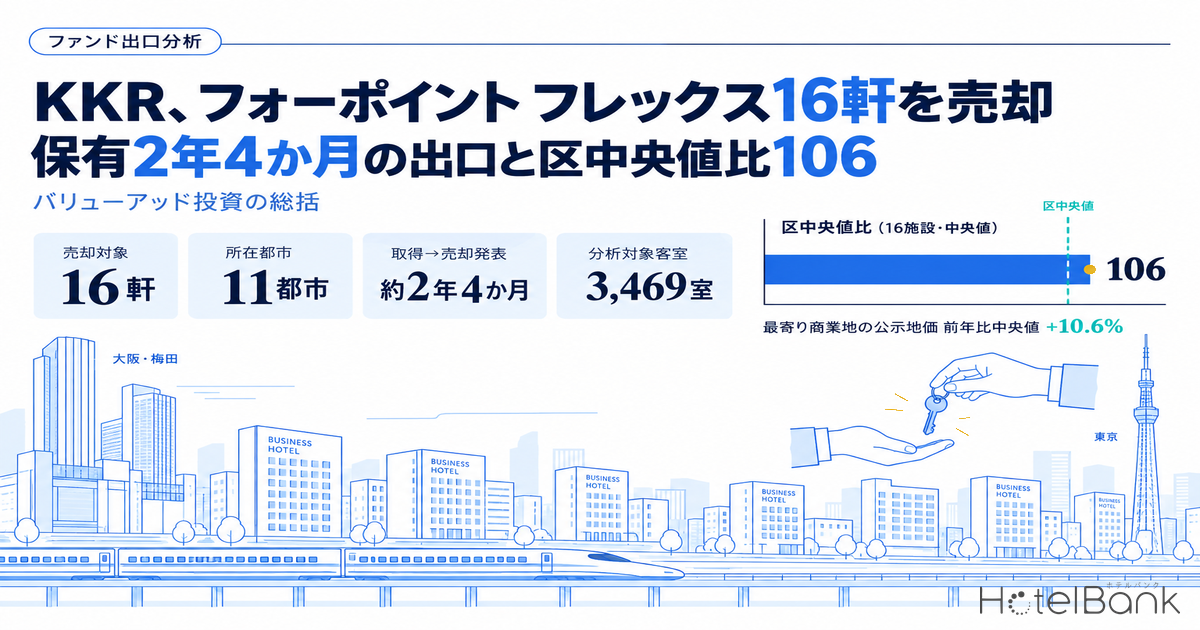
On September 25, 2026, KKR announced that funds it manages will sell 16 hotels in Japan operating under the “Four Points Flex by Sheraton” brand to a leading global institutional investor. The hotels are located in 11 cities including Greater Tokyo, Osaka, Kyoto and Fukuoka; KKR acquired them from Unizo Holdings in 2024, and the sale is the exit following a full renovation and rebrand. Neither the financial terms nor the buyer’s name has been disclosed. This article uses public disclosures to trace the roughly two years and four months from acquisition to the sale announcement, then sets the estimated settled ADR of the brand’s 16 hotels in Japan against the median business-hotel ADR of each hotel’s city or ward, to read what a value-add investment looks like at the point of exit.
The background to the acquisition and rebrand — 14 former Unizo hotels bought in 2024 and converted from the Unizo brand to Four Points — and how room rates at those properties moved after conversion are not repeated here. The subject of this article is the September 2026 sale: the fund’s exit and a review of the holding period.
Metric Definitions Used in This Article
- ADR (average daily rate): an estimated settled rate (tax-excluded equivalent), calculated by applying a property-type correction factor to the lowest-priced plan each property publishes on OTAs (two guests per room, per-room rate, tax included). Checked against property-level results disclosed by listed hotel REITs (91 properties, most recent 3 months), the median error is about 7%. These are estimates and differ from each property’s actual settled prices and accounting figures. Area-level ADR is the median of the properties covered (the level of a typical property in the area).
- Ward-median index: a hotel’s estimated settled ADR divided by the median estimated settled ADR of business hotels in the same city or ward for the same month, multiplied by 100. Averaged over 12 months matched month by month (Sep 2025–Aug 2026, settled months only). Above 100 means a higher rate level than a typical business hotel in that city or ward.
- Hotels covered: the 16 Four Points Flex by Sheraton hotels in Japan listed in a release by the operator, K+ Hospitality Management (November 19, 2025), matched against our database. This does not establish that they are the same 16 hotels KKR is selling. Room counts are the values in our database.
- Data sources: MetroEngines Research (estimated settled ADR); Ministry of Land, Infrastructure, Transport and Tourism (MLIT) Real Estate Information Library (official land prices)
- — 16 hotels in 11 cities: KKR is selling the portfolio en bloc to a leading global institutional investor (announced September 25, 2026). The price, yield, buyer’s name and the list of hotels have not been disclosed.
- — From the May 7, 2024 announcement that the acquisition had closed to the sale announcement: about 2 years and 4 months. In that period 13 hotels reopened under the new brand and 3 hotels opened in Tokyo.
- — The 16 hotels in Japan listed by the operator total 3,469 rooms (room counts in our database). Osaka City’s 4 hotels and 922 rooms account for about 27%. They are not necessarily the same 16 hotels as those in the sale.
- — The ward-median index of estimated settled ADR has a median of 106, with 9 of the 16 hotels above 100 (12-month average, Sep 2025–Aug 2026). Weighted by rooms, it is 99.6.
- — Official land prices at the nearest commercial sites rose by a median +10.6% YoY (15 sites, as of January 1, 2026). Asset management by KJRM and operation by K+ Hospitality Management continue after the sale.
The sale announcement — what was disclosed and what was not
The facts confirmed in KKR’s announcement (the Japanese version via JCN Newswire and the English version via Business Wire) are as follows. The sale covers 16 hotels operating as “Four Points Flex by Sheraton”, located in 11 cities including Greater Tokyo, Osaka, Kyoto and Fukuoka. The buyer is described only as “a leading global institutional investor”; no name is given. The hotels were acquired in 2024 from Unizo Holdings, and were fully renovated and rebranded during the holding period.
The announcement also lists the value-creation measures taken during the holding period: modernisation of rooms and services, a stronger management team, institutional budgeting and revenue management practices, and stronger organisation and HR practices. Asset management is handled by KJRM, which KKR acquired in 2022, and KJRM will continue in that role after the sale. Hotel operation will remain with K+ Hospitality Management, KKR’s hotel operating platform in Japan. In other words, the sale was announced as a change of owner in which all three layers — the brand (the partnership with Marriott International), asset management and operation — carry over unchanged.
On the other hand, the sale price, the acquisition price, the yield and the list of hotels have not been disclosed. This article does not estimate the price or the yield. The figures used below are the locations, room counts and estimated settled ADR of the 16 hotels publicly listed under the brand in Japan, and we note at the outset that they do not describe the terms of the transaction.
A 2-year-4-month timeline — acquisition, conversion, entry into Tokyo, sale
The joint announcement by KKR and Marriott International on May 7, 2024 reported the completed acquisition of 14 hotels affiliated with Unizo Holdings, located in 10 cities “including Hakodate, Morioka, Utsunomiya, Yokohama, Nagoya, Kanazawa, Kyoto, Osaka, Kobe and Hakata”, with more than 3,600 rooms. Renovation work was expected to be completed in the second half of 2024, and the brand name at the time was “Four Points Express by Sheraton”. In Japan the hotels now operate under the name “Four Points Flex by Sheraton”.
A later release by the operator, K+ Hospitality Management, dated November 19, 2025, stated that “since 2024, 13 hotels have reopened under the brand in major Japanese cities such as Osaka and Nagoya”, and announced that Tokyo Higashi Kanda (the first Tokyo hotel) had opened on August 22, 2025 and Tokyo Ueno on October 14, and that Tokyo Shibuya West (Ohashi, Meguro Ward; 92 rooms) would open on December 1. The hotel list in the same release shows 16 hotels, including Tokyo Shibuya West.
| Date | Event (as stated in public disclosures) |
|---|---|
| May 7, 2024 | KKR and Marriott announce the completed acquisition of 14 Unizo HD-affiliated hotels and the brand launch (10 cities, 3,600+ rooms; renovation expected to finish in H2 2024) |
| 2024 onward | 13 hotels reopen under the brand in major cities such as Osaka and Nagoya (per K+ Hospitality Management) |
| August 22, 2025 | Tokyo Higashi Kanda opens as the first Tokyo hotel |
| October 14, 2025 | Tokyo Ueno opens |
| December 1, 2025 | Tokyo Shibuya West (92 rooms) opens |
| September 25, 2026 | KKR announces the sale of 16 hotels (11 cities). Buyer: a leading global institutional investor; terms not disclosed. Asset management by KJRM and operation by K+ Hospitality Management continue |
There is a gap of 2 hotels and 1 city between the 2024 acquisition announcement (14 hotels, 10 cities) and the 2026 sale announcement (16 hotels, 11 cities). What the primary sources confirm is only that 3 hotels opened in Tokyo under the same brand. Because the sale announcement does not name the hotels, it cannot be determined from it whether the 3 Tokyo hotels are included in the sale, or which of the 14 hotels from 2024 remain in it. This article does not speculate on this point, and defines its scope as “the 16 hotels in Japan on the operator’s published list”.
City distribution and room scale of the 16 hotels — 4 hotels in Osaka hold about 27% of rooms
Matching the 16 hotels on the operator’s published list against our database gives a total of 3,469 rooms. They are located in 11 cities — Hakodate, Morioka, Utsunomiya, Tokyo, Yokohama, Kanazawa, Nagoya, Kyoto, Osaka, Kobe and Fukuoka. The number of cities matches the sale announcement, but as noted above, it cannot be confirmed that the hotels are the same.
By city, Osaka accounts for 4 hotels and 922 rooms, about 27% of the total, spread across the city’s terminal and business districts: Umeda (Kita Ward), Shinsaibashi and Kitahama (Chuo Ward) and Shin-Osaka (Yodogawa Ward). Tokyo’s 23 wards have 3 hotels and 369 rooms, a small room count relative to the number of hotels, because all three Tokyo hotels opened in 2025 have fewer than 200 rooms (78–199 rooms). By contrast, station-front and central sites in regional hub cities hold hotels of 200–300-plus rooms, such as Utsunomiya (323 rooms), Kyoto Oike (317 rooms), Hakodate (277 rooms) and Morioka (259 rooms). The average is about 217 rooms per hotel — a mid-to-large configuration for limited-service hotels.
Where rates sit — 9 of 16 hotels above their city or ward median
Next, we compared each hotel’s estimated settled ADR (12-month average, Sep 2025–Aug 2026, settled months only) with the median estimated settled ADR of business hotels in the same city or ward, matched month by month. Because Four Points Flex is a limited-service midscale brand, the comparison set is business hotels in the same city or ward. Tokyo Ueno and Tokyo Shibuya West, which opened in autumn 2025 or later, were calculated over their months after opening only (10 months from November 2025 and 9 months from December, respectively).
The result: 9 of the 16 hotels have a ward-median index above 100, and the median index is 106. The nine are Tokyo Shibuya West (138), Tokyo Higashi Kanda (116), Shin-Osaka (116), Osaka Umeda (115), Nagoya Station (115), Tokyo Ueno (114), Fukuoka Hakata (110), Utsunomiya (108) and Osaka Shinsaibashi (105) — mostly sites near Shinkansen stations or major terminals, and central Tokyo. Nagoya Station’s estimated settled ADR is about ¥11,600, about 15% above the business-hotel median of Nakamura Ward (about ¥10,100). Fukuoka Hakata, at about ¥15,400, came in about 10% above the Hakata Ward median (about ¥14,100).
The remaining seven are Morioka (94), Hakodate (92), Yokohama (91), Kanazawa (90), Kobe Sannomiya (90), Osaka Kitahama (80) and Kyoto Oike (71), priced close to or more affordably than a typical business hotel in their city or ward. This is consistent with the brand’s positioning as an “accessible price range” set out in the 2024 announcement; in a ward with many high-priced lodgings, such as Nakagyo Ward in Kyoto, the portfolio supplies around 300 rooms at rates more affordable than the ward median.
| Hotel | City / ward | Rooms | Est. settled ADR (¥) | Ward business-hotel median (¥) | Ward-median index | Ward N (properties) | Nearest commercial site land price (¥/m²) | Land price YoY |
|---|---|---|---|---|---|---|---|---|
| Tokyo Shibuya West (東京渋谷ウエスト) | Meguro Ward, Tokyo | 92 | 24,328 9 months | 17,578 | 138.4 | 8–10* | 1,350,000 | +15.4% |
| Tokyo Higashi Kanda (東京東神田) | Chiyoda Ward, Tokyo | 78 | 18,762 | 16,135 | 116.3 | 63–65 | 4,180,000 | +16.8% |
| Shin-Osaka (新大阪) | Yodogawa Ward, Osaka | 225 | 10,726 | 9,243 | 116.0 | 29–31 | 3,100,000 | +15.7% |
| Osaka Umeda (大阪梅田) | Kita Ward, Osaka | 220 | 12,310 | 10,667 | 115.4 | 53–55 | 7,730,000 | +10.6% |
| Nagoya Station (名古屋駅前) | Nakamura Ward, Nagoya | 210 | 11,555 | 10,068 | 114.8 | 63–65 | 8,650,000 | +1.5% |
| Tokyo Ueno (東京上野) | Taito Ward, Tokyo | 199 | 16,717 10 months | 14,674 | 113.9 | 152–162 | 1,050,000 | +20.7% |
| Fukuoka Hakata (福岡博多) | Hakata Ward, Fukuoka | 217 | 15,431 | 14,096 | 109.5 | 131–134 | 2,000,000 | +11.7% |
| Utsunomiya (宇都宮) | Utsunomiya City | 323 | 7,710 | 7,136 | 108.0 | 40–42 | 219,000 | +1.9% |
| Osaka Shinsaibashi (大阪心斎橋) | Chuo Ward, Osaka | 186 | 12,874 | 12,322 | 104.5 | 155–159 | 15,300,000 | +13.3% |
| Morioka (盛岡) | Morioka City | 259 | 6,229 | 6,661 | 93.5 | 22–24 | 128,000 | +0.0% |
| Hakodate (函館駅) | Hakodate City | 277 | 6,790 | 7,371 | 92.1 | 47–49 | 160,000 | +10.3% |
| Yokohama (横浜駅西) | Nishi Ward, Yokohama | 156 | 13,647 | 15,033 | 90.8 | 5–6* | 2,930,000 | +12.7% |
| Kanazawa (金沢) | Kanazawa City | 220 | 7,962 | 8,833 | 90.1 | 81–84 | 870,000 | +8.1% |
| Kobe Sannomiya (神戸三宮) | Chuo Ward, Kobe | 199 | 9,953 11 months | 11,061 | 90.0 | 40 | 412,000 | +4.3% |
| Osaka Kitahama (大阪北浜) | Chuo Ward, Osaka | 291 | 9,839 | 12,322 | 79.8 | 155–159 | 4,410,000 | — |
| Kyoto Oike (京都御池) | Nakagyo Ward, Kyoto | 317 | 11,329 | 15,868 | 71.4 | 76–82 | 3,300,000 | +10.0% |
Weighted by rooms, the 16 hotels’ ward-median index is 99.6, lower than the simple median (106). Setting Utsunomiya aside, the hotels with more rooms — Kyoto Oike (317 rooms), Osaka Kitahama (291), Hakodate (277) and Morioka (259) — sit closer to, or more affordably than, their ward median. From the buyer’s side, the portfolio combines central-Tokyo and terminal-site hotels that out-price their ward median with large hotels in regional hub and tourist cities that carry volume.
Rate positioning moves with the seasons — index 109–112 in the spring peak
Looked at month by month, the portfolio’s position against the ward median shifts with the seasons. The monthly index of the 16 hotels (median) was 96–97 in September–October 2025 and January 2026, 112 in November 2025, and rose to 109–112 from March to May 2026. This indicates that during the spring peak, including cherry-blossom season and Golden Week, the hotels were selling at higher rates than a typical business hotel in their city or ward. In summer (July–August 2026) the index was 101–102, almost level with the ward median.
The “institutional budgeting and revenue management practices” that the announcement cites among the holding-period initiatives coincide with this kind of rate-setting in demand periods. However, the index shows relative position against a typical hotel in the ward; it does not directly show year-on-year change at the same hotel or the effect of the conversion. A before-and-after comparison of rates around the conversion is outside the scope of this article.
Land prices at the sites — nearest commercial land prices up a median +10.6% YoY
Checking the official land-price standard site nearest to each hotel in a commercial zone (as of January 1, 2026) in the MLIT Real Estate Information Library, the median change across the 15 sites with a YoY comparison was +10.6%. Double-digit rises stand out at sites in Tokyo and Osaka, such as Kitaueno, Taito Ward near Tokyo Ueno (+20.7%), Nihonbashi-Kodenmacho, Chuo Ward near Higashi Kanda (+16.8%), Miyahara, Yodogawa Ward near Shin-Osaka (+15.7%), and Higashiyama, Meguro Ward near Shibuya West (+15.4%). Some sites moved more calmly, such as Ekinishi-dori in Morioka (flat), Meieki 3-chome near Nagoya Station (+1.5%) and Higashi-Shukugo in Utsunomiya (+1.9%).
Official land prices are the price of land, calculated differently from a hotel’s income-based value. Even so, the fact that much of the portfolio sits in city centres and station-front areas where land prices keep rising is one of the premises for a buyer assessing asset value over the holding period.
An en-bloc sale as the exit of a value-add fund
This deal follows the typical path of value-add real estate investment: acquire a group of existing hotels held by an operating company in one transaction; attach a loyalty programme and distribution network through renovation and conversion to a global brand; put operating systems such as budgeting, revenue management and HR in place; and, once operations are on track, hand the whole portfolio over to a long-term holder. KKR’s announcement is notable for listing the substance of this value creation in concrete terms.
Acquisition (2024)
En-bloc acquisition of 14 hotels affiliated with an operating company (10 cities, 3,600+ rooms), premised on renovation and rebranding.
Value creation (2024–2026)
Full renovation, rebranding through the partnership with Marriott, an asset-management (KJRM) and operating (K+) structure, and new openings in Tokyo.
Exit (September 2026)
16 hotels in 11 cities sold en bloc to a leading global institutional investor. Asset management and operation continue.
For the buyer, the advantages of an en-bloc sale are that a sizeable investment can be executed at once, and that the brand, asset-management and operating structure are taken over in completed form. Building up a dozen-plus limited-service hotels with thousands of rooms through individual acquisitions would take a long time. With the announcement stating explicitly that KJRM and K+ Hospitality Management will keep their roles after the sale, operating continuity has been presented as a premise of the deal. As for the buyer’s profile, the announcement offers nothing beyond “a leading global institutional investor”, and this article does not attempt to identify it further.
On the market environment, CBRE’s “Japan Investment MarketView Q2 2026” (released August 3, 2026) put commercial real estate investment in the quarter at ¥1.121 trillion, up 17% year on year, while hotel investment fell short of the same quarter a year earlier. At the same time, expected yields for offices and hotels fell 5 bps quarter on quarter to record lows. A phase in which hotel investment volume is below the previous year while expected yields are falling can be seen as one environment in which a sizeable portfolio with an established operating structure finds it easier to choose its exit.
In the same announcement, KKR said it will continue to pursue investment opportunities across a broad range of Japanese real estate, including commercial, office and residential assets, among them its investment in Sapporo Real Estate. While it has reached the exit in hotels, KKR is signalling that its investment in Japanese real estate will continue.
What funds, operators and lenders should take from it
For private funds, this deal offers one reference point for the holding period of a rebrand-led value-add strategy. On a public-disclosure basis, it took about two years and four months from the announced closing of the acquisition to the sale announcement, during which 13 hotels were rebranded and 3 opened in Tokyo. The design of concentrating renovation and brand introduction into a short period, putting operating systems in place and then selling en bloc is an easy one to refer to for investors weighing similar strategies.
For hotel operators considering a rebrand, the spread in rate positioning is instructive. The 16 hotels’ ward-median index ranges from 71 to 138: within the same brand, hotels at terminal sites and in central Tokyo price above the ward norm, while in cities with deep tourism demand the brand supplies large room inventories at rates more affordable than the ward median. A design that fits the brand’s price band to each location is useful material when assessing the effect of a brand conversion.
For lenders, the explicit statement that asset management and operation continue despite the change of owner is material for judging the operating continuity that underpins lending and collateral valuation. The 16 hotels are mainly in city centres and station-front areas where land prices keep rising, and 9 of them price above their city or ward median. A well-diversified configuration like this is one template for overseas institutional investors acquiring Japanese limited-service hotels en bloc, and a clue for reading future transactions.
Summary
KKR’s sale of 16 Four Points Flex by Sheraton hotels closes out a value-add investment that reached its exit in about two years and four months, from the 2024 en-bloc acquisition through renovation, rebranding and openings in Tokyo. The price, yield, buyer’s name and list of hotels have not been disclosed. Looking at the 16 hotels in Japan listed by the operator, they have 3,469 rooms spread across 11 cities; the estimated settled ADR of 9 of the 16 is above the median business hotel in their city or ward, and the median index is 106. The index rose to 109–112 in the spring peak, and official land prices at the nearest commercial sites keep rising, by a median +10.6% YoY. The next point to watch is how the portfolio will be managed under its new owner, which has taken over the operating structure.
References and Sources
■ Data sources
Estimated settled ADR = MetroEngines Research (hotel-level N=16; business hotels in each city or ward N=5–162 properties/month; settled months Sep 2025–Aug 2026). Transaction and history = public disclosures by KKR (September 25, 2026), KKR and Marriott International (May 7, 2024) and K+ Hospitality Management (November 19, 2025). Land prices = MLIT Real Estate Information Library, “Official Land Prices” (as of January 1, 2026).
■ Calculation assumptions
The ward-median index is each hotel’s estimated settled ADR divided by the median estimated settled ADR of business hotels in the same city or ward for the same month, multiplied by 100, matched month by month and averaged over 12 months. Tokyo Ueno and Tokyo Shibuya West, opened in autumn 2025 or later, are calculated over their months after opening only. Room-weighted values are weighted by room counts in our database. The sale price, acquisition price and yield are not estimated.
■ Limitations
The scope is the 16 hotels in Japan on the operator’s published list; the announcement does not allow confirmation that they are the same 16 hotels KKR is selling. Estimated settled ADR is an estimate based on public OTA prices, with a median error of about 7% against property-level disclosures by listed hotel REITs. Meguro Ward and Nishi Ward (Yokohama) are reference values because their business hotels number 10 or fewer. Official land prices are the price of land, calculated differently from a hotel’s income-based value.
■ Market data
- MetroEngines Research — Estimated settled ADR (hotel-level N=16; business hotels in each city or ward N=5–162 properties/month; settled months Sep 2025–Aug 2026)
■ Transaction and company disclosures
- KKR sells its Japan hotel portfolio “Four Points Flex by Sheraton” (JCN Newswire, September 25, 2026; in Japanese)
- KKR Sells Four Points Flex by Sheraton Portfolio in Japan (Business Wire, September 25, 2026)
- KKR and Marriott International announce new hotel brand Four Points Express by Sheraton, entering Japan’s midscale (limited-service) hotel market (KKR, May 7, 2024; in Japanese)
- “Four Points Flex by Sheraton” to open in Shibuya, Tokyo on Monday, December 1, 2025 (K+ Hospitality Management, November 19, 2025; in Japanese)
- “Four Points Flex by Sheraton” plans to open three new hotels in Tokyo (PR TIMES, August 2025; in Japanese)
■ Government statistics and public data
■ Industry reports