

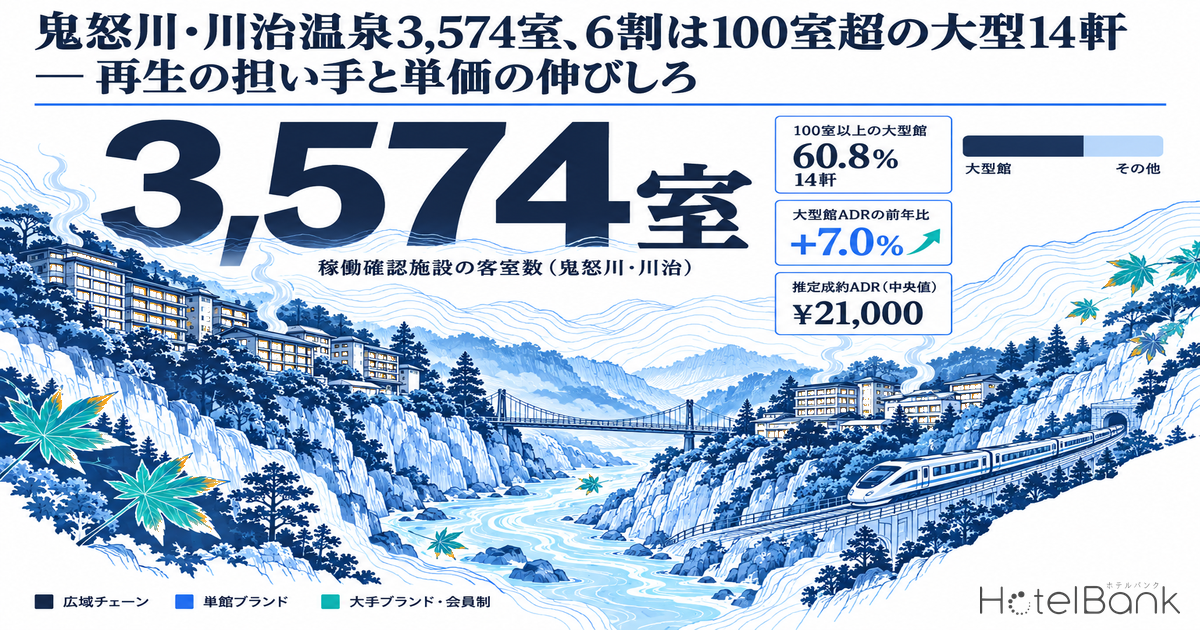
About two hours from Asakusa by Tobu Railway limited express, Kinugawa-Kawaji Onsen, where large hot-spring ryokan line the Kinugawa river gorge, is one of the closest large-scale onsen resorts to Greater Tokyo. According to MetroEngines Research & Consulting, 65 properties with 3,574 rooms across the two onsen areas had confirmed selling prices in the latest 12 months (September 2025 to August 2026). Of these, 14 large properties with 100 or more rooms account for 60.8% of the rooms.
Overnight guests in the area fell from a peak of 3.41 million in 1993 and recovered to 1,203,030 in 2025, returning to the 1.2 million level for the first time in six years. Who operates the large properties today, and where does ADR upside remain? This article breaks down the room stock by operator type and size band, then layers on REIT transactions, rebranding cases, land prices and a simplified renovation model to identify who is driving the turnaround and what conditions matter for investment decisions.
Scope of this article: This piece focuses on the room stock of a single onsen area, Kinugawa-Kawaji, broken down by operator type, and on who is driving its turnaround and where ADR upside remains. Chain-level pricing strategy, public subsidy programs for onsen-area redevelopment, disaster risk and short-term booking pace are outside its scope. It does not comment on the business condition of any individual property, and all estimates are simplified models based on publicly available data.
Metric Definitions Used in This Article
- ADR (average daily rate) = estimated settled ADR (tax-exclusive equivalent), calculated by applying a category-specific adjustment factor to the lowest-plan price level each property publishes on OTAs and similar channels (two guests in one room, per-room rate, tax included). In a reconciliation against property-level actuals disclosed by listed hotel REITs (91 properties, latest three months), the median error was about 7%. These are estimates and differ from each property’s actual settled prices and accounting figures. Area-level ADR is the median of the properties covered (the level of a typical property in the area). Because ryokan mainly sell plans with dinner and breakfast, the level includes meals.
- OCC (occupancy rate) = rooms sold as a share of total rooms in the area (an estimate based on OTA sales inventory; a consistency check against monthly REIT disclosures confirmed accuracy within roughly a few percentage points). It is an estimate based on how inventory sold on OTAs is consumed and differs from the actual occupancy of a whole property.
- Target area = Kinugawa Onsen (4 km radius centered near Tobu Kinugawa-Onsen Station) and Kawaji Onsen (2.5 km radius centered on the Kawaji Onsen hot-spring town). Confirmed-operating properties = properties whose selling prices were confirmed in at least one month between September 2025 and August 2026.
- Operator type = our own classification based on property names and official websites (regional chain / major brand or membership club / small-scale and new formats / single-property brand).
- Data source: MetroEngines Research
- — 3,574 rooms in 65 properties: the Kinugawa-Kawaji rooms with confirmed selling prices in the latest 12 months (September 2025 to August 2026). The 14 large properties with 100+ rooms hold 2,172 rooms (60.8%).
- — Large-property estimated settled ADR of ¥16,900, up 7.0% YoY: ¥7,500 below mid-sized properties with 30-99 rooms (¥24,400), but the highest same-property growth of any size band (N=14).
- — Large properties were acquired at ¥22-24 million per room: Ooedo Onsen Monogatari Premium Kinugawa Kanko Hotel (2017) and the former KAI Kawaji (2024). The small-scale KAI Kinugawa was ¥64.17 million per room.
- — Yield on renovation investment of 9.8% (illustrative case): 150 rooms, post-renovation ADR lifted to the mid-sized level, 70% occupancy (full-year assumption) and 50% flow-through. If the ADR uplift is halved, the yield falls to 4.9%.
- — 1,203,030 overnight guests (2025): back above 1.2 million for the first time in six years, but still only about 35% of the 1993 peak of 3.41 million.
Summary — 14 Large Properties Hold 60% of Rooms, and Their ADR Grew Fastest at +7.0% YoY
To start with the conclusion, the room stock of Kinugawa-Kawaji is concentrated in a small number of large properties, and it is those large properties whose ADR is now growing fastest. Of the 3,574 confirmed-operating rooms, the 14 properties with 100 or more rooms hold 2,172 (60.8%). The estimated settled ADR of large properties (median of 12-month averages) is ¥16,900, which is ¥7,500 below mid-sized properties with 30-99 rooms (¥24,400), yet their same-property YoY change of +7.0% was the highest of any size band.
The operator picture is equally clear. Of the 14 large properties, five are run by onsen ryokan and resort chains with regional or nationwide networks, eight trade under their own property-specific names as single-property brands, and one is a membership hotel affiliated with a major real estate group. Since 2015, REIT acquisitions, chain acquisitions with rebranding, and new membership hotel development have followed one another, so the turnaround of this onsen area is advancing through the restructuring of existing large properties rather than new construction. The room to close the ADR gap through renovation is the upside for investors.
Demand Back to the 1.2 Million Level, ADR Above the Nikko City Average
According to the Shimotsuke Shimbun, reporting figures compiled by the Kinugawa-Kawaji Onsen Ryokan Cooperative, overnight guests at Kinugawa-Kawaji Onsen totaled 1,203,030 in 2025, up 107,434 from the previous year. Foreign overnight guests numbered 53,551, exceeding 50,000 for the second consecutive year. That is about 35% of the 1993 peak of 3.41 million recorded in a survey report by the Ministry of Land, Infrastructure, Transport and Tourism (MLIT), and it can be read as a continuing recovery from the 2011 trough of 1.48 million. For Nikko City as a whole, overnight tourist stays in 2024 reached 2,940,895 (+5.8% YoY) and foreign overnight stays 161,338, the highest since the municipal merger for the second straight year (Nikko City Tourism Division).
On the access side, Tobu Railway launched its new limited express SPACIA X on July 15, 2023, adding trains with private compartments and lounge-style seating between Asakusa and Kinugawa-Onsen. A product that makes the journey itself part of the purpose of the trip creates a channel that brings higher-spending guests to the onsen area.
Next, the ADR level. According to MetroEngines Research, the estimated settled ADR for Nikko City as a whole averaged ¥17,900 over the 12 months from September 2025 to August 2026 (112-123 properties covered each month), up 3.4% from ¥17,400 in the same period a year earlier. Within Kinugawa-Kawaji, the median of 12-month averages for the 51 properties covered by the estimate among confirmed-operating properties was ¥21,000, a step above the city as a whole. The chart below overlays the monthly median for Kinugawa-Kawaji by year. In 2026, January started at ¥22,300, above the same month a year earlier (¥19,600), and August came in at ¥21,400.
On the supply-demand side, Nikko City occupancy (OTA listed-inventory basis, estimated) was 77.7% in June 2026 (80 properties / 3,685 rooms, as listed on major booking sites), 78.7% in July (84 properties / 3,634 rooms) and 86.1% in August (102 properties / 4,096 rooms). For ryokan alone it was 79.3% in June (45 properties / 3,018 rooms) and 87.2% in August (63 properties / 3,460 rooms), meaning close to 90% of the city’s ryokan inventory is consumed in the summer peak. As a precondition for examining how far ADR can be raised, the depth of demand is confirmed.
Breaking Down the 3,574 Rooms — by Size Band and Operator Type
The property master lists 87 lodging properties with 4,117 rooms in the target area. Of these, 65 properties with 3,574 rooms had confirmed selling prices in the latest 12 months: 56 properties and 3,193 rooms in Kinugawa Onsen and 9 properties and 381 rooms in Kawaji Onsen. By category, ryokan make up the large majority at 51 properties, with 14 small-format properties such as cottages and whole-house rentals, guesthouses and pensions. The breakdown below uses these 65 properties and 3,574 rooms as the population.
| Size band | Properties | Rooms | Room share | Estimated settled ADR (median) | YoY (same property) |
|---|---|---|---|---|---|
| 100+ rooms | 14 | 2,172 | 60.8% | ¥16,903 (N=14) | +7.0% (N=14) |
| 30-99 rooms | 18 | 919 | 25.7% | ¥24,448 (N=15) | −0.1% (N=13) |
| Under 30 rooms | 33 | 483 | 13.5% | ¥22,219 (N=22) | +4.4% (N=18) |
| Total | 65 | 3,574 | 100% | ¥21,031 (N=51) | +5.1% (N=45) |
Viewed from the operator side, the picture becomes sharper still. Onsen ryokan and resort chains with regional or nationwide networks (Ooedo Onsen Monogatari, Itoen Hotels, Livemax, Ohruri Group, Mikazuki and others) hold 8 properties and 1,067 rooms (29.9%); brands of major hotel and real estate companies and membership hotels (KAI, Tokyu Harvest Club, Kanaya Hotel and others) hold 4 properties and 297 rooms (8.3%); small-scale and new formats such as whole-house rentals, cottages and guesthouses hold 13 properties and 165 rooms (4.6%); and single-property brands trading under their own names hold 40 properties and 2,045 rooms (57.2%).
| Operator type | Properties | Rooms | Room share | Of which 100+ rooms | Estimated settled ADR (median) |
|---|---|---|---|---|---|
| Regional chain (onsen ryokan and resorts) | 8 | 1,067 | 29.9% | 5 properties, 920 rooms | ¥17,535 (N=8) |
| Major brand / membership club | 4 | 297 | 8.3% | 1 property, 150 rooms | ¥52,633 (N=4) |
| Small-scale and new formats | 13 | 165 | 4.6% | — | — (3 properties covered by the estimate) |
| Single-property brand | 40 | 2,045 | 57.2% | 8 properties, 1,102 rooms | ¥22,219 (N=36) |
What this breakdown shows is that operators are divided by size band. In the 100+ room band, regional chains with 920 rooms and single-property brands with 1,102 rooms are roughly balanced, while the under-30-room band is occupied by single-property brands and small-scale and new formats. Fourteen properties have opened since 2010, but together they have only 319 rooms; the main new entrants are small formats such as detached villas, whole-house rentals and room-only lodgings. Conversely, properties founded or opened in 1989 or earlier number 28 with 2,386 rooms, about three-quarters of the rooms whose year is confirmed. Moves to add new large-scale room supply are limited, so how the existing large properties are remade determines the ADR of the onsen area as a whole.
Who Runs the 14 Large Properties — 5 Chain, 8 Single-Property, 1 Membership
The 14 properties with 100 or more rooms are listed below. Room counts are property-master values, and the founding or opening year is the year registered in the property master, which may not match the year the building was completed.
| Property | Onsen area | Rooms | Operator type | Founded / opened |
|---|---|---|---|---|
| Nikko Kinugawa Hotel Mikazuki | Kinugawa | 259 | Regional chain | 1978 |
| Ooedo Onsen Monogatari Hotel Kinugawa Gyoen | Kinugawa | 197 | Regional chain | 1972 |
| Asaya Hotel | Kinugawa | 192 | Single-property brand | 1888 |
| Itoen Hotel New Sakura | Kinugawa | 192 | Regional chain | — |
| Ooedo Onsen Monogatari Premium Kinugawa Kanko Hotel | Kinugawa | 172 | Regional chain | 1981 |
| Kinugawa Onsen Hotel | Kinugawa | 162 | Single-property brand | 1931 |
| Kinugawa Plaza Hotel | Kinugawa | 160 | Single-property brand | 1951 |
| Hotel Harvest Kinugawa | Kinugawa | 150 | Major brand / membership club | 1992 |
| Kinugawa Park Hotels | Kinugawa | 132 | Single-property brand | 1950 |
| Ichiryukaku Honkan | Kawaji | 124 | Single-property brand | 1934 |
| Hotel Sunshine Kinugawa | Kinugawa | 117 | Single-property brand | 1984 |
| Kinugawa Royal Hotel | Kinugawa | 115 | Single-property brand | 1956 |
| Hotel New Ohruri | Kinugawa | 100 | Regional chain | 1979 |
| Kinugawa Grand Hotel Yume no Toki | Kinugawa | 100 | Single-property brand | 1966 |
Many of the large single-property brands are long-established houses dating back to the Meiji era or earlier, or properties founded in the early Showa era. A long operating history is a strength that can be used as a brand asset in the transition from group and banquet demand to individual and small-party demand. The five regional-chain properties, meanwhile, bring operating know-how for running many rooms with an affordably priced product that combines buffet dining with all-you-can-drink packages. The operators of large properties can be sorted into two tracks: self-funded renovation by long-established houses, and acquisition and rebranding by chains.
Restructuring Since 2015 — REIT Acquisitions, Chain Rebrands and New Membership Hotels
Lining up the main transactions and rebrands in Kinugawa-Kawaji over the past ten years in chronological order shows where the players driving the turnaround have come from.
| Date | Property / event | Player and details |
|---|---|---|
| November 2015 | KAI Kinugawa opens | Acquired the same month by Hoshino Resorts REIT, Inc. (3287). Acquisition price ¥3.08 billion, 48 rooms |
| December 2017 | Ooedo Onsen Monogatari Kinugawa Kanko Hotel acquired | Ooedo Onsen Reit Investment Corporation (now Nippon Hotel & Residential Investment Corporation, 3472). Acquisition price ¥3.87 billion, 172 rooms |
| June 2022 | Hotel New Ohruri reopens | Ohruri Group. 100 rooms in total, all overlooking the Kinugawa river |
| December 2022 | Tokyu Harvest Club VIALA Kinugawa Keisui opens | Tokyu Land Corporation. Membership-based, 58 rooms, each with an open-air bath fed by its own hot-spring source |
| July 2023 | Limited express SPACIA X enters service | Tobu Railway. Asakusa to Tobu-Nikko and Kinugawa-Onsen |
| May 2024 | Former KAI Kawaji acquired | Ooedo Onsen Monogatari Hotels & Resorts. Acquisition price ¥1.26 billion (from Hoshino Resorts REIT). KAI Kawaji ceased operations at the end of September that year |
| July 2024 | Ooedo Onsen Monogatari Premium Kinugawa Kanko Hotel | Reopened after renovation as part of the Premium series. New lounge added; guest rooms, open-air baths and restaurant renovated |
| October 2024 | Kaede Resort Kinugawa Onsen | Reopened after renovation as an all-detached-villa property |
| February 2025 | TAOYA Kawaji opens | Ooedo Onsen Monogatari Hotels & Resorts. The former KAI Kawaji relaunched under the all-inclusive TAOYA brand |
What deserves attention is the per-room level obtained by dividing the transaction price by the number of rooms. KAI Kinugawa was ¥64.17 million per room, Ooedo Onsen Monogatari Premium Kinugawa Kanko Hotel ¥22.5 million per room, and the former KAI Kawaji ¥23.33 million per room (on a 54-room basis). There is a roughly threefold gap in acquisition price per room between a high-value-added small property and large properties with many rooms. Large-property transactions cluster in a range of ¥22-24 million per room, and acquiring at this level and then lifting the ADR band through renovation and rebranding is the turnaround model that has actually been chosen in this onsen area.
| Property | Rooms | Acquisition price | Per room | Acquisition date and acquirer |
|---|---|---|---|---|
| KAI Kinugawa | 48 | ¥3,080 million | ¥64.2 million | November 2015, Hoshino Resorts REIT |
| Ooedo Onsen Monogatari Premium Kinugawa Kanko Hotel | 172 | ¥3,870 million | ¥22.5 million | December 2017, Nippon Hotel & Residential Investment Corporation (Ooedo Onsen Reit at the time of acquisition) |
| Former KAI Kawaji (now TAOYA Kawaji) | 54 | ¥1,260 million | ¥23.3 million | May 2024, Ooedo Onsen Monogatari Hotels & Resorts |
It is also worth looking at what makes up the acquisition price. The site of the former KAI Kawaji is disclosed as 8,671.47 sqm. Applying the official posted land price for commercial land in Kinugawa Onsen (¥30,100 per sqm) gives a land value of about ¥260 million, or about ¥4.8 million per room, which is only about 20% of the ¥23.33 million acquisition price per room. Most of the value of a large onsen ryokan lies in the building and the operation, and the ADR achievable after renovation, rather than the land price level, drives the investment decision.
ADR Upside — the ¥7,500 Gap Between Large and Mid-Sized Properties
Placing the estimated settled ADR by size band side by side, properties with 100+ rooms came to ¥16,900, those with 30-99 rooms ¥24,400 and those with under 30 rooms ¥22,200. Many large properties serve meals buffet-style and are priced to keep a large number of rooms occupied, so their ADR level is below that of mid-sized properties. On a same-property basis, however, the YoY change was highest for large properties at +7.0% (N=14), ahead of −0.1% for mid-sized properties (N=13) and +4.4% for small properties (N=18).
The ¥7,500 gap with mid-sized properties serves directly as a yardstick for the upside of large properties. In practice, many of the rebrands carried out in this onsen area have combined renovation of guest rooms, large communal baths and lounges with meals and all-you-can-drink packages, positioning the product as “a stay one step up at a still-affordable price.” Even for the same large property, conversion to a Premium series or an all-inclusive format leaves room to bring the ADR band closer to the mid-sized level. If the ADR of the 2,172 rooms in properties with 100+ rooms rises by just ¥1,000, then at an assumed 70% occupancy (full year) about ¥550 million in annual room revenue would be added to the onsen area as a whole.
Location and Land Prices — Clustered Along the Gorge, Commercial Land Stops Falling in 2026
| Commercial, Kinugawa-Onsen Ohara (station front) | ¥37,900/sqm |
| Commercial, Kinugawa-Onsen Ohara | ¥30,100/sqm |
| Commercial, Kinugawa-Onsen Taki | ¥22,900/sqm |
| Residential, Kinugawa-Onsen Ohara | ¥17,500/sqm |
Lodging properties are clustered in a long, narrow band running north from Kinugawa-Onsen Station along both banks of the gorge. Large properties are concentrated along this gorge, while small room-only lodgings and whole-house rentals are scattered on the south side closer to the station. Kawaji Onsen lies about 7 km to the north and forms a small, separate hot-spring town at the confluence of the Kinugawa and Ojika rivers.
Land prices had been declining gradually since 2019, but in 2026 two commercial sites near the station turned flat with a 0.0% rate of change. Station-front commercial land (Kinugawa-Onsen Ohara) went from ¥41,400 in 2019 to ¥37,900 in 2026, and commercial land on the north side of the hot-spring town (Kinugawa-Onsen Taki) from ¥25,700 to ¥22,900. As noted above, land accounts for a small share of the acquisition price, and a low land price level can also be seen as a condition that makes it easier to direct capital toward renovating, downsizing or rebuilding the buildings.
When considering who will run these operations, the surrounding resident population also matters. The resident population within a 3 km radius centered near Kinugawa-Onsen Station was 4,298 in 2020 and an estimated 3,943 in 2025, with 41.8% aged 65 or older, and is projected to reach 2,948 in 2040, down 31.4% from 2020. When turning around a large property, securing staff without relying only on local hiring, and designing operations that can run many rooms with few people, such as buffet or all-inclusive formats, become preconditions alongside ADR. The ease of transplanting this operating know-how is part of why regional chains have such a presence as operators of large properties.
A Simplified Renovation Scenario — Moving a 150-Room Large Property Into the Mid-Sized ADR Band
Finally, we use a simplified model to estimate the returns from lifting the ADR band of a large property through renovation. The subject is a 150-room large onsen ryokan, with pre-renovation estimated settled ADR set at the large-property median of ¥16,900 and post-renovation ADR at the mid-sized median of ¥24,400. Occupancy is set at 70% for the full year (more conservative than the 79-87% summer actuals for ryokan in Nikko City).
Renovation cost is set at about ¥9.8 million per room, which is 20% of the new-build replacement cost (about ¥49 million per room) obtained by multiplying the 2025 planned construction cost for reinforced-concrete buildings in MLIT’s Building Starts Statistics (¥2.026 million per tsubo, about 3.3 sqm) by a gross floor area of 80 sqm per room including common areas. The share of the ADR uplift that remains as operating profit (flow-through) is set at 50%, on the premise that the costs of upgraded meals and revised staffing are deducted.
| Item | Base case Illustrative | ADR uplift halved | Occupancy −5pt | Flow-through 40% | ADR halved + occupancy −5pt |
|---|---|---|---|---|---|
| Post-renovation ADR | ¥24,400 | ¥20,650 | ¥24,400 | ¥24,400 | ¥20,650 |
| Occupancy (full year) | 70% | 70% | 65% | 70% | 65% |
| Incremental room revenue (annual) | ¥287 million | ¥144 million | ¥267 million | ¥287 million | ¥133 million |
| Incremental operating profit (annual) | ¥144 million | ¥72 million | ¥133 million | ¥115 million | ¥67 million |
| Renovation cost (150 rooms) | ¥1,471 million | ¥1,471 million | ¥1,471 million | ¥1,471 million | ¥1,471 million |
| Yield on renovation investment | 9.8% | 4.9% | 9.1% | 7.8% | 4.5% |
| Payback period | 10.2 years | 20.5 years | 11.0 years | 12.8 years | 22.0 years |
In the base case, the yield on renovation investment is 9.8% and payback takes about 10 years. If the ADR uplift is only half of what was assumed, the yield falls to 4.9%, which shows that the size of the ADR uplift, more than occupancy, separates success from failure. Put differently, the rational sequence for designing a renovation is to decide first which demand segment to sell to and at what price, and then allocate investment across guest rooms, meals and common areas to match that ADR. Where an acquisition is involved, the transaction track record of ¥22-24 million per room plus renovation cost of ¥9.8 million gives ¥32-34 million per room as a guide to total investment, and room revenue at a post-renovation ADR of ¥24,400 and 70% occupancy (full-year assumption) comes to about ¥6.2 million per room per year.
The following table shows how the yield on renovation investment moves along two axes, the ADR uplift and occupancy (renovation cost of ¥1,471 million and 50% flow-through held fixed). With the ADR uplift at the base ¥7,500, the yield holds at 8.4% even if occupancy falls to 60% (full year), whereas if the uplift is only ¥2,500 the yield stays at 3.7% even at 80% occupancy (full year).
| ADR uplift \ Occupancy | 60% | 65% | 70% | 75% | 80% |
|---|---|---|---|---|---|
| +¥2,500 | 2.8% | 3.0% | 3.3% | 3.5% | 3.7% |
| +¥3,750 (half) | 4.2% | 4.5% | 4.9% | 5.2% | 5.6% |
| +¥5,000 | 5.6% | 6.0% | 6.5% | 7.0% | 7.4% |
| +¥6,250 | 7.0% | 7.6% | 8.1% | 8.7% | 9.3% |
| +¥7,500 (base) | 8.4% | 9.1% | 9.8% | 10.5% | 11.2% |
Note that the estimate is a simplified model that looks only at incremental room revenue; it does not factor in ancillary revenue such as banquets, day-use bathing and shops, the reduction of fixed costs through downsizing, or the use of subsidy programs. The Japan Tourism Agency established a program in fiscal 2026 to subsidize the demolition of lodging facilities in onsen areas and the reuse of the vacated sites, and for the turnaround of large properties involving downsizing, such programs are an option for lowering total investment.
Perspectives for Investment Decisions
Stock: concentrated in large properties
14 properties with 100+ rooms hold 2,172 rooms (60.8%)
New openings are mainly small formats, and new supply of large-scale rooms is limited. The onsen area’s ADR moves with the remaking of existing large properties.
Upside: the ¥7,500 gap with mid-sized properties
Large ¥16,900 → mid-sized ¥24,400
Large properties posted the highest YoY growth at +7.0%. Room remains to close the ADR band through renovation and rebranding.
Players: acquisition × rebranding
Transactions at ¥22-24 million per room
REITs and regional chains acquire large properties and turn them around through Premium and all-inclusive conversions. Transplanting operating know-how is the key.
The turnaround of Kinugawa-Kawaji has advanced not as development that builds new properties but as a restructuring in which existing large properties are acquired, renovated and sold differently. For ryokan turnaround funds and onsen ryokan chains, the question comes down to how far the ADR band can be lifted after renovation, having acquired at the transaction level of ¥22-24 million per room. For regional financial institutions too, now that demand has returned to the 1.2 million level and large-property ADR is growing at +7.0% YoY, this is a phase in which to capture the funding needs of long-established single-property brands as they embark on self-funded renovation.
Frequently Asked Questions
Q. How many rooms are there in Kinugawa-Kawaji Onsen?
A. According to MetroEngines Research & Consulting, 65 properties with 3,574 rooms had confirmed selling prices between September 2025 and August 2026 (Kinugawa: 56 properties, 3,193 rooms; Kawaji: 9 properties, 381 rooms). Of these, the 14 large properties with 100 or more rooms hold 2,172 rooms, about 60% of the total.
Q. What is the level of room rates in Kinugawa-Kawaji?
A. The estimated settled ADR (median of 12-month averages) is ¥21,000, above the ¥17,900 for Nikko City as a whole. By size band, it is ¥16,900 for properties with 100+ rooms, ¥24,400 for 30-99 rooms and ¥22,200 for under 30 rooms.
Q. What is the transaction price per room for large onsen ryokan?
A. In disclosed transactions, Ooedo Onsen Monogatari Premium Kinugawa Kanko Hotel was ¥22.5 million per room and the former KAI Kawaji was ¥23.33 million per room. KAI Kinugawa, a small high-value-added property, was ¥64.17 million per room.
⚠ Note on ADR for future dates: The estimated settled ADR from September 2026 onward in the chart is an estimate based on the selling price levels published on OTAs and similar channels at the time of the survey, and it will change as the check-in date approaches. Please avoid comparing these figures directly with those for finalized months (through August 2026).
References and Sources
■ Data sources
Estimated settled ADR, occupancy (OTA listed-inventory basis, estimated) and the property master are compiled by MetroEngines Research & Consulting (September 2024 to December 2026, compiled as of September 27, 2026). The target area is the coordinate range of Kinugawa Onsen (4 km radius) and Kawaji Onsen (2.5 km radius); confirmed-operating properties are the 65 properties with 3,574 rooms whose selling prices were confirmed between September 2025 and August 2026. REIT-owned properties are from the ownership master (as of September 21, 2026). Among the properties owned by seven J-REITs (Ichigo Hotel REIT Investment Corporation (3463), Invincible Investment Corporation (8963), Nippon Hotel & Residential Investment Corporation (3472), Japan Hotel REIT Investment Corporation (8985), Hoshino Resorts REIT, Inc. (3287), MORI TRUST REIT, Inc. (8961) and Kasumigaseki Hotel REIT Investment Corporation (401A)), N=2 properties are located in the target area.
■ Model assumptions
A 150-room large onsen ryokan is assumed. Pre-renovation ADR ¥16,900 (median of the 100+ room band), post-renovation ADR ¥24,400 (median of the 30-99 room band), occupancy 70% (full-year assumption), flow-through 50%. Renovation cost is 20% of the 2025 planned construction cost for reinforced-concrete buildings of ¥2.026 million per tsubo × gross floor area of 80 sqm per room = about ¥9.8 million per room. Incremental room revenue = 150 rooms × 365 days × occupancy × ADR difference. The land guide value applies the official posted price of ¥30,100 per sqm for commercial land in Kinugawa Onsen to the disclosed site area of 8,671.47 sqm of the former KAI Kawaji.
■ Limitations and caveats
Estimated settled ADR is an estimate derived from published prices and differs from each property’s actual settled prices and accounting figures. Ryokan levels include meals, and differences between size bands also reflect differences in meal content. Operator type is a classification based on property names and official websites, and at some properties ownership and operation are separate. The occupancy, flow-through and renovation cost in the model are illustrative and not the actual results of any existing property; an actual investment decision requires a property-specific feasibility study.
■ Market data
- MetroEngines Research & Consulting — estimated settled ADR (Nikko City: 112-123 properties each month; Kinugawa-Kawaji: N=51 properties), occupancy (OTA listed-inventory basis, estimated), property master
■ Government statistics and public data
- MLIT Real Estate Information Library — official land prices and prefectural land price survey (2019-2026), zoning
- MLIT National Land Numerical Information — future population projections by 250 m mesh (FY2024 projection by the National Spatial Planning and Regional Policy Bureau)
- MLIT Building Starts Statistics — planned construction cost by structure
- Nikko City, “Tourist Arrivals and Overnight Stays in Nikko City, 2024” (March 25, 2025)
- Nikko City, “Tourism Statistics”
- MLIT, National Land Policy Initiative Survey report (March 2005) — overnight guests at Kinugawa-Kawaji Onsen in 1993
■ REIT and IR materials
■ News and press releases
- Kinugawa-Kawaji Onsen overnight guests top 1.2 million in 2025 for the first time in six years (Shimotsuke Shimbun)
- Ooedo Onsen Monogatari acquires the former Hoshino Resorts KAI Kawaji, to reopen under a new brand next February (TRAICY, October 2024)
- TAOYA Kawaji grand opening in February 2025 (PR TIMES)
- Ooedo Onsen Monogatari Premium Kinugawa Kanko Hotel reopens after renovation on July 22 (PR TIMES, 2024)
- Tokyu Harvest Club VIALA Kinugawa Keisui opens December 9, 2022 (Tokyu Land)
- Hotel New Ohruri (Ohruri Group official website)
- Kinugawa Onsen Kaede Resort (official website)
- Tobu SPACIA X to debut July 15 (TRAICY, February 2023)
- Japan Tourism Agency considers subsidies for removing lodging facilities in onsen areas and reusing the sites (Jiji Press, November 2025)