

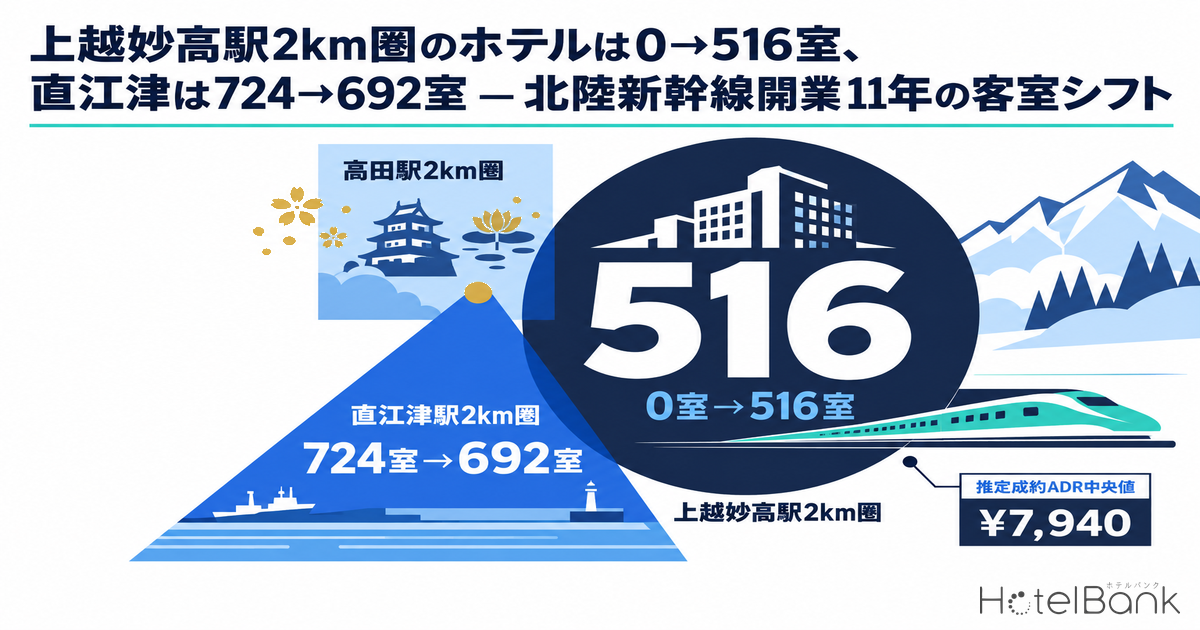
It has been 11 years since Hokuriku Shinkansen trains began stopping at Joetsu-Myoko Station. Over that time, hotel rooms in Joetsu City, Niigata Prefecture, have quietly “moved stations.” When MetroEngines Research takes a property-by-property inventory of the lodging facilities it can confirm on sale on major booking sites, hotels within 2km of Joetsu-Myoko Station grew from 0 rooms in 2015 to 3 hotels with 516 rooms by 2020. Over the same period, the 2km zone around Naoetsu Station in the port district went from 724 rooms to 692, and the 2km zone around Takada Station in the old castle town went from 343 to 347 — essentially flat. This article overlays the three locations on six axes — room stock, station ridership, land prices, resident population and workers, estimated settled ADR, and disaster risk — and organizes the findings as decision material for developers and regional financial institutions choosing sites in the Hokuriku and Shin’etsu regions.
Metric Definitions Used in This Article
- ADR (average daily rate): An estimated settled rate (tax-exclusive equivalent), calculated by applying segment-specific adjustment factors to the lowest-plan price level each property publishes on OTAs (per-room rate for two guests, tax-inclusive). Checked against property-level results disclosed by listed hotel REITs (91 properties, most recent 3 months), the median error is about 7%. These are estimates and differ from each property’s actual settled prices and accounting figures. Area-level ADR is the median of the properties covered (the level of a typical property in the area).
- OCC (occupancy): The share of rooms sold relative to total rooms in the area (an estimate based on OTA sales inventory; consistency checks against REIT monthly disclosures confirm accuracy to within roughly a few points). Because it is based on how OTA-listed inventory is absorbed, it differs from a property’s actual overall occupancy.
- Room stock: Total rooms of lodging facilities within a 2km radius of each station that were confirmed on sale on major booking sites in the most recent 3 months (August–October 2026). The annual series was reconstructed as of each year-end from each property’s opening year and from properties whose closure could be confirmed in public information. Leisure (love) hotels are excluded.
- Station locations: Joetsu-Myoko Station (37.0815°N, 138.2488°E) and Naoetsu Station (37.1701, 138.2423) were confirmed with the Geospatial Information Authority of Japan (GSI) address search; Takada Station (37.1155, 138.2430) was confirmed using the GSI coordinates of its address, 4-1-1 Nakamachi.
- Data sources: MetroEngines Research & Consulting (room stock, ADR, OCC); MLIT Real Estate Information Library (land prices, disaster risk); National Land Numerical Information (resident population); Economic Census (employment); JR East and Echigo TOKImeki Railway (ridership).
- — 0 → 516 rooms: The 2km zone around Joetsu-Myoko Station had 0 rooms in 2015, when the Hokuriku Shinkansen opened; three limited-service hotels opened in 2018–2020, bringing it to 516 rooms. The Naoetsu zone went from 724 to 692 rooms and the Takada zone from 343 to 347 — essentially flat.
- — Station users equal 0.53× the resident population: Joetsu-Myoko Station is used by 2,928 people a day (FY2024, JR + Echigo TOKImeki Railway). Against 0.16× at Naoetsu and 0.09× at Takada, it is a gateway station weighted toward visitors.
- — Land is 1–2% of total investment: Commercial land near the stations is priced at ¥36,900–¥63,600/㎡ (2026). Land cost per room is ¥185,000–¥318,000, against construction cost of about ¥18.19 million per room, so land price is not a deciding factor in site selection.
- — Estimated settled ADR in the Shinkansen station zone is about 30% higher: September 2026 medians within 2km were about ¥7,900 at Joetsu-Myoko (N=3), about ¥6,000 at Naoetsu (N=11) and about ¥6,100 at Takada (N=5). Joetsu City as a whole was ¥7,083 (N=37).
- — A simple estimate puts gross investment yield at 5.5% vs. 4.1–4.2%: For a 100-room limited-service hotel, after factoring in rising construction costs. The rate gap translates directly into a yield gap, and all three locations share the same design condition of sitting inside flood inundation zones.
11 Years of Room Stock — 3 Hotels and 516 Rooms at the Shinkansen Station; the Two Older Hubs Flat Despite Turnover
Start with how the stock moved. When the Shinkansen opened in March 2015, there was not a single hotel within 2km of Joetsu-Myoko Station; stock first appeared when APA Hotel Joetsu-Myoko Ekimae (アパホテル〈上越妙高駅前〉, 161 rooms) opened in July 2018. Super Hotel Joetsu-Myoko Ekinishiguchi (スーパーホテル上越妙高駅西口, 107 rooms) followed in January 2020 and Toyoko Inn Joetsu-Myoko Ekinishiguchi (東横INN上越妙高駅西口, 248 rooms) in March of the same year, turning the station area into a limited-service cluster of 3 hotels and 516 rooms. More than 500 rooms accumulated within walking distance of the station within five years of the line opening, and the fact that all of them are national chains located right next to the station’s west and east exits is the first clue to reading demand at this station.
Meanwhile, the 2km zone around Naoetsu Station, which had 11 properties and 724 rooms at the end of 2015, grew to 758 rooms through small openings — Yoneyama Heart Hotel (米山ハートホテル, 12 rooms) in 2017 and Aikawa Naoetsu-ko (あいかわ直江津港店, 22 rooms) in 2018 — before Herbal Spa & Hotel Genkijin (ハーバルスパ&ホテル元気人, 66 rooms) closed in September 2019, settling the count at 12 properties and 692 rooms. The Takada Station zone had 5 properties and 343 rooms at the end of 2015; with the addition of Yado Bar TATSUJI (やどバーTATSUJI, 4 rooms) in 2021 it now stands at 6 properties and 347 rooms, barely moving in 11 years. In other words, Joetsu City’s hotel rooms can be read as “nearly all of the growth over these 11 years located at the Shinkansen station.”
The property-level inventory is shown in the table below. The Naoetsu zone is anchored by Hotel Alpha-One Joetsu (ホテル・アルファーワン上越, 176 rooms, opened 1988) and Hotel Route-Inn Joetsu (ホテルルートイン上越, 126 rooms, opened 2002), with long-established city hotels near the station mixed with small ryokan. In the Takada zone, Art Hotel Joetsu (アートホテル上越, 198 rooms) accounts for 57% of the zone’s rooms, with the remainder made up of small and mid-size business hotels and ryokan near the station. Note that each 2km zone also contains many lodging facilities — mainly small ryokan — that sell through channels other than the major booking sites; counted by facilities in operation, the Naoetsu and Takada zones each have 14. Please read the stock figures in this article as “rooms confirmed on sale on booking sites.”
| Hub | Property | Rooms | Opened | Type | Distance from station |
|---|---|---|---|---|---|
| Joetsu-Myoko Sta. | Toyoko Inn Joetsu-Myoko Ekinishiguchi (東横INN上越妙高駅西口) | 248 | 2020 | Limited-service | 0.17km |
| APA Hotel Joetsu-Myoko Ekimae (アパホテル〈上越妙高駅前〉) | 161 | 2018 | Limited-service | 0.34km | |
| Super Hotel Joetsu-Myoko Ekinishiguchi (スーパーホテル上越妙高駅西口) | 107 | 2020 | Limited-service | 0.26km | |
| Naoetsu Sta. | Hotel Alpha-One Joetsu (ホテル・アルファーワン上越) | 176 | 1988 | Limited-service | 0.59km |
| Hotel Route-Inn Joetsu (ホテルルートイン上越) | 126 | 2002 | Limited-service | 1.28km | |
| Hotel Century Ikaya (ホテルセンチュリーイカヤ) | 101 | — | City hotel | 0.19km | |
| Hotel Monzen no Yu (ホテル 門前の湯) | 75 | 2011 | With hot-spring bath | 1.60km | |
| Hotel Himart (ホテルハイマート) | 70 | 2015 | City hotel | 0.14km | |
| 7 other properties (incl. Ryoso Minato-so (旅荘みなと荘), 50 rooms; ryokan and small hotels) | 144 | — | Ryokan / limited-service | 0.2–1.5km | |
| Takada Sta. | Art Hotel Joetsu (アートホテル上越) | 198 | 1993 | City hotel | 0.16km |
| Takada Terminal Hotel (高田ターミナルホテル) | 59 | 1987 | Limited-service | 0.06km | |
| 4 other properties (incl. Takada Station Hotel (タカダステーションホテル), 39 rooms) | 90 | — | Limited-service / ryokan | 0.06–1.7km |
On the map, the three stations line up along a roughly 10km north–south line. Joetsu-Myoko Station lies about 4km south of central Takada, and Naoetsu Station about 6km north of Takada, so their 2km zones do not overlap. In short, although the three hubs are in the same city, they behave as “three small markets” with separate catchments.
Station Ridership — Joetsu-Myoko Back to 99% of Its 2015 Level, Naoetsu Structurally Shrinking
The reason hotels gathered at the station shows up in ridership trends. According to JR East’s published figures, average daily Shinkansen boardings at Joetsu-Myoko Station were 2,086 in FY2015, its first year of operation, rising to 2,238 in FY2018. After falling to 762 in FY2020 during the COVID-19 pandemic, they recovered to 2,068 in FY2024 — 99% of the first-year level. On the conventional-line side, Echigo TOKImeki Railway carries another 860 passengers (FY2024), so more than 2,900 people use the station each day in total.
Naoetsu Station is the opposite case. When the Shinkansen opened, parts of the Shinetsu Main Line and Hokuriku Main Line were transferred to Echigo TOKImeki Railway, and JR East’s boardings fell from 2,337 in FY2015 to 1,605 in FY2024, while Echigo TOKImeki Railway’s fell from 1,778 to 1,276 — both down by around 30%. Takada Station (Echigo TOKImeki Railway) saw only a modest 5% decline, from 2,162 to 2,061, suggesting it is supported by everyday school and commuter use.
What deserves attention here is the ratio of station users to the resident population nearby. The resident population within 1.5km of Joetsu-Myoko Station is 5,508 (2025 estimate), and its 2,928 daily boardings (JR + Echigo TOKImeki Railway) equal 0.53 times that figure. Naoetsu Station has 2,881 boardings against a resident population of 18,466, or 0.16 times, and Takada Station 2,061 against 21,892, or 0.09 times. Joetsu-Myoko is a gateway station where “people who come from outside and leave again” far outweigh local everyday use, and it was a natural outcome that hotel demand concentrated there.
The gateway function also works as a starting point for trips to the ski resorts of Myoko Kogen and onward toward Itoigawa. In Myoko City, secondary transport from the station to the ski areas and lodging clusters is limited relative to rising inbound demand, and reports say plans are under way to cover the 2025–26 season with a taxi fleet of 21 vehicles from three companies plus Japan’s version of ride-sharing. The flow of arriving by Shinkansen, staying at a hotel in front of Joetsu-Myoko Station and heading to Myoko Kogen the next morning functions as a route that pulls winter demand into the Joetsu City side.
Land Prices — Station-Front Commercial Land at ¥55,000 (Joetsu-Myoko), ¥63,600 (Takada) and ¥36,900 (Naoetsu); Land Cost per Room Is 1–2% of Construction Cost
Pulling the official land price (chika koji) and prefectural land price survey points around the three stations from MLIT’s Real Estate Information Library shows that station-front commercial land differs at each. At Yamato 5-chome, 160m from Joetsu-Myoko Station (commercial zone, 500% floor area ratio), the price was flat at ¥55,000/㎡ in both 2025 and 2026, and nearby residential land (Yamato 2-chome, 800m from the station) went from ¥30,700/㎡ in 2015 to ¥30,200/㎡ in 2026 — a decline of just 1.6% over 11 years.
At Chuo 1-chome, 200m from Naoetsu Station (commercial zone, 500% FAR), the price fell 32.5% from ¥54,700/㎡ in 2015 to ¥36,900/㎡ in 2026, and it was still down 3.1% year on year in 2026. Hommachi 5-chome, 300m from Takada Station (commercial zone, 500% FAR), still holds the city’s highest level at ¥63,600/㎡, but that is 31.6% below the ¥93,000/㎡ of 2015. The picture is one of land prices that “hold their level” at the Shinkansen station and land prices that “keep adjusting gradually” at the two older hubs.
How much the land price gap matters for limited-service hotel development, however, only becomes visible when converted to a per-room basis. Using the full 500% FAR of a commercial zone and assuming 25㎡ of gross floor area per room including common areas, each room needs 5㎡ of site. Land cost then comes to only about ¥275,000 per room in front of Joetsu-Myoko Station, about ¥318,000 in front of Takada Station and about ¥185,000 in front of Naoetsu Station. Building the same 25㎡ (7.56 tsubo) at the 2025 steel-frame (S) construction cost of ¥2.405 million per tsubo, based on MLIT’s Building Construction Starts statistics, costs about ¥18.19 million per room, so land stays within 1–2% of total investment. For these three locations at least, there is almost no situation in which land price decides site selection; the decision comes down to “which demand gateway to build at.”
| Station-front commercial land | Land price (2026) | vs. 2015 | Land cost per room | Construction cost per room | Land share |
|---|---|---|---|---|---|
| Joetsu-Myoko Sta. · Yamato 5-chome (160m from station) | ¥55,000/㎡ | — (point set in 2025, ±0.0%) | ¥275,000 | ¥18.19M | 1.5% |
| Takada Sta. · Hommachi 5-chome (300m from station) | ¥63,600/㎡ | −31.6% | ¥318,000 | ¥18.19M | 1.7% |
| Naoetsu Sta. · Chuo 1-chome (200m from station) | ¥36,900/㎡ | −32.5% | ¥185,000 | ¥18.19M | 1.0% |
Resident Population and Workers — What Separates the Three Hubs’ Demand Types
Next, read each hub’s underlying demand through resident population and workers. According to the 250m-mesh future population estimates in the National Land Numerical Information, the resident population within 1.5km of each station is 5,508 at Joetsu-Myoko, 18,466 at Naoetsu and 21,892 at Takada (all 2025 estimates). The projected change from 2020 to 2040 is −20.2% for Joetsu-Myoko, −19.3% for Naoetsu and −23.5% for Takada, so all three are expected to shrink by around 20%. The share of residents aged 65 and over is 32.0% at Joetsu-Myoko, 30.5% at Naoetsu and 35.4% at Takada.
Looking at employment within 1km of each station in the Economic Census (2021), there are 1,474 workers at Joetsu-Myoko, 5,807 at Naoetsu and 6,816 at Takada. The share of office workers is highest in Takada at 12.2%, followed by Naoetsu at 9.7% and Joetsu-Myoko at 8.5%. Takada retains the core functions of the old town center, including Joetsu City Hall and bank branches, while Naoetsu has a cluster of port- and energy-related businesses. The Joetsu-Myoko area has few workers, but efforts to build a base for business demand traveling to and from Tokyo by Shinkansen have begun, such as the 2021 opening of “JM-DAWN,” a satellite office using local 5G.
Placed side by side, the mesh maps show that the area around Joetsu-Myoko Station is low-density, with housing scattered among farmland and the population mass skewed to the north of the station (toward Minami-Takada). Around Takada Station, population spreads across the entire old town, but many meshes have a high senior share — depth as a place to live coexists with a future decline in residential demand. On this basis, the lodging demand at the three hubs can be classified as follows.
Joetsu-Myoko Sta. Shinkansen gateway type
2,928 station users a day against a resident population of 5,508 (0.53×). Business and leisure visitors from the Tokyo area, plus demand from travelers using it as a starting point for Myoko Kogen and Itoigawa. A cluster of 3 limited-service hotels with 516 rooms is already in place, and its median room ADR is the highest of the three hubs.
Naoetsu Sta. Port and energy business-demand type
5,807 workers within 1km of the station, backed by Naoetsu Port with its LNG terminal and thermal power plant. Business demand supported by long stays for construction, maintenance and business trips is the core, absorbed by two limited-service hotels with 302 rooms and city hotels in front of the station.
Takada Sta. Castle-town living and event hub type
6,816 workers and a 12.2% office share, with the city’s core functions still in place. Strong seasonality, with demand concentrated in April around events such as the Takada Castle Site Park Cherry Blossom Festival (418,000 visitors in 2024), and a 198-room city hotel supporting demand that includes weddings and banquets.
Estimated Settled ADR and Occupancy — Joetsu City Holds a Stable ¥6,700–7,600 Range Year-Round; Myoko City Rises 1.8× in Winter
On pricing, Joetsu City’s estimated settled ADR stayed within a narrow ¥6,700–¥7,600 range over the 12 months from October 2025 to September 2026, with a 12-month average of about ¥7,100. The high was about ¥7,600 in April 2026 (the month of the Cherry Blossom Festival) and the low about ¥6,700 in June 2026, so the seasonal swing is within about ±6% of the average. September 2026 came in at about ¥7,100 (N=37 properties), essentially flat at −1.3% year on year.
Neighboring Myoko City looks quite different. Its 2025 estimated settled ADR moved from about ¥8,300 in September to about ¥12,500 in December, and reached about ¥13,200 in January–February 2026 — 1.8 times Joetsu City. This is the classic seasonality of a resort market, with ski demand pushing up winter rates. Nagaoka City ranges from about ¥7,500 to ¥9,800 (January 2026 to August 2025), peaking in the month of its summer fireworks festival, and Itoigawa City — a reference figure given its small sample of 7–9 properties — moves between ¥7,800 and ¥11,300. Compared with these surrounding cities, Joetsu City has a pricing structure of an “easy-to-use business base” with leveled rates.
| Area | Sep 2026 ADR | N (properties) | Last-12-month low–high | Peak month |
|---|---|---|---|---|
| Joetsu City | ¥7,083 | 37 | ¥6,706–¥7,554 | April (Cherry Blossom Festival) |
| Myoko City | ¥8,814 | 40 | ¥8,410–¥13,166 | January–February (skiing) |
| Nagaoka City | ¥9,340 | 30 | ¥7,478–¥9,636 | August (fireworks) |
| Itoigawa City (reference) | ¥9,830 | 8 | ¥7,766–¥11,272 | January, May |
Taking medians within 2km of the three stations, September 2026 estimated settled ADR was about ¥7,900 in the Joetsu-Myoko zone (N=3), about ¥6,000 in the Naoetsu zone (N=11) and about ¥6,100 in the Takada zone (N=5), putting the Shinkansen station about 30% above the other two hubs. In the August peak, the Joetsu-Myoko zone rose to about ¥8,900, while the Naoetsu zone was about ¥6,100 and the Takada zone also about ¥6,100 — the Shinkansen station has much more room to reflect seasonal peaks in its rates. The small samples call for caution, but the fact that “a different station in the same city means a different rate” feeds directly into the revenue assumptions of site selection.
On occupancy, Joetsu City’s estimated OCC based on OTA-listed inventory was 88.1% in August 2026 (18 properties / 897 rooms) and 85.8% in September (16 properties / 887 rooms, based on major booking site listings). In September, it reached 99–100% on the 19th (Sat) through the 21st (Mon, holiday) — the first half of the five-day Silver Week holiday (19th–23rd) — and held around 86% on weekdays as well. This is an occupancy curve with a small weekday–weekend gap, typical of a city with deep business demand.
Disaster Risk — All Three Stations Inside Flood Inundation Zones; Tsunami of 3–5m on Naoetsu’s Port Side
Finally, we overlay the disaster risk information from MLIT’s Real Estate Information Library on the three stations and the main hotel locations. In the flood inundation zones for the maximum assumed rainfall, Joetsu-Myoko Station falls within the zones of the Aota River (inundation depth under 0.5m) and the Yashiro River (0.5m to under 3m), Naoetsu Station within those of the Odate River and Seki River (both 0.5m to under 3m), and Takada Station within that of the Gimyo River (0.5m to under 3m). In Joetsu City, where urban areas spread across the alluvial fan and lowlands of the Seki River system, ground-floor levels and the placement of electrical equipment designed around the “0.5–3m” band are a design condition at all three hubs.
Tsunami inundation assumptions apply only around Naoetsu Station: the station itself is in a 0.01m to under 0.3m zone, the location of Ryoso Minato-so in Minatomachi 1-chome is in a 3m to under 5m zone, and Aikawa Naoetsu-ko is in a 1m to under 3m zone. Joetsu-Myoko and Takada stations and their surrounding hotels are outside the tsunami assumption areas. None of the three stations or main hotels is inside a sediment disaster warning zone. On the liquefaction tendency map, the Joetsu-Myoko area is back marsh, the Naoetsu area is sandbar/gravel bar, and the Takada area is alluvial fan — all landform classes that are “somewhat prone to liquefaction” — while the seaside lowland of Naoetsu (the locations of Hotel Route-Inn Joetsu and Monzen no Yu) is delta/coastal lowland that is “prone to liquefaction.” Elsewhere in Niigata Prefecture, in Niigata City’s Chuo Ward at the mouth of the Shinano River, 100% of hotel rooms sit on ground prone to liquefaction, and HotelBank’s analysis of that market found that this ground condition creates no ADR difference.
| Hub | Flood inundation (maximum assumed) | Tsunami inundation | Sediment disaster warning zone | Liquefaction tendency (landform class) |
|---|---|---|---|---|
| Joetsu-Myoko Sta. · 3 station-front properties | Inside: Aota River 0.5m to under 3m / Yashiro River under 0.5m to under 3m | Not applicable | Outside | Back marsh · somewhat prone to liquefaction |
| Naoetsu Sta. · station-front properties | Inside: Odate River under 0.5m to under 3m / Seki River 0.5m to under 3m | Station 0.01m to under 0.3m; Minatomachi side 1m to under 5m | Outside | Sandbar/gravel bar (seaside lowland is delta/coastal lowland) |
| Takada Sta. · station-front properties | Inside: Gimyo River under 0.5m to under 3m | Not applicable | Outside | Alluvial fan · somewhat prone to liquefaction (Art Hotel Joetsu’s location is natural levee · prone to liquefaction) |
Risk information is not grounds for rejecting a location but a precondition to be built into design and the business plan. Since all three hubs share the same flood band, the differences are limited to tsunami (Naoetsu’s port side) and ground conditions (the seaside lowland), and the Joetsu-Myoko and Takada station areas can be compared on equal terms.
The Investment View — A REIT-Owned Benchmark and the Growth Room Left at the Shinkansen Station
There is one listed-REIT-owned property in Joetsu City. Art Hotel Joetsu (198 rooms) in front of Takada Station was acquired by Invincible Investment Corporation (インヴィンシブル投資法人, 8963) in February 2018 for ¥2,772 million, or about ¥14.0 million per room (listed REIT property data, as of October 5, 2026). The property’s operating results disclosed by the REIT for August 2026 were occupancy of 83.8%, ADR of ¥11,100 and RevPAR of ¥9,297; the difference from this article’s estimated settled ADR for the same month (about ¥10,500) is about 5%, within the error range assumed for the estimate.
Across the portfolio, Invincible’s 101 domestic hotels posted August 2026 occupancy of 87.3% (−0.5pt YoY), ADR of ¥17,887 (−3.2%) and RevPAR of ¥15,608 (−3.8%), and the REIT cited the fading of demand after the Osaka Expo and a decline in visitors from China. In the same August 2026, however, its “Other” region grew to occupancy of 92.9% (+1.5pt) and RevPAR of ¥26,862 (+3.4%), indicating that city hotels in regional cities are relatively firm. The fact that this Takada station-front property maintains high occupancy serves as a benchmark showing the resilience of demand at the castle-town hub.
So if a new 100-room limited-service hotel were built, which of the three hubs would have the edge? The table below is a simple estimate that applies each station zone’s September 2026 median ADR and a uniform 85.8% estimated OCC for Joetsu City as a whole. Land cost uses the per-room conversion from the previous section, and construction cost is shown in two stages: the 2025 steel-frame cost of ¥2.405 million per tsubo, and that cost with construction inflation during the build period for a 2028 opening (+5.3% in 2026, +5.0% in 2027) factored in.
| Item | Joetsu-Myoko Sta. front Rate advantage | Naoetsu Sta. front | Takada Sta. front |
|---|---|---|---|
| Rooms / gross floor area per room | 100 rooms / 25㎡ | 100 rooms / 25㎡ | 100 rooms / 25㎡ |
| Land cost (500㎡ site) | ¥27.5M | ¥18.5M | ¥31.8M |
| Construction cost (2025 actuals, steel frame ¥2.405M/tsubo) | ¥1,819M | ¥1,819M | ¥1,819M |
| ADR assumption (2km median, Sep 2026) | ¥7,940 | ¥5,970 | ¥6,076 |
| OCC assumption (Joetsu City estimate, Sep 2026) | 85.8% | 85.8% | 85.8% |
| Annual rooms revenue | ¥249M | ¥187M | ¥190M |
| GOP (45% GOP margin) | ¥112M | ¥84M | ¥86M |
| Gross investment yield (2025 actuals basis) | 6.1% | 4.6% | 4.6% |
| Construction cost (with inflation, ×1.106) | ¥2,012M | ¥2,012M | ¥2,012M |
| Gross investment yield (after inflation) | 5.5% | 4.1% | 4.2% |
The implication of the estimate is clear. The difference in land cost barely affects yield, and the rate gap within the 2km zones translates directly into a yield gap of around 1.5 points. Even though the Shinkansen station already has 3 hotels and 516 rooms, its rates are the highest, which can be read as business and leisure demand from the Tokyo area and touring demand toward Myoko and Itoigawa still leaving room to be converted into price. Rising construction costs raise the hurdle for new entrants, but for the three existing hotels they are also an upside factor that slows the growth of competition.
Sensitivity Analysis — Yields When the Full-Year Occupancy Assumption and ADR Move
The estimate above applies the single-month September 2026 estimate for Joetsu City as a whole uniformly across the year as its occupancy assumption. September includes Silver Week, so to check how far the yield moves if the full-year average falls below this, we test three scenarios and a two-axis sensitivity table for the 100-room hotel in front of Joetsu-Myoko Station (total investment of ¥2,040 million including construction inflation).
| Scenario | ADR assumption | Full-year occupancy assumption | Annual rooms revenue | GOP | Gross investment yield |
|---|---|---|---|---|---|
| Downside | ¥7,083 (Joetsu City-wide median, Sep 2026) | 75.0% | ¥194M | ¥87M | 4.3% |
| Base (the assumption in the text) | ¥7,940 (median within 2km of Joetsu-Myoko Sta., Sep 2026) | 85.8% | ¥249M | ¥112M | 5.5% |
| Upside | ¥8,900 (level within 2km of Joetsu-Myoko Sta., Aug 2026) | 85.8% | ¥279M | ¥125M | 6.1% |
| ADR assumption \ full-year occupancy | 70% | 75% | 80% | 85.8% | 90% |
|---|---|---|---|---|---|
| ¥6,000 | 3.4% | 3.6% | 3.9% | 4.1% | 4.3% |
| ¥7,000 | 3.9% | 4.2% | 4.5% | 4.8% | 5.1% |
| ¥7,940 | 4.5% | 4.8% | 5.1% | 5.5% | 5.8% |
| ¥8,900 | 5.0% | 5.4% | 5.7% | 6.1% | 6.5% |
| ¥10,000 | 5.6% | 6.0% | 6.4% | 6.9% | 7.2% |
Holding the base ADR of ¥7,940, the yield falls to 4.8% if full-year occupancy drops to 75%, and to 4.5% at 70%; keeping the yield at 5% or more requires full-year occupancy of roughly 78% or higher. Around the base case, a 10-point move in full-year occupancy shifts the yield by about 0.6 points, and a ¥1,000 move in ADR shifts it by about 0.7 points. Because the Shinkansen station’s advantage comes from its rates, in the downside case — where the station zone’s rate falls to the Joetsu City-wide level (about ¥7,000) and full-year occupancy stays at 75% — the gap narrows to a level close to the base estimates for the Naoetsu and Takada station fronts (4.1–4.2%). The starting point for a business plan is not to stretch September’s single-month occupancy across the year, but to reset the assumption using full-year occupancy results that include winter and the rainy season.
This does not mean the two older hubs have no growth potential. Naoetsu has long-stay demand tied to the port and energy sectors as well as railway tourism resources such as Echigo TOKImeki Railway’s sightseeing trains and the D51 Rail Park, while Takada has nationally known seasonal events — the Cherry Blossom Festival (418,000 visitors in 2024) and the Lotus Festival (113,000 in the same year) — and established city-hotel demand including weddings and banquets. “Repositioning” — raising rates by renovating existing properties or revising room mix — is likely a direction that can capture local demand with a smaller investment than new construction.
Summary — As Decision Material for Site Selection
Overlaying Joetsu City’s three hubs on six axes shows that what happened in the 11 years since the Hokuriku Shinkansen opened was “the consolidation of rooms at the Shinkansen station”: Naoetsu’s and Takada’s existing stock was not lost, but all of the increase located in front of Joetsu-Myoko Station. Joetsu-Myoko is a gateway location with a high 0.53× ratio of station users to residents, flat station-front commercial land prices, and the highest estimated settled ADR within 2km of the three hubs. Naoetsu rests on port and energy business demand, and Takada on the core functions of a castle town and seasonal events — each with a different demand foundation.
For developers and regional financial institutions considering sites, the question is not land price but “which demand gateway to build at.” Being inside flood inundation zones is a design condition shared by all three hubs, and differences in tsunami and ground conditions are limited to Naoetsu’s port side. An environment in which Joetsu City’s estimated settled ADR moves within a stable ¥6,700–¥7,600 range and estimated OCC exceeds 85% suits business-demand-driven investment that values resilient occupancy over rate upside. How much of the ¥13,000-plus winter-rate demand generated by inbound travelers to Myoko Kogen the Shinkansen station can capture will likely determine its growth potential over the next five years.
Frequently Asked Questions
Q. How many hotel rooms are there around Joetsu-Myoko Station?
Within 2km of Joetsu-Myoko Station there are 3 lodging facilities with 516 rooms that can be confirmed on sale on major booking sites (as of October 2026). All are limited-service hotels that opened in 2018–2020; in 2015, when the Hokuriku Shinkansen opened, there were 0 rooms.
Q. What is the average room rate at hotels in Joetsu City?
According to MetroEngines Research’s estimated settled ADR, Joetsu City was about ¥7,100 in September 2026 (N=37 properties, tax-exclusive equivalent) and has moved within a ¥6,700–¥7,600 range over the last 12 months. Neighboring Myoko City rises into the ¥13,000 range in winter.
Q. Is there disaster risk around Naoetsu and Takada stations?
All three stations are inside flood inundation zones for the maximum assumed rainfall (including the 0.5m to under 3m depth band). Tsunami inundation assumptions apply only around Naoetsu Station, where the station is in a 0.01m to under 0.3m zone and the port side in a 1m to under 5m zone. None of the three stations is in a sediment disaster warning zone.
Related Reading
References and Sources
■ Data sources
Room stock, estimated settled ADR and estimated OCC were compiled by MetroEngines Research & Consulting from public information on OTAs. Room stock covers properties confirmed on sale within 2km of each station in August–October 2026 (Joetsu-Myoko N=3, Naoetsu N=12, Takada N=6); estimated settled ADR is based on N=33–37 properties per month in Joetsu City; and estimated OCC is based on 16–18 properties in Joetsu City. Land prices and disaster risk are from the MLIT Real Estate Information Library, resident population from the National Land Numerical Information, employment from the Economic Census for Business Activity (2021), ridership from figures published by JR East and Echigo TOKImeki Railway, and REIT property operating results from Invincible Investment Corporation’s disclosures.
■ Estimate assumptions
Land cost per room is a conversion assuming 500% FAR and 25㎡ gross floor area per room (including common areas), i.e. 5㎡ of site per room. The 100-room estimate uses annual rooms revenue = 100 rooms × 365 days × ADR × occupancy assumption, with ADR set to the September 2026 median estimated settled ADR within 2km of each station, the occupancy assumption set to Joetsu City’s September 2026 estimate applied uniformly across the year, a 45% GOP margin, and gross investment yield = GOP ÷ (land + construction cost). Construction cost uses the 2025 steel-frame cost of ¥2.405 million per tsubo, with inflation of ×1.106 (+5.3% in 2026, +5.0% in 2027). The sensitivity analysis moves ADR and the full-year occupancy assumption using the same formula.
■ Limitations and caveats
Estimated settled ADR and estimated OCC are estimates based on OTA listing information and differ from each property’s actual results and accounting figures. The station-zone medians rest on small samples of N=3–11. The occupancy assumption is a single-month September value and may come in lower on a full-year basis due to seasonal variation. Room stock is limited to properties confirmed on sale on major booking sites and excludes properties that sell only through other channels. Yields are simple GOP-based values and exclude FF&E, pre-opening costs, management fees, fixed asset tax and interest. Disaster risk is a zone assessment for location coordinates; site-level details should be confirmed with the municipality’s hazard maps.
■ Market data
- MetroEngines Research & Consulting — Room stock (2km around each station; properties confirmed on sale on major booking sites), estimated settled ADR (Joetsu City N=37 and others), estimated OCC (Joetsu City, 16–18 properties), listed REIT property data (as of October 5, 2026)
■ Government statistics and public data
- MLIT Real Estate Information Library — Official land price and land price survey points, flood inundation zones (maximum assumed), tsunami inundation assumptions, sediment disaster warning zones, liquefaction tendency map
- MLIT National Land Numerical Information — 250m-mesh future population estimates (2024 MLIT Policy Bureau estimates)
- MIC/METI “Economic Census for Business Activity” (2021) — Establishments and workers within 1km of each station
- JR East “Passenger Boardings by Station” — Average daily boardings at Joetsu-Myoko Station (Shinkansen) and Naoetsu Station (conventional lines), by fiscal year
- Echigo TOKImeki Railway — Average daily boardings at Joetsu-Myoko, Naoetsu and Takada stations, by fiscal year
- GSI Maps (Geospatial Information Authority of Japan) — Confirmation of station coordinates
- MLIT “Building Construction Starts Statistics” — 2025 construction cost by structure (steel frame ¥2.405M per tsubo)
■ Municipal materials
- Joetsu City Statistical Handbook, “18 Tourism” — Visitor numbers for the Takada Castle Site Park Cherry Blossom Festival and Lotus Festival (2024)
- Joetsu City, “Joetsu City Tourism Data Book 2025” — 2023 tourist visits of 3,222,665 (+8.5% YoY)
- Joetsu City, Naoetsu Port materials — LNG terminal (operating since December 2013) and LNG-fired power plant (commercial operation from May 2014)
■ REIT and industry reports
- Invincible Investment Corporation, “Monthly Operating Results for August 2026” (September 25, 2026) — Occupancy, ADR and RevPAR for 101 domestic hotels and results by region
- Invincible Investment Corporation portfolio list — Art Hotel Joetsu (acquired February 2018, acquisition price ¥2,772 million, 198 rooms)
- archi-book, 2025 Building Construction Starts Statistics summary — Cost per tsubo by structure
■ News and press releases
- MLIT Hokuriku-Shinetsu District Transport Bureau materials — Inbound secondary transport in the Myoko Kogen area (taxi operating area integration, Japan’s version of ride-sharing)
- Kenbiya regional news — “JM-DAWN” satellite office near Joetsu-Myoko Station (2021)
- Herbal Spa & Hotel Genkijin property information — Closed September 23, 2019