

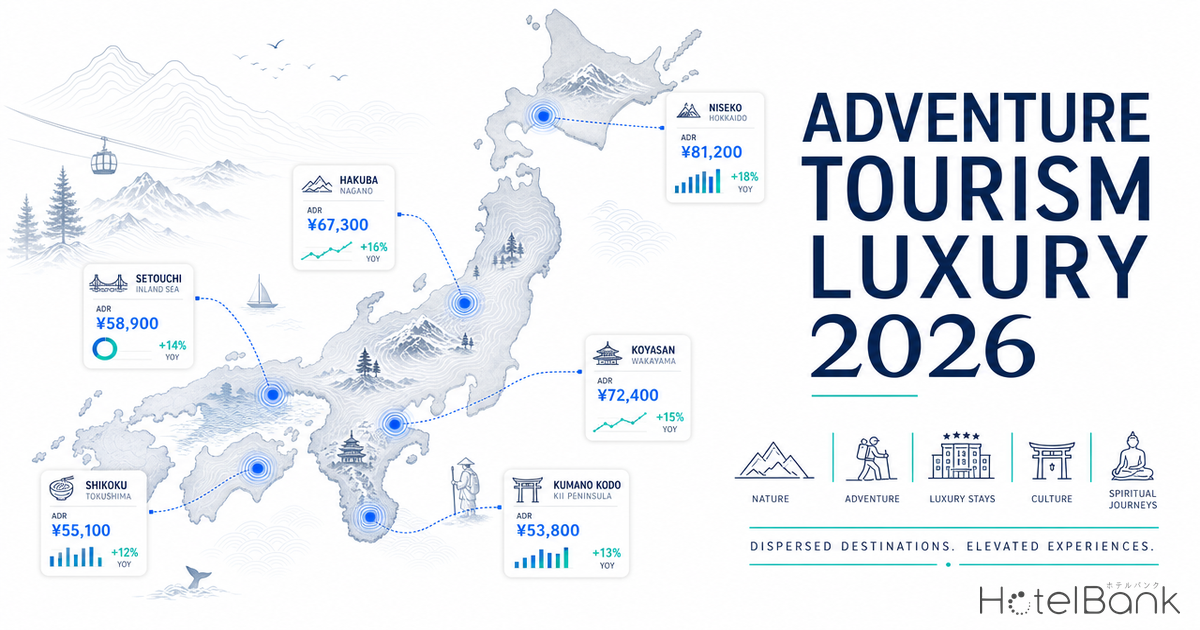
The global adventure travel (AT) market continues its rapid growth, and Japan is no exception. According to multiple market research firms, Japan’s AT market was valued at approximately $31.1 billion in 2025 and is projected to reach roughly $90 billion by 2034, with a compound annual growth rate (CAGR) of 12.54%. The Japan Tourism Agency (JTA) and JNTO have positioned AT as a core strategy for “attracting high-value travelers to regional areas,” and in September 2023, the Adventure Travel World Summit (ATWS) was held in Hokkaido, drawing over 750 buyers and media representatives from 64 countries.
The essence of AT is “immersive travel combining three elements: nature, culture, and physical activity.” The Western affluent travelers who drive this segment typically spend over ¥1 million per visit to Japan — precisely overlapping with the JTA’s definition of high-value travelers. This article visualizes the state of luxury accommodation readiness in Japan’s AT market by examining six key destinations: Niseko, Hakuba, Setouchi Art, Koyasan (Mt. Koya), Kumano Kodo, and Shikoku Pilgrimage (Tokushima). We analyze accommodation pricing data for May–June 2026 and guest review data (126,386 total reviews) compiled by MetroEngines Research.
Metric Definitions Used in This Article
- ADR (Average Daily Rate): The average of published selling prices on OTAs and similar platforms. This differs from actual transaction prices. Rates are per room for double occupancy (tax included), averaged across all plans (room-only through meal-inclusive).
- Analysis Period: Check-in dates from May 1 to June 30, 2026 (weekdays = Mon–Thu, weekends = Fri–Sun).
- Properties Covered: Luxury to upper-grade accommodations within a 5–10 km radius of each area’s center coordinates, plus representative properties with review scores of 4.3 or higher — 61 properties total (data collected).
- Data Sources: MetroEngines Research, compiled by HotelBank Editorial Team.
Japan’s AT Market Size and Policy Positioning
Japan is rapidly gaining prominence within the global AT market. According to estimates from multiple market research firms, Japan’s AT market reached $31.1 billion in 2025 and is projected to expand to $90 billion by 2034. A CAGR of 12.54% is more than double the overall global hotel industry growth rate (5–6%), indicating that AT is a structurally growing segment.
Policy tailwinds are also favorable. The Japan Tourism Agency has developed its “Adventure Tourism Knowledge Collection,” and JNTO maintains a dedicated AT team that continues to invite tour operators and media from Western countries and Australia. According to JTA estimates, inbound visitors via AT will reach 5.1 million by 2025 and 10.14 million by 2030, with tourism revenue projected at approximately ¥1 trillion by 2030. Per-capita spending of $3,728 (approximately ¥550,000) is several times higher than the average for visitors to Japan, making AT a rare segment that achieves both regional visitor distribution and high per-night rates. The ripple effects of inbound demand on regional ADR have been analyzed in detail in our May 2026 inbound booking trends report.
However, challenges are also clear. A survey of ATWS 2023 participants cited Japan’s AT product weaknesses as “guide English proficiency,” “distance to destinations,” and “insufficient information dissemination.” In other words, accommodations where affluent travelers want to stay exist in regional areas, but the “delivery” and “reception environment” remain bottlenecks.
Source: Spherical Insights, JTA Knowledge Collection, JNTO materials; compiled by HotelBank Editorial Team
ADR Map of 6 Areas: A Clear 3-Tier Structure
Comparing the average ADR across all six areas for May–June 2026 reveals a clear three-tier structure. The top tier comprises Koyasan (average ¥79,000, N=582) and Niseko (average ¥72,000, N=439). The middle tier includes Hakuba (¥44,500, N=585) and Kumano Kodo (¥39,100, N=405). The lower tier consists of Setouchi Art (¥27,900, N=284) and Shikoku Pilgrimage / Tokushima (¥16,000, N=904). With an approximately 5x price gap between the top and bottom tiers, the areas functioning as luxury AT destinations versus those that are not is strikingly clear.
Source: MetroEngines Research, compiled by HotelBank Editorial Team
Koyasan’s presence is particularly notable. While its image as a tourist destination centers on “temple lodgings (shukubo),” the upper tier of these shukubo have established a price range of ¥80,000–¥180,000 per night through product design combining luxury Japanese-style rooms, shojin ryori (Buddhist cuisine), and meditation experiences. Examples include Ichijoin (¥177,700/room, tax included), Shukubo Ekoin (¥139,000/room, tax included), and Shukubo Sojiin (¥88,900/room, tax included) — multiple shukubo maintaining high occupancy rates driven by bookings from Western affluent travelers. It is a rare destination that has possessed all three AT requirements — “cultural experience + physicality + nature” — for over a millennium.
Niseko needs no introduction as a luxury resort cluster. Ultra-high-net-worth-focused boutique villas and hidden retreats, represented by Zaborin (average ¥205,200/room, tax included per unit), line the area. While the ADR for May–June is 20–30% lower than the winter peak season (December–February), the luxury segment still maintains ¥60,000–¥100,000, suggesting growing recognition of the green season “Summer Niseko.” The expansion of foreign hotel brands in Hokkaido has been examined in our Hyatt Centric Sapporo opening report.
Source: MetroEngines Research, compiled by HotelBank Editorial Team
Weekday vs. Weekend ADR — Affluent Demand Is “Day-Agnostic”
Typical domestic travel demand concentrates on weekends, with resort hotels commonly showing a 20–40% price differential between weekdays and weekends. However, in areas where AT affluent travelers are the primary customer base, this pattern is weak or even reversed.
| Area | Weekday ADR | Weekend ADR | Weekend Premium | P75 (Upper Quartile) |
|---|---|---|---|---|
| Koyasan | ¥80,400 | ¥77,500 | -3.6% | ¥103,800 |
| Niseko | ¥73,600 | ¥70,300 | -4.5% | ¥88,000 |
| Hakuba | ¥43,000 | ¥46,200 | +7.4% | ¥63,400 |
| Kumano Kodo | ¥38,200 | ¥40,200 | +5.2% | ¥49,000 |
| Setouchi Art | ¥27,400 | ¥28,400 | +3.7% | ¥34,400 |
| Tokushima Pilgrimage | ¥15,500 | ¥16,600 | +7.1% | ¥19,300 |
Source: MetroEngines Research, compiled by HotelBank Editorial Team
Koyasan and Niseko exhibit a “reverse weekend premium” where weekday ADR exceeds weekend rates. This is evidence that long-stay Western affluent and inbound guests are filling weekdays with consecutive-night bookings, rather than domestic weekend visitors. In other words, these two areas already have low dependence on domestic weekend demand, with booking patterns aligned to the flight and vacation schedules of global affluent travelers becoming the primary driver of pricing. Meanwhile, Hakuba, Kumano Kodo, Setouchi, and Tokushima still follow a conventional pattern where domestic weekend visitors dominate, generating a +3–7% weekend premium.
Looking at P75 (upper quartile) ADR, the figures are: Koyasan ¥103,800, Niseko ¥88,000, Hakuba ¥63,400, Kumano Kodo ¥49,000, Setouchi ¥34,400, and Tokushima ¥19,300 — with the gap widening even further beyond average ADR. This reflects the difference between “areas where multiple luxury-focused specialist properties exist” and those where they do not. Whether a destination can establish pricing in the upper quartile range is a critical indicator for capturing AT affluent demand.
Guest Reviews: Each Area’s Strengths and Room for Growth
Next, we analyze 126,386 guest reviews compiled by MetroEngines Research and examine category-level ratings by area. In overall scores, Koyasan leads at 4.65, followed by Niseko at 4.57 and Setouchi at 4.51, with Tokushima at the bottom at 4.24. The correlation between overall scores and average ADR is weak, confirming that price and satisfaction are evaluated on separate axes.
Source: MetroEngines Research, compiled by HotelBank Editorial Team (N=126,386)
Category-level analysis reveals each area’s distinct character. Koyasan maintains high marks across all categories — Service 4.43, Rooms 4.35, and Cleanliness 4.41 — with the “disciplined hospitality” rooted in shukubo culture earning particular praise. Niseko scores well on Value for Money at 4.41 and Facilities/Amenities at 4.19, with resort-level facilities rated as commensurate with pricing. Kumano Kodo achieves the highest bath/onsen score across all areas at 4.52, with the “World Heritage site + onsen” combination proving highly effective.
However, areas for improvement are also clear. Setouchi Art significantly trails other areas in Dining at 3.28, Cleanliness at 3.70, and Location at 3.70, reflecting the structural challenge of a landscape dominated by guesthouses and minshuku with virtually no luxury-class properties. Despite possessing globally rare art tourism content, the area lags behind in luxury accommodation development. Hakuba‘s Facilities/Amenities score of 4.05 is somewhat lower than Niseko and Koyasan, suggesting significant room for developing premium facilities to support “summer trekking, mountain biking, and paragliding demand” needed to capture AT affluent travelers during the ski off-season (May–June).
3-Axis Matrix: Luxury-Ready Areas vs. White Spaces
Mapping the six areas across three axes — “ADR level,” “upper quartile depth,” and “overall review score” — reveals the landscape of luxury AT readiness in Japan.
Source: MetroEngines Research, compiled by HotelBank Editorial Team
The upper-right cluster (high price x high rating) is occupied by Koyasan and Niseko. Both have linked their unique cultural and natural resources to luxury accommodation, achieving globally competitive pricing. The middle zone contains Hakuba and Kumano Kodo. Both areas have reached world-class AT content standards, but luxury accommodation supply is limited, with a thin upper quartile tier. Setouchi Art and Tokushima Pilgrimage sit in the lower left — white spaces where luxury accommodation infrastructure is severely lacking.
Regarding Setouchi, despite the presence of world-class art content such as the Benesse Art Site Naoshima and Chichu Art Museum, luxury to high-grade accommodations within a 10 km radius are limited, with ADR remaining at ¥27,900. However, plans for an Aman Naoshima and luxury resort projects by Setouchi Holdings are underway, and the landscape could change dramatically within the next few years. For Tokushima and the pilgrimage route, if English-guided pilgrimage tours and trail infrastructure improve, the area has the potential to become a “Japanese Camino de Santiago” for Western travelers.
Conclusion: 3 KPIs for the AT Market and Investment Opportunities in White Spaces
This analysis reveals three KPIs for Japan’s AT luxury market.
| Metric | Top Area | White Space |
|---|---|---|
| ADR Level (Average) | Koyasan ¥79,000 | Tokushima ¥16,000 |
| Upper Quartile ADR (P75) | Koyasan ¥103,800 | Tokushima ¥19,300 |
| Overall Review Score | Koyasan 4.65 | Tokushima 4.24 |
First, Koyasan and Niseko have reached maturity as “globally luxury-ready areas,” even achieving a reverse weekend premium where weekday ADR exceeds weekends. They represent some of the few proven examples of Japan’s AT being evaluated at world-class standards.
Second, Hakuba and Kumano Kodo are transitional areas where infrastructure has not yet caught up with content quality. Despite possessing World Heritage sites, national parks, and onsen resources, they lack luxury properties in the upper quartile tier, presenting significant opportunities for new openings or rebranding of existing facilities to push rate levels higher.
Third, Setouchi Art and Tokushima Pilgrimage are white spaces in luxury infrastructure — both a challenge and the greatest investment opportunity. Given that globally distinctive content in art tourism and pilgrimage tourism already exists, new luxury accommodation supply can be viewed as a demand-led opportunity with promising returns.
If, as JNTO projects, AT-driven visitors to Japan grow to 10 million by 2030, more than half of that spending will occur in regional areas. A per-capita spending level of ¥550,000 encompasses accommodation, dining, experiences, and guides as an integrated package — meaning that for lodging alone, demand for luxury stays at ¥30,000–¥100,000 per night will disperse across regional Japan. Of the six areas analyzed in this article, four still have “white space in upper quartile supply.” The next decade of Japan’s AT market will be determined by appropriate investment in these white spaces and the adoption of globally benchmarked operational expertise.
Note on Forward-Looking ADR: The ADR figures in this article represent the average of selling prices published on OTAs at the time of research and are subject to change as check-in dates approach. Please be aware that prices currently set high may decline through last-minute discounts, and averages may shift as additional room inventory becomes available.
Sources & References
- Japan Tourism Agency “Adventure Tourism Knowledge Collection” PDF
- Japan Tourism Agency “Promoting Adventure Tourism” Official Page
- JNTO “ATWS2023 Hokkaido/Japan Report” JNTO Website
- JNTO “Regional Potential to Meet the Needs of Travelers Seeking Premium Tourism Services” Report
- Spherical Insights “Japan Adventure Tourism Market” Market Size Estimates
- JTB Tourism Research & Consulting “Redefining the High-Value Traveler” Column
- DBJ Hokkaido Branch “Building Sustainable Tourism in Hokkaido Through Adventure Tourism” DBJ Report PDF