

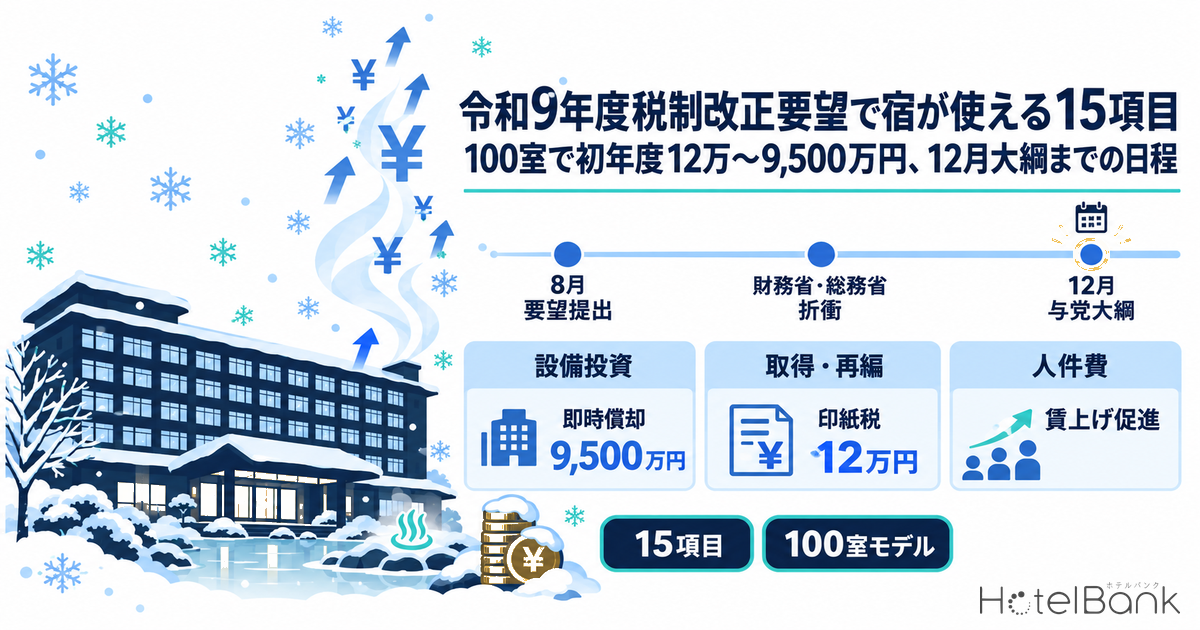
The FY2027 (Reiwa 9) tax reform requests from government ministries and agencies, compiled by the Ministry of Finance as of August 31, total 208 items including duplicates (124 after removing duplicates). Of these, the Ministry of Land, Infrastructure, Transport and Tourism (MLIT, including the Japan Tourism Agency) submitted 34 and the Ministry of Economy, Trade and Industry (METI) submitted 48. Using these primary documents and the local-tax requests published by the Ministry of Internal Affairs and Communications (MIC), this article picks out the items that affect the acquisition, renovation, succession and labor costs of lodging properties, lists each item’s requesting body, scope and deadline, and then models a hotel with 100 rooms and a ¥2 billion building acquisition price to estimate the tax difference in year one and cumulatively. It also sets out the timeline to the ruling parties’ tax reform outline in December.
Everything covered here is a ministry “request”, not a decision. The requests will now go through negotiations with the MOF Tax Bureau and the MIC Local Tax Bureau and deliberation by the ruling parties’ tax commissions, and their adoption and content will be settled in the December outline. Schemes for which an extension is requested remain available as they are until their current deadline (in most cases March 31, 2027), but the requirements after an extension may change. Please consult a certified tax accountant for tax decisions based on your own circumstances.
- — Of the 208 items (124 after removing duplicates), no national-tax item names the lodging industry; lodging properties benefit through three routes: the “SME track”, the “location track” and the “acquisition track”
- — In the model of 100 rooms and a ¥2 billion building, using immediate expensing under the SME Management Strengthening Tax Scheme on a ¥300 million renovation defers ¥95.17 million in year one (¥0.95 million per room); choosing the 10% tax credit gives a permanent saving of ¥30 million
- — Immediate expensing reverses by ¥6.83 million a year from year two, leaving ¥67.83 million cumulatively after five years and zero after 15 years. The property tax special measure for advanced equipment (3% wage increase) yields ¥11.03 million over five years that never reverses
- — The SME special measures apply only to companies with capital of ¥100 million or less; with capital above ¥100 million, the model’s benefit, excluding the location and acquirer tracks, is just ¥120,000 of stamp duty. The order of magnitude is set by capital, not room count
- — All are at the request stage; adoption, rates and deadlines will be fixed in the ruling parties’ tax reform outline in mid-to-late December (last year, deliberations began on November 20 and the outline was decided on December 19)
About the Data in This Article
- Source of request items: MLIT and METI request sheets published in the Ministry of Finance’s “FY2027 Tax Reform Requests” (requests submitted by ministries, dated August 31); request sheets in MIC’s “FY2027 Tax Reform Requests from Ministries (Local Taxes)”; and MLIT’s “FY2027 MLIT Tax Reform Requests” (published August 28, 2026). Item names, rates and deadlines are quoted as stated in the sheets.
- Assumptions of the 100-room model: The property is acquired for a total of ¥2 billion — a ¥1.4 billion building (reinforced concrete, straight-line, depreciation rate 0.026) and ¥600 million of building fixtures (straight-line, depreciation rate 0.067) — with land excluded. The combined effective tax rate for corporate tax, local corporate tax, corporate inhabitant tax and enterprise tax is 34% (an approximation for the portion of an SME’s income above ¥8 million), the property tax rate is 1.4%, and depreciable assets are valued on the declining-balance method (15-year useful life, depreciation factor 0.142).
- Nature of the estimates: Effects labeled “deferral” shift the timing of taxation and do not change cumulative tax. Effects labeled “permanent” reduce the tax itself. All are upper-bound values assuming credit limits (such as 20% of corporate tax) are not reached; actual tax depends on each company’s income, capital and whether plans are certified. Please confirm tax decisions with a certified tax accountant.
- Distribution of property size: Among domestic properties tracked by MetroEngines Research, the 30,069 properties in hotel and ryokan categories with a registered room count were aggregated into property and room counts by room-size band.
Overview of the Requests — Few Items Name Lodging; Benefits Come Through the “SME” and “Location” Tracks
Looking first at the whole picture, the Ministry of Finance’s simple tally shows 208 requested items and 8 items for abolition or reduction, with MLIT submitting 34 items and 1, and METI 48 items and 1. None of the national-tax items includes “lodging”, “hotel” or “ryokan” in its name, and the Japan Tourism Agency is the responsible division for only two: the “Extension of special taxation measures in Okinawa’s tourism destination development promotion areas” and the “Review of confirmation procedures for the consumption tax exemption system for foreign travelers following the introduction of the Japan Electronic System for Travel Authorization (JESTA)”.
In practice, however, lodging properties benefit through other routes. One is the capital investment, wage increase and corporate tax rate special measures overseen by the Small and Medium Enterprise Agency; these cover “almost all industries”, so any lodging operator with capital of ¥100 million or less can use them. Another is location-linked special measures: the accelerated depreciation for peninsula and remote-island areas explicitly lists the “ryokan business” among eligible industries, and Okinawa’s investment tax credit includes “hot spring recreation facilities attached to lodging facilities” and “conference and training facilities attached to lodging facilities” among eligible facilities. Finally, at the acquisition and securitization stage, the stamp duty reduction and the registration and license tax and real estate acquisition tax special measures for REITs apply to hotel transactions themselves. The sections below are organized along these three routes.
| Ministry | Requested items | Items for abolition/reduction |
|---|---|---|
| MLIT (incl. Japan Tourism Agency) | 34 | 1 |
| METI (incl. Small and Medium Enterprise Agency) | 48 | 1 |
| Ministry of Health, Labour and Welfare | 21 | 0 |
| Financial Services Agency | 20 | 1 |
| Ministry of Agriculture, Forestry and Fisheries | 19 | 3 |
| Total, all 18 ministries and agencies (incl. duplicates) | 208 | 8 |
| Excluding duplicates | 124 | 4 |
Source: Compiled by HotelBank Editorial Team from Ministry of Finance, “Status of FY2027 Tax Reform Requests” (simple tally as of August 31)
Requests Relevant to Lodging Properties — Requesting Body, Scope and Deadline
The table below extracts the items relevant to lodging investment decisions from both national taxes (compiled by the Ministry of Finance) and local taxes (compiled by MIC). “Current deadline” is as stated in each sheet; if a request is approved, the measure continues until the “after request” deadline. The deadline of the business succession tax scheme (December 2027) and the issue of own-share valuation are covered separately, so this table focuses on new and extension items in the FY2027 requests. The table has 16 rows, but because we could not confirm the content of the request sheet for accelerated depreciation in depopulated areas, that row is shown for reference only; the “15 items” in this article exclude it.
| Requested item | Requesting body | How it applies to lodging properties | Current deadline → after request | Tax type |
|---|---|---|---|---|
| Expansion of the SME Management Strengthening Tax Scheme (more flexible requirements for business-scale-expansion equipment; 2-year extension) | SME Agency (jointly submitted by MLIT) | With a certified Management Improvement Plan, acquiring tools/fixtures, building fixtures, software, etc. qualifies for immediate expensing or a 10% tax credit (7% for capital over ¥30 million up to ¥100 million) | 2027/3/31 → 2029/3/31 | Corporate tax, income tax |
| Extension of the SME Investment Promotion Tax Scheme (extension with review) | SME Agency (jointly submitted by MLIT) | Without plan certification, 30% special depreciation or a 7% tax credit on machinery, software, etc. (tax credit only for capital of ¥30 million or less) | 2027/3/31 → 2029/3/31 | Corporate tax, income tax |
| Expansion of the property tax special measure for SME capital investment contributing to productivity and wage increases (review of wage-increase requirements, expansion to R&D equipment; 2-year extension) | SME Agency (local tax) | For newly acquired depreciable assets under an Advanced Equipment Introduction Plan, the tax base is halved for 3 years with a wage-increase policy of 1.5% or more, or cut to 1/4 for 5 years with 3.0% or more | 2027/3/31 → 2029/3/31 | Property tax |
| Expansion and extension of the wage increase promotion tax scheme for SMEs (3-year extension; requirement shifted to “average salary per employee”) | SME Agency | Raising total payroll by 1.5%/2.5% or more earns a tax credit of 15%/30% of the increase, plus 5% for Kurumin/Eruboshi certification; credit capped at 20% of corporate tax, 5-year carryforward | 2027/3/31 → 2030/3/31 (FY2027–FY2029) | Corporate tax, income tax |
| Expansion and extension of the SME Disaster Prevention and Mitigation Investment Promotion Tax Scheme (flood-prevention equipment added as structures; can be combined with local government subsidies; 2-year extension) | SME Agency | With a certified Business Continuity Enhancement Plan, acquiring private power generators, water-stop equipment, etc. qualifies for special depreciation (16% for acquisitions from April 2025) | 2027/3/31 → 2029/3/31 | Corporate tax, income tax |
| Extension of the special corporate tax rate for SMEs | SME Agency | Applies 15% instead of the standard 19% to annual income up to ¥8 million | 2027/3/31 → 2029/3/31 | Corporate tax |
| Extension of the special measure for entertainment expenses (deductibility for SMEs) | SME Agency | Entertainment expenses up to the fixed deduction limit of ¥8 million are deductible | 2027/3/31 → 2030/3/31 | Corporate tax |
| Extension of the stamp duty special measure for construction contracts and real estate transfer contracts (3-year extension) | MLIT Construction Industry Promotion Division | Reduces stamp duty on hotel sale contracts and renovation construction contracts by 20–50% from the standard rate | 2027/3/31 → 2030/3/31 | Stamp duty |
| Extension of the registration and license tax special measure for REITs and TMKs (2-year extension), and the 3/5 deduction from the real estate acquisition tax base (local tax) | MLIT Real Estate Market Development Division | When a REIT etc. acquires a hotel, the transfer registration rate falls from the standard 2% to 1.3%, and 3/5 is deducted from the real estate acquisition tax base | 2027/3/31 → 2029/3/31 | Registration and license tax, real estate acquisition tax |
| Extension of the SME business restructuring investment loss reserve (mid-size/SME grouping tax scheme) (3-year extension, procedural review) | SME Agency (jointly submitted by MLIT) | When an SME with a certified Management Improvement Plan conducts M&A through share acquisition, 70% of the acquisition price can be deducted as a reserve (added back to income over 5 years after a 5-year grace period) | 2027/3/31 → 2030/3/31 | Corporate tax |
| Extension of accelerated depreciation for industrial machinery, etc. in Peninsula Promotion and Remote Island Promotion areas (2-year extension each) | MLIT National and Regional Policy Bureau | Explicitly lists “ryokan business” as eligible. For 5 years, additional depreciation of 32% of the ordinary limit for machinery and 48% for buildings, fixtures and structures. Capital of ¥50 million or less: acquisitions etc.; above that: new construction or expansion | 2027/3/31 → 2029/3/31 | Corporate tax, income tax |
| Extension of accelerated depreciation for business equipment, etc. in depopulated areas | MLIT | Listed as an item in the Ministry of Finance request list (the sheet is in image format, so details are not quoted in this article) | Extension requested | Corporate tax, income tax |
| Extension of special taxation measures in Okinawa’s tourism destination development promotion areas (3-year extension) | Japan Tourism Agency Regional Tourism Promotion Division (jointly with Cabinet Office and METI) | For new construction or expansion of hot spring recreation and conference facilities etc. attached to lodging facilities (acquisition cost over ¥10 million), 15% of machinery and 8% of buildings etc. is credited against corporate tax (limit 20% of corporate tax, 4-year carryforward, acquisition cost cap ¥2 billion). Automatically linked to corporate inhabitant tax | 2027/3/31 → 2030/3/31 | Corporate tax, corporate inhabitant tax, business office tax |
| Extension of the burden adjustment measures and municipal reduction system for property tax on land | MLIT (local tax) | Continues phase-in relief as the burden on commercial land is expected to rise with the FY2027 revaluation | Extension requested | Property tax, city planning tax |
| Review of acquisition cost thresholds for depreciable assets | METI Corporate Affairs Division | Reviews, in light of inflation, the thresholds for full expensing below ¥100,000 and 3-year equal depreciation from ¥100,000 to under ¥200,000 (no amounts given) | New (permanent) | Corporate tax, income tax |
| Review of confirmation procedures for the consumption tax exemption system for foreign travelers following the introduction of JESTA | Japan Tourism Agency Tourism Strategy Division | With JESTA introduced during FY2028, some entrants will not receive a landing permission stamp, so confirmation procedures at in-hotel duty-free shops will be revised | Permanent measure | Consumption tax, liquor tax |
Source: Compiled by HotelBank Editorial Team from MLIT and METI request sheets in the Ministry of Finance’s “FY2027 Tax Reform Requests” and MIC’s “FY2027 Tax Reform Requests from Ministries (Local Taxes)”
Two points in the table are new for the lodging industry. The first is the “business-scale-expansion equipment” category of the SME Management Strengthening Tax Scheme. For this expanded category, added in the FY2025 reform to cover buildings and their fixtures, the request seeks “stronger incentives, including more flexible eligibility requirements”. According to expert commentary, the current expanded category requires, among other things, an investment plan aiming for sales above ¥10 billion, a design that is hard for a standalone 100-room hotel to reach; if requirements are relaxed, it could become usable for investments involving extensions or rebuilding. (The current Type E category offers 15–25% special depreciation on the building itself, conditional on a 5% wage increase.) The second is the acquisition cost threshold for depreciable assets: the ¥100,000 and ¥200,000 thresholds have been left unchanged for many years. Replacements of guest room TVs, refrigerators and bedding cluster around these thresholds, so depending on the details of the review, year-one deductible expenses could shift.
Setting Up the 100-Room Model — 2,300 Properties and 278,000 Rooms Sit in the Same Size Band
Before the estimates, let us check which segment a 100-room property represents. Among domestic properties tracked by MetroEngines Research, aggregating the 30,069 properties in hotel and ryokan categories with a registered room count by size shows 2,300 properties with 100–149 rooms holding 278,334 rooms; together with 1,525 properties with 150–199 rooms holding 261,447 rooms, the “100-room range” accounts for 539,781 rooms. By property count, those under 20 rooms dominate at 13,537, but by rooms the 100-room range (about 540,000) and 200+ rooms (about 600,000) each carry roughly 30% of the total (about 31% and 34%), so 100 rooms is close to the center of room supply.
Source: Compiled by HotelBank Editorial Team from MetroEngines Research (hotel and ryokan categories, properties with a registered room count, N=30,069 properties)
The model is set as follows. An existing hotel is acquired for a total of ¥2 billion — a ¥1.4 billion building and ¥600 million of building fixtures — with land separate. The building is reinforced concrete depreciated on the straight-line method (rate 0.026, ¥36.4 million a year) and the fixtures on the straight-line method (rate 0.067, ¥40.2 million a year). In the first year after acquisition, the owner invests ¥300 million in tools/fixtures and building fixtures as a guest room renovation, ¥30 million in machinery and ¥20 million in a private power generator, and raises wages by 2.5% for 40 employees with total payroll of ¥140 million. The effective tax rate for corporate taxes is 34%. SME special measures apply to corporations with capital of ¥100 million or less (some tax credits only to ¥30 million or less), so capital within this range is also assumed. All of these are assumptions; when applying them to your own accounts, please reset the assumptions with your tax accountant.
Estimate 1: Capital Investment — ¥95 Million Moves in Year One With Immediate Expensing, ¥30 Million With the Tax Credit
The largest effect comes from the SME Management Strengthening Tax Scheme. If the ¥300 million renovation (tools/fixtures and building fixtures) is acquired under a certified Management Improvement Plan and immediate expensing is chosen, the difference of ¥279.9 million versus ordinary depreciation (15-year straight-line, ¥20.1 million a year) is added to year-one deductible expenses. At a 34% effective tax rate, year-one tax falls by ¥95.17 million, equivalent to ¥0.95 million per room. However, this is a deferral: from year two, the tax on the ¥20.1 million of depreciation that would ordinarily have been deducted comes back at ¥6.83 million every year, so the difference disappears over 15 years. Choosing the tax credit instead permanently reduces tax by ¥30 million, or 10% of the acquisition cost (¥21 million at 7% for capital over ¥30 million up to ¥100 million). Which is better depends on the size of year-one income and the credit cap of 20% of corporate tax.
The SME Investment Promotion Tax Scheme is easier to use because it requires no plan certification. Applying 30% special depreciation to ¥30 million of machinery increases year-one deductible expenses by ¥9 million, a tax deferral of ¥3.06 million. With capital of ¥30 million or less, the 7% tax credit (¥2.1 million) can also be chosen. Hotel assets classed as machinery are limited (linen laundry equipment, some kitchen machinery, etc.), so items classed as building fixtures, such as air conditioning and plumbing, are logically picked up under the Management Strengthening Tax Scheme.
The Disaster Prevention and Mitigation Investment Promotion Tax Scheme is small in scale, but the request brings a practical change. Applying 16% special depreciation to a ¥20 million private power generator increases year-one deductible expenses by ¥3.2 million, a tax deferral of ¥1.09 million. The request adds flood-prevention equipment (structures) to eligible assets and allows combination with local government subsidies, moving toward a combination in which flood barriers and waterproof doors are installed with municipal subsidies while also using special depreciation.
On the property tax side, the special measure under the Advanced Equipment Introduction Plan applies directly to renovation investment. The ¥300 million of newly acquired depreciable assets has a year-one assessed value of ¥278.7 million (declining-balance, half-year depreciation), and property tax of ¥3.9 million. Declaring a wage-increase policy of 1.5% or more halves the tax base for 3 years, a reduction of ¥1.95 million in year one and ¥5.06 million over 3 years. With 3.0% or more, the base is cut to 1/4 for 5 years, widening the reduction to ¥2.93 million in year one and ¥11.03 million over 5 years. This is not a deferral but a permanent reduction in tax itself, and the request is to review the wage-increase requirement and extend the measure by 2 years.
Source: HotelBank Editorial Team estimates applying the rates and limits in the ministries’ FY2027 tax reform request sheets to the 100-room model (assumptions in text). Deferral = difference in timing of taxation; permanent = difference in tax amount
Estimate 2: Acquisition and Restructuring — ¥120,000 of Stamp Duty, ¥37 Million for REIT Acquisitions, ¥119 Million From the M&A Reserve
Stamp duty applies to anyone at the acquisition stage. A ¥2 billion real estate transfer contract falls in the “over ¥1 billion up to ¥5 billion” bracket, with duty of ¥320,000 under the special measure versus the standard ¥400,000; a ¥300 million renovation construction contract falls in the “over ¥100 million up to ¥500 million” bracket, with ¥60,000 versus the standard ¥100,000 — a combined difference of ¥120,000. The amount is small, but note that if the request is not approved, contracts from April 2027 onward revert to the standard rates. The request is a 3-year extension to March 31, 2030.
If the acquirer is a REIT or similar, the scale changes. The registration and license tax on transfer registration uses the property tax assessed value as its base; assuming an assessed value of ¥1.2 billion (60% of the acquisition price), tax falls from ¥24 million at the standard 2% to ¥15.6 million at the special 1.3%, a difference of ¥8.4 million. On the local tax side, 3/5 is deducted from the base of the real estate acquisition tax (4% for non-residential buildings), reducing it by ¥28.8 million. The total is ¥37.2 million, or ¥372,000 per room, and MLIT is requesting a 2-year extension as a means to achieve the government’s target of “total REIT assets of about ¥40 trillion by around 2030”.
When an operating company buys a ryokan or hotel through a share acquisition, the mid-size/SME grouping tax scheme (SME business restructuring investment loss reserve) is available. For a ¥500 million share acquisition, ¥350 million (70%) can be deducted as a reserve, deferring ¥119 million of tax in year one. It is added back to income over 5 years after a 5-year grace period, so it disappears cumulatively, but it matters greatly for cash flow right after an acquisition. The request is a 3-year extension and a “procedural review reflecting the realities of SME M&A”, jointly submitted by MLIT.
Estimate 3: Labor Costs and Income — ¥1.05 Million a Year From a 2.5% Wage Increase, ¥320,000 a Year From the Reduced Rate
The wage increase promotion tax scheme is the item whose design moves most among the requests. Currently, raising total payroll by 1.5% or more year on year earns a tax credit of 15% of the increase, or 30% at 2.5% or more, with an additional 5% for Kurumin or Eruboshi certification. In the model with total payroll of ¥140 million, a 2.5% (¥3.5 million) increase yields a credit of ¥1.05 million, or ¥1.22 million with the add-on; sustained for 3 years, ¥3.15 million is permanently saved. The credit is capped at 20% of corporate tax, and unused amounts can be carried forward for 5 years.
The request is to extend this by 3 years and change the total-based test of “increase in total employee salaries” to an “increase in average salary per employee” test. In industries like lodging where headcount fluctuates with seasonality, the total-based test was hard to meet in years when headcount fell, but a per-employee average test would change how a company is assessed. The thresholds themselves are also to be reviewed to “support more aggressive wage increases”, so how the rates and requirements are set in the December outline will be the most immediate issue for the lodging industry. Outside the SME version, the wage increase tax scheme was abolished for large companies and reduced for mid-size companies in the FY2026 reform, making the SME track the core of the scheme.
The special corporate tax rate applies 15% instead of 19% to annual income up to ¥8 million, a difference of ¥320,000 a year if income is ¥8 million or more, or ¥640,000 over a 2-year extension. The entertainment expense special measure extends SMEs’ deductibility up to ¥8 million by 3 years and is relevant to hotels with wedding and banquet sales activities. In its July 28 requests, the Japan Hotel Association also asked for an increase in the non-taxable cap on food and drink entertainment expenses (¥10,000), which is not included in the SME Agency’s request sheet.
Looking Cumulatively — “Deferrals” Unwind, “Permanent” Savings Accumulate
Lined up on year-one figures alone, immediate expensing’s ¥95.17 million stands out, but the picture changes on a five-year cumulative basis. The immediate-expensing benefit reverses by ¥6.83 million a year from year two, leaving ¥67.83 million cumulatively in year five and zero by year 15. The peninsula and remote-island accelerated depreciation is also a deferral, but it builds by ¥12.5 million a year over five years, reaching ¥62.51 million cumulatively, before reversing over the remaining depreciation period. By contrast, the property tax special measure (3% wage increase, 1/4 for 5 years) leaves ¥11.03 million over five years, and the wage increase tax scheme ¥1.05 million a year, or ¥5.25 million over five years, both as permanent effects that never reverse.
Source: HotelBank Editorial Team estimates (100-room model). Deferrals shift the timing of taxation; the cumulative difference returns to zero at the end of the depreciation period
| Item (application assumed in model) | Year one | 5-year cumulative | Per room (year one) | Nature |
|---|---|---|---|---|
| Management Strengthening: immediate expensing (¥300m renovation) | ¥95.17m | ¥67.83m | ¥952,000 | Deferral |
| Management Strengthening: 10% tax credit (same; alternative to immediate expensing) | ¥30.00m | ¥30.00m | ¥300,000 | Permanent (limit 20% of corporate tax) |
| Okinawa tourism promotion areas (¥200m hot spring facilities etc. + ¥30m machinery) | ¥20.50m | ¥20.50m | ¥205,000 | Permanent (4-year carryforward) |
| Peninsula/remote island accelerated depreciation 48% (new ¥1.4bn building + ¥600m fixtures) | ¥12.50m | ¥62.51m | ¥125,000 | Deferral (5 years) |
| Advanced equipment property tax measure, 3% wage increase (¥300m depreciable assets) | ¥2.93m | ¥11.03m | ¥29,000 | Permanent |
| Advanced equipment property tax measure, 1.5% wage increase (same) | ¥1.95m | ¥5.06m (3 years) | ¥20,000 | Permanent |
| Investment Promotion: 30% special depreciation (¥30m machinery) | ¥3.06m | — | ¥31,000 | Deferral (¥2.1m permanent with 7% credit) |
| Wage increase promotion: 2.5% raise (¥140m payroll) | ¥1.05m | ¥5.25m | ¥11,000 | Permanent (limit 20% of corporate tax) |
| Disaster prevention/mitigation: 16% special depreciation (¥20m generator) | ¥1.09m | — | ¥11,000 | Deferral |
| Special corporate tax rate 15% (if income exceeds ¥8m) | ¥0.32m | ¥0.64m (2 years) | ¥3,000 | Permanent |
| Stamp duty special measure (¥2bn transfer contract + ¥300m construction contract) | ¥0.12m | ¥0.12m | ¥1,000 | Permanent (at contract only) |
| REIT registration and license tax 1.3% + real estate acquisition tax 3/5 deduction (assessed value ¥1.2bn) | ¥37.20m | ¥37.20m | ¥372,000 | Permanent (acquirer is a REIT etc.) |
| Grouping tax scheme: 70% reserve (¥500m share acquisition) | ¥119.00m | ¥119.00m | ¥1.19m | Deferral (added back over 5 years after 5-year grace) |
Source: HotelBank Editorial Team estimates based on rates and limits in the ministries’ FY2027 tax reform request sheets. Effective tax rate 34%, property tax rate 1.4%, assuming credit limits are not reached
Sensitivity — How the Effect Moves With Capital Bracket, Renovation Amount and Tax Rate
The estimates so far rest on a single set of assumptions: “capital of ¥100 million or less, a ¥300 million renovation and a 34% effective tax rate”. In reality, which special measures are available depends on capital, and the size of the effect moves with investment amount and tax rate. First, the year-one effects of the items usable in the model were summed by capital bracket (the location tracks for Okinawa and peninsulas/remote islands, and the track for acquisitions by REITs etc., are added separately).
| Capital bracket | Items usable in the model | Year one (immediate expensing / special depreciation chosen) | Year one (tax credit chosen) |
|---|---|---|---|
| Capital ¥30m or less | Management Strengthening (immediate expensing or 10% credit), Investment Promotion (30% special depreciation or 7% credit), disaster prevention/mitigation, advanced equipment (3% wage increase), wage increase promotion, 15% corporate tax rate, stamp duty | ¥103.74m | ¥37.61m |
| Capital over ¥30m up to ¥100m | Management Strengthening (immediate expensing or 7% credit), Investment Promotion (30% special depreciation only), disaster prevention/mitigation, advanced equipment (3% wage increase), wage increase promotion, 15% corporate tax rate, stamp duty | ¥103.74m | ¥29.57m |
| Capital over ¥100m (not an SME etc.) | Stamp duty only (SME special measures not applicable) | ¥0.12m | ¥0.12m |
Source: HotelBank Editorial Team estimates summing the items in Table 3 according to eligibility by capital bracket. The immediate expensing / special depreciation column includes deferrals; the tax credit column is permanent effect, excluding disaster prevention/mitigation (special depreciation). Assumes credit limits are not reached
With capital of ¥100 million or less, the year-one effect when choosing immediate expensing is about ¥103.74 million, unchanged across the ¥30 million capital line. The difference appears when choosing tax credits: ¥37.61 million for ¥30 million or less, but only ¥29.57 million for over ¥30 million up to ¥100 million, because the Management Strengthening credit rate falls to 7% and the Investment Promotion credit is unavailable. Above ¥100 million of capital, none of the SME special measures can be used, leaving only the ¥120,000 of stamp duty in the model. Even for the same 100-room hotel, the order of magnitude of the effect is set by capital, not room count.
| Renovation amount (tools/fixtures, building fixtures) | Immediate expensing, 25% effective rate | Immediate expensing, 30% | Immediate expensing, 34% | 10% tax credit | Corporate tax needed to use the credit fully in the year |
|---|---|---|---|---|---|
| ¥100m | ¥23.33m | ¥27.99m | ¥31.72m | ¥10.00m | ¥50.00m |
| ¥200m | ¥46.65m | ¥55.98m | ¥63.44m | ¥20.00m | ¥100.00m |
| ¥300m (model) | ¥69.98m | ¥83.97m | ¥95.17m | ¥30.00m | ¥150.00m |
| ¥400m | ¥93.30m | ¥111.96m | ¥126.89m | ¥40.00m | ¥200.00m |
| ¥500m | ¥116.63m | ¥139.95m | ¥158.61m | ¥50.00m | ¥250.00m |
Source: HotelBank Editorial Team estimates applying the rates and limits in the SME Management Strengthening Tax Scheme request sheet to the 100-room model. Immediate expensing = year-one difference versus ordinary depreciation (15-year straight-line, rate 0.067) × effective tax rate, a deferral. Because the tax credit is capped at 20% of corporate tax, the rightmost column = credit ÷ 20%
The immediate-expensing effect is roughly proportional to renovation amount and tax rate, ranging from ¥23.33 million for a ¥100 million renovation at a 25% effective rate to ¥158.61 million for ¥500 million at 34%. The 10% tax credit is unaffected by the tax rate, but the cap of 20% of corporate tax bites. Using the full ¥30 million credit in the year on the model’s ¥300 million renovation requires ¥150 million of corporate tax, and a standalone 100-room hotel company does not necessarily pay that much corporate tax every year. The smaller a company’s income, the less of the credit it can use, which makes the deferral from immediate expensing more effective for cash flow.
Two Location-Based Add-Ons — Okinawa’s 8% Credit and the 48% Accelerated Depreciation for Peninsulas and Remote Islands
The Japan Tourism Agency, jointly with the Cabinet Office and METI, is requesting a 3-year extension of the investment tax credit for tourism destination development promotion areas under the Act on Special Measures for the Promotion and Development of Okinawa. Eligible facilities explicitly include “recreation facilities (including hot spring recreation facilities attached to lodging facilities)” and “assembly facilities (including conference and training facilities attached to lodging facilities)”, so the credit covers new construction or expansion of attached facilities rather than the lodging building itself. If the model newly builds ¥200 million of hot spring and conference buildings and ¥30 million of machinery, 8% of the buildings (¥16 million) and 15% of the machinery (¥4.5 million), totaling ¥20.5 million, is credited against corporate tax. The limit is 20% of corporate tax, and amounts not used can be carried forward for 4 years. On the local tax side, it is automatically linked to the corporate tax portion of the corporate inhabitant tax, and specified private tourism facilities over ¥100 million newly built in Naha City have the asset-based business office tax base halved for 5 years. The Japan Tourism Agency’s sheet sets as targets for this measure Okinawa tourism revenue of ¥1.3328 trillion in FY2029 and capital investment by users of ¥3.038 billion.
The accelerated depreciation for Peninsula Promotion and Remote Island Promotion areas covers manufacturing, the ryokan business, sales of agricultural, forestry and fishery products, information services and others, in areas where municipalities have drawn up industry promotion plans certified by the competent minister. For the ryokan business, companies with capital of ¥50 million or less are eligible for acquisitions etc. of machinery, buildings, fixtures and structures, and those above ¥50 million for new construction or expansion; the minimum acquisition cost is ¥5 million for capital of ¥10 million or less, ¥10 million for over ¥10 million up to ¥50 million, and ¥20 million above ¥50 million. For 5 years, an additional 32% of the ordinary depreciation limit for machinery and 48% for buildings, fixtures and structures can be depreciated. If the model’s ¥1.4 billion building and ¥600 million of fixtures are newly built in a peninsula area, 48% of ordinary depreciation of ¥76.6 million, or ¥36.77 million, is added each year, deferring ¥12.5 million of tax a year, or ¥62.51 million over 5 years. MLIT’s sheet shows population change of −13.5% in peninsula areas and −17.2% on remote islands (2015 to 2024) and cites the need to support the ryokan business as a core local industry as the reason for the extension. Combined with property tax exemptions by ordinance in designated areas, this accelerated depreciation moves investment IRR by roughly 0.6pt depending on location.
Local Tax Issues — The FY2027 Revaluation and Burden Adjustment Measures for Land
Hotel property tax is levied on three layers: buildings, depreciable assets and land. For land, MLIT has included the “Extension of the burden adjustment measures and municipal reduction system for property tax on land” in its local tax requests. The sheet states that because land prices are rising nationwide, especially sharply from 2024 to 2026, “the property tax burden on commercial land, etc. is expected to increase significantly with the FY2027 revaluation”, and positions the burden adjustment measures as having “the effect of easing the sharp increase in property tax burden tied to land prices rising on expectations, and aligning it with the timing of increases in rent and other income”. The commercial land price index is shown at +21.4% recently for the average of the three major metropolitan areas and +15.0% for the national average (an index with 2008 = 100 based on MLIT’s Land Price Publication), so hotels near stations and in entertainment districts are most exposed to the revaluation. The Japan Hotel Association also listed the extension of the same measures first in its July requests, making this an item where ministry and industry requests overlap.
For depreciable assets, there is the Advanced Equipment Introduction Plan special measure discussed above. According to the SME Agency’s sheet, it was applied in 11,120 cases in FY2023, 6,539 in FY2024 and 4,523 in FY2025 (through December), with a revenue loss of ¥7.6 billion in FY2025. The sheet notes that after the FY2025 reform made a wage-increase declaration a requirement, labor productivity among users who declared wage increases rose 2.6% year on year, and the request reviews the wage-increase requirement in light of this record.
Overlap With Industry Requests — 4 of the Association’s 10 Items Made It Into Ministry Requests
The Japan Hotel Association decided its FY2027 tax reform requests at its July 23 board meeting and published them on July 28. They are: raising the non-taxable cap on food and drink entertainment expenses and extending the special measure; extending the burden adjustment measures for property tax on land; shortening the number of years for buildings to reach their final residual value ratio for property tax (45 years for hotels and ryokan, whereas a survey by four lodging associations found 32 years appropriate); resuming plan certification under the Industrial Competitiveness Enhancement Act; abolishing stamp duty or raising its non-taxable cap; relief measures if the consumption tax on food is cut; creating a tourism human resources investment promotion tax scheme; creating a crisis-response reserve system for the lodging industry; creating a cybersecurity investment promotion tax scheme; maintaining the consumption tax exemption system for foreign travelers; and extending the SME Investment Promotion and SME Management Strengthening tax schemes.
Matched against the ministries’ requests, four items have corresponding ministry requests and will be on the table for the December outline: extension of the Investment Promotion and Management Strengthening tax schemes, extension of the entertainment expense special measure, extension of the land burden adjustment measures, and maintenance of the tax exemption system (as the JESTA-related review). On the other hand, no corresponding items were found in the MLIT and METI sheets reviewed this time for the review of years to final residual value ratio, the tourism human resources investment promotion tax scheme, the crisis-response reserve or the cybersecurity investment tax scheme. Lodging-specific tax measures are at the stage of being proposed by industry associations and remain issues for the future.
Timeline to the Ruling Parties’ Tax Reform Outline in December — Last Year, Deliberations Began November 20 and the Outline Was Decided December 19
Tax reform follows almost the same schedule every year. Ministry requests are all in by the end of August; from September to November the MOF Tax Bureau and MIC Local Tax Bureau hold hearings with each ministry; the ruling parties’ tax commissions begin deliberations in mid-to-late November; the ruling parties’ outline is decided in mid-to-late December; and the government’s outline is approved by the Cabinet within the year. For the FY2026 reform, the LDP Tax Commission general meeting was held on November 20, 2025, the ruling parties’ outline was adopted on December 19 and Cabinet approval came on December 26. Amendment bills are usually submitted to the ordinary Diet session from January of the following year, enacted by the end of March and take effect on April 1.
| Timing | Event | Meaning for lodging operators |
|---|---|---|
| July 28, 2026 (Tue) | Japan Hotel Association publishes its FY2027 tax reform requests | Industry-side issues are all on the table |
| August 28, 2026 (Fri) | MLIT publishes its tax reform requests (36 pages) | Japan Tourism Agency and MLIT items are set |
| August 31, 2026 (Mon) | Ministry of Finance compiles ministry requests (national taxes) | 208 items (124 excluding duplicates) made public |
| September 1, 2026 (Tue) | MIC publishes ministry requests (local taxes) | Property tax and real estate acquisition tax items can be confirmed |
| September–November | Hearings with each ministry by the MOF Tax Bureau and MIC Local Tax Bureau; requests narrowed down | Details of the “review” in extension items are worked out |
| Mid-to-late November (usual) | Ruling parties’ tax commissions begin deliberations (general meeting on November 20 last year) | Requirements for the wage increase and Management Strengthening tax schemes start appearing in news reports |
| Mid-to-late December (usual) | Ruling parties’ tax reform outline decided (December 19 last year); government outline approved by Cabinet (December 26 last year) | Adoption, rates and deadlines are fixed |
| January–March 2027 | Amendment bills submitted to and debated in the Diet; usually enacted by end of March | Current schemes continue until enactment |
| April 1, 2027 | Amended law takes effect | Schemes granted an extension continue without a gap |
Source: Compiled by HotelBank Editorial Team from publication dates of the Ministry of Finance, MIC and MLIT; the prior year’s timeline is from the Liberal Democratic Party’s “FY2026 Tax Reform Outline” (December 19, 2025) and the Ministry of Finance’s “FY2026 Tax Reform Outline” (Cabinet approval December 26, 2025). From November onward, the usual schedule is shown; dates may shift with the political calendar
A practical point to note: even if extensions are included in the outline, the law is not enacted until the end of March, so treatment differs when an investment straddles the line between current schemes requiring “acquisition by March 31, 2027” and the extended schemes from April 1. The Management Improvement Plan, Business Continuity Enhancement Plan and Advanced Equipment Introduction Plan all require certification before equipment is acquired, so if you are planning renovations from spring 2027 onward, preparing plans and certification applications within this year widens your options. In addition, with the Early Business Revitalization Act taking effect on December 11, 2026, METI has requested adding the Act’s rights-modification resolutions to the tax exemption conditions of the business succession tax scheme; for successions involving restructuring of borrowings, it is worth checking this alongside the Act itself.
Summary — For a 100-Room Hotel, the Benefits Come Through Three Tracks: “SME”, “Location” and “Acquisition”
The items in the FY2027 tax reform requests relevant to lodging properties do not name the lodging industry; they take effect through three routes: SME special measures for capital investment, wage increases and the corporate tax rate; location special measures for peninsulas, remote islands and Okinawa; and special measures for stamp duty, registration and license tax and real estate acquisition tax on sales and securitization. In the model of 100 rooms and a ¥2 billion building acquisition price, using immediate expensing under the Management Strengthening Tax Scheme on a ¥300 million renovation defers ¥95.17 million in year one (¥0.95 million per room), or the tax credit gives a permanent ¥30 million; the advanced equipment property tax measure yields ¥11.03 million over 5 years with a 3% wage-increase policy, the wage increase tax scheme ¥1.05 million a year, Okinawa’s investment tax credit ¥16 million on ¥200 million of attached facilities, and the peninsula/remote island accelerated depreciation ¥12.5 million a year for new construction. If a REIT or similar is the acquirer, ¥37.2 million moves through the registration and license tax and real estate acquisition tax.
All of these are at the request stage, and adoption and requirements will be decided in the ruling parties’ tax reform outline in December. Many of the extension items are described as “extension with review”, so rates and thresholds will not necessarily continue as they are. For lodging operators, preparation comes down to three points: confirming by capital whether your company falls within the SME range; sorting out which of the Management Improvement Plan, Advanced Equipment Introduction Plan and Business Continuity Enhancement Plan applies to investment plans from spring 2027 onward; and estimating how your numbers would move if the wage-increase test changes to a “per-employee average”. For tax decisions, please do not use this article’s assumptions as they are, and consult a certified tax accountant individually.
Frequently Asked Questions
Q. What happens from April 2027 if a request is not included in the outline?
A. Schemes for which an extension is requested end at their current deadline (in most cases March 31, 2027). Acquisitions and contracts within the deadline usually remain under the current scheme, but for schemes requiring plan certification, the order of certification date and acquisition date is a requirement, so please consult a tax accountant about investments close to the deadline.
Q. Up to what size of hotel company can use the SME special measures?
A. The SME range is in principle corporations with capital of ¥100 million or less (¥30 million or less for some tax credits), excluding subsidiaries of large corporations and the like. Because it is determined by capital and ownership, not room count, a 100-room or 300-room hotel can qualify depending on the company structure.
Q. What is the difference between “deferral” and “permanent” in the estimates?
A. A deferral, such as immediate expensing or accelerated depreciation, brings forward the timing of deductible expenses; over the whole depreciation period, total tax does not change. A permanent effect, such as a tax credit or a reduction in the property tax base, reduces the tax actually paid. As a rule of thumb, look at deferrals if you prioritize cash flow and at permanent effects if you prioritize the total.
References and Sources
■ Data Sources
Request items, rates and deadlines are quoted from MLIT and METI request sheets in the Ministry of Finance’s “FY2027 Tax Reform Requests” (dated August 31), MIC’s “FY2027 Tax Reform Requests from Ministries (Local Taxes)”, and MLIT’s “FY2027 MLIT Tax Reform Requests” (published August 28, 2026). Industry requests are from the Japan Hotel Association’s published materials (July 28, 2026), and the prior year’s timeline from the ruling parties’ and government’s FY2026 tax reform outlines. The room-size distribution aggregates MetroEngines Research facility data (30,069 properties in hotel and ryokan categories with a registered room count).
■ Estimation Assumptions
100 rooms; ¥1.4 billion building (reinforced concrete, straight-line, rate 0.026) + ¥600 million building fixtures (straight-line, rate 0.067); land separate. In year one, ¥300 million renovation (tools/fixtures and building fixtures), ¥30 million machinery and ¥20 million private power generator, plus a 2.5% wage increase on total payroll of ¥140 million. Effective tax rate 34%, property tax rate 1.4%, depreciable assets on the declining-balance method (15-year useful life, factor 0.142, half-year in year one). For REIT registration and license tax and real estate acquisition tax, the assessed value is assumed at 60% of the acquisition price (¥1.2 billion). Capital of ¥100 million or less (¥30 million or less for some tax credits) is assumed; the sensitivity tables vary the capital bracket, renovation amount and effective tax rate.
■ Limitations
All figures are upper bounds based on the rates and limits at the request stage; rates, requirements and deadlines may change with the December outline and the law amendment the following March. Tax credits assume limits such as 20% of corporate tax are not reached; companies with small income may not be able to use them fully as estimated. Five-year cumulative figures assume current rates continue even in years beyond the requested extension period (mostly 2 or 3 years). Accelerated depreciation in depopulated areas is not included in the estimates because the content of its request sheet could not be confirmed. Please consult a certified tax accountant for individual tax decisions.
■ Government Publications (Primary Sources)
- Ministry of Finance, “FY2027 Tax Reform Requests” (requests submitted by ministries, dated August 31) (Japanese)
- Ministry of Finance, “Status of FY2027 Tax Reform Requests” (simple tally as of August 31) (Japanese)
- Ministry of Finance, FY2027 Tax Reform Requests (MLIT) — request sheets for extension of the stamp duty special measure, extension of the REIT registration and license tax special measure, extension of peninsula/remote island accelerated depreciation, review of the tax exemption system following JESTA, and extension of the Okinawa tourism promotion area special measures (Japanese)
- Ministry of Finance, FY2027 Tax Reform Requests (METI) — request sheets for the SME Management Strengthening Tax Scheme, SME Investment Promotion Tax Scheme, SME wage increase promotion tax scheme, SME Disaster Prevention and Mitigation Investment Promotion Tax Scheme, special corporate tax rate, entertainment expense special measure, acquisition cost thresholds for depreciable assets, and the business succession tax scheme under the Early Business Revitalization Act (Japanese)
- MLIT, “FY2027 MLIT Tax Reform Requests” (published August 28, 2026) (Japanese)
- MIC, “FY2027 Tax Reform Requests from Ministries (Local Taxes)” (Japanese)
- METI request sheet published by MIC: “Expansion of the property tax special measure for SME capital investment contributing to productivity and wage increases” (Japanese)
- MLIT request sheet published by MIC: “Extension of special taxation measures in Okinawa’s tourism destination development promotion areas” (local taxes) (Japanese)
- SME Agency, “Overview of the SME Disaster Prevention and Mitigation Investment Promotion Tax Scheme” (16% special depreciation) (Japanese)
■ Industry Associations and Commentary
- Japan Hotel Association, “Decision on FY2027 Tax Reform Requests and Budget/Policy Requests” (July 28, 2026) (Japanese)
- TKC, “MLIT Publishes FY2027 Tax Reform Requests” (August 31, 2026) (Japanese)
- Yamada & Partners, “FY2025 Tax Reform: Review and Extension of the SME Management Strengthening Tax Scheme” (explanation of business-scale-expansion equipment requirements) (Japanese)
- TKC, “Ruling Parties’ FY2026 Tax Reform Outline Decided” (December 19, 2025) (Japanese)
- National Tax Agency, commentary on the SME business restructuring investment loss reserve (Article 56 of the Act on Special Measures Concerning Taxation) (Japanese)
■ Market Data
- MetroEngines Research — room-size distribution of domestic lodging properties (30,069 properties in hotel and ryokan categories with a registered room count)