

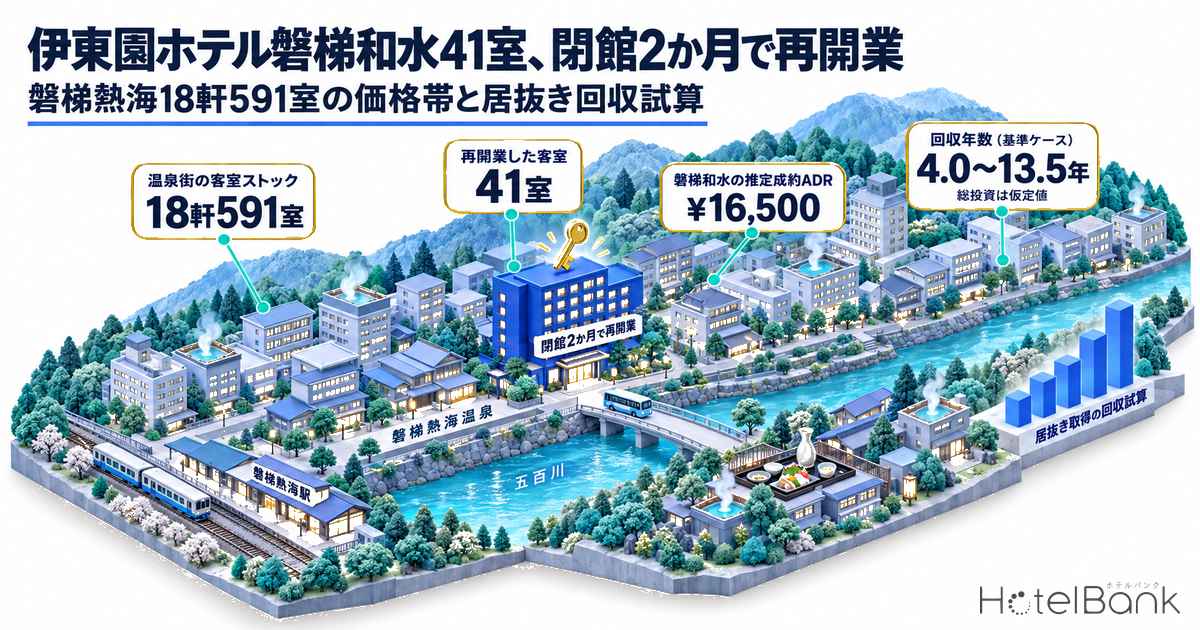
Itoen Hotels opened Itoen Hotel Bandai Nagomi (伊東園ホテル磐梯和水; Koriyama, Fukushima; 41 rooms) on August 1, 2026, in the building of Yutorelo Bandai Atami (ゆとりろ磐梯熱海), which had closed on May 31. The company acquired the property and was welcoming guests again two months later. MetroEngines Research counts 18 inns with observable selling prices at Bandai Atami Onsen, totaling 591 rooms; the 41 rooms are 6.9% of that stock. This article looks at what the return of these 41 rooms means in terms of room stock, price bands and occupancy, and estimates the payback period for acquiring a closed property as-is (a “fit-out-included” or inuki purchase), stating the assumed range of acquisition cost per room up front.
Metric Definitions Used in This Article
- ADR (average daily rate) = estimated settled rate (tax-excluded equivalent), calculated by applying a segment-specific adjustment factor to the lowest-plan level each property publishes on OTAs (per-room rate for two guests sharing a room, tax included). Checked against property-level results disclosed by listed hotel REITs (91 properties, most recent three months), the median error is about 7%. These are estimates and differ from each property’s actual transaction prices and accounting figures. Area-level ADR is the median of the properties covered (the level of a typical property in the area).
- OCC (occupancy) = share of rooms sold out of total rooms in the area (an estimate based on OTA inventory; consistency checks against REIT monthly disclosures show accuracy within roughly a few percentage points). In this article it is written as “occupancy (OTA-listed inventory basis, estimated)” and used only at the municipal level. It is based on how quickly inventory sold on OTAs is absorbed and differs from a property’s actual overall occupancy.
- References to listed prices mean the per-room rate for two guests sharing a room (tax included). “Lowest-plan level” is the monthly average of each day’s cheapest plan; meal conditions vary by property and plan.
- LT (lead time) = days until check-in. Booking curve = the path of remaining OTA rooms toward the check-in date. This article uses only LT45 to LT1.
- Room stock = total rooms at properties within a 2km radius of Bandai Atami Station whose selling prices could be observed in July–September 2026. Inns not listed on OTAs are excluded. The room count for Bandai Nagomi is the published figure; others come from MetroEngines Research property data.
- Survey date: October 6, 2026. Data source: MetroEngines Research
- — 41 rooms, 6.9% of room stock: Itoen Hotels acquired the closed Yutorelo Bandai Atami and reopened it after a two-month gap. Stock within 2km of the station went from 17 properties / 550 rooms back to 18 properties / 591 rooms.
- — Published rate of ¥9,680 (¥19,360 for two guests per room) is an entry price about 25% below the ¥25,900 median lowest-plan level of the 18 inns in the onsen town. Estimated settled ADR is ¥16,500, in the same ¥16,000 range as the existing Mukaitaki.
- — On holiday weekends, room count is the ceiling: occupancy (OTA-listed inventory basis, estimated) at Koriyama ryokan reached 98–100% for stays on September 19–22, 2026. The September 20 night sold out (0 rooms left) at LT21.
- — Payback of 4.0–13.5 years: base case (GOP margin 20%) assuming total investment of ¥3 million–¥10 million per room. New construction costs ¥46.1 million–¥50.8 million per room, so the assumed inuki range is about 7–22% of that.
- — The ¥26,000–¥35,000 estimated settled ADR band is empty: mid-sized inns cluster in the high ¥10,000s, and ¥35,000+ is served only by inns with 15 rooms or fewer. A design that targets the upper band with a mid-sized building remains open.
Summary — The 41-Room Reopening Returned “Rooms to Sell on Sold-Out Days” to the Onsen Town
In short, this reopening can be summarized as “a deal that put 41 rooms to sell on sold-out days back into an onsen town whose room count had been shrinking.” There are three reasons. First, Bandai Atami has lost three properties with 83 rooms since the end of 2019, so a 41-room closure was significant for the town. Second, the published rate of ¥9,680 per person with two meals (¥19,360 for two guests per room) is an entry price about 25% below the median lowest-plan level of the town’s 18 inns. Third, occupancy (OTA-listed inventory basis, estimated) at Koriyama ryokan reached 98–100% over the five-day September holiday (stays on the 19th–22nd), meaning that on high-demand days the number of rooms itself caps revenue.
From an investment standpoint, the key point is that a building which would cost more than ¥40 million per room to build new was back in operation two months later with only partial renovation. Because the acquisition price and renovation cost have not been disclosed, this article does not estimate the actual transaction value; instead it shows payback periods assuming total investment of ¥3 million–¥10 million per room. In the base case (full-year occupancy 70%, ADR ¥14,500, GOP margin 20%), payback is 4.0–13.5 years.
Reopened Two Months After Closing — Outline of the Deal
First, the sequence of the deal based on public announcements and press reports. On May 1, Fukushima Minpo (福島民報) reported that the operator of Yutorelo Bandai Atami (formerly Seiryozan Club, 清稜山倶楽部) would withdraw on May 31 and that Itoen Hotels planned to take it over. Itoen Hotels announced the opening of Itoen Hotel Bandai Nagomi on July 10 and began operating on August 1.
| Date | Event | Source |
|---|---|---|
| June 2018 | Itoen Hotels opens Itoen Hotel Bandai Mukaitaki (伊東園ホテル磐梯向滝) at Bandai Atami Onsen | MetroEngines Research property data |
| May 1, 2026 | Report that Yutorelo Bandai Atami’s operator will withdraw on May 31 and Itoen Hotels plans to take over | Fukushima Minpo |
| May 31, 2026 | Yutorelo Bandai Atami ends operations | Fukushima Minpo |
| July 10, 2026 | Itoen Hotels announces Itoen Hotel Bandai Nagomi will open on August 1 | Company press release |
| July 13, 2026 | Reservations open on the official website (by phone from the 14th) | Company press release |
| August 1, 2026 | Opening. 41 rooms, from ¥9,680 per person with two meals (tax included, bathing tax excluded) | Company press release |
According to Fukushima Minyu Shimbun (福島民友新聞, July 11), Itoen Hotels bought the property from Relo Vacations, which had operated Yutorelo, and reopened it after a partial renovation. The room count remains 41, unchanged from the Yutorelo era, and the acquisition price and renovation cost were not disclosed. The gap between closure and reopening was only two months. That speed was possible precisely because this was an as-is acquisition that kept the existing room configuration rather than a full renovation.
The speed matters to both seller and buyer. The shorter the closure, the smaller the impact on the onsen town’s visitor flow and on suppliers. For the buyer, whether the property is open in time for the Obon holidays and the September holiday weekend determines first-year revenue. An August 1 opening satisfied both. How many days of closure an operator change entails, and how that moves first-year earnings, depends on the acquisition structure chosen, since whether operating licenses can be carried over differs by scheme.
In product design, the difference from Itoen Hotel Bandai Mukaitaki, the company’s existing property three minutes’ walk away, is clearly drawn. The release positions Bandai Nagomi as a “modern hideaway” themed on the clear Gohyaku River (五百川) that flows nearby, with dinner served kaiseki-style. All-you-can-drink alcohol and soft drinks at dinner are included at no extra charge. Owning two properties with different characters in the same onsen town can be read as a design to widen the range of price points and guest types the company can serve.
Room Stock — 18 Properties, 591 Rooms; 41 Rooms Are 6.9% of the Town
How much weight do 41 rooms carry in the onsen town? Within a 2km radius of Bandai Atami Station, 18 inns with 591 rooms had observable selling prices in July–September 2026. The 41 reopened rooms account for 6.9% of that, and Itoen Hotels’ two properties combined (Mukaitaki 48 rooms, Nagomi 41 rooms) total 89 rooms, or 15.1%.
The size distribution is skewed. Six inns with 40+ rooms hold 417 rooms, or 70.6% of the total, while ten inns with fewer than 20 rooms account for 129 rooms. Only one property exceeds 100 rooms (162 rooms), and 41 rooms ranks sixth in size in the town. Mid-sized and larger inns that can take groups are few, so whether one of them is closed or operating visibly changes the town’s weekend capacity.
Behind this is the shrinkage of stock over the past few years. Kampo no Yado Koriyama (かんぽの宿 郡山, 36 rooms), operated by Japan Post, closed on December 20, 2019, and two more properties with 47 rooms closed by 2021. Within what MetroEngines Research tracks, the three total 83 rooms. Adding those 83 rooms back to today’s 18 properties gives 674 rooms, and 591 rooms is 12.3% below that.
In June–July, while Yutorelo Bandai Atami was closed, stock had fallen to 17 properties / 550 rooms — 18.4% below the add-back figure of 674. The August 1 reopening brought stock back to 591 rooms. That rooms were restored by restarting an existing building rather than by new construction is worth noting as a form of supply recovery at a time of steadily rising construction costs.
Location — A Commercial-Zoned Onsen Town Where Benchmark Land Prices Are Bottoming Out at ¥26,000/㎡
Next, location. Bandai Atami Onsen is an onsen town whose inns line the Gohyaku River for about 1.8km northwest of Bandai Atami Station on the JR Banetsu West Line. Bandai Nagomi is about 1.3km from the station in a straight line; according to the release, it is about 90 minutes from Tokyo Station to Koriyama Station by Tohoku Shinkansen, about 20 minutes by Banetsu West Line to Bandai Atami Station, and about 5 minutes from the station by shuttle bus.
The core of the onsen town is zoned commercial, so there are few restrictions on lodging use. Land prices are low: the 2026 benchmark price for commercial land in Atami 5-chome, Atami-machi, where Bandai Nagomi stands, is ¥25,900 per ㎡, or about ¥86,000 per tsubo. That is down 4.1% over five years from ¥27,000 in 2021, but the annual decline has narrowed from 2.9% in 2021 to 0.4% in 2026. The official published land price for residential land in Atami 1-chome, near the station, is ¥23,900 per ㎡ in 2026.
What this land price level shows is that most of an onsen ryokan’s value lies not in the land but in the building, hot-spring facilities and continuity of operations. Because demolishing and rebuilding rarely pencils out, whether a buyer emerges who can use the existing building as-is decides the asset’s fate. On disaster risk, constraints from flood-inundation zones and liquefaction are small, but plots near the slopes along the Gohyaku River are designated landslide warning zones, so checking zone designations and insurance terms is a prerequisite at acquisition.
Price Bands — ¥9,680 Is an Entry Price About 25% Below the Town Median
Now to price positioning. The published rate of ¥9,680 per person with two meals equals ¥19,360 for two guests per room (tax included, bathing tax excluded). Ranking the lowest-plan levels of the town’s 18 inns (Aug–Sep 2026 average, two guests per room, tax included) from low to high, ¥19,360 would be seventh, about 25% below the 18-inn median of ¥25,900. With an inn offering two meals at this level, the town now has a deeper choice of entry-price options.
In actual listings, Bandai Nagomi’s lowest-plan level averaged ¥24,600 in August–September, against ¥18,900 for Mukaitaki. The pricing puts the kaiseki-style Nagomi one step higher and the existing Mukaitaki on the entry side. Estimated settled ADR is ¥16,500 for Nagomi and ¥16,200 for Mukaitaki, both in the ¥16,000 range.
| Property | Rooms | Lowest-plan level (2 guests/room, tax incl.) | Est. settled ADR (tax-excl. equiv.) |
|---|---|---|---|
| Hotel Hananoyu (ホテル華の湯) | 162 | ¥27,200 | ¥20,273 |
| Shikisai Ichiriki (四季彩 一力) | 66 | ¥28,821 | ¥19,634 |
| Hagihime no Yu Eirakukan (萩姫の湯 栄楽館) | 54 | ¥22,380 | ¥16,366 |
| Itoen Hotel Bandai Mukaitaki (伊東園ホテル磐梯向滝) | 48 | ¥18,922 | ¥16,218 |
| Hakkeien (八景園) | 46 | ¥12,364 | ¥7,972 |
| Itoen Hotel Bandai Nagomi (伊東園ホテル磐梯和水) | 41 | ¥24,578 | ¥16,526 |
| Momijikan Kirakuya (紅葉館 きらくや) | 25 | ¥17,141 | ¥9,246 |
| Yu no Yado Rakuzan (湯のやど 楽山) | 20 | ¥40,094 | ¥21,532 |
| 水林亭 | 19 | ¥16,955 | ¥8,006 |
| Asakaso (浅香荘) | 18 | ¥39,274 | ¥24,838 |
| Yamashiroya Bettei Tsuki no Niwa (山城屋別邸 月の庭) | 15 | ¥14,010 | ¥7,725 |
| Hanare no Yado Yomogino (離れの宿 よもぎ埜) | 15 | ¥65,992 | ¥42,979 |
| Yamashiroya (山城屋) | 13 | ¥24,694 | ¥17,950 |
| Orifushi no Yado Shogetsu (をりふしの宿 昭月) | 12 | ¥49,112 | ¥25,754 |
| Atamiso (熱海荘) | 11 | ¥147,348 | ¥89,872 |
| Onsen Guesthouse Yukori (温泉ゲストハウス 湯kori) | 10 | ¥17,392 | — |
| Moritaya (守田屋) | 9 | ¥50,610 | ¥35,548 |
| Auberge (オーベルジュ鈴鐘) | 7 | ¥73,060 | — |
Positioning — Mid-Sized Inns Cluster in the ¥10,000s; Upper Price Bands Are Served by Inns of 20 Rooms or Fewer
Overlaying room count and estimated settled ADR shows the onsen town splits into two tiers. Five inns with 222 rooms sit in the ¥14,000–¥20,000 estimated settled ADR band, including Bandai Nagomi and Mukaitaki. Four inns with 212 rooms follow at ¥20,000–¥26,000. Meanwhile, ¥35,000 and above is served by three inns with 35 rooms, all small properties of 15 rooms or fewer.
ClusterHigh ¥10,000s × 40+ rooms
5 inns, 222 rooms at ¥14,000–¥20,000 estimated settled ADR.
On lowest-plan level, 11 inns with 499 rooms (84.4%) are under ¥30,000 for two guests per room. This is the town’s main battleground, where the ability to stack up occupancy determines earnings.
Gap ①¥26,000–¥35,000 × mid-sized
No inns at ¥26,000–¥35,000 estimated settled ADR.
Even on lowest-plan level, there are no inns at ¥30,000 to under ¥39,000 for two guests per room (¥15,000–¥19,500 per person). There is room to aim one step higher through added value in meals and rooms.
Gap ②¥10,000–¥14,000
No inns at ¥10,000–¥14,000 estimated settled ADR either.
There is a gap between the four inns with 105 rooms under ¥10,000 and those at ¥14,000+. Pushing weekday two-meal stays into this band overlaps with the design of the ¥9,680 published rate.
Gap ① carries the most implications for investment that acquires an existing building and adds value. Seven inns with 92 rooms have a lowest-plan level of ¥39,000 or more, but all have 20 rooms or fewer; at present no inn with 40+ rooms is found in this price band. In other words, the option of acquiring a mid-sized building, investing further in rooms and food, and targeting ¥15,000–¥19,000+ per person remains open with little competition. Bandai Nagomi chose a design that captures occupancy with an entry price, but when another building in the same town changes hands, a design targeting the upper band will also be worth comparing.
Rate and Occupancy — Rates Flat to Slightly Down YoY; on Peak Days, Room Count Is the Ceiling
Rates first. Estimated settled ADR for Koriyama as a whole was ¥8,000 in August 2026 (N=52), up 3.6% YoY. However, this is a citywide median that includes business hotels around Koriyama Station and should be read separately from onsen-town ryokan. The median for the 15 ryokan at Bandai Atami in the same August was ¥20,000, about 2.5 times the citywide figure.
Year on year, the onsen town’s estimated settled ADR was down 11.7% in August and ¥16,900 in September (−3.4% YoY), running slightly below the prior year. But the movement is not one-directional: by property, September split evenly with 7 up and 7 down. The median listed price (all-plan average, tax included) for the same group rose 2.4% in August and 8.0% in September, suggesting a mix of properties that hold the pricing of their upper plans while lowering entry-level plans to capture occupancy. This is less a phase of growing revenue through price increases than one of building revenue by stacking rooms sold.
Next, occupancy. Occupancy (OTA-listed inventory basis, estimated) for 13 Koriyama ryokan with 543 rooms (listed on major booking sites) averaged 80.6% in September 2026 and 83.7% in August (12 properties, 515 rooms). Day by day, the peaks and troughs are pronounced. In September, the Sunday–Thursday average excluding holidays was only 74.6%, while three regular Saturdays averaged 94.2%, and stays on the 19th–22nd during the five-day holiday (September 19–23) reached 98.1–100.0%. In August, Obon (9th–14th) stayed above 97%, and 19 of the 61 days in August–September exceeded 90% occupancy.
In other words, in this onsen town rooms sell out on weekends and holidays, and that caps revenue. It is precisely on these sold-out days that the return of 41 rooms has the greatest effect. The booking pace is distinctive too. For the September 20 stay, mid-holiday, remaining rooms across 13 properties / 530 rooms (listed on major booking sites) were 30 at LT45, 8 at LT30 and 0 at LT21. By contrast, the regular Saturday of September 12 still had 126 rooms left at LT7, falling to 37 at LT1.
Holidays sell out three weeks ahead, while regular Saturdays see 89 rooms move in the final week. Because the two selling patterns coexist in the same town, it pays to structure sales differently for days that sell out early and days that hold inventory until the last minute. At the property level, the existing Itoen Hotel Bandai Mukaitaki (48 rooms) had 0/48 rooms left at LT14 for the September 19 stay (published allotment peaked at 60.4% of total rooms). The value of the same operator having a second property three minutes’ walk away shows up on days like these.
Looking at Bandai Nagomi’s lowest listed rate (two guests per room, tax included) by day, weekdays in early September were around ¥22,400, Saturdays ¥26,800, and the mid-holiday stay of September 20 ¥37,800. The holiday rate is about 1.7 times the weekday rate, confirming that from its second month the property was moving prices with demand.
Two Properties Three Minutes Apart — Functions That Nearby Multi-Property Operations Can Share
Bandai Nagomi’s defining feature is its proximity — three minutes’ walk — to the existing Mukaitaki. Because the specific arrangements in this case have not been disclosed, here we outline functions that are generally easy to share when the same operator owns two nearby properties. For a prospective acquirer, the key point is that the same building is valued differently depending on whether it is seen as a standalone 41 rooms or as 89 rooms combined with an existing property.
| Function | What is shared (general) | Items most affected |
|---|---|---|
| Purchasing & cooking | Joint ordering of food and beverages; consolidated prep and inventory | Food cost |
| Staffing | Shared shifts for front desk, housekeeping, shuttle and maintenance; cover according to demand | Labor cost, hiring pool |
| Guest referral | Directing guests to the other property when one is full; two properties at different price points | Rooms sold on sold-out days |
| Sales | Shared reservation center, own website and membership base | Distribution fees, direct-booking ratio |
| Facilities | Bundled ordering of maintenance and repairs for hot-spring equipment and buildings | Repair cost, unit cost of capex |
The referral effect in particular should be considered alongside the occupancy data in the previous section. On days when the whole town sells out, such as holidays and Obon, whether bookings that one property cannot absorb can be routed to the other determines revenue. On weekdays, conversely, combining staffing and purchasing across two properties dilutes fixed costs. Being effective at both the peaks and the troughs of demand is the strength of a nearby location.
Payback Estimate — Assuming Total Investment of ¥3M–¥10M per Room Gives 4.0–13.5 Years
Finally, the economics of an as-is acquisition. To repeat, the acquisition price and renovation cost in this case have not been disclosed, and the following does not estimate the actual transaction value. It assumes combined acquisition and renovation investment of ¥3 million–¥10 million per room and checks how payback moves within that range. Occupancy, ADR and GOP margin are all set as full-year assumptions.
| Item | Conservative | Base Base | Upside | How the assumption was set |
|---|---|---|---|---|
| Rooms | 41 | 41 | 41 | Published figure |
| Occupancy (full-year, assumed) | 60% | 70% | 80% | Occupancy (OTA-listed inventory basis, estimated, 12–13 properties) for Koriyama ryokan was 74.1–83.7% in July–September 2026. Because this indicator runs higher than actual occupancy, the base was set at 70% |
| ADR (full-year, tax-excl. equiv.) | ¥13,000 | ¥14,500 | ¥16,500 | Multiplying Bandai Nagomi’s Aug–Sep average of ¥16,500 by Mukaitaki’s ratio of “trailing 12-month average ÷ Aug–Sep average” (0.89) gives about ¥14,700; the base rounds this |
| Annual revenue | ¥117M | ¥152M | ¥198M | 41 rooms × 365 days × occupancy × ADR (rate includes two meals) |
| GOP margin (assumed) | 15% | 20% | 25% | Set below the level (about 39%) disclosed for 91 hotels by a listed REIT (Invincible Investment Corporation), because ryokan with two meals require food costs and staffing |
| GOP (annual) | ¥17.5M | ¥30.4M | ¥49.4M | Annual revenue × GOP margin |
Under these assumptions, the next table lists the simple payback period (total investment ÷ GOP) for each investment level. In the base case, payback is 4.0 years at ¥3 million per room (¥123 million total), 6.7 years at ¥5 million (¥205 million), and even at ¥10 million (¥410 million) it stays within 13.5 years. To recover the investment within 10 years in the conservative case, total investment would need to be held to around ¥4 million per room.
| Total investment (acquisition + renovation, assumed) | Total | Conservative | Base | Upside | GOP yield (base) |
|---|---|---|---|---|---|
| ¥3M/room | ¥123M | 7.0 yrs | 4.0 yrs | 2.5 yrs | 24.7% |
| ¥5M/room | ¥205M | 11.7 yrs | 6.7 yrs | 4.2 yrs | 14.8% |
| ¥8M/room | ¥328M | 18.7 yrs | 10.8 yrs | 6.6 yrs | 9.3% |
| ¥10M/room | ¥410M | 23.4 yrs | 13.5 yrs | 8.3 yrs | 7.4% |
For the base case of ¥5 million per room (¥205 million total), the next table varies ADR and occupancy across five steps each, with GOP margin fixed at 20%. A 5-point change in occupancy moves payback by roughly 0.5 years — about the same as raising ADR by ¥1,000. Whether weekday rooms sold can be stacked up weighs on the economics as much as raising or lowering prices.
| Occupancy (full-year, assumed) \ ADR | ¥12,500 | ¥13,500 | ¥14,500 | ¥15,500 | ¥16,500 |
|---|---|---|---|---|---|
| 60% | 9.1 yrs | 8.5 yrs | 7.9 yrs | 7.4 yrs | 6.9 yrs |
| 65% | 8.4 yrs | 7.8 yrs | 7.3 yrs | 6.8 yrs | 6.4 yrs |
| 70% | 7.8 yrs | 7.2 yrs | 6.7 yrs | 6.3 yrs | 5.9 yrs |
| 75% | 7.3 yrs | 6.8 yrs | 6.3 yrs | 5.9 yrs | 5.5 yrs |
| 80% | 6.8 yrs | 6.3 yrs | 5.9 yrs | 5.5 yrs | 5.2 yrs |
The upper end of the assumed range was set at ¥10 million per room by reference to per-room prices paid by listed REITs for ryokan-type properties in onsen resorts. Extracting the five onsen-ryokan-type properties in Tohoku, northern Kanto and Hokuriku from the holdings of seven listed hotel REITs — Ichigo Hotel REIT Investment Corporation (3463), Invincible Investment Corporation (8963), Nippon Hotel & Residential Investment Corporation (3472), Japan Hotel REIT Investment Corporation (8985), Hoshino Resorts REIT, Inc. (3287), Mori Trust REIT, Inc. (8961) and Kasumigaseki Hotel REIT Investment Corporation (401A) — acquisition prices were ¥10 million–¥32.5 million per room. In Fukushima Prefecture, a property at Higashiyama Onsen in Aizuwakamatsu was acquired at ¥10 million per room.
| Property | Prefecture | Owner | Acquired | Acquisition price | Rooms | Per room |
|---|---|---|---|---|---|---|
| Oedo Onsen Monogatari Higashiyama Grand Hotel (大江戸温泉物語東山グランドホテル) | Fukushima | Nippon Hotel & Residential Investment Corporation | Dec 2017 | ¥1,230 million | 123 | ¥10.00M |
| Tennen Onsen Tazawako Lake Resort (天然温泉田沢湖レイクリゾート) | Akita | Invincible Investment Corporation | Aug 2023 | ¥1,475 million | 80 | ¥18.44M |
| Oedo Onsen Monogatari Awara (大江戸温泉物語あわら) | Fukui | Nippon Hotel & Residential Investment Corporation | Sep 2016 | ¥1,901 million | 95 | ¥20.01M |
| Oedo Onsen Monogatari Premium Kinugawa Kanko Hotel (大江戸温泉物語Premium 鬼怒川観光ホテル) | Tochigi | Nippon Hotel & Residential Investment Corporation | Dec 2017 | ¥3,870 million | 172 | ¥22.50M |
| Oedo Onsen Monogatari Premium Ikaho (大江戸温泉物語Premium 伊香保) | Gunma | Nippon Hotel & Residential Investment Corporation | Sep 2016 | ¥1,299 million | 40 | ¥32.48M |
However, these were acquisitions of operating buildings with lease contracts attached, under different conditions from buying a property that has ceased operations. Since a closed building’s earnings track record has been interrupted, it is natural to assume it can change hands at a lower unit price. Either way, across the whole assumed range total investment remains a fraction of new construction.
| Construction cost if built new (reference) | Cost per tsubo | Cost for 41 rooms / 2,870㎡ floor area | Per room |
|---|---|---|---|
| Based on 2025 actuals (hotels or ryokan, all-structure average) | ¥2.178M | about ¥1.89B | about ¥46.1M |
| With construction-period inflation (+5%/yr, 2 years) | ¥2.401M | about ¥2.08B | about ¥50.8M |
Building the same 41 rooms new would cost about ¥1.89 billion at 2025 unit costs, or about ¥2.08 billion with escalation during construction — ¥46.1 million–¥50.8 million per room. The assumed inuki range (¥3 million–¥10 million per room) is about 7–22% of new construction. Recovering the new-build cost from the base-case GOP of ¥30.4 million would take more than 50 years, showing that new supply is hard to justify for onsen ryokan in this price band. Rising construction costs also act to deter new entrants, which is a tailwind in the competitive environment for operators able to put existing buildings back into use.
What to Check Before Acquiring — Occupancy Assumptions, Building, and Rights
As the wide range of the estimates suggests, the success of an as-is acquisition depends on how the assumptions are set. The items worth checking when considering a similar deal are summarized below, mapped to the data in this article.
| Category | What to check | Clues from this article’s data |
|---|---|---|
| Market | Occupancy assumptions in a phase where rates run flat to slightly below the prior year | The onsen town’s estimated settled ADR was −3.4% YoY in September. Check payback under the conservative case too (full-year occupancy 60%, ADR ¥13,000) |
| Demand skew | How far weekday rooms sold can be built up | Estimated September occupancy at Koriyama ryokan averaged 74.6% Sunday–Thursday excluding holidays and 94.2% on regular Saturdays. Lifting weekdays decides full-year occupancy |
| Building & facilities | Building age; renewal history of hot-spring equipment, piping and HVAC | Determining the scope of renovation decides where total investment lands within the assumed ¥3M–¥10M per room |
| Disaster | Landslide warning zone designations; insurance terms | Parts along the Gohyaku River are designated warning zones. Flood and liquefaction constraints are small |
| Staffing | Housekeeping, shuttle and kitchen arrangements | Operators with a nearby existing property can more easily share shifts |
| Rights | Hot-spring usage rights, any leasehold land, succession of permits and licenses | Not verifiable from public data; confirm individually in due diligence |
Implications — What Sellers, Lenders and Acquirers Should Look For
With all of this in mind, here are the points to focus on by position. First, for ryokan owners considering a sale or succession, operators already active in the same onsen town can be strong counterparties. A buyer that can share purchasing and staffing with an existing property can expect higher post-reopening profits than a buyer entering alone, and so is more likely to put a favorable value on the same building. Scheduling the handover just before a peak season also helps: here, two months from the end of May closure to the August 1 opening allowed the property to capture Obon and the September holiday weekend.
For regional financial institutions, the key is shifting the yardstick of valuation from land to post-reopening profit. Commercial land in Atami-machi is around ¥26,000 per ㎡, so the land offers limited depth as collateral. On the other hand, in an onsen town where holiday occupancy (estimated) reaches 98–100%, rooms being in operation has value in itself. Identifying “operators with an existing property nearby” early as succession candidates for borrowers makes it easier to propose ways to shorten closure periods.
For operators and funds pursuing acquisitions, the next question is which price band to occupy. At Bandai Atami, mid-sized inns cluster in the high-¥10,000s estimated settled ADR range, while the ¥26,000–¥35,000 band has no entrants and ¥35,000+ is served by inns of 15 rooms or fewer. Beyond a design that captures occupancy with entry pricing, a design that targets ¥15,000–¥19,000+ per person with a mid-sized building is also worth considering. Larger onsen resorts elsewhere in northern Kanto, such as Kinugawa-Kawaji, where big ryokan dominate room stock, offer a point of comparison for the turnaround of large ryokan and their room for rate growth.
Conclusion
The reopening of Itoen Hotel Bandai Nagomi was a deal that returned 41 rooms (6.9% of stock) after a two-month gap to Bandai Atami Onsen, where three properties with 83 rooms have closed since the end of 2019. The published rate of ¥9,680 is about 25% below the town’s median lowest-plan level, and estimated settled ADR averaged ¥16,500 over the first two months, in the same ¥16,000 range as the existing Mukaitaki.
On demand, occupancy (OTA-listed inventory basis, estimated) at Koriyama ryokan reached 98–100% over the five-day September holiday (stays on the 19th–22nd), and 19 of the 61 days in August–September exceeded 90%. Having more rooms to sell on sold-out days matters. On economics, assuming total investment of ¥3 million–¥10 million per room, base-case payback is 4.0–13.5 years — an order of magnitude apart from new construction (¥46.1 million–¥50.8 million per room).
In an onsen town whose room count has been shrinking, supply is determined less by building new than by who puts existing buildings back to work. As-is acquisition by operators with an existing property nearby is a leading route to that. Once results for the autumn foliage season and the year-end holidays are in, the full-year occupancy assumption can be reset on firmer numbers.
References & Sources
■ Data Sources
Prices and remaining rooms are based on data observed daily on OTAs by MetroEngines Research & Consulting. Room stock and listed prices cover the 18 properties within 2km of Bandai Atami Station with selling prices observed in July–September 2026 (Bandai Nagomi’s room count is the published figure); estimated settled ADR covers 16 of those properties and Koriyama as a whole (N=52 properties); occupancy and booking curves cover 12–13 Koriyama ryokan with 515–543 rooms. Land prices, zoning and disaster zones are from the MLIT Real Estate Information Library; construction costs from MLIT’s “Statistics on Building Construction Starts”; REIT acquisition prices and room counts from each investment corporation’s disclosures; and the deal timeline from Itoen Hotels’ press release and press reports.
■ Estimate Assumptions
Total investment (acquisition + renovation) is an assumed ¥3 million–¥10 million per room and is not an estimate of this deal’s acquisition price or renovation cost. Full-year occupancy of 60%, 70% and 80%, ADR of ¥13,000, ¥14,500 and ¥16,500 (tax-excluded equivalent), and GOP margins of 15%, 20% and 25% were set as the conservative, base and upside assumptions respectively. Annual revenue = 41 rooms × 365 days × occupancy × ADR; simple payback = total investment ÷ annual GOP; GOP yield = annual GOP ÷ total investment. New-build construction cost assumes 70㎡ of floor area per room (including common areas) and applies 5% annual escalation over two years to the 2025 planned construction cost for hotels or ryokan (all-structure average).
■ Limitations
Occupancy is an estimate based on the absorption of inventory sold on OTAs; it differs from properties’ actual overall occupancy and is used only at the municipal level. Bandai Nagomi’s figures are results for the first two months after opening (August–September 2026) and do not represent a full-year level that includes the foliage season and winter. Inns not listed on OTAs are excluded from room stock. GOP is before property tax, insurance, capex and interest, and conditions that cannot be verified from public data, such as hot-spring usage rights and succession of permits, are not reflected in the estimates.
■ Market Data
- MetroEngines Research & Consulting — estimated settled ADR (Bandai Atami N=16 properties, Koriyama N=52 properties), listed prices (N=18 properties), occupancy (OTA-listed inventory basis, estimated; 12–13 Koriyama ryokan), booking curves (13 properties / 530 rooms), property-level remaining-room trends. Survey date October 6, 2026
■ Government Statistics & Public Data
- MLIT Real Estate Information Library — official land prices and prefectural land price survey, zoning, station ridership, flood-inundation zones, landslide warning zones, liquefaction tendency
- MLIT “Statistics on Building Construction Starts” — planned construction cost for hotels or ryokan (2025, all-structure average ¥2.178 million per tsubo)
■ REITs & Industry Reports
- Nippon Hotel & Residential Investment Corporation portfolio disclosures — acquisition prices and room counts for four onsen-ryokan-type properties
- Invincible Investment Corporation portfolio and hotel operating results — acquisition price and room count for Tennen Onsen Tazawako Lake Resort; GOP ratio of 91 hotels under operating contracts
- Turner & Townsend — outlook for construction cost escalation in Japan
■ News & Press Releases
- Itoen Hotels, “Itoen Hotel Bandai Nagomi to open August 1 (Sat) at Bandai Atami Onsen, Fukushima” (PR TIMES, July 10, 2026; Japanese)
- Bandai Atami Onsen: operator of “Yutorelo Bandai Atami (formerly Seiryozan Club)” to withdraw; Itoen Hotels (Tokyo) to take over (Fukushima Minpo, May 1, 2026; Japanese)
- Successor to Yutorelo Bandai Atami, “Itoen Hotel Bandai Nagomi,” to open August 1 in Koriyama (Fukushima Minyu Shimbun, July 11, 2026; Japanese)
- Itoen Hotels to open “Bandai Nagomi” at Bandai Atami Onsen on August 1, its second property in the area (Ryoko Shimbun, July 10, 2026; Japanese)
- Kampo no Yado Koriyama (closed December 20, 2019) property information (Nifty Onsen; Japanese)