

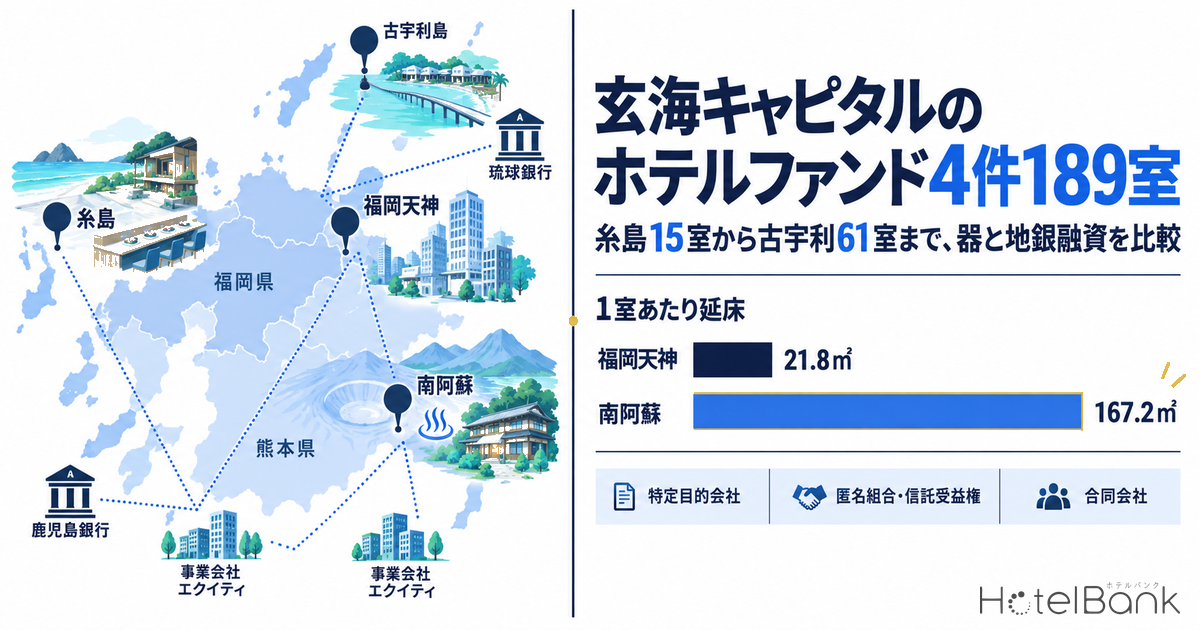
Genkai Capital Management (玄海キャピタルマネジメント), an independent real estate asset manager based in Fukuoka and Tokyo, announced four lodging funds between May and September 2026. Placed side by side, they cover 189 rooms in total — from a 15-room property in Itoshima to a 61-room project on Kouri Island (古宇利島) — funded by equity from operating companies in Kyushu and Okinawa and by loans from regional banks. For lodging properties of 10 to 100 rooms, a size that listed REITs and large private funds find hard to acquire, who invested, who lent, and which vehicle was used? Drawing only on what the company disclosed in its four press releases, this article compares the vehicles, equity investors, lenders and operators, and reads them against the estimated realized ADR of the four municipalities where the properties are located.
HotelBank has previously covered the financing structure of single deals, the succession of hot-spring inns through investment limited partnerships, and the legal framework of silent partnerships (tokumei kumiai, TK) and special purpose companies (tokutei mokuteki kaisha, TMK). This article takes a different angle: it lines up four deals arranged by one asset manager in roughly half a year and focuses on how the vehicle and the providers of capital change with the type of deal. The general rules governing TMK and GK-TK structures are not repeated here.
Metric Definitions Used in This Article
Note on metrics: ADR (average daily rate) = estimated realized rate (tax-exclusive equivalent), calculated by applying a segment-specific adjustment factor to the lowest-plan price level each property publishes on OTAs (per room, two guests per room, tax included). In a check against property-level actuals disclosed by listed hotel REITs (91 properties, most recent three months), the median error was about 7%. These are estimates and differ from each property’s actual transacted rates and accounting figures. Area-level ADR is the median of the properties covered (the level of a typical property in the area). OCC (occupancy) = rooms sold as a share of total rooms in the area (an estimate based on OTA inventory; a consistency check against monthly REIT disclosures confirmed accuracy within roughly a few percentage points). Where listed prices are mentioned, they are per-room prices for two guests per room (tax included). Estimated realized ADR covers five segments — business, city, resort, ryokan and capsule hotels — and excludes vacation rentals, pensions and similar properties. Figures are as of the survey date of October 5, 2026; annual averages use finalized months only (September 2025–August 2026). Data source: MetroEngines Research & Consulting.
- — 4 deals, 189 rooms: The lodging funds Genkai Capital Management announced between May and September 2026 differ in both size and deal type — 15 rooms (Itoshima), 17 rooms (Minamiaso), 61 rooms (Kouri Island) and 96 rooms (Fukuoka Tenjin).
- — The vehicle changes with the deal type: The development-stage Kouri Island project uses preferred equity in a TMK; the operating Tenjin hotel uses a trust beneficiary interest and TK equity; and Minamiaso, where the fund takes over a renovated building, uses a GK (godo kaisha) with TK equity.
- — Regional banks and local operating companies: The two lenders disclosed by name are Kagoshima Bank and Bank of the Ryukyus. The equity side features Kyushu Electric Power and other operating companies with ties to Kyushu and Okinawa.
- — 21.8–167.2 m² of gross floor area per room: Destination-stay properties allocate more than 100 m² to each room. The estimated realized ADR of top-quartile properties (September 2025–August 2026) was ¥61,000 in Nakijin Village and ¥41,600 in Minamiaso Village, and that tier consists of small properties with 5 to 22 rooms.
- — Fund size, LTV and yield are undisclosed for all 4 deals: This article does not estimate amounts. Using area-level rates and assumed occupancy of 60–80%, it only works out room revenue per room and per square meter of gross floor area.
Comparing the 4 Deals — Vehicle, Investors, Lender and Operator Differ Each Time
We start by lining up what was disclosed for the four deals under the same headings. Everything in the table below comes from the company’s press releases; items not stated there are marked “Not stated.” Only gross floor area per room is our own calculation, dividing the disclosed gross floor area by the room count.
| Item | Kouri Island (Nakijin Village, Okinawa) | Hotel LiVEMAX Fukuoka Tenjin (ホテルリブマックス福岡天神; Chuo Ward, Fukuoka City) | THE SHIKAKA (Itoshima City, Fukuoka) | Aso Retreat HONO by Onko Chishin (阿蘇リトリート HONO by 温故知新; Minamiaso Village, Kumamoto) |
|---|---|---|---|---|
| Announcement date | May 15, 2026 | July 15, 2026 | July 22, 2026 | September 7, 2026 |
| Deal type | New development (construction started February 2026; opening planned for April 2028) | Acquisition of an existing hotel (completed October 2018; acquired June 30, 2026) | Newly built, just opened (completed March 2026; opened June 11) | Major renovation and partial extension of a closed ryokan (opening planned for November 2026) |
| Rooms | 61 rooms (average room about 50 m²) | 96 rooms | 15 rooms (13 two-story wooden buildings) | 17 rooms (average room about 81.20 m²) |
| Gross floor area / site area | About 8,127 m² (planned) / Not stated | 2,095.95 m² / 517.79 m² | 1,614.94 m² / 8,531.00 m² | 2,843.06 m² / 28,059.94 m² |
| Gross floor area per room | About 133.2 m² | 21.8 m² | 107.7 m² | 167.2 m² |
| Vehicle | TMK (preferred equity) | TK equity in an operator (eigyosha) holding a trust beneficiary interest | Private fund (type of vehicle not stated) | GK (TK equity) |
| Equity providers | Daito Trust Construction (大東建託), Nishimatsu Construction (西松建設), Kyushu Electric Power (九州電力), Columbia Works (コロンビア・ワークス) and others | Leading local companies | Investors (profile not stated) | List (リスト), several domestic corporations including some in Kyushu, and the Genkai Capital group (same-boat investment) |
| Lender | Bank of the Ryukyus (琉球銀行) and others | Kagoshima Bank (鹿児島銀行; non-recourse loan) | Not stated | Several domestic financial institutions including some in Kyushu |
| Asset manager | Genkai Capital Management, Columbia Asset Management (コロンビア・アセットマネジメント) | Genkai Capital Management | Genkai Capital Management | Genkai Capital Management |
| Operator | One Suite LLC (合同会社One Suite) | Lease (tenant name not stated) | Grano 24K (グラノ24K) | Onko Chishin (温故知新) |
| Fund size, LTV, yield | Undisclosed | Undisclosed | Undisclosed | Undisclosed |
Source: Compiled by MetroEngines Research & Consulting from Genkai Capital Management press releases (May 15, July 15, July 22 and September 7, 2026). Gross floor area per room = disclosed floor area ÷ room count
What the table shows is that, even with the same asset manager, the vehicle and the line-up of equity investors change with the type of deal. The Kouri Island development, which takes more than two years from construction start to opening, brought in operating companies from construction, electric power and housing through preferred equity in a TMK. The operating hotel in Tenjin combined TK equity from local companies with a non-recourse loan from a regional bank. For the 15 rooms in Itoshima and the 17 rooms in Minamiaso, by contrast, the character of the operator is itself the investment case, and the releases devote much of their text to the operators’ concepts.
Source: Compiled by MetroEngines Research & Consulting from floor areas and room counts disclosed in Genkai Capital Management press releases
Lining up gross floor area per room gives 21.8 m² in Tenjin against 107.7 m² in Itoshima, about 133.2 m² on Kouri Island and 167.2 m² in Minamiaso: the smaller the property, the more floor it devotes to each room. Because the average guest room in Minamiaso is disclosed as about 81.20 m², nearly half of the floor area per room goes to space other than guest rooms — shared areas such as the restaurant, hot-spring baths and lounge. An urban hotel that packs in rooms to maximize floor efficiency and a destination-stay property that spends floor area to earn a higher rate are both called “hotel funds,” but they make money in entirely different ways.
Location — Land at ¥968,000/m² in Kiyokawa, Around ¥10,000/m² in Shikaka and Kain
Plotted on a map, the four sites split into one in central Fukuoka and three resort locations: the western edge of the Fukuoka metropolitan area, the Aso caldera, and a small island off northern Okinawa Island. The size of each circle represents the number of rooms.
Source: Compiled by MetroEngines Research & Consulting from addresses in Genkai Capital Management press releases. Positions are approximate, at the district (aza/chome) level
The difference in location shows up directly in land prices. Looking up nearby reference points for each site in the Real Estate Information Library of the Ministry of Land, Infrastructure, Transport and Tourism (MLIT), the Official Land Price point about 430 m from the Tenjin property (Kiyokawa 2-chome, Chuo Ward, Fukuoka City; commercial zone, floor area ratio 400%) stood at ¥968,000/m² in 2026, up 11.0% YoY. By contrast, the Prefectural Land Price Survey point at Nijo-Shikaka, Itoshima City, was ¥7,720/m² (flat YoY), and the two survey points at Kain, Minamiaso Village, were just ¥6,350/m² and ¥10,200/m². The gap between Kiyokawa and Shikaka is about 125-fold.
| Deal | Nearby point (survey type) | Distance from site | 2026 price | YoY | Zoning / floor area ratio |
|---|---|---|---|---|---|
| Hotel LiVEMAX Fukuoka Tenjin | Fukuoka Chuo 5-7, Kiyokawa 2-chome, Chuo Ward (Official Land Price) | About 430 m | ¥968,000/m² | +11.0% | Commercial zone, 400% |
| THE SHIKAKA | Itoshima-12, Nijo-Shikaka (二丈鹿家字帯石) (Prefectural Land Price Survey) | About 600 m | ¥7,720/m² | 0.0% | No zoning designation, 200% |
| Aso Retreat HONO | Minamiaso-4, Kain (河陰字堀渡ノ上) (Prefectural Land Price Survey) | About 800 m | ¥6,350/m² | +1.6% | No zoning designation |
| Same as above | Minamiaso-3, Kain (河陰字大道上) (Prefectural Land Price Survey) | About 930 m | ¥10,200/m² | +2.0% | No zoning designation |
| Kouri Island development | Nakijin 5-1, Nakasone, Nakijin Village (Prefectural Land Price Survey, commercial land) | About 4.9 km (village center on the main-island side) | ¥25,800/m² | +3.2% | No zoning designation |
Source: Compiled by MetroEngines Research & Consulting from the MLIT Real Estate Information Library (Official Land Prices and Prefectural Land Price Survey, 2026). Distances are straight-line distances from the representative point of each site’s district (aza/chome)
It is these land price levels that allow 15 rooms in Itoshima to sit on an 8,531.00 m² site and 17 rooms in Minamiaso on 28,059.94 m². Site area per room is about 569 m² in Itoshima and about 1,651 m² in Minamiaso — more than two orders of magnitude above the roughly 5.4 m² in Tenjin. In Tenjin, gross floor area is about 4.0 times the site area, a density in line with the 400% designated floor area ratio of the nearby reference point. In other words, the urban type “stacks floors on expensive land” while the destination-stay type “spreads rooms across a large site” — contrasting designs, and in the latter, money flows to the quality of the buildings and the operation rather than to the land.
In addition, the release states that the Itoshima site lies within Genkai Quasi-National Park. A location inside a natural park brings scarcity, since new supply is hard to add, but extensions and alterations require permit procedures, which should be kept in mind. The Kouri Island release likewise refers to its architectural approach — “low-rise, separate buildings” and “minimizing the impact on the natural environment” — which can be read in the same context.
Rates by Municipality — The High-Rate Tier Is Made Up of Small Properties With 10–22 Rooms
So do the rates needed to justify more than 100 m² of floor per room actually exist in each municipality? Estimated realized ADR for September 2025–August 2026 (12-month average of monthly medians) was ¥35,000 in Nakijin Village (19–21 properties covered), ¥25,600 in Minamiaso Village (14–18 properties) and ¥16,100 in Chuo Ward, Fukuoka City (79–83 properties). YoY changes were +5.2%, +6.8% and +10.4% respectively, so all three were trending up.
Source: MetroEngines Research & Consulting (estimated realized ADR, September 2025–August 2026. Top quartile covers properties with at least six months of data: Nakijin Village N=18 properties, 271 rooms; Minamiaso Village N=14 properties, 262 rooms; Chuo Ward, Fukuoka City N=79 properties, 11,180 rooms)
The municipal median alone does not reveal the price band the two destination-stay deals are aiming for. Taking the 12-month average for each property and then the median of the top quartile gives ¥61,000 in Nakijin Village (4 properties, ¥52,200–¥80,700) and ¥41,600 in Minamiaso Village (4 properties, ¥39,000–¥46,900) — a tier at 1.6 to 1.7 times the village median. What stands out is the size of these properties: the top four in Nakijin Village have 5 to 22 rooms and the top four in Minamiaso Village have 10 to 17 rooms. All are small.
Source: MetroEngines Research & Consulting (estimated realized ADR by property, September 2025–August 2026 average; Nakijin Village N=18 properties, Minamiaso Village N=14 properties. Based on listings on major booking sites)
The scatter plot confirms that properties with estimated realized ADR above ¥30,000 are limited to 11 properties with 118 rooms in Nakijin Village (the largest has 35 rooms) and 5 properties with 73 rooms in Minamiaso Village (the largest has 17 rooms). The 17 rooms in Minamiaso add about 23% to the existing room stock in this band, and a specification with a hot-spring bath in every room places the property on the same footing as the onsen ryokan that make up the village’s upper tier. The 61 rooms on Kouri Island are equivalent to about half of the 118 rooms in Nakijin Village’s above-¥30,000 band — an unprecedented scale for the village’s high-rate tier. The operator, One Suite LLC, runs a 22-room and a 9-room property on the same island, and both sit in the village’s upper tier in our data. The plan can be read as an operator with a high-rate track record on the island scaling up along the same line.
Itoshima City, on the other hand, is a market that cannot be described by a single average. The 12-month average of estimated realized ADR is ¥7,400, but this reflects only the three to four properties that fall within the five covered segments (436 rooms in total, including business hotels and a large resort hotel). The listed price over the same period (average of all plans, tax included) was ¥45,600, about six times higher, and behind that gap is a tier of small, high-priced properties, mainly vacation rentals and villas. Counting properties by listed price band gives the following.
| Listed price band (two guests per room, tax incl., 12-month average) | Properties | Rooms | Rooms per property (median) |
|---|---|---|---|
| Under ¥15,000 | 4 | 327 | 34.5 rooms |
| ¥25,000–¥50,000 | 7 | 124 | 2 rooms |
| ¥50,000–¥100,000 | 7 | 27 | 4 rooms |
| ¥100,000 or more | 2 | 2 | 1 room |
Source: MetroEngines Research & Consulting (Itoshima City; 20 properties with 480 rooms for which listed prices were confirmed for at least six months between September 2025 and August 2026. These are listed prices, not estimated realized ADR. No properties fell in the ¥15,000–¥25,000 band)
The nine properties with listed prices of ¥50,000 or more have 29 rooms in total; the largest has just 10 rooms, and most are whole-house rentals. Itoshima has two layers — “a low-rate tier of several hundred rooms” and “high-priced villas of 1 to 10 rooms” — and hardly any properties in between, with more than 10 rooms and meals included, are listed. THE SHIKAKA, with 15 rooms in 13 buildings and a sushi counter, can be seen as a property placed between these two layers, which is consistent with the operator’s positioning of it as a “food-driven regional revitalization hotel.” However, the property opened in June 2026 and is not in our annual data, so we do not comment on its rate level here.
Choosing the Vehicle — TMK for Development, TK and Trust Beneficiary Interests for Operating Assets
With those market differences in mind, we turn to the choice of vehicle. The vehicle is specified for three of the four deals: a TMK for the development-stage Kouri Island project, a GK with TK equity for Minamiaso ahead of its opening, and TK equity in an operator that acquired a trust beneficiary interest for the operating Tenjin hotel.
Kouri Island — TMK and preferred equity
About two years and two months from construction start to opening. Several operating companies — a general contractor, a housing company, an electric utility — line up as preferred equity investors, and the release lists roles down to project manager, design and construction. For a deal with many investors and a long development period, a vehicle that makes it easy to spell out the division of roles was chosen.
Tenjin — trust beneficiary interest, TK and non-recourse debt
An operating property completed in 2018 was acquired as a trust beneficiary interest and financed with TK equity and a non-recourse loan from Kagoshima Bank. The scheme diagram shows a lease from the trustee to the tenant; the vehicle itself does not run the hotel. The company calls this “regional securitization.”
Minamiaso — GK and TK, with the asset manager investing too
A developer acquires and renovates an existing ryokan, and the fund takes over the completed building. The release states that the asset manager’s group makes a same-boat investment, investing on the same footing as the investors, signaling a stance of overseeing everything from pre-opening through to exit.
The difference in vehicle is also a difference in who takes the development risk. On Kouri Island, the investors themselves are the ones providing construction and utilities, and they fund the development period through preferred equity. In Minamiaso, by contrast, List Development (リストデベロップメント) handles the renovation and extension as seller and developer, and the fund takes on the asset once it is complete. Who carries the funding burden during the development period is thus settled differently in each deal.
Another common thread is that none of the vehicles operates the property directly; operation is entrusted to specialist operators. Kouri Island has One Suite, which has a track record on the island; Itoshima has Grano 24K, which has developed the Budounoki (ぶどうの樹) business in Okagaki Town; and Minamiaso has Onko Chishin, which operates small, high-rate hotels. All three are paired with an operator that is strong in the region or the segment. In a property of 10 to 20 rooms, the operator’s ability to conceive the product drives the rate, so “who operates it” sits at the center of the investment decision, more than the design of the vehicle.
Providers of Capital — Kyushu and Okinawa Companies and Regional Banks Take the Lead
Looking at the line-up for equity and debt, entities rooted in Kyushu and Okinawa stand out. The two lenders disclosed by name are Kagoshima Bank (Tenjin) and Bank of the Ryukyus (Kouri Island), and Minamiaso too is described as funded by “several domestic financial institutions including some in Kyushu.” On the equity side, Kyushu Electric Power took part in Kouri Island, “leading local companies” in Tenjin, and domestic corporations including some in Kyushu in Minamiaso.
The likely background is deal size. The four deals have 15 to 96 rooms, which tends to fall short of the ticket size large institutional investors look for per deal. For local operating companies, on the other hand, investing in lodging within their own business area creates touchpoints with their core business. Energy supply to a remote island for an electric utility, construction work for a contractor, and guest referrals and trade for local companies are examples — motives that cannot be measured by financial yield alone appear to be encouraging the investment. How small funds led by regional banks divide the role of supplying capital with acquisitions by large REITs is compared in our structural analysis of regional bank-led small-scale continuous development and renovation funds.
From the regional banks’ side as well, non-recourse loans for lodging properties offer a way to extend credit to assets outside the home prefecture while managing collateral and cash flow property by property. The combination of Kagoshima Bank lending against a hotel in Chuo Ward, Fukuoka City, and Bank of the Ryukyus joining a development in the north of its own prefecture shows that regional banks are beginning to handle lodging assets in both their home and neighboring markets.
That said, fund size, equity amounts, loan-to-value ratio and expected yield have not been disclosed for any of the four deals. The number of investors, their stakes and the loan terms are also unknown, and this article does not estimate them. What can be compared is “who was involved”; “how much and on what terms” lies outside the scope of the published materials.
How Floor Area Is Used and Room Revenue — A Simple Calculation at Area-Level Rates
With the amounts undisclosed, the economics of individual deals cannot be discussed. Instead, we use the rate level of each municipality to work out mechanically how room revenue per square meter of floor changes when gross floor area per room differs this much. Rates are area levels from our data and occupancy is an assumption of 60–80%; neither is a plan figure or an actual result for any property.
| Assumption (area-level rate × disclosed floor area per room) | Rate | Floor area per room | 60% occupancy | 70% occupancy | 80% occupancy | Per m² of gross floor area (70% occupancy) |
|---|---|---|---|---|---|---|
| Minamiaso Village, top-quartile median (N=4 properties) | ¥41,644 | 167.2 m² | ¥9.12mn | ¥10.64mn | ¥12.16mn | ¥64,000 |
| Minamiaso Village, median | ¥25,595 | 167.2 m² | ¥5.61mn | ¥6.54mn | ¥7.47mn | ¥39,000 |
| Nakijin Village, top-quartile median (N=4 properties) | ¥61,023 | 133.2 m² | ¥13.36mn | ¥15.59mn | ¥17.82mn | ¥117,000 |
| Nakijin Village, median | ¥34,973 | 133.2 m² | ¥7.66mn | ¥8.94mn | ¥10.21mn | ¥67,000 |
| Chuo Ward, Fukuoka City, median | ¥16,067 | 21.8 m² | ¥3.52mn | ¥4.11mn | ¥4.69mn | ¥188,000 |
Source: Calculated from MetroEngines Research & Consulting data (estimated realized ADR, September 2025–August 2026) and floor areas disclosed by Genkai Capital Management. Annual room revenue per room = rate × occupancy × 365 days. Ancillary revenue such as food and beverage and bathing facilities is not included
At 70% occupancy, annual room revenue per room is ¥15.59mn at the upper-tier level of Nakijin Village and ¥10.64mn at the upper-tier level of Minamiaso Village — 2.6 to 3.8 times the ¥4.11mn at the median level of Chuo Ward, Fukuoka City. Converted to revenue per square meter of gross floor area, however, the relationship reverses: ¥188,000 in Chuo Ward against ¥117,000 for the Nakijin upper tier and ¥64,000 for the Minamiaso upper tier. Small destination-stay properties earn a lot per room, but their room revenue per unit of floor is only 30–60% of the urban type.
Two factors can close this gap. The first is the land price difference seen earlier: even with generous use of floor area, the land cost burden is relatively light. The second is ancillary revenue. The sushi counter and winery dining in Itoshima and the natural hot spring and food experiences in Minamiaso are income sources on top of room revenue, and the shared areas that account for nearly half of the floor area per room are where that revenue is earned. For funds investing in small properties, it is useful to assess floor productivity on total revenue including food and beverage, not on room rate alone. Itoshima is not included in this table because no properties there allow an upper-tier estimated realized ADR to be calculated.
Note: This is a simplified calculation. Actual investment decisions require a detailed feasibility study.
Minamiaso Village — Listed Properties Up From 56 to 73 in a Year, Rates Near Last Year’s Level After the Quake
Of the four deals, Minamiaso deserves a note on timing. The 2026 Kumamoto Earthquake struck Kumamoto Prefecture on July 28, 2026, and affected lodging demand in the Aso area as well. According to List’s announcement, Aso Retreat HONO was completed on August 31 and is scheduled to open on November 2. It will be a new high-rate property joining Aso after the earthquake.
Source: MetroEngines Research & Consulting (estimated realized ADR in Minamiaso Village, monthly median, 14–18 properties covered. 2024 covers September–December; 2026 covers the finalized months of January–August)
Overlaying estimated realized ADR in Minamiaso Village by year, 2026 was above the prior year in many months — +7.4% YoY in January, +10.2% in February, +5.5% in June and +5.4% in July — and even in August, immediately after the earthquake, it was ¥26,000, down just 3.5% YoY. The number of properties with confirmed listed prices rose from 56 in August 2025 to 73 in August 2026, and the village’s lodging supply is deepening, mainly through vacation rentals and small properties.
Renovating the building of a closed ryokan, reconfiguring it into 17 rooms averaging about 81.20 m², and reopening it means, for the area, putting an idle lodging asset back to work. Given that the village’s above-¥30,000 band amounts to 5 properties with 73 rooms, the additional 17 rooms can be expected to widen the choice in the high-rate tier and expand capacity for visitors who come to Aso for the stay itself. A structure in which corporations and financial institutions in Kyushu provide the funding and the asset manager also invests offers a useful model for supporting turnaround projects with local capital.
Practical Implications — Three Points When Putting Capital Into Small Properties
To sum up so far, the four deals split into a type where “an operating urban asset is held with local capital” and a type where “a small, high-rate regional property is developed together with an operator,” and the vehicle and investors were chosen to fit the type. For operating companies considering an equity investment, regional banks and shinkin banks considering a loan, and lodging developers considering how to raise funds, the issues come down to the following three.
Verify the operator’s track record through rates
A property of 10 to 20 rooms is underwritten on the upper-tier rate, not the median of its municipality. In Nakijin Village the top four properties were at about 1.7 times the median, and in Minamiaso Village about 1.6 times. Check in numbers whether the operator has a record in that tier in the same area or segment.
Assess floor productivity on total revenue
A property with more than 100 m² per room cannot match the urban type on floor productivity through room revenue alone. It is useful to assess total revenue including food and beverage, bathing facilities and retail together with the lighter land burden that comes with low land prices.
Work back from the deal type to the vehicle
The four deals suggest a pattern: a TMK where the development period is long and investors are many, and TK equity with a trust beneficiary interest where the fund takes on an operating or completed asset. Deciding the time to exit and the number of parties first narrows the choice of vehicle.
While listed REITs proceed with acquisitions in the billions of yen per property, there are many lodging properties across Japan that fall below that threshold. These four deals show that when local operating companies, regional banks and a locally based asset manager team up, capital can reach even a 15-room or 17-room property in the form of a fund. With amounts and terms not disclosed, any assessment of the economics has to wait for future disclosure and operating results, but as a combination of “who invests, who lends and who operates,” the deals offer material that could be applied in other regions.
Summary
The four lodging funds Genkai Capital Management announced between May and September 2026 total 189 rooms and differ widely in character, with gross floor area of 21.8–167.2 m² per room; the vehicles also split into a TMK, a GK with TK equity, and a trust beneficiary interest with TK equity. Kagoshima Bank and Bank of the Ryukyus are named as lenders, and the equity side features Kyushu Electric Power and other operating companies with ties to Kyushu and Okinawa. In the municipalities concerned, the tier with estimated realized ADR above ¥30,000 consists of small properties of roughly 10 to 22 rooms, and the two destination-stay deals plan to join that band. Fund size, LTV and yield are all undisclosed, so future disclosure and post-opening results will be the next material for verification.
References and Sources
■ Data sources
Room counts, floor areas, vehicles, investors, lenders and operators for the four deals are from four Genkai Capital Management press releases (May 15, July 15, July 22 and September 7, 2026) and List’s announcement. Land prices are from the Official Land Prices and Prefectural Land Price Survey (2026) in the MLIT Real Estate Information Library. Estimated realized ADR and listed prices are compiled by MetroEngines Research & Consulting (finalized months from September 2024 to August 2026, as of the October 5, 2026 survey date); municipal values are monthly medians of the properties covered. Coverage for September 2025–August 2026 is 14–18 properties in Minamiaso Village, 19–21 in Nakijin Village, 79–83 in Chuo Ward, Fukuoka City, and 3–4 in Itoshima City. Property-level rates cover properties with at least six months of data — 18 properties with 271 rooms in Nakijin Village, 14 properties with 262 rooms in Minamiaso Village and 79 properties with 11,180 rooms in Chuo Ward, Fukuoka City — and the Itoshima City listed price bands cover 20 properties with 480 rooms.
■ Calculation assumptions
Gross floor area per room = disclosed gross floor area ÷ room count (planned area for Kouri Island). Annual room revenue per room = area-level estimated realized ADR (the municipal median, or the median of top-quartile properties) × occupancy (assumed at 60%, 70% and 80%) × 365 days. Room revenue per m² of gross floor area is annual room revenue at 70% occupancy divided by gross floor area per room. The top quartile is the top four properties in each village ranked by rate. Ancillary revenue such as food and beverage and bathing facilities, operating costs and investment amounts are not included in the calculation.
■ Limitations and caveats
Fund size, equity amounts, loan-to-value ratio and expected yield are undisclosed for all four deals, and this article does not estimate the economics or yield of any individual deal. The rates used in the calculation are municipal levels, not plan figures or actual results for any property. Estimated realized ADR is an estimate derived from listed prices, limited to five segments — business, city, resort, ryokan and capsule hotels — and excludes vacation rentals and villas (because only 3–4 properties are covered in Itoshima City, the distribution by listed price band is shown alongside). The top quartile is a small sample of four properties per village, and the level moves when the properties covered change. THE SHIKAKA, Aso Retreat HONO and the Kouri Island development have either just opened or not yet opened, and are not included in any of the data.
■ Primary sources (press releases)
■ Government statistics and public data
■ Market data
• MetroEngines Research & Consulting — estimated realized ADR (Nakijin Village, Minamiaso Village, Chuo Ward of Fukuoka City and Itoshima City; September 2024–August 2026), property-level rates (18 properties in Nakijin Village, 14 in Minamiaso Village, 79 in Chuo Ward of Fukuoka City), and the distribution of listed price bands in Itoshima City (20 properties)