

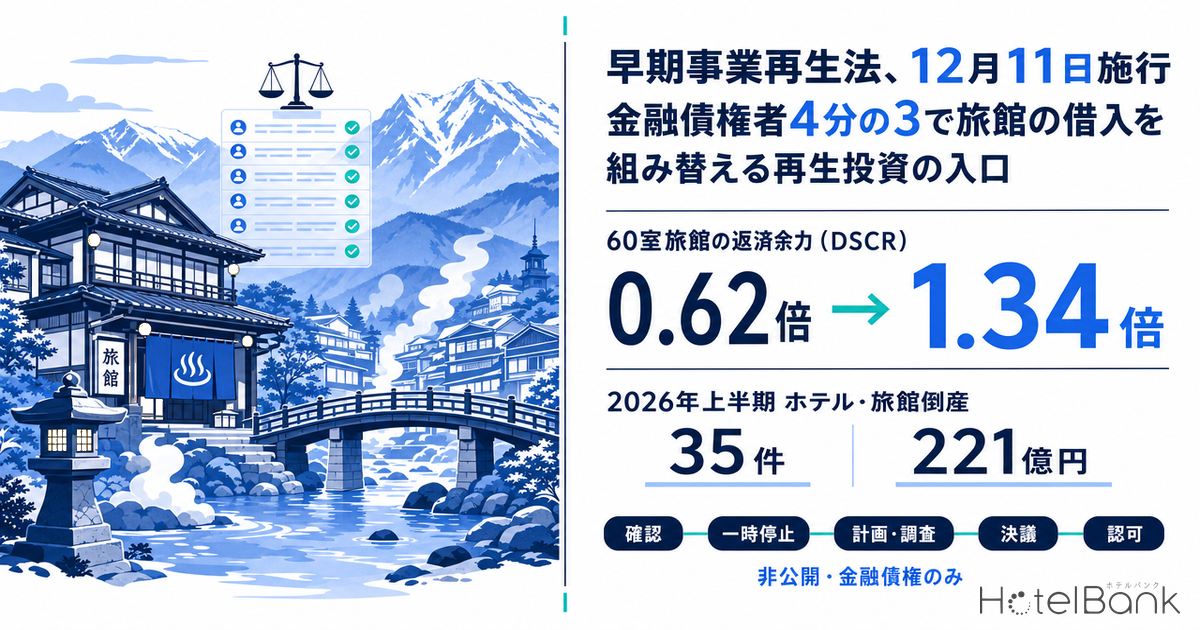
On December 11, 2026, Japan’s Early Business Revitalization Act (早期事業再生法) takes effect. It creates a procedure under which a company can restructure the terms of its borrowings without unanimous consent, provided that creditors holding at least three-quarters of the total voting rights of financial-institution creditors agree and a court approves. Until now, an out-of-court workout for a ryokan or hotel collapsed if even a single lender objected. This article confirms the framework of the new regime from official sources, overlays accommodation-sector exit statistics with the estimated settled ADR of ryokan in major onsen prefectures, and quantifies the entry point for turnaround sponsors through a capital-restructuring scenario for a hypothetical 60-room ryokan.
Metric Definitions Used in This Article
- ADR (Average Daily Rate): An estimated settled room rate (tax-excluded equivalent), calculated by applying a segment-specific adjustment factor to the lowest plan price each property publishes on OTAs (per room, two guests, tax-included). Checked against property-level results disclosed by listed hotel REITs (91 properties, most recent three months), the median error is about 7%. These are estimates and differ from each property’s actual transaction prices and accounting figures. Area-level ADR is the median of the properties covered (the level of a typical property in the area).
- DSCR (Debt Service Coverage Ratio): Annual cash available for debt service (GOP minus the capex reserve) divided by annual principal and interest payments. A value below 1.0x means the business’s cash flow alone cannot cover scheduled debt service.
- Secured / unsecured portion: Of a financial claim, the portion expected to be recovered from collateral is the secured portion; the remainder is the unsecured portion.
- Data sources: MetroEngines Research & Consulting / Ministry of Economy, Trade and Industry (METI) / Teikoku Databank / Tokyo Shoko Research / Bank of Japan
- — Three-quarters plus court approval: With the consent of creditors holding at least three-quarters of the total voting rights of financial-institution creditors, debt forgiveness and maturity extensions can be approved without unanimous consent. The Act takes effect on December 11, 2026.
- — Trade creditors excluded, process non-public: Only financial debt is restructured while payments for food, linen and other supplies continue as normal, and portions secured by collateral are excluded from the majority vote.
- — 35 cases, ¥22.1 billion: Hotel and ryokan bankruptcies in H1 2026 (Teikoku Databank). The number of cases fell 7.9% YoY while total liabilities rose 72.3%, pushing average liabilities per case up to about ¥630 million.
- — 5 of 6 prefectures: In five of six major onsen prefectures, the estimated settled ADR of ryokan for January–August 2026 exceeded the prior-year level (e.g. Nagano +6.7%; monthly N=111–526 properties).
- — DSCR 0.62x → 1.34x: A model of a 60-room ryokan. Combining a 50% write-down of the unsecured portion with ¥200 million of renovation capital lifts debt service coverage above 1x, with a cash-on-cash yield on the equity of about 6.8% (sensitivity range 4.0–9.7%).
What Is the Early Business Revitalization Act? — From Unanimity to Majority Vote
Its formal title is the “Act on Procedures for the Adjustment of Debts Owed by Businesses to Financial Institutions, etc. for Facilitating Smooth Business Revitalization” (Act No. 67 of 2025). It was enacted in June 2025 and promulgated on June 13 of that year. On June 30, 2026, METI promulgated the ministerial ordinance setting out the details of the regime and the public notice defining the asset valuation standards, and published a Q&A explaining how the law is to be interpreted. The Act takes effect on December 11, 2026.
The essence of the regime is captured in one sentence of METI’s explanation: rights relating to claims can be adjusted “through a majority vote of financial creditors and court approval.” Under existing out-of-court workouts such as Turnaround ADR (事業再生ADR), unanimous consent of all participating financial institutions was required. Even if the main bank and government-affiliated lenders supported a rehabilitation plan, a single creditor with a small claim could block it. The new Act makes it possible to overcome that “single objection,” with court approval as the safeguard.
The Act covers businesses that are “at risk of falling into economic distress.” The name “early” comes from the fact that it can be used at a stage before civil rehabilitation (民事再生), which presupposes that the business is already in distress. The procedure is conducted with the involvement of a designated verification and investigation body, a third-party organization designated by the Minister of Economy, Trade and Industry.
How the Procedure Works
| Stage | Description |
|---|---|
| 1. Confirmation | The business applies to a designated verification and investigation body and is confirmed on points such as the need for debt adjustment and whether claims qualify as covered claims |
| 2. Standstill | Covered creditors are requested to refrain from exercising rights such as collection. The scope of the request is set out in Article 11 of the ordinance, and notification to labor unions and others is prescribed in Article 13 |
| 3. Plan and investigation | A proposal for the modification of rights and a business revitalization plan are prepared and investigated by the designated body. Assets are valued in line with the asset valuation standards in the public notice |
| 4. Resolution | The plan is approved at a meeting of covered creditors with the consent of at least three-quarters of total voting rights |
| 5. Court approval | Once the court approves the resolution, the modification of rights also binds creditors who voted against it |
Source: Compiled by the HotelBank Editorial Team from METI, “Q&A and Other Materials Published Ahead of the December 11 Entry into Force of the Early Business Revitalization Act” (June 30, 2026) and BUSINESS LAWYERS, “Overview and Key Points of the Early Business Revitalization Act”
For ryokan and hotel operators, three points matter in practice. First, the modification of rights is limited to loan claims held by financial institutions and similar lenders; trade claims such as food, linen and distribution commissions are not included. The business can keep paying suppliers as usual while restructuring only its borrowings. Second, commentators note that the procedure proceeds without public notice, in private. Avoiding the impression of a “legal insolvency proceeding” among guests with bookings and business partners is significant in the accommodation business, where brand and customer acquisition are the very essence of enterprise value. Third, portions secured by collateral are excluded from modification by majority vote. What the majority can change is the unsecured portion, and the position of creditors holding the value of the collateral property is protected.
The voting requirements also contain safeguards. According to commentary, in addition to the basic requirement of at least three-quarters of total voting rights, if a single creditor holds three-quarters or more of the total, the consent of a majority of the covered creditors attending the meeting is also required. The design does not allow a single lender to push a plan through alone. The court will also reportedly refuse approval if the resolution runs counter to the general interest of covered creditors — that is, if it would yield less than they would recover in a liquidation. The regime is premised on dissenting creditors being no worse off than in liquidation.
Comparison with Existing Restructuring Procedures
| Item | Early Business Revitalization Act | Turnaround ADR | Civil Rehabilitation |
|---|---|---|---|
| Approval requirement | At least 3/4 of total voting rights + court approval | Unanimous consent of covered creditors | Majority vote of creditors + court approval |
| Covered claims | Loan claims of financial institutions, etc. | Mainly financial claims | Includes trade claims |
| Disclosure | Non-public | Non-public | Public notice |
| When it can be used | When at risk of falling into distress | When in distress | When in distress |
Source: Compiled by the HotelBank Editorial Team from METI, BUSINESS LAWYERS, “Overview and Key Points of the Early Business Revitalization Act,” and other published commentary. Application to individual cases should be confirmed with professional advisers
Why It Matters So Much for Hospitality — Larger Exits and ¥4.1 Trillion in Borrowings
Banks remain the gateway to financing for the accommodation sector. According to the Bank of Japan’s “Loans and Bills Discounted by Sector,” outstanding loans to the accommodation sector across the three categories of lenders totaled ¥4.117 trillion at end-June 2026, and equipment funds accounted for 61.1% of the domestic-bank portion. With long-term borrowings tied to buildings and equipment, the capital structure means debt service tends to weigh first, even when occupancy recovers.
Exit statistics reflect this pattern. According to Teikoku Databank, bankruptcies of hotel and ryokan operators in H1 2026 numbered 35, with total liabilities of ¥22.113 billion. While the number of cases fell by three from a year earlier, total liabilities rose 72.3%. Liabilities per case were about ¥632 million, 1.9 times the approximately ¥338 million of a year earlier. This indicates that the center of gravity of exits is shifting from small inns to mid-size and large properties with heavier borrowings.
Source: Compiled by the HotelBank Editorial Team from Teikoku Databank research (as reported by Kanko Keizai Shimbun, H1 of each year 2024–2026)
The same trend is visible on a full-year basis. Hotel and ryokan bankruptcies in 2025 totaled 81, the second consecutive annual increase and the highest level in a decade after the pandemic year of 2020. In Teikoku Databank’s separate “accommodation sector” tally, which uses a different industry definition, 267 businesses exited the market in 2025: 89 bankruptcies plus 178 voluntary closures and dissolutions. Among the causes of bankruptcy, the firm cites the start of repayments on zero-interest, unsecured COVID loans (“zero-zero loans”) and rising labor and utility costs, and notes that 58 cases over the past five years involved aging facilities or repairs as a factor.
What stands out is that moves to “keep the business alive” are already happening ahead of exit. According to Tokyo Shoko Research, there were 213 cases in FY2025 in which a company had transferred its main business to another company before going bankrupt, and by industry, ryokan and hotels were the largest group with 31 cases. An inn with a building, staff and customers is easy to carry on as a business even if the company itself exits. The Early Business Revitalization Act adds the option of making that handover before bankruptcy rather than after — and in tandem with restructuring the borrowings.
The Earnings Base for Revitalization — Ryokan ADR Up YoY in 5 Onsen Prefectures
Restructuring borrowings will not sustain a turnaround unless cash available for debt service grows. We therefore compared the estimated settled ADR of the ryokan category in six prefectures with many ryokan, for the January–August 2026 average versus the same period a year earlier. Nagano rose 6.7%, Tochigi 4.6%, Shizuoka 3.5%, Gunma 2.8% and Oita 2.1%, so five of the six prefectures exceeded the prior-year level. In terms of level, Shizuoka (about ¥18,700) and Oita (about ¥18,000) are the highest, while Nagano is about ¥13,300.
Source: MetroEngines Research & Consulting (ryokan category; monthly 2026 samples per prefecture range from a minimum of 111 to a maximum of 526 properties). Simple January–August average of estimated settled ADR (tax-excluded equivalent)
| Prefecture | Jan–Aug 2025 | Jan–Aug 2026 | YoY | Monthly properties (2026, minimum) |
|---|---|---|---|---|
| Nagano | ¥12,431 | ¥13,258 | +6.7% | 493 |
| Tochigi | ¥15,689 | ¥16,413 | +4.6% | 201 |
| Shizuoka | ¥18,107 | ¥18,744 | +3.5% | 433 |
| Gunma | ¥15,068 | ¥15,495 | +2.8% | 278 |
| Oita | ¥17,611 | ¥17,987 | +2.1% | 304 |
| Ishikawa | ¥18,115 | ¥17,487 | −3.5% | 111 |
Source: MetroEngines Research & Consulting. Estimated settled ADR (tax-excluded equivalent), settled months through August 2026
Ishikawa is down 3.5% YoY, but at about ¥17,500 its level sits in the middle of the six prefectures. Because growth rates look small when the prior year’s level is used as the base, it is more practical to set the revenue assumptions of a rehabilitation plan based on actual performance over the most recent 12 months. In every prefecture, rates have held firm compared with two years ago, suggesting that an environment is taking shape in which cash flow can cover both debt service and reinvestment — provided borrowings are brought in line with what the business can support.
Source: MetroEngines Research & Consulting (circle size = ryokan estimated settled ADR level for January–August 2026; YoY change in popup)
Capital-Structure Scenarios for a 60-Room Ryokan — Extension, Write-Down and Renovation
So how does restructuring by majority vote change the numbers of a single ryokan? Assuming a 60-room ryokan with ¥800 million of borrowings, we compared debt service coverage (DSCR) in the current state and under three scenarios. The assumed ADR of ¥16,000 sits within the January–August 2026 range of the six prefectures above (about ¥13,300–¥18,700).
■ Model assumptions
60 rooms / ADR ¥16,000 / OCC 55% (assumed, full-year average) / rooms revenue at 55% of total (total revenue including F&B of about ¥350 million) / GOP margin 15% / capex reserve at 4% of total revenue / borrowings of ¥800 million (secured portion ¥400 million, unsecured portion ¥400 million); currently the full amount is repaid on a level-payment basis at 2.0% over 15 years. The secured portion is outside the majority vote, so its terms are left unchanged in all scenarios. After restructuring, the unsecured portion carries 1.0% interest over 25 years. Scenario C assumes a sponsor invests ¥200 million of renovation capital, with ADR +12% (about ¥17,900), OCC +3pt and a GOP margin of 17%. Recovery on the unsecured portion in liquidation is assumed to be lower than the claim amount retained in each scenario.
Source: Modeled by MetroEngines Research & Consulting based on MetroEngines Research ADR levels
| Item | Current | A. Maturity extension | B. 30% unsecured write-down | C. 50% unsecured write-down + renovation |
|---|---|---|---|---|
| Remaining borrowings | ¥800M | ¥800M | ¥680M | ¥600M |
| Annual debt service | ¥62.3M | ¥49.3M | ¥43.8M | ¥40.2M |
| Cash available for debt service (GOP − capex reserve) | ¥38.5M | ¥38.5M | ¥38.5M | ¥53.8M |
| DSCR | 0.62x | 0.78x | 0.88x | 1.34x |
| Annual cash flow after debt service | −¥23.7M | −¥10.7M | −¥5.3M | +¥13.6M |
Source: MetroEngines Research & Consulting model. This is a simplified estimate; an actual investment decision requires a detailed feasibility study
The results are clear. Scenario A, a maturity extension alone, reduces annual debt service by about ¥13 million, but DSCR stays at 0.78x. Even Scenario B, a 30% write-down of the unsecured portion, reaches only 0.88x — restructuring the borrowings alone does not get coverage to 1x. What lifts coverage above 1x is Scenario C, which injects renovation capital alongside the write-down to raise revenue itself: DSCR reaches 1.34x, leaving about ¥14 million of annual cash flow after debt service. The cash-on-cash yield on the sponsor’s ¥200 million investment is about 6.8%.Back-calculating an acquisition ceiling from post-renovation rates and a target yield — benchmarked against actual market levels in onsen areas such as Yugawara and Izu-Nagaoka — is the natural next step for a sponsor sizing a bid.
What the model shows is that the value of the Early Business Revitalization Act lies less in “reducing debt” as such than in allowing a write-down and new money to be combined into a single plan. From the lenders’ side, too, Scenario C keeps ¥200 million of the ¥400 million unsecured portion as a claim, and the renovation improves the earning power of the collateral property. As long as it exceeds expected recovery in a liquidation, it is a plan that a majority of creditors have a rational reason to support.
Scenario C Sensitivity — How Far Can Post-Renovation Rates and Occupancy Fall While Staying Above 1x?
Scenario C’s 1.34x assumes that the renovation raises ADR by 12% and OCC by 3pt. To allow for a renovation effect below expectations, we held the loan terms (secured ¥400 million at 2.0% over 15 years; remaining unsecured ¥200 million at 1.0% over 25 years) and the 17% GOP margin fixed, and varied post-renovation ADR and OCC.
| Case | Post-renovation assumption | DSCR | CF after debt service (annual) | Cash-on-cash yield on ¥200M equity |
|---|---|---|---|---|
| Downside | ADR +6% (about ¥17,000), OCC unchanged | 1.20x | +¥8.1M | about 4.0% |
| Base | ADR +12%, OCC +3pt (Scenario C in the text) | 1.34x | +¥13.6M | about 6.8% |
| Upside | ADR +18% (about ¥18,900), OCC +6pt | 1.48x | +¥19.4M | about 9.7% |
Source: MetroEngines Research & Consulting model (assumptions as in the text)
| OCC\ADR | ¥16,000 | ¥17,000 | ¥17,920 | ¥19,000 | ¥20,000 |
|---|---|---|---|---|---|
| 50% | 1.03 | 1.09 | 1.15 | 1.22 | 1.29 |
| 54% | 1.11 | 1.18 | 1.25 | 1.32 | 1.39 |
| 58% | 1.19 | 1.27 | 1.34 | 1.42 | 1.49 |
| 62% | 1.28 | 1.36 | 1.43 | 1.52 | 1.60 |
| 66% | 1.36 | 1.44 | 1.52 | 1.61 | 1.70 |
Source: MetroEngines Research & Consulting model. Bold = Scenario C in the text; orange = below 1.10x
DSCR exceeded 1x in all 25 combinations. Even the harshest combination — ADR of ¥16,000 (no rate uplift from renovation) and OCC of 50% (full-year average) — yields 1.03x. On a simple calculation, cash available for debt service still covers principal and interest if OCC falls to about 43% at an ADR of about ¥17,900, or if ADR falls to about ¥13,400 at an OCC of 58%. The GOP margin, however, has a large effect: even with ADR and OCC as in Scenario C, DSCR drops to 1.13x if the GOP margin stays at the current 15%. When lenders assess a rehabilitation plan, the focus is likely to be less on the rate assumptions than on how much of the rise in labor and utility costs post-renovation operations can absorb.
What Each Stakeholder Can Do in the Three Months Before Entry into Force
| Stakeholder | Direction of consideration |
|---|---|
| Turnaround sponsors (operating companies, funds) | Look for deals with large room for rate uplift through renovation at the pre-bankruptcy planning stage rather than in post-bankruptcy auctions. The gap between current ADR and the expected post-renovation rate determines the required write-down and the equity amount |
| Regional banks and shinkin banks | Sort out whether claims on borrowers are secured or unsecured, and prepare the material to compare expected recovery in liquidation with recovery under a rehabilitation plan. The dynamic in which a small minority of lenders holds the key to consensus will change |
| Advisers to owners facing succession | Add a third option — rehabilitation with restructured borrowings — to succession to an heir or sale to a third party. The fact that it can be used at the stage of being “at risk of” distress buys time |
Practical points to confirm include the designation status and fees of designated verification and investigation bodies, the specific scope of covered “financial institutions, etc.” (Articles 2–4 of the ordinance) and of loan claims (Article 5), and the asset valuation standards (public notice). All of these are detailed in the ordinance, public notice and Q&A published by METI, so any deal should be assessed on the basis of the original texts and confirmation with professional advisers. On the timeline for business succession, note also thatthe deadline for Japan’s business succession tax deferral falls in December 2027.
Conclusion
The Early Business Revitalization Act is a procedure that allows only financial debt to be restructured, privately, with the consent of at least three-quarters of total voting rights and court approval. In the accommodation sector, liabilities per bankruptcy in H1 2026 have grown to about ¥630 million, while ryokan ADR in onsen prefectures rose YoY in five of six prefectures. At a moment when heavy borrowings and recovering earning power coexist, our 60-room ryokan model shows that debt service coverage rises to 1.34x when a write-down is combined with renovation capital, not a write-down alone. The December 11, 2026 entry into force is likely to give turnaround sponsors an entry point to engage with an inn’s enterprise value at an earlier stage than a post-bankruptcy auction.
References and Sources
■ Data sources
The description of the regime is based on METI’s published materials, the statutory text on e-Gov Law Search, and published commentary by law firms and others. Bankruptcy and business-transfer counts and liabilities are figures published by Teikoku Databank and Tokyo Shoko Research (including via press reports). Ryokan ADR is the estimated settled ADR (tax-excluded equivalent) for the ryokan category from MetroEngines Research & Consulting, calculated as the simple average of monthly values for January–August of 2025 and 2026 respectively. The number of properties covered monthly in 2026 ranges from 111 to 526 by prefecture. Outstanding loans to the accommodation sector are from the Bank of Japan’s “Loans and Bills Discounted by Sector” (end-June 2026).
■ Model assumptions
60 rooms, ADR ¥16,000, OCC 55% (assumed, full-year average), rooms revenue at 55% of total, GOP margin 15%, capex reserve at 4% of total revenue, borrowings of ¥800 million (secured ¥400 million / unsecured ¥400 million). Currently the full amount is repaid in annual level payments at 2.0% over 15 years; after restructuring the unsecured portion carries 1.0% over 25 years, and the secured portion’s terms are unchanged in all scenarios. Scenario C: ¥200 million equity, ADR +12%, OCC +3pt, GOP margin 17%. The sensitivity analysis holds Scenario C’s loan terms and GOP margin fixed and varies only post-renovation ADR and OCC.
■ Limitations and caveats
The model is a hypothetical one that does not refer to any specific property and excludes taxes, lost revenue during renovation closures, procedural costs (such as fees of designated verification and investigation bodies) and working capital. Write-down rates and interest rates are determined case by case by the resolution of the creditors’ meeting and court approval, and a plan may not be approved when compared with liquidation value. Estimated settled ADR is an estimate based on published OTA prices and differs from each property’s actual transaction prices. Whether the regime applies should be confirmed against the original texts of the ordinance, public notice and Q&A and with professional advisers.
■ Laws and official documents
- METI, “Q&A and Other Materials Published Ahead of the December 11 Entry into Force of the Early Business Revitalization Act” (June 30, 2026) (Japanese)
- METI, “Early Business Revitalization” (Japanese)
- e-Gov Law Search, “Act on Procedures for the Adjustment of Debts Owed by Businesses to Financial Institutions, etc. for Facilitating Smooth Business Revitalization” (Act No. 67 of 2025, promulgated June 13, 2025) (Japanese)
- Bank of Japan, “Loans and Bills Discounted by Sector” (sector: accommodation, end-June 2026)
■ Commentary
- BUSINESS LAWYERS, “Overview and Key Points of the Early Business Revitalization Act” (Japanese)
- Nakamoto & Partners, “Commentary on the Early Business Revitalization Act” (Japanese)
■ Bankruptcy and business-transfer statistics
- Kanko Keizai Shimbun, “H1 Hotel and Ryokan Bankruptcies at 35, Liabilities ¥22.1 Billion — Fewer Cases, Sharply Larger Amounts” (Teikoku Databank research) (Japanese)
- Kanko Keizai Shimbun, “Hotel and Ryokan Bankruptcies in H1 at 38, Liabilities ¥12.8 Billion” (Teikoku Databank research) (Japanese)
- Kanko Keizai Shimbun, “Hotel and Ryokan Bankruptcies Last Year Rise for Second Straight Year to 81” (Teikoku Databank research, February 9, 2026) (Japanese)
- Teikoku Databank, “Bankruptcies, Closures and Dissolutions in the Accommodation Sector (2025)” (Japanese)
- Tokyo Shoko Research, “Pre-Bankruptcy Business Transfers Remain High After COVID: 213 Cases in FY2025, Ryokan and Hotels the Largest Group” (Japanese)
■ Market data
- MetroEngines Research & Consulting — Estimated settled ADR for the ryokan category (6 prefectures, July 2024–August 2026)