

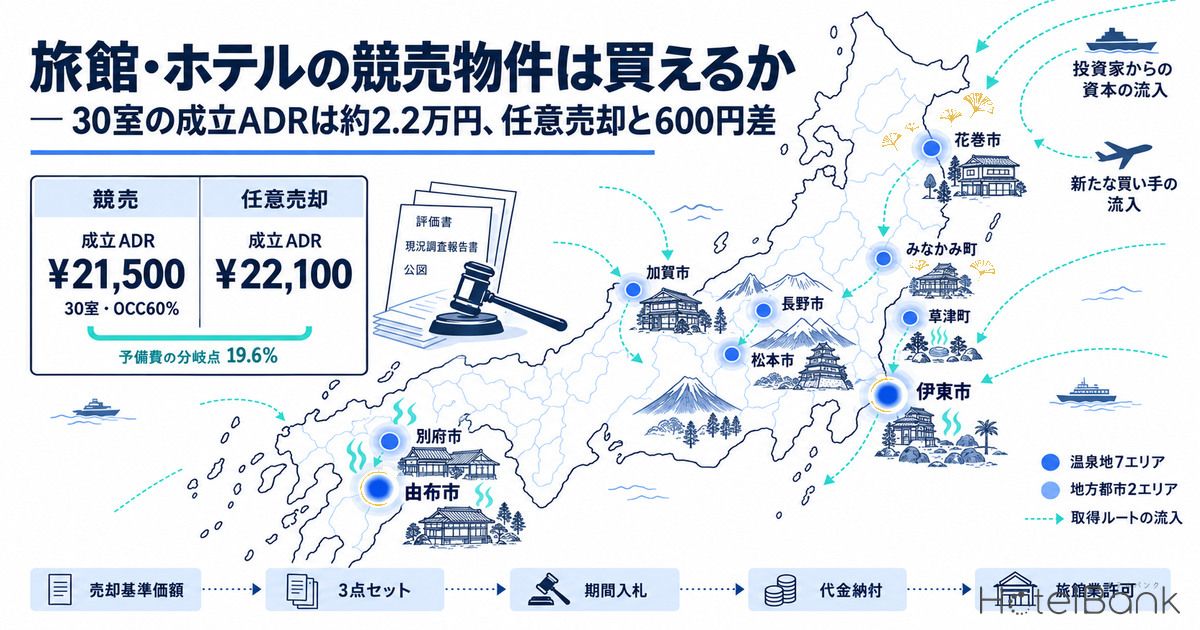
When an inn or hotel can no longer stay open, how does its building reach the market? Two routes dominate on the private-sector side: a court-ordered real estate auction (keibai), filed by a lender or other secured creditor, and a voluntary sale (nin’i baikyaku), in which the owner sells with the creditors’ consent before it comes to that. This article looks at both routes from the buyer’s side. What can you know at the time you bid, and what can’t you? And how much does that uncertainty raise the room rate a property needs to earn after its turnaround? We quantify it with 30-room and 60-room models.
Scope of this article (and how it differs from our earlier coverage)
We have covered public-sector disposal routes in earlier Japanese-language articles: sales of national land, conversions of closed schools, the fishing-port facility program, and the turnaround market for 43 publicly run lodges (kokumin shukusha). Bankruptcy counts and succession opportunities, and the acquisition schemes used in private negotiated deals, have also had their own articles. This article is about the mechanics of one acquisition route: enforcement of a security interest (auction) and the voluntary sale. Where we compare it with a negotiated deal, we only describe the differences.
This article explains the legal framework and general practice. It is not legal, tax or investment advice on any individual case, and it does not name any specific auction property or business.
Metric Definitions Used in This Article
ADR (average daily rate): An estimated realized rate (tax-exclusive equivalent). It is calculated from the lowest plan price each property publishes on booking sites (two guests per room, per-room price, tax included), with a correction factor applied by property type. Checked against property-level results disclosed by listed hotel REITs (91 properties, most recent three months), the median error is about 7%. It is an estimate and differs from each property’s actual realized rates and accounting figures. Area-level ADR is the median of the properties covered (the level of a typical property in the area).
OCC (occupancy rate): Rooms sold as a share of total rooms in the area, estimated from OTA sales inventory. It reflects how inventory listed on booking sites sells through and differs from each property’s actual occupancy.
Standard sale price and minimum bid price: The standard sale price (baikyaku kijun kagaku) is the value the enforcement court sets for an auctioned property based on a court-appointed appraiser’s valuation. The minimum bid price (kaiuke kanō kagaku) is that value less 20%. Bids must be at or above it (Civil Execution Act, Article 60).
Break-even ADR: In this article’s model, the estimated realized ADR needed to earn the target NOI yield on the total investment. Data source: MetroEngines Research
Key Takeaways
— District courts received 17,599 new real estate enforcement cases in 2024, up 11.3% from the previous year. The figure covers all property types, including homes and land. No count for lodging properties alone is published.
— At auction, bidders generally cannot inspect the building before bidding, and the buyer cannot hold the seller liable for defects in type or quality (Civil Code, Article 568(4)). The court’s “three-document set” covers occupancy, rights and valuation. It does not tell you whether the baths, electrical substation, or water and drainage systems work.
— Total investment for the 30-room model is ¥424 million via auction and ¥436 million via voluntary sale. The purchase price is only 23–34% of total investment. Turnaround capex accounts for around 60%.
— At full-year OCC of 60% and a 10% NOI yield, the break-even ADR for 30 rooms is ¥21,500 via auction and ¥22,100 via voluntary sale, a gap of just ¥600. Even buying 30% cheaper at auction, most of the difference is eaten up by contingency, replacement furniture and equipment, and a longer vacancy period. Above a 19.6% contingency, the two routes’ break-even ADRs flip.
— Against the median ryokan ADR in seven hot-spring areas, Yufu and Ito have medians above the 30-room break-even line, and Kaga is roughly level with the 60-room line. In the other four areas, the break-even line is 1.2–1.4 times the median, so the key is a design that holds down total investment, such as fewer rooms or lighter capex.
How Large Is the Pool? 17,599 New Real Estate Enforcement Cases in 2024, Across All Property Types
According to the Supreme Court’s Annual Report of Judicial Statistics (Civil and Administrative), district courts received 11,860 new “auctions as enforcement of a security interest” and 5,739 “compulsory auctions” involving real estate in 2024, for a total of 17,599. The total fell for three straight years, from 21,272 in 2019 to 15,449 in 2022, and was flat at 15,814 in 2023. In 2024 it turned upward, rising 11.3% year on year; enforcement of security interests alone rose 16.2%.
However, these counts cover all property types, including homes, land and commercial property. No count for lodging properties alone is published, and the 17,599 figure cannot be read as a count of hotels or inns. Ryokan and hotels are likely a small part of the total. The route is best understood as one where a steady number of properties come through each year, but you will not see them unless you go looking.
Several stages come before a security interest is enforced. First comes a change in repayment terms (rescheduling). For guaranteed loans, a credit guarantee corporation then repays the lender on the borrower’s behalf (subrogated repayment). According to the National Federation of Credit Guarantee Corporations, subrogated repayments (principal and interest) bottomed out at 20,816 cases and ¥242.6 billion in FY2021, then rose to 43,830 cases and ¥494.6 billion in FY2023, 48,303 cases and ¥549.8 billion in FY2024, and 48,176 cases and ¥549.1 billion in FY2025. The count has now stayed in the 48,000 range for two years. A guarantee corporation that has repaid the lender acquires a right of reimbursement; if there is collateral, it chooses between a voluntary sale and an auction to recover. These are also all-industry figures and cannot be treated as lodging-industry counts.
On the lodging side, Teikoku Databank counted 35 hotel and ryokan bankruptcies in the first half of 2026. Not every bankrupt property’s building goes to auction, however. In some cases operations are taken over through a business transfer; in others, the property goes to a buyer in a negotiated voluntary sale.
How an Auction Works: Bids From 80% of the Standard Sale Price, With a 20% Deposit
Real estate auctions follow procedures set out in the Civil Execution Act. Once a secured creditor’s petition leads to a decision to commence the auction, a court execution officer inspects the property’s current condition, an appraiser values it, and the court sets the standard sale price. The property then goes to a period bidding process. The key points from a buyer’s perspective are summarized in the table below.
| Stage | What happens | Legal basis |
|---|---|---|
| 1. Decision to commence auction / attachment | Begins on a petition from a secured creditor or other party; the attachment is registered | Civil Execution Act, Art. 45 and 188 |
| 2. Status investigation and appraisal | The execution officer investigates the occupants, their right to occupy and the building’s condition; the appraiser calculates a value | Same Act, Art. 57 and 58 |
| 3. Setting the standard sale price | Set by the court based on the appraisal. The minimum bid price is 80% of it, and bids must be at or above that level | Same Act, Art. 60 |
| 4. Property statement prepared / three-document set published | The property statement, status investigation report and appraisal report can be viewed at the court and are also published on BIT, the courts’ real estate auction information site | Same Act, Art. 62 |
| 5. Period bidding | Bids are submitted during a set bidding period (normally eight days at the Tokyo District Court’s Civil Execution Center). The deposit is normally 20% of the standard sale price. Bidders must also declare that they are not members of an organized crime group | BIT “Bidding Procedures”; same Act, Art. 65-2 |
| 6. Bid opening / decision to permit sale | The court permits the sale to the highest bidder | Same Act, Art. 69 |
| 7. Payment | Ownership transfers once the price is paid by the deadline | Same Act, Art. 78 and 79 |
| 8. Handover | If occupants do not leave voluntarily, the buyer can generally petition for a delivery order within six months of payment | Same Act, Art. 83 |
Compared with a negotiated deal, three differences matter most in practice. First, buyers generally cannot see inside the building. An inspection system exists (Civil Execution Act, Art. 64-2), but only the attaching creditor can request it, not prospective buyers. Second, buyers cannot claim for non-conformity. Under Civil Code Article 568(4), the seller’s warranty rules do not apply to defects in the type or quality of property sold at auction. Third, the buyer must deal with any occupants, such as an operating company. A building tenant whose lease is subordinate to the mortgage is allowed a six-month grace period after payment before vacating (Civil Code, Art. 395).
What the Three-Document Set Tells You: Five Items to Read for a Lodging Property
According to BIT, the status investigation report records the property’s current condition, its occupants and whether they have a right to occupy, with photographs attached. The appraisal report describes the surroundings and the appraised value, with drawings attached. The property statement records rights the buyer must take over, such as leases, and whether a right to use the underlying land for the building arises. Applied to a lodging property, the items to read come down to the five below.
| Item | Main document | What to look for in a lodging property |
|---|---|---|
| Occupancy and right to occupy | Status investigation report, property statement | Is an operating company still running the business as a tenant? If its lease predates the mortgage and can be asserted against it, the buyer takes over as landlord. If the lease is subordinate, the six-month grace period applies. The operator’s contract structure directly shapes how the property can be run after acquisition |
| Statutory superficies / right to use the land | Property statement | Are the land and building owned by different parties, or is only the building being sold (Civil Code, Art. 388)? Are the hot-spring source, parking, annex buildings or staff dormitory on separate lots or under different owners? |
| Encroachments and boundaries | Status investigation report, appraisal report | Do outdoor baths, connecting corridors, pipes or signs extend onto neighboring or public land? On sloped hot-spring sites, drawings and actual conditions sometimes do not match |
| Current condition of the building | Status investigation report (photos), appraisal report | Unregistered extensions, building age, and photos of the exterior and parts of the interior. Photos do not show whether equipment works |
| Appraised value and discount approach | Appraisal report | Appraisers build auction-specific discount factors (occupants who will not leave voluntarily, no seller warranty, etc.) into an “auction market adjustment.” Practitioner commentary puts it typically at around 0.6–0.7, and the Tokyo District Court reduced the discount for properties in the 23 wards from 30% to 20% from March 2017 |
Read in price terms, the auction market adjustment means bidding starts at roughly 30% below the going rate in negotiated deals. But the discount is not free. No inspection, no seller warranty, no guaranteed handover: the discount built into the appraisal is the price paid for the buyer taking on these costs. The next section sets those costs out in concrete terms.
What the Three-Document Set Does Not Tell You: Pricing In What You Cannot Check
For a lodging property, the areas that move turnaround costs the most are the ones the three-document set does not cover. The table below lists what cannot be confirmed in pre-bid due diligence (DD), with the issues each raises and how this article’s model prices them in.
| Unknown item | Issue after acquisition | How the model prices it in |
|---|---|---|
| Whether an inspection is possible | Wear to guest rooms and wet areas cannot be judged beyond what the photos show | Flat guest-room renovation cost of ¥5 million per room; any overrun absorbed by the contingency |
| Working condition of equipment (heat source, HVAC, elevators) | The longer the closure, the more likely replacement rather than reuse | Electrical substation budgeted as a full replacement (¥10 million for 30 rooms, ¥15 million for 60 rooms) |
| Whether water, drainage and bath systems work (filtration and circulation, pipes, tubs) | Working baths are the minimum condition for a hot-spring ryokan to reopen, and they must meet hygiene standards | Bath renovation and replacement of filtration and hot-water equipment budgeted separately (¥14 million for 30 rooms, ¥28 million for 60 rooms) |
| Asbestos | A survey is required before renovation work starts, and costs jump depending on the area to be removed | +10% on base capex |
| Inspection certificate / legal compliance | If the renovation requires a building confirmation application, the existing parts must be shown to comply with current law | Absorbed through the contingency and a longer vacancy period (18 months) |
| Ownership of furniture, fixtures, equipment and the reservation system | Movable furniture, leased items and system contracts do not necessarily transfer with the building | Assumed to be re-procured at ¥500,000 per room plus a lump sum of ¥3–5 million |
| Hot-spring rights | If the spring belongs to another owner or is supplied under a piping contract, the rights may not come with the building (see Who Owns the Hot Spring Water?) | Not absorbed by the contingency; the purchase-price assumption itself must be revisited |
In our model, the inability to inspect is priced in as a “no-DD contingency” set at 15% of base capex (including asbestos work). For a voluntary sale, where on-site surveys and equipment checks can be reflected in negotiated terms, we set the same contingency at 5%. This 10-point gap is what determines the difference in break-even ADR between the two routes, as shown below.
Auction vs. Voluntary Sale: Which Deals Come Through Which Route
A voluntary sale is not a legal procedure. The owner obtains consent from every secured creditor to discharge their mortgages, then sells the property in an ordinary sale. It is a negotiated deal, usually through a broker, and handover terms can be negotiated. The table compares it with an auction point by point.
| Issue | Auction (enforcement of a security interest) | Voluntary sale |
|---|---|---|
| Process | A court procedure. The court sets the bidding dates | The owner sells with the creditors’ consent. If consent cannot be reached, the case moves to auction |
| Starting point for price | The standard sale price (including the auction market adjustment). The minimum bid price is 80% of it | Negotiated with market value as the reference. Requires every secured creditor to agree to discharge |
| How information flows | The three-document set is published on BIT and open to anyone | Offered to a limited set of parties through brokers and creditors |
| Pre-purchase investigation | Inspecting the building interior and equipment is generally not possible | On-site surveys, document review and equipment checks can be done and reflected in the price |
| Seller warranty | No claim for defects in type or quality (Civil Code, Art. 568(4)) | Set by contract; some deals include a disclaimer clause |
| Handover | The buyer deals with occupants after payment; a delivery order is available | Handover date, items left behind, staff and existing guest bookings can be settled by negotiation |
| Business continuity | Taking over a property while it is still operating is not guaranteed | Combined with a business transfer, the deal can be structured so operations continue without a break |
| Brokerage fee | None | Payable |
| Competition among buyers | Price set by bidding; open to individuals and businesses alike | Negotiated; buyers who hear early tend to control the negotiation |
There are also general tendencies in which deals end up on which route. Voluntary sales are more likely when a successor can be found while the business keeps operating, when there are few secured creditors so consent is easier to reach, and when the aim is to transfer the whole business, including the hot-spring source and staff. Auctions are more likely when junior secured creditors or tax-arrears attachments pile up and consent to discharge cannot be reached, when the property has been closed long enough that even the owner no longer knows the state of occupancy or equipment, or when the owner cannot be contacted. Information on the former flows early and to few; on the latter, late and to many. It makes sense for buyers to maintain separate sourcing channels to match the kind of deal they want.
A Winning Bid Does Not Come With a Hotel Business License: Buildings, Fire Safety and Related Permits Are the Buyer’s Job
What transfers at auction is ownership of the real estate, not the status of the licensed operator. The amended Hotel Business Act, in force from December 13, 2023, allows the operator’s status to be succeeded through a business transfer (Art. 3-2). An auction or a sale of the real estate alone does not qualify. The buyer, or the operator it appoints, must obtain a new license (Art. 3(1)). A new license application involves a fresh review of whether the building and equipment meet the standards set by Cabinet Order, and a fire-code compliance notice and other documents must be attached. This is the same as for a real estate acquisition in a negotiated deal.
The same applies to related permits. A hot-spring use permit and, if meals are served, a food business permit must be obtained again by the new owner. Depending on the scale of renovation, a building confirmation application may be required, and the existing parts will have to comply with current law. For a building without an inspection certificate, the work starts with a status survey. If the building predates Japan’s 1981 seismic standards, the decision whether to renovate and keep using it or rebuild comes first (see Japan’s pre-1981 hotel stock of 236,000 rooms).
Our model therefore sets the vacancy period until opening as follows. For the auction route, the sequence “payment → handover → status survey and design → construction → permits” takes 18 months. For the voluntary-sale route, assuming surveys and design can proceed before the contract is signed, it takes 12 months.
Modeling the Break-Even Line Against Rates in Seven Hot-Spring Areas and Two Regional Cities
To test the break-even line, we compiled estimated realized ADR and occupancy for seven hot-spring areas (Kaga, Kusatsu, Minakami, Yufu, Beppu, Ito and Hanamaki) and two regional cities (Matsumoto and Nagano). For the hot-spring areas the benchmark is the median for the ryokan category; for the regional cities it is the median across all properties.
| Area | Type | Ryokan ADR (12-month median) | All-property ADR (12-month median) | Occupancy (est., Aug 2026) |
|---|---|---|---|---|
| Yufu (Oita) | Hot spring | ¥23,800 (N=120–129) | ¥23,800 (N=131–142) | 78.7% (136 properties / 1,556 rooms) |
| Ito (Shizuoka) | Hot spring | ¥23,500 (N=63–70) | ¥20,500 (N=120–128) | 84.7% (173 properties / 3,526 rooms) |
| Kaga (Ishikawa) | Hot spring | ¥20,500 (N=40–42) | ¥20,000 (N=44–47) | 81.3% (44 properties / 2,580 rooms) |
| Minakami (Gunma) | Hot spring | ¥17,600 (N=42–47) | ¥18,100 (N=46–51) | 87.1% (37 properties / 989 rooms) |
| Beppu (Oita) | Hot spring | ¥17,100 (N=74–84) | ¥15,300 (N=113–126) | 79.5% (128 properties / 3,785 rooms) |
| Kusatsu (Gunma) | Hot spring | ¥16,600 (N=68–83) | ¥17,300 (N=77–92) | 88.4% (57 properties / 1,867 rooms) |
| Hanamaki (Iwate) | Hot spring | ¥15,200 (N=25–27) | ¥13,600 (N=29–32) | 85.2% (28 properties / 1,560 rooms) |
| Matsumoto (Nagano) | Regional city | — | ¥13,300 (N=91–108) | 96.1% (68 properties / 3,096 rooms) |
| Nagano (Nagano) | Regional city | — | ¥11,100 (N=70–78) | 93.2% (36 properties / 2,318 rooms) |
■ Model Assumptions
| Item | Auction route | Voluntary-sale route | Basis |
|---|---|---|---|
| Assumed property | Ryokan with hot spring, over 30 years old, currently closed. Two sizes: 30 and 60 rooms | — | |
| Purchase price | ¥3.3 million per room (¥99 million for 30 rooms) | ¥4.71 million per room (= ¥3.3 million ÷ 0.7) | Based on the ¥100 million acquisition price in our earlier 30-room public-lodge model, with a 30% auction market adjustment assumed to be built into the auction price |
| Acquisition costs | 5.0% of price | 8.3% of price | Transaction taxes of 3.0% plus 2.0% for registration, professional fees and dealing with occupants. A 3.3% brokerage fee is added for the voluntary sale |
| Guest-room renovation | ¥5 million per room | Light-renovation unit cost from our earlier article on 43 public lodges | |
| Baths | ¥14 million for 30 rooms / ¥28 million for 60 rooms (two systems) | Sum of the upper ends of published price ranges: large bath and tub renovation ¥3–8 million, filtration and hot-water equipment replacement ¥2–6 million | |
| Electrical substation | ¥10 million for 30 rooms / ¥15 million for 60 rooms | Assumed value based on published prices for cubicle units (300 kW: ¥5.5–6.5 million; 500 kW and above: ¥10–12 million), plus installation | |
| Kitchen | ¥51 million for 30 rooms / ¥65 million for 60 rooms | Fixed capex of ¥51 million (up to 40 rooms) from our earlier kitchen investment model. For 60 rooms, assumed about 30% higher for a larger space and more equipment | |
| Asbestos work | +10% on the capex above | Midpoint of the 7.5–15.3% range in the mid scenario of our earlier 40-room ryokan model | |
| No-DD contingency | 15% | 5% | This article’s assumption (reflecting whether inspection and equipment checks are possible) |
| Furniture and pre-opening | ¥500,000 per room + lump sum | ¥200,000 per room + lump sum | Auction assumes re-procuring items of unclear ownership; voluntary sale assumes some items are taken over. Lump sum: ¥3 million for 30 rooms, ¥5 million for 60 rooms |
| Holding costs during vacancy | 18 months | 12 months | ¥230,000 per room per year for property tax, statutory inspections, insurance, security and basic utility charges (unit costs from our earlier articles on property tax and statutory inspections), plus a 2.5% annual cost of funds |
| Revenue assumptions | Total revenue = room revenue × 1.2 (ancillary F&B, shop, etc.), NOI margin 25%, target NOI yield 10%, OCC 60% (full-year average; sensitivity 50–70%) | This article’s assumptions | |
This is a simplified model. Actual investment decisions require a detailed feasibility study for each property. Break-even ADR = total investment × target yield ÷ NOI margin ÷ 1.2 ÷ (rooms × 365 × OCC).
On the 30-room auction route, the purchase price of ¥99 million makes up just 23.3% of the ¥424 million total investment (about ¥14.2 million per room). Turnaround capex — renovation of rooms, baths, substation and kitchen, plus asbestos work and contingency — comes to ¥285 million, or 67.1%. On the voluntary-sale route, the purchase price rises to ¥141 million, or 32.4%, and total investment is ¥436 million. The pattern is the same at 60 rooms: ¥794 million via auction (about ¥13.2 million per room) and ¥822 million via voluntary sale.
| Model | Total investment | Per room | Purchase price share | Break-even ADR, OCC 50% | Break-even ADR, OCC 60% | Break-even ADR, OCC 70% |
|---|---|---|---|---|---|---|
| 30 rooms, auction | ¥424M | approx. ¥14.2M | 23.3% | ¥25,800 | ¥21,500 | ¥18,500 |
| 30 rooms, voluntary sale | ¥436M | approx. ¥14.5M | 32.4% | ¥26,500 | ¥22,100 | ¥19,000 |
| 60 rooms, auction | ¥794M | approx. ¥13.2M | 24.9% | ¥24,200 | ¥20,100 | ¥17,300 |
| 60 rooms, voluntary sale | ¥822M | approx. ¥13.7M | 34.4% | ¥25,000 | ¥20,800 | ¥17,900 |
Where the 30% Auction Discount Gets Eaten Up
Comparing the 30-room models, the auction route saves ¥42.3 million on the purchase price and ¥6.8 million on acquisition costs, about ¥49.1 million in total. Against that, it adds ¥24.7 million in no-DD contingency, ¥9 million to re-procure furniture and pre-opening items, and ¥3.8 million in holding costs and interest for the longer vacancy. The net advantage left is about ¥11.5 million, or only around ¥600 in break-even ADR. For how acquisition costs build up in detail, see Hotel acquisition costs: 7.1% of the purchase price.
And this advantage flips easily depending on the contingency assumption. The contingency level at which the two routes’ break-even ADRs are equal is 19.6% for 30 rooms and 21.1% for 60 rooms. For a property where equipment is more worn than expected and you need to allow for overruns above 20% of renovation costs, the voluntary sale — where you can inspect before you buy — gives a lower break-even line than the cheaper auction.
| Sensitivity (auction route, OCC 60% / full year) | Break-even ADR, 30 rooms | Break-even ADR, 60 rooms |
|---|---|---|
| Base case | ¥21,500 | ¥20,100 |
| Purchase price halved (¥1.65 million per room) | ¥18,800 | ¥17,400 |
| Purchase price zero (turnaround capex and holding costs only) | ¥16,100 | ¥14,700 |
| 0% contingency (equipment checked in advance) | ¥19,600 | ¥18,400 |
| 30% contingency (large equipment overruns) | ¥23,400 | ¥21,900 |
| Target NOI yield 8% | ¥17,200 | ¥16,100 |
| Target NOI yield 12% | ¥25,800 | ¥24,200 |
The sensitivity table shows that getting the turnaround capex estimate right matters more to the break-even line than negotiating the purchase price. Halving the purchase price lowers the 30-room break-even ADR only about 13%, from ¥21,500 to ¥18,800. Even at a purchase price of zero, ¥16,100 remains. Turnaround capex and vacancy holding costs alone are enough to reach the rate level of a mid-priced hot-spring ryokan.
Three Scenarios and a Two-Way Sensitivity: How Far Can the Break-Even Line Move?
The sensitivities above move one factor at a time. In real deals, equipment condition (the contingency) and the occupancy achievable after the turnaround tend to move in the same direction. For the 30-room auction route, we show three scenarios combining the two, and a two-way grid of occupancy and target yield. All are derived proportionally from the values in the sensitivity table above; no new assumptions are introduced.
| Scenario | No-DD contingency | Full-year OCC | Break-even ADR | Markets that clear the line |
|---|---|---|---|---|
| Downside — large equipment overruns and occupancy does not fully recover | 30% | 50% | ¥28,100 | None of the nine areas’ medians reach it |
| Mid — this article’s base case | 15% | 60% | ¥21,500 | Medians in Yufu and Ito are above it |
| Upside — equipment checked in advance and occupancy recovers to upper levels | 5% | 70% | ¥17,300 | Four areas: Yufu, Ito, Kaga and Minakami |
| Target NOI yield \ Full-year OCC | 50% | 60% | 70% |
|---|---|---|---|
| 8% | ¥20,600 | ¥17,200 | ¥14,800 |
| 10% (base case) | ¥25,800 | ¥21,500 | ¥18,500 |
| 12% | ¥31,000 | ¥25,800 | ¥22,200 |
The highest median ryokan ADR among the nine areas is Yufu’s ¥23,800. Six of the nine cells fall below that level, meaning the market in at least one area reaches the break-even line. Raise the target NOI yield to 12%, and only the 70% occupancy cell is still within reach. Raising the yield target by 2 points carries the same weight as needing 10 more points of occupancy.
Overlaying the break-even line on each area’s median ryokan ADR splits the areas clearly. Only Yufu (¥23,800) and Ito (¥23,500) have medians above the 30-room break-even ADR of ¥21,500. For Kaga (¥20,500), the 30-room line is 1.05 times the median, while the 60-room line of ¥20,100 is roughly level with it. In Minakami, Beppu, Kusatsu and Hanamaki, the 30-room line is 1.22–1.41 times the median. Making a deal work in these markets requires either assuming the property moves into the area’s top rate band after the turnaround, or a design that cuts total investment itself through fewer rooms or selective equipment spending.
As a gauge of what is achievable, here are turnaround cases we have followed. A former public lodge in Oshu, Iwate, with 42 rooms, was turned around by a private operator; its estimated realized ADR reached about ¥20,400 in August 2026, 16 months after opening (+40.4% year on year). Its average for the most recent 12 months, however, is about ¥15,600. Reaching the ¥20,000 range in a peak month and holding it for a full year are different milestones, and the break-even line has to be judged against the latter. A 35-room turnaround in Higashikagawa, Kagawa, kept its room count unchanged but replaced its banquet hall and chapel with experience spaces such as a sauna, pool and terrace. It raised the listed price of its cheapest plan from around ¥16,000 to ¥22,800–23,900 from the autumn — a useful reference for climbing the rate ladder without adding rooms.
The two regional cities are not markets where the hot-spring ryokan model applies as is. Replacing it with a 30-room limited-service hotel without baths or kitchen, with total revenue at room revenue × 1.05 and an NOI margin of 30%, total investment comes to ¥341 million (about ¥11.4 million per room). The break-even ADR is ¥16,500 at full-year OCC of 60%, ¥14,100 at 70% and ¥12,400 at 80%. In Matsumoto, the median ADR across all properties is ¥13,300, and estimated occupancy in August was 96.1% (68 properties / 3,096 rooms). In a market where high occupancy can be assumed, the break-even line comes down to near the median.
Conclusion: The Auction Discount Is the Price of Not Knowing
Enforcement of security interests and voluntary sales are the private-sector primary supply routes through which regional lodging stock reaches the market. New real estate enforcement cases run at just under 18,000 a year across all property types. Lodging properties are only a part of that, and the route is visible only to buyers with a channel into it. At auction, the auction market adjustment is built into the appraisal, and bids can start at 80% of the standard sale price. In return, the buyer accepts that the building interior and equipment cannot be inspected, that there is no seller warranty, and that licenses must be obtained from scratch. In our model, the cost of taking on these risks offsets most of the price discount, and the 30-room break-even ADR ends up only ¥600 apart from the voluntary sale.
Buyers who can make the auction route work
Operators who can judge the scope of equipment replacement from the exterior, drawings and photos, and keep the contingency under 20%. The more design, surveys and licensing they can handle in-house, the more they can shorten the long vacancy period.
Deals where a voluntary sale works best
Properties still operating, with few secured creditors, or where the hot-spring source and staff are to be transferred together. Combined with a business transfer, the license can be succeeded and operations need not stop.
Locations where the market reaches the break-even line
Of the nine areas, Yufu and Ito roughly meet the 30-room line on their medians, and Kaga the 60-room line. Elsewhere, the starting point is a design that lowers total investment through fewer rooms and selective equipment spending.
When choosing an acquisition route, the first thing to compare is not how cheap the price is, but how much you can know before bidding and what it costs to close that gap. Read the three-document set closely, convert what you cannot know into contingency and vacancy time, and carry it through to a break-even ADR — then auctions and voluntary sales can be compared on the same yardstick.
■ Limitations and Caveats
Real estate enforcement cases in the judicial statistics and subrogated repayments by credit guarantee corporations cover all property types and all industries, not lodging properties alone. Break-even ADR is a simplified model based on this article’s assumptions and does not indicate the price, renovation cost, tax amount or permit requirements of any individual property. Renovation costs for baths and substations are assumed values based on published price ranges and vary widely with equipment capacity, deterioration and location. Ryokan ADR is the median of the properties covered in each area and does not guarantee the rate achievable after a turnaround. Occupancy is estimated from OTA sales inventory; August 2026 is peak season and does not represent full-year levels. The description of the legal framework summarizes general practice; specific procedures should be confirmed in each court’s public notices and with professionals.
Related Articles
- Who Owns the Hot Spring Water? Own Sources, Piped Supply and Central Management in Ryokan Valuation
- Hotel Acquisition Costs Are 7.1% of the Price: How a 6.5% Gross Yield Becomes 4.65%
- Japan’s Pre-1981 Hotel Stock of 236,000 Rooms: Retrofit or Rebuild?
References and Sources
■ Data Sources
Estimated realized ADR is based on the lowest plan price each property publishes on major booking sites (two guests per room, per-room price, tax included), with a correction factor applied by property type. For the nine municipalities we used the median of monthly values from September 2025 to August 2026 (ryokan category for the seven hot-spring areas; all properties for the two regional cities). Estimated occupancy is an August 2026 estimate based on how listed inventory on major booking sites sold through; the number of properties and rooms covered is shown alongside. The legal framework and procedures are described from the Civil Execution Act, Civil Code and Hotel Business Act, and court publications; case counts are from the Supreme Court’s Annual Report of Judicial Statistics and the National Federation of Credit Guarantee Corporations. Renovation unit costs are this article’s assumptions, drawn from published price ranges and models in our earlier articles.
■ Market Data
- MetroEngines Research & Consulting — Estimated realized ADR (nine municipalities, Sep 2025–Aug 2026, ryokan category and all properties); estimated occupancy (Aug 2026, based on listings on major booking sites)
■ Laws and Court Publications
- Supreme Court of Japan, Annual Report of Judicial Statistics (Civil and Administrative), 2019–2024 (Japanese)
- BIT Real Estate Auction Information Site, “Three-Document Set” (Japanese)
- BIT Real Estate Auction Information Site, “Minimum Bid Price” (Japanese)
- BIT Real Estate Auction Information Site, “Bidding Procedures” (Japanese)
- Tokyo District Court Civil Execution Center, “Purchase Procedures for Auctioned Real Estate” (Japanese)
- Osaka District Court, “Overview of New Civil Execution Procedures Under the Amended Law” (inspection system) (Japanese)
- e-Gov Law Search, Civil Execution Act (Japanese)
- e-Gov Law Search, Civil Code (Art. 388, 395, 568) (Japanese)
- e-Gov Law Search, Hotel Business Act (Japanese)
■ Public and Industry Statistics
■ Practitioner Commentary and Cost Benchmarks
- “Auction Discounts in Real Estate Auctions: Reasons and Typical Rates” (practitioner commentary by a law firm) (Japanese)
- “Ryokan Renovation Costs and Keys to Success” (cost guides for large bath and tub renovation and for filtration and hot-water equipment replacement) (Japanese)
- “Cubicle Substation Prices and Costs” (unit prices by capacity) (Japanese)