

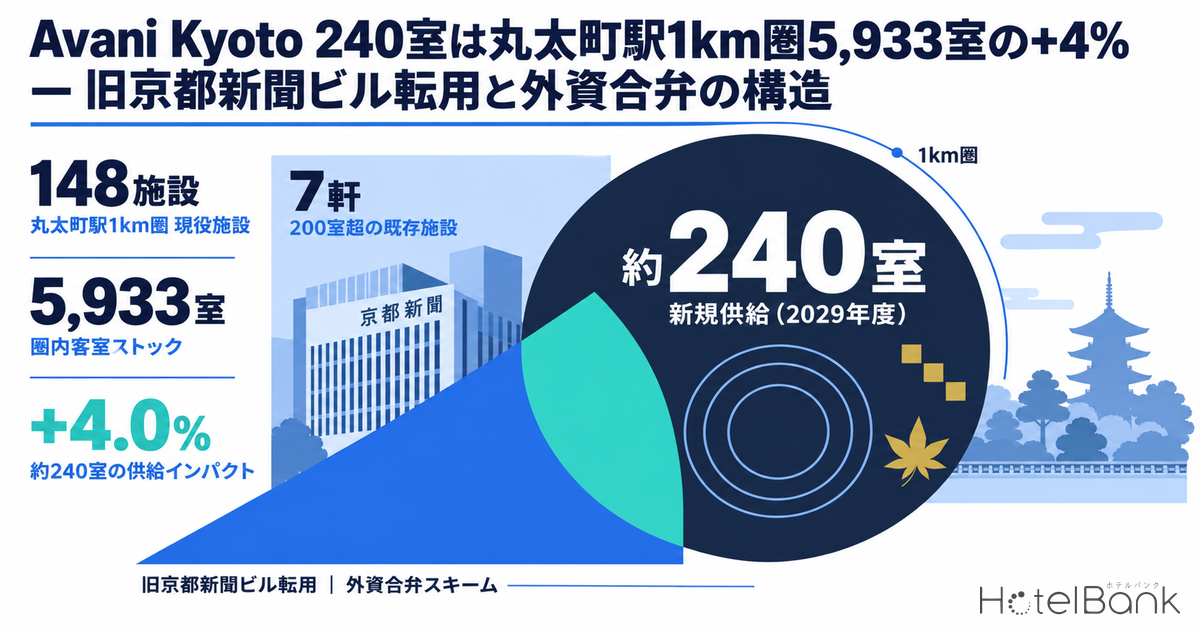
On June 15, 2026, Royal Holdings announced “Avani Kyoto” (tentative name), a plan to renovate and extend the former Kyoto Shimbun headquarters building into a premium lifestyle hotel of about 240 rooms, opening within fiscal 2029. What sets it apart from earlier foreign-brand entries is that Thailand’s Minor International is participating in the project’s special purpose company (TMK) alongside Taisei Corporation and Heiwa Real Estate. A property-by-property inventory of rooms within a 1km radius of Marutamachi Station on the Karasuma subway line, where the hotel will sit, finds 148 active properties with 5,933 rooms. Only seven of them exceed 200 rooms, and only three large properties sit in the estimated settled ADR band of ¥30,000-¥60,000. This article examines, from the perspective of developers and lenders considering bringing in an overseas brand, how the area’s room stock was built up, the price tiers and peak-date inventory sell-through of comparable properties, the deal structure combining a TMK with a joint-venture operator, and what it means to keep the existing building frame.
Metric Definitions Used in This Article
- ADR (average daily rate) = an estimated settled rate (tax-excluded equivalent), calculated by applying a segment-specific adjustment factor to the lowest plan each property publishes on OTAs (per room, two guests per room, tax included). Checked against property-level results disclosed by listed hotel REITs (91 properties, latest three months), the median error is about 7%. It is an estimate and differs from each property’s actual settled rates and accounting figures. Area-level ADR is the median of the target properties (the level of a typical property in the area).
- Listed price = the average of all plans on OTAs (per room, two guests per room, tax included). Segments outside the scope of the settled ADR estimate (such as deluxe) are shown at this level and are not called ADR.
- LT (lead time) = days until check-in. LT0 = the day of stay. Remaining-inventory trends in this article use only observation points LT45-1 and are shown in rooms.
- Active properties = properties located within a 1km radius of the station whose sales were observed on major booking sites in the latest three months (July-September 2026). 148 properties / 5,933 rooms (based on major booking site listings).
- Data sources = MetroEngines Research & Consulting (prices, inventory, property master), MLIT Real Estate Information Library (zoning), MIC/METI Economic Census (employment), and company press releases.
- — +4.0%: about 240 rooms is the supply increase against the 148 active properties and 5,933 rooms within 1km of Marutamachi Station. Against the 13 properties with more than 150 rooms (2,934 rooms) alone, it is +8.2%.
- — 3 properties: only Ace Hotel Kyoto, Hyatt Place Kyoto and Chapter Kyoto sit in the band of more than 150 rooms and an estimated settled ADR of ¥30,000-¥60,000. The crowded band is ¥10,000-¥25,000.
- — Two-stage build-up: growth in 2013-19 was driven by inns of 10 rooms or fewer, while seven large properties with more than 150 rooms have been added since 2020.
- — Equity plus JV operation: Minor invests in the TMK, and its joint venture with Royal Holdings operates the hotel. Capital enters differently from IHG’s rebranding model or Hilton’s domestic-owner model.
- — ¥1.8bn-¥4.3bn per year: the range of room revenue using the ADRs of four reference properties and an assumed annual occupancy of 70-85%. Nakagyo Ward’s monthly ADR swings by up to 2.3x, so setting a floor for off-peak months is key to any variable-rent design.
The Plan in Outline — About 240 Rooms in 23,000 m² of Floor Area, or Roughly 96 m² per Room
First, the outline of the plan as disclosed. The project is named the “Kyoto Shimbun Building Redevelopment Project” (tentative), and the developer is Kyoto Gosho-Minami Kaihatsu TMK, established in November 2025 by three companies: Taisei Corporation, Heiwa Real Estate and MINOR INTERNATIONAL PCL. The 3,894 m² site remains owned by Kyoto Shimbun Holdings and is leased to the TMK. The existing North Building (8 floors above ground, 2 below) will be renovated, while the South Building will be demolished and replaced with a new 5-story building with one basement level. Total floor area is about 23,000 m², with reinforced concrete construction. The hotel will be operated by Royal Minor Hotels (established March 31, 2025), a joint venture between Royal Holdings and Minor Hotels, and it will be the Japan debut of Avani, a brand with more than 40 hotels in 24 countries. The release states that the room count and exterior are based on the basic plan and may change through design work and consultations with authorities.
Dividing the numbers plainly, using about 23,000 m² of floor area for about 240 rooms works out to roughly 96 m² per room (gross floor area basis). By comparison, Motto by Hilton Kyoto Shijo Karasuma, also scheduled to open in Kyoto in fiscal 2029, is planned with 108 rooms in about 4,300 m², or roughly 40 m² per room. Avani’s building can therefore be read as devoting considerable floor area to uses other than guest rooms. This is consistent with the announcement that a restaurant using the former press room and a lobby lounge will be opened to the community, and it is reasonable to assume a lifestyle-hotel revenue model that earns from F&B and public spaces rather than a rooms-only model.
| Item | Disclosed details |
|---|---|
| Name | Avani Kyoto (tentative) / premium lifestyle hotel |
| Location / access | 337 Shoshoi-Otabicho and others, Kurumaya-cho-dori Ebisugawa-agaru, Nakagyo Ward, Kyoto; directly connected to Marutamachi Station on the Karasuma subway line |
| Scale | About 240 rooms; site 3,894 m²; floor area about 23,000 m²; RC construction |
| Buildings | Renovated building (former North Building), 8 floors above / 2 below + new building (former South Building site), 5 floors above / 1 below |
| Developer | Kyoto Gosho-Minami Kaihatsu TMK (Taisei Corporation, Heiwa Real Estate, MINOR INTERNATIONAL PCL.; established November 2025). Land leased from Kyoto Shimbun Holdings |
| Operator | Royal Minor Hotels (JV of Royal Holdings and Minor Hotels, established March 31, 2025) |
| Opening | Within fiscal 2029 (planned) |
| Zoning (our check) | Commercial district, FAR 600%, building coverage 80% (MLIT Real Estate Information Library) |
Room Inventory Within 1km of Marutamachi Station — Small Inns Drove 2013-19 Growth; Large Hotels Arrived After 2020
We checked each property within a 1km radius of the planned site (centered on Marutamachi Station at 35.0165, 135.7596, as verified on the GSI Maps, covering the southern half of the Kyoto Imperial Garden, the east side of Nijo Castle, and parts of Karasuma-Oike and Sanjo-dori), and defined the 148 properties and 5,933 rooms with sales observed in July-September 2026 as active stock. By size band, there are 75 properties with 10 rooms or fewer (213 rooms), 42 with 11-50 rooms (1,115 rooms), 18 with 51-150 rooms (1,671 rooms), and 13 with more than 150 rooms (2,934 rooms). Whole-house machiya rentals and guesthouses account for half of the properties, while half of the rooms are concentrated in the 13 properties with more than 150 rooms. New supply of about 240 rooms equals 4.0% of the area’s rooms, or 8.2% of the over-150-room class.
The area’s build-up is easiest to understand by opening year. Tracing active properties back by opening year, 21 properties opened in 2012 or earlier account for 1,684 rooms, while the 22 properties opened in 2013-16 add only 150 rooms, 20 of which have 10 rooms or fewer. Another 45 properties were added in 2017-19, but with only 1,187 rooms: 23 have 10 rooms or fewer and 16 have 11-50 rooms. In other words, what grew around Marutamachi during the inbound boom was small-scale lodging; only two large properties with more than 150 rooms opened in that period, Tokyu Stay Kyoto Sanjo-Karasuma (2017, 182 rooms) and Hotel Resol Trinity Kyoto (2018, 180 rooms). The picture changes after 2020. The 23 properties opened in 2020-22 add 1,700 rooms (four with more than 150 rooms: Ace Hotel Kyoto, HOTEL THE MITSUI KYOTO, Chapter Kyoto and Hyatt Place Kyoto), and the 27 opened in 2023-26 add 1,168 rooms (three with more than 150 rooms: Four Points Flex by Sheraton Kyoto Oike, Mitsui Garden Hotel Kyoto Sanjo Premier and Loisir Hotel Classic Garden Kyoto Sanjo), showing a shift toward larger properties. Avani sits on the extension of this post-2020 trend.
| Size band | Properties | Rooms | Room share | Main properties / characteristics |
|---|---|---|---|---|
| Up to 10 rooms | 75 | 213 | 3.6% | Whole-house machiya rentals and guesthouses; 43 opened in 2013-19 |
| 11-50 rooms | 42 | 1,115 | 18.8% | RAKURO Kyoto, nol kyoto sanjo, Tassel Inn Kyoto Kawaramachi-Nijo, etc. |
| 51-150 rooms | 18 | 1,671 | 28.2% | The Royal Park Hotel Iconic Kyoto, Candeo Hotels Kyoto Karasuma-Rokkaku, hotel MONday Kyoto Marutamachi, etc. |
| Over 150 rooms | 13 | 2,934 | 49.5% | From Hotel Monterey Kyoto (327 rooms) to HOTEL THE MITSUI KYOTO (161 rooms) |
| Total | 148 | 5,933 | 100% | Properties with sales observed in Jul-Sep 2026 |
| Commercial (FAR 400-700%) | approx. 41% |
| Neighborhood commercial (200-300%) | approx. 18% |
| Residential (Category 1/2 residential, medium-to-high-rise residential) | approx. 21% |
| Quasi-industrial | approx. 2% |
| No zoning designation (Kyoto Imperial Garden, etc.) | approx. 19% |
Price Tiers of the 200-Room Class — Only Three Large Hotels at ¥30,000-¥60,000, a Thin Band for Avani to Enter
Next, we look at where a property of about 240 rooms would sit in the area’s price structure. Ranking the 13 properties with more than 150 rooms by estimated settled ADR for October 2025-September 2026 (12-month average): Ace Hotel Kyoto at ¥57,600, Hyatt Place Kyoto at ¥37,700, Chapter Kyoto, a Tribute Portfolio Hotel at ¥32,000, Kyoto Brighton Hotel at ¥29,400 and ANA Crowne Plaza Kyoto at ¥24,600. Hotel Monterey Kyoto, Tokyu Stay Kyoto Sanjo-Karasuma and Hotel Resol Trinity Kyoto are in the ¥18,000-¥20,700 band, and Four Points Flex, Loisir and Hearton Hotel Kyoto in the ¥10,100-¥11,400 band. The deluxe properties outside the scope of the settled ADR estimate, HOTEL THE MITSUI KYOTO, The Royal Park Hotel Iconic Kyoto and Mitsui Garden Hotel Kyoto Sanjo Premier, show listed prices (all-plan average, tax included) of ¥253,800, ¥53,700 and ¥52,400 respectively.
Plotting this distribution on two axes, room count and estimated settled ADR, only three properties, Ace, Hyatt Place and Chapter, fall in the band of more than 150 rooms and ¥30,000-¥60,000. Given that the median estimated settled ADR for Nakagyo Ward as a whole is ¥17,000 on a 12-month average (N=102-112 properties), and the median for the 44 properties in the area for which settled ADR can be estimated is ¥19,700, the premium lifestyle tier Avani is targeting is roughly twice the level of a typical property in the area, and competition is concentrated in the ¥10,000-¥25,000 band of large business and city hotels. Note that during the November 2025 autumn-foliage season, Nakagyo Ward’s estimated settled ADR rose to ¥25,800, 2.1x the ¥12,500 of January 2026 and 2.3x the ¥11,300 of June 2026, the lowest of the 12 months. Because seasonality is so pronounced in this market, whether a lifestyle-tier property can fully capture rates in peak months is what separates outcomes.
CrowdedOccupied territory
¥10,000-¥25,000 x 150-330 rooms
A band lined with seven large business and city hotels. About 30% of the area’s rooms are here.
WS1Large lifestyle-tier properties
¥30,000-¥60,000 x 150+ rooms
Only three: Ace, Hyatt Place and Chapter. Avani’s ~240 rooms are expected to enter this band.
WS2Small, high-rate
Over ¥40,000 x 50 rooms or fewer
Machiya and small luxury properties are scattered here, but there is no supply at the 100-room scale.
| Property | Rooms | Opened | Est. settled ADR, 12-month avg | Nov 2025 | Foreign-language review share |
|---|---|---|---|---|---|
| Hotel Monterey Kyoto (ホテルモントレ京都) | 327 | 2007 | ¥19,653 | ¥29,381 | 25.3% |
| Four Points Flex by Sheraton Kyoto Oike (フォーポイント フレックス by シェラトン 京都御池) | 317 | 2024 | ¥11,447 | ¥18,724 | 17.3% |
| Hearton Hotel Kyoto (ハートンホテル京都) | 294 | 1996 | ¥10,140 | ¥15,872 | 86.5% |
| ANA Crowne Plaza Kyoto (ANAクラウンプラザホテル京都) | 282 | 1986 | ¥24,638 | ¥35,856 | 19.7% |
| Hyatt Place Kyoto (ハイアット プレイス 京都) | 239 | 2022 | ¥37,719 | ¥61,153 | 33.5% |
| Ace Hotel Kyoto (エースホテル京都) | 213 | 2020 | ¥57,591 | ¥67,760 | 47.3% |
| Chapter Kyoto, a Tribute Portfolio Hotel (チャプター京都トリビュートポートフォリオホテル) | 203 | 2021 | ¥31,994 | ¥43,242 | 13.6% |
| Mitsui Garden Hotel Kyoto Sanjo Premier (三井ガーデンホテル京都三条プレミア) | 185 | 2024 | Listed price ¥52,391 | — | 67.9% |
| Tokyu Stay Kyoto Sanjo-Karasuma (東急ステイ京都三条烏丸) | 182 | 2017 | ¥20,656 | ¥31,070 | 67.5% |
| Kyoto Brighton Hotel (京都ブライトンホテル) | 182 | 1998 | ¥29,423 | ¥41,985 | 34.5% |
| Hotel Resol Trinity Kyoto (ホテルリソルトリニティ京都) | 180 | 2018 | ¥18,431 | ¥29,056 | 59.3% |
| Loisir Hotel Classic Garden Kyoto Sanjo (ロワジールホテル クラシックガーデン京都三条) | 169 | 2024 | ¥11,337 | ¥19,300 | 62.6% |
| HOTEL THE MITSUI KYOTO | 161 | 2020 | Listed price ¥253,818 | — | 76.3% |
We also checked inventory sell-through on a peak date. For the night of Friday, August 14, 2026, during the Obon holiday, three properties with more than 150 rooms had at least 30% of their total rooms listed on major booking sites: Ace Hotel Kyoto, Mitsui Garden Hotel Kyoto Sanjo Premier and Kyoto Brighton Hotel. (Properties listing less than 30% were excluded because their inventory cannot be read reliably. Small listed allocations may reflect several possibilities, such as selling mainly through other channels like the official website or travel agencies, releasing inventory gradually as check-in approaches, or contracts that set small allocations to booking sites in the first place.) Ace Hotel Kyoto (213 rooms) had 120 rooms remaining at LT45, 106 at LT30, 71 at LT14 and 46 at LT1, continuing to sell into the final days while raising its lowest listed price from ¥35,400 at LT45 to ¥59,700 at LT14, showing how a lifestyle-tier property captures rate from late demand. Mitsui Garden Hotel Kyoto Sanjo Premier (185 rooms) drew down its remaining inventory at a steady pace from 73 rooms at LT45 to 7 at LT1, and Kyoto Brighton Hotel (182 rooms) sold through from 49 rooms to 4. All of these are room-count observations and do not indicate the occupancy rate of any individual property.
Deal Structure — The TMK Holds the Building, the Brand Owner Invests, and a JV Operates
The project’s capital structure has three layers. Kyoto Shimbun Holdings retains the land, and Kyoto Gosho-Minami Kaihatsu TMK renovates, builds and owns the buildings on leased land. MINOR INTERNATIONAL PCL. participates in that TMK alongside Taisei Corporation and Heiwa Real Estate, and the hotel is operated by Royal Minor Hotels, a joint venture between Minor Hotels and Royal Holdings. Under the conduit (pass-through) requirements that give a TMK its tax treatment, the TMK does not operate a lodging business itself; standard practice is a lease or a management contract with an operating company. The disclosed materials do not say whether this project uses a lease or a management contract, or whether rent is fixed or variable.
What stands out structurally is that the foreign company that owns the brand is participating from the development stage as an investor in the TMK. Overseas brands usually enter Japan by placing their brand, via a franchise or management contract, on a building developed by a domestic owner; cases in which the brand side shares development risk are limited. In July 2025, Minor signed a hotel management agreement with Rist Development for Anantara Karuizawa Retreat (51 rooms, opening planned for 2030), which is a contract-based entry. In Kyoto, by contrast, it is taking part in both equity and operation, and Royal Minor Hotels is reported to be planning 21 hotel openings in Japan by 2035 under three brands: Avani, Anantara and Tivoli. On the domestic side, Royal Holdings has hands-on experience with staffing and licensing through its restaurant business and its operation of Richmond Hotels, and is expected to translate the foreign brand’s operating standards into Japan’s labor and Hotel Business Act framework.
From a lender’s perspective, three points will drive the assessment: the collateral is a building on leasehold land, the works include a renovation that retains the existing frame, and opening is three years away in fiscal 2029. Lease term and ground-rent revision terms, the treatment of any existing non-conforming parts of the renovated building, and construction-cost fluctuations would be absorbed by the operator’s creditworthiness under a fixed-rent structure, or by the seasonal swing in the area’s estimated settled ADR under a variable-rent structure. As shown in the previous section, Nakagyo Ward’s monthly ADR differs by 2.1x between January and November and by 2.3x between June and November, so any variable-rent design should look separately at capturing rate in peak months and at the floor in off-peak months.
| Layer | Entity | Role | What the disclosures confirm |
|---|---|---|---|
| Land | Kyoto Shimbun Holdings | Owner; leases the land to the TMK | Site of 3,894 m². Lease term and ground rent not disclosed |
| Building (the asset) | Kyoto Gosho-Minami Kaihatsu TMK | Developer of the renovation and new build; owns the buildings | Taisei Corporation, Heiwa Real Estate and MINOR INTERNATIONAL PCL. participate. Ownership ratios not disclosed |
| Operation | Royal Minor Hotels | Operates under the Avani brand | JV of Royal Holdings and Minor Hotels. Lease vs. management contract not disclosed |
Renovation Plus New Build — Securing Floor Area Close to the 600% FAR Cap While Keeping the Existing Frame
Checking the site’s zoning in the MLIT Real Estate Information Library shows a commercial district with a 600% floor-area ratio and 80% building coverage; 600% of the 3,894 m² site gives a simple cap of 23,364 m². The disclosed floor area of about 23,000 m² is about 98% of that (a simple calculation that ignores FAR bonuses and exclusions), suggesting that retaining the existing 8-story North Building secures floor area that nearly uses up the current FAR. Under its 2007 New Landscape Policy, Kyoto City reorganized maximum building heights into six levels from 10m to 31m, setting 31m along major arterial roads in the city center while holding areas meant to harmonize with traditional kyo-machiya townhouses to 15m. Existing buildings constructed before the tighter rules may not be able to recover the same floor area if rebuilt under current regulations, so a renovation that keeps the frame can be advantageous in both height and FAR compared with a new build under current rules. The institutional background of this point, and how the city’s scheme for attracting high-quality accommodation facilities is applied, are beyond the scope of this article.
A number of cases in Kyoto have converted corporate headquarters and office buildings into hotels, and Avani continues that lineage. Marufukuro, a renovation of the former Nintendo headquarters building (completed 1930), retained three RC buildings running north to south, partly dismantled and restored them, added a new wing and opened in 2022. Shinpuhkan, the former Kyoto Central Telephone Office (completed 1926), kept its preserved building while adding a new one, and Ace Hotel Kyoto opened there with 213 rooms in 2020. The Imperial Hotel Kyoto, which uses the Yasaka Kaikan in Gion, kept the southwest facades and structure and demolished the rest because the theater building was hard to convert as-is; it opened in March 2026 with 55 rooms. All of these retain the existing design while adding rooms in a new wing, and Avani’s North Building renovation plus South Building new build applies this method at a scale of about 240 rooms, larger than the three cases cited here (18-213 rooms).
| Property | Original building | Method | Opening / rooms |
|---|---|---|---|
| Marufukuro (丸福樓) | Former Nintendo headquarters (completed 1930) | Renovated three RC buildings, partly dismantled and restored, added a new wing | 2022, 18 rooms |
| Ace Hotel Kyoto (Shinpuhkan) | Former Kyoto Central Telephone Office (completed 1926) | Kept the preserved building, added a new wing | 2020, 213 rooms |
| The Imperial Hotel Kyoto (帝国ホテル 京都) | Yasaka Kaikan (Registered Tangible Cultural Property) | Kept the southwest facades and structure, demolished the rest | 2026, 55 rooms |
| Avani Kyoto (tentative) | Former Kyoto Shimbun headquarters (about 60 years old) | Renovate the 8-story North Building, demolish the South Building and build a new 5-story building, convert the former press room into public space | FY2029, about 240 rooms |
Entry Routes for Overseas Brands — Rebranding, Domestic Owner, and “Equity Plus JV Operation”
Overseas brands entered Kyoto one after another in 2025-26, but the way capital comes in varies. On August 24, 2026, IHG Hotels & Resorts announced a portfolio agreement covering 14 hotels and 1,063 rooms in Kyoto City owned by GCP Hospitality, part of Hong Kong’s Gaw Capital; over the next 12 months, 12 will be renovated and converted to the midscale conversion brand “Garner”, one to “Holiday Inn Express”, and one will remain unbranded. Ownership is a foreign fund and the brand is placed by contract: a rebranding model. Hilton has Motto by Hilton Kyoto Shijo Karasuma (108 rooms, opening planned for fiscal 2029), a new build developed by a domestic owner, and a plan to convert Kyoto Brighton Hotel (opened 1998, 182 rooms) into a Curio Collection by Hilton with about 160 rooms in 2028, combining the domestic-owner model with a brand conversion of an existing hotel. Hyatt Place Kyoto (239 rooms), which opened in the area in April 2022, is a precedent of similar size to Avani and serves as a reference point for price tier.
Compared with these, Avani is a third model in which “the brand owner invests in the TMK and a joint venture with a major domestic restaurant company operates the hotel”; the difference is that the brand side enters the area not only as operator but also as equity. For developers, this means that negotiations to bring in an overseas brand can extend beyond the level of franchise and management fees to the sharing of development funding and the design of the exit (a sale or inclusion in a REIT). For hotel operators, it is an implemented example of a JV operating company between a foreign brand and a domestic business, an option for bridging brand standards with domestic labor and licensing practice.
| Entry route | Example (Kyoto) | Ownership | How the brand enters | Building |
|---|---|---|---|---|
| Rebranding / portfolio | IHG x GCP Hospitality, 14 hotels / 1,063 rooms (announced August 2026; 12 to Garner) | Foreign fund | Contract (conversion brand) | Renovation of existing hotels |
| Domestic owner | Motto by Hilton Kyoto Shijo Karasuma, 108 rooms (FY2029) | Domestic owner | Contract | New build |
| Brand conversion of an existing hotel | Kyoto Brighton Hotel to Curio Collection by Hilton, about 160 rooms (2028) | Domestic owner | Contract | Existing hotel |
| Equity plus JV operation | Avani Kyoto (tentative), about 240 rooms (FY2029) | TMK (Taisei Corporation, Heiwa Real Estate, Minor) | Brand owner invests; JV operates | Renovation of an existing building + new build |
Room Revenue Sensitivity — ¥1.8bn-¥4.3bn per Year Across Four Reference Price Tiers and Occupancy; the Monthly Floor Is Key to Security Design
As noted in the deal-structure section, whether rent is fixed or variable, and whether the arrangement is a lease or a management contract, has not been disclosed. Under variable rent or a management contract, what lenders and developers need to look at is the level and volatility of room revenue. Here we fix the room count at about 240 rooms (87,600 available room-nights per year), take ADR from the estimated settled ADR of four reference properties in the area (12-month average for October 2025-September 2026, tax-excluded equivalent), and assume annual occupancy of 70-85% as a modeling assumption to estimate room revenue. The center of the assumption is the March 2026 result for 113 major hotels in the city compiled by the Kyoto City Tourism Association (81.6%), not the actual results of each reference property. Non-room revenue such as F&B and banquets is excluded.
| Annual occupancy (modeling assumption) | Kyoto Brighton Hotel level ¥29,423 | Chapter Kyoto level ¥31,994 | Hyatt Place Kyoto level ¥37,719 | Ace Hotel Kyoto level ¥57,591 |
|---|---|---|---|---|
| 70% | 1.80 | 1.96 | 2.31 | 3.53 |
| 75% | 1.93 | 2.10 | 2.48 | 3.78 |
| 80% | 2.06 | 2.24 | 2.64 | 4.04 |
| 85% | 2.19 | 2.38 | 2.81 | 4.29 |
Against ¥2.64bn per year in the middle case (Hyatt Place Kyoto level, 80%), the pessimistic case (Kyoto Brighton Hotel level, 70%) is ¥1.80bn, about 30% lower. While the vertical spread in the table (occupancy 70% to 85%) is about 1.2x, the horizontal spread (ADR ¥29,423 to ¥57,591) is about 2x: what determines the revenue range is the choice of price tier more than occupancy. The optimistic Ace Hotel Kyoto case reaches over ¥4bn per year, but it should be read as an upper-bound guide premised on the property with the highest estimated settled ADR in the area.
| Scenario | ADR reference level (12-month avg) | Annual occupancy (assumed) | Room revenue / year | Reference property monthly ADR, high / low |
|---|---|---|---|---|
| Pessimistic | Kyoto Brighton Hotel level (¥29,423) | 70% | ¥1.80bn | ¥41,985 / 21,318 (2.0x) |
| Middle | Hyatt Place Kyoto level (¥37,719) | 80% | ¥2.64bn | ¥64,107 / 19,242 (3.3x) |
| Optimistic | Ace Hotel Kyoto level (¥57,591) | 85% | ¥4.29bn | ¥92,668 / 43,126 (2.1x) |
More important than the annual level is the monthly swing. Over the 12 months, the reference properties’ monthly estimated settled ADR differed by about 2.0x to 3.3x between the highest and lowest month (Chapter Kyoto: ¥53,598 / ¥20,251, about 2.6x). Hyatt Place Kyoto went from ¥64,107 in October 2025 to ¥19,242 in February 2026, a wider swing than the 2.3x of Nakagyo Ward as a whole. The lifestyle tier can capture high rates in peak months, but its off-peak declines can also be larger, so a variable-rent design is safer if it is premised on the off-peak floor rather than the annual average.
| Rooms | vs. 5,933 rooms in area | vs. 2,934 rooms in 150+ class | Available room-nights / year | Room revenue (middle) |
|---|---|---|---|---|
| 200 rooms | 3.4% | 6.8% | 73,000 | ¥2.20bn |
| 240 rooms | 4.0% | 8.2% | 87,600 | ¥2.64bn |
| 280 rooms | 4.7% | 9.5% | 102,200 | ¥3.08bn |
The room count is based on the basic plan and may change in later design stages. Even across 200-280 rooms, the supply increase relative to the area’s rooms stays at 3.4-4.7%, so the issue remains competition within the over-150-room class (6.8-9.5%) and with the three incumbents in the ¥30,000-¥60,000 band, rather than the impact on the market as a whole.
Investment Considerations — Five Axes: Demand, Brand, Structure, Building and Market
On demand, according to the Kyoto City Tourism Association, occupancy at 113 major hotels in the city in March 2026 was 81.6% (+2.5pt YoY), average room rate was ¥26,017 (+4.7%), and RevPAR was ¥21,230 (+8%). Foreign guest-nights were 559,898 (-0.4%); by country and region, the United States led with 27.4%, Europe grew +16.0%, and China fell -64.9%. The association projected April occupancy at 81.1% (vs. 89.5% a year earlier). According to Japan National Tourism Organization (JNTO) estimates, international visitor arrivals in August 2026 were 3,098,900 (-9.6% YoY), and the January-August cumulative total was 27,626,300 (-2.7%); China fell -59.0% while South Korea rose +28.7% and the United States +1.5%, showing a reshuffling of the source-market mix. A rising share of visitors from Europe, North America and Australia could be a tailwind for lifestyle-tier brands. However, the area’s foreign-language review share is 47.3% at Ace Hotel Kyoto and 33.5% at Hyatt Place Kyoto, while Hearton Hotel Kyoto, with one of the lowest estimated settled ADRs in the area, has the highest at 86.5%; there is no consistent relationship between price tier and foreign-language review share. Because foreign-language reviews include languages other than Western ones, how much Western demand flows to the lifestyle tier needs to be checked separately against market-by-market lodging statistics.
| Axis | Opportunity | Points to watch |
|---|---|---|
| Demand | Overlap of the Gosho-Minami office cluster (30,493 employees) with tourism demand; rising share of Western visitors | Nakagyo Ward’s monthly ADR swing is up to 2.3x (Nov 2025 / Jun 2026); capturing rate in peak months drives returns |
| Brand | Avani’s Japan debut; the 150+ rooms x ¥30,000-¥60,000 band is thin, with three properties in the area | Axis of differentiation from the three incumbents in the band (Ace, Hyatt Place, Chapter) |
| Structure | Brand owner invests and shares development risk; broad options for exit design | Lease vs. management contract and fixed vs. variable rent not disclosed; collateral valuation of a building on leasehold land |
| Building | Existing frame secures floor area near the FAR cap; a generous footprint of about 96 m² per room | Surveys for existing non-conformity and asbestos in the renovated building, construction-cost fluctuations, construction period through FY2029 |
| Market | Upsizing since 2020 has expanded the area’s rooms to 5,933, with brands clustering | Supply of +4.0% in the area and +8.2% in the 150+ class; openings such as Motto and Curio overlap in the same period |
Summary
The room stock within 1km of Marutamachi Station stands at 148 active properties and 5,933 rooms, built up in two stages: inns of 10 rooms or fewer grew in 2013-19, and large properties with more than 150 rooms arrived after 2020. Avani Kyoto’s roughly 240 rooms equal 4.0% of the area’s rooms, and only three incumbents, Ace, Hyatt Place and Chapter, occupy the band of more than 150 rooms at an estimated settled ADR of ¥30,000-¥60,000, leaving room for lifestyle-tier supply. The deal structure, in which the brand owner invests in a TMK and a JV with a major domestic restaurant company operates the hotel, brings capital in differently from IHG’s rebranding model or Hilton’s domestic-owner model. Renovating the existing North Building works as a way to secure floor area close to the 600% FAR cap, and the project can be seen as an attempt to scale Kyoto’s conversion practice, built up through Marufukuro and Shinpuhkan, to about 240 rooms. For developers and lenders considering bringing in an overseas brand, it is likely to become a precedent that widens the discussion from negotiating brand fees to designing capital and exit.
Note on ADR for future dates: In this article, estimated settled ADRs for October-December 2026 are estimates based on the level of selling prices published on OTAs at the time of research and will change as check-in dates approach. They are not used for comparison with finalized months (through September 2026). The room count and building configuration of Avani Kyoto (tentative) are based on the basic plan and may change.
Frequently Asked Questions
Q. How much will the opening of Avani Kyoto increase rooms around Marutamachi?
A. Against the 148 properties and 5,933 rooms within a 1km radius of Marutamachi Station with sales observed in July-September 2026, about 240 rooms is a 4.0% increase. Limited to the large properties with more than 150 rooms (13 properties, 2,934 rooms), it is 8.2%.
Q. Are there properties of the same size and price tier nearby?
A. Three properties have more than 150 rooms and an estimated settled ADR (12-month average) of ¥30,000-¥60,000: Ace Hotel Kyoto, Hyatt Place Kyoto, and Chapter Kyoto, a Tribute Portfolio Hotel.
Q. Can a TMK (special purpose company) operate a hotel directly?
A. Under the conduit requirements, a TMK does not operate a lodging business itself; standard practice is to lease the hotel to an operating company or to entrust its operation under a management contract. The disclosed materials do not state which approach this project will take.
References and Sources
■ Data sources
We checked each property located within a 1km radius of Marutamachi Station (35.0165, 135.7596, as verified on the GSI Maps) and defined the 148 properties and 5,933 rooms with sales observed on major booking sites in July-September 2026 as active stock (duplicate listings of the same property removed). Estimated settled ADR uses monthly aggregates for Nakagyo, Kamigyo and Shimogyo wards (Nakagyo Ward: N=102-112 properties for October 2025-September 2026) and property-level monthly values; remaining-inventory trends are room counts of inventory published on major booking sites (LT45-1). Plan details and deal structure are from the companies’ disclosures, and demand statistics are published figures from the Kyoto City Tourism Association and JNTO.
■ Modeling assumptions
Supply impact = about 240 rooms / 5,933 active rooms (for the over-150-room class, / 2,934 rooms). Room revenue sensitivity is calculated as about 240 rooms x 365 days x annual occupancy (a modeling assumption of 70-85%) x the reference properties’ estimated settled ADR (12-month average for October 2025-September 2026, tax-excluded equivalent), and excludes F&B and banquet revenue, rent and management fees, and the first-year ramp-up. Nakagyo Ward’s monthly swing is the highest month divided by the lowest month over the finalized months (October 2025-September 2026).
■ Limitations
Estimated settled ADR is an estimate derived from OTA published prices and differs from each property’s actual settled rates and accounting figures. Remaining-inventory trends observe only allocations published on major booking sites and do not indicate a property’s overall occupancy. Foreign-language review share is the share of reviews by posting language and does not directly indicate guests’ nationality mix or the Western share. The 10 properties / 44 rooms with unknown opening year are excluded from the opening-period tally. Avani’s room count, building configuration and rent structure are based on the basic plan or undisclosed, and market conditions in fiscal 2029, when it is scheduled to open, will differ from the observation period of this article.
■ Market data
- MetroEngines Research & Consulting — inventory of properties within 1km of Marutamachi Station (148 properties, 5,933 rooms), estimated settled ADR (Nakagyo Ward N=98-112, individual properties), remaining inventory on a peak date (LT45-1)
- HotelBank Editorial Team research — share of guest reviews posted in a foreign language (by property)
■ Government statistics and public data
- MLIT Real Estate Information Library — zoning, floor-area ratio, building coverage ratio (Japanese)
- MIC/METI “Economic Census for Business Activity” (2021) — establishments and employees within a 1km radius
- Kyoto City “New Landscape Policy” materials — maximum building heights (six levels from 10m to 31m) (Japanese)
- Geospatial Information Authority of Japan, GSI Maps — coordinates of Marutamachi Station
- JNTO “Visitor Arrivals, August 2026 Estimates” (Travel Voice, September 16, 2026) (Japanese)
- Kyoto City Tourism Association “March 2026 Occupancy of Major Hotels and Foreign Guest-Nights” (Travel Voice, April 30, 2026) (Japanese)
■ Press releases and company materials
- Royal Holdings, “Avani brand makes its Japan debut: Avani Kyoto (tentative) to open in FY2029 using the former Kyoto Shimbun headquarters building” (PR TIMES, June 15, 2026) (Japanese)
- Royal Holdings press release, original (June 15, 2026) (Japanese)
- Travel Voice, “Avani Kyoto (tentative) to open in FY2029” (June 18, 2026) (Japanese)
- Impress Watch, “Former Kyoto Shimbun HQ building to become a hotel, using its exterior, design and former press room” (June 15, 2026) (Japanese)
- Royal Holdings, “Royal Minor Hotels and Rist Development agree on Japan’s first Anantara project” (July 10, 2025) (Japanese)
- Travel Voice, “IHG signs portfolio agreement for 14 hotels, 1,063 rooms in Kyoto City” (August 24, 2026) (Japanese)
- FASHIONSNAP, “Marufukuro opens in the renovated former Nintendo headquarters” (January 20, 2022) (Japanese)
- Travel Watch, “Shinpuhkan and Ace Hotel Kyoto open” (2020) (Japanese)
- Bijutsu Techo, “The Imperial Hotel Kyoto to open in spring 2026, using the Yasaka Kaikan” (Japanese)
Source: Hyatt Hotels Japan, “Press Releases, April 2026”
Source: Hilton, “Company Overview” (updated August 25, 2026)