

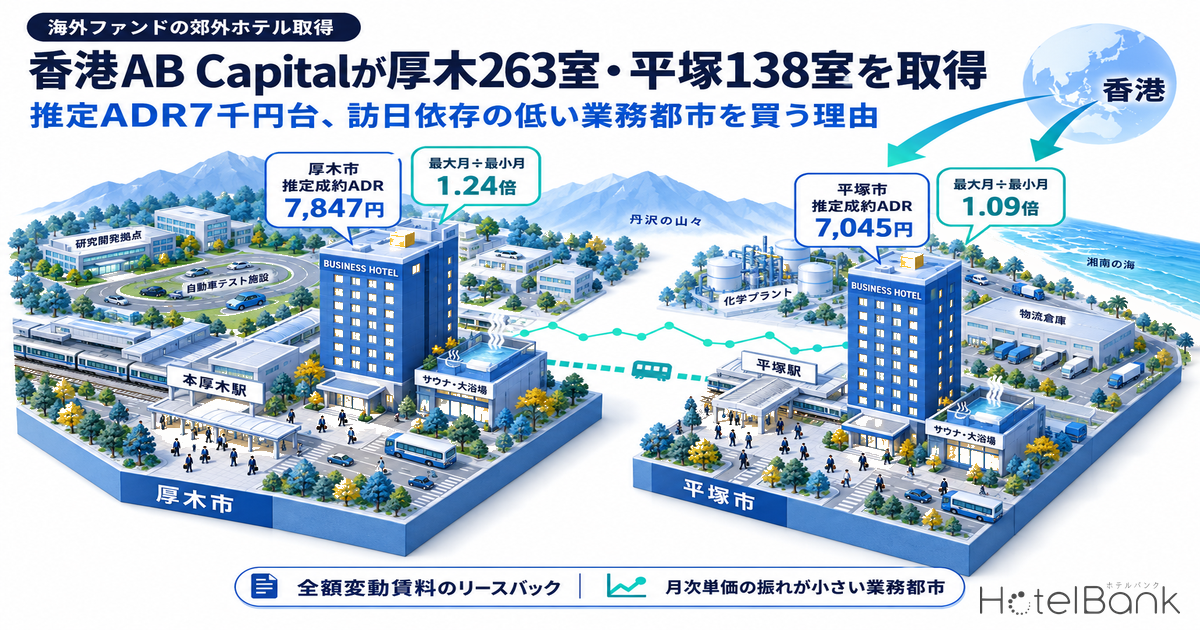
Hong Kong-based real estate fund manager AB Capital Investment announced on June 12, 2026 that it had acquired two hotels in Kanagawa: 3S HOTEL ATSUGI (263 rooms) and 3S HOTEL HIRATSUKA (138 rooms). They are the firm’s 13th and 14th hotels in Japan. A fund that had been buying tourism and transit locations in city centers such as Asakusa, Kamata and Shinsaibashi has now extended its reach to Hon-Atsugi Station and Hiratsuka Station, two business cities in the outer Tokyo metropolitan area. This article compiles the estimated settled ADR for Atsugi and Hiratsuka, the room stock and working population within 1 km of each station, and how weekday and Saturday bookings fill, and tests the firm’s description of these as “locations less exposed to swings in inbound demand” against market data.
Rather than the overall flow of foreign capital into Japanese hotels or the ward-level rate tiers of Yokohama, Kawasaki and Sagamihara, this article narrows its scope to the two buildings acquired by a single overseas fund and to the markets of the business cities in central Kanagawa and Shonan.
- — The 5 properties and 731 rooms AB Capital acquired in 2026 (2 in Sapporo, 2 in Kanagawa, 1 in Kyoto) include nothing in Tokyo or Osaka, and the 401 rooms in Kanagawa make up 31.5% of the 11 properties and 1,274 rooms it currently holds.
- — The 12-month average estimated settled ADR is about ¥7,800 in Atsugi and about ¥7,000 in Hiratsuka. The ratio of the highest month to the lowest is 1.24x and 1.09x, smaller than 1.60x in Taito Ward (Tokyo) and 1.78x in Chuo Ward (Osaka).
- — Within 1 km of Hon-Atsugi Station there are 13 properties with 1,721 rooms. Rooms that opened in 2016 or later total just 162 (9.4%), a very different pace of supply growth from the 1 km radius of Yokohama Station on the same basis (73.4%).
- — Across 30 properties and 3,550 rooms in central Kanagawa, Shonan and Sagamihara, estimated occupancy one day before the stay in September 2026 was almost level at 87.2% on weekdays and 87.5% on Saturdays.
- — The median estimated settled ADR of the 11 properties with a large communal bath or sauna is ¥8,374, 6.6% higher than the 45 properties without. Compared within the same city or ward, the gap narrows to 1–2%.
Metric Definitions Used in This Article
*Metric definitions used in this article: ADR (average daily rate) = an estimated settled rate (tax-exclusive equivalent) calculated by applying a correction factor by property type to the lowest-plan price level each property publishes on OTAs (two guests per room, price per room, tax included). When checked against the property-level results disclosed by listed hotel REITs (91 properties, most recent three months), the median error is about 7%. These are estimates and differ from each property’s actual settled prices and accounting figures. Area-level ADR is the median of the properties covered (the level of a typical property in the area). OCC (occupancy) = rooms sold as a share of total rooms in the area (an estimate based on inventory sold on OTAs; consistency checks against monthly REIT disclosures confirm accuracy to within roughly a few points). Where listed prices are mentioned, they are the price per room for two guests per room (tax included). LT (lead time) = number of days until the check-in date. ADR in this article uses only finalized months (September 2025–August 2026), and the survey date is October 5, 2026. Data source: MetroEngines Research & Consulting.
Deal Overview — A Leaseback of Two Hotels and 401 Rooms Carved Out of a Delisted Operating Company
Let us begin with the publicly disclosed facts. According to AB Capital’s announcement, the two buildings were acquired through AB Capital Fund II, and they are assets carved out by a food-and-beverage company that went private together with an investment fund and is redirecting capital to its core business. Nikkei Real Estate Market Report (日経不動産マーケット情報) reports that the seller was Shonan Fund No. 1 TMK (湘南ファンド第1号特定目的会社), a special-purpose company of the DD Group, that delivery took place in June 2026, that the transaction was structured as trust beneficiary interests, and that Shonan Label (湘南レーベル), a company under the same group, continues to operate the hotels.
The point to note is the form of the rent. The firm explains that it separated ownership from operation and structured a leaseback in which the rent is entirely variable. With no fixed rent, the fund’s income is tied directly to the revenue of the two hotels, so the structure makes the stability of rate and occupancy decisive for the investment’s outcome. The acquisition price appears in neither the firm’s announcement nor press reports, and this article makes no estimate of price or yield.
| Item | 3S HOTEL ATSUGI | 3S HOTEL HIRATSUKA |
|---|---|---|
| Location | Izumi-cho, Atsugi, Kanagawa | Akashi-cho, Hiratsuka, Kanagawa |
| Nearest station | Hon-Atsugi Station (Odakyu Odawara Line), 1-minute walk | Hiratsuka Station (JR Tokaido Line), 4-minute walk |
| Rooms | 263 | 138 (per the firm; 139 in press reports) |
| Completion | 2005 (annex: 2007) | 2002 |
| Scale | 12 floors above ground (annex: 8 floors) | 11 floors above ground |
| Facilities | Large communal bath and sauna installed in 2021–2024 renovations (concept name “Shonan Sauna & Stay”). Also open to day-use guests | |
| Acquiring entity | AB Capital Fund II (a value-add fund specializing in hotels in Japan) | |
| Seller / operator | Seller: Shonan Fund No. 1 TMK (an SPC of the DD Group) / Operator: Shonan Label (continuing) | |
| Rent structure | Leaseback with fully variable rent (per the firm’s announcement) | |
| Guest mix | Domestic guests exceed 95% (as of February 2026, per the firm’s announcement) | |
| Acquisition price | Not disclosed | |
The deal also shows up in market-wide statistics. According to JLL, hotel investment volume in Asia Pacific in the first half of 2026 rose 54% year on year to US$6.8 billion, of which Japan led the region with a 75% increase to US$1.9 billion, and “the acquisition of a Kanagawa hotel portfolio by AB Capital Investment” was cited as one of Japan’s major transactions. Two suburban limited-service hotels have reached a scale at which they are named among the country’s representative deals.
A Shift in Targets — None of the 5 Properties and 731 Rooms of 2026 Is in Tokyo or Osaka
How, then, have the firm’s acquisition targets shifted? The portfolio on its official website lists 16 properties including those already sold, and the room counts add up to 1,929. The 5 properties and 770 rooms in Tokyo’s 23 wards are clustered in Asakusa, Kabukicho and Kamata, and 4 of them with 595 rooms are marked as sold in 2024–2025. The 4 properties and 312 rooms in Osaka City—Shinsaibashi, Ebisucho, Shin-Imamiya and Hanazonocho—also all sit on the tourist routes of the southern city center.
Acquisitions since the start of 2026 look different. Listed on an announcement and press-report basis, they are Sapporo Susukino in April (123 rooms), Atsugi and Hiratsuka in June (401 rooms), the north exit of Sapporo Station in August (161 rooms) and Kyoto Kawaramachi-Gojo in September (46 rooms): 5 properties and 731 rooms, with not a single property in Tokyo or Osaka. Excluding the 60 rooms near Kyoto Station that the official website still shows as held but that MIRAI Corporation (投資法人みらい) acquired in August 2026, the firm currently holds 11 properties and 1,274 rooms; the 401 rooms in Kanagawa account for 31.5%, and the 263-room Atsugi hotel has the most rooms of all 16 properties. The picture that emerges is of a fund that built its track record in city-center tourist locations and has widened its footing to suburban business cities and regional core cities.
| Property (as written on the firm’s website) | Location | Type | Rooms | Completion | Notes |
|---|---|---|---|---|---|
| Folio Sakura Shinsaibashi Osaka by Banyan Tree | Osaka City (Shinsaibashi) | Business hotel | 48 | 2018 | Held |
| Prostyle Ryokan Tokyo Asakusa | Tokyo (Asakusa) | Boutique hotel / ryokan | 43 | 2019 | Sold in 2024 |
| Hotel LiVEMAX Shinjuku Kabukicho Meijidori | Tokyo (Kabukicho) | Business hotel | 113 | 2019 | Sold in 2024 |
| APA Hotel Kamataeki-Higashi | Tokyo (Kamata) | Business hotel | 220 | 2016 | Sold in 2024 |
| Randor Residential Hotel Kyoto Suites | Kyoto City (Kyoto Station area) | Apartment hotel | 60 | 2019 | Sold in August 2026 (acquired by MIRAI Corporation) |
| Randor Hotel Osaka Namba Suites | Osaka City (Ebisucho) | Apartment hotel | 21 | 2020 | Held |
| Vessel Inn Asakusa Tsukuba Express | Tokyo (Asakusa) | Business hotel | 175 | 1992 | Held; fully renovated in 2023 |
| APA Hotel Keikyu Kamata ekimae Nishi | Tokyo (Kamata) | Business hotel | 219 | 2008 / 2020 | Sold in 2025 |
| Urakusatsu Tou | Kusatsu Town, Gunma | Onsen ryokan | 56 | 2022 | Held |
| City Express by Marriott Osaka Namba South | Osaka City (Hanazonocho) | International midscale | 143 | 2018 | Held; reopened after renovation in May 2026 |
| City Express by Marriott Osaka Shin-Imamiya | Osaka City (Shin-Imamiya) | International midscale | 100 | 2016 | Held; reopened after renovation in May 2026 |
| Smile Hotel Sapporo Susukino Minami | Sapporo City (Susukino) | Business hotel | 123 | 2018 | Held; acquired April 2026 |
| 3S Hotel Atsugi | Atsugi, Kanagawa | Business hotel | 263 | 2005 | Held; acquired June 2026 |
| 3S Hotel Hiratsuka | Hiratsuka, Kanagawa | Business hotel | 138 | 2002 | Held; acquired June 2026 |
| Residence Hotel Stripe Sapporo | Sapporo City (Sapporo Station north exit) | Business hotel | 161 | 1988 | Held; acquisition announced August 2026 |
| Kyoto Gojoan | Kyoto City (Kawaramachi-Gojo) | Upscale hotel | 46 | 2026 | Held; acquisition announced September 2026 |
Rates in Atsugi and Hiratsuka — Estimated Settled ADR in the ¥7,000s, With Monthly Swings Less Than Half Those of City-Center Tourist Locations
Next, we look at rates in the markets acquired. The average estimated settled ADR for September 2025–August 2026 was about ¥7,800 in Atsugi (N=20–22 properties) and about ¥7,000 in Hiratsuka (N=8 properties). Taito Ward, home to Asakusa where the firm has bought before, was about ¥14,400, and Chuo Ward in Osaka, home to Shinsaibashi, was about ¥12,300; the Atsugi and Hiratsuka levels are 50–60% of those. Compared with the preceding 12 months, Atsugi was +0.6% and Hiratsuka −1.5%, so the level itself has barely moved.
What stands out in exchange for the low rate is month-to-month stability. Dividing the highest of the 12 months by the lowest gives 1.24x for Atsugi (about ¥9,000 in August 2026 ÷ about ¥7,200 in June) and 1.09x for Hiratsuka (about ¥7,300 in April ÷ about ¥6,700 in February). By contrast, Taito Ward is 1.60x and Chuo Ward in Osaka 1.78x, with rates moving sharply up and down with the cherry blossom and autumn tourist seasons or the presence of large events. Chuo Ward’s −34.6% year-on-year figure for August 2026 largely reflects comparison with a prior year that fell within the run of Expo 2025 Osaka, Kansai.
| Area | 12-month average | vs. preceding 12 months | Highest month | Lowest month | Highest ÷ lowest | August YoY | N (properties) |
|---|---|---|---|---|---|---|---|
| Atsugi | ¥7,847 | +0.6% | ¥8,984 (Aug) | ¥7,225 (Jun) | 1.24x | +7.3% | 20–22 |
| Hiratsuka | ¥7,045 | −1.5% | ¥7,263 (Apr) | ¥6,682 (Feb) | 1.09x | −5.4% | 8 |
| Taito Ward (Tokyo) | ¥14,403 | +4.2% | ¥18,516 (Apr) | ¥11,579 (Aug) | 1.60x | −7.2% | 161–177 |
| Chuo Ward (Osaka) | ¥12,322 | −7.1% | ¥16,534 (Oct) | ¥9,290 (Jun) | 1.78x | −34.6% | 184–194 |
Set against a contract with fully variable rent, this stability matters a great deal. Because rent is tied to revenue, what supports the fund’s income is not the upside in peak seasons but how small the downside is across the year. The “structural hedge against swings in inbound tourism” that the firm cited as the aim of the acquisition can be confirmed in the form of the range of monthly rates.
Location Assessment — 46,000 Workers Around Hon-Atsugi, and Station-Front Land Prices Up 75% in 10 Years
What underpins the stable rate is the workforce concentrated around the stations. Aggregating the Economic Census within a 1 km radius, the area around Hon-Atsugi Station has 2,766 establishments and 45,632 employees, meaning about 1.5 times as many people work there as the resident population of 30,843. Hiratsuka Station has 2,636 establishments and 25,152 employees, fewer than its resident population of 35,237. Whereas Hon-Atsugi has a strong character as a “place people come to work,” Hiratsuka is a station front where residential and commercial areas overlap. In its announcement the firm likewise describes the Hon-Atsugi area as one where the R&D bases of electronics and automobile manufacturers cluster, and Hiratsuka as an industrial city with chemical and automotive plants and logistics.
The two acquired hotelsOther lodging properties (circle size = number of rooms) Dashed line = 1 km radius from the station
| Indicator (1 km radius) | Hon-Atsugi Station | Hiratsuka Station | Source |
|---|---|---|---|
| Establishments | 2,766 | 2,636 | Ministry of Internal Affairs and Communications / Ministry of Economy, Trade and Industry, Economic Census for Business Activity (2021) |
| Employees | 45,632 | 25,152 | |
| Share of office-type employees | 15.6% | 17.4% | |
| Resident population (2020) | 30,843 | 35,237 | Ministry of Land, Infrastructure, Transport and Tourism (MLIT), National Land Numerical Information (future population projections by 250 m mesh) |
| 2040 projection (vs. 2020) | −3.8% | −6.8% | |
| Share aged 65+ (2025) | 21.4% | 27.9% | |
| Station passengers (2019→2023) | 151,791→123,159/day | 123,614→110,712/day | MLIT, National Land Numerical Information (passengers by station) |
| Station-front published land price (January 1, 2026) | ¥1.550 million/sqm (+10.7%) | ¥0.870 million/sqm (+4.6%) | MLIT, Real Estate Information Library (published land prices) |
| Same, change since 2016 | +75.1% | +17.6% | |
| Station-front zoning / floor-area ratio | Commercial district, 600% | Commercial district, 600% | MLIT, Real Estate Information Library (zoning) |
Looking at the distribution of resident population by mesh, both stations are ringed by cells with dense populations. The 2040 projections, however, anticipate gradual declines of −3.8% for Hon-Atsugi and −6.8% for Hiratsuka. Since these are locations that draw lodging demand from workers and visitors rather than residents, what will matter going forward is whether the concentration of establishments is maintained.
Land prices bring out the difference between the two stations. The published land price in front of Hon-Atsugi Station rose 75.1% from ¥0.885 million/sqm in 2016 to ¥1.550 million/sqm in 2026, and growth has continued at +10.7% over the latest year alone. In front of Hiratsuka Station the rise was limited to 17.6%, from ¥0.740 million/sqm to ¥0.870 million/sqm, and prices were nearly flat through 2021. At Hon-Atsugi, where land appreciation has run ahead, the profitability hurdle for building a new hotel has risen, and this can also be read as increasing the relative merit of acquiring existing buildings.
Room Stock Within 1 km of the Stations — New Openings Over 10 Years: 162 Rooms at Hon-Atsugi, 191 at Hiratsuka
What about the supply side? Counting properties for which selling prices could be observed in the most recent three months (excluding leisure hotels) within a 1 km radius of each station gives 13 properties and 1,721 rooms for Hon-Atsugi Station and 8 properties and 1,105 rooms for Hiratsuka Station. The acquired 263 rooms make it the largest property within 1 km of Hon-Atsugi Station at 15.3% of the total, and the 138 rooms are 12.5% of the stock within 1 km of Hiratsuka Station.
What catches the eye here is how few new rooms there are. By opening year as tracked by MetroEngines Research & Consulting, the only property to open within 1 km of Hon-Atsugi Station since 2016 is one with 162 rooms in September 2020, just 9.4% of the current stock. Within 1 km of Hiratsuka Station, 19 rooms in March 2020 and 172 rooms in July 2024 total 191 rooms, or 17.3%. Counting the 1 km radius of Yokohama Station on the same basis, 12 of the 17 properties and 2,415 of the 3,288 rooms, or 73.4%, opened in 2016 or later. Compared with city centers, the station fronts of central Kanagawa and Shonan are markets where the line-up of competitors is slow to change.
| Station (1 km radius) | Properties | Rooms | Employees | Rooms per 10,000 employees | Median estimated settled ADR | N for ADR |
|---|---|---|---|---|---|---|
| Hon-Atsugi Station | 13 | 1,721 | 45,632 | 377 | ¥7,177 | 13 |
| Hiratsuka Station | 8 | 1,105 | 25,152 | 439 | ¥7,029 | 7 |
| Ebina Station | 4 | 666 | 25,781 | 258 | ¥8,366 | 4 |
| Fujisawa Station | 14 | 1,157 | 37,599 | 308 | ¥9,398 | 10 |
| Hashimoto Station | 3 | 472 | 22,746 | 208 | ¥7,855 | 3 |
| Yokohama Station | 17 | 3,288 | 163,865 | 201 | ¥14,340 | 16 |
| Shin-Yokohama Station | 15 | 3,273 | 58,713 | 557 | ¥11,598 | 14 |
| Kawasaki Station | 34 | 4,548 | 91,240 | 498 | ¥9,636 | 31 |
Comparing the depth of room stock relative to workers, Hon-Atsugi Station has 377 rooms per 10,000 employees and Hiratsuka Station 439, fewer than Shin-Yokohama Station (557) and Kawasaki Station (498) and more than Yokohama Station (201). In other words, these are not markets with extremely few rooms. The difference appears in rates: the medians for Hon-Atsugi and Hiratsuka are in the ¥7,000s, below about ¥9,600 at Kawasaki Station, about ¥11,600 at Shin-Yokohama Station and about ¥14,300 at Yokohama Station. These can be summarized as markets where the premium from tourism and events is small and the going rate for business demand translates directly into the room rate.
Positioning — No Property Within 1 km of Either Station Has an Estimated Settled ADR of ¥9,000 or More
The following chart plots the 16 business and city hotels within 1 km of the stations by number of rooms and estimated settled ADR. The 11 properties at Hon-Atsugi fall in a band of ¥6,100–8,600 and the 5 at Hiratsuka in a band of ¥6,400–8,200; neither station has a property at ¥9,000 or more. Given that the 1 km radius of nearby Ebina Station has one at about ¥10,300 and that of Fujisawa Station has several at ¥9,000 or more, the station fronts of Atsugi and Hiratsuka are markets where an upper price tier has yet to form.
The band where properties cluster
¥6,000–8,600 × 50–350 rooms
All 16 business and city hotels within 1 km of the two stations fall in this band. The price difference is contained within a range of about ¥2,500, and rate differences by property size are also small.
The vacant band
¥9,000 or more
Zero properties within 1 km of the two stations. Whether an upper price tier can be formed through renovation of facilities and guest rooms and through ancillary services is the question on which the value-add potential turns.
How Weekdays and Saturdays Fill — Level at 87.2% and 87.5% One Day Before the Stay
The nature of the demand can also be checked from how bookings come in. Among business and city hotels in central Kanagawa, Shonan and Sagamihara—Atsugi and Hiratsuka plus Ebina, Isehara, Chigasaki, Fujisawa and the three wards of Sagamihara City—we fixed as the population the 30 properties and 3,550 rooms that list 30% or more of their total rooms on major booking sites, and compiled the path of remaining rooms for all 30 nights of September 2026. Because Atsugi and Hiratsuka alone have fewer than 10 eligible properties, the aggregate includes the surrounding business cities.
Excluding the holiday period, weekday occupancy (15 Monday–Thursday nights; OTA-listed inventory basis, estimated) progressed from 47.4% at 45 days before the stay to 63.9% at 14 days and 73.0% at 7 days, reaching 87.2% the day before. Saturdays (3 nights) were 53.9% at 45 days out and 87.5% the day before. The gap of 6.5 points at 45 days out narrows to 0.3 points by the day before the stay. Weekday bookings building by 23.3 points in the final two weeks and catching up to the same height as Saturdays is characteristic of a market whose mainstay is business travel.
The contrast with business hotels in Naka Ward, Yokohama, which has a stronger tourism and leisure character, is clear. Saturdays in that ward were already 72.2% full at 45 days out, 16.7 points above the weekday figure of 55.5%. In central Kanagawa, Shonan and Sagamihara, weekends fill ahead to a lesser degree and weekday and weekend levels line up. The “balanced occupancy between weekdays and weekends” the firm mentioned in its announcement can be confirmed in an aggregate that includes the surrounding markets.
| Area / day of week | 45 days | 30 days | 14 days | 7 days | 3 days | 1 day |
|---|---|---|---|---|---|---|
| Central Kanagawa, Shonan & Sagamihara: weekdays (Mon–Thu) | 47.4% | 52.9% | 63.9% | 73.0% | 81.4% | 87.2% |
| Central Kanagawa, Shonan & Sagamihara: Saturdays | 53.9% | 61.5% | 70.9% | 77.0% | 80.6% | 87.5% |
| Naka Ward, Yokohama (business): weekdays (Mon–Thu) | 55.5% | 60.4% | 69.0% | 75.3% | 81.0% | 85.8% |
| Naka Ward, Yokohama (business): Saturdays | 72.2% | 75.4% | 80.6% | 84.2% | 86.7% | 90.5% |
| Kanagawa (business): weekdays (Mon–Thu) | 50.9% | 57.8% | 69.3% | 77.2% | 83.0% | 87.6% |
| Kanagawa (business): Saturdays | 64.8% | 70.3% | 78.2% | 82.3% | 84.6% | 89.0% |
It is also worth checking where individual properties sit. The next chart overlays, for the 30 properties, estimated settled ADR and the number of days among the 15 September weekday nights on which zero remaining rooms were observed the day before the stay. The 8 properties in Atsugi and Hiratsuka have a median ADR of about ¥7,400 and an average of 1.9 day-before sell-out days, against about ¥8,500 and an average of 3.0 days for the other 22, placing them where there is headroom in both rate and sell-out frequency. In Sagamihara City there are properties where a day-before sell-out was observed on more than half of weekdays, so even among similar business cities the tightness of supply and demand varies.
Do Large Baths and Saunas Lift Rates? — +6.6% at the Median, 1–2% Within the Same City or Ward
The distinguishing feature of the two acquired hotels is the large communal bath and sauna installed in the 2021–2024 renovations. This shows in guest ratings too: in reviews for the most recent 24 months (October 2024–September 2026) compiled by the HotelBank Editorial Team, 42.2% of the 844 reviews of 3S HOTEL ATSUGI mentioned the sauna and 27.8% the large bath. At 3S HOTEL HIRATSUKA, 50.1% of 469 reviews mentioned the sauna, and comments such as “The large bath and sauna are the best…” and “Close to the station, a big bath…” stand out. The facilities appear to have become established as a reason the hotels are chosen.
Do such facilities, then, produce a rate difference in the surrounding market? Among business and city hotels in central Kanagawa, Shonan and Sagamihara (the nine cities of Atsugi, Ebina, Yamato, Ayase, Isehara, Hadano, Hiratsuka, Chigasaki and Fujisawa plus the three wards of Sagamihara City), we took the 58 properties with 30 or more rooms for which estimated settled ADR could be calculated for 10 or more months, and compared them after dividing them into “with” and “without” based on the content of their reviews.
| Group | Properties | Rooms | Median estimated settled ADR | Ratio to the median of the same city or ward |
|---|---|---|---|---|
| With large bath / sauna | 11 | 1,672 | ¥8,374 | 1.015 |
| Without large bath / sauna | 45 | 6,005 | ¥7,855 | 0.999 |
| Classification withheld (excluded from the tally) | 2 | 230 | — | — |
The result: the median for the 11 properties with a large bath or sauna was about ¥8,400 and that for the 45 without about ¥7,900, a difference of 6.6%. Converted to a ratio against the median of the city or ward where each property is located, however, the figures become 1.015 and 0.999, and the gap narrows to 1–2%. Properties with these facilities are more common in cities with higher going rates such as Fujisawa, so a simple comparison mixes in differences of location. Compared also with the +9.3% rate difference our separate nationwide analysis found for business hotels with both hot-spring baths and saunas, the rate difference produced in this area by the presence of facilities alone is small.
Put the other way, this can also be read as leaving room to price the facilities into room rates and to link them to non-room income. On its official website the firm describes the spa and sauna facilities of both hotels as offering considerable scope to generate additional revenue, and monetizing the facilities, including day use, is likely to be the axis of the value-add plan.
Implications for Investors, Owners and Lenders — Reading the Deal as One That Prices “Stability”
Pulling this together, the acquisition can be positioned as a deal that places value on stability rather than growth. Rates are only 50–60% of those in city-center tourist locations, but monthly swings are less than half, new supply over the past 10 years has been limited, and weekdays and weekends fill in step. A contract with fully variable rent functions as a mechanism that connects that stability directly to the fund’s income.
| Stakeholder | Issues to draw from this deal | Indicators worth checking |
|---|---|---|
| Acquisition staff at private funds | Even suburban limited-service hotels become investable for overseas capital when the conditions line up: station front, around 200 rooms, and ancillary facilities. Carve-outs of non-core assets from operating companies can be a source of supply | Highest ÷ lowest monthly ADR, rooms per 10,000 employees, share of new openings in the past 10 years |
| Owners of suburban and regional limited-service hotels | A leaseback in which the owner sells and continues operating at the same time is an option for moving from holding to operating. The domestic guest ratio and the evenness of occupancy by day of week are worth organizing as selling points for buyers | Domestic guest ratio, weekday–Saturday occupancy gap, composition of non-room revenue |
| Regional banks and shinkin banks in Kanagawa | Hotels in business cities that are less swayed by inbound demand can be assessed on the stability of repayment sources rather than on rate upside. It is worth bearing in mind that under a variable-rent structure the seasonal variation in revenue appears directly in the rent | Range of monthly revenue, concentration of surrounding establishments, trend in station-front land prices |
| Operators | In a market where the ¥9,000-plus tier is vacant, forming an upper tier through renovation of facilities and rooms is a direction for differentiation. For large baths and saunas, measures that tie their strength in reviews to rate and ancillary income are likely to be effective | Room rate of facility users, day-use revenue, remaining rooms the day before on weekdays |
There are also points to keep in mind. First, demand in Atsugi and Hiratsuka is supported by surrounding establishments, and any reorganization of R&D bases or plants would affect business demand directly. Second, the resident population within 1 km of the stations in 2040 is projected at −3.8% for Hon-Atsugi and −6.8% for Hiratsuka, so the possibility that the local commercial concentration shrinks over the long term needs to be factored in. Third, occupancy in this article is an estimate based on listed inventory and rates are estimated settled ADR; neither represents the actual operating results of the two hotels. We also note again that, with the acquisition price undisclosed, the investment economics cannot be assessed.
Summary
AB Capital’s acquisition of 263 rooms in Atsugi and 138 rooms in Hiratsuka is a case showing that what overseas capital buys has broadened from city-center tourist locations to business cities in the outer Tokyo metropolitan area. In market data, estimated settled ADR in the two cities is low, in the ¥7,000s, while the monthly highest ÷ lowest ratio stays within 1.24x and 1.09x, and new supply within 1 km of the stations over 10 years has been limited to between roughly 10% and just under 20% of the current stock. The booking pattern, in which weekdays and Saturdays fill to the same height, also corroborates that these are markets supported by domestic business demand.
The firm has since added 161 rooms in Sapporo in August and 46 rooms in Kyoto in September, taking its acquisition record in Japan to 16 properties. As the move to diversify sources of demand by combining tourist cities and business cities continues, owners of suburban and regional limited-service hotels are likely to be asked, in conversations with potential buyers and lenders, whether they can demonstrate the “stability” of their assets in numbers.
About the Methodology
Room stock covers lodging properties within a 1 km radius of each station for which selling prices could be observed in the most recent three months (July–September 2026), counted excluding leisure hotels. Opening years are information within the scope tracked by MetroEngines Research & Consulting and are not a complete census. Estimated settled ADR uses only finalized months; area values are the median of the properties covered, and values for the 1 km station radius are the median of property-level 12-month averages. Occupancy (OTA-listed inventory basis, estimated) was calculated by identifying properties that list 30% or more of their total rooms on major booking sites over six weekday nights in early September 2026 to fix the population, and dividing remaining rooms from 45 days before the stay through the day before by total rooms. Values for the day of the stay and observations earlier than 45 days out are not used.
Frequently Asked Questions
Q. Which hotels in Kanagawa did AB Capital acquire?
A. Two buildings: 3S HOTEL ATSUGI in Atsugi (263 rooms, a 1-minute walk from Hon-Atsugi Station) and 3S HOTEL HIRATSUKA in Hiratsuka (138 rooms, a 4-minute walk from Hiratsuka Station). The firm announced the deal on June 12, 2026. The acquisition price has not been disclosed.
Q. What is the rate level for hotels in Atsugi and Hiratsuka?
A. The average estimated settled ADR for September 2025–August 2026 was about ¥7,800 in Atsugi (N=20–22 properties) and about ¥7,000 in Hiratsuka (N=8 properties). That is 50–60% of the level in Taito Ward (about ¥14,400) and Chuo Ward, Osaka (about ¥12,300).
Q. Why are suburban business cities becoming a target for overseas funds?
A. The firm explains that a guest mix in which domestic guests exceed 95% serves as a hedge against swings in inbound tourism. In this article’s tally as well, the highest ÷ lowest ratio of monthly rates was 1.24x in Atsugi and 1.09x in Hiratsuka, smaller than 1.60x in Taito Ward.
Related Articles
References and Sources
■ Data sources
Estimated settled ADR, room stock within 1 km of stations, and occupancy (OTA-listed inventory basis, estimated) are tallies by MetroEngines Research & Consulting (survey date: October 5, 2026). Estimated settled ADR uses the finalized months of September 2025–August 2026, with N=20–22 properties for Atsugi and N=8 properties for Hiratsuka. Booking pace is for stays in September 2026, covering 30 properties / 3,550 rooms (major-booking-site listing basis). Deal details are based on AB Capital Investment’s announcements and official website, Nikkei Real Estate Market Report, JLL and MIRAI Corporation’s disclosure; workers, population and land prices are based on the Economic Census, National Land Numerical Information and published land prices.
■ Assumptions
Because the acquisition price has not been disclosed, this article makes no estimate of price, yield or cash flow. Area estimated settled ADR is the median of the properties covered, and values for the 1 km station radius are the median of property-level 12-month averages. Room stock counts properties for which selling prices were observed in the most recent three months (July–September 2026), excluding leisure hotels. Occupancy takes as a fixed population the properties listing 30% or more of total rooms on major booking sites and covers 45 days before the stay through the day before. The presence of a large bath or sauna was classified, for properties with 50 or more reviews in the most recent 24 months, as “with” at a mention rate of 15% or more and “without” at under 5%. The number of properties currently held is 11, being the 16 listed on the firm’s website less the 5 already sold.
■ Limitations and caveats
Rates and occupancy are both estimates and do not represent the actual operating results or accounting figures of the two acquired hotels. Hiratsuka (N=8 properties) and the 1 km radii of Ebina and Hashimoto stations (N=3–4 properties) have few properties and should be read as reference levels. Opening years are information within the scope that could be tracked and are not a complete census. Booking pace is a single-month observation for September 2026 and does not reflect seasonal differences. The facility classification is a proxy based on review mention rates and is not based on a facilities register. Economic Census values are as of 2021.
■ Market data
・MetroEngines Research & Consulting — Estimated settled ADR (Atsugi N=20–22 properties, Hiratsuka N=8 properties, and others), room stock within 1 km of stations, occupancy (OTA-listed inventory basis, estimated; 30 properties / 3,550 rooms covered)
・Guest review tallies (by the HotelBank Editorial Team, October 2024–September 2026)
■ Government statistics and public data
・MLIT, Real Estate Information Library — published land prices and zoning
・MLIT, National Land Numerical Information — future population projections by 250 m mesh, passengers by station
・Ministry of Internal Affairs and Communications / Ministry of Economy, Trade and Industry, Economic Census for Business Activity (2021)
■ Industry reports and press releases
・AB Capital Investment, “AB Capital Acquires a 401-Key Kanagawa Hospitality Portfolio, Marking its 13th & 14th Hotel Transactions” (June 12, 2026)
・AB Capital Investment official website, “Portfolio” (viewed October 5, 2026)
・MIRAI Corporation, “Notice Concerning Acquisition of Domestic Real Estate Trust Beneficiary Interests (Randor Hotel Kyoto Suites)” (August 3, 2026) and portfolio list (in Japanese)
・AB Capital Investment, “AB Capital Expands Hokkaido Footprint with Hospitality Acquisition in Central Sapporo” (August 31, 2026)
・AB Capital Investment, “AB Capital Expands Kyoto Footprint with Boutique Hospitality Acquisition in Central Kyoto” (September 30, 2026)
・JLL, “Asia Pacific hotel investment volume in the first half of 2026 records an all-time-high 54% increase” (August 12, 2026; in Japanese)
■ News
・[Transaction] Hong Kong’s AB Capital acquires two hotels in Kanagawa (Nikkei Real Estate Market Report, August 28, 2026; in Japanese)
・HVS Asia Pacific Hotel Transactions Bulletin Week Ending 4 September 2026 (Hotel News Resource)