

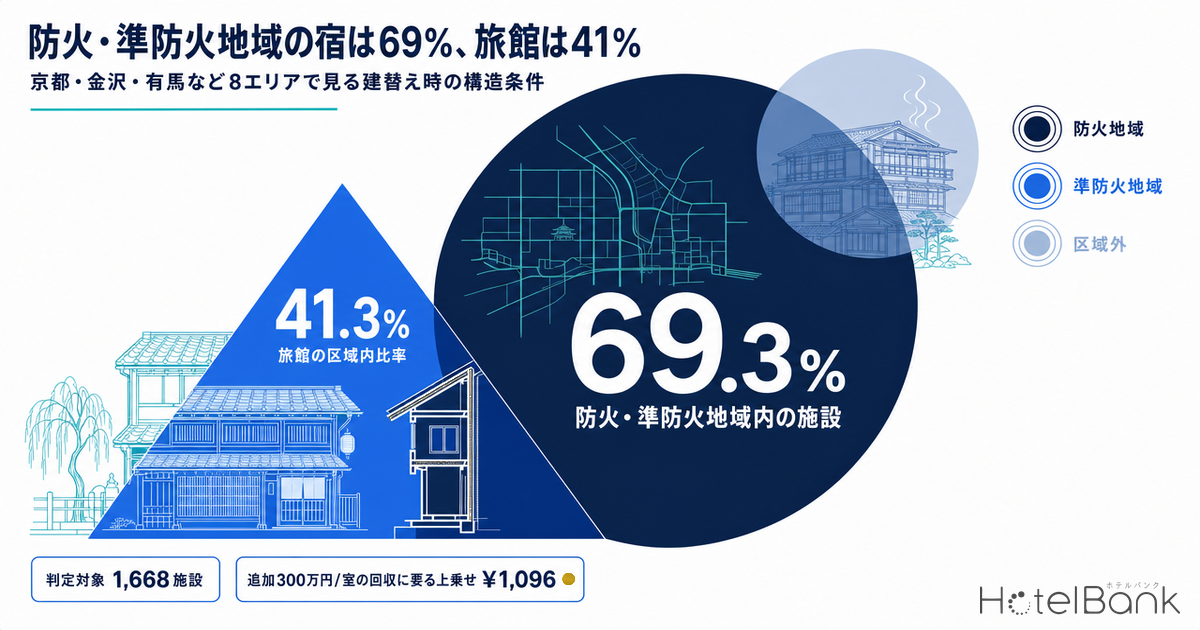
When an investor acquires a ryokan or machiya inn to rebuild or extend it, the first thing that fixes the design brief is neither the use zone nor the landscape code. It is whether the site lies in a fire prevention district (防火地域) or a quasi-fire prevention district (準防火地域). We overlaid the fire and quasi-fire prevention district layer of the Ministry of Land, Infrastructure, Transport and Tourism (MLIT) Real Estate Information Library (retrieved October 1, 2026) on lodging locations. Across eight areas — Higashiyama and Nakagyo Wards in Kyoto, Takayama, Kanazawa, Arima, Dogo, Beppu and Kurashiki — 69.3% of the 1,668 properties and 78.4% of the 53,314 rooms confirmed as operating sit inside one of the two districts. This article sets out, by district, the structural classes required under Article 61 of the Building Standards Act, then looks at the design assumptions for rebuilding a small ryokan of two to three wooden storeys and roughly 500 m² of floor area, and at payback sensitivity against estimated settled ADR in each area.
Metric Definitions Used in This Article
- ADR (average daily rate): an estimated settled rate (tax-exclusive equivalent) derived by applying a property-type adjustment factor to the lowest-plan level each property publishes on OTAs (two guests per room, per-room rate, tax included). Checked against the property-level results disclosed by listed hotel REITs (91 properties, latest three months), the median error is about 7%. It is an estimate and differs from each property’s actual settled rates and accounting figures. Area-level ADR is the median across the properties covered (the level of a typical property in the area). This article uses the average of the closed months from September 2025 to August 2026 and shows N (number of properties covered) alongside.
- District classification: each property is classed as “fire prevention district / quasi-fire prevention district / outside both” according to whether its representative coordinates fall inside a polygon of the MLIT Real Estate Information Library “fire and quasi-fire prevention district” layer (retrieved October 1, 2026). Because the test uses representative coordinates, the result can differ from the actual designation of the site near a district boundary. Always check an individual site against the municipality’s city planning map.
- Properties covered: properties whose address belongs to each area and for which a selling price was observed in at least one month between September 2025 and August 2026 (all property types, including ryokan, hotels, machiya, guesthouses and holiday rentals). Room counts are the values registered in the property master.
- Occupancy: the occupancy used in the payback sensitivity is an assumed 40–60%, not an actual or estimated figure for the area.
- Data sources: MetroEngines Research & Consulting (based on listings on major booking sites); MLIT Real Estate Information Library; MLIT “Building Starts Statistics”
Where This Article Sits Among the Rules
The rules that decide whether an inn can be rebuilt come in overlapping layers: construction cost and storey limits by structure, existing non-conforming status under use zoning, municipal ordinances that restrict where a ryokan business may locate, and landscape codes governing exteriors. This article deals with a separate city-planning layer from all of those — fire prevention and quasi-fire prevention districts. These provisions set not a building’s “use” or “appearance” but its grade of fire resistance.
- — Across eight areas — Higashiyama and Nakagyo Wards in Kyoto, Takayama, Kanazawa, Arima, Dogo, Beppu and Kurashiki — 69.3% of 1,668 lodging properties (78.4% of rooms) sit inside a fire prevention or quasi-fire prevention district (retrieved October 1, 2026).
- — For ryokan alone the share is 41.3%, 143 of 346 properties. By contrast 83.7% of machiya inns and 64.0% of small inns with 15 rooms or fewer are inside a district: the smaller and more central the inn, the more fire rules shape the design brief.
- — For a two-storey wooden rebuild, three lines separate the structural grades: 500 m² of total floor area in a quasi-fire prevention district, two storeys, and 300 m² of ryokan use on the second floor (Article 27).
- — Recovering an extra ¥3 million per room of construction cost over 15 years takes an uplift of ¥1,096 per night (assuming 50% occupancy), equal to 3.2% (Arima) to 6.4% (Beppu) of ryokan estimated settled ADR.
- — In Kinosaki the city states outright that there is no designation; in Atami the designation is confirmed in city documents; in Kusatsu no district could be confirmed on the layer. The final check belongs on the municipal city planning map.
69.3% of 1,668 Properties in 8 Areas Sit Inside Fire Districts — 41.3% for Ryokan
The conclusion first. In tourist destinations, the closer an inn is to the centre, the more likely it sits inside a fire or quasi-fire prevention district. Across the eight areas the distribution is 156 properties and 18,695 rooms in fire prevention districts, 1,000 properties and 23,109 rooms in quasi-fire prevention districts, and 512 properties and 11,510 rooms outside both. All 156 properties in fire prevention districts stand in commercial zones, and they are mostly mid- and high-rise hotels near stations and entertainment quarters. The 1,000 properties in quasi-fire prevention districts spread across more use zones — 568 in commercial, 203 in neighbourhood commercial and 92 in Category 1 residential zones — and include many machiya and small ryokan.
Narrow the view to ryokan, however, and the picture changes. Of the 346 ryokan with 7,396 rooms in the eight areas, only 143 properties (41.3%) and 4,021 rooms (54.4%) are inside a district; the majority, 203 properties, are outside. Takayama, which includes the Okuhida hot spring villages, and Beppu, where inns are scattered through hillside hot spring quarters such as Kannawa and Myoban, push up the outside share. “Rebuilding an onsen ryokan means designing to fire-district rules” is therefore not a safe generalisation: even within one city, the starting point for design differs between inns in the central built-up area and inns in outlying hot spring districts.
Distribution by Area — Dogo and Nakagyo Almost Entirely Inside, Half of Takayama and Beppu Outside
Start with the breakdown by area. The table below sets out property and room counts for all property types by district.
| Area | Properties | Rooms | Fire prevention properties / rooms | Quasi-fire prevention properties / rooms | Outside both properties / rooms | Share inside (properties) | Share inside (rooms) |
|---|---|---|---|---|---|---|---|
| Higashiyama Ward, Kyoto | 379 | 4,866 | 7 / 520 | 269 / 3,073 | 103 / 1,273 | 72.8% | 73.8% |
| Nakagyo Ward, Kyoto | 321 | 13,170 | 48 / 4,969 | 272 / 8,197 | 1 / 4 | 99.7% | 100.0% |
| Takayama | 288 | 6,503 | 15 / 1,234 | 96 / 1,706 | 177 / 3,563 | 38.5% | 45.2% |
| Kanazawa | 281 | 14,429 | 59 / 9,436 | 182 / 3,861 | 40 / 1,132 | 85.8% | 92.2% |
| Arima (Arima-cho, Kita Ward, Kobe) | 47 | 1,716 | 0 / 0 | 27 / 920 | 20 / 796 | 57.4% | 53.6% |
| Dogo (Dogo districts, Matsuyama) | 45 | 1,593 | 0 / 0 | 43 / 1,591 | 2 / 2 | 95.6% | 99.9% |
| Beppu | 225 | 6,861 | 0 / 0 | 104 / 3,705 | 121 / 3,156 | 46.2% | 54.0% |
| Kurashiki | 82 | 4,176 | 27 / 2,536 | 7 / 56 | 48 / 1,584 | 41.5% | 62.1% |
| 8-area total | 1,668 | 53,314 | 156 / 18,695 | 1,000 / 23,109 | 512 / 11,510 | 69.3% | 78.4% |
In Dogo, 43 of 45 properties are in a quasi-fire prevention district, reaching 99.9% on a room basis. In Nakagyo Ward, Kyoto, only one of 321 properties is outside: 48 properties with 4,969 rooms are in fire prevention districts and 272 properties with 8,197 rooms in quasi-fire prevention districts. In Kanazawa, fire prevention districts hold 9,436 rooms, 65.4% of the total, but this reflects the mid- and high-rise hotels around Katamachi, Korinbo and Kanazawa Station; by property count the 182 in quasi-fire prevention districts are more numerous. In Kurashiki too, fire prevention districts centred on the Achi district in front of Kurashiki Station account for 60.7% of rooms, while many inns in Honmachi, Higashimachi and other streets around the Bikan Historical Quarter were classed as outside both districts on this layer.
By contrast, 54.8% of rooms in Takayama, 46.0% in Beppu and 46.4% in Arima are outside both districts. In Takayama the old townscape and the station front fall in quasi-fire and fire prevention districts, while the 75 properties of the Okuhida hot spring villages lie outside. In Higashiyama Ward, Kyoto, 103 properties with 1,273 rooms are also outside, clustered on the lower slopes around Kiyomizu and Kodaiji. Note that parts of Gionmachi Minamigawa and Komatsucho in Higashiyama Ward were designated by Kyoto City in February 2003 as areas covered by its “Ordinance on Fire Safety Measures for the Preservation of Traditional Landscapes”, a mechanism that permits traditional wooden buildings under fire standards separate from those of ordinary fire and quasi-fire prevention districts.
| Machiya and small inns by district (8 areas) | Properties | Fire prevention | Quasi-fire prevention | Outside both | Share inside |
|---|---|---|---|---|---|
| Machiya (Higashiyama Ward, Nakagyo Ward, Kanazawa, Takayama) | 300 | 8 | 243 | 49 | 83.7% |
| Ryokan (8 areas) | 346 | 9 | 134 | 203 | 41.3% |
| Ryokan, machiya, guesthouses and minshuku with 15 rooms or fewer (8 areas) | 653 | 20 | 398 | 235 | 64.0% |
Of 300 machiya inns, 251 (83.7%) are inside a district, the great majority in quasi-fire prevention districts. Because machiya stand in the centre of the built-up area, their renovation or rebuilding cannot be considered apart from fire rules. For Kyoto machiya, road-access conditions — many front roads less than 4 m wide — are a further factor that decides whether a building can be rebuilt at all. Of the small inns with 15 rooms or fewer, 418 of 653 (64.0%) are also inside a district, so for a buyer taking over a small inn through business succession, checking the district is one of the first items to read in the property summary.
Three Areas Where the Layer Showed No District — Kinosaki’s City States “No Designation”
For three areas — Kinosaki Onsen (Kinosaki-cho, Toyooka), Kusatsu and Atami — no fire or quasi-fire prevention district polygons were found in the map tiles where the properties stand. The absence of a polygon is not, however, the same as the absence of a designation. We therefore cross-checked municipal city planning documents and the fire classification attached to the standard sites of the 2026 (Reiwa 8) Official Land Price survey.
| Area | Properties / rooms covered | Of which ryokan | Layer | Municipal documents and Official Land Price standard sites | Treatment in this article |
|---|---|---|---|---|---|
| Kinosaki (Kinosaki-cho, Toyooka) | 81 / 1,234 | 67 / 1,061 | No polygon | Toyooka City explains that “there is no designation of fire prevention or quasi-fire prevention districts within the city; however, areas with a designated use zone are subject to Article 22 of the Building Standards Act.” The standard site in the commercial area of Yushima, Kinosaki-cho, also carries no fire classification | No fire or quasi-fire prevention district designated (Article 22 area) |
| Kusatsu | 143 / 2,730 | 87 / 1,822 | No polygon | The town’s city planning explanation refers only to roof and exterior wall restrictions inside use zones (Articles 22 and 23). The three standard sites around Yubatake carry no fire classification | No district could be confirmed on this layer |
| Atami | 222 / 5,141 | 63 / 2,296 | No polygon | Atami City’s “Outline of City Planning” records 21 ha of fire prevention district and 151.2 ha of quasi-fire prevention district (decided June 28, 1989). The Ginza-cho standard site is in a fire prevention district and the Kasuga-cho standard site in a quasi-fire prevention district | No district could be confirmed on this layer (excluded from the district tallies) |
The three areas differ in their circumstances. In Kinosaki the city states that there is no designation, and the hot spring street lined with three-storey wooden ryokan is subject to roof and exterior wall restrictions as an Article 22 area. In Atami the designation of fire and quasi-fire prevention districts is confirmed in city documents, so this article does not tally properties inside and outside. In Kusatsu no district could be confirmed on either the layer or the standard sites, but a final check against the town’s city planning map is still required. The implication for a prospective buyer is simple: the less a map service shows for an area, the less advisable it is to skip checking the city planning map at the municipal office.
Structural Requirements on Rebuilding — Article 61 Sets the Grade by Storeys × Floor Area
What, then, changes once a site is inside a district? Article 61 of the Building Standards Act and Article 136-2 of its Enforcement Order prescribe the performance required of buildings in fire and quasi-fire prevention districts by the combination of number of storeys and total floor area. The table below sets out the classes.
| District | Scale | Class required (Order Art. 136-2) | How a wooden building complies |
|---|---|---|---|
| Fire prevention district | 3 or more storeys, or total floor area over 100 m² | Fire-resistive building, or a building with equal or better fire-spread-prevention performance (item 1) | Wooden fire-resistive construction, or design as a fire-spread-prevention building |
| 2 storeys or fewer and total floor area of 100 m² or less | Quasi-fire-resistive building, or a building with equal or better fire-spread-prevention performance (item 2) | Wooden quasi-fire-resistive construction | |
| Quasi-fire prevention district | 4 or more storeys above ground, or total floor area over 1,500 m² | Fire-resistive building or equivalent (item 1) | Wooden fire-resistive construction, or a fire-spread-prevention building |
| 3 storeys above ground and 1,500 m² or less, or 2 storeys or fewer above ground and over 500 m² up to 1,500 m² | Quasi-fire-resistive building or equivalent (item 2) | Wooden quasi-fire-resistive construction | |
| 2 storeys or fewer above ground and 500 m² or less | Wooden buildings: fire-preventive construction for the parts of exterior walls and eaves liable to catch fire from adjacent buildings, plus fire-protection equipment at exterior wall openings (item 3). Non-wooden buildings: fire-protection equipment at exterior wall openings (item 4) | Can remain ordinary wooden construction, but with higher specifications for exterior walls, eaves and windows | |
| Outside both (Article 22 area) | — | Non-combustible roofing (Article 22); quasi-fire-preventive performance for the parts of wooden exterior walls liable to catch fire from adjacent buildings (Article 23) | Can remain ordinary wooden construction |
| Regardless of district (Article 27, ryokan use) | Third or higher floor used as a ryokan / ryokan portion of the second floor is 300 m² or more | The former: fire-resistive building or equivalent (except three-storey buildings under 200 m² in total floor area fitted with the prescribed alarm equipment and so on); the latter: quasi-fire-resistive building or equivalent | The use-based requirement overlaps the district requirement |
What happens when this table is applied to a small wooden ryokan of two to three storeys and roughly 500 m² of floor area? For a three-storey building, Article 27 bites first, whether or not the site is inside a district. A ryokan of 200 m² or more in total floor area that uses its third floor for guest rooms must be a fire-resistive building or equivalent, so the conclusion does not change much with the district. It is rather in two-storey buildings that the district divides the design.
Two storeys, outside both districts (Article 22 area)
If the guest-room portion of the second floor is under 300 m², the project can be planned as ordinary wooden construction that meets non-combustible roofing and quasi-fire-preventive exterior wall requirements. With 500 m² over two storeys, concentrating common areas on the ground floor makes it easy to stay within this range.
Two storeys in a quasi-fire prevention district
At 500 m² or less in total floor area, the building stays wooden, with fire-preventive construction for exterior walls and eaves and fire-protection equipment in the windows. Exceed 500 m² by even 1 m² and it moves up to a quasi-fire-resistive building or equivalent. For an inn of around 500 m², whether it crosses this line is the first fork in the design.
Two storeys in a fire prevention district
Above 100 m² in total floor area, a fire-resistive building or equivalent becomes the premise. To proceed in wood, the options are wooden fire-resistive construction or a fire-spread-prevention building, which raises the performance of exterior walls and openings so that interior timber can be left exposed.
The treatment of extensions that retain the existing building also needs to be understood. Wooden ryokan built before the district was designated are often existing non-conforming buildings that do not meet the current Article 61. Article 86-7 of the Act and Articles 137-10 and 137-11 of the Enforcement Order provide that current rules are not applied to the existing portion only within a small scope — for example, where the floor area of the extension or alteration is 50 m² or less, the building has two storeys or fewer after the work, and the exterior walls and eaves of the extended or altered portion are of fire-preventive construction. Because the conditions have been revised in recent amendments, the practical sequence is to check the latest conditions in MLIT’s “Commentary on Relaxation Measures for Existing Buildings” and then compare extending by one or two guest rooms against a full rebuild.
Being inside a district is not only a burden. Under the amendment that took effect in 2019, a 10-percentage-point addition to the building coverage ratio (Article 53, paragraph 3) was extended to fire-resistive and quasi-fire-resistive buildings (or equivalent) in quasi-fire prevention districts. For machiya on narrow plots and inns on hot spring streets, rebuilding in quasi-fire-resistive wood creates room to widen the ground floor. The fire-spread-prevention building introduced by the same amendment opens a design route that leaves interior columns and beams exposed as timber, which works as upside for inns that want to tie a wooden aesthetic to their rate. Where a historic wooden ryokan is to be used as it stands, there is also a separate route — a municipal ordinance exempting the building from the Building Standards Act (the Article 3, paragraph 1, item 3 route) — and in Kinosaki Onsen, Toyooka City has enacted a preservation and utilisation ordinance aimed at three-storey wooden ryokan.
Construction Cost by Structure — Statistical Cost per m²: Wood ¥302,000, Steel ¥457,000, RC ¥482,000
How much does construction cost change as the grade rises? No public statistics isolate fire-resistive or quasi-fire-resistive wooden buildings, so here we only tabulate lodging-industry buildings in MLIT’s “Building Starts Statistics” by structure and present the result as a range. Over the three years 2022–2024 combined, wooden buildings numbered 4,116 at ¥302,300 per m², steel-frame buildings 2,309 at ¥457,200, and reinforced concrete buildings 711 at ¥481,700.
Restated for an inn of 500 m² and 10 rooms, the planned construction cost is about ¥151 million if built in wood, about ¥229 million if switched to steel frame and about ¥241 million in RC, a gap from wood of roughly ¥7.7–9.0 million per room. This figure, however, is the statistical gap “when the structure is changed from wood to non-wood”, not the increment for choosing quasi-fire-resistive wood. The size bands also differ: the average wooden building is 113 m², the average RC building 1,857 m². It is therefore reasonable to read the increment for planning a two-storey building of more than 500 m² in quasi-fire-resistive wood in a quasi-fire prevention district as lying somewhere between zero and about ¥9 million per room, with the actual amount determinable only from the designer’s and contractor’s estimates.
Payback Sensitivity — An Extra ¥3 Million per Room Equals 3.2–6.4% of Ryokan ADR
Pulling this together, what an investment decision needs to know comes down to two points: the probability of falling inside a district, and whether the increment can be absorbed in the rate. We therefore set the additional construction cost provisionally at ¥3 million per room and calculated the uplift needed per night to recover it evenly over 15 years at an assumed occupancy of 50%. ¥3 million ÷ (15 years × 365 days × 50%) gives ¥1,096. Dividing this by the estimated settled ADR of ryokan in each area (city or ward level, 12-month average) gives the right-hand column of the table below.
| Area | Ryokan properties / rooms | Of which inside properties / rooms | Share inside (rooms) | Ryokan estimated settled ADR (Sep 2025 – Aug 2026) | Required uplift (¥1,096 ÷ ADR) |
|---|---|---|---|---|---|
| Higashiyama Ward, Kyoto | 27 / 272 | 13 / 157 | 57.7% | ¥28,231 Higashiyama Ward · N=16–18 · 12 months | 3.9% |
| Nakagyo Ward, Kyoto | 25 / 761 | 25 / 761 | 100.0% | ¥18,468 Nakagyo Ward · N=11–19 · 12 months | 5.9% |
| Takayama | 108 / 1,818 | 16 / 288 | 15.8% | ¥17,848 Takayama · N=83–104 · 12 months | 6.1% |
| Kanazawa | 28 / 375 | 12 / 124 | 33.1% | ¥28,035 Kanazawa · N=22–26 · 12 months | 3.9% |
| Arima (Arima-cho, Kita Ward, Kobe) | 33 / 975 | 21 / 621 | 63.7% | ¥33,925 Kita Ward, Kobe · N=32–33 · 11 months | 3.2% |
| Dogo (Dogo districts, Matsuyama) | 26 / 1,234 | 26 / 1,234 | 100.0% | ¥18,038 Matsuyama · N=36 · 12 months | 6.1% |
| Beppu | 88 / 1,839 | 26 / 785 | 42.7% | ¥17,172 Beppu · N=74–84 · 12 months | 6.4% |
| Kurashiki | 11 / 122 | 4 / 51 | 41.8% | ¥24,106 Kurashiki · N=9 · 12 months | 4.5% |
The same ¥3 million weighs twice as much in some areas as in others. In Kita Ward, Kobe (Arima), where ryokan ADR is ¥33,900, the uplift is only 3.2%, against 6.4% in Beppu at ¥17,200 and 6.1% in Matsuyama (Dogo) at ¥18,000. Overlay the share inside a district and Dogo stands out: all 26 ryokan with 1,234 rooms are in a quasi-fire prevention district, so both the weight of the increment relative to the rate and the probability of being inside are high. Beppu has the highest uplift, but 57.3% of its ryokan rooms are outside both districts, so the premise can be changed by the choice of property. In Arima, 63.7% of ryokan rooms are in a quasi-fire prevention district, but the high rate leaves it better placed to absorb the increment.
| Additional construction cost (per room) | Occupancy (assumed) 40% | Occupancy (assumed) 50% | Occupancy (assumed) 60% |
|---|---|---|---|
| ¥1 million | ¥457 | ¥365 | ¥304 |
| ¥3 million | ¥1,370 | ¥1,096 | ¥913 |
| ¥5 million | ¥2,283 | ¥1,826 | ¥1,522 |
| ¥9 million (equivalent to the statistical wood-to-RC gap) | ¥4,110 | ¥3,288 | ¥2,740 |
What the sensitivity table shows is that if the increment stays at around ¥1 million per room, an uplift of ¥300–500 per night is enough, within 3% of the rate in every area. A plan that merely raises exterior wall and window specifications for a two-storey building of 500 m² or less in a quasi-fire prevention district is likely to fall in this band. Conversely, an increment in the ¥9 million per room class, where the structure itself changes, requires an uplift of about ¥3,300 per night at an assumed 50% occupancy, approaching 20% of the rate in areas where ryokan ADR is in the high ¥10,000s. Whether to hold floor area at 500 m² or less and get through with upgraded wooden specifications, or to exceed 500 m², move up to quasi-fire-resistive construction and recover the cost through the coverage ratio addition and more rooms, is a decision made within this range.
Note that there is no consistent rate difference between inside and outside a district. Looking at property-level ryokan ADR (median of 12-month averages) by district: in Arima it is ¥31,300 (N=21) in the quasi-fire prevention district and ¥36,400 (N=10) outside; in Beppu ¥16,300 (N=25) in the quasi-fire prevention district against ¥17,500 (N=59) outside, slightly higher outside; and in Takayama the order is reversed, ¥30,200 (N=13) in the quasi-fire prevention district and ¥16,500 (N=82) outside. What sets the rate is location and product, not the district, and the fire classification is best read purely as a premise on the construction cost side.
Basic Site Information — Official Land Price Standard Sites Also Carry the Fire Classification
Finally, we list the Official Land Price standard site closest to the centre of each area. The attributes of a standard site record the fire classification alongside the use zone and floor area ratio, which makes them a useful clue for confirming the district early in an acquisition review.
| Area | Standard site (location) | Use zone, floor area ratio | Fire classification | 2026 Official Land Price (¥/m²) | YoY |
|---|---|---|---|---|---|
| Higashiyama Ward, Kyoto | Gionmachi Kitagawa | Commercial, 600% | Fire prevention | 5,300,000 | +16.5% |
| Nakagyo Ward, Kyoto | Sanjo-dori Yanaginobanba Higashi-iru, Nakanocho | Commercial, 400% | Quasi-fire prevention | 2,440,000 | +10.9% |
| Takayama | Kami-Sannomachi | Neighbourhood commercial, 300% | Quasi-fire prevention | 531,000 | +24.9% |
| Kanazawa | Katamachi 2-chome | Commercial, 600% | Fire prevention | 735,000 | +7.3% |
| Arima | Arima-cho (residential site) | Category 2 residential, 200% | Not stated | 50,000 | +2.5% |
| Dogo | Dogo Yunomachi | Commercial, 400% | Quasi-fire prevention | 363,000 | +4.6% |
| Beppu | Kitahama 2-chome | Commercial, 500% | Quasi-fire prevention | 171,000 | +18.8% |
| Kurashiki | Tsurugata 1-chome | Neighbourhood commercial, 200% | Quasi-fire prevention | 199,000 | +3.6% |
| Kinosaki | Yushima, Kinosaki-cho | Commercial, 400% | Not stated | 244,000 | +2.5% |
| Kusatsu | Oaza Kusatsu | Neighbourhood commercial, 300% | Not stated | 57,800 | +5.9% |
| Atami | Ginza-cho | Commercial, 500% | Fire prevention | 275,000 | +14.6% |
Land prices continue to rise in the centres of tourist destinations: Kami-Sannomachi in Takayama is up 24.9% YoY, Kitahama in Beppu up 18.8% and Gionmachi Kitagawa in Higashiyama Ward, Kyoto up 16.5%. The more land values rise, the more yield depends on how much floor area and how many rooms the building can secure. The grade classes of fire and quasi-fire prevention districts are a premise to check before acquisition, side by side with the floor area ratio that caps that floor area.
Implications for Buyers — Draw the Three Lines First: 500 m², Two Storeys, 300 m²
For funds considering the acquisition of ryokan and machiya inns, business succession buyers and the regional financial institutions that lend to them, we restate this article’s findings as a procedure. First, confirm whether the property lies in a fire prevention district, a quasi-fire prevention district or an Article 22 area, using not only a map service but the municipal city planning map. As Atami shows, there are cases where the designation is confirmed in city documents even though no district appears on the layer.
Second, it is useful to test the post-rebuild scale against three lines: 500 m² of total floor area in a quasi-fire prevention district, two storeys, and 300 m² of ryokan use on the second floor. A plan that stays inside all three can proceed with upgraded wooden specifications, and the increment tends to fall in a range recoverable with an uplift of a few hundred yen per night. A plan that crosses a line has to build its economics on a switch to quasi-fire-resistive or fire-resistive construction, together with the coverage ratio addition, more rooms and the rate upside of a design that exposes timber.
Third, put the options that retain the existing building in the same table. Comparing three cases — the relaxation that limits an extension to 50 m² or less, preservation and reuse under an exemption ordinance, and a full rebuild — by the required uplift against the area’s ryokan ADR makes it easier to see which fits one’s funding plan. If a full rebuild is chosen, the demolition cost that arises up front also has to be budgeted. The estimates in this article are simplified; an actual investment decision requires a detailed feasibility study and prior consultation with an architect and the designated administrative agency.
Conclusion
In the eight areas of Kyoto (Higashiyama and Nakagyo Wards), Takayama, Kanazawa, Arima, Dogo, Beppu and Kurashiki, 69.3% of 1,668 lodging properties and 78.4% of rooms are in a fire prevention or quasi-fire prevention district. Machiya inns are 83.7% inside and small inns with 15 rooms or fewer 64.0% inside: the smaller and more central the inn, the more fire rules shape the design brief. Ryokan, by contrast, are only 41.3% inside, and in outlying hot spring districts there is ample room to plan in ordinary wooden construction under Article 22. Structural requirements on rebuilding are set by storeys and total floor area, and for a two-storey building in a quasi-fire prevention district 500 m² is the dividing line between grades. The uplift needed to recover an extra ¥3 million per room is ¥1,096 per night, equal to 3.2–6.4% of ryokan ADR. Checking the district, drawing the scale lines and weighing the increment against the rate, in that order, is the starting point for investment that hands old inns on to the next generation.
Frequently Asked Questions
Q. Can a wooden ryokan in a quasi-fire prevention district be rebuilt in wood?
If it has two storeys or fewer above ground and 500 m² or less of total floor area, it can be planned in wood by giving the exterior walls and eaves fire-preventive construction and fitting fire-protection equipment to windows and other openings. Above 500 m², or with three storeys, a quasi-fire-resistive building or better is required. If the third floor is used for guest rooms, also check the use-based rule for ryokan (Article 27 of the Building Standards Act).
Q. Where can I check which district my property is in?
MLIT’s Real Estate Information Library can display fire and quasi-fire prevention districts on a map, but some areas are not shown. The surest final check is the municipality’s city planning counter or city planning map.
Q. Does being in a fire or quasi-fire prevention district lower an inn’s rate?
In the eight areas studied, there was no consistent direction of rate difference between inside and outside a district. The district is a factor in the construction cost premise; the rate appears to be set by location and product.
References and Sources
■ Data sources
Property location, property type, room counts and estimated settled ADR are compiled by MetroEngines Research & Consulting (based on listings on major booking sites, N=1,668 properties, 53,314 rooms; ADR is for the ryokan property type at city or ward level, September 2025 to August 2026). Fire and quasi-fire prevention districts, use zones and Official Land Prices are from the MLIT Real Estate Information Library (retrieved October 1, 2026); cost per m² by structure is from MLIT “Building Starts Statistics” (lodging industry, 2022–2024 cumulative).
■ Estimate assumptions
District classification is a point-in-polygon test on each property’s representative coordinates (where both fire and quasi-fire prevention apply, the property is classed as fire prevention district). Payback sensitivity is the per-night uplift for simple payback of an additional construction cost of ¥1–9 million per room over 15 years at 40–60% occupancy (all assumed values); the mid case is ¥3 million and 50%. Interest, repairs and tax are excluded.
■ Limitations and caveats
Because classification uses representative coordinates, it can differ from the actual designation of the site near district boundaries. An area with no polygon on the layer is not synonymous with “no designation”. Cost per m² by structure is the statistical gap for switching to non-wooden construction, not the increment for choosing quasi-fire-resistive or fire-resistive wood. Estimated settled ADR is an estimate and differs from individual properties’ actual results. This article does not judge the legality of any individual project.
■ Market data
| MetroEngines Research & Consulting — property location, property type and room counts (N=1,668 properties, 53,314 rooms, plus 446 properties in three further areas); estimated settled ADR (ryokan property type at city or ward level, September 2025 to August 2026) |
■ Government statistics and public data
■ Laws and regulations
| Building Standards Act (Act No. 201 of 1950), Articles 22, 23, 27, 53, 61 and 86-7 — e-Gov Laws and Regulations Search |
| Enforcement Order of the Building Standards Act (Cabinet Order No. 338 of 1950), Articles 136-2, 137-10 and 137-11 — e-Gov Laws and Regulations Search |
■ Municipal publications
■ Methodology and caveats
District classification is a point-in-polygon test of each property’s representative coordinates against the fire and quasi-fire prevention district polygons. Where both apply, the property is classed as fire prevention district. Properties near a boundary may differ from the actual designation of the site. Payback sensitivity is an estimate of simple payback of additional construction cost over 15 years at 40–60% occupancy (assumed), excluding interest, repairs and tax. Cost per m² by structure is the planned construction cost at the start of construction and excludes design and supervision fees and furniture, fixtures and equipment. This article organises statutory provisions and statistics and does not judge the legality of any individual project.