

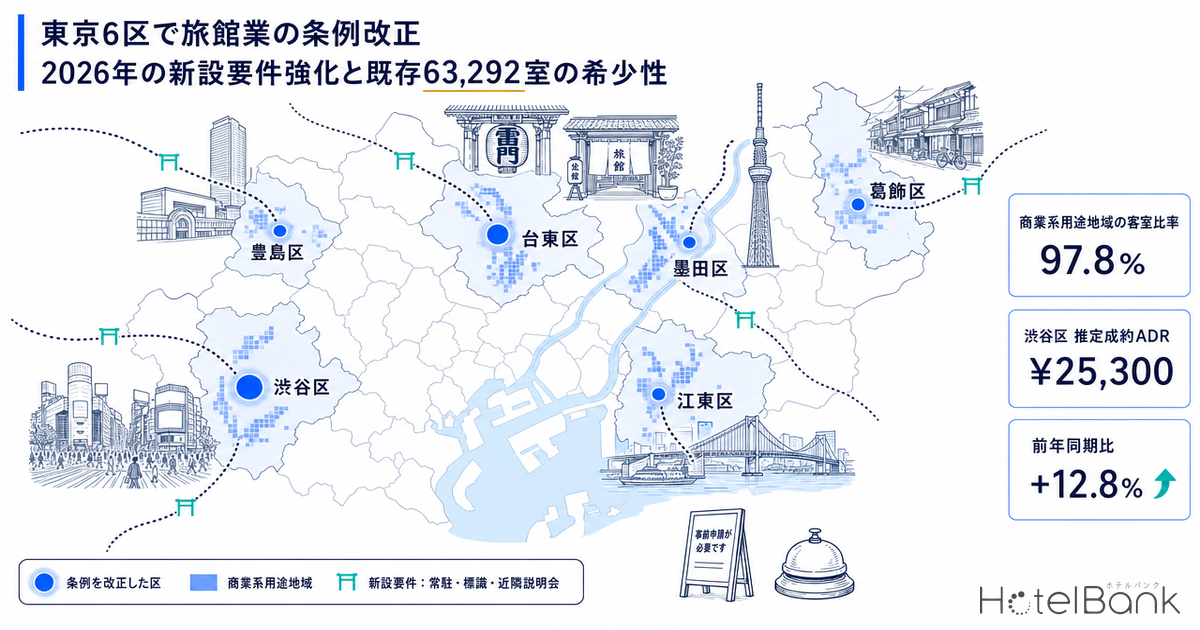
When sourcing hotel land, investors usually look first at how much demand a ward has. In Tokyo in 2026, however, the factor that bites sooner is regulatory: where in that ward can a new lodging facility actually open? Since the start of 2026, six wards have amended their enforcement ordinances under the Hotel and Ryokan Business Act (旅館業法) in quick succession — Sumida and Katsushika (effective April 1, 2026), Shibuya and Koto (July 1), Taito (October 1), and Toshima (in two stages, September 17 and December 16). Requirements such as on-site staff, neighborhood briefings and advance posting of signage are now stacked onto new license applications.
This article inventories, ordinance by ordinance and with effective dates, what has become a new requirement in these six wards. It then overlays zoning (city planning) data on the existing room stock to quantify how much land realistically remains for new builds. Finally, using a 100-room model, it works backward to estimate how much of the time saved can be priced in when acquiring an existing ryokan/hotel license through succession. Coverage is the 919 facilities and 63,292 rooms confirmed as operating in the six wards (MetroEngines Research; facilities with price observations between June 17 and September 16, 2026, as of September 17, 2026).
Metric Definitions Used in This Article
- ADR (Average Daily Rate): An estimated settled rate (tax-exclusive equivalent), calculated by applying segment-specific adjustment factors to the lowest published plan level on OTAs and similar channels (double occupancy, per-room rate, tax-inclusive). Checked against property-level results disclosed by listed hotel REITs (91 properties, latest 3 months), the median error is about 7%. This is an estimate and differs from each property’s actual transaction prices and accounting figures. Area-level ADR is the median of the covered properties (the level of a typical property in the area).
- OCC (Occupancy Rate): The share of sold rooms against the total room count in the area (an estimate based on OTA sales inventory). It differs from each property’s actual occupancy.
- Room stock: Total rooms of facilities with price observations in the latest 3 months (June 17 – September 16, 2026). Defined by actual sales observations rather than an “in operation” flag.
- Zoning districts: Determined by overlaying the city planning decision data (zoning districts) from the MLIT Real Estate Information Library onto facility coordinates. Because classification is by coordinate point, results may differ near district boundaries.
- Data sources: MetroEngines Research & Consulting / MLIT Real Estate Information Library / published materials of each municipality
Defining the Scope First
This article covers facilities that require a license under the Hotel and Ryokan Business Act (ryokan/hotel business and simple lodging (簡易宿所) business). It is not about operating-day limits or exclusion zones for private lodging businesses notified under the Private Lodging Business Act (住宅宿泊事業法) — that is a different asset class. However, because the national government’s technical advice of July 15, 2026 raised consistency between the two regimes as an issue, we touch on private-lodging developments where necessary. Note that “minpaku” in this article is not limited to minpaku under the Private Lodging Business Act; it refers to listing-based short-stay inventory, including properties under the Hotel and Ryokan Business Act and special-zone minpaku. Listing counts do not match official notification counts.
- — Six wards amended their Hotel and Ryokan Business Act enforcement ordinances in 2026: Sumida and Katsushika on April 1, Shibuya and Koto on July 1, Toshima on September 17 and December 16, and Taito on October 1. Rather than closing off districts, the amendments add on-site staff, a front desk, pre-application signage and neighborhood briefings to new license applications.
- — 97.8% of rooms are concentrated in commercial zones (5 wards excluding Koto; 51,149 of 52,276 rooms). Yet commercial zones account for only 9.5–78.6% of ward land area — the area where building is legally permitted and the area the market actually uses are two different things.
- — Official commercial land prices rose +11.5% to +18.9% YoY (2026 official land price survey, median). The more new builds are confined to commercial land, the more a drawn-out plan becomes a cost in itself.
- — Estimated settled ADR is above the prior year in all six wards: Shibuya leads at ¥25,300 (+12.8%). Estimated OCC is 88.1–91.4% (June–August 2026 average) — supply is not stagnating because demand is weak.
- — An acquisition that opens 12 months sooner is worth ¥1.56 million per room (Taito 100-room model, 35% GOP margin). Including rising land and construction costs, a year of delay costs 15.7% of total investment, or 12.6–19.0% depending on assumptions.
Six Wards Amended Their Ryokan Ordinances in 2026 — What Was Added to New-License Requirements
First, the facts, with effective dates. Everything below is based on materials published by each ward (reference date: September 17, 2026). The core of the amendments is twofold — “station operating staff inside the facility” and “notify neighbors before applying” — and, importantly, none of them closes off districts outright.
| Municipality | Amended ordinance | Promulgated / passed | Effective | Main provisions affecting new license applications |
|---|---|---|---|---|
| Sumida | Ordinance partially amending the Hotel and Ryokan Business Act Enforcement Ordinance (Sumida Ward Ordinance No. 52 of 2025) | Promulgated Dec 10, 2025 | Apr 1, 2026 | Revises structural and equipment standards for ryokan/hotel and simple lodging businesses. Operated together with the private lodging ordinance (No. 53) effective the same day |
| Katsushika | Ordinance and regulations partially amending the Katsushika Ward Hotel and Ryokan Business Act Enforcement Ordinance | Promulgated Dec 17, 2025 | Apr 1, 2026 | Mandatory signage at all lodging facilities in the ward; manager names and emergency contacts must be posted where the public can easily see them |
| Shibuya | Shibuya Ward Hotel and Ryokan Business Act Enforcement Ordinance and bylaws | Promulgated Mar 26, 2026 | Jul 1, 2026 | Signage (at least 1.2m tall × 0.9m wide) from 60 days before the application date, a neighborhood briefing before applying, and resident operating staff (inside the facility, on the same site or on an adjacent site). Display of emergency contacts also applies to existing facilities |
| Koto | Ordinance and regulations partially amending the Koto Ward Hotel and Ryokan Business Act Enforcement Ordinance | Promulgated Mar 13, 2026 | Jul 1, 2026 | Adds a requirement for space where the operator or staff can be stationed. Non-administrative fine of up to ¥50,000 for violating the on-site requirement. Management checks at least once every 24 hours with records kept, and written advance explanation to guests |
| Toshima | Ordinance partially amending the Toshima Ward Hotel and Ryokan Business Act Enforcement Ordinance | Passed Sep 16, 2026 | Sep 17 / Dec 16, 2026 | Sep 17: documents to attach to license applications, publicizing business plans, guidance/advice/recommendations/public disclosure. Dec 16: operator responsibilities; structural and equipment standards for ryokan/hotel and simple lodging businesses (front desk and resident staff) |
| Taito | Partial amendment of the Taito City, Tokyo Hotel and Ryokan Business Act Enforcement Ordinance | — | Oct 1, 2026 | New provisions for guidance and recommendations on violations of compliance items (Art. 12), orders (Art. 13), and public disclosure of operator information (Art. 14) |
The on-site staffing requirement has the largest practical impact. Koto replaced its previous “response within roughly a 10-minute walk” arrangement with on-site stationing and attached a fine to violations. Shibuya requires the staff station to be “a room of sufficient size that can be entered and exited without passing through guest rooms” plus “a toilet that staff can use outside guest rooms,” so the staff space must be planned from the design stage. Toshima’s December 16 provisions build a front desk and resident staff into its structural and equipment standards. For small or unstaffed new projects, all of this means fewer sellable rooms for the same floor area.
Procedurally, Shibuya’s rule — “post signage from 60 days before applying and hold a neighborhood briefing before the application” — imposes the heaviest front-loaded burden. At least two months of public notice, plus the briefing schedule, must be built into the timeline from the construction or acquisition decision to opening. What is easy to overlook here is the exemption the ward spells out. Shibuya’s amendment summary states that signage and briefings “do not apply when receiving approval for succession.” In other words, an acquisition that takes over an existing license does not trigger these two procedures.
How Succession Is Positioned in the Law
The amended Hotel and Ryokan Business Act, effective December 13, 2023, created Article 3-2 (business transfer): “Where an operator transfers the lodging business concerned, and the transferor and transferee receive the approval of the prefectural governor for the transfer and acquisition, the transferee shall succeed to the status of the operator.” Mergers and splits fall under Article 3-3, and inheritance under Article 3-4. Before the amendment, the process was a closure notice from the transferor plus a new license application by the transferee, which could leave a gap in licensing.
However, Article 3-2(2) applies Article 3(2) (grounds for disqualification) and Article 3(3)–(6) mutatis mutandis. Article 3(3) allows a license to be refused where a facility within roughly 100 meters of the grounds of a school, child welfare facility, social education facility or similar “is likely to significantly harm a wholesome facility environment,” and the same perspective applies to the review of succession approvals. Succession is not automatic — it is an approval procedure.
Developments at the national level are also worth noting. On July 15, 2026, the Director of the Environmental Health Division (Health and Environmental Health Bureau, MHLW), the Director of the Real Estate Business Division (Real Estate and Construction Economy Bureau, MLIT) and the Director of the Tourism Industry Division (Japan Tourism Agency) jointly issued “On Zero-Day Restrictions etc. Concerning Notified Residences under the Private Lodging Business Act (Technical Advice)” (健生衛発0715第1号・国不動第129号・観観産第78号). It clarifies that a de facto prohibition of private lodging in designated districts (so-called zero-day restrictions) may be imposed to the extent reasonably deemed necessary.
What matters in this article’s context is the sentence that serves as a proviso. The technical advice asks municipalities, when regulating, to “take care to ensure consistency with related regulations, such as the city planning of the area concerned (location restrictions on lodging facilities, etc.) and the operation of licensing for lodging facilities around educational facilities etc. under Article 3(3) of the Hotel and Ryokan Business Act (Act No. 138 of 1948),” and gives, in parentheses, the example of “ensuring consistency by, for instance, also regulating simple lodging facilities etc. in the same way when regulating private lodging businesses to protect the quiet residential environment of residential areas.” In other words, the national framework anticipates that municipalities that close districts to private lodging will move in the same direction on the ryokan side (especially simple lodging) and on the city planning side.
In practice, district-level lines are already being drawn on the private lodging side. Through an amendment to its private lodging ordinance effective July 1, 2026, Shibuya added Category 1 and 2 Residential Zones and Quasi-Residential Zones to its restricted areas (previously limited to school districts and exclusively residential zones). From December 16, 2026, Toshima will prohibit new openings in exclusively residential zones, residential zones, quasi-industrial zones and school districts (about 70% of the ward) and limit the operating period to 120 days a year across the entire ward. These are different assets from the license-based properties this article covers, but they serve as a leading indicator of which zoning districts are being named in the policy of “not increasing lodging-related traffic in residential areas.”
Lodging Sits on Only a Fraction of Each Ward’s Land
Before the ordinances even come into play, the Building Standards Act (Appended Table 2) determines where lodging facilities can be located. Ryokan and hotels cannot be built in Category 1 and 2 Low-Rise Exclusively Residential Zones, Category 1 and 2 Mid/High-Rise Exclusively Residential Zones, Rural Residential Zones, Industrial Zones or Exclusively Industrial Zones, and in Category 1 Residential Zones the lodging portion is capped at 3,000㎡. Applying these rules to zoning data for the six wards, the share of land where building is not permitted is 45.5% in Toshima, 44.5% in Shibuya, 34.5% in Katsushika, 23.7% in Koto, 12.0% in Taito and 4.2% in Sumida (our tabulation from city planning decision data in the MLIT Real Estate Information Library, based on designated zoning area).
Yet the places where rooms actually stand are narrower still. Overlaying the 919 facilities and 63,292 rooms confirmed as operating in the six wards on zoning data, 97.8% of rooms (51,149 of 52,276) in the five wards excluding Koto were concentrated in Commercial and Neighborhood Commercial Zones: 99.6% in Taito, 98.0% in Sumida, 97.1% in Toshima, 93.8% in Shibuya and 91.2% in Katsushika. Meanwhile, the share of ward land in commercial zones varies widely — 78.6% in Taito versus 34.3% in Toshima, 28.7% in Shibuya, 9.8% in Koto and 9.5% in Katsushika. The area where building is legally permitted and the area the market actually uses are two different things.
Koto alone has a different structure. Quasi-industrial zones cover 48.9% of the ward, and large waterfront facilities are located there, so only 17.7% of rooms are in commercial zones while 69.5% are in industrial zones (quasi-industrial, industrial and exclusively industrial). Ryokan and hotels can be built in quasi-industrial zones, making Koto the only one of the six wards with a large receiving area outside commercial land. Note that zoning is determined by point classification using facility coordinates, so results may differ near district boundaries. The intent is not to judge individual facilities; please read these figures as ward-level distribution trends.
On the map, nearly every facility in Taito lines up along the commercial belt running through Asakusa, Ueno and Kuramae; Toshima’s cluster around Ikebukuro Station; and Shibuya’s gather in the station-front commercial areas of Shibuya, Ebisu and Harajuku. The residential and exclusively residential land spreading across each ward’s periphery is barely used for lodging supply. The map confirms visually that land sourcing competes not across a “ward” but for a limited number of lots inside these belts.
| Ward | Facilities observed | Rooms | Rooms in commercial zones | Commercial share of land | Non-buildable share of land | Est. settled ADR (12-month avg.) | YoY | Est. OCC |
|---|---|---|---|---|---|---|---|---|
| Taito | 414 | 25,440 | 99.6% | 78.6% | 12.0% | ¥14,400 | +4.2% | 91.2% |
| Sumida | 135 | 6,520 | 98.0% | 41.6% | 4.2% | ¥15,400 | +4.9% | 88.5% |
| Toshima | 143 | 11,901 | 97.1% | 34.3% | 45.5% | ¥12,400 | +4.8% | 88.1% |
| Shibuya | 104 | 7,359 | 93.8% | 28.7% | 44.5% | ¥25,300 | +12.8% | 91.4% |
| Koto | 71 | 11,016 | 17.7% | 9.8% | 23.7% | ¥14,200 | +8.5% | 90.9% |
| Katsushika | 52 | 1,056 | 91.2% | 9.5% | 34.5% | ¥9,000 | +3.4% | — |
On rates, all six wards are above the prior-year period. Shibuya stands out with an estimated settled ADR of ¥25,300 (+12.8% YoY, 29–34 facilities covered), followed by Koto +8.5%, Sumida +4.9%, Toshima +4.8%, Taito +4.2% and Katsushika +3.4%. Estimated OCC is also high: 91.2% in Taito, 91.4% in Shibuya and 90.9% in Koto (all June–August 2026 averages). The picture in Tokyo in 2026 is not that supply is failing to grow because demand is weak, but that requirements for new openings are getting heavier amid strong demand.
New Openings Had Been Getting Smaller — The Reality the Ordinances Address
Why the 2026 amendments focused on on-site staff and front desks becomes clear from opening data. New openings in Tokyo (based on confirmed OTA listings) went from 139 properties averaging 50.5 rooms in 2021 to 86 averaging 43.2 rooms in 2024 and 98 averaging 28.6 rooms in 2026 — the size per property shrank more than the count. The share of openings with 10 rooms or fewer rose from 38.8% in 2021 to 62.8% in 2024 and remains a majority at 53.1% in 2026. The market used the 2018 amendment to the Hotel and Ryokan Business Act — which relaxed front-desk requirements and made single-room licensing realistic — in the form of small, lean-staffed operations.
Narrowing to the six wards, openings fell from 69 properties / 2,697 rooms in 2021 to 41 properties / 1,368 rooms in 2026 — roughly half on a room basis. The breakdown, however, is polarized. Of the 41 properties opened in the six wards in 2026, 22 are small facilities of 10 rooms or fewer, while large station-front projects such as APA Hotel Keisei Ueno Ekimae Minami (アパホテル〈京成上野駅前南〉, 342 rooms, August), APA Hotel Shibuya Ekimae (アパホテル〈渋谷駅前〉, 231 rooms, scheduled for December) and KOKO HOTEL Ikebukuro (152 rooms, February) push up the room count. The amended standards, which presuppose staff space and a front desk, fit the latter kind of project well, while prompting design reviews for small-lot, lean-staffed projects like the former. How thick this new supply is relative to existing stock is broken down ward by ward in Tokyo 23 Wards Supply Pressure 2026: Arakawa 16.0%, Minato Just 4.5%.
The pipeline ahead reinforces this pattern. Picking up planned projects in the six wards from MLIT’s Building Dynamics Statistics Survey yields Ikebukuro 2-8-1, Toshima (328 rooms, completion scheduled September 2026), Ryusen 2-chome, Taito (168 rooms, completion scheduled November 2025), Dogenzaka 2-10, Shibuya (231 rooms, October 2026), Dogenzaka 2-38 (130 rooms, March 2027) and Dogenzaka 2-chome 24-1 (mixed use including a hotel, March 2028) — all in station-front commercial areas. No plans emerging from residential districts could be identified. Note that the planning data is based on building confirmation applications at the time of the survey; counts and rooms are expected to rise as applications are added, so treat these figures as a lower bound for the confirmed pipeline.
Land Prices on That Limited Commercial Land Are Rising at Double-Digit Rates
The more new builds are confined to commercial land, the more land acquisition cost there matters. In the 2026 official land price survey (as of January 1, 2026), median commercial land prices in the six wards were ¥5,250,000/㎡ in Shibuya (N=33 sites), ¥1,730,000/㎡ in Toshima (N=31), ¥1,700,000/㎡ in Taito (N=47), ¥1,120,000/㎡ in Koto (N=17), ¥965,000/㎡ in Sumida (N=13) and ¥521,000/㎡ in Katsushika (N=19). Median YoY changes were +18.9% in Taito, +16.7% in Koto, +15.8% in Toshima, +14.7% in Sumida, +13.9% in Shibuya and +11.5% in Katsushika — double-digit increases across the board. Commercial land is moving faster than residential land (from +5.5% in Katsushika to +10.3% in Shibuya, with Taito and Sumida at +13.6%).
These increases translate directly into the “cost of waiting.” Assuming a 400㎡ site on commercial land in Taito (¥680 million at the median ¥1,700,000/㎡), one more year at the same rate of increase adds ¥128 million to acquisition cost. With the amendments adding a 60-day notice period and a briefing before the application, and with design revisions to accommodate staff space, the front end of the project timeline will certainly get longer. The holding costs incurred between securing land and opening add to this burden on top of the price increase itself.
How Much of the Time Saved Can Be Priced Into License Succession? (Simplified 100-Room Model)
Now let us translate these inputs into an acquisition decision. The difference between building new and acquiring an existing asset shows up not in final building performance but in when cash flow starts. Assuming a 100-room limited-service hotel in Taito, we put a figure on a one-year delay in operations. All assumptions are published figures and our own estimates; actual investment decisions require an individual feasibility study.
| Item | Assumption | Basis |
|---|---|---|
| Rooms | 100 rooms | A model case larger than the observed Taito average (25,440 rooms / 414 facilities = 61 rooms) |
| Estimated settled ADR | ¥14,400 | Taito average, September 2025 – August 2026 (161–177 facilities covered) |
| Occupancy (assumed) | 85% | Set conservatively against estimated OCC of 91.2% (June–August 2026 average, 145 facilities / 13,435 rooms) |
| Annual rooms revenue | ¥446.8 million | 100 rooms × ¥14,400 × 85% × 365 days |
| GOP margin | 35% | Set conservatively against the 38.9% operating result disclosed by a listed REIT (Invincible Investment Corporation, 91 MHM-operated properties, FY ended December 2024) and the 50–60% benchmark for limited-service hotels |
| Annual GOP | ¥156.4 million | ¥1.56 million per room per year |
| Land (400㎡) | ¥680 million | Median official commercial land price in Taito, ¥1,700,000/㎡ (2026 survey, N=47) |
| Construction (2,800㎡ GFA = 847 tsubo) | ¥1,653 million | ¥1.952 million/tsubo (2024 all-structure average based on MLIT Building Construction Starts Statistics) |
| Total investment | ¥2,333 million | ¥23.3 million per room; GOP yield 6.7% |
Under these conditions, a one-year delay in ramp-up costs ¥156.4 million of annual GOP — ¥1.56 million per room, equivalent to 6.7% of total investment. A two-year delay costs 13.4%. On top of that, the party that waits faces two more costs. One is land: if Taito’s +18.9% YoY commercial land price increase continues, the site costs ¥128 million more in a year. The other is construction: applying the conservative +5.0% from Turner & Townsend’s international construction market survey outlook for Tokyo construction costs (+5.3% in 2026, +5.0% in 2027), the ¥1,653 million construction cost rises by about ¥83 million in a year. Together, the three total ¥367 million per year — ¥3.67 million per room, or 15.7% of total investment.
| GOP margin | 6 months | 12 months | 18 months | 24 months |
|---|---|---|---|---|
| 30% | ¥67 million | ¥134 million | ¥201 million | ¥268 million |
| 35% (base) | ¥78 million | ¥156 million | ¥235 million | ¥313 million |
| 40% | ¥89 million | ¥179 million | ¥268 million | ¥357 million |
| 50% | ¥112 million | ¥223 million | ¥335 million | ¥447 million |
Put differently, for an acquisition that shortens the time to opening by 12 months, a premium of up to ¥1.56 million per room (at a 35% GOP margin) can be justified by forgone GOP alone. Factoring in rising land and construction costs widens that range further. This is not a story of “existing assets being expensive” but of regulation and market conditions pushing up the value of time.
| Assumption set | GOP forgone | Land price increase | Construction cost increase | Total per year | Share of total investment |
|---|---|---|---|---|---|
| Optimistic (GOP margin 30%, land +11.5%, construction +5.0%) | ¥134 million | ¥78 million | ¥83 million | ¥295 million | 12.6% |
| Middle (GOP margin 35%, land +18.9%, construction +5.0%) | ¥156 million | ¥128 million | ¥83 million | ¥367 million | 15.7% |
| Pessimistic (GOP margin 50%, land +18.9%, construction +5.6%) | ¥223 million | ¥128 million | ¥93 million | ¥444 million | 19.0% |
Changing the assumptions does not change the direction. The cost of waiting one year falls within 12.6–19.0% of total investment, and even under the lightest assumptions it is ¥295 million a year. The higher a property’s GOP margin, and the faster land prices move in its ward, the higher the price of time. Conversely, an acquisition that takes over an existing license and building and ramps up 12 months sooner can justify a price within this range.
1. New Builds Have Not Been Shut Out
The six wards’ amendments do not close off districts. Large projects on station-front commercial land remain viable, and 1,368 rooms opened in the six wards in 2026. What has changed is the design latitude for projects premised on small lots and lean staffing.
2. Succession Can Mean Lighter Procedures
Shibuya explicitly exempts cases receiving succession approval from advance signage and neighborhood briefings. Succession through a business transfer under Article 3-2 of the Hotel and Ryokan Business Act does not require obtaining a new license. However, the approval review applies Article 3(3) (roughly 100m around schools, etc.) mutatis mutandis.
3. The Contest Is Inside the Commercial Belts
In five wards, 97.8% of rooms are in commercial zones, yet those zones cover just 28.7% of Shibuya, 34.3% of Toshima and 9.5% of Katsushika. Competition for sites concentrates inside these belts, where land prices are rising at double-digit rates YoY.
Four Points That Are Easy to Misread
1. Transitional measures are cut off by application date. Shibuya applies the amended ordinance to facilities applying on or after July 1, 2026, and the pre-amendment standards to facilities that applied on or before June 30 (the obligation to display emergency contacts also covers existing facilities). Koto likewise applies the pre-amendment rules where an application was accepted before the effective date. In due diligence, confirm under which point-in-time standards the target facility’s license was granted.
2. Succession requires approval; it is not automatic. Succession through a business transfer requires applications from both the transferor and transferee and administrative approval, with the disqualification grounds and school-proximity provisions applied mutatis mutandis. How to choose between this and a share acquisition (transferring control while keeping the legal entity), the timeline to approval, and the revenue forgone if operations are suspended all differ by scheme. Because each scheme has its own trade-offs, it is essential to compare them against the target’s licensing history and schedule before committing.
3. The zoning debate is further along on the private lodging side. The July 15, 2026 technical advice stated that when regulating private lodging to protect residential environments, municipalities should take care to ensure consistency, for example by regulating simple lodging facilities in the same way. At present none of the six wards’ Hotel and Ryokan Business Act ordinances imposes district restrictions, but the possibility that consistency will be pursued — including on the city planning side — is worth factoring into medium-term land strategy.
4. Ordinances are amended frequently. Everything in this article is based on materials published by each ward as of September 17, 2026. As Toshima shows, parts of an amendment can take effect almost immediately after passage, so in practice direct confirmation with the public health center where you plan to apply is a prerequisite.
Summary
In 2026, six Tokyo wards amended their Hotel and Ryokan Business Act enforcement ordinances, adding resident operating staff, front desks or staff space, pre-application signage and neighborhood briefings to the requirements for new applications. The provisions do not close off districts, but for new supply — which had shrunk to the point where properties of 10 rooms or fewer made up half of openings — they call for a rethink of both design and timeline.
Meanwhile, of the six wards’ 63,292 rooms, 97.8% in the five wards excluding Koto sit in commercial zones, while commercial zones’ share of ward land varies widely from 9.5% to 78.6%. Land where hotels cannot be built under the Building Standards Act reaches 45.5% in Toshima and 44.5% in Shibuya, and the land actually in use is narrower still. Official land prices on that limited commercial land are rising +11.5% to +18.9% YoY.
Demand is firm: estimated settled ADR is above the prior-year period in all six wards (Shibuya’s +12.8% is the largest), and estimated OCC stands at 88.1–91.4% (June–August 2026 average). In this environment, the value of acquiring stock that already holds a ryokan/hotel license and ramping up quickly rises in relative terms. In the 100-room model, opening 12 months sooner is worth ¥156 million of annual GOP (¥1.56 million per room, 6.7% of total investment), and including rising land and construction costs, a year is worth 15.7% of total investment. Our conclusion: when regulation is lengthening timelines, the case for acquisitions that buy time grows stronger.
References and Sources
■ Data Sources
Coverage is the six wards of Taito, Sumida, Toshima, Shibuya, Koto and Katsushika: 919 facilities and 63,292 rooms with price observations between June 17 and September 16, 2026. Estimated settled ADR is the average of monthly medians from September 2025 to August 2026 (facilities covered: Taito 161–177, Sumida 29–31, Toshima 58–62, Shibuya 29–34, Koto 39–42, Katsushika 6–8); YoY compares with September 2024 – August 2025; estimated OCC is the June–August 2026 average (based on listings on major booking sites). Zoning is determined by point classification, overlaying city planning decision data from the MLIT Real Estate Information Library on facility coordinates (classification matched for 1,619 of 1,625 facilities). Land prices are from 302 sites in the six wards in the 2026 official land price survey. Descriptions of ordinances are based on amendment summaries and ordinance texts published by each ward (reference date: September 17, 2026).
■ Model Assumptions
The 100-room model assumes a limited-service hotel in Taito with estimated settled ADR of ¥14,400 (Taito 12-month average), assumed occupancy of 85% (set conservatively against estimated OCC of 91.2%, June–August 2026 average), a 35% GOP margin (set conservatively against the 38.9% operating result disclosed by a listed REIT), land of 400㎡ × ¥1,700,000/㎡, and GFA of 2,800㎡ = 847 tsubo × ¥1.952 million/tsubo. Annual rooms revenue is calculated as 100 rooms × ADR × occupancy × 365 days, excluding non-rooms revenue. The three cases in Table 5 combine GOP margins of 30–50% (the same band as Table 4), land price increases of +11.5% to +18.9% (the actual range across the six wards) and construction cost increases of +5.0% to +5.6% (Turner & Townsend’s outlook).
■ Limitations and Caveats
Estimated settled ADR and estimated OCC are both estimates based on OTA-listed inventory and differ from each property’s actual transaction prices and occupancy (estimated OCC tends to run high because unlisted rooms are counted as sold). Katsushika’s estimated OCC is not shown because coverage is thin at 5 facilities / 356 rooms. Zoning is determined by coordinate point, so results may differ near district boundaries. New openings are based on confirmed OTA listings and planned projects on building confirmation applications; both should be read as lower bounds that will rise as more are added. Ordinances are amended frequently, and in practice direct confirmation with the public health center where you plan to apply is a prerequisite. The 100-room model is a simplified estimate; investment decisions require an individual feasibility study.
■ Market Data
- MetroEngines Research & Consulting — Room stock (919 facilities / 63,292 rooms with price observations from June 17 to September 16, 2026), estimated settled ADR, estimated OCC, new opening data (based on confirmed OTA listings)
■ Primary Legal and Municipal Sources (reference date: September 17, 2026)
- Japan Tourism Agency, “Notice to Local Governments on Minpaku — Issuance of ‘On Zero-Day Restrictions etc. Concerning Notified Residences under the Private Lodging Business Act (Technical Advice)'” (July 15, 2026; 健生衛発0715第1号・国不動第129号・観観産第78号) (Japanese)
- Shibuya City, “Summary of Amendments to the Shibuya Ward Hotel and Ryokan Business Act Enforcement Ordinance and Bylaws (Promulgated March 26, 2026)” (Japanese)
- Shibuya City, “Summary of Amendments to the Ordinance and Regulations on the Proper Operation of Private Lodging Businesses in Shibuya Ward (Promulgated March 26, 2026)” (Japanese)
- Koto City, “On the Amendment of the Koto Ward Hotel and Ryokan Business Act Enforcement Ordinance” (promulgated March 13, 2026; effective July 1) (Japanese)
- Taito City, “On the Partial Amendment of the Hotel and Ryokan Business Act Enforcement Ordinance (Effective October 1, 2026)” (Japanese)
- Sumida City, “Review of How Private Lodging Businesses Should Be Regulated” (Sumida Ward Ordinances No. 52 and 53 of 2025; effective April 1, 2026) (Japanese)
- Katsushika City, “[Important] To All Operating Lodging Businesses in Katsushika Ward” (promulgated December 17, 2025; effective April 1, 2026) (Japanese)
- Toshima City, “We Have Amended the Private Lodging Business Act Ordinance” (district and period restrictions from December 16, 2026) (Japanese)
- Toshima City, “‘Ordinance Partially Amending the Toshima Ward Hotel and Ryokan Business Act Enforcement Ordinance’ Passed on September 16 at the 3rd Regular Session of the Toshima Ward Assembly” (September 16, 2026) (Japanese)
- e-Gov Law Search, “Hotel and Ryokan Business Act (Act No. 138 of 1948),” Article 3(3) and Article 3-2 (Japanese)
- e-Gov Law Search, “Building Standards Act (Act No. 201 of 1950),” Appended Table 2 (Japanese)
■ Government Statistics and Public Data
- MLIT Real Estate Information Library — city planning decision data (zoning districts); official land prices and prefectural land price survey (2026 official land prices)
- MLIT, “Building Dynamics Statistics Survey” (planned project data, based on building confirmation applications)
- MLIT, “Building Construction Starts Statistics” (construction cost per tsubo)
■ Industry Reports and IR