

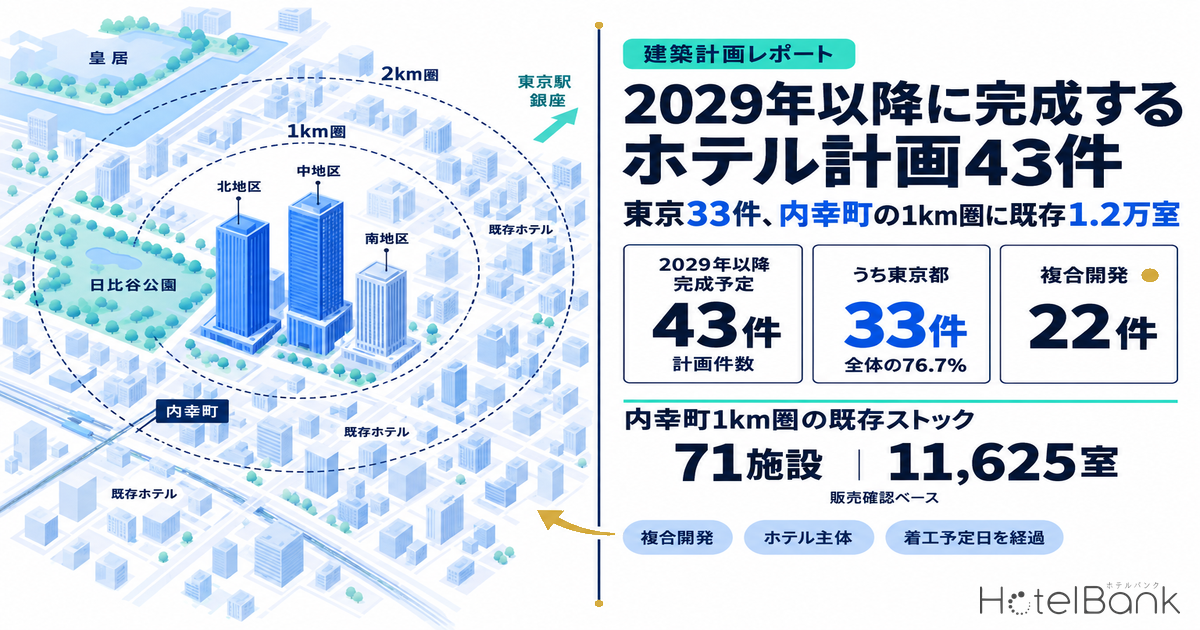
This article covers hotel projects scheduled for completion in 2029 or later. Hotel projects completing in 2027-2028 were covered in an earlier HotelBank article on 26 hotel completions totaling 5,243 rooms; this piece looks only at the period beyond that. Among the building plans tracked by MetroEngines Research, 94 filings list a scheduled completion date of January 1, 2029 or later. Consolidating multiple filings for the same building yields 43 projects. Of these, 33 are in Tokyo, 22 are mixed-use developments combined with offices or residences, and 17 had passed their filed construction start date as of the survey date (September 23, 2026). As a case study, we look at the two supertall towers in the Uchisaiwaicho 1-chome block facing Hibiya Park, and map the 70 existing hotels with 11,595 rooms within 1 km.
Metric Definitions Used in This Article
- Hotel project (building plan): Filed building-plan information whose principal use includes a hotel (lodging facility). Aggregated by MetroEngines Research from public sources such as the Ministry of Land, Infrastructure, Transport and Tourism (MLIT) Building Dynamics Statistics Survey, within the scope it tracks. Based on building-plan filings; not a complete count. It does not indicate opening dates, operators or brands.
- Project count: Where a single building has multiple filings (plan changes, re-filings, etc.), they are consolidated into one project. The “94 filings” in the text is the count before consolidation; “43” is the number of projects after consolidation.
- Scheduled completion: The completion year and month stated in the filing. For projects with multiple filings, the most recent scheduled completion is used. These are planned values that may shift due to construction delays or plan changes.
- Mixed-use / Hotel-led: A mechanical classification. Filings whose principal-use description includes offices, residences, MICE facilities, halls, department stores or similar are “mixed-use”; filings that add only ancillary uses such as retail, restaurants or parking to the hotel are “hotel-led”.
- Construction start date passed: Projects whose filed construction start date is earlier than the survey date. Actual construction progress has not been verified.
- Existing room stock: Total rooms of hotels tracked by MetroEngines Research that show sales for stay dates on or after the survey date (OTA-listing basis). Nationally, around 27,000 properties with confirmed operations are covered.
- Data sources: MetroEngines Research & Consulting; MLIT Building Dynamics Statistics Survey
Source: MetroEngines Research & Consulting; MLIT Building Dynamics Statistics Survey (within the scope tracked by MetroEngines Research; based on building-plan filings, not a complete count)
- — 25 of the 43 projects are scheduled for completion in 2029: from 2030 onward the count thins to around five per year. However, building confirmation applications are often filed one to two years before opening, so the further out the year, the more these counts are a floor that future filings will raise.
- — Tokyo accounts for 33 projects and 86.0% of total floor area: Chuo Ward has 11, Minato Ward 6 and Chiyoda Ward 5. Ginza alone has 7 hotel projects lined up.
- — Mixed-use projects are moving first: 12 of the 17 projects past their construction start date are mixed-use. Of the 21 hotel-led projects, 16 have not yet reached their filed start date.
- — The Uchisaiwaicho 1-chome block has three districts and three hotel projects: the Central district (48 floors above ground, approx. 360,000 m², completion scheduled for end-October 2031), the South district (46 floors, December 2029 per filing) and the North district (the new Imperial Hotel main building, March 2037 per filing).
- — Existing stock within 1 km is 70 hotels and 11,595 rooms: business hotels hold 54.5% of rooms. The same 1 km radius contains 10 hotel projects completing in 2029 or later.
Defining the Window: Only Projects Scheduled for Completion from January 2029
HotelBank has covered hotel supply by time horizon. Hotels opening in 2026 were covered in our city-by-city list of new hotel openings for 2026, and projects completing in 2027-2028 in our analysis of 26 hotel completions with 5,243 rooms. This article looks beyond that, limiting its scope to projects with a scheduled completion date of January 1, 2029 or later. Not a single project scheduled for completion in December 2028 or earlier is included.
Extending the window further out also changes the nature of the data. Many buildings completing in 2029 or later have not yet filed building confirmation applications, or are still at the concept or redevelopment-association stage. The 43 projects here are therefore “a floor: the projects whose filings can be confirmed today”, not the total supply for 2029-2032. On the other hand, the projects named here are mainly large developments whose developer, scale and location are already settled. As a guide to where central Tokyo’s supply map is heading, they carry plenty of information.
Before consolidation by building, there were 94 filings. Re-filings due to plan changes and filings by construction zone attach multiple filings to the same building. This article counts each building once and uses the scheduled completion from the most recent filing. Some projects treated as 2028 completions in earlier coverage slipped to 2029 in later filings and appear here. Shifting completion dates are, in effect, the norm for long-horizon building plans.
The 43 Projects at a Glance: 25 in 2029, Room Counts Filed for Only 5
By scheduled completion year, 2029 has 25 projects, or 58.1% of the total. 2030 and 2031 have five each, 2032 has four, and 2033 or later has four (2033, 2037 x2 and 2041). The concentration in 2029 does not mean demand is skewed toward 2029. Building confirmation applications, filed two to four years before completion, are largely in for projects completing through 2029, while those further out have not yet been filed. The count for 2030 and later is expected to grow with future filings.
Room counts appear in the filings for only 5 of the 43 projects: the Central Tower in the Central district of the Uchisaiwaicho 1-chome block (100 rooms), the rebuild of the former Metro Kaikan and former Central Hotel in Shinjuku 3-chome (158 rooms), a project in Ikegami-cho, Utsunomiya (320 rooms), the Kuramae Ekimae Hotel PJ (66 units), and a project in Gora, Hakone (12 rooms in the West Wing and 46 in the East Wing, 58 in total), for a combined 702 rooms. For large mixed-use developments, hotel room counts and operators are usually not disclosed at the building-plan stage. This article therefore also uses the gross floor area of the whole building (including non-hotel uses) as a gauge of scale. The combined gross floor area of the 43 projects reaches approximately 4.5 million m².
Source: MetroEngines Research & Consulting; MLIT Building Dynamics Statistics Survey (N=43 projects; within the scope tracked by MetroEngines Research; based on building-plan filings, not a complete count; 2030 onward expected to increase with future filings)
Reading the chart, 16 of the 25 projects in 2029 are hotel-led and the remaining 9 are mixed-use. From 2030 onward the mix flips: 13 of 18 projects are mixed-use. The longer a project takes to complete, the more likely it is a large redevelopment stacking multiple uses. Standalone hotel buildings have short construction periods and a short gap between confirmation application and completion, so standalone projects for 2030 and later have yet to show up in the data.
Distribution by Prefecture: 33 Projects in Tokyo, 86.0% of Floor Area
The 43 projects are located in just six prefectures. Tokyo stands out with 33 (76.7%), followed by Kanagawa with 4, Tochigi 2, Osaka 2, Hyogo 1 and Chiba 1. By gross floor area, Tokyo has approximately 3.87 million m², or 86.0% of the total, followed by Kanagawa at approximately 420,000 m².
Source: MetroEngines Research & Consulting; MLIT Building Dynamics Statistics Survey (N=43 projects, scheduled for completion from January 2029)
Breaking Tokyo’s 33 projects down by ward, Chuo Ward leads with 11, followed by Minato 6, Chiyoda 5, Taito 4, Shibuya 3, Shinjuku 3 and Nakano 1. Seven of Chuo Ward’s 11 are in Ginza. The Ginza projects are mainly mid-size, hotel-led buildings of 3,000-20,000 m² and 7-14 floors above ground, with a clear trend of adding hotels when office buildings are rebuilt. Taito Ward’s four projects (Kuramae, Asakusa, Moto-Asakusa and Yanagibashi) are likewise mid-size and hotel-led.
In Minato, Chiyoda and Shibuya wards, by contrast, mixed-use developments of 30 or more floors dominate. At Shinagawa Station West Exit, Shibaura 1-chome, the Roppongi-Toranomon district, Shibuya 2-chome West and the Uchisaiwaicho 1-chome block, hotel floors are planned on upper or lower levels in combination with offices and residences. In short, Tokyo’s supply from 2029 onward splits into two streams: “mid-size hotel-led buildings in Ginza and Taito” and “supertall mixed-use towers in Minato, Chiyoda and Shibuya”.
Outside Tokyo, the projects in Yokohama (Minato Mirai 21 Central District Blocks 60 and 61, and the Yokohama Station South East Exit district), Osaka (Namba Sennichimae and Cosmosquare Ekimae) and Kobe (the new JR Sannomiya station building) are all mixed-use developments at station fronts or waterfronts. Among regional cities, Utsunomiya has two: one a standalone 320-room hotel project, the other a redevelopment project that incorporates a business hotel into its commercial building.
Principal Use and Construction Stage: 12 of 22 Mixed-Use Projects Already Past Their Start Date
By principal use, the split is nearly even: 22 mixed-use projects (51.2%) and 21 hotel-led projects (48.8%). Their scale, however, is entirely different. Among mixed-use projects, 12 have 30 or more floors and 15 exceed 100,000 m² of gross floor area. Hotel-led projects mostly have 4-16 floors, with gross floor area of roughly 1,500-20,000 m² (excluding the new Imperial Hotel main building).
Looking at filed construction start dates, 17 projects (39.5%) had passed theirs as of the survey date: 12 mixed-use and 5 hotel-led. Conversely, 16 of the 26 projects that have not yet reached their start date are hotel-led. Mixed-use projects break ground early after going through land readjustment or urban redevelopment procedures and take four to six years to complete. Many hotel-led buildings are slated to start around 2027 and aim for completion in 2029 after roughly two years of construction.
Source: MetroEngines Research & Consulting (N=43 projects)
Source: MetroEngines Research & Consulting (N=43 projects, as of September 23, 2026)
For typical construction periods, see our analysis of hotel build times across 67 planned projects (2.80 years from start to completion). It measured construction periods of 1.96 years for standalone hotels and 4.00 years for mixed-use developments. In this article’s sample, too, the gap between scheduled start and scheduled completion is longer for mixed-use projects.
Note that “construction start date passed” is a classification based on what the filing states; it does not confirm that work has begun on site. For example, the Nakano Station New North Exit project was filed with an April 2024 start and March 2029 completion, but Nakano Ward revised the plan in response to rising project costs and announced a new redevelopment framework in August 2026. The ward has indicated it will re-tender for a private developer, targeting completion in FY2034. The longer the horizon, the more a filed completion date can change. Every year in this article should be read on that basis.
Case Study: Uchisaiwaicho 1-chome Block, Two Filings for 360,000 m²-Class Towers of 46-48 Floors
Among projects completing in 2029 or later, the one that is emblematic in both scale and location is the Uchisaiwaicho 1-chome block (Chiyoda Ward, Tokyo), facing Hibiya Park. The block consists of three districts (North, Central and South) and is being developed as a whole by private developers under the “TOKYO CROSS PARK” concept. Each of the three districts plans a building that includes hotel use.
For the Central Tower in the Central district, the focus of this article, MetroEngines Research tracks two filings. The earlier filing, by NTT Urban Development and others, described 46 floors above ground, approximately 361,000 m² of gross floor area and scheduled completion in February 2029. The most recent filing, by NTT Urban Development and TEPCO Power Grid, describes 48 floors, approximately 361,000 m² and completion at the end of October 2031. On December 8, 2025, NTT Urban Development and TEPCO Power Grid announced that construction of the “NTT Hibiya Tower” had started on December 1, 2025: 48 floors above ground and 6 below, approximately 230 m tall, approximately 360,000 m² of gross floor area, with completion scheduled for the end of October 2031. Filings for the same building have continued, updating the floor count and scheduled completion. In our count, this building is counted once (scheduled completion October 2031), based on the latest filing.
In the South district of the same block, Dai-ichi Life Insurance, Chuo-Nittochi, Tokyo Century, TEPCO Power Grid and others broke ground in April 2025 on the South Tower, with 46 floors above ground and approximately 290,000 m² of gross floor area. Centered on offices, it combines a hotel, retail and wellness-promotion facilities. The developers have announced completion scheduled for March 2029; the scheduled completion in the filing we track is December 2029. In the North district, a new main building for the Imperial Hotel Tokyo (29 floors above ground, approximately 150,000 m²) is planned, with filed completion in March 2037. The Imperial Hotel has announced that its Tokyo property will be rebuilt between FY2024 and FY2036 (planned).
| District / building | Main developers (per filing) | Floors above ground | Gross floor area | Principal use | Scheduled completion |
|---|---|---|---|---|---|
| Central district, Central Tower (earlier filing) | NTT Urban Development and others | 46 | approx. 361,000 m² | Office, retail, hotel, other | Feb 2029 |
| Central district, Central Tower (latest filing) | NTT Urban Development, TEPCO Power Grid | 48 | approx. 361,000 m² | Office, retail, hotel | Oct 2031 |
| South district, Building A (South Tower) | South district redevelopment, individual implementers | 45 | approx. 287,000 m² | Office, hotel, wellness, retail | Dec 2029 |
| North district (new Imperial Hotel main building) | Imperial Hotel, Mitsui Fudosan | 29 | approx. 150,000 m² | Hotel, banquet halls, etc. | Mar 2037 |
Source: MetroEngines Research & Consulting; MLIT Building Dynamics Statistics Survey. Floors, gross floor area and scheduled completion are as filed and may differ from developer announcements (e.g. South Tower: 46 floors, completion scheduled for March 2029)
For the South district, the hotel’s room count and operating brand are not stated at the filing stage. For the Central district, the filing states 100 rooms, and media reports say a small luxury hotel (around 100 rooms) by the Imperial Hotel and NTT Urban Development is to open on floors 44-48. In mixed-use buildings of 300,000 m²-class, the hotel occupies only part of the floor space. The size of the gross floor area therefore cannot be read directly as a large number of hotel rooms.
Existing Room Stock Around Uchisaiwaicho: 70 Hotels and 11,595 Rooms Within 1 km
How many rooms already exist around the site? Centered on the Central Tower site, we counted by radius the hotels whose sales MetroEngines Research can confirm. Within 500 m there are 14 hotels with 2,780 rooms; within 1 km, 70 hotels with 11,595 rooms; within 1.5 km, 139 hotels with 21,662 rooms; and within 2 km, 236 hotels with 35,504 rooms. The 1 km radius covers most of Hibiya, Yurakucho, Ginza, Shimbashi and part of Toranomon, one of the densest concentrations of hotel rooms in Japan.
Source: MetroEngines Research & Consulting (by radius from the Central district site of the Uchisaiwaicho 1-chome block; hotels with confirmed sales for stay dates on or after the survey date; 2 km radius N=236 hotels)
By type, business hotels account for 40 of the 70 hotels and 6,320 rooms within 1 km, or 54.5% of rooms. Deluxe hotels number 10 with 2,468 rooms (21.3%), city hotels 10 with 2,013 rooms (17.4%) and capsule hotels 3 with 428 rooms. Business hotels are the majority by count, but within 500 m, four deluxe hotels hold 1,173 rooms, or 42.2% of rooms. The closer to prime Hibiya Park frontage, the more large luxury and city hotels line the streets.
| Type | Hotels | Rooms | Share of rooms |
|---|---|---|---|
| Business hotel | 40 | 6,320 | 54.5% |
| Deluxe hotel | 10 | 2,468 | 21.3% |
| City hotel | 10 | 2,013 | 17.4% |
| Capsule hotel | 3 | 428 | 3.7% |
| Other (hostels, resort category, etc.) | 7 | 366 | 3.2% |
| Total | 70 | 11,595 | 100.0% |
Source: MetroEngines Research & Consulting (1 km radius, N=70 hotels; hotel types per our classification)
This 1 km radius contains 10 hotel projects scheduled for completion in 2029 or later: the three districts of the Uchisaiwaicho 1-chome block plus seven in Ginza (the G7 Project, Ginza 3-chome Development Project, Kyoto Shimbun Ginza 8-chome Project, Ginza 8-chome Hotel Development Project, Kobiki Building Hotel Project, Ginza 2-chome Project and Ginza Boeki Building Rebuild Project). Expanding to 2 km adds the Kyobashi 3-chome East district, the Tsukiji district development, Roppongi-Toranomon district Block D, Nihonbashi 3-chome and the W350 Project in Marunouchi, for 15 in total. In the map below, blue circles are existing hotels (circle size = rooms) and navy diamonds are project sites completing in 2029 or later.
Source: MetroEngines Research & Consulting; MLIT Building Dynamics Statistics Survey (project sites are approximate locations based on filing information; dashed lines are 1 km and 2 km radii)
Site Conditions: Hibiya Commercial Land at ¥22 Million per m², 900% FAR
The entire area around the Uchisaiwaicho 1-chome block is designated a commercial zone and fire-prevention district. The official land price point “Chiyoda 5-25” (Yurakucho 1-chome, 100 m from Hibiya Station), about 200 m from the site, has a floor area ratio of 900% and building coverage ratio of 80%; its official land price as of January 1, 2026 was ¥22 million per m², up 1.4% year on year. “Chiyoda 5-46” (Uchisaiwaicho 1-chome), adjacent to the site, was ¥15.4 million per m², up 2.7%. Moving toward Ginza, increases are even larger: points in Ginza 5-, 6- and 7-chome rose 10-14% year on year.
Source: Compiled by MetroEngines Research & Consulting from MLIT Real Estate Information Library (official land price “Chiyoda 5-25”, Yurakucho 1-chome)
On land costing more than ¥20 million per m², it is difficult for a standalone hotel building to recover the land cost. New hotel floor space in this area therefore takes the form of hotels embedded in supertall mixed-use towers together with offices and retail. The Central and South districts of Uchisaiwaicho planning hotels as part of mixed-use buildings is a textbook example. The relationship between floor-area-ratio bonuses and hotel floor space is also covered in an earlier HotelBank article showing how a FAR bonus can turn 100 rooms into 151-168.
Projects Without an Operator Are an Opening for Attraction and Entry
Most projects completing in 2029 or later have not announced an operator. Among the 22 mixed-use developments, even when the filed principal use says “hotel”, the room count, grade and brand are usually left blank. Thirteen projects are scheduled for completion in 2031 or later, and for many of them the work of defining hotel-floor specifications and concepts is expected to get fully under way from here. Who commissions the hotel floors in mixed-use projects, and when the operator is chosen, is analyzed in detail in an earlier HotelBank article finding that 73% of owners across 70 hotel projects are non-hotel companies.
For hotel operators and brands, this means ample room to enter. Five to six years before completion, specifications such as room size, the mix of food and beverage and banqueting, and links with wellness or MICE can still be designed in, reflecting the operator’s know-how. For developers too, selecting an operator early and reflecting it in the business plan is an effective way to firm up the revenue outlook for the hotel floors. Just as the Uchisaiwaicho South Tower pairs wellness-promotion facilities with a hotel and the Tsukiji district pairs a MICE facility with a hotel, there is wide latitude in designs that combine hotels with surrounding uses.
The opportunity is also visible from the existing stock side. Within 1 km of Uchisaiwaicho, business hotels hold more than half the rooms, while large luxury and city hotels cluster along Hibiya Park. Which price band and guest segment will a hotel on the upper floors of a mixed-use tower serve? Being able to set its positioning by sharing roles with nearby existing hotels is an upside unique to the stage before an operator is chosen.
List of Hotel Projects Scheduled for Completion in 2029 or Later (43 Projects)
The list below consolidates, by building, the hotel projects with a scheduled completion date of January 1, 2029 or later, within the scope tracked by MetroEngines Research. They are sorted by earliest scheduled completion. Scheduled completion and floor counts are as filed and do not represent confirmed opening dates. “(tentative)” indicates a provisional project name.
| Scheduled completion | Project name (per filing) | Location | Floors above ground | Principal use | Construction start date |
|---|---|---|---|---|---|
| Jan 2029 | (tentative) Kuramae Ekimae Hotel PJ | Kuramae, Taito Ward, Tokyo | 12 | Hotel-led | Not yet reached |
| Jan 2029 | Shinagawa Station West Exit District A | Takanawa, Minato Ward, Tokyo | 28 | Mixed-use | Passed |
| Jan 2029 | (tentative) Urayasu Akemi 5-chome Project | Akemi, Urayasu, Chiba | 6 | Hotel-led | Not yet reached |
| Feb 2029 | (tentative) Nihonbashi Koamicho Hotel Project | Nihonbashi Koamicho, Chuo Ward, Tokyo | 13 | Hotel-led | Not yet reached |
| Feb 2029 | Minato Mirai 21 Central District Blocks 60 and 61 Development | Minatomirai, Nishi Ward, Yokohama | 27 | Mixed-use | Passed |
| Feb 2029 | (tentative) Asakusa 2-chome (Dembo-in Street) | Asakusa, Taito Ward, Tokyo | 8 | Hotel-led | Not yet reached |
| Feb 2029 | (tentative) Okura Resort Hakone Gora | Gora, Hakone, Kanagawa | 4 | Hotel-led | Passed |
| Mar 2029 | Hotel project in Ikegami-cho, Utsunomiya (320 rooms) | Ikegami-cho, Utsunomiya, Tochigi | 14 | Hotel-led | Passed |
| Mar 2029 | Nakano Station New North Exit Area Core Facility Development * | Nakano, Nakano Ward, Tokyo | 60 | Mixed-use | Passed |
| Mar 2029 | (tentative) Shibuya Ward Yoyogi 1-chome Project | Yoyogi, Shibuya Ward, Tokyo | 14 | Hotel-led | Passed |
| Mar 2029 | (tentative) Yanagibashi 1-chome Project | Yanagibashi, Taito Ward, Tokyo | 15 | Hotel-led | Not yet reached |
| Apr 2029 | (tentative) Kobiki Building Hotel Project | Ginza, Chuo Ward, Tokyo | 12 | Hotel-led | Passed |
| Apr 2029 | (tentative) Kyoto Shimbun Ginza 8-chome Project | Ginza, Chuo Ward, Tokyo | 14 | Mixed-use | Not yet reached |
| May 2029 | Rebuild of former Metro Kaikan and former Central Hotel (158 rooms) | Shinjuku, Shinjuku Ward, Tokyo | 16 | Hotel-led | Not yet reached |
| Jul 2029 | (tentative) Ginza 2-chome Project | Ginza, Chuo Ward, Tokyo | 7 | Hotel-led | Passed |
| Jul 2029 | Shibuya Upper West Project | Dogenzaka, Shibuya Ward, Tokyo | 34 | Mixed-use | Passed |
| Aug 2029 | (tentative) G7 Project | Ginza, Chuo Ward, Tokyo | 13 | Hotel-led | Not yet reached |
| Aug 2029 | (tentative) Taito Ward Moto-Asakusa 2-chome Project | Moto-Asakusa, Taito Ward, Tokyo | 13 | Hotel-led | Not yet reached |
| Sep 2029 | (tentative) Shinjuku 318 Development Project | Shinjuku, Shinjuku Ward, Tokyo | 12 | Hotel-led | Not yet reached |
| Oct 2029 | (tentative) Ginza 3-chome Development Project | Ginza, Chuo Ward, Tokyo | 14 | Hotel-led | Not yet reached |
| Oct 2029 | New JR Sannomiya Station Building | Kumoidori, Chuo Ward, Kobe | 30 | Mixed-use | Passed |
| Oct 2029 | (tentative) Ginza Boeki Building Rebuild Project | Ginza, Chuo Ward, Tokyo | 14 | Hotel-led | Not yet reached |
| Dec 2029 | Uchisaiwaicho 1-chome Block South District, Building A (South Tower) | Uchisaiwaicho, Chiyoda Ward, Tokyo | 45 | Mixed-use | Passed |
| Dec 2029 | Shibuya 2-chome West District Type 1 Urban Redevelopment (Block B) | Shibuya, Shibuya Ward, Tokyo | 41 | Mixed-use | Passed |
| Dec 2029 | Fujisawa Station South Exit Urban Redevelopment | Minamifujisawa, Fujisawa, Kanagawa | 17 | Mixed-use | Not yet reached |
| Mar 2030 | (tentative) Shinjuku 4-chome PJ | Shinjuku, Shinjuku Ward, Tokyo | 13 | Mixed-use | Not yet reached |
| Mar 2030 | (tentative) Cosmosquare Ekimae Project | Nankohoku, Suminoe Ward, Osaka | 18 | Mixed-use | Passed |
| Mar 2030 | Kita-Aoyama 3-chome District Block B-1 | Kita-Aoyama, Minato Ward, Tokyo | 38 | Mixed-use | Passed |
| Mar 2030 | (tentative) Chuo Ward Ginza 8-chome Hotel Development Project | Ginza, Chuo Ward, Tokyo | 14 | Hotel-led | Not yet reached |
| Apr 2030 | (tentative) Akihabara Mansei-bashi Hotel Project | Kanda Sudacho, Chiyoda Ward, Tokyo | 13 | Hotel-led | Not yet reached |
| Mar 2031 | (tentative) Namba Sennichimae Redevelopment Project | Namba Sennichimae, Chuo Ward, Osaka | 28 | Mixed-use | Not yet reached |
| Mar 2031 | (tentative) Shibaura 1-chome Project | Shibaura, Minato Ward, Tokyo | 47 | Mixed-use | Passed |
| Mar 2031 | (tentative) Nihonbashi 3-chome Project | Nihonbashi, Chuo Ward, Tokyo | 14 | Hotel-led | Not yet reached |
| Mar 2031 | Roppongi-Toranomon District Block D | Roppongi, Minato Ward, Tokyo | 53 | Mixed-use | Passed |
| Oct 2031 | Uchisaiwaicho 1-chome Block Central District, Central Tower | Uchisaiwaicho, Chiyoda Ward, Tokyo | 48 | Mixed-use | Passed |
| Apr 2032 | Kyobashi 3-chome East District Type 1 Urban Redevelopment | Kyobashi, Chuo Ward, Tokyo | 35 | Mixed-use | Not yet reached |
| Apr 2032 | Shinagawa Station West Exit District B-1-2 | Takanawa, Minato Ward, Tokyo | — | Mixed-use | Not yet reached |
| May 2032 | (tentative) Kita-Aoyama 3-chome Joint Building Development | Kita-Aoyama, Minato Ward, Tokyo | 14 | Hotel-led | Not yet reached |
| Dec 2032 | Tsukiji District Development (MICE/hotel/residence building, hotel building) | Tsukiji, Chuo Ward, Tokyo | — | Mixed-use | Not yet reached |
| Mar 2033 | Utsunomiya Bamba District Urban Redevelopment (commercial building) | Babadori, Utsunomiya, Tochigi | 12 | Mixed-use | Not yet reached |
| Mar 2037 | Uchisaiwaicho 1-chome Block North District (new Imperial Hotel main building) | Uchisaiwaicho, Chiyoda Ward, Tokyo | 29 | Hotel-led | Not yet reached |
| Apr 2037 | Yokohama Station South East Exit District Urban Redevelopment | Takashima, Nishi Ward, Yokohama | 45 | Mixed-use | Not yet reached |
| Jan 2041 | (tentative) W350 Project | Marunouchi, Chiyoda Ward, Tokyo | 70 | Mixed-use | Not yet reached |
Source: MetroEngines Research & Consulting; MLIT Building Dynamics Statistics Survey (N=43 projects, 94 filings; within the scope tracked by MetroEngines Research; based on building-plan filings, not a complete count). “Passed” means the filed construction start date had passed as of September 23, 2026. *For the Nakano Station New North Exit project, Nakano Ward announced a new redevelopment framework in August 2026, and timing is expected to change from the filed schedule
Frequently Asked Questions
Q. How many hotel projects will be completed in 2029 or later?
Within the scope tracked by MetroEngines Research, 43 (94 filings consolidated by building). This is based on building-plan filings and is not a complete count. The number for 2030 and later is expected to grow with future building confirmation applications.
Q. Where are they concentrated?
Tokyo has 33 (76.7%) and accounts for 86.0% of gross floor area. Within Tokyo, Chuo Ward leads with 11 (7 of them in Ginza), followed by Minato Ward with 6 and Chiyoda Ward with 5.
Q. When will the hotels in the Uchisaiwaicho 1-chome block be completed?
The Central Tower in the Central district (NTT Hibiya Tower) has been announced for completion at the end of October 2031. The South Tower in the South district is scheduled for completion in March 2029 per the developers’ announcement, and the new Imperial Hotel main building in the North district is scheduled for March 2037 per its filing. All are planned dates and may change.
Summary
Within the scope tracked by MetroEngines Research, there are 43 hotel projects scheduled for completion in 2029 or later. Thirty-three of them are in Tokyo, splitting into two streams: mid-size hotel-led buildings in Ginza and Taito, and supertall mixed-use towers in Minato, Chiyoda and Shibuya. Many mixed-use projects are already past their construction start date, while many hotel-led projects have starts coming up around 2027.
In the case-study Uchisaiwaicho 1-chome block, three buildings in the Central, South and North districts each plan a hotel, adding new floor space to the existing 70 hotels and 11,595 rooms within 1 km. The scheduled completion of the 360,000 m²-class Central Tower moved to the end of October 2031 as its filings were updated. Long-horizon projects shift in both timing and specification. That is precisely why the stage before the operator and the content of the hotel floors are decided is also an opportunity for operators and brands to be brought in and to enter.
Related Articles
- Hotel Build Times: 2.80-Year Median, 1.96 Solo vs 4.00 Mixed-Use
- Tokyo 23 Wards Supply Pressure 2026: Arakawa 16.0%, Minato Just 4.5%
References and Sources
■ Data sources
Building-plan filing information tracked by MetroEngines Research & Consulting (aggregated from public sources such as the MLIT Building Dynamics Statistics Survey). 94 filings with a scheduled completion date of January 1, 2029 or later were consolidated into 43 projects by building (as of September 23, 2026). Existing room stock covers hotels we track that show sales for stay dates on or after the survey date (OTA-listing basis; 2 km radius centered on the Central district of the Uchisaiwaicho 1-chome block, N=236 hotels). Land prices are official land prices (2024-2026) from the MLIT Real Estate Information Library.
■ Assumptions
This article does not estimate revenue or yields; it is limited to counts, floor areas and room numbers. Where a building has multiple filings it is counted once, using the scheduled completion from the most recent filing. “Mixed-use / hotel-led” is a mechanical classification based on the filed principal-use description; “construction start date passed” indicates whether the filed start date had passed as of September 23, 2026. Scale is gauged by the gross floor area of the whole building (including non-hotel uses), and radii are straight-line distances from the approximate project site.
■ Limitations
Based on building-plan filings, not a complete count. Because building confirmation applications are often filed one to two years before opening, counts for 2030 and later are a current floor. Scheduled completions may shift with construction delays or plan changes (Nakano Ward is reviewing the Nakano Station New North Exit plan). Room counts and operators are absent from most filings, so a large gross floor area cannot be read as a large number of hotel rooms. Existing stock excludes hotels not listed on OTAs.
■ Market data
- MetroEngines Research & Consulting — Aggregation of hotel building plans (scheduled for completion from January 2029, N=43 projects, 94 filings); existing room stock around the Uchisaiwaicho 1-chome block (2 km radius, N=236 hotels)
■ Government statistics and public data
- MLIT, Building Starts Statistics and Building Dynamics Statistics Survey
- MLIT Real Estate Information Library — official land prices (Chiyoda 5-25, Chiyoda 5-46 and others, 2024-2026)
- Nakano Ward, “Redevelopment of the Nakano Station New North Exit Area (Ward Office and Sun Plaza District)” (Japanese)
■ Corporate releases and materials
- Dai-ichi Life Insurance and others, “Start of Construction of the South Tower, Uchisaiwaicho 1-chome Block South District” (April 3, 2025, Japanese)
- Imperial Hotel, “Business Continuity Plan During the Rebuilding of the Tokyo Property” (March 25, 2022, Japanese)
- Hyatt Hotels Japan, press materials, April 2026 (used to cross-check room counts of existing Hyatt-affiliated hotels on the map)
- Hilton, company overview (updated August 25, 2026) (used to cross-check room counts of existing Hilton-affiliated hotels on the map)
■ News
- Construction starts on “NTT Hibiya Tower” facing Hibiya Park, part of the Uchisaiwaicho redevelopment including the Imperial Hotel (Impress Watch, December 8, 2025, Japanese)
- Construction starts on Uchisaiwaicho “South Tower” next to Hibiya Park, 46 floors and 230 m (Impress Watch, April 3, 2025, Japanese)
- Redevelopment of the former Nakano Sun Plaza site to be reviewed (Kenbiya, Japanese)