

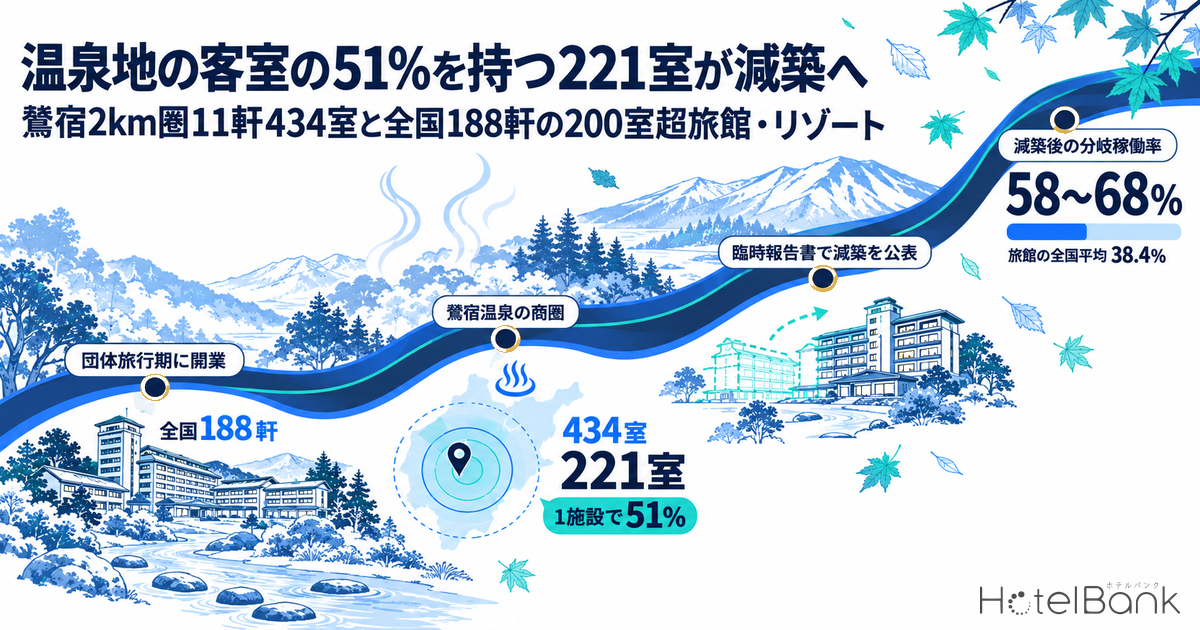
In an extraordinary report filed on August 6, 2026, Nihon House Holdings (日本ハウスホールディングス) announced that it will demolish part of the building of Hotel Morinokaze Oshuku (ホテル森の風鶯宿), which it operates at Oshuku Onsen in Shizukuishi Town, Iwate Prefecture, to reduce its size. The stated purpose is “improving the profitability of the hotel business and the efficiency of facility operations,” and the company expects to book a loss on retirement of fixed assets of approximately ¥800 million in the fiscal year ending April 2027. The disclosure does not state the scope of the reduction, the room count after the work, or the construction schedule.
The hotel has 221 rooms, and by itself accounts for 51% of the 11 properties and 434 rooms that MetroEngines Research could confirm on sale within a 2km radius. A decision to cut floor area at a building that holds half of an onsen town’s rooms gives owners and lenders of large ryokan and resort hotels built in the group-travel era a concrete example of an option that is neither rebuilding nor closing. This article looks in turn at where building reduction (genchiku) sits in the regulatory framework, the distribution and opening decades of Japan’s 188 ryokan and resort hotels with 200 or more rooms, ADR by room-count band, and the break-even occupancy when a 221-room property is cut by 20% or 40%.
Metric Definitions Used in This Article
- ADR (average daily rate): An estimated settled rate (tax-exclusive equivalent) calculated by applying a segment-specific adjustment factor to the lowest-plan price level each property publishes on OTAs and similar channels (two guests per room, price per room, tax included). When checked against property-level results disclosed by listed hotel REITs (91 properties, most recent three months), the median error is about 7%. These are estimates and differ from each property’s actual settled prices and accounting figures. Area-level ADR is the median of the properties covered (the level of a typical property in the area).
- OCC (occupancy rate): The ratio of rooms sold to total rooms in the area (an estimate based on OTA sales inventory). The occupancy by room-count band in this article (OTA-listed inventory basis, estimated) is an estimate based on how inventory sold through OTAs and similar channels is absorbed, and differs from the actual occupancy of the whole property. Occupancy for individual properties is not calculated.
- Room stock within 2km of Oshuku: The room count of properties within a 2km radius of 39.638°N, 140.934°E for which sales prices could be confirmed on major booking sites for stay dates in July–October 2026. Room counts come from each company’s published materials or, where these could not be confirmed, from MetroEngines Research’s property information.
- Nationwide coverage: 9,050 properties and 306,255 rooms classified as ryokan or resort hotels for which sales prices could be confirmed for stay dates in July–September 2026 (major booking-site listing basis). Properties not listed on booking sites are not included.
- Building reduction (genchiku): The common term for work that removes part of a building to reduce its floor area or number of storeys. Unlike a renovation that enlarges guest rooms (reducing the room count), the building itself becomes smaller.
- Data source: MetroEngines Research & Consulting
- — A 221-room hotel is to be downsized: In an extraordinary report filed on August 6, 2026, Nihon House Holdings disclosed a partial reduction of the Hotel Morinokaze Oshuku building. It expects to book a loss on retirement of fixed assets of approximately ¥800 million in the fiscal year ending April 2027; the scope, the post-reduction room count and the schedule are not stated
- — One property holds 51% of the onsen town: Of the 11 properties and 434 rooms confirmed on sale within 2km of Oshuku, one property holds 221 rooms, more than the 213 rooms of the other 10 combined. A 20% cut would leave 390 rooms in the area; a 40% cut, 346 rooms
- — 188 properties and 62,986 rooms nationwide have 200+ rooms: 2.1% of the 9,050 ryokan and resort hotels hold 20.6% of the rooms, and 96 of them (51%) opened between the 1970s and the 1990s. There are also 42 properties with 13,294 rooms that opened in 1981 or earlier
- — The rate gap by size is small: Median ADR for September 2025–August 2026 ranges from about ¥15,000 to ¥18,000 across room-count bands, a difference of ¥2,800. The gaps appear at the upper end of the distribution and in GOP per m² of total floor area (¥10,900 for large properties, ¥19,100 for small ones)
- — Break-even occupancy is 58–68% for a 20% reduction and 42–56% for 40%: An estimate for a 221-room model. Demolition at ¥90,000/m² costs ¥198 million to ¥1,045 million, and payback from lower holding costs alone takes 9–18 years. Whether the rate of the remaining rooms can be raised by a few percent determines the outcome
What Was Disclosed — Removing Part of the Building to “Improve Profitability and Operating Efficiency”
We start with the primary source. An extraordinary report is a statutory disclosure under the Financial Instruments and Exchange Act, and this one reported two matters at once: a “transfer of fixed assets” and a “retirement of fixed assets.” The Oshuku item falls under the latter, and the board resolution is dated July 30, 2026.
| Item | Disclosed content |
|---|---|
| Document filed | Extraordinary report (filed August 6, 2026, addressed to the Director-General of the Kanto Local Finance Bureau) |
| Resolution date | July 30, 2026 (Board of Directors) |
| Subject | Part of the fixed assets relating to Hotel Morinokaze Oshuku (Shizukuishi Town, Iwate District, Iwate Prefecture) |
| Content | Reduction (genchiku) of part of the hotel building |
| Purpose | Improving the profitability of the hotel business and the efficiency of facility operations |
| Impact on results | Loss on retirement of fixed assets of approx. ¥800 million to be booked in the consolidated and non-consolidated accounts for the fiscal year ending April 2027 |
| Not stated in the disclosure | Scope of the reduction, room count after the reduction, construction schedule, construction cost |
Source: Compiled by MetroEngines Research & Consulting from Nihon House Holdings Co., Ltd., “Extraordinary Report” (filed August 6, 2026)
The same report also set out plans to convert four properties in Nasu and Hakone into trust beneficiary interests and transfer them, booking a gain on sale of fixed assets of approximately ¥4,500 million. Handover is scheduled for October 1, 2026, and the company explains that the proceeds will go to growth investment in its housing business, capital expenditure on the hotels it continues to hold, and repayment of borrowings. In other words, the Oshuku reduction can be read as part of a “hotel portfolio optimization” that redirects management resources to the hotels the company will keep.
The ¥800 million figure needs to be read with care, however. A loss on retirement of fixed assets is the amount that arises from the accounting treatment of writing assets off the books; it is not the demolition cost itself. No breakdown has been disclosed, and this article does not attempt to back out the scale of the reduction from it. What follows takes the hotel’s 221-room scale as a starting point and sets out the structure that applies to properties of that size in general.
11 Properties and 434 Rooms Within 2km of Oshuku — One Property Exceeds the Other 10 Combined
Oshuku Onsen is an onsen town in the southern part of Shizukuishi Town, immediately west of Morioka City. MetroEngines Research confirmed 11 properties and 434 rooms on sale within a 2km radius for stay dates in July–October 2026. Of these, 221 rooms are concentrated in a single property, more than the 213 rooms of the other 10 combined. The second-largest property has 57 rooms and the third-largest 37; no other building exceeds 100 rooms.
Source: MetroEngines Research & Consulting (N=11 properties, 434 rooms; major booking-site listing basis; as of October 2, 2026). Circle size shows room count; the dashed line is the 2km radius
Source: MetroEngines Research & Consulting (N=11 properties, 434 rooms). Room counts are from each company’s published materials and MetroEngines Research’s property information
| Property | Type | Rooms | Share of area | Developments in 2026 |
|---|---|---|---|---|
| Hotel Morinokaze Oshuku (ホテル森の風 鶯宿) | Resort hotel | 221 | 50.9% | Partial building reduction (disclosed in August) |
| Gensen Ichizu Iwate Shizukuishi (源泉一途 岩手雫石) | Ryokan | 57 | 13.1% | Reopened after renovation on July 1 |
| Take-akari no Yado Kagasuke (竹あかりの宿 加賀助) | Ryokan | 37 | 8.5% | — |
| Oshuku Onsen Yutorelo Shizukuishi (鶯宿温泉 ゆとりろ雫石) | Ryokan | 35 | 8.1% | Rebranded opening in October |
| Hotel Remnant Oshuku (ホテルレムナント鶯宿) | Ryokan | 17 | 3.9% | — |
| Hotel Uguisu (ホテル鶯) | Ryokan | 16 | 3.7% | — |
| Kawacho (川長) / Seikoso (清光荘) | Ryokan | 12 each | 2.8% each | — |
| Onsen Minshuku Eiya (温泉民宿 栄弥) / Koeda Ryokan (小枝旅館) / Onsen Minshuku Akebono-so (温泉民宿 あけぼの荘) | Minshuku / ryokan | 10 / 9 / 8 | 6.2% in total | — |
| Total | 11 properties | 434 | 100% |
Source: MetroEngines Research & Consulting (N=11 properties, 434 rooms); company press releases. In addition, the property information shows 7 small ryokan with 50 rooms that could not be confirmed on sale on booking sites; including them gives 18 properties and 484 rooms (221 rooms would be 46%)
What stands out here is how much has happened since the start of 2026. In July, Gensen Ichizu Iwate Shizukuishi (源泉一途 岩手雫石), a 57-room ryokan that puts its undiluted, unheated source spring at the forefront, reopened after renovation. In October, Oshuku Onsen no Yado Akai Fusha (鶯宿温泉の宿 赤い風車) reopened under a new brand as the 35-room Oshuku Onsen Yutorelo Shizukuishi (鶯宿温泉 ゆとりろ雫石), with dog-friendly guest rooms. These two properties alone represent 21% of the rooms in the area. With the reduction at the largest property coming on top, a little over 70% of the onsen town’s rooms will have been the subject of some form of reinvestment within a single year.
At the same time, in an onsen town where one property holds half the rooms, how that property sets its scale directly sets the capacity of the whole town. If the 221 rooms were cut by 20%, rooms in the area would go from 434 to 390; a 40% cut would take them to 346. Right-sizing is an individual company’s investment decision, and it is also a decision that reshapes the supply-demand balance of the onsen town.
Shizukuishi’s 12-Month Average ADR Is About ¥10,000 — 56% of Large Properties Nationwide, With Room for Rates to Rise
Next, the rate level of the town as a whole. Besides Oshuku, Shizukuishi Town includes properties around the ski resorts and in the Koiwai direction. The town-wide estimated settled ADR (all property types, median of properties) averaged ¥10,000 over the 12 months from September 2025 to August 2026, almost flat at −1.8% against ¥10,100 in the same period a year earlier. By month, August 2026 was ¥10,800 (N=13), down 21.4% from ¥13,700 in the same month a year earlier, and June, the low point of the year, was ¥8,000 (N=12, −16.9% YoY).
Source: MetroEngines Research & Consulting (Shizukuishi Town, all property types, N=11–14 properties). September–December 2026 are estimates based on listed price levels at the time of the survey
With only around 13 properties covered, however, the monthly median can easily shift with the movement of a single property. In fact, taking ryokan alone, August 2026 was ¥10,700 (N=10), up 26.4% from ¥8,500 in the same month a year earlier — the opposite direction. Rather than single-month swings, the point to note is the level itself: over the past two years it has stayed within a range of ¥8,000 to the ¥13,000s. The ryokan and resort hotels with 200 or more rooms nationwide, discussed below, have a 12-month average median of ¥17,700, and Shizukuishi Town is at 56% of that. Put the other way, this can be read as a market where rates still have room to rise.
What Is Building Reduction? — No Statutory Definition, and the Procedure Depends on “What You Keep”
How, then, is building reduction treated under the rules? The Building Standards Act contains no definition of the term genchiku. What the Act requires building confirmation for is construction (new construction, extension, reconstruction or relocation), major repairs and major remodeling, and certain changes of use. Work that simply demolishes part of a building to reduce floor area does not fall directly under any of these.
| Category | Content | Treatment for building confirmation, etc. (general) |
|---|---|---|
| Extension | Increasing the floor area of an existing building | Confirmation application required (except 10m² or less outside fire-prevention and quasi-fire-prevention districts) |
| Reconstruction | Removing all or part of a building and rebuilding something whose use, scale and structure do not differ significantly | Confirmation application required |
| Major repair / remodeling | Renovating more than half of any of the walls, columns, floors, beams, roof or stairs | Confirmation application required for ryokan and hotels with floor area over 200m² |
| Removal | Demolishing a building | No confirmation application required. A building removal notification is required for floor area over 10m² |
| Building reduction (genchiku) | Removing part of a building to reduce its floor area or number of storeys (common term) | Outside the scope of confirmation if limited to partial removal. Confirmation is required if more than half of the principal structural parts of the retained portion are renovated, or if an extension is involved |
Source: Compiled by MetroEngines Research & Consulting from the Building Standards Act (Articles 2, 6 and 15). This is a general summary; the treatment of individual cases is determined by the designated administrative agency or designated confirmation and inspection body
In practice, the work involves building a new exterior wall where a guest-room wing has been cut away and reconfiguring elevator and building-services piping systems. For this reason, “how far you intervene in the building you keep” is where the procedures diverge. In addition, if the floor area of the demolished portion is 80m² or more, prior notification under the Construction Material Recycling Act and a report of the results of a prior asbestos survey are required, and notifications for changes to structure and equipment are also made in relation to the ryokan business licence and fire-protection equipment.
On the tax and registration side, a smaller floor area directly lowers holding costs. The Real Property Registration Act requires an application to change the heading section of the register within one month of the date on which a building’s floor area or similar particulars change. Fixed asset tax is levied on the actual condition as of January 1 each year, so if removal and registration are completed within the year, only the remaining portion is taxed as a building from the following fiscal year. Many other costs — depreciation, fire insurance premiums, maintenance and inspection of building services, and the base load of air conditioning and hot water — also move in proportion to floor area.
In the background is support from policy. In its FY2026 budget, the Japan Tourism Agency established a “community development support project for regional onsen areas through the removal and regeneration of derelict buildings” (¥1 billion, subsidy rate of two-thirds), making the removal and reduction costs of closed ryokan and similar buildings in the centres of onsen towns eligible for subsidy. The project materials state that “ryokan and the like that have been downscaled for individual travellers can be sufficiently viable as businesses,” so the idea of regenerating by becoming smaller is now written into a national programme. The programme targets the regeneration of ryokan that have gone out of business, but the present case, in which an operating property chooses reduction on its own initiative, can be seen as putting the same idea into practice while continuing to operate.
The seismic angle should not be overlooked either. The Act on Promotion of Seismic Retrofitting of Buildings requires seismic assessment of ryokan and hotels with three or more storeys and floor area of 5,000m² or more that were built under the old seismic standards. Reduction that removes upper floors to lighten the building is sometimes used as a seismic retrofit method, and work that cuts floor area can in some cases deliver both improved safety and lower holding costs at once. How much old-standard stock remains nationwide, and whether it is heading toward retrofit or rebuilding, is analyzed in detail in Japan’s Pre-1981 Hotel Stock: 236k Rooms, 19.1% — Retrofit or Rebuild.
188 Ryokan and Resort Hotels Nationwide Have 200+ Rooms — 2.1% of Properties Hold 20.6% of Rooms
So how unusual is a 221-room scale nationwide? Sorting by room count the 9,050 properties and 306,255 rooms classified as ryokan or resort hotels and confirmed on sale in July–September 2026, those with 200 or more rooms number 188 properties and 62,986 rooms. That is only 2.1% of properties, but 20.6% of rooms. The breakdown is 164 resort hotels with 56,775 rooms and 24 ryokan with 6,211 rooms; the average is 335 rooms per property and the median about 270.
Source: MetroEngines Research & Consulting (N=188 properties, 62,986 rooms; major booking-site listing basis; as of October 2, 2026)
By prefecture, Okinawa has 49 properties with 16,107 rooms and Hokkaido 39 properties with 12,145 rooms; these two alone account for 47% of the 188. They are followed by Chiba with 10, Niigata with 7, Nagano and Shizuoka with 6 each, and Fukushima and Gunma with 5 each, and 39 prefectures have at least one property with 200 or more rooms. Iwate has 4 properties with 1,117 rooms, and the six Tohoku prefectures together have 15 properties with 3,934 rooms. Note that the resort hotel category also includes large properties in bayside and urban areas, so the figures for Chiba and Okinawa contain a considerable number of locations that are not onsen towns.
Source: MetroEngines Research & Consulting (N=188 properties; opening years are from MetroEngines Research’s property information)
By opening decade, 96 properties with 30,899 rooms opened between the 1970s and the 1990s, when group travel was the core of lodging demand — 51% of properties and 49% of rooms. The peak is concentrated in two decades, with 36 properties from the 1980s and 43 from the 1990s. Even limiting the count to those that opened in 1981 or earlier, when the seismic standards changed, 42 properties with 13,294 rooms are still in operation and on sale. Properties whose opening year became more recent through rebranding or reopening are counted in the newer decade, so the number of buildings that actually date from the group-travel era is likely higher than this.
In other words, half of the ryokan and resort hotels with 200 or more rooms are 27–56 years past their opening and are reaching the time for equipment renewal and major repairs. Whether to renew the total floor area as it stands, including banquet halls and large baths, or to cut floor area first and then renew, is likely to be an issue that many of these 188 properties face over the next 10 years.
Scale and Rate — Median ADR Is ¥15,000–¥18,000, With Little Difference by Room-Count Band
Does becoming smaller raise the rate? To answer this, we divided the 9,050 properties into four bands by room count and compared the median estimated settled ADR (12-month average) for September 2025–August 2026. The result was ¥15,200 for 49 rooms or fewer, ¥16,200 for 50–99 rooms, ¥18,000 for 100–199 rooms and ¥17,700 for 200 rooms or more, a spread of only ¥2,800 across the bands. A relationship in which larger scale means a lower rate cannot be confirmed in the medians.
Source: MetroEngines Research & Consulting (N=8,322 properties; estimated settled ADR for September 2025–August 2026, 12-month average. Bars show the middle 50% range; points show the median)
| Room-count band | Properties | Rooms | Median ADR | Middle 50% range | Top 10% threshold | August 2026 YoY | Occupancy (OTA-listed inventory basis, estimated) |
|---|---|---|---|---|---|---|---|
| 49 rooms or fewer | 7,518 | 123,355 | ¥15,157 | ¥8,338–¥25,080 | ¥37,825 | −1.9% | 73.5% N=61 / 1,107 rooms |
| 50–99 rooms | 946 | 65,514 | ¥16,244 | ¥10,836–¥22,685 | ¥32,020 | −4.9% | 79.4% N=85 / 5,718 rooms |
| 100–199 rooms | 398 | 54,400 | ¥17,966 | ¥12,639–¥24,854 | ¥34,607 | −7.7% | 82.0% N=80 / 10,414 rooms |
| 200 rooms or more | 188 | 62,986 | ¥17,738 | ¥12,523–¥25,793 | ¥32,350 | −11.0% | 86.0% N=173 / 57,605 rooms |
Source: MetroEngines Research & Consulting. ADR covers the 8,322 properties for which a 12-month average could be calculated; YoY compares the medians of the 7,775 properties confirmed in both August 2025 and August 2026. Occupancy (OTA-listed inventory basis, estimated) is the June–August 2026 average; for 200 rooms or more it covers the 173 properties whose sales inventory could be confirmed, and for the other bands randomly sampled properties that could be confirmed (61–85 properties), weighted by room count (399 properties and 74,844 rooms in total; major booking-site listing basis). It is an estimate based on how inventory sold through OTAs and similar channels is absorbed, and differs from the actual occupancy of the whole property
The difference appears not in the median but at the upper end of the distribution. The top 10% threshold reaches ¥37,800 for 49 rooms or fewer, against ¥32,400 for 200 rooms or more. Small properties have a higher rate ceiling, while large properties tend to cluster around the middle. In addition, the YoY change for August 2026 was −1.9% for 49 rooms or fewer, −4.9% for 50–99 rooms, −7.7% for 100–199 rooms and −11.0% for 200 rooms or more: the larger the band, the larger the decline. The result suggests that the more rooms a property has, the more it tends to give up rate to fill rooms when demand softens.
What about occupancy? Aggregating June–August 2026 occupancy (OTA-listed inventory basis, estimated) by the same bands gives 73.5% for 49 rooms or fewer (61 properties, 1,107 rooms), 79.4% for 50–99 rooms (85 properties, 5,718 rooms), 82.0% for 100–199 rooms (80 properties, 10,414 rooms) and 86.0% for 200 rooms or more (173 properties, 57,605 rooms) — higher for the larger bands (all on a major booking-site listing basis). However, this metric is estimated from how inventory offered on booking sites is absorbed, and the differences between bands cannot be read directly as differences in actual occupancy. Larger properties are more likely to have channels other than booking sites, such as travel agencies and direct bookings, and may add inventory as the stay date approaches or have contracts that limit the allocation to booking sites in the first place. A Japan Ryokan & Hotel Association survey also shows a gap in the share of guests arriving through travel agencies: 38.0% for large properties against 18.3% for small ones.
Occupancy based on financial statements can be checked in the industry association’s survey. According to the Japan Ryokan & Hotel Association’s FY2025 Statistical Survey of Business Conditions (FY2024 accounts, 151 valid responses), room occupancy is roughly level at 61.1% for large properties (100 rooms or more), 62.4% for mid-sized and 59.2% for small properties (30 rooms or fewer), while revenue and profit per room are far higher at small properties.
| Metric (FY2024 accounts) | Large 100+ rooms | Mid-sized 31–99 rooms | Small 30 rooms or fewer |
|---|---|---|---|
| Valid responses / average rooms | 28 / 180 rooms | 68 / 59 rooms | 55 / 17 rooms |
| Room occupancy (vs. previous fiscal year) | 61.1% (+9.1pt) | 62.4% (+1.4pt) | 59.2% (−4.7pt) |
| Revenue per room per day (vs. previous fiscal year) | ¥51,001 (−19.0%) | ¥58,984 (+4.7%) | ¥82,700 (+20.8%) |
| Annual revenue per room | ¥11,002 thousand | ¥12,438 thousand | ¥15,435 thousand |
| GOP per room | ¥1,431.9 thousand | ¥1,333.1 thousand | ¥2,579.7 thousand |
| GOP per m² of total floor area | ¥10.9 thousand | ¥8.4 thousand | ¥19.1 thousand |
| Total floor area per room | 132m² | 159m² | 133m² |
| Workers per room | 0.80 | 1.20 | 1.50 |
Source: Japan Ryokan & Hotel Association (一般社団法人日本旅館協会), “FY2025 Statistical Survey of Business Conditions (from FY2024 financial statements, etc.).” The rate is total revenue divided by rooms sold, and is on a different basis from the estimated settled ADR in this article
The point to take from this table is that total floor area per room is 130–160m² regardless of scale. If the guest room itself is 30–50m², then once banquet halls, large baths, the lobby, kitchens and staff circulation are added, a ryokan carries three to four times that floor area for each room. GOP per m² of total floor area is ¥10,900 for large properties against ¥19,100 for small ones, so on the measure of how much is earned relative to floor area, smaller properties have the edge. Building reduction can be positioned as an investment that pushes up this “return per unit of floor area.”
Estimate — Cutting 221 Rooms by 20% or 40% Puts Break-Even Occupancy at 58–68% and 42–56%
From here we estimate the gains and losses of building reduction for a 221-room model property. This is not the actual performance of any specific property but a general model that applies industry-statistics averages. The idea is simple: compare the holding costs saved each year by cutting floor area with the profit on the revenue missed on peak days because there are fewer rooms, and call the annual average occupancy at which the two balance the “break-even occupancy.” If actual occupancy is below the break-even occupancy, the reduction improves the annual bottom line.
| Assumption | Value | Basis |
|---|---|---|
| Model property | 221 rooms | The scale taken as this article’s starting point |
| Revenue per room per night | ¥51,001 | Japan Ryokan & Hotel Association survey, revenue per room per day for large properties (total revenue basis, including meals and ancillary revenue) |
| Share of costs that vary with revenue | 50% | Based on the same survey’s cost-of-sales ratio of 23.9% and operating expense ratio of 12.7% for large properties, among others, half of missed revenue is assumed to be lost profit |
| Day-to-day variation in occupancy | Annual average ±30 points | A simplification of the gap between weekdays and weekends/peak days (assumed to be uniformly distributed within the range) |
| Floor area removed per room | A 50m² / B 90m² / C 132m² | A is guest rooms and corridors only; C is the survey’s total floor area per room (ancillary areas such as banquet halls are also cut proportionally); B is the midpoint |
| Holding costs that vary with floor area | A ¥5,000 / B ¥7,500 / C ¥10,000 (per m² per year) | The sum of fixed asset tax on the building of ¥500–1,100, the base portion of utilities of ¥1,500–2,900, repairs and maintenance of ¥1,000–3,000, and annualized equipment renewal of ¥2,000–3,000 |
| Demolition unit cost | ¥90,000 (¥51,000–¥147,000) per m² | Actual amounts (tax included) of five demolition contracts published by local governments |
Source: Compiled by MetroEngines Research & Consulting from the Japan Ryokan & Hotel Association, “FY2025 Statistical Survey of Business Conditions,” and materials published by local governments. The holding-cost breakdown is the editorial team’s own assumption
The holding-cost assumptions are set as a range. Annualized equipment renewal takes as a guide ¥2,300–3,300, obtained by dividing the lodging industry’s capital expenditure of ¥310,000–430,000 per room per year (a level based on the Financial Statements Statistics of Corporations) by 132m² per room. Utilities plus repairs and maintenance total ¥2,500–5,900, equivalent to 18–43% of the operating expenses of large ryokan in the association survey (about ¥13,700 per m² of total floor area).
Source: MetroEngines Research & Consulting estimate. Reference lines are 38.4% for ryokan in the Japan Tourism Agency’s Accommodation Travel Statistics Survey, 2025 annual figures (preliminary), and 61.1% for large properties in the Japan Ryokan & Hotel Association survey
| Scenario | Scale of reduction | Floor area removed | Annual holding-cost saving | Break-even occupancy | Demolition cost (¥90,000/m²) | Simple payback period |
|---|---|---|---|---|---|---|
| A Guest-room wing only, low cost | 20% (221→177 rooms) | 2,200m² | ¥11.0 million | 58.1% | ¥198 million | 18.0 years |
| 40% (221→133 rooms) | 4,400m² | ¥22.0 million | 41.5% | ¥396 million | ||
| B Standard | 20% (221→177 rooms) | 3,960m² | ¥29.7 million | 63.3% | ¥356 million | 12.0 years |
| 40% (221→133 rooms) | 7,920m² | ¥59.4 million | 48.8% | ¥713 million | ||
| C Ancillary areas also cut proportionally, high cost | 20% (221→177 rooms) | 5,808m² | ¥58.08 million | 68.5% | ¥523 million | 9.0 years |
| 40% (221→133 rooms) | 11,616m² | ¥116.16 million | 56.2% | ¥1,045 million |
Source: MetroEngines Research & Consulting estimate. Simple payback period is demolition cost ÷ annual holding-cost saving (assuming no missed revenue). It does not include the new exterior wall at the cut face, reconfiguration of building-services systems, or the impact of closure during construction
To summarize the results, break-even occupancy is 58.1–68.5% for a 20% reduction and 41.5–56.2% for a 40% reduction. The break-even point for a 20% reduction is high because, even with rooms cut to 177, revenue is missed only on days when occupancy exceeds 80%. Even at a property averaging 60% for the year, days above 80% are, in the model, only about one-sixth of the year. With a 40% reduction, by contrast, the property is full on every day when occupancy would exceed 60%, so missed revenue swells quickly at properties averaging above 50%.
Setting these break-even points against official statistics makes their position clear. According to the Japan Tourism Agency’s Accommodation Travel Statistics Survey, room occupancy in 2025 was 61.8% overall (+2.2 points YoY), against 38.4% for ryokan. A property averaging 38.4% for the year would miss no revenue at all with a 20% reduction, and even with a 40% reduction the lost profit from missed revenue would be only ¥11.6 million a year, with the holding-cost saving larger in all three scenarios. At a property with the 61.1% large-property average from the Japan Ryokan & Hotel Association survey, on the other hand, a 20% reduction is a net cost of ¥9.8 million a year in Scenario A and positive in B and C. A 40% reduction falls short on holding-cost savings alone in all three scenarios, with a shortfall of ¥47.7 million to ¥141.9 million a year.
That shortfall is, however, within a range that rate can cover. If a property at 61.1% occupancy carried out a 40% reduction, raising the rate of the remaining 133 rooms by 2.2–6.5% would bring the accounts into balance (assuming the rate increase flows straight through to profit). Recasting this at 54.5%, the same survey’s average occupancy for large properties in Tohoku, a 20% reduction is positive in every scenario, a 40% reduction breaks even with a rate increase of 3.9% in A and 2.1% in B, and C turns positive even with the rate unchanged. Fewer rooms raise scarcity on peak days and also create room to put the maintenance costs saved into renovating the rooms that remain. What decides the success of a reduction is less the holding-cost saving itself than whether the rate of the remaining rooms can be raised by a few percent.
The weight of the upfront cost should also be noted. Demolition costs in contract amounts published by local governments range widely, from ¥51,000 to ¥147,000 per m² of total floor area; at the central ¥90,000, Scenario B comes to ¥356 million for a 20% reduction and ¥713 million for a 40% reduction. Recovering this from holding-cost savings alone would take 9–18 years, so this is not an investment made in expectation of a quick payback. It is reasonable to see it as a long-term asset strategy that only works when combined with the effect of “not having to renew” equipment that has reached its renewal date, lower seismic retrofit costs, and higher rates. Note that if the revenue rate is set at half of this article’s model (¥25,500), break-even occupancy rises to 61.4–77.1% for a 20% reduction and 46.2–67.0% for a 40% reduction. The lower a property’s rate, the less it hurts to miss revenue by cutting rooms, and the easier it is for a reduction to work.
Checking the Location — No Use Zoning, Hazard Zones Along the Rivers and Slopes, and Population Nearly Halving by 2040
Finally, we check the locational conditions of Oshuku Onsen against public data. According to the Ministry of Land, Infrastructure, Transport and Tourism’s Real Estate Information Library, the onsen town lies within Shizukuishi Town’s city planning area, and no use zone is designated. While restrictions on use are loose, building coverage and floor area ratios follow the values the designated administrative agency sets for each area.
| Item | Situation within 2km of Oshuku Onsen |
|---|---|
| City planning | Within the city planning area; no use zone designated |
| Flood inundation zones | The maximum-scale inundation zones of the Oshuku River and the Minami River extend into the area (inundation depth classes from under 0.5m up to 5–10m) |
| Sediment disaster hazard zones | 16 hazard zones and 14 special hazard zones (by type: 17 debris flow, 12 steep-slope collapse, 1 landslide) |
| Liquefaction | Mainly mountains, hills and valley-floor lowlands; liquefaction tendency is “unlikely” to “somewhat unlikely” |
| Land prices (around Shizukuishi Station) | Official land prices (January 1, 2026): commercial ¥22,400/m² (−2.6% YoY), residential ¥14,900/m² (−0.7% YoY). Prefectural land price survey (July 1, 2026): commercial ¥17,000/m² (−1.7% YoY), residential ¥12,500/m² (−0.8% YoY) |
| Resident population | 775 in 2020 → 399 in 2040 (−48.5%). Share aged 65+ in 2025 is 56.0% |
Source: Compiled by MetroEngines Research & Consulting from the Ministry of Land, Infrastructure, Transport and Tourism’s Real Estate Information Library (city planning areas, use zones, flood inundation zones, sediment disaster hazard zones, liquefaction, official land prices, prefectural land price survey) and National Land Numerical Information (future population projections by 250m mesh). The land price points are around Shizukuishi Station, about 6.5–7.5km from the onsen town, and the official-price and survey points are different locations
As is typical of an onsen town set in a river valley, the inundation zones of the Oshuku River and the Minami River run through the area, and hazard zones for debris flow and steep slopes line the hillsides behind. These are conditions shared by many mountain onsen towns and should be kept in mind as a premise when reviewing building layout. Because work that cuts floor area is also an opportunity to choose again which wings to keep, evacuation routes and the layout within the site can be considered at the same time.
Land prices are in the low ¥20,000s per m² for commercial land around Shizukuishi Station, the highest in the town. In a location where the assessed value of land is small, most of the holding cost sits on the building side. Fixed asset tax, repairs and equipment renewal all vary with floor area, so this is a location where the effect of making the building smaller tends to show relatively strongly.
Source: Ministry of Land, Infrastructure, Transport and Tourism, National Land Numerical Information (future population projections by 250m mesh, FY2024 National Spatial Planning and Regional Policy Bureau estimates). Resident population (census basis), not visitor or transient population
On population, the resident population within the 2km radius is projected to fall 48.5%, from 775 in 2020 to 399 in 2040. As of 2025, those aged 65 and over make up 56.0%, and those aged 15–64 number only 230. In the Economic Census (2021) of the Ministry of Internal Affairs and Communications and the Ministry of Economy, Trade and Industry, the number of workers in the same area is 737, close to the resident population, which suggests that much of the workforce commutes in from outside the area (employment data tends to come out on the low side in rural areas). Large ryokan in the association survey have 0.80 workers per room, which works out to about 180 people needed at a 221-room scale. The “efficiency of facility operations” that the disclosure cites as a purpose is easier to understand when set against this labour outlook.
Implications for Operators, Lenders and Design-Build Firms — Count “How Many Rooms Are Selling” Wing by Wing
For owners of large properties, the starting point is to count sales results by wing and by floor. As the estimate shows, a 20% reduction misses revenue only on days when occupancy exceeds 80%. Counting how many days exceeded 80% in the past year, and how many rooms sold on those days, will show the upper limit on the number of rooms that can be cut. The cost of continuing to hold a guest-room wing that sells only a few dozen nights a year should be set side by side with the profit that wing generates on peak days.
For lenders, it is useful to look at the retirement loss and the source of repayment separately. The part of the retirement loss that writes down book value involves no cash outflow; the cash that goes out is the demolition cost and the cost of renovating the retained side. After the reduction, fixed asset tax and maintenance costs fall permanently, and the area subject to equipment renewal also shrinks. If the repayment plan is rebuilt on the post-reduction room count and holding costs, repayment capacity is thicker on the same revenue. Designing renewal-investment lending and the reduction as one package should also make the use of funds easier to explain.
For design and construction firms, the treatment of the cut face and a schedule that keeps the property trading will be the core of the proposal. How the exterior wall, the elevator and piping systems, and the fire-protection compartments are reconfigured after a guest-room wing is removed changes both whether a confirmation application is needed and the construction cost. A smaller total floor area can also change which equipment standard applies, so it is advisable to consult the competent authorities early on both the fire and building sides. With the Japan Tourism Agency’s new programme adding the reduction of closed ryokan to its eligible costs, the track record of reduction work in onsen towns is likely to grow.
Summary
To bring this together, there are four key points. First, at Oshuku Onsen one property holds 221 of the 434 rooms across 11 properties within 2km, and that property has disclosed that it will reduce part of its building. Second, there are 188 ryokan and resort hotels with 200 or more rooms nationwide, with 62,986 rooms, and 51% of them opened between the 1970s and the 1990s. Third, median ADR by room-count band is ¥15,000–¥18,000 with little difference by scale; the gaps appear at the upper end of the distribution and in return per unit of floor area. Fourth, break-even occupancy for the 221-room model is 58–68% for a 20% reduction and 42–56% for a 40% reduction, and at the 38.4% national average for ryokan the holding-cost saving is larger in both cases.
Building reduction is not a measure that cuts rooms that are selling. It is a decision to stop paying to hold floor area that is used only on peak days and to concentrate investment in the rooms that remain. Demand is too hard to read to rebuild, and the impact on the onsen town is too large to close. That an investment decision to refit the scale of the building to demand — an option lying between the two — has been set out in the form of a listed company’s disclosure is significant. For the 188 properties approaching renewal, it is likely to be an occasion to re-examine floor area itself as a management metric.
Frequently Asked Questions
Q. Does building reduction require building confirmation?
A. If only part of the building is demolished, it is in principle outside the scope of a confirmation application. However, confirmation is required if more than half of the walls, columns, floors and so on of the retained portion are renovated, or if an extension is involved. A building removal notification is required for removal of floor area exceeding 10m². Please check the treatment of individual cases with the designated administrative agency or designated confirmation and inspection body.
Q. When does fixed asset tax go down after a reduction?
A. Fixed asset tax is levied on the actual condition as of January 1 each year. If removal is completed within the year and the change to the heading section of the register is made within one month of the change in floor area, the remaining portion becomes the taxable base from the following fiscal year.
Q. How many rooms is it reasonable to cut?
A. In this article’s 221-room model, the estimate shows the annual bottom line improving with a 20% reduction for properties whose annual average occupancy is below 58–68%, and with a 40% reduction for those below 42–56%. In practice, the decision is made by checking wing by wing how many rooms sell on high-occupancy days.
Note on ADR for future dates: The ADR for September–December 2026 shown in this article’s charts is an estimate based on sales prices published on OTAs and similar channels at the time of the survey (October 2, 2026), and will change as the check-in date approaches. The estimate is a simplified one based on averages from published statistics and the editorial team’s own assumptions; actual investment decisions require a detailed feasibility study based on the performance of the individual property.
References and Sources
■ Data sources
The room stock within 2km of Oshuku and the property counts, room counts and opening years, estimated settled ADR and occupancy (OTA-listed inventory basis, estimated) of ryokan and resort hotels nationwide (9,050 properties, 306,255 rooms) are aggregated by MetroEngines Research & Consulting (major booking-site listing basis, as of October 2, 2026). The content of the reduction disclosure is from Nihon House Holdings’ extraordinary report; management metrics by scale from the Japan Ryokan & Hotel Association’s “FY2025 Statistical Survey of Business Conditions”; nationwide room occupancy from the Japan Tourism Agency’s Accommodation Travel Statistics Survey, 2025 annual figures (preliminary); and locational conditions from the Ministry of Land, Infrastructure, Transport and Tourism’s Real Estate Information Library and National Land Numerical Information.
■ Estimate assumptions
A general model applying industry-statistics averages to a 221-room model property, not the performance of a specific property. Revenue per room per night of ¥51,001; share of costs that vary with revenue of 50%; daily occupancy assumed to be uniformly distributed within ±30 points of the annual average. Three scenarios with floor area removed per room of 50m² / 90m² / 132m² and holding costs that vary with floor area of ¥5,000 / ¥7,500 / ¥10,000 per m² per year; demolition cost of ¥90,000/m² (¥51,000–¥147,000). Break-even occupancy is the annual average occupancy at which the annual holding-cost saving balances the profit on revenue missed on peak days because of the reduced room count.
■ Limitations and caveats
The extraordinary report does not disclose the scope of the reduction, the post-reduction room count, the schedule or the construction cost, and this article does not estimate the scale of the reduction. Estimated settled ADR is an estimate based on published sales prices; Shizukuishi Town has only 11–14 properties covered, and the monthly median can easily change with the movement of a single property. Occupancy (OTA-listed inventory basis, estimated) does not reflect channels other than booking sites, and differences between room-count bands cannot be read as differences in actual occupancy. The estimate does not include the new exterior wall at the cut face, reconfiguration of building-services systems, closure during construction, or changes in rate and occupancy after the reduction. The holding-cost breakdown is the editorial team’s own assumption.
■ Corporate disclosures and press releases
- Nihon House Holdings Co., Ltd., “Extraordinary Report” (filed August 6, 2026, EDINET)
- Core Global Management Co., Ltd., opening release for Gensen Ichizu Iwate Shizukuishi (PR TIMES)
- Relo Vacations Co., Ltd., release on the start of reservations for Oshuku Onsen Yutorelo Shizukuishi (PR TIMES)
■ Market data
- MetroEngines Research & Consulting — estimated settled ADR, occupancy (OTA-listed inventory basis, estimated), property information (9,050 ryokan and resort hotels, 306,255 rooms, as of October 2, 2026)
- Japan Ryokan & Hotel Association, “FY2025 Statistical Survey of Business Conditions (from FY2024 financial statements, etc.), Commentary Edition”
■ Government statistics, public data and legislation
- Japan Tourism Agency, “Community Development Support Project for Regional Onsen Areas through the Removal and Regeneration of Derelict Buildings” (FY2026 budget)
- Japan Tourism Agency, Accommodation Travel Statistics Survey (2025 annual figures, preliminary)
- Ministry of Land, Infrastructure, Transport and Tourism, Real Estate Information Library — city planning areas, use zones, flood inundation zones, sediment disaster hazard zones, liquefaction, official land prices, prefectural land price survey
- Ministry of Land, Infrastructure, Transport and Tourism, National Land Numerical Information (future population projections by 250m mesh) / Ministry of Internal Affairs and Communications and Ministry of Economy, Trade and Industry, Economic Census for Business Activity (2021)
- Building Standards Act / Real Property Registration Act / Act on Promotion of Seismic Retrofitting of Buildings (e-Gov Laws and Regulations Search)
■ News