

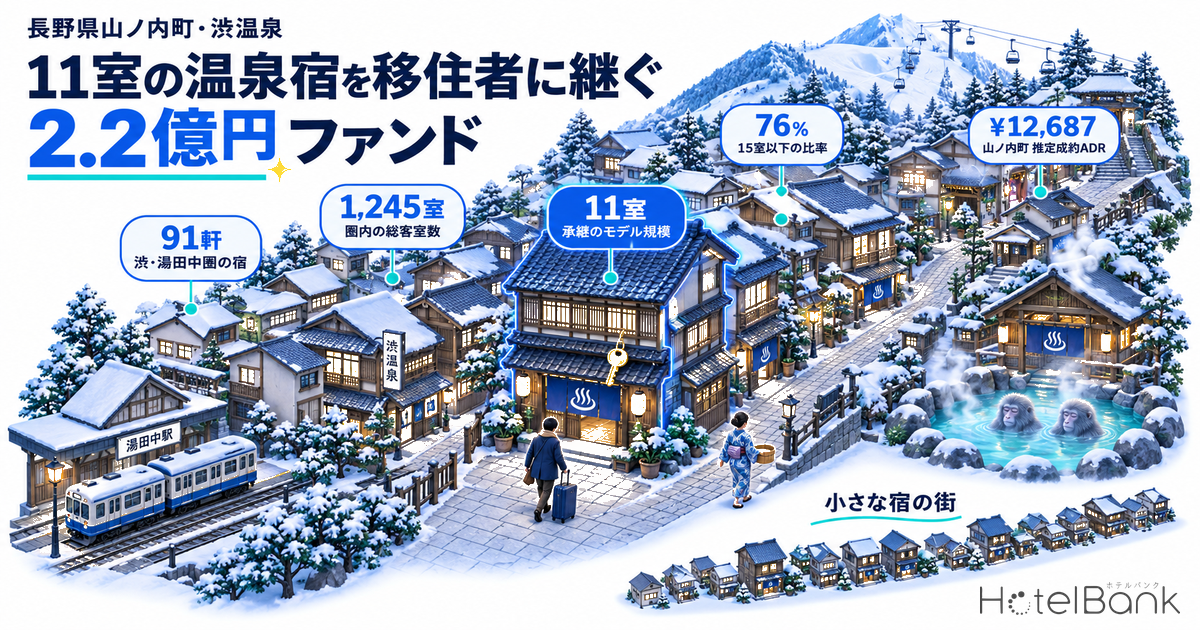
On August 20, 2026, Yadoroku Inc. (株式会社ヤドロク), based in Yamanouchi Town, Nagano, announced the launch of the Onsen Ryokan Business Succession No. 1 Investment Limited Partnership (温泉旅館事業承継1号投資事業有限責任組合). The ¥220 million fund revives onsen inns of around 10 guest rooms that have no successor, working alongside people who want to relocate to the area, and supports them until the newcomer takes over the inn as a family business. Within a 2 km radius of Shibu Onsen (渋温泉), the company’s home base, there are 91 inns with 1,245 rooms, and 76% of the 67 inns with confirmed rate listings have 15 rooms or fewer. This article uses the supply structure of this “town of small inns” and the estimated settled ADR for Yamanouchi (about ¥12,700 in August 2026) to estimate the room revenue an 11-room inn generates and how many successions ¥220 million could finance.
Metric Definitions Used in This Article
| ADR (average daily rate) | An estimated settled rate (tax-exclusive equivalent) calculated by applying segment-specific adjustment factors to the lowest-plan price level each property publishes on OTAs (two guests per room, price per room, tax included). Checked against property-level results disclosed by listed hotel REITs (91 properties, most recent three months), the median error is about 7%. These are estimates and differ from each property’s actual settled prices and accounting figures. Area-level ADR is the median of the properties covered (the level of a typical property in the area). |
| Room occupancy | The assumptions in the estimates use the room occupancy rate of ryokan from the Japan Tourism Agency’s Overnight Travel Statistics Survey, 2025 annual figures (final). |
| Status of the estimates | Room revenue, investment amounts and payback periods are all simplified estimates based on assumptions set by the editorial team; they are not plan figures published by the fund or the operating company. |
| Data source | MetroEngines Research (covering about 27,000 properties confirmed to be operating in Japan) |
- — The onsen ryokan business succession fund Yadoroku announced on August 20, 2026 totals ¥220 million (at this stage). The company is the GP, local stakeholders are the LPs, and the targets are onsen inns with around 10 guest rooms. The fund term, number of deals and investment per deal have not been disclosed.
- — The Shibu–Yudanaka 2 km radius has 91 inns and 1,245 rooms, almost unchanged from 89 inns and 1,265 rooms in 2016. Of the 67 inns with confirmed rate listings, 76% (51 inns) have 15 rooms or fewer.
- — Yamanouchi’s estimated settled ADR was ¥12,687 in August 2026 (N=101 properties, −1.8% YoY). December 2025 was ¥16,360 (+29.1% YoY): this is a town where rates rise in winter.
- — Annual room revenue for an 11-room inn comes to ¥13.84 million–¥27.98 million across three scenarios with full-year occupancy of 27.2%–55% (base case ¥19.43 million; editorial estimate excluding ancillary revenue).
- — Assuming ¥30 million–¥110 million of funding per inn, ¥220 million covers 2 to 7 inns. At ¥55 million, payback takes 11.3 years in the base case, or 10 years if ADR is raised to about ¥14,300.
The Fund’s Framework — Five Disclosed Facts, the Rest Left Blank
First, let us set out what can be confirmed from primary sources. According to Yadoroku’s official announcement (August 20, 2026) and its press release, the partnership’s formal name is the Onsen Ryokan Business Succession No. 1 Investment Limited Partnership, known for short as the Onsen Ryokan Business Succession Fund. The general partner (GP) is Yadoroku, the limited partners (LPs) are described as “local stakeholders who support regional revitalization,” and the fund size is stated as “¥220 million at this stage.”
The investment targets are “ultra-small lodging facilities of around 10 guest rooms that can be run as a family business.” The fund says it will revive onsen inns without successors together with people who wish to relocate, and provide end-to-end support until the newcomer ultimately takes over the inn as a family business in the community. It also mentions developing ryokan management and operations talent in partnership with universities. On the other hand, the fund term, target number of deals, investment per deal and the names of investee properties have not been disclosed.
Ahead of this, the company announced on July 1, 2026 that it had taken over Tsukimi-no-Yu Yamaichiya (月見の湯 山一屋) in Shibu Onsen. MetroEngines Research property data shows the inn has 11 guest rooms, which falls squarely within the size band the fund targets. However, the relationship between this succession and the fund cannot be read from the published materials, so this article treats it as “the most recent real example of a 10-room-scale inn changing hands.”
| Item | Disclosed content | Source |
|---|---|---|
| Name | Onsen Ryokan Business Succession No. 1 Investment Limited Partnership (short name: Onsen Ryokan Business Succession Fund) | Yadoroku official site, August 20, 2026 |
| GP / LP | GP: Yadoroku Inc. / LPs: local stakeholders who support regional revitalization | Same as above |
| Fund size | ¥220 million at this stage | Same as above |
| Target | Ultra-small lodging facilities of around 10 guest rooms that can be run as a family business | Press release, August 20, 2026 |
| Mechanism | Revival together with prospective newcomers, with end-to-end support until the newcomer takes over as a family business; talent development in partnership with universities | Same as above |
| Term, number of deals, investment per deal, investees | Not disclosed | — |
The vehicle chosen, an investment limited partnership (LPS), is a partnership based on Japan’s Limited Partnership Act for Investment. The GP, which executes the business, bears unlimited liability, while LPs are liable only up to the amount of their contribution. The businesses a partnership may engage in are limited to those listed in the law, such as acquiring shares or equity interests, acquiring monetary claims and lending to businesses, so in general terms it participates through equity investment in, or loans to, the company that runs the inn. For local investors, the fact that liability is capped at the amount invested makes this a vehicle that is easy to join.
Supply in the Shibu–Yudanaka 2 km Radius — 91 Inns, 1,245 Rooms, a “Town of Small Inns” Flat for a Decade
What does the market at the fund’s doorstep look like? Lodging facilities within a 2 km radius centered on Shibu Onsen (including the Yudanaka, Andai, Kanbayashi and Kakuma hot springs) numbered 91 with 1,245 rooms in 2026, against 89 with 1,265 rooms in 2016 — barely any movement in ten years. The average is 13.7 rooms per inn. In contrast to urban areas where new openings keep piling up, this is an onsen town where existing inns have carried on without turnover.
Of these, 67 inns with 968 rooms had rate listings confirmed on booking sites during the 12 months from September 2025 to August 2026. The remaining properties are thought to include inns that rely mainly on direct sales and telephone bookings, or that operate only in certain seasons. The median room count of the 67 inns is 10; 38 inns have 10 rooms or fewer and 13 have 11–15 rooms, so inns with 15 rooms or fewer alone account for 76% of the total. The “around 10 rooms” the fund sets out is, in this town, simply what a standard inn looks like.
Reading the Location — 4,196 Residents Within 2 km and a 45.5% Senior Share Show How Scarce Successors Are
So why are the successors “newcomers”? The background is the demographic makeup of the onsen town itself. According to the Ministry of Land, Infrastructure, Transport and Tourism’s future population projections by 250 m mesh, the resident population within 2 km of Shibu Onsen falls from 4,639 in 2020 to a projected 4,196 in 2025, and is expected to shrink to 2,965 by 2040 (−36.1% versus 2020). The share aged 65 and over in 2025 is 45.5%, nearly level with the working-age population (47.5%).
Against 67 inns, the working-age population within the radius is just 1,993, which works out to about 30 people per inn. With the room to find a successor from within the local community narrowing year by year, a design that hands the family business to someone coming from outside reads as a natural choice given the demographics. Note that the figures here are resident population based on the national census, not the daytime or visitor population including overnight guests.
| 2020 | 4,639 |
| 2025 (projected) | 4,196 |
| 2040 (projected) | 2,965 |
| Share aged 65+ (2025) | 45.5% |
| 2016 | ¥31,033/㎡ |
| 2020 | ¥27,700/㎡ |
| 2026 | ¥23,833/㎡ (−2.48% YoY) |
| Highest point in town (Oaza Hirao) | ¥27,800/㎡ |
On land prices, Yamanouchi’s average official land price in 2026 was ¥23,833 per square meter (−2.48% YoY), down about 23% in ten years from ¥31,033 in 2016. Even the highest point in town, Oaza Hirao, stands at only ¥27,800. For an inn on a 300 ㎡ site, the land would be valued at roughly ¥7 million–¥8 million, so land makes up a small share of acquisition funding. Put the other way, this is a market where the financing plan for a succession is weighted toward building renovation and post-opening working capital rather than land.
Rate Seasonality — Yamanouchi Is a Town Where Rates Rise in Winter; December Was +29.1% YoY
What about the rates that drive room revenue? The estimated settled ADR for Yamanouchi as a whole was ¥12,687 (N=101 properties) in August 2026, the latest finalized month, roughly flat at −1.8% from ¥12,914 a year earlier. June was ¥10,434 and July ¥10,983, so the start of summer runs just above ¥10,000.
The peak in this town’s rates, however, comes in winter rather than summer. December 2025 was ¥16,360 (+29.1% YoY), January 2026 ¥15,048 (+12.4%) and February ¥14,363 (+14.3%): the three months of the ski season ran double digits above the previous year. The day-weighted average for the 12 months from September 2025 to August 2026 comes to about ¥12,700, and the four months from December to March (33% of the days in the year) account for 39% of the annual total on a rate basis. The first winter after the fund’s launch on August 20 will be the first test of the earning power of the inns it takes on.
Positioning — Room Count × Estimated Settled ADR: Only the 16–30 Room Band Sits at ¥29,000
Next, let us line up the inns in the 2 km radius by room count and rate. Taking the average of the most recent 12 months for the 52 inns where estimated settled ADR could be calculated for six months or more, the median is about ¥11,000 (N=28) for inns with 10 rooms or fewer and about ¥12,700 (N=10) for 11–15 rooms, so the small-scale bands largely overlap with the level for the town as a whole. By contrast, the 16–30 room band is at about ¥29,500 (N=5), forming a rate band more than twice as high within the same onsen town.
| Room count | Properties | Rooms | Median est. settled ADR | 1st–3rd quartile | N for ADR |
|---|---|---|---|---|---|
| 10 rooms or fewer | 38 | 268 | ¥10,962 | ¥7,969–¥14,228 | 28 |
| 11–15 rooms Fund target band | 13 | 156 | ¥12,721 | ¥8,852–¥18,494 | 10 |
| 16–30 rooms | 6 | 129 | ¥29,496 | — (N=5) | 5 |
| 31 rooms or more | 10 | 415 | ¥11,816 | ¥9,199–¥30,550 | 9 |
| Total | 67 | 968 | ¥11,606 | — | 52 |
Dense 15 rooms or fewer × under ¥15,000
Of the 38 inns with 15 rooms or fewer for which ADR could be calculated, 29 cluster here. This is the town’s core zone, where family-run inns line up at standard prices.
Opportunity 1 15 rooms or fewer × above ¥20,000
Four of the 38 inns fall here. There are precedents of inns that raised their rates while staying at the 10-room scale, which can serve as a reference point for where a renovation could land.
Opportunity 2 16–30 rooms × above ¥25,000
A band with a median of ¥29,000. It shows that the onsen town has demand that can absorb high rates, and provides the basis for the upside of the small-scale bands.
What this shows is that the Shibu–Yudanaka location is not incapable of supporting high rates. Since inns in the ¥20,000–¥30,000 range are viable within the same streetscape of public-bath hopping, a 10-room inn also has room to move between rate bands depending on product design — room fit-out, meals, private baths and so on. A fund structure in which renovation capital comes in at the same time as the succession could play a role in supporting that move. Note that narrowing the scope to an 800 m radius of Shibu Onsen’s public baths gives 30 inns and 350 rooms, a different aggregation scope from the 91 inns in the 2 km radius used in this article.
The Assets Reviews Reveal — 9.1% Mention the Proprietress or Proprietor, a Town Where People Are the Product
Part of a small inn’s value lies in things that do not readily show up in numbers. When the HotelBank Editorial Team analyzed 11,462 guest reviews (most recent 24 months) for 65 properties in the 2 km radius using natural language processing, mentions of the hot spring were most common at 21.9% (2,506 reviews), followed by staff friendliness at 17.2% (1,971) and the personality of the owner — the proprietress (okami) or proprietor — at 9.1% (1,048). Mentions of hospitality also came to 5.8% (663), and in each case the context was overwhelmingly positive.
What stands out is that mentions of the owner are spread across 42 properties. At inns where “people” are at the center of guest evaluations, the succession phase, when the manager changes, is exactly when the handover period and the training framework determine value. The fund’s commitment to talent development in partnership with universities, and to supporting newcomers “end to end” until they take over, is consistent with the review structure of this onsen town. In addition, elements characteristic of small inns, such as private baths (6.0%) and shuttle service from the station (5.8%), also drew a certain share of mentions.
Room Revenue of an 11-Room Inn — ¥13.84 Million to ¥27.98 Million a Year Across Three Scenarios
So how much room revenue does an 11-room inn generate in a year? We set three scenarios by multiplying Yamanouchi’s monthly estimated settled ADR (finalized figures for September 2025–August 2026) by an assumed occupancy rate held uniform through the year. The conservative scenario uses the 27.2% room occupancy of ryokan in Nagano from Japan Tourism Agency statistics (2025 final), the base scenario the 38.2% for ryokan nationwide from the same source, and the upside scenario 55% as an editorial assumption.
| Item | Conservative | Base | Upside |
|---|---|---|---|
| Rooms | 11 | 11 | 11 |
| Assumed occupancy (full year) | 27.2% | 38.2% | 55.0% |
| Basis for occupancy | Nagano ryokan (2025) | Nationwide ryokan (2025) | Editorial assumption |
| Room nights sold per year | 1,092 | 1,534 | 2,208 |
| ADR (annual, day-weighted) | ¥12,670 | ¥12,670 | ¥12,670 |
| Annual room revenue | ¥13.84M | ¥19.43M | ¥27.98M |
| Annual room revenue per room | ¥1.26M | ¥1.77M | ¥2.54M |
Annual room revenue in the base scenario is about ¥19.43 million, or about ¥1.77 million per room. Bear in mind that this estimate covers room revenue only; at ryokan, where a stay with dinner and breakfast is the norm, food and beverage revenue comes on top of this. Also, because ADR uses the median for the town as a whole, the revenue level would change if an inn moved into the band above ¥20,000 seen in the previous section. It is best read strictly as a starting point: “what you get at the town’s standard rate with occupancy in line with the statistics.”
How Many Inns Does ¥220 Million Cover? — 2 to 7 on an Assumed ¥30 Million–¥110 Million per Inn
The fund has not disclosed its investment per deal. We therefore assumed three levels of funding required per inn, combining acquisition, renovation and initial working capital, and worked backward to how many inns ¥220 million would cover. The amounts below are editorial assumptions and do not represent the fund’s plans. The calculation is simple division, with no allowance for the partnership’s operating expenses and no use of borrowing alongside.
| Item | A. Light renovation | B. Mid-scale renovation | C. Full renovation |
|---|---|---|---|
| Funding required per inn (assumed) | ¥30M | ¥55M | ¥110M |
| Per room (11 rooms) | ¥2.73M | ¥5.00M | ¥10.00M |
| Inns covered by ¥220M | 7.3 | 4.0 | 2.0 |
| Share of the 51 inns with 15 rooms or fewer in the 2 km radius | About 14% | About 8% | About 4% |
| Payback (base; operating CF margin 25%) | 6.2 years | 11.3 years | 22.6 years |
| Payback (upside; operating CF margin 25%) | 4.3 years | 7.9 years | 15.7 years |
| Payback (base; operating CF margin 15%) | 10.3 years | 18.9 years | 37.7 years |
The simple back-calculation gives 7 inns at ¥30 million each, 4 at ¥55 million and 2 at ¥110 million. Since there are 51 inns with 15 rooms or fewer in the 2 km radius, ¥220 million reaches at most just over a tenth of them. As the “No. 1” in the name suggests, it is natural to read this as a scale for first establishing the model with a handful of inns.
From a payback perspective, assuming 25% of room revenue remains in hand in the base scenario, annual operating cash flow is about ¥4.86 million. On that basis the principal is recovered in 6.2 years for a ¥30 million investment and 11.3 years for ¥55 million. To recover ¥55 million in 10 years with occupancy unchanged at 38.2% (full year, ryokan nationwide, 2025), the required ADR is about ¥14,300, a 13% increase from the town’s annual level. Given that the median for the 16–30 room band is ¥29,000, this is within reach for a succession that involves renovation.
Sensitivity analysis (B. mid-scale renovation ¥55 million; base scenario; operating CF margin 25%)
| Item | Base | ADR −10% | Occupancy −5pt | Both |
|---|---|---|---|---|
| Annual room revenue | ¥19.43M | ¥17.49M | ¥16.89M | ¥15.20M |
| Operating CF | ¥4.86M | ¥4.37M | ¥4.22M | ¥3.80M |
| Yield on investment | 8.8% | 7.9% | 7.7% | 6.9% |
| Payback | 11.3 years | 12.6 years | 13.0 years | 14.5 years |
Two-axis sensitivity — payback period (B. mid-scale renovation ¥55 million; operating CF margin 25%)
| Assumed occupancy (full year) \ ADR | ¥11,400 (−10%) | ¥12,670 (town’s annual level) | ¥14,300 (+13%) | ¥16,000 | ¥20,000 |
|---|---|---|---|---|---|
| 27.2% (Nagano ryokan) | 17.7 years | 15.9 years | 14.1 years | 12.6 years | 10.1 years |
| 33.2% (base −5pt) | 14.5 years | 13.0 years | 11.5 years | 10.3 years | 8.3 years |
| 38.2% (nationwide ryokan) | 12.6 years | 11.3 years | 10.0 years | 9.0 years | 7.2 years |
| 45.0% | 10.7 years | 9.6 years | 8.5 years | 7.6 years | 6.1 years |
| 55.0% (upside) | 8.7 years | 7.9 years | 7.0 years | 6.2 years | 5.0 years |
Viewed on two axes, at the town’s annual rate level (¥12,670), payback exceeds 10 years unless full-year occupancy tops roughly 43%. If, on the other hand, the rate can be raised to ¥20,000, payback shortens to about 10 years even at 27.2% occupancy, the same as the Nagano ryokan average. Considering that small inns above ¥20,000 actually exist in the same radius, designing the payback around a move between rate bands is a more realistic option than assuming occupancy far above the statistical average.
Designing the Exit — Three Issues Before the Successor Buys the Inn
What distinguishes this fund is that the exit is set not as a sale to a third party but as “a buyout by the successor.” On the path where the newcomer builds up experience and capital while running the inn and ultimately takes it over as a family business, at least three institutional issues come into play.
| Issue | Key points of the rules | Implications for succession design |
|---|---|---|
| Form of transfer | There are two routes: transferring the shares or equity interests of the company that runs the inn, or a business transfer of the business itself | With a transfer of shares or equity interests, the operating company itself does not change, making it easier to carry over licenses and contracts as they are |
| Ryokan business license | Under the amended Inns and Hotels Act (Ryokan Business Act), in force since December 13, 2023, the operator’s status can be succeeded through an approval procedure even in a business transfer | Approval must be obtained before the transfer takes effect, so prior consultation with the public health center should be built into the schedule |
| Personal guarantees by managers | The Guidelines for Personal Guarantees Provided by Business Owners include special provisions for business succession, setting out the principle that guarantees should not, as a rule, be required from both the outgoing manager and the successor | If the successor takes on borrowing at the time of the buyout, there is room to discuss the treatment of guarantees with financial institutions early |
As for the funds for the buyout, existing schemes such as Japan Finance Corporation loans and the business succession tax regime are candidates to be combined. Compared with Real Estate Specified Joint Enterprise schemes, which raise money in small lots from the general public, this LPS is a vehicle in which a small number of local investors put money into the business itself, and its character is closer to regional business succession infrastructure than to a yield product.
Opportunities and Risks — Rising Winter Rates Are a Tailwind; Demographics Constrain the Time Horizon
| Factor | Details | Assessment |
|---|---|---|
| Rate trend | Estimated settled ADR for December 2025–March 2026 was +12% to +29% YoY | Opportunity |
| Supply | The 2 km radius went from 89 to 91 inns in ten years. Added competition from new supply is limited | Opportunity |
| Rate upside | A band with a median of ¥29,000 (16–30 rooms) is established within the same radius | Opportunity |
| Seasonality | June–July runs just above ¥10,000. Full-year cash flow tends to depend on the four winter months | Caution |
| Population | Resident population in the 2 km radius will be −36.1% in 2040 versus 2020. Family operation, rather than hired staff, becomes the premise | Caution |
| Buildings | In reviews, 8.3% (951 reviews) mention the age of the building. Renovation investment tends to feed directly into guest evaluations | Caution |
To sum up so far, the Shibu–Yudanaka market offers tailwinds for the succession of small inns on three counts: supply is not growing, winter rates are rising, and a higher price band actually exists. On the other hand, the decline in the population within the radius narrows the option of hiring staff and expanding scale, so the fund’s choice to focus on the 10-room scale that a family can run reads as a rational line drawn with the location’s constraints in mind.
Implications by Reader — Financial Institutions, Investors, Inn Owners and Local Governments
For business succession officers at regional financial institutions, the point to note is that the two-stage design — equity goes in first, and the successor buys the inn after gaining experience — gives the loan review at the time of the buyout a track record to work with. Monthly room revenue during the operating period becomes direct evidence for the lending decision.
For local stakeholders considering an investment, it is useful to check the relationship between investment per inn and payback period against their own time horizon. In this article’s estimates, recovering a ¥55 million investment at standard occupancy and rates takes about 11 years, and raising the rate by 13% brings it within 10 years. Beyond the financial yield, how one values the ripple effect of one more inn remaining in the onsen town is likely to be the deciding factor.
For inn owners looking for a successor, the choice between closing down and passing the inn on within the family now has a third option: “handing it over to a third party over time.” And for local government officials in charge of tourism and relocation, an opportunity has emerged to design relocation policy and inn succession as one. Support for everyday life — housing, child-rearing, getting through the winter — bears directly on whether those who take over inns stay.
Frequently Asked Questions
Q. What kind of inns does the Onsen Ryokan Business Succession Fund target?
A. The published materials describe them as “ultra-small lodging facilities of around 10 guest rooms that can be run as a family business.” The scheme revives onsen inns without successors together with people who wish to relocate, and supports them until the newcomer takes over the inn as a family business.
Q. Have the fund’s size and investors been disclosed?
A. The total is ¥220 million at this stage, the GP is Yadoroku Inc., and the LPs are disclosed as “local stakeholders who support regional revitalization.” The fund term, investment per deal and investees have not been disclosed.
Q. What are room rates like at inns around Shibu Onsen?
A. The estimated settled ADR for Yamanouchi as a whole was about ¥12,700 in August 2026 (N=101 properties, tax-exclusive equivalent, per room). Rates tend to rise in winter; December 2025 was about ¥16,400.
Summary
Yadoroku’s Onsen Ryokan Business Succession Fund is a ¥220 million scheme that provides financial backing for the time it takes to hand onsen inns of around 10 rooms to newcomers. The Shibu–Yudanaka 2 km radius, with 91 inns and 1,245 rooms almost unchanged for ten years and 76% of inns with listed rates at 15 rooms or fewer, turned out to be a market with no shortage of targets.
The room revenue an 11-room inn generates at the town’s standard rate and statistics-level occupancy is around ¥19.43 million a year, and on an assumed investment of ¥30 million–¥110 million per inn, ¥220 million corresponds to 2 to 7 inns. The key to payback is a move between rate bands, and the existence of a ¥29,000 band within the same radius is the basis for that. With winter rates running double digits above the previous year, results from the first peak season after launch will be what draws in the next investment and the next succession.
Note on the data: ADR in this article uses estimates for finalized months through August 2026; levels for months after the survey date (October 4, 2026) are not used as a basis. Room revenue, investment amounts and payback periods are simplified estimates based on assumptions and do not represent the results of individual properties or the investment performance of any specific fund.
Related Articles
| Ryokan Succession Crisis: 89 Bankruptcies & 30% Without Heirs in 2025 |
References and Sources
■ Data sources
Aggregated data from MetroEngines Research & Consulting (Yamanouchi monthly estimated settled ADR: finalized months from August 2024 to August 2026, N=89–131 properties per month / properties and rooms within a 2 km radius centered on Shibu Onsen: N=91 properties, of which 67 properties and 968 rooms had rate listings confirmed between September 2025 and August 2026 / property-level estimated settled ADR: 52 properties with six or more months of data); review analysis by the HotelBank Editorial Team (65 properties, 11,462 reviews, most recent 24 months); Japan Tourism Agency, Overnight Travel Statistics Survey, 2025 annual figures (final); MLIT National Land Numerical Information (future population projections by 250 m mesh); MLIT Land Price Publication; official announcements and press releases of Yadoroku Inc. (July 1 and August 20, 2026).
■ Assumptions for the estimates
11 guest rooms, open 365 days. ADR is ¥12,670 (tax-exclusive equivalent, per room), the day-weighted average of Yamanouchi’s monthly estimated settled ADR for September 2025–August 2026. Occupancy is held uniform through the year: conservative 27.2% (Nagano ryokan, 2025), base 38.2% (nationwide ryokan, 2025) and upside 55% (editorial assumption). Funding required per inn was assumed by the editorial team at three levels — ¥30 million, ¥55 million and ¥110 million — and the operating CF margin (ratio to room revenue) at 25% and 15%. Payback is a simple calculation of required funding ÷ annual operating CF and does not include borrowing, interest, taxes, the partnership’s operating expenses, or ancillary revenue such as food and beverage.
■ Limitations and caveats
The fund’s term, target number of deals, investment per deal and investees have not been disclosed, and the estimates in this article are not the fund’s plan figures. ADR is an estimate based on the median for the town as a whole and differs from the settled rates and accounting figures of individual inns. Occupancy is an assumption applying prefectural and national ryokan averages, not actual results for Shibu–Yudanaka. The median for the 16–30 room band rests on a small sample of N=5 and should be read as a reference value. The 24 of the 91 inns in the 2 km radius for which rate listings could not be confirmed are not included in the tabulations by size and by rate.
■ Primary sources (fund and succession)
■ Market data
| MetroEngines Research & Consulting — estimated settled ADR (Yamanouchi; N=89–131 properties per month), property and room data for the Shibu Onsen 2 km radius (N=91 properties / 67 with confirmed rate listings) |
| HotelBank Editorial Team research (NLP analysis) — 11,462 guest reviews, 65 properties, most recent 24 months |
■ Government statistics and public data
■ Industry materials
| Relo Hotel Solutions, “What Is GOP? A Key Metric for Measuring Hotel and Ryokan Profit” (in Japanese) |