

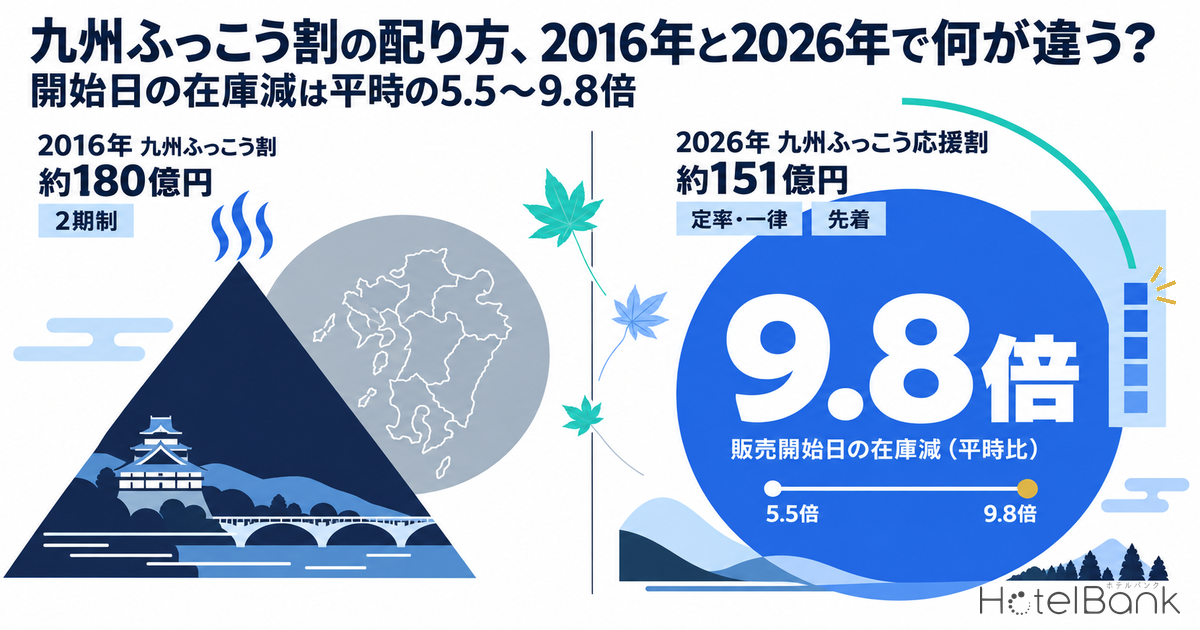
Under the Kyushu Fukko Ouen-wari (九州ふっこう応援割, Kyushu Recovery Support Discount), prefecture after prefecture announced that applications had closed on the day sales opened on booking sites or the day after. In Nagasaki, the allocation was reported to have sold out 20 minutes after sales began. Sell-outs also happened under the 2016 Kyushu Fukko-wari (九州ふっこう割, Kyushu Recovery Discount), but the two programs distribute the discount quite differently: the size and duration of the budget, how discount rates are set, whether sales are split into phases, and whether allocation is first-come-first-served or by lottery. This article lines up the 2016 and 2026 sales designs from primary sources, uses one chart of our inventory data to check where demand concentrated under first-come-first-served allocation, and then sets out how to read the reopened allocations and how hotels can prepare. The conclusion up front: the 2026 design is “flat rate, uniform, first-come-first-served, with launch dates staggered by prefecture and channel,” and on each prefecture’s launch day, listed inventory for October stays fell by 5.5–9.8 times the normal daily amount.
Metric Definitions Used in This Article
- Decrease in listed inventory (room-nights): For each of the 24 stay dates from October 1 to 24, 2026, the decrease in rooms remaining on major booking sites between the previous day’s observation and the current day’s observation, summed across stay dates (1 room × 1 night = 1 room-night). Because it includes not only bookings but also listings withdrawn or inventory pulled by the property, it is not the number of bookings itself. Stay dates where remaining rooms increased from the previous day are netted off as negatives.
- Multiple of normal: The decrease on the launch day divided by the average daily decrease over the five days immediately before launch.
- LT (lead time): Days until the stay date. This analysis uses only observations from LT45 to LT1; same-day (LT0) observations and those 46 or more days out are excluded. This is why stay dates from October 25 onward are not included.
- Properties covered: A fixed set of properties for each stay date, made up of properties listing at least 30% of their total rooms on major booking sites (major booking site listing basis). Property and room counts by prefecture are shown in Table 2.
- Data source: MetroEngines Research (observations through September 25, 2026). Program details are based on announcements by the Japan Tourism Agency, the Kyushu Tourism Organization and each prefecture, and on contemporaneous news reports.
- — The 2016 program had about ¥18 billion, six months and two phases. Discount rates varied by product, as in “up to 70%, 50% on average,” and were lowered in Phase 2 (October–December). In Phase 2, some sales channels switched from first-come-first-served to a lottery.
- — The 2026 program has combined project-cost ceilings of about ¥15.1 billion across seven prefectures, with a uniform flat rate of 50% (60% in Kumamoto and Kagoshima) on every product. There are no phases; instead, launch dates are staggered by prefecture and by channel, and the discount is distributed first-come-first-served, “ending once the budget runs out.”
- — On the launch day alone, the decrease in listed inventory for October 1–24 stays was 9.8x normal in Miyazaki, 8.9x in Saga, 8.1x in Nagasaki, 7.1x in Oita and 5.5x in Kumamoto (all versus the average of the preceding five days).
- — The next day diverged. Nagasaki fell back to 0.5x normal, while Kumamoto stayed high at 1.7x. Kumamoto sells “in order, starting with operators that are ready,” a design in which each newly opened channel creates another small launch day.
- — Under first-come-first-served, there is more than one “launch day.” With Nagasaki (properties 9/28, travel agencies etc. 9/30), Saga (travel agencies 10/2) and Oita (travel agencies 10/9, properties 10/16) still to come, hotels have room to allocate inventory ahead of each upcoming launch date.
How the Discount Was Distributed in 2016 and 2026 — What Is the Same and What Differs
First, we align the outlines of the two programs using primary sources. The 2016 Kyushu Fukko-wari was the “subsidy program for discounted travel plans to support Kyushu tourism,” funded with about ¥18 billion of national money from the reserve fund for Kumamoto Earthquake recovery, and covered stays from July to December (Nikkei, May 31, 2016). According to the tally by the secretariat at the Kyushu Tourism Promotion Organization, it was used by a cumulative 2,719,000 people, about 1.8 times the target of 1.5 million (Nikkei, March 2, 2017).
The 2026 Kyushu Fukko Ouen-wari is a travel and accommodation discount program announced by the Japan Tourism Agency on August 28. The discount rate is 50% (60% in Kumamoto and Kagoshima), and the cap per person per trip is ¥20,000 for accommodation only or one night with transportation, ¥30,000 for two or more nights with transportation, and ¥35,000 for multi-prefecture tours covering two or more prefectures. Eligible stays start on October 1 and run until December 15 in Fukuoka and December 25 in the five prefectures of Saga, Nagasaki, Kumamoto, Oita and Miyazaki (Japan Tourism Agency, “Kyushu Fukko Ouen-wari,” updated September 24, 2026). The same page states explicitly that the program “ends once each prefecture’s budget runs out.”
| Item | 2016 Kyushu Fukko-wari | 2026 Kyushu Fukko Ouen-wari |
|---|---|---|
| Funding | About ¥18 billion of national funds (reserve fund for Kumamoto Earthquake recovery) | Combined project-cost ceilings of the seven prefectures: ¥15,125.98 million (about ¥15.5 billion in reports at the time of announcement) |
| Eligible period | About six months, July–December | 10/1–12/25 (Fukuoka until 12/15). Kagoshima expected from mid-October to end-February 2027 (excluding the year-end and New Year holidays) |
| Phasing | Two phases: Phase 1 (July–September) and Phase 2 (October–December). Phase 2 went on sale in stages from September 9 | A single phase. Instead, launch dates are staggered by prefecture and by sales channel |
| Discount rate | Kumamoto and Oita: Phase 1 up to 70% (50% on average), Phase 2 up to 50% (25% on average) Other five prefectures: Phase 1 up to 50% (20% on average), Phase 2 up to 40% (10% on average) | Flat rate applied uniformly to all products. 60% in Kumamoto and Kagoshima, 50% in the other five prefectures |
| Cap (per person) | For products with transportation: ¥20,000 for 1 night/2 days, ¥30,000 for 2 nights/3 days or longer | ¥20,000 for accommodation only or 1 night with transportation, ¥30,000 for 2+ nights with transportation, ¥35,000 for multi-prefecture tours |
| Allocation method | First-come-first-served (applications stop once coupons run out). In Phase 2, some sales channels (accommodation vouchers) switched to a lottery | First-come-first-served (ends once the budget runs out) |
| Sales channels | Discounted products from booking sites and travel agencies, accommodation vouchers | Travel agencies, accommodation operators and online booking sites (difference reimbursed from national government → prefecture → operator) |
| Eligible travelers | Reported to include foreign visitors | Japan Tourism Agency materials state “domestic travelers, etc.” |
| Results | Cumulative 2,719,000 users (about 1.8x the 1.5 million target) | In progress |
Source: Compiled by HotelBank Editorial Team from Nikkei (May 31, 2016 and March 2, 2017), KNT-CT Holdings news release (July 1, 2016), Higo Journal (August 27, 2016), Japan Tourism Agency “Kyushu Fukko Ouen-wari” (updated September 24, 2026) and its program overview, the Kyushu Tourism Organization’s “Kyushu Fukko Ouen-wari information site,” Travel Watch (September 18, 2026), and prefectural releases and news reports. The 2026 figures are the sum of the project-cost ceilings published for each of the seven prefectures
Both programs share the principle of “stopping applications once the budget allocation runs out.” In 2016, too, a travel agency that began sales on July 1 announced for its accommodation products that it would “stop accepting applications once coupons run out” (KNT-CT Holdings, July 1, 2016), and contemporaneous summaries note that some Phase 1 plans sold out early (imidas, “Kyushu Fukko-wari”).
The difference lies in where the mechanisms that spread demand over time are placed. In 2016, the six months were split into two phases, with the discount rate lowered for each phase. As a result, demand chasing deep discounts gathered at the Phase 1 launch, while Phase 2 picked up the remaining demand with shallower discounts. In Phase 2 sales, some channels (accommodation vouchers) also switched to a lottery; as a Kumamoto local outlet put it, “because it is a lottery rather than first-come-first-served, everyone’s chance of getting one is greatly improved” (Higo Journal, August 27, 2016).
One more point: in 2016, the discount rate was presented separately as a “maximum” and an “average.” For Kumamoto and Oita in Phase 1, the maximum was 70% against an average of 50%, and the depth of the discount was designed product by product by travel agencies and booking sites. Because products near the maximum were limited in number, sell-outs occurred unevenly at the product level. In 2026, by contrast, the same flat rate applies to every product, and at any price point below the ¥20,000 cap, the discount rate is identical at every property and in every plan. By our editorial team’s count, only around the top 10% of listed prices for October stays across the seven Kyushu prefectures reach the cap. If conditions are nearly the same whichever product a traveler chooses, the only thing that differentiates travelers is “when they applied,” and the first-come-first-served effect becomes that much stronger.
Source: Compiled by HotelBank Editorial Team from Nikkei (May 31, 2016) and Japan Tourism Agency “Kyushu Fukko Ouen-wari” (updated September 24, 2026). Priority prefectures are Kumamoto and Oita in 2016 and Kumamoto and Kagoshima in 2026. In 2026 the maximum and average are equal because the rate is flat
As Figure 1 shows, the 2026 average discount rate exceeds that of the 2016 Phase 1 priority prefectures (50% on average), and for the other five prefectures it is 50% compared with averages of 20% and 10% in 2016. Dividing the funding by the period, 2016 comes to about ¥3 billion per month (about ¥18 billion over six months), while 2026 comes to just over ¥5 billion per month (about ¥15.1 billion over mainly 86 days, or 76 days in Fukuoka). More funding rides on each sales window, and the discount is uniformly deep. This combination is likely what showed up as the concentration of demand immediately after each prefecture’s launch.
2026 Launches and Suspensions — Timeline by Prefecture and Channel
In 2026, launch dates differ by prefecture, and even within the same prefecture the dates are split among booking sites, travel agencies and accommodation properties. According to reports, in Kumamoto and Nagasaki, where sales began on September 15, both prefectures said that the portions of the first allocation prepared by two major booking sites sold out on the same day (Nikkei, September 15, 2026). In Nagasaki, the allocation sold out 20 minutes after sales opened at 10 a.m. that day, and a prefectural official said demand “exceeded expectations” (Asahi Shimbun, September 19, 2026). In Kumamoto, one property reported that “bookings hit the cap in about 30 minutes” (Nishinippon Shimbun, September 15, 2026).
| Prefecture | Booking-site launch | Other channels (scheduled) | Launch-day decrease | vs. normal | Next day | Properties / rooms covered |
|---|---|---|---|---|---|---|
| Kumamoto | 9/15 (Tue) 10:00 | In order, as operators become ready | 15,646 room-nights | 5.5x | 1.7x | 379–386 properties / 14,262–14,402 rooms |
| Nagasaki | 9/15 (Tue) 10:00 (early start on some sites) | Properties 9/28; travel agencies and booking sites 9/30 | 6,167 room-nights | 8.1x | 0.5x | 266–273 properties / 11,471–11,564 rooms |
| Saga | 9/24 (Thu) 12:00 | Travel agencies 10/2; properties early October | 3,223 room-nights | 8.9x | 1.5x | 138–141 properties / 4,475–4,514 rooms |
| Oita | 9/25 (Fri) 12:00 | Travel agencies 10/9; properties 10/16 | 7,174 room-nights | 7.1x | — | 474–479 properties / 10,887–10,952 rooms |
| Miyazaki | 9/25 (Fri) 10:00 | Properties and travel agencies from 9/28 | 6,485 room-nights | 9.8x | — | 159–161 properties / 6,906–6,914 rooms |
| Fukuoka (reference) | From 9/24 (Thu), operator by operator | Same as left | 11,617 room-nights | 3.3x | 1.7x | 438–441 properties / 29,710–29,815 rooms |
Source: Launch dates from the Kyushu Tourism Organization’s “Kyushu Fukko Ouen-wari information site” (checked September 27, 2026). Inventory decreases compiled by HotelBank Editorial Team from MetroEngines Research (stays October 1–24, observations LT45–LT1, major booking site listing basis; property and room counts vary by stay date). “vs. normal” is the ratio to the average daily decrease over the preceding five days; “Next day” is the same ratio for the day after launch. For Oita and Miyazaki, observations for the day after launch had not yet arrived at the time of tabulation. Fukuoka is a reference value because launches were staggered by operator and the preceding five days include the Autumnal Equinox holiday
Under First-Come-First-Served, Demand Converged on Launch Day — Measured Inventory
We check how demand behaves under first-come-first-served allocation using inventory movements on major booking sites. Figure 2 sets each prefecture’s launch day as “D0” and plots the daily decrease in listed inventory before and after it as a multiple of the average for the preceding five days. The scope is the 24 stay dates from October 1 to 24.
Source: Compiled by HotelBank Editorial Team from MetroEngines Research (stays October 1–24, observations LT45–LT1, through September 25, 2026 observation). Coverage: Kumamoto 379–386 properties / 14,262–14,402 rooms, Nagasaki 266–273 / 11,471–11,564, Saga 138–141 / 4,475–4,514, Oita 474–479 / 10,887–10,952, Miyazaki 159–161 / 6,906–6,914 (major booking site listing basis). These are decreases in listed inventory, not the number of bookings itself
In all five prefectures, the five days before launch ranged from 0.1x to 1.6x normal, with a clear jump at D0. The largest multiple was Miyazaki at 9.8x, followed by Saga at 8.9x, Nagasaki at 8.1x, Oita at 7.1x and Kumamoto at 5.5x. Kumamoto had the lowest multiple of the five but the largest decrease in volume at 15,646 room-nights; because a recovery pace of around 2,800 room-nights per day was already under way before launch, its multiple comes out smaller. This article focuses on the relationship between these launch-day steps and the way the discount is distributed.
The key point is the next day (D+1). Nagasaki dropped to 0.5x normal the day after launch. Only some booking sites went first, with launches by accommodation properties and travel agencies set later, on September 28 and 30. Once the early allocation filled in 20 minutes, there was almost nowhere to apply for the discount until the next launch date. Kumamoto, meanwhile, stayed high at 1.7x the next day. Kumamoto announced that it “will sell in order, starting with operators that are ready” (Asahi Shimbun, cited above), so each time a channel opens, another small launch day is created. Saga’s 1.5x the next day may also reflect multiple channels operating on the same day. However, because inventory decreases include bookings outside the discount and listing adjustments by properties, causation cannot be established from this data.
This difference suggests that even within a first-come-first-served program, the sharpness of demand spikes depends on “how many launch days there are.” In 2016, the program was split into two phases with a lower discount rate in the second, and part of Phase 2 moved to a lottery. In 2026, instead of phases, launch dates are spread across prefectures and channels. Even with the same first-come-first-served rule, prefectures with a single launch day spike sharply on one day, while prefectures that open channels one after another see a more gradual continuation — a difference that appears to show up in the inventory data.
Reading Reopened Allocations and Additional Budgets — How Cancellations Show Up in Inventory
What is being reported as “sold out” is the discount budget allocation assigned to each booking site or travel agency; it does not mean the properties’ rooms are full. Booking sites that have stopped accepting applications also advise that the discount may become available again depending on cancellations and other factors (checked by our editorial team on their announcement pages on September 26, 2026). When a discounted booking is cancelled, the room returns to inventory on the property side, and on the sales side the discount budget returns to that channel’s allocation. Note that these two move independently.
On the inventory side, cancellations appear as a “net increase in remaining rooms.” For Kumamoto stays from October 1 to 24, we observed net increases of 700 room-nights on September 19 and 1,139 room-nights on September 21, after applications were suspended. These increases may include not only cancellations of discounted bookings but also inventory added by properties and re-bookings made to switch existing reservations to discounted ones. Treatment of such switching varies by prefecture; in Kumamoto, Saga, Nagasaki and Oita, existing reservations are not eligible.
Additional budget on the funding side is decided through prefectural supplementary budgets. Each prefecture has submitted a supplementary budget to its September regular assembly session, funded by the project-cost ceiling set by the national government, and the ceilings for the seven prefectures total ¥15,125.98 million. Kagoshima launched its own prefectural discount on September 14 (for stays from September 14 to October 13), and it is reported that it will open bookings for the Kyushu Fukko Ouen-wari in mid-October, covering stays through the end of February 2027 (excluding December 26–January 3) (Travel Watch, September 18, 2026). Of the seven prefectures, Kagoshima is the only one whose peak of applications is still ahead, and it is also the only prefecture that fills the gap after December 25.
How Hotels Can Prepare — Ahead of the Next Launch Day
Under first-come-first-served allocation, demand spikes on each launch day. For hotels, this is also an opportunity, because they “know in advance when demand will come.” Table 3 organizes the actions hotels can take into four stages: before a launch day, on launch day, when allocations reopen, and after the program ends.
| Stage | Rationale | Specific measures |
|---|---|---|
| Before the next launch day | Even in prefectures where booking-site allocations filled first, launch dates for properties and travel agencies are still to come | In line with the dates for Nagasaki (properties 9/28; travel agencies and booking sites 9/30), Miyazaki (from 9/28), Saga (travel agencies 10/2; properties early October), Oita (travel agencies 10/9; properties 10/16) and Kagoshima (mid-October), decide your direct-sales allocation and inventory distribution to each channel by the day before |
| On launch day | Inventory moves at 5–10 times the normal pace in a single day | Weekend and holiday stay dates fill first, so offer more discount-eligible plans on weekday stay dates. Concentrate staff for booking calls and inquiries on that day |
| After suspension / on reopening | Allocations come back in small increments through cancellations and additional budgets | Confirm which channels can resell returned rooms as discount-eligible, and announce reopenings quickly on your website, social media and to past inquirers. Also present the appeal of stay dates that can be enjoyed without the discount (weekdays, multi-night stays, meals) side by side |
| From 12/26 | Except in Kagoshima, the discount lapses for now | Promote your own plans for the year-end/New Year period and January–February (multi-night discounts, early-bird rates, meal-inclusive plans) to guests who stayed during the discount period, to encourage repeat visits |
Source: Compiled by HotelBank Editorial Team based on the Kyushu Tourism Organization’s “Kyushu Fukko Ouen-wari information site,” Travel Watch (September 18, 2026) and MetroEngines Research observations
Inventory allocation on launch day in particular is an issue specific to first-come-first-served programs. Because inventory moves all at once on launch day, concentrating too much inventory in a particular channel leaves no rooms to offer to channels that open later. Conversely, holding back a certain number of rooms for later launch dates allows hotels to sell them with the discount when direct bookings with properties or travel agency sales begin. In prefectures where direct-sales applications are about to open, clearly stating the discount eligibility conditions and start time on your own booking page translates directly into drawing power.
From December 26, the discount lapses for now in the six prefectures other than Kagoshima, and travelers’ effective cost will step up once it ends. In the 2016 experience, cumulative guest nights in the seven Kyushu prefectures still grew by 8.7% year on year in the half-year immediately after the program ended, so there is considerable scope for a design that converts guests won during the discount period into future visits to shape post-program revenue.
Summary
Both the 2016 Kyushu Fukko-wari and the 2026 Kyushu Fukko Ouen-wari are based on first-come-first-served allocation that “ends once the budget runs out.” The difference lies in how the mechanisms for spreading demand are placed: in 2016, six months were split into two phases with declining discount rates, the depth of the discount varied by product, and part of Phase 2 used a lottery. In 2026, the discount rate is a flat rate applied uniformly to all products, and instead of phases, launch dates are staggered by prefecture and channel.
In our inventory data, the decrease in listed inventory for October on a single launch day reached 5.5–9.8 times normal, and the next day diverged between 0.5x in Nagasaki and 1.7x in Kumamoto. Under first-come-first-served allocation, demand converges on launch days, and the number and spacing of launch days appear to determine how sharp the spikes are. For hotels, the upcoming launch dates for properties and travel agencies, along with Kagoshima’s mid-October start, are the next peaks, and there is room to prepare inventory allocation and reopening announcements in advance.
Frequently Asked Questions
Q. What is the difference between the 2016 Kyushu Fukko-wari and the 2026 Kyushu Fukko Ouen-wari?
The 2016 program had about ¥18 billion over six months from July to December, split into two phases (July–September and October–December) with lower discount rates in the second (Kumamoto and Oita: up to 70% → up to 50%; other five prefectures: up to 50% → up to 40%). The 2026 program has combined project-cost ceilings of about ¥15.1 billion across seven prefectures, runs from October 1 to December 25 (December 15 in Fukuoka), and applies a uniform 50% discount to all products (60% in Kumamoto and Kagoshima).
Q. Was the 2016 program a lottery?
Phase 1 was first-come-first-served, with applications stopped once coupons ran out. In Phase 2 (on sale in stages from September 9, 2016), local media at the time reported that some sales channels (accommodation vouchers) switched from first-come-first-served to a lottery.
Q. Can the Kyushu Fukko Ouen-wari reopen in prefectures where applications were suspended?
Booking sites that stopped accepting applications advise that the discount may become available again depending on cancellations and other factors. In addition, sales through accommodation properties and travel agencies are still to begin in Nagasaki, Saga, Oita and Miyazaki. Kagoshima is expected to open bookings in mid-October.
Q. Does “sold out” mean the hotels are fully booked?
No. “Sold out” refers to the discount budget allocation assigned to each sales channel; it does not mean the properties’ rooms are full. Even after the discount allocation stops, properties continue their regular sales.
Related Articles
Methodology and caveats: The inventory decrease is the sum, for each stay date from October 1 to 24, of day-over-day decreases in rooms remaining on major booking sites. It includes not only bookings but also listings withdrawn and inventory pulled by properties, and is not the number of bookings itself. Observations run through September 25, 2026 and will continue to change toward the stay dates. Because the program’s sales status is updated daily, please check the announcements of the Japan Tourism Agency, the Kyushu Tourism Organization and each prefecture for the latest application status.
References and Sources
- Japan Tourism Agency, “Kyushu Fukko Ouen-wari” (updated September 24, 2026) (Japanese)
- Japan Tourism Agency, “Kyushu Fukko Ouen-wari” program overview (PDF, Japanese)
- Kyushu Tourism Organization, “Kyushu Fukko Ouen-wari information site” (checked September 27, 2026) (Japanese)
- Nikkei, “Government to issue travel vouchers for Kumamoto Earthquake recovery: up to 70% off for Kyushu” (May 31, 2016) (Japanese)
- Nikkei, “Kyushu Fukko-wari used by 2,719,000 people, 1.8 times the target” (March 2, 2017) (Japanese)
- KNT-CT Holdings, “‘Kyushu Fukko-wari’ products go on sale today!” (July 1, 2016) (Japanese)
- Higo Journal, “Second phase of ‘Kyushu Fukko-wari,’ which sold out instantly last time, confirmed” (August 27, 2016) (Japanese)
- imidas Current Terms Dictionary, “Kyushu Fukko-wari” (Japanese)
- Nikkei, “Kyushu Fukko Ouen-wari: Oita bookings from the 25th; partly sold out in Kumamoto and Nagasaki” (September 15, 2026) (Japanese)
- Asahi Shimbun, “Kyushu Fukko Ouen-wari sells out in 20 minutes in places; sales to expand in stages, ‘stay calm'” (September 19, 2026) (Japanese)
- Nishinippon Shimbun, “Kyushu Fukko Ouen-wari bookings open; some properties sell out in 30 minutes” (September 15, 2026) (Japanese)
- Travel Watch, “Kagoshima’s ‘Kyushu Fukko Ouen-wari’ expected to start in mid-October” (September 18, 2026) (Japanese)
- MetroEngines Research — daily observations of listed inventory on major booking sites (six Kyushu prefectures, stays October 1–24, observations through September 25, 2026)