

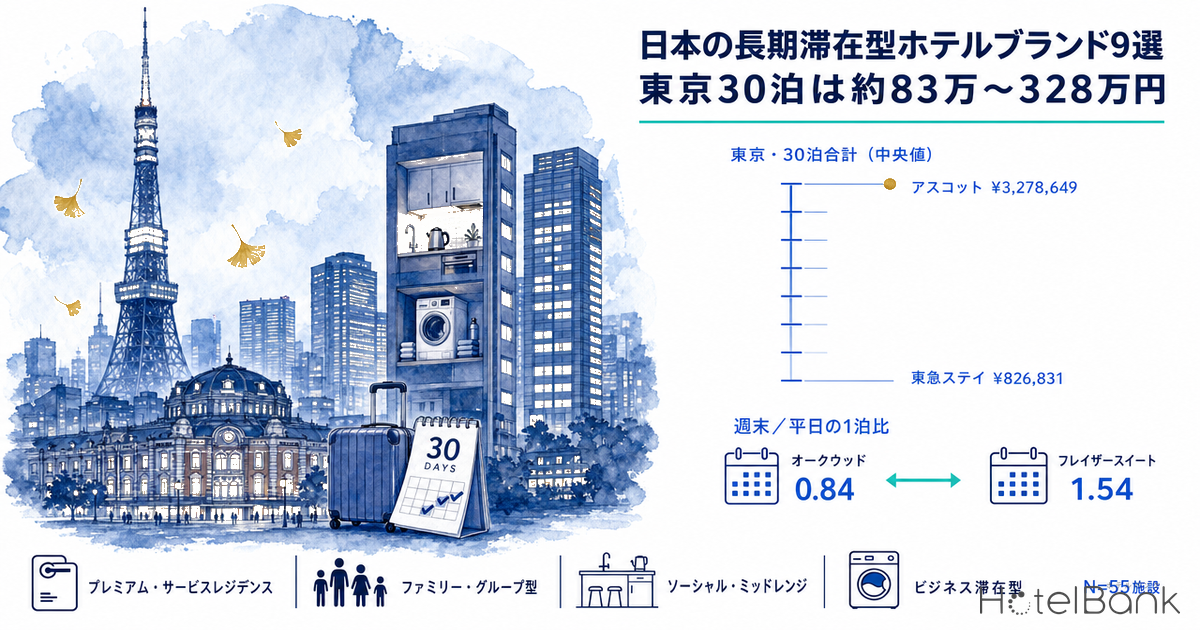
Japan’s extended-stay hotel market spans brands with very different profiles, from international serviced residences and home-grown apartment hotels to business-stay hotels built around rooms with washer-dryers. This article lists the nine major brands by operator, footprint, long-stay amenities and price range, and compares them on a like-for-like basis using 30-night rates at 55 properties in Tokyo (check-in October 19 to the night of November 17, 2026, as listed on September 22, 2026). The median 30-night total ranges from about ¥0.83 million to about ¥3.28 million, a spread of roughly four times.
- — Median 30-night totals in Tokyo run from about ¥0.83 million at business-stay brand Tokyu Stay to about ¥2.61–3.28 million at the premium serviced residences (Ascott, Oakwood, Hyatt House, Fraser Suites) (N=55 properties × 30 nights).
- — By price range and amenities, the major brands fall into four families: premium serviced residences, family/group apartments, social mid-range, and business-stay.
- — The ratio of Friday/Saturday nightly rates to weekday rates ranges from 0.84 at Oakwood to 1.54 at Fraser Suites. Brands strong in weekday corporate demand and brands strong in weekend/leisure demand price in visibly different ways.
- — The family/group brands (MIMARU, Minn) centre on rooms for four or more guests: mid-priced per room, but inexpensive per person.
Metric Definitions Used in This Article
- Listed rate: The selling price published on OTAs and similar channels, per room for two guests sharing (tax included). It differs from the actual transacted price.
- 30-night total: For each property, the sum over 30 nights of the lowest listed rate on sale for each night from check-in Monday, October 19 to the night of Tuesday, November 17, 2026. Because the room type may differ from night to night, this is a lower-end guide to the actual amount payable over 30 nights. Brand values are the median across the brand’s Tokyo properties in scope.
- Weekend/weekday nightly ratio: The average listed rate for Friday and Saturday nights divided by the average listed rate for Sunday–Thursday nights. The further above 1.00, the more the brand prices up at weekends.
- Data source: MetroEngines Research (rates listed as of September 22, 2026; N=55 properties × 30 nights = 1,650 room-nights)
Japan’s Extended-Stay Hotels: The 9 Major Brands
We start by answering the frequently searched question “what extended-stay hotel brands are there in Japan?” with a list. Prices are aligned to a single city (Tokyo), showing the median 30-night total across each brand’s Tokyo properties. Brands are ordered from the lowest 30-night total upward; the order does not indicate scale or quality.
| Brand | Operator | Main locations | Long-stay amenities | Tokyo 30-night total (median) | Properties (N) |
|---|---|---|---|---|---|
| Tokyu Stay | Tokyu Resorts & Stay (Tokyu Land Corporation group) | Centred on Tokyo, plus Sapporo, Hakodate, Kanazawa, Kyoto, Osaka, Hiroshima, Fukuoka, Naha and others (official: 30 locations nationwide) | In-room washer-dryer, mini-kitchen and microwave (varies by room type). Weekly and monthly plans available | ¥826,831 Per night ¥27,561 | 19 |
| Minn | SQUEEZE | Tokyo, Osaka, Kyoto, Sapporo, Fukuoka and others | Mainly apartment-style rooms with kitchens; some properties have rooms with washing machines. Large-group occupancy | ¥1,068,522 Per night ¥35,617 | 14 |
| lyf | Ascott (The Ascott Limited) | Tokyo (Ginza, Shibuya), Fukuoka (Tenjin) | Shared social kitchen, laundry and co-working lounge | ¥1,166,821 Per night ¥38,894 | 2 |
| Citadines | Ascott (The Ascott Limited) | Tokyo (Shinjuku), Yokohama, Osaka. Citadines North Shinjuku Tokyo scheduled to open October 28, 2026 | Kitchen or mini-kitchen depending on room type (25㎡+), coin laundry on site | ¥1,342,863 Per night ¥44,762 | 1 |
| MIMARU | Cosmos Initia / Cosmos Hotel Management (Daiwa House Group) | Tokyo, Kyoto, Osaka | Kitchen and dining area in every room; rooms of about 40㎡ for four or more guests | ¥1,996,329 Per night ¥66,544 | 15 |
| Fraser Suites | Frasers Hospitality (headquartered in Singapore) | Tokyo (Akasaka). The company also operates Fraser Residence Nankai Osaka | All rooms 32㎡+ with front-loading washer-dryer; room types with kitchens available | ¥2,614,430 Per night ¥87,148 | 1 |
| Hyatt House | Hyatt | Tokyo (Shibuya), Kanazawa | Kitchen, washer-dryer and combination oven in every room; 32㎡+ | ¥3,187,144 Per night ¥106,238 | 1 |
| Oakwood | Ascott (The Ascott Limited) | Mainly Tokyo (also in Kyoto) | Kitchen, washer-dryer and dishwasher in every unit (Oakwood Premier Tokyo) | ¥3,253,379 Per night ¥108,446 | 1 |
| Ascott (The Residence) | Ascott (The Ascott Limited) | Tokyo (Marunouchi) | Mainly rooms with kitchens, washer-dryer. Studio to three-bedroom | ¥3,278,649 Per night ¥109,288 | 1 |
Source: Compiled by HotelBank Editorial Team from MetroEngines Research (55 properties of 9 brands in Tokyo; 30 nights from check-in October 19 to November 17, 2026; rates listed as of September 22, 2026). Operators, locations and amenities are based on each company’s official information and press releases. Prices are listed per-room rates for two guests sharing (tax included). Table sorted by 30-night total, lowest first.
What the list shows is that “extended stay” covers clearly distinct design philosophies: serviced residences with full kitchens and washer-dryers in the room, apartment hotels that sleep four or more, social-style brands that support daily life with shared kitchens and laundries, and business-stay hotels that put a washer-dryer in a compact room. Because the property and room counts each company publishes are defined differently, this article does not compare brands by scale; instead it organises them by price range, location, amenities and guest needs.
Tokyo 30-Night Prices Range from ~¥0.83M to ¥3.28M, Stepping Up Across Four Families
Looking at 30-night totals by brand across the 55 Tokyo properties, prices fall roughly into four tiers. The most affordable is Tokyu Stay (median about ¥0.83 million, about ¥27,600 per night), followed by Minn (about ¥1.07 million), lyf (about ¥1.17 million) and Citadines (about ¥1.34 million). MIMARU sits at about ¥2.00 million and Fraser Suites at about ¥2.61 million, while Hyatt House, Oakwood and Ascott cluster at about ¥3.19–3.28 million.
Source: Compiled by HotelBank Editorial Team from MetroEngines Research (55 properties in Tokyo; 30 nights from check-in October 19 to November 17, 2026; rates listed as of September 22, 2026). Unit: ¥ million; 30-night total of listed per-room rates for two guests sharing (tax included).
Within the same brand, however, location creates a wide spread. Across its 19 Tokyo properties Tokyu Stay ranges from about ¥0.46 million to about ¥1.56 million; MIMARU’s 15 properties range from about ¥1.55 million to about ¥3.25 million; and Minn’s 14 properties from about ¥0.48 million to about ¥1.54 million. Being able to pick a location within a brand to fit the budget adds convenience both for long-stay guests and for corporate travel and relocation managers.
| Brand | N (properties) | 30-night total: min | 30-night total: median | 30-night total: max | Weekend/weekday nightly ratio |
|---|---|---|---|---|---|
| Tokyu Stay | 19 | ¥457,694 | ¥826,831 | ¥1,564,225 | 1.14 |
| Minn | 14 | ¥477,713 | ¥1,068,522 | ¥1,541,690 | 1.26 |
| lyf | 2 | ¥1,010,536 | ¥1,166,821 | ¥1,323,105 | 1.19 |
| Citadines | 1 | — | ¥1,342,863 | — | 1.10 |
| MIMARU | 15 | ¥1,547,191 | ¥1,996,329 | ¥3,250,369 | 1.19 |
| Fraser Suites | 1 | — | ¥2,614,430 | — | 1.54 |
| Hyatt House | 1 | — | ¥3,187,144 | — | 0.99 |
| Oakwood | 1 | — | ¥3,253,379 | — | 0.84 |
| Ascott | 1 | — | ¥3,278,649 | — | 1.05 |
Source: Compiled by HotelBank Editorial Team from MetroEngines Research (N=55 properties × 30 nights = 1,650 room-nights; rates listed as of September 22, 2026). Weekend/weekday nightly ratio = average listed rate for Friday–Saturday nights ÷ average listed rate for Sunday–Thursday nights (calculated per property; median adopted). For brands with N=1, the value is that of the representative property.
Note that prices are compared per room for two guests sharing. Brands such as MIMARU and Minn, whose rooms sleep four to six, have a lower per-person cost even when the room rate is mid-range. Rather than judging value from the 30-night total alone, it needs to be read together with occupancy capacity and room size.
Weekend vs. Weekday Pricing Reveals “Whose Long Stay” Each Brand Serves
Comparing Friday/Saturday nightly rates with Sunday–Thursday rates within the 30 nights brings out differences in each brand’s demand structure. Oakwood (representative property) scores 0.84, meaning weekends are about 16% cheaper than weekdays, which suggests that weekday corporate and business-travel demand is propping up its rates. Hyatt House (0.99) and Ascott (1.05) also show little difference between weekends and weekdays, implying a base of corporate and long-term contract stays that are relatively insensitive to the day of the week.
Source: Compiled by HotelBank Editorial Team from MetroEngines Research (55 properties in Tokyo; nights of October 19 to November 17, 2026; rates listed as of September 22, 2026). Average listed rate for Friday–Saturday nights ÷ average listed rate for Sunday–Thursday nights; brand median of values calculated per property.
By contrast, MIMARU (1.19), lyf (1.19) and Minn (1.26) price higher at weekends: family, group and leisure stays concentrate on weekends, and that is where they capture rate. Fraser Suites (1.54) had listings in the ¥170,000s per night on Saturday, November 7 and Saturday, November 14; setting a high price band on specific Saturdays pushed its ratio up. Tokyu Stay (1.14) and Citadines (1.10) sit in between, and can be described as balanced brands that capture both weekday business stays and weekend leisure stays.
On a daily basis, 28 of Hyatt House’s 30 nights fell within the ¥100,000–119,999 per-night range, and its night-to-night variability (coefficient of variation, standard deviation ÷ mean) was 5.4%, the smallest of the nine brands. For long-stay guests this makes budgets predictable, and the pricing sits well with corporate monthly contracts. Oakwood traced a wave of higher weekdays and lower weekends, peaking at about ¥174,900 for the night of Tuesday, November 10.
Source: Compiled by HotelBank Editorial Team from MetroEngines Research (lowest listed rate on sale by check-in date, two guests per room, tax included; rates listed as of September 22, 2026). Oakwood and Hyatt House are one representative property each; MIMARU (N=15), Minn (N=14) and Tokyu Stay (N=19) are medians across their Tokyo properties.
Features and Strengths by Brand
Ascott family (Ascott, Oakwood, Citadines, lyf): Singapore-headquartered Ascott (The Ascott Limited) acquired Oakwood Worldwide in 2022 and operates five brands in Japan: Ascott, Oakwood, Citadines, lyf and Somerset. A press release dated August 4, 2026 states that it operates 22 properties in Tokyo, Yokohama, Osaka, Kyoto and Fukuoka. A single operator spans price points from about ¥1.17 million (lyf) to about ¥3.28 million (Ascott), allowing it to serve everyone from solo mid-term guests to expatriate families in stages. Citadines North Shinjuku Tokyo (106 hotel rooms and 73 serviced residence units) is scheduled to open on October 28, 2026.
Hyatt House: A long-stay brand within Hyatt’s Essentials portfolio. In Japan it operates two properties, Hyatt House Kanazawa (opened August 2020, 92 rooms) and Hyatt House Tokyo Shibuya (opened February 26, 2024, 126 rooms) (Hyatt Japan press materials, April 2026). Every room at Shibuya has a kitchen, washer-dryer and combination oven, and rooms are 32㎡ or larger. Its hallmark is a narrow price swing across the 30 nights, making long-stay budgets easy to plan.
Fraser Suites: Operated by Frasers Hospitality (headquartered in Singapore), with the 224-room Fraser Suites Akasaka Tokyo in Akasaka. All rooms are 32㎡ or larger with front-loading washer-dryers, and some room types have kitchens. In Osaka it operates Fraser Residence Nankai Osaka, with kitchens and washer-dryers.
MIMARU: An apartment hotel brand run by Daiwa House Group companies Cosmos Initia and Cosmos Hotel Management. Every room has a kitchen and dining area, and rooms of about 40㎡ sleep four or more. According to an August 26, 2026 announcement, MIMARU Osaka Shinsaibashi CENTRAL, opened on September 1, is the 28th property, bringing the total to 1,500 rooms, with a target of 3,000 rooms by 2030. In Tokyo its properties are concentrated in eastern areas such as Ueno, Asakusa and Nihonbashi, and it is strongly positioned as a sightseeing base for inbound families.
Minn: An apartment hotel brand operated by SQUEEZE, with spacious rooms for groups and families and facilities such as kitchens, marketed as designed for group and long stays. It uses digital operations such as smartphone self check-in, and openings continue in 2026 in Osaka, Sapporo and elsewhere. In Tokyo it has properties in Asakusa, Ueno, Akihabara and Nihonbashi, as well as in the Kasai, Kamata and Haneda areas.
Tokyu Stay: A stay-oriented hotel brand operated by Tokyu Resorts & Stay, with in-room amenities such as washer-dryers, mini-kitchens and microwaves (varies by room type). Its official website states that it operates 30 locations nationwide from Hokkaido to Okinawa. At all 19 Tokyo properties we confirmed listings of plans for mid- to long-term stays such as consecutive-night, weekly and monthly plans, serving a wide range of uses from business trips and training to temporary housing during relocations.
Where They Sit in Tokyo: Premium Brands in Central Business Districts, Apartment Types Concentrated in the East
Plotting the 55 Tokyo properties on a map, colour-coded by family, shows clearly different location profiles. Premium serviced residences are dotted around business and commercial centres such as Marunouchi/Yaesu, Akasaka and Shibuya, close to corporate relocation and business-travel demand. Family/group brands MIMARU and Minn cluster along the eastern sightseeing routes of Ueno, Asakusa and Nihonbashi, extending to Haneda and Kasai. Tokyu Stay is spread across the areas around major stations such as Shibuya, Shinjuku, Ginza, Ikebukuro and Gotanda.
Source: Compiled by HotelBank Editorial Team from MetroEngines Research (55 properties in Tokyo; 30-night totals based on rates listed as of September 22, 2026)
Which Brands Suit Which Guest Needs and Investment Theses
Layering price range, amenities, day-of-week pricing and location, the major brands can be organised into four families. For investors and operators, which demand is made the core determines how room design (size, capacity, kitchen or not) and sales channels (corporate contracts versus individual/leisure) are put together.
| Family | Brand | Tokyo 30-night total (median) | Best-fit guest needs | Investment/operating thesis |
|---|---|---|---|---|
| Premium serviced residences | Ascott / Oakwood / Hyatt House / Fraser Suites | ~¥2.61M–3.28M | Corporate expatriates and assignees, project stays, temporary stays by affluent families | Corporate contracts leveraging deep weekday demand. Full kitchens and large rooms support high rates |
| Family/group apartments | MIMARU / Minn | ~¥1.07M–2.00M (per room) | Inbound families and groups, multigenerational travel, mid-term leisure stays | Designed to earn rate through capacity. Inexpensive per person; strong at weekends and in holiday periods |
| Social mid-range | lyf / Citadines | ~¥1.17M–1.34M | Mid-term stays by singles and couples, remote workers, younger guests | Common areas (kitchen, laundry, workspace) add stay value, balancing turnover and length of stay at a mid-range price point |
| Business-stay | Tokyu Stay | ~¥0.83M | Temporary housing for business trips, training and relocations; mid- to long-term business stays | Compact rooms × washer-dryers reduce the hassle of multi-night stays, with broad coverage of central near-station locations |
Source: Compiled by HotelBank Editorial Team from MetroEngines Research (prices from this article’s Tokyo 30-night aggregation; rates listed as of September 22, 2026)
Premium serviced residences recoup the heavy capital cost of full kitchens and large rooms through deep weekday corporate demand and high rates. Since some brands see prices soften at weekends, capturing weekend leisure and staycation demand leaves room to smooth occupancy further.
The family/group type earns rate per room through high-capacity rooms and is strong at weekends and in holiday periods. Inbound arrivals reached a record of about 42.68 million in 2025 (Japan National Tourism Organization), and the spread of family and group travel to Japan is a tailwind for this family. Combining it with weekday mid- to long-term stays (training, medical visits, temporary housing around a move, etc.) offers upside in dampening day-of-week swings.
The social mid-range and business-stay types pursue a strategy of lowering the hassle of multi-night stays by providing laundry, cooking and work facilities even in compact rooms, extending length of stay at mid-range prices. Brands that spread broadly around major stations, like Tokyu Stay in particular, count as a strength the convenience of letting companies choose accommodation for assignees and trainees by location.
For hotels: plan-name hints that work for this theme
Most common appeal elements in consecutive-night and long-stay plan names published for Tokyo (N=909) ——
Multi-night discount 81%Room only 41%Breakfast included 37%Long stay / live-in 32%Discount 17%Kitchen appliances 12%
Examples of actual names (anonymised):
- [5-Night Plan] ~Suite & Deluxe~ 15% OFF! With lounge access (no meals)
- [7-Night Plan] ~Suite & Deluxe~ 20% OFF! With lounge access (no meals)
- [3-Night Plan] ~Suite & Deluxe~ With lounge access ◆ Perfect base for your trip! (no meals)
* Trends based on an aggregation of published plan names; this does not show that naming causes sales.
Summary
The major extended-stay hotel brands in Japan span a wide range of 30-night totals in Tokyo, from about ¥0.83 million (Tokyu Stay) to about ¥3.28 million (Ascott), and can be organised into four families: premium serviced residences, family/group apartments, social mid-range and business-stay. Day-of-week pricing shows in the numbers the difference between brands strong in weekday corporate demand and brands strong in weekend leisure and family demand. From an investment and development standpoint, the guest need chosen as the core determines room design and sales channels. Looking not only at price range but also at capacity, amenities, location and day-of-week swings together is the starting point for brand selection and positioning.
⚠ Note on prices for future dates: The 30-night totals in this article are estimates based on selling prices for the nights of October 19 to November 17, 2026, as published on OTAs and similar channels at the time of the survey (September 22, 2026), and will change as check-in dates approach. Please note that amounts may change due to last-minute price cuts or changes in availability.
Frequently Asked Questions (FAQ)
Q. What extended-stay hotel brands are there in Japan?
A. The major brands include Ascott, Oakwood, Citadines and lyf (all Ascott), Hyatt House, Fraser Suites, MIMARU, Minn and Tokyu Stay. By price range and amenities, they are easiest to understand in four families: premium serviced residences, family/group apartments, social mid-range and business-stay.
Q. How much does a 30-night stay at an extended-stay hotel in Tokyo cost?
A. Based on listed rates for the nights of October 19 to November 17, 2026 (two guests per room, tax included, as of September 22, 2026), the median 30-night total by brand ranges from about ¥0.83 million at Tokyu Stay to about ¥3.28 million at Ascott. Prices vary by location even within the same brand, and fixed-price consecutive-night or monthly plans may change the amount.
Q. How do extended-stay hotels differ from regular hotels?
A. They provide facilities for “living”, such as kitchens, washer-dryers, dining areas and workspaces in the room or on site, and are designed around multi-night, weekly and monthly stays. Depending on the brand, some put everything in the room, while others supplement with shared kitchens and laundries.
Q. From an investment perspective, which family should I focus on?
A. Premium serviced residences are the core play for capturing weekday corporate demand at high rates; apartment types for capturing inbound family and group leisure demand through capacity; and business-stay types for capturing mid- to long-term business-trip, training and relocation demand in near-station locations. Differences in day-of-week pricing (weekend/weekday nightly ratio of 0.84–1.54) are also a clue for reading the demand structure.
Methodology and Sources
■ Data source
From publicly listed price data for approximately 27,000 properties tracked by MetroEngines Research and confirmed to be operating, we extracted 55 properties of nine extended-stay brands in Tokyo (Tokyu Stay 19, MIMARU 15, Minn 14, lyf 2, and one each for Ascott, Oakwood, Citadines, Hyatt House and Fraser Suites). Published figures for operators, locations, amenities and property counts are based on each company’s official website and press releases; information on Hyatt House properties in Japan is based on Hyatt Japan’s press materials (April 2026).
■ Calculation assumptions
For the 30 nights from check-in Monday, October 19 to Tuesday, November 17, 2026, we took the lowest listed rate on sale (not sold out) for each property and each night (two guests per room, tax included) and summed the 30 nights. Brand values are the median across the brand’s Tokyo properties in scope. Rates are as listed on September 22, 2026. For brands with N=1, the value is that of the representative property.
■ Limitations and caveats
The 30-night total is a stack of each night’s lowest price, and since the room type may change from night to night, it comes out lower than the rate for staying 30 nights in the same room. Fixed-price long-stay plans and monthly rates offered via official websites or on enquiry are not included. Because prices are per room, the per-person cost is lower for brands with high-capacity rooms. These are listed rates for future dates and will change.
Source: Hyatt Japan, press materials (April 2026)
References and Sources
- MetroEngines Research — listed rates at 55 properties in Tokyo (nights of October 19 to November 17, 2026, as of September 22, 2026)
- Hyatt Japan, press materials (April 2026)
- Hyatt House Tokyo Shibuya official website (rooms)
- Ascott Japan, opening announcement for Citadines North Shinjuku Tokyo (August 4, 2026)
- Travel Vision, “Ascott plans further M&A following its 2022 acquisition of Oakwood” (January 17, 2024)
- Oakwood Premier Tokyo official website
- Ascott Marunouchi Tokyo official website (rooms with kitchens and washer-dryers)
- Citadines Shinjuku Tokyo official website
- lyf Ginza Tokyo official website
- Fraser Residence Nankai Osaka official website
- Travel Watch, opening of Fraser Suites Akasaka Tokyo
- Cosmos Initia, opening announcement for MIMARU Osaka Shinsaibashi CENTRAL (August 26, 2026)
- Cosmos Initia, “APARTMENT HOTEL MIMARU”
- SQUEEZE「Minn」
- Tokyu Stay official website
- Tokyu Stay, “Fixed-price long-stay plans”
- Tokyu Resorts & Stay, “Tokyu Stay”
- Japan National Tourism Organization (JNTO), “Visitor Arrivals” 2025
- Japan Tourism Agency, “Overnight Travel Statistics Survey”