

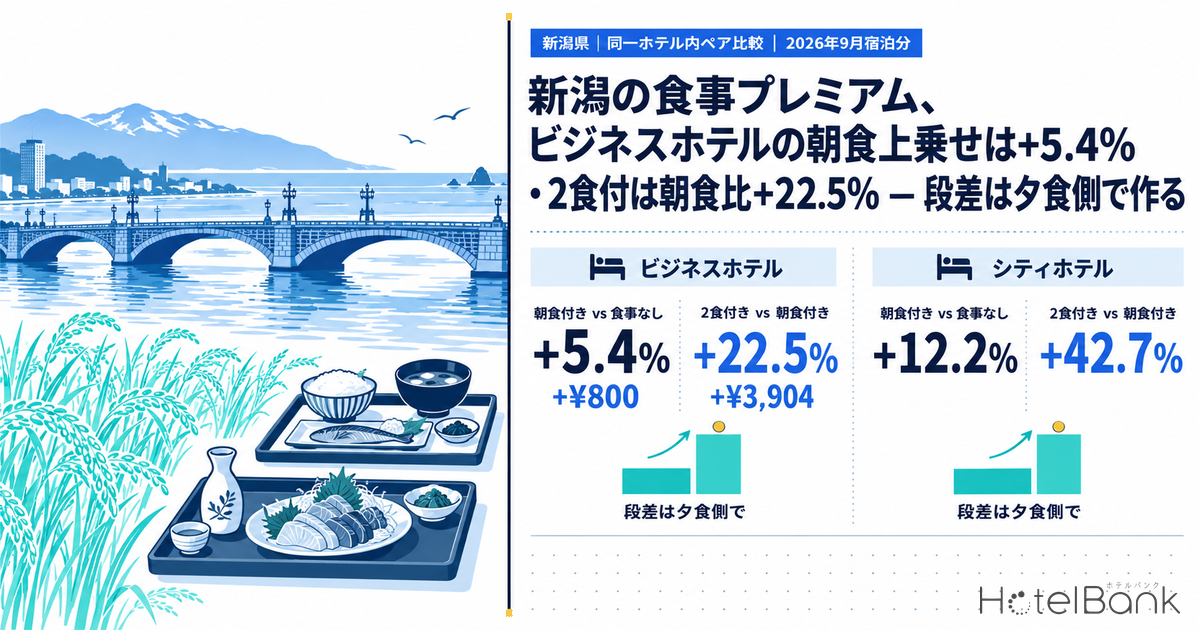
At business hotels in Niigata Prefecture, the gap between room-only and breakfast-included rates sold by the same hotel is just ¥800 per room, or +5.4% (N=66). By contrast, the step from breakfast included to half board (breakfast and dinner) is ¥3,900, or +22.5% (N=23) — roughly five times the breakfast step. City hotels show the same shape: a breakfast premium of +12.2% (N=16) against a half-board premium of +42.7% (N=11) over breakfast included. The conclusion of this article is that in Niigata, the easier place to build a price step between plans is dinner, not breakfast.
This article uses a “paired comparison”: it takes only the properties that sell both of two meal types within the same hotel and compares the difference between them. A simple average across all hotels would mix in differences in location and room rates between hotels that sell breakfast plans and hotels that sell room-only plans alone. The paired method avoids that bias.
Scope: city hotels and business hotels in Niigata Prefecture. Meal premiums cover city hotels N=11–16 properties and business hotels N=22–66 properties (varies by comparison pair; ryokan excluded). Reference estimated settled ADR covers business hotels N=124–135 properties and city hotels N=18 properties. The price metric in this article is estimated settled ADR (the settled price level estimated from OTA and other sales data, tax-exclusive equivalent). A meal premium is the difference in yen and in percent between meal types within the same hotel. Both are defined at the end of the article. Data as of: September 25, 2026.
- — Niigata business hotels price breakfast included vs room only at a thin +5.4% / ¥800 (N=66, September 2026 stays).
- — Half board vs breakfast included is +22.5% for business hotels (N=23) and +42.7% for city hotels (N=11); the dinner step is about 4–5 times the breakfast step.
- — The business-hotel breakfast premium shrank from +12.5% in May to +3.3% in August, while the dinner step held steady in the low-20% range throughout May–September 2026.
- — Business hotels in Chuo Ward, Niigata City show a breakfast gap of +0.5% (N=28), close to zero; Nagaoka, Sanjo and Joetsu sit around 10%.
- — Where the breakfast premium is thin, build the price step on the dinner side — that is the baseline for plan pricing.
Niigata meal premiums from same-hotel paired comparison (September 2026 stays)
The table below aggregates, for plans on sale for September 2026 stays, the within-hotel difference in yen and in percent for each pair of meal types. N= is the number of properties that sell both meal types, i.e. where a pair could be formed. Because the set of properties differs by pair, the steps are not added together to derive a “room only → half board” gap; read each one as an independent yardstick.
| Segment | Comparison pair | Difference (per room) | Premium | N= (properties with a pair) |
|---|---|---|---|---|
| City hotels | Breakfast included vs room only | +¥2,621 | +12.2% | 16 |
| City hotels | Half board vs breakfast included | +¥11,575 | +42.7% | 11 |
| City hotels | Half board vs room only | +¥14,264 | +58.5% | 11 |
| Business hotels | Breakfast included vs room only | +¥800 | +5.4% | 66 |
| Business hotels | Half board vs breakfast included | +¥3,904 | +22.5% | 23 |
| Business hotels | Half board vs room only | +¥4,920 | +29.7% | 22 |
Source: compiled by HotelBank Editorial Team from MetroEngines Research (September 2026 stays, based on current sales status; ryokan excluded)
What stands out first for business hotels is how thin the breakfast premium is: +5.4% (N=66). With 66 properties forming a pair, breakfast plans are hardly rare among business hotels. Even so, the gap to room only is just ¥800. Half board, which adds dinner, is +22.5% over breakfast included (N=23), a difference of ¥3,904 — about 4.9 times the breakfast step (¥800). Only 23 business hotels sell half board, but plans that include dinner carry a clear price gap.
City hotels have different ratios but the same shape. Their breakfast premium is +12.2% / ¥2,621 (N=16), more than double that of business hotels, while the step up to half board is +42.7% / ¥11,575 (N=11), about 4.4 times the breakfast step. From room only to half board the gap reaches +58.5% (N=11). In both segments the steps follow the same pattern: “small at breakfast, large at dinner”.
Source: compiled by HotelBank Editorial Team from MetroEngines Research (September 2026 stays, same-hotel paired comparison; city N=11–16, business N=22–66)
The breakfast premium moves month to month; the dinner step stays put
Lining up the same paired comparison by stay month from May to September 2026 shows how differently the two steps behave. The business-hotel breakfast premium ran at around double digits — +12.5% in May (N=66), +10.4% in June (N=66) and +9.7% in July (N=65) — before shrinking to +3.3% in August (N=66); September came in at +5.4% (N=66). In yen, it narrowed from ¥1,704 in May to ¥522 in August. The gap between room only and breakfast included tends to close in peak months.
Meanwhile, business-hotel half board vs breakfast included ran at +20.5% in May, +24.7% in June, +22.3% in July, +20.3% in August and +22.5% in September (all N=23), never straying far from the low 20s. The city-hotel breakfast premium was also steady at 10.2–12.2% (N=16), and city-hotel half board vs breakfast included moved within 36.8–45.9% (N=11). The business-hotel breakfast step expands and contracts with the season, while the dinner step barely moves. That is one reason dinner makes the easier anchor for plan pricing.
Source: compiled by HotelBank Editorial Team from MetroEngines Research (by 2026 stay month, same-hotel paired comparison; September based on current sales status)
By municipality, business hotels in Chuo Ward, Niigata City have almost no breakfast gap
Splitting the prefecture-wide +5.4% by municipality brings out clear local differences. Among municipalities with five or more pairs, business hotels in Chuo Ward, Niigata City carry a breakfast premium of just +0.5% (N=28) — there is almost no difference between room only and breakfast included. Nagaoka (+9.2%, N=9), Sanjo (+10.0%, N=6) and Joetsu (+10.9%, N=5) all keep a premium of around 10%. City hotels in Chuo Ward, Niigata City are at +15.8% (N=7), a thicker premium than city hotels across the prefecture.
| Municipality | Segment | Breakfast included vs room only: difference | Premium | N= (properties with a pair) | Reference: premium for July stays |
|---|---|---|---|---|---|
| Chuo Ward, Niigata City | City hotels | +¥3,944 | +15.8% | 7 | +14.6% (N=7) |
| Chuo Ward, Niigata City | Business hotels | +¥73 | +0.5% | 28 | +13.1% (N=27) |
| Nagaoka | Business hotels | +¥1,520 | +9.2% | 9 | +5.8% (N=9) |
| Sanjo | Business hotels | +¥1,212 | +10.0% | 6 | +10.7% (N=6) |
| Joetsu | Business hotels | +¥1,650 | +10.9% | 5 | +10.1% (N=5) |
Source: compiled by HotelBank Editorial Team from MetroEngines Research (September 2026 stays; only municipalities with five or more pairs shown)
For July stays, business hotels in Chuo Ward, Niigata City carried a premium of +13.1% (N=27). Because the breakfast gap swings widely from month to month, a single month’s figure is not enough to label this a “market where breakfast doesn’t sell”. Still, the August–September narrowing of the prefecture-wide breakfast premium overlaps with what happened in this market. Even with a fixed breakfast charge, the premium in percent expands and contracts whenever the room-only rate moves.
Price-level context — estimated settled ADR YoY for finalized months
Meal-plan steps need to be read alongside the room-rate level. Niigata Prefecture’s estimated settled ADR (finalized) for business hotels was ¥8,383 in August 2026 (N=126), +5.4% on ¥7,956 a year earlier (N=127). Across the finalized months of January–August, it beat the prior year in every month except July (−1.1%). For city hotels it was ¥10,355 in August 2026 (N=18), −11.9% on ¥11,759 a year earlier (N=18); across January–August it was below the prior year in every month except March (+8.1%). Business hotels are in a phase of building up room rates, while city hotels are in a phase where room rates fall short of the prior year in most months.
Source: compiled by HotelBank Editorial Team from MetroEngines Research (estimated settled ADR, finalized figures only; business hotels N=124–135, city hotels N=18)
For city hotels, whose room rates are below the prior year, raising the share of half board (+42.7% over breakfast included, N=11) can lift revenue per room even when room rates are hard to push. For business hotels, the breakfast premium is shrinking while room rates run above the prior year. If meals are to be the differentiator, dinner (+22.5% over breakfast included, N=23) is the stronger lever. Note that estimated settled ADR from September 2026 onward is an estimate based on current sales status and may change. A like-for-like comparison with finalized figures requires waiting for month-end finalization, so this article uses only finalized months for YoY.
For revenue managers running business and city hotels in Niigata — implications and action plan
1. Check breakfast pricing by its premium in percent over room only. The business-hotel breakfast premium moved from +12.5% in May to +3.3% in August (N=about 66). If the breakfast charge is held as a fixed amount, the premium automatically thins in months when the room-only rate goes up. Checking month by month how many percent your breakfast plan sits above room only makes it easy to see where you stand against the market step.
2. There is room to make dinner the main step. The half board vs breakfast included step is +22.5% for business hotels (N=23) and +42.7% for city hotels (N=11), and both vary little across stay months. Even properties without a dinner plan should consider building a “step above breakfast included” — for example a dinner plan in partnership with a nearby restaurant, or a scaled-down dinner set.
3. Use separate yardsticks for Chuo Ward, Niigata City and the rest. Business hotels in Chuo Ward had a September breakfast premium of +0.5% (N=28), versus around 10% in Nagaoka, Sanjo and Joetsu. Even within one prefecture, some markets make it easy to differentiate on breakfast and others do not. Benchmark against the municipality closest to your own location.
4. City hotels should build rate from both the room and the meals. For city hotels, where finalized estimated settled ADR has been below the prior year in most months (August −11.9% YoY, N=18), steering guests toward half board can help make up revenue per room.
| Timing | Action | Decision trigger (figures in this article) | Aim |
|---|---|---|---|
| This week | Calculate your own breakfast included vs room only premium by stay month | Check your position against the business-hotel prefecture average of +5.4% (N=66) and Chuo Ward’s +0.5% (N=28) | Establish where the breakfast step stands today |
| This week | Check whether you sell half board and its premium over breakfast included | Is it below business hotels’ +22.5% (N=23) or city hotels’ +42.7% (N=11)? | Establish where the dinner step stands |
| Within 2 weeks | Consider launching or revising dinner-included and half-board plans | If you have no dinner-included tier and your breakfast premium sits around the prefecture average of +5.4% | Build the step on the dinner side |
| Within 2 weeks | Consider switching the breakfast charge from a fixed amount to one linked to room only (premium in percent) | If your property shows the pattern of the breakfast gap shrinking in peak months (August +3.3%, N=66) | Prevent the breakfast gap from eroding in peak months |
| Toward next month | Track the half-board sales mix monthly | Months when city-hotel estimated settled ADR is below the same month a year earlier (August −11.9%, N=18) | Supplement rate from sources other than the room |
| Toward next month | Review plan design against the breakfast premium in your municipality | The gap to Nagaoka +9.2% (N=9), Sanjo +10.0% (N=6) and Joetsu +10.9% (N=5) | Steps designed to match local market reality |
Source: compiled by HotelBank Editorial Team from MetroEngines Research
The actions listed here do not promise results. Use them as a starting point for checking your own plan design against the market steps. Meal-plan prices should be decided together with food cost, service capacity and guest mix.
Summary — three yardsticks for reading meal-plan steps
| Yardstick | Niigata Prefecture now (September 2026 stays) | How to read it |
|---|---|---|
| Breakfast step | Business +5.4% (N=66) / City +12.2% (N=16) | Expands and contracts by month. Check the premium in percent monthly |
| Dinner step | Business +22.5% (N=23) / City +42.7% (N=11) | About 4–5 times the breakfast step and stable. The main step |
| Local differences | Chuo Ward business +0.5% (N=28) / Nagaoka, Sanjo, Joetsu around 10% | Benchmark against the figures for your own municipality |
At business and city hotels in Niigata, the gap you can charge for breakfast is small, and it shifts with the season. Once dinner is included, a clear gap holds steadily. Where the breakfast premium is thin, build the step on the dinner side. Use this shape, shown by same-hotel paired comparison, as the benchmark when revising plans.
Frequently asked questions
Q. What is a “paired comparison” of meal premiums?
A. It is a method that takes only the cases where the same hotel sells both of two meal types (e.g. room only and breakfast included) and aggregates the difference in yen and percent within that hotel. A simple average across all hotels mixes in differences in location and room rates between hotels that sell breakfast plans and hotels that sell room only, so the method is used to avoid that selection bias.
Q. How much more does breakfast included cost than room only at business hotels in Niigata Prefecture?
A. For September 2026 stays it is +5.4%, or ¥800 per room (N=66). It was +12.5% in May and shrank to +3.3% in August, so it expands and contracts from month to month.
Q. How much more does half board cost than breakfast included?
A. For September 2026 stays, business hotels are +22.5% / ¥3,904 (N=23) and city hotels +42.7% / ¥11,575 (N=11). Across the May–September 2026 stay months, business hotels stayed in the low-20% range and city hotels within 36.8–45.9%.
Q. Why build the step on the dinner side?
A. Because the dinner step is about 4–5 times the breakfast step and stays stable across stay months. The breakfast premium tends to shrink in peak months, and with a fixed breakfast charge the premium in percent erodes in months when the room-only rate is raised.
Q. Does it differ by municipality?
A. Yes. For September 2026 stays, business hotels in Chuo Ward, Niigata City have a breakfast gap of +0.5% (N=28), close to zero, while Nagaoka +9.2% (N=9), Sanjo +10.0% (N=6) and Joetsu +10.9% (N=5) hold at around 10%. In practice, benchmark against the figures for the municipality closest to your own.
About the data
| Item | Description |
|---|---|
| Meal premium | Takes only properties that sell both of two meal types (room only, breakfast included, half board) within the same hotel, and aggregates by segment the within-hotel difference in yen and percent for room only vs breakfast included (or breakfast included vs half board). A method for avoiding the differences in property mix (selection bias) that arise in a simple average across all hotels. N= is the number of properties with a pair and differs by combination. Ryokan are excluded. Combinations with N below 5 are not cited. |
| Estimated settled ADR | The settled price level (tax-exclusive equivalent) estimated from OTA and other sales data (lowest-plan level × segment-specific coefficient, ensembled across multiple channels). Past months are finalized figures; current and future months are estimates based on current sales status. Median error of 6.6% against published operating results. |
| Breakdown of N= | Meal premiums (September 2026 stays): city hotels breakfast included vs room only N=16, half board vs breakfast included N=11, half board vs room only N=11 / business hotels breakfast included vs room only N=66, half board vs breakfast included N=23, half board vs room only N=22. Estimated settled ADR (January 2025–August 2026, finalized figures): business hotels N=124–135, city hotels N=18. |
| Data as of | September 25, 2026. Because sales status and inventory change daily, the figures in this article are a snapshot at the time of retrieval. Meal premiums for September 2026 stays are based on current sales status. |
Source: compiled by HotelBank Editorial Team from MetroEngines Research
References and sources
■ Data sources
Public OTA and other sales data collected by MetroEngines Research (sales prices by meal type for city and business hotels in Niigata Prefecture, May–September 2026 stays), and estimated settled ADR derived from the same data (finalized figures, January 2025–August 2026).
■ Calculation assumptions
Meal premiums are differences in yen and percent covering only properties that sell both of two meal types within the same hotel. Because the set of properties (N=) differs by combination, the steps are not added together. Combinations with N below 5 are not cited. Estimated settled ADR YoY compares finalized months only.
■ Limitations and caveats
September 2026 stays are a snapshot based on sales status as of now (September 25, 2026) and may change with future sales and inventory movements. Ryokan are excluded. The municipality breakdown shows only municipalities with five or more pairs; in areas with few properties, a price change at a handful of properties can move the premium substantially.
■ Market data
Compiled by HotelBank Editorial Team from MetroEngines Research (meal-premium aggregation by same-hotel paired comparison; finalized estimated settled ADR).